23 Sep 2013
by The Hare Krishna Movement
in A.C. Bhaktivedanta Swami Prabhupada, Ecstasy, Krishna Nectar, Spiritual Life, Vrndavana
Tags: A.C. Bhaktivedanta Swami Prabhupada, divine ecstasies, Krishna's friends, Krsna, Krsna-katha, lotus flower, lunch with krssn, Pariksit, SB 10, Srila Prabhupada's divine ecstasies, Srimad Bhagavatam, Sukadeva Goswami, whorl of a lotus flower

Today, being Monday, and the start of another workday week, I wanted to focus my mind, not on all the work ahead, but rather, on some Krishna Nectar from Srila Prabhupada’s Srimad Bhagavatam. We share with you a few of Srila Prabhupada’s divine ecstasies. As we mentioned is a previous post, there are two kṛṣṇa-kathās; narrations spoken by Kṛṣṇa, and narrations spoken about Kṛṣṇa. Please note text 5 & 6 which is spoken by Krsna.
…devotees who have accepted the essence of life, are attached to Kṛṣṇa in the core of their hearts, and He is the aim of their lives. It is their nature to talk only of Kṛṣṇa at every moment, as if such topics were newer and newer.
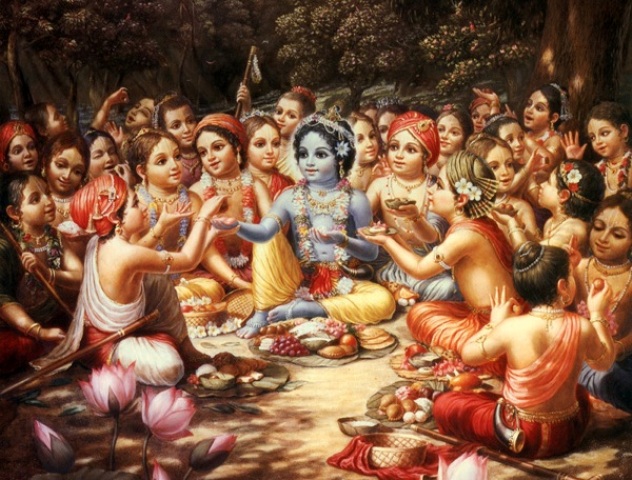
Like the whorl of a lotus flower surrounded by its petals and leaves, Kṛṣṇa sat in the center, encircled by lines of His friends, who all looked very beautiful. Every one of them was trying to look forward toward Kṛṣṇa, thinking that Kṛṣṇa might look toward him. In this way they all enjoyed their lunch in the forest.
Among the cowherd boys, some placed their lunch on flowers, some on leaves, fruits, or bunches of leaves, some actually in their baskets, some on the bark of trees and some on rocks. This is what the children imagined to be their plates as they ate their lunch.
Srimad Bhagavatam
By His Divine Grace A. C. Bhaktivedanta Swami Prabhupada
Canto 10, Chapter 13, Text 1-12
Translations and purports More
20 Sep 2013
by The Hare Krishna Movement
in A.C. Bhaktivedanta Swami Prabhupada, Srimad Bhagavatam
Tags: A.C. Bhaktivedanta Swami Prabhupada, age of kali, austerity, brahminical culture, cleanliness, innocent animals, Kali, Kali-yuga, ksatriya rulers, Maharaja Pariksit, mercy. truthfulness, Punishment and Reward of Kali, SB 17, spiritual initiation, Srimad Bhagavatam, sudra, surabji, Suta Goswami

Śrīmad-Bhāgavatam
By His Divine Grace A. C. Bhaktivedanta Swami Prabhupāda
Chapter Seventeen
More
16 Sep 2013
by The Hare Krishna Movement
in A.C. Bhaktivedanta Swami Prabhupada, Jiva Goswami, Srimad Bhagavatam, Vamanadeva
Tags: A.C. Bhaktivedanta Swami Prabhupada, Aditi, appearance of lord vamandeva, Bali Maharaja, club, conchshell, disc, dwarf-brahmana, Jiva Goswami, Krsna, lotus, Srila Prabhupada, Srimad Bhagavatam, Vamana, Vamanadeva, Vijaya

Today we honor the Appearance of Lord Vamandeva, who, as some of you know, appeared as the fifteenth incarnation of Krsna. Lord Vāmanadeva assumed the form of a dwarf-brāhmaṇa [Vāmana] and visited the arena of sacrifice arranged by Mahārāja Bali. The following is a brief summary from Srila Prabhupada’s Srimad Bhagavatam, 8th Canto, Chapter 18.
Today also marks the Appearance of Srila Jiva Goswami, and there is a brief instruction given by him on understanding God at bottom of post.
Lord Vāmanadeva appeared in this world from the womb of Aditi completely equipped with conchshell, disc, club and lotus. His bodily hue was blackish, and He was dressed in yellow garments. Lord Viṣṇu appeared at an auspicious moment on Śravaṇa-dvādaśī when the Abhijit star had arisen. At that time, in all the three worlds (including the higher planetary system, outer space and this earth), all the demigods, the cows, the brāhmaṇas and even the seasons were happy because of God’s appearance. Therefore this auspicious day is called Vijayā.
More
22 Jul 2013
by The Hare Krishna Movement
in A.C. Bhaktivedanta Swami Prabhupada, Honey
Tags: A.C. Bhaktiveanta Swami Prabhupada, bee-mind, devotees, honey from the lotus flower, Lord Krsna, lotus, lotus feet of the Lord, lotus flower, lotus honey, Palace of Gold, Prabhupada's Palace, pure devotees, Srimad Bhagavatam

This last week we harvested some of the honey from our bee hives, and as we extracted it I was in awe of its beautiful golden color. After we offered some of it to the Lord, we sampled its taste and it was amazing, not of this world. They must be devotee bees’s gathering the nectar from the lotus flowers and rose gardens at Srila Prabhupada’s Palace of Gold, here at New Vrindavan. The taste and texture was other-worldly, and remarkable. So I thought I would take a moment to to find some references on honey from Srila Prabhupada’s Books.
The pure devotees are always hankering after the lotus feet of the Lord. The lotus has a kind of honey which is transcendentally relished by the devotees. They are like the bees who are always after the honey. Śrīla Rūpa Gosvāmī, the great devotee ācārya of the Gauḍīya-Vaiṣṇava-sampradāya, has sung a song about this lotus honey, comparing himself to the bee:
“O my Lord Kṛṣṇa, I beg to offer my prayers unto You. My mind is like the bee, and it is after some honey. Kindly, therefore, give my bee-mind a place at Your lotus feet, which are the resources for all transcendental honey.” (SB 1.11.26)
When the Lord entered the forest of Vṛndāvana, all the inhabitants of the forest, both animate and inanimate, were eager to receive Him. He saw that the flowers of the forest, all fully blossoming, were weeping in ecstasy, honey flowing down their petals. The waterfalls on the hilly rocks were gladly flowing, and one could hear sweet sounds from the caves nearby. (Light of the Bhagavata text 24)
More
16 Jul 2013
by The Hare Krishna Movement
in A.C. Bhaktivedanta Swami Prabhupada, Books by Srila Prabhupada, Free Downloads, Free eBooks, Srila Prabhupada's Books, Srimad Bhagavatam
Tags: A.C. Bhaktivedanta Swami Prabhupada, Book Distribution, epic bhagavatam, free books, free pdf download, pdf download, Srimad Bhagavatam, Tenth Canto, The Hare Krishna Movement


One of our readers suggested that we also upload Part One and Part Two of the Tenth Canto as a Free PDF Download, to go with Part Three which we posted the other day. So with great pleasure we post the Free links to read or save the pdf files of Part One and Two of Srila Prabhupada’s Epic Srimad-Bhagavatam.

click on link for free pdf download; SB10.1

click on link for free pdf download; SB10.2
More
14 Jul 2013
by The Hare Krishna Movement
in A.C. Bhaktivedanta Swami Prabhupada, BBT, Book Changes, Books by Srila Prabhupada, Srimad Bhagavatam
Tags: A.C. Bhaktivedanta Swami Prabhupada, BBT, dictaphone, final volume, Founder Acarya, foward to tenth canto, International Society for Krishna Consciousness, Krsna Balarama Mandir, Sanskrit text, Srimad Bhagavatam, Tenth Canto, translation and commentary

Śrīmad-Bhāgavatam
By His Divine Grace A.C. Bhaktivedanta Swami Prabhupada
Tenth Canto, Part Three
Foward
This is the final Śrīmad-Bhāgavatam volume translated by His Divine Grace A. C. Bhaktivedanta Swami Prabhupada, founder-acarya of the International Society for Krishna Consciousness. It is smaller than the earlier volumes because it ends where the renowned author stopped translating just before his departure from this mortal world on November 14, 1977, at the Krsna-Balarama Mandira in Vrndavana, India.
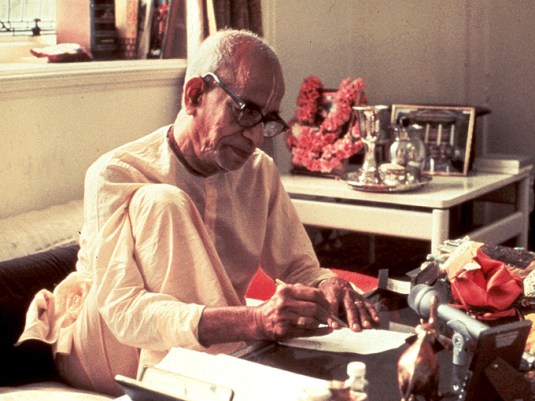
The first part of this volume was produced in the usual fashion. Srila Prabhupada would sit and read silently from the Sanskrit text and then speak the translation and commentary into his dictaphone. Later, due to illness, it became necessary for his disciples to assist him personally.
In these last days Srila Prabhupada was gravely ill. Unable to eat for weeks, his health had deteriorated, making even the slightest movement excruciatingly painful.
As he lay still, a devotee would softly read the Sanskrit to him. Another disciple, sitting on his bed, held the microphone to him, nearly touching his mouth. And then Srila Prabhupada would speak, voice sometimes barely audible.
These recordings, made in his quarters at the temple, constitute the balance of this book.
In these final moments, the physician attending His Divine Grace confided that an ordinary man in such critical condition would have been crying out from the intense pain. Srila Prabhupada’s disciples were awestruck as they watched their spiritual master work quietly, undisturbed.
In the last part of the book we find Srila Prabhupada’s usual clarity of thought, constant scriptural references, scrupulous attention to detail, and rigorous philosophical exposition fully intact, just as they were in the preceding twenty-nine volumes of the Śrīmad-Bhāgavatam.
Srila Prabhpada’s last days and this translation will stands an inspiring reminder that even the severest material circumstances cannot impede the activities of a pure devotee of the Supreme Personality of Godhead.
-The Publishers

For a Free PDF download of this special volume click on following link; SB-10-03-1980
More
02 Jul 2013
by The Hare Krishna Movement
in A.C. Bhaktivedanta Swami Prabhupada, Maharaja Pariksit, Spiritual Master, Srila Prabhupada's Books, Srimad Bhagavatam, Sukadeva Goswami
Tags: A.C. Bhaktivedanta Swami, at time of death, hear chant and remember, Maharaja Pariksit, perfection of life, segue, self realization, Srimad Bhagavatam, Sukadeva Goswami

This morning I was marveling at how beautifully Srila Prabhupada segues [def: an uninterrupted transition from one song to another. 2. go on without a pause.] from the First Canto of the Srimad Bhagavatam into the Second Canto. This Srimad Bhagavatam, is truly one of the most amazing books in existence today!
You are the spiritual master of great saints and devotees. I am therefore begging you to show the way of perfection for all persons, and especially for one who is about to die. (SB 1.19.37)
Please let me know what a man should hear, chant, remember and worship, and also what he should not do. Please explain all this to me. (SB 1.19.38)
Śrī Sūta Gosvāmī said: The King thus spoke and questioned the sage, using sweet language. Then the great and powerful personality, the son of Vyāsadeva, who knew the principles of religion, began his reply… (SB 1.19.40) [End of First Canto]
[Start of Second Canto]…Śrī Śukadeva Gosvāmī said: My dear King, your question is glorious because it is very beneficial to all kinds of people. The answer to this question is the prime subject matter for hearing, and it is approved by all transcendentalists. (SB 2.1.1)
…That very Śrīmad-Bhāgavatam I shall recite before you because you are the most sincere devotee of Lord Kṛṣṇa. One who gives full attention and respect to hearing Śrīmad-Bhāgavatam achieves unflinching faith in the Supreme Lord, the giver of salvation. (SB 2.1.10)
Unless one is perfectly anxious to inquire about the way of perfection, there is no necessity of approaching a spiritual master. A spiritual master is not a kind of decoration for a householder. Generally a fashionable materialist engages a so-called spiritual master without any profit. The pseudo spiritual master flatters the so-called disciple, and thereby both the master and his ward go to hell without a doubt. Mahārāja Parīkṣit is the right type of disciple because he puts forward questions vital to the interest of all men, particularly for the dying men. The question put forward by Mahārāja Parīkṣit is the basic principle of the complete thesis of Śrīmad-Bhāgavatam. Now let us see how intelligently the great master replies. (from purport to SB 1.19.37)
Full translation and purports More
24 Jun 2013
by The Hare Krishna Movement
in A.C. Bhaktivedanta Swami Prabhupada, Ganges, Srimad Bhagavatam
Tags: A.C. Bhaktivedanta Swami Prabhupada, amartya, baby Krsna, Ganges, Ganges River, Gokula, Krsna's lotus feet, sacred rivers, sanctified, SB 1.19.6, Srimad Bhagavatam, transcendental, Tulasi, tulasi leaves, Yamuna, Yamuna river
click on image to enlarge
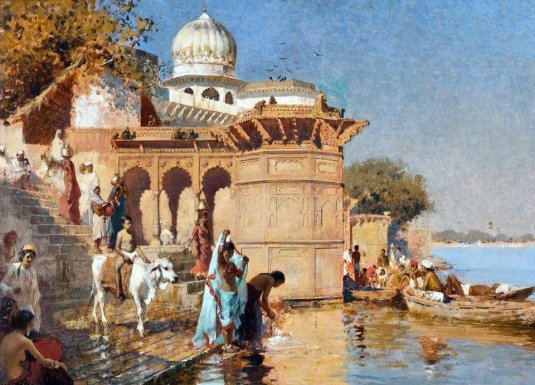
…Both the Ganges and the Yamunā are amartyā (transcendental) rivers, but the Yamunā is still more sanctified for the following reasons.
…And as far as sanctity is concerned, the River Yamunā is more directly connected with Lord Kṛṣṇa than the Ganges. The Lord sanctified the River Yamunā from the beginning of His transcendental pastimes in the world. While His father Vasudeva was crossing the Yamunā with the baby Lord Kṛṣṇa for a safe place at Gokula on the other bank of the river from Mathurā, the Lord fell down in the river, and by the dust of His lotus feet the river at once became sanctified. It is especially mentioned herein that Mahārāja Parīkṣit took shelter of that particular river which is beautifully flowing, carrying the dust of the lotus feet of Lord Kṛṣṇa, mixed with tulasī leaves. Lord Kṛṣṇa’s lotus feet are always besmeared with the tulasī leaves, and thus as soon as His lotus feet contact the water of the Ganges and the Yamunā, the rivers become at once sanctified. The Lord, however, contacted the River Yamunā more than the Ganges. (from purport to SB 1.19.6)
Full verse and purport More
14 Jun 2013
by The Hare Krishna Movement
in A.C. Bhaktivedanta Swami Prabhupada, Dedication Slokas, Srimad Bhagavatam
Tags: A.C. Bhaktivedanta Swami, collection of slokas, dedication slokas, krsne sva-dhamopagate, original books by srila prtabhupada, slokas, srila prabhupada slokas, Srimad Bhagavatam
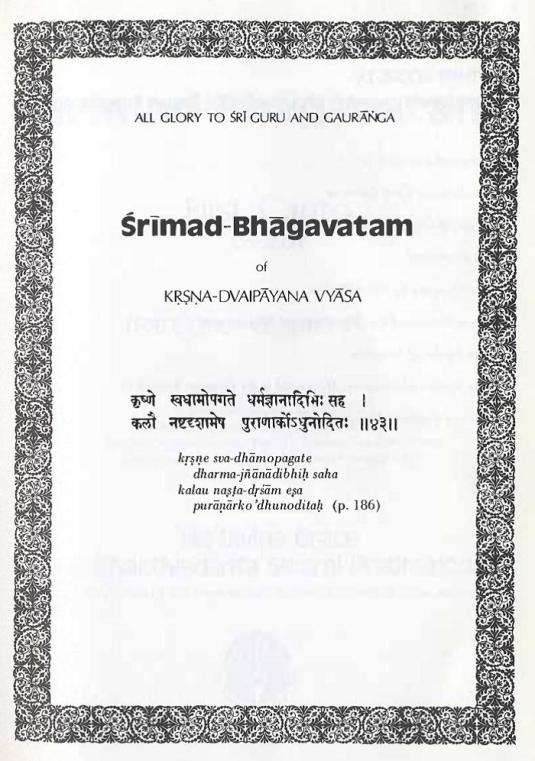
For anyone who has had the good fortune to read and study Srila Prabhupada’s epic Srimad Bhagavatam, will know that on the title page of each and every volume is a dedication sloka. I thought it would be interesting to compile a list of the dedication slokas from all of the original books. I stopped this collection of slokas with the Tenth Canto, Part Three, as this is where Srila Prabhupada left off, and where my collection of Srimad Bhagavatam’s stops. -Vyasasan das
More
05 Jun 2013
by The Hare Krishna Movement
in A.C. Bhaktivedanta Swami Prabhupada, Back to Godhead, Kali Yuga
Tags: A.C. Bhaktivedanta Swami Prabhupada, bhagavatam, chanting Hare Krishna, future, Hare Krishna, hypocrisy, kalau dasa-nidhe rajan, Kali-yuga, past, prediction, present, Srimad Bhagavatam

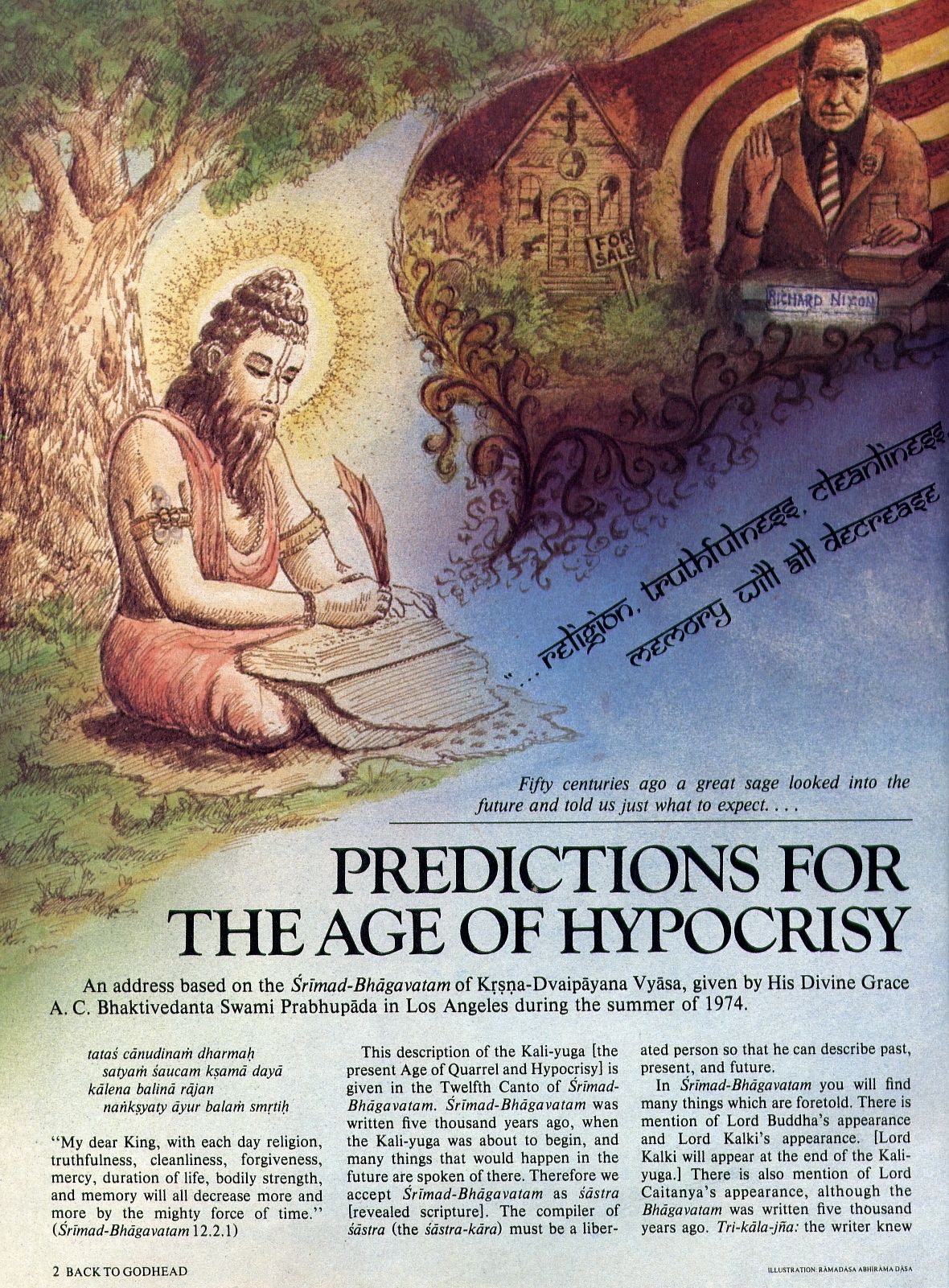
Predictions for the Age of Hypocrisy
Fifty centuries ago a great sage looked into the future and told us just what to expect. . .
An address based on the Srimad-Bhagavatam of Krsna-Dvaipayana Vyasa, given by His Divine Grace A.C. Bhaktivedanta Swami Prabhupada in Los Angeles during the summer of 1974.
Excerpted from Back to Godhead Magazine
tatas canu-dinam dharmah
satyam saucam ksama daya
kalena balina rajan
nanksyaty ayur balam smrtih
“My dear King, with each day religion, truthfulness, cleanliness, forgiveness, mercy, duration of life, bodily strength, and memory will all decrease more and more by the mighty force of time.” (Srimad-Bhagavatam 12.2.1)
This description of the Kali-yuga [the present Age of Quarrel and Hypocrisy] is given in the Twelfth Canto of Srimad-Bhagavatam. Srimad-Bhagavatam was written five thousand years ago, when the Kali-yuga was about to begin, and many things that would happen in the future are spoken of there. Therefore we accept Srimad-Bhagavatam as sastra [revealed scripture]. The compiler of sastra (the sastra-kara) must be a liberated person so that he can describe past, present, and future.
In Srimad-Bhagavatam you will find many things which are foretold. There is mention of Lord Buddha’s appearance and Lord Kalki’s appearance. [Lord Kalki will appear at the end of the Kali-yuga.] There is also mention of Lord Caitanya’s appearance, although the Bhagavatam was written five thousand years ago. Tri-kala-jna: the writer knew past, present, and future.
So here Sukadeva Gosvami is describing the chief symptoms of this age. He says, tatas canudinam: with the progress of this age (Kali-yuga), dharma, religious principles; satyam, truthfulness; saucam, cleanliness; ksama, forgiveness; daya, mercifulness; ayur, duration of life; balam, bodily strength; smrti, memory—these eight things will gradually decrease to nil or almost nil.
More
24 May 2013
by The Hare Krishna Movement
in A.C. Bhaktivedanta Swami Prabhupada, Festivals, Nrsimha, Srimad Bhagavatam
Tags: A.C. Bhaktivedanta Swami Prabhupada, demons, half lion, half man, half man and half lion, hiranyakasipu, king of the demons, Lord Nrsimhadeva, Lord Visnu, Nrsimha, Nrsimhadeva, prahlada, Prahlada Maharaja, SB 7.8, Sri Nrkesari, Srimad Bhagavatam, Supreme Personality of Godhead
click on image to enlarge
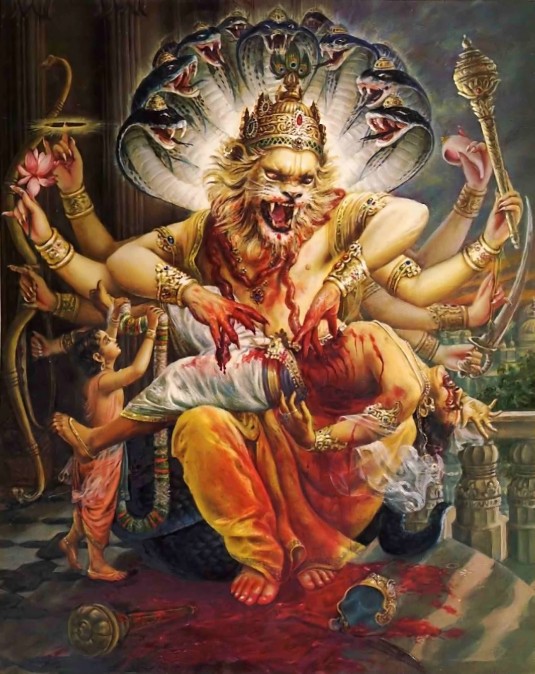
In honnor of the Appearance of Lord Nṛsiṁhadeva, we are posting the entire Eighth Chapter from the Seventh Canto of the Srimad Bhagavatam, entitled “Lord Nṛsiṁhadeva Slays the King of the Demons”. We are celebrating Lord Nrsimhadeva’s today, with a fast till dusk, because it is the variant date for our area. This is a wonderful chapter, and one I am fond of reading on this auspicious day.
Śrīmad-Bhāgavatam
By His Divine Grace A. C. Bhaktivedanta Swami Prabhupāda
Canto Seven, Chapter Eight
Lord Nṛsiṁhadeva Slays the King of the Demons
As described in this chapter, Hiraṇyakaśipu was ready to kill his own son Prahlāda Mahārāja, but the Supreme Personality of Godhead appeared in front of the demon as Śrī Nṛkeśarī, half lion and half man, and killed him.
More
30 Apr 2013
by The Hare Krishna Movement
in A.C. Bhaktivedanta Swami Prabhupada, Peace Formula
Tags: A.C. Bhaktivedanta Swami Prabhupada, Bg. 5.29, bhagavad-gita, demigods, formula for peace, illusory energy, krsna consciousness, living entities, Lord Krsna, material world, maya, peace formula, SB 1.11.33, Srila Prabhupada, Srimad Bhagavatam, supreme predominator

This is a combined post from my reading this morning, from the Srimad Bhagavatam 1.11.33 and Bhagavad-gita 5.29, wherein Srila Prabhupada is describing the factual formula for peace in this material world. Very interesting.
…In the material world no one is permanently fortunate, however clever one may be. There have been so many big empires in different parts of the world, there have been so many powerful kings all over the world, and there have been so many fortunate men, but all of them have been liquidated gradually. This is the law of material nature. But spiritually it is different. The spiritual relation with the Lord is so enlivening and resourceful that no one can leave the company of the Lord, once having taken shelter of Him. (SB 1.11.33 purport)
…The conditioned souls within the clutches of illusory energy are all anxious to attain peace in the material world. But they do not know the formula for peace, which is explained in the Bhagavad-gītā. The greatest peace formula is simply this: Lord Kṛṣṇa is the beneficiary in all human activities. Men should offer everything to the transcendental service of the Lord because He is the proprietor of all planets and the demigods thereon. No one is greater than He…Under the spell of illusion, living entities are trying to be lords of all they survey, but actually they are dominated by the material energy of the Lord. The Lord is the master of material nature, and the conditioned souls are under the stringent rules of material nature. Unless one understands these bare facts, it is not possible to achieve peace in the world either individually or collectively. This is the sense of Kṛṣṇa consciousness: Lord Kṛṣṇa is the supreme predominator, and all living entities, including the great demigods, are His subordinates. One can attain perfect peace only in complete Kṛṣṇa consciousness. (Bg 5.29 purport)
Full texts and purports More
19 Apr 2013
by The Hare Krishna Movement
in A.C. Bhaktivedanta Swami Prabhupada, Lectures, Rama
Tags: God, God disposes, God's desire, Lecture by Srila Prabhupada, Lord Ramachndra's Appearance Day, Rama, Srimad Bhagavatam

In honor of the Appearance Day of Lord Ramachandra, we are posting a Lecture given by His Divine Grace A.C. Bhaktivedanta Swami Prabhupada from way back in 1966, when many of us here in the Western world were just hearing about Rama, and His amazing pastimes, for the very first time.
…When God comes in incarnation or He sends His representative to reclaim, they perform wonderful acts. They are not ordinary, common men. Either God or God’s representative, they act in such a way that it is not possible for any common man. That is the particular symptom of God and God’s representative. (Ramachandra’s Appearance Day Lecture, December 27, 1966 New York)
Full Lecture More
14 Apr 2013
by The Hare Krishna Movement
in A.C. Bhaktivedanta Swami Prabhupada, Srimad Bhagavatam, Srimati Radharani
Tags: A.C. Bhaktivedanta Swami Prabhupada, devotee, feminine counterpart of God, feminine nature, pure devotee, Radha, Radharani, Srimad Bhagavatam, Srimati Radharani, Vedic literatures, Vrndavana
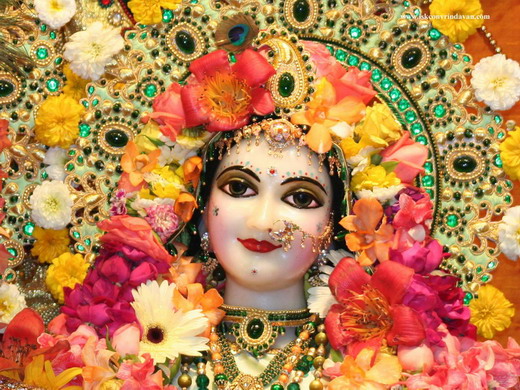
…In the Brahma-saṁhitā it is said that the Lord is never to be found by becoming a great scholar of the Vedic literatures, but He is very easily approachable through His pure devotee. In Vṛndāvana all the pure devotees pray for the mercy of Śrīmatī Rādhārāṇī, the pleasure potency of Lord Kṛṣṇa. Śrīmatī Rādhārāṇī is a tenderhearted feminine counterpart of the supreme whole, resembling the perfectional stage of the worldly feminine nature. Therefore, the mercy of Rādhārāṇī is available very readily to the sincere devotees, and once She recommends such a devotee to Lord Kṛṣṇa, the Lord at once accepts the devotee’s admittance into His association. The conclusion is, therefore, that one should be more serious about seeking the mercy of the devotee than that of the Lord directly, and by one’s doing so (by the good will of the devotee) the natural attraction for the service of the Lord will be revived. (Purport Srimad Bhagavatam 2.3.23)
Full text and purport More
30 Mar 2013
by The Hare Krishna Movement
in A.C. Bhaktivedanta Swami Prabhupada, Spiritual Life, Spiritual Master, Spiritual World, Srimad Bhagavatam
Tags: Bs. 5.28, cintamani-dhama, cintamani=arakara-sadmasu, cows, goddesses of fortune, gopis, Govinda, kalpa-vrksa, Laksmis, Lord Govinda, SB 1.11.26, spiritual gems, Spiritual Life, spiritual master A.C. Bhaktivedanta Swami Prabhupada, Spiritual world, Srimad Bhagavatam, touchstone, transcendental abode, transcendental windows

Sometimes when I am sitting and reading from Srila Prabhupada’s Srimad Bhagavatam, a verse or sentence from the purport just jumps out from the page almost like it is in 3D, and I catch a glimpse of what the Spiritual World must be like. It is beyond even my imagination, but sometimes I catch a glimmer of light, through a transcendental window, by the grace of my spiritual master His Divine Grace A. C. Bhaktivedanta Swami Prabhupada.
…The transcendental abode of the Lord where the trees are all desire trees and the buildings are made of touchstone. The Lord Govinda is engaged there in herding the surabhi cows as His natural occupation.
“I worship Govinda, the primeval Lord, the first progenitor who is tending the cows, yielding all desire, in abodes built with spiritual gems, surrounded by millions of purpose trees, always served with great reverence and affection by hundreds of thousands of lakṣmīs or gopīs.” (Bs 5.29)
…And those who are artists, overtaken by the beautiful creation, should better see to the beautiful face of the Lord for complete satisfaction. The face of the Lord is the embodiment of beauty. What they call beautiful nature is but His smile, and what they call the sweet songs of the birds are but specimens of the whispering voice of the Lord.
More
06 Mar 2013
by The Hare Krishna Movement
in A.C. Bhaktivedanta Swami Prabhupada, Spiritual Life, Spiritual Master, Srimad Bhagavatam, Sukadeva Goswami
Tags: A.C. Bhaktivedanta Swami Prabhupada, at the time of death, dying man, great master, guru, Maharaja Pariksit, spiritual master, Srimad Bhagavatam, Sukadeva Gosvami, thesis of Srimad Bhagavatam

You are the spiritual master of great saints and devotees. I am therefore begging you to show the way of perfection for all persons, and especially for one who is about to die.
Please let me know what a man should hear, chant, remember and worship, and also what he should not do. Please explain all this to me.
Unless one is perfectly anxious to inquire about the way of perfection, there is no necessity of approaching a spiritual master. A spiritual master is not a kind of decoration for a householder. Generally a fashionable materialist engages a so-called spiritual master without any profit. The pseudo- spiritual master flatters the so-called disciple, and thereby both the master and his ward go to hell without a doubt. Mahārāja Parīkṣit is the right type of disciple because he puts forward questions vital to the interest of all men, particularly for the dying men. The question put forward by Mahārāja Parīkṣit is the basic principle of the complete thesis of Śrīmad-Bhāgavatam. Now let us see how intelligently the great master replies. (from purport to SB 1.19.37)
Srimad Bhagavatam
By His Divine Grace A.C. Bhaktivedanta Swami
Canto 1, Chapter 19, Text 29-40
More
27 Feb 2013
by The Hare Krishna Movement
in Premanjana das, Quotes by Srila Prabhupada
Tags: A.C. Bhaktivedanta Swami Prabhupada, All Devotees Should Write, bhagavad-gita, devotees should write, krishna consciousness articles, Pranjal Joshi, preachers of krishna consciousness, Premanjana das, Srila Prabhupada writting, Srimad Bhagavatam, Teachings of Lord Caitanya
This is a very nice compilation of quotes on the importance of writting based on the works of Srila Prabhupada.
“All students should be encouraged to write some article after reading Srimad-Bhagavatam, Bhagavad-gita and Teachings of Lord Caitanya. They should realize the information, and they must present their assimilation in their own words. Otherwise, how they can become preachers?”
(Letter to Brahmananda — Los Angeles, July 1, 1969)
More
24 Feb 2013
by The Hare Krishna Movement
in A.C. Bhaktivedanta Swami Prabhupada, Beyond Birth & Death, Bhagavad-gita, Bhismadeva, Srimad Bhagavatam
Tags: A.C. Bhaktivedanta Swami Prabhupada, beyond samsara, bhagavad-gita, Bhismadeva, bhutva-bhutva, Lord Sri Krsna, mystic yogis, mystics, parliyate, pure devotee, repetition of different bodies, samsara, samsara means material existence, samsara means this material entanglement, Srimad Bhagavatam, yogic situation, yogis

Beyond Saṁsāra
As I was reading from the Srimad Bhagavatam this morning about the passing of Bhīṣmadeva it was being described how “The perfect yogīs or mystics can leave the material body at their own sweet will at a suitable time and go to a suitable planet desired by them.” And how it is possiable to go beyond Saṁsāra, and go back to Godhead without any doubt.
…In the momentous hour of leaving his material body, Bhīṣmadeva set the glorious example concerning the important function of the human form of life. The subject matter which attracts the dying man becomes the beginning of his next life. Therefore, if one is absorbed in thoughts of the Supreme Lord Śrī Kṛṣṇa, he is sure to go back to Godhead without any doubt.
And what is Samsara?
Saṁsāra means material existence. That is called saṁsāra. Bhūtvā bhūtvā pralīyate (BG 8.19). You take your birth once in some form of body. You live for some time. Then you have to give up this body. Then you have to accept another body. Then again live for some time. Then give up that body. Again accept another body. In this way, it is going on. That is called saṁsāra, rotating within this material world. (Lecture on Gurvastakam at Upsala University by His Divine Grace -Stockholm, September 9, 1973)
The saṁsāra means repetition of different bodies. That is called saṁsāra. (Lecture on SB 1.2.4 -Rome, May 28, 1974)
Saṁsāra means this material entanglement. This is called saṁsāra.
(Lecture on CC Madhya-lila 25.40-50 – San Francisco, January 24, 1967)
More
18 Feb 2013
by The Hare Krishna Movement
in A.C. Bhaktivedanta Swami Prabhupada, Guru & Disciple, Krsna-katha, Srimad Bhagawatam
Tags: A.C. Bhaktivedanta Swami Prabhupada, bepetition of birth and death, bhagavad-gita, disciple, Krsna, Krsna-katha, liberated spiritual master, nivrtta-tarsaih, SB 10.1.4, Srila Prabhupada, Srimad Bhagavatam, Supreme Personality of Godhead
click on image to enlarge
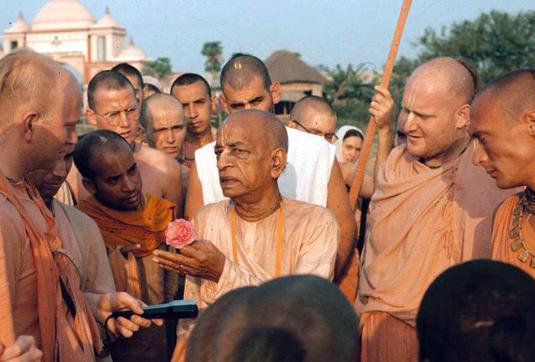
…When discourses on kṛṣṇa-kathā take place between a liberated spiritual master and his disciple, others also sometimes take advantage of hearing these topics and also benefit. These topics are the medicine to stop the repetition of birth and death. The cycle of repeated birth and death, by which one takes on different bodies again and again, is called bhava or bhava-roga. If anyone, willingly or unwillingly, hears kṛṣṇa-kathā, his bhava-roga, the disease of birth and death, will certainly stop. Therefore kṛṣṇa-kathā is called bhavauṣadha, the remedy to stop the repetition of birth and death.
In India it is the practice among the general populace to hear about Kṛṣṇa, either from Bhagavad-gītā or from Śrīmad-Bhāgavatam, in order to gain relief from the disease of repeated birth and death. Although India is now fallen, when there is a message that someone will speak about Bhagavad-gītā or Śrīmad-Bhāgavatam, thousands of people still gather to hear. The following verse indicates, however, that such recitation of Bhagavad-gītā and Śrīmad-Bhāgavatam must be done by persons completely freed from material desires (nivṛtta-tarṣaiḥ).
If we hear the glories of the Supreme Personality of Godhead from liberated persons, this hearing will certainly free us from the bondage of material activities, but hearing Śrīmad-Bhāgavatam spoken by a professional reciter cannot actually help us achieve liberation. Kṛṣṇa-kathā is very simple. In Bhagavad-gītā it is said that Kṛṣṇa is the Supreme Personality of Godhead. As He Himself explains, mattaḥ parataraṁ nānyat kiñcid asti dhanañjaya: “O Arjuna, there is no truth superior to Me.” Simply by understanding this fact—that Kṛṣṇa is the Supreme Personality of Godhead—one can become a liberated person. (Purport SB 10.1.4)
Full Verse and Purport More
Previous Older Entries Next Newer Entries











Foward to Final Volume of the Srimad Bhagavatam
14 Jul 2013 1 Comment
by The Hare Krishna Movement in A.C. Bhaktivedanta Swami Prabhupada, BBT, Book Changes, Books by Srila Prabhupada, Srimad Bhagavatam Tags: A.C. Bhaktivedanta Swami Prabhupada, BBT, dictaphone, final volume, Founder Acarya, foward to tenth canto, International Society for Krishna Consciousness, Krsna Balarama Mandir, Sanskrit text, Srimad Bhagavatam, Tenth Canto, translation and commentary
Śrīmad-Bhāgavatam
By His Divine Grace A.C. Bhaktivedanta Swami Prabhupada
Tenth Canto, Part Three
Foward
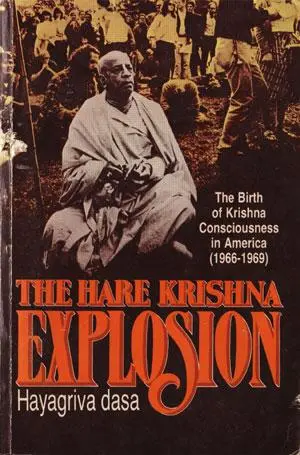
This is the final Śrīmad-Bhāgavatam volume translated by His Divine Grace A. C. Bhaktivedanta Swami Prabhupada, founder-acarya of the International Society for Krishna Consciousness. It is smaller than the earlier volumes because it ends where the renowned author stopped translating just before his departure from this mortal world on November 14, 1977, at the Krsna-Balarama Mandira in Vrndavana, India.
The first part of this volume was produced in the usual fashion. Srila Prabhupada would sit and read silently from the Sanskrit text and then speak the translation and commentary into his dictaphone. Later, due to illness, it became necessary for his disciples to assist him personally.
In these last days Srila Prabhupada was gravely ill. Unable to eat for weeks, his health had deteriorated, making even the slightest movement excruciatingly painful.
As he lay still, a devotee would softly read the Sanskrit to him. Another disciple, sitting on his bed, held the microphone to him, nearly touching his mouth. And then Srila Prabhupada would speak, voice sometimes barely audible.
These recordings, made in his quarters at the temple, constitute the balance of this book.
In these final moments, the physician attending His Divine Grace confided that an ordinary man in such critical condition would have been crying out from the intense pain. Srila Prabhupada’s disciples were awestruck as they watched their spiritual master work quietly, undisturbed.
In the last part of the book we find Srila Prabhupada’s usual clarity of thought, constant scriptural references, scrupulous attention to detail, and rigorous philosophical exposition fully intact, just as they were in the preceding twenty-nine volumes of the Śrīmad-Bhāgavatam.
Srila Prabhpada’s last days and this translation will stands an inspiring reminder that even the severest material circumstances cannot impede the activities of a pure devotee of the Supreme Personality of Godhead.
-The Publishers
For a Free PDF download of this special volume click on following link; SB-10-03-1980
More