I saw this posted on Facebook, and thought we would share it here with all of you. In this article by Locan Ananda Prabhu, he again makes the argument for Arsa-prayoga, or no change.
Srila Prabhupada was recognized as a great Sanskrit scholar. His depth of knowledge was unfathomable. Not a single word of his should have been changed. That policy is called arsa-prayoga, and it guarantees that the spiritual head of our institution should never be dishonored by changing his words.
THE ROD OF CHASTISEMENT IS GONE!!!
by Locan Ananda Dasa
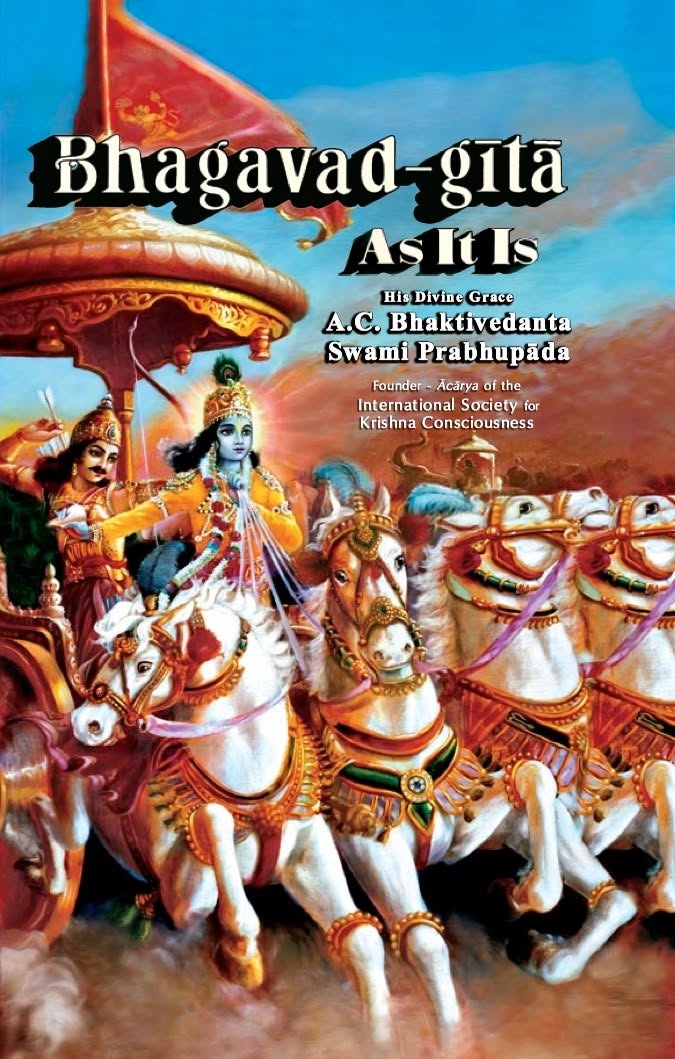
One of my favorite verses in the Bhagavad-Gita As It Is
was once found in Chapter 10, verse 38:
“Among punishments I am the rod of chastisement, and of those who seek victory, I am morality. Of secret things I am silence, and of the wise I am wisdom.” (B.g. 10.38, original)
Chapter 10 is entitled, “The Opulence of the Absolute” wherein Krishna enumerates some of His extraordinarily splendorous manifestations. On August 12, 1976, Srila Prabhupada was having an evening darshan in Tehran, the capital and largest city in Iran. He was talking about how ordinary people know little about the greatness of God. “They say, ‘God is great,’ but how great? That they do not know.” Srila Prabhupada then asked his secretary at the time, Harikesa dasa, to read selected verses from the Bhagavad-Gita, beginning with Chapter 10, verse 20:
“I am the Self, O Gudakesa, seated in the hearts of all creatures. I am the beginning, the middle and the end of all beings.” (B.g. 10.20)
Harikesa prabhu continued to read through the verses that followed, the chapter ending with verse 42:
“But what need is there, Arjuna, for all this detailed knowledge. With a single fragment of Myself I pervade and support this entire universe.” (B.g. 10.42)
When he finished the reading, Srila Prabhupada said, “That’s it. This is greatness. So we should not simply be satisfied ‘God is great.’ We must try to know how great He is. Then our God consciousness will be fixed up. It’s all right?”
Regarding your last question about the importance of chanting; this chanting process is the only way of attaining full Krishna Consciousness in this age of kali yuga. Lord Caitanya stressed upon this point, and we may take it from His authority that no other method will prove to be successful in this matter. (Letter to Sivananda, January 23 1969, Los Angeles)
‘Beyond Birth and Death’ is one of my favorite small books written by His Divine Grace A. C. Bhaktivedanta Swami. The first chapter is a good introduction to the philosophy of Krishna Consciousness. We have included the entire first chapter for those interested.
We Are Not These Bodies
(Chapter One from Beyond Birth & Death)
The very first step in self-realization is realizing one’s identity as separate from the body. “I am not this body but am spirit soul” is an essential realization for anyone who wants to transcend death and enter into the spiritual world beyond. It is not simply a matter of saying “I am not this body,” but of actually realizing it. This is not as simple as it may seem at first. Although we are not these bodies but are pure consciousness, somehow or other we have become encased within the bodily dress. If we actually want the happiness and independence that transcend death, we have to establish ourselves and remain in our constitutional position as pure consciousness.
“O descendant of Bharata, he who dwells in the body is eternal and can never be slain. Therefore you need not grieve for any creature.” (Bhagavad-gita 2.30)
Living in the bodily conception, our idea of happiness is like that of a man in delirium. Some philosophers claim that this delirious condition of bodily identification should be cured by abstaining from all action. Because these material activities have been a source of distress for us, they claim that we should actually stop these activities. Their culmination of perfection is in a kind of Buddhistic nirvāṇa, in which no activities are performed. Buddha maintained that due to a combination of material elements, this body has come into existence, and that somehow or other if these material elements are separated or dismantled, the cause of suffering is removed. If the tax collectors give us too much difficulty because we happen to possess a large house, one simple solution is to destroy the house. However, Bhagavad-gītā indicates that this material body is not all in all. Beyond this combination of material elements, there is spirit, and the symptom of that spirit is consciousness.
…One issue that many find shocking is the extent to which Srila Prabhupada’s Bhagavad-gita As It Is was edited without having been authorized by His Divine Grace, Srila Prabhupada. He was never a fan of extensive editing of any of his published works. What’s more, the over-edited edition published in 1983 removed thirty-two color pages that Srila Prabhupada insisted be included in his great opus. Three of those eliminated color pages were of the predecessor acaryas, namely Srila Bhaktisiddhanta Saraswati Thakur, Srila Gaura Kishora Das Babaji Maharaja and Srila Thakur Bhaktivinode.
Even the pocket Gita printed in India included all of the color plates found in the Macmillan edition.
If you are just hearing about this for the first time, please contact the GBC representative in your area and humbly request that this offense be rectified with the next printing. Doing so will attract Srila Prabhupada’s blessings. Do not fear when the cause is just.
A CRISIS IN LEADERSHIP
by Locan Ananda dasa
Many followers of Srila Prabhupada’s teachings have been calling for the worldwide reformation of the leadership of the International Society for Krishna Consciousness. The charge being made is that leaders and managers need to adhere more closely to the specific instructions of our Founder Acarya. There should be greater vigilance and the immediate correction of inappropriate behavior on the part of errant leaders.
Everyone wants Happiness and wants to avoid Distress, this is a fact. This Krishna Consciousness Movement is meant to deliver all of suffering humanity from the threefold miseries of material existence.
The attempt in this material world to maximize happiness and minimize distress is called the struggle for existence.
…This material world is the world of duality, and we cannot understand happiness without distress or distress without happiness. This is therefore called the relative world. Spiritual happiness is above these dualities, and that spiritual happiness is the perfection of yoga. Yoga ādhyātmikaḥ. Yoga is the happiness of the soul, and the individual soul can be happy when it is with the Supersoul, the Supreme Soul.Nityo nityānāṁ cetanaś cetanānām (Kaṭha Upaniṣad 2.2.13). There is the Supreme Soul, or the supreme living being, and there are many individual souls, individual beings. We are many, but the principal living being is one, Kṛṣṇa. He is the fire, and we are the sparks from that fire. The sparks are illuminated when they are with the original fire, but if the sparks no longer associate with the original fire, they are extinguished. Similarly, our real happiness is in enjoying with the Supreme Being. Happiness is being in His company. Kṛṣṇa is not alone, but is always with His friends, either the gopīs or the cowherd boys, or with His mother and father. We never find Kṛṣṇa alone. He may be with Rādhārāṇī or with His devotees. He is like a king or president. When one says that the king or president is coming, it is understood that he is not coming alone. He comes with His secretaries, ministers and many others. (Teachings of Lord Kapila)
…Everyone is trying to get out of material distress and gain some happiness. In any case, when something is material, there is only so-called happiness and so-called distress. For instance, there may be fireworks going on, and this may be happiness for someone but distress for us. Some people are thinking that these fireworks are very enjoyable, and we are thinking that they are very inconvenient. That is the material world. On one side there is happiness, and on the other side there is distress. Both happiness and distress are actually illusions. In summer, water is happiness, but in winter it is distress. The water is the same, but at one time it brings happiness and at another time it brings distress. When a son is born, he brings happiness, but when he dies, he brings distress. In either case, the son is the same. (Teachings of Lord Kapila)
Today marks the disappearance day of Srila Bhaktivinoda Thakura. We honor it with a half day fast followed by a nice vegetarian feast. We share with you one of my favorite songs composed by Srila Bhaktivinoda.
Kabe Ha’be Bolo (Invocation of the Holy Name) by Srila Bhaktivinoda Thakura
When, oh when, will that day be mine? When my offenses ceasing, taste for the name increasing, when in my heart will your mercy shine? When, oh when will that day be mine?
Lower than a blade of grass, more tolerant than a tree. When will my mind attain this quality? Respectful to all, not expecting their honour, then shall I taste the name’s nectar sublime. When oh when will that day be mine?
The great mistake of modern civilization is to encroach upon others’ property as though it were one’s own and thereby create an unnecessary disturbance of the laws of nature.
We are witnessing a world in turmoil right now, with nations at war with each other. And I am reminded of the peace formula that Srila Prabhupada has given us. He first presented the peace formula in an early edition of Back to Godhead Magazine, then in the Bhagavad-gita, and it appeared in many small books and pamphlets. We share with you today, a sampling of the peace formula in some of the early small books.
“A person in full consciousness of Me, knowing Me to be the ultimate beneficiary of all sacrifices and austerities, the Supreme Lord of all planets and demigods, and the benefactor and well-wisher of all living entities, attains peace from the pangs of material miseries.” (Bhagavad-gita 5.29)
The politicians and diplomats are trying to establish peace in the world. We have the United Nations and many other organizations. They are working to establish real peace and tranquillity, to eliminate misunderstanding between man and man and nation and nation. But that is not happening. The defect is that the root is wrong. Everyone is thinking, “It is my country,” “It is my family,” “It is my society,” “It is my property.” This “my” is illusion. This “I-and-my” philosophy is māyā-illusion.
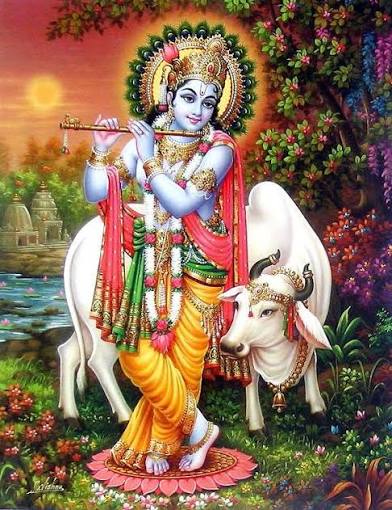
“My dear friend, there is one boy – His name is Govinda. He is standing on the bank of the Yamunā near the Keśi-ghāṭa, and He is playing on His flute. He is so beautiful, especially during this full-moon night. If you have any intentions to enjoy in this material world with your children, husband, or other family members, then please do not go there.”
The Vedic literature is unique among all the world’s scriptures because it details a practical process by which anyone can purify his or her consciousness and see God face to face. In a lecture, delivered in Los Angeles on August 15, 1972, Śrīla Prabhupāda explains, “One must actually be very eager to see God…. One must be very serious and think, ‘Yes, I have been informed about God. So if there is a God, I must see Him.'”
Excerpts from Lecture Los Angeles on August 15, 1972
jaya–all glories to: rādhā-mādhava–Rādhā and the Lord of sweetness; kuñja-bihārī–He who enjoys loving pastimes in the groves of Vṛndāvana; gopī-jana-vallabha–the lover of the cowherd maidens of Vraja; giri-vara-dhārī–the holder of the great hill named Govardhana;
Krsna is the lover of Radha. He displays many amorous pastimes in the groves of Vrndavana, He is the lover of the cowherd maidens of Vraja, and the holder of the great hill named Govardhana.
yaśodā-nandana–the beloved son of mother Yaśodā; vraja-jana-rañjana–the delighter of the inhabitants of Vraja; yāmuna-tīra-vana-cārī–who wanders in the forests along the banks of the river Yamunā
He is the beloved son of mother Yasoda, the delighter of the inhabitants of Vraja, and He wanders in the forests along the banks of the River Yamuna!
Purport to Jaya Rādhā-Mādhava New York, July 20, 1971
Prabhupāda: So you know this song Jaya Rādhā-Mādhava?
Devotees: Jaya!
Prabhupāda: So you can follow me?
Devotees: Jaya! Haribol! (Śrīla Prabhupāda leads singing of Jaya Rādhā-Mādhava)
Prabhupāda: So this is the original nature of Kṛṣṇa, original nature of Kṛṣṇa. He is Rādhā-Mādhava. He is the lover of Śrīmatī Rādhārāṇī. And kuñja-vihārī, always enjoying the company of the gopīs within the bushes of Vrndavana forest. Rādhā-mādhava kuñja-vihārī. So He’s not only lover of Rādhārāṇī, but braja-jana-vallabha. The whole residents of Vṛndāvana, they love Kṛṣṇa. They do not know anything else. They do not know whether Kṛṣṇa is God, or not; neither they are very much harassed, that “I shall love Kṛṣṇa if He is God.” “He may be God or He may be whatever He is. It doesn’t matter, but we love God, Kṛṣṇa.” That’s all. That is called unalloyed love.
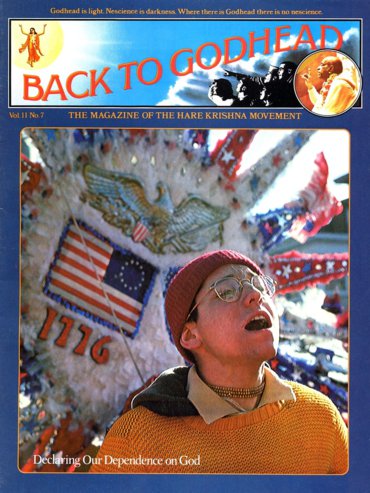
Two hundred years ago, Americans fought the War of Independence to assure life, liberty, and happiness in a fledgling nation. In a conversation with the BACK TO GODHEAD staff, His Divine Grace A.C. Bhaktivedanta Swami Prabhupada explains that Americans can actually achieve these things only by maintaining a God conscious society, with God conscious leaders.
BTG: Thomas Jefferson put the basic philosophy of the American Revolution into the Declaration of Independence. The important men of the day who signed this document agreed that there are certain very obvious or self-evident truths; the first of which is that all men are created equal. By this they meant that all men are equal before the law and have an equal opportunity to be protected by the law.
Srila Prabhupada: Yes, in that sense men are, as you say, created equal.
BTG: Another point in the Declaration of Independence is that all men are endowed by God with certain natural rights that cannot be taken away from them. These are the rights of life, liberty, and
Srila Prabhupada: But animals also have the right to life. Why don’t animals also have the right to live? The rabbits, for instance, are living in their own way in the forest. Why does the government allow hunters to go and shoot them?
Yesterday we shared with you the first printing of Srila Prabhupada’s epic translations of the Srimad Bhagavatam, and today we share with you his last.
For a Free PDF download of this special volume click on following link; SB-10-03-1980
Śrīmad-Bhāgavatam By His Divine Grace A.C. Bhaktivedanta Swami Prabhupada Tenth Canto, Part Three
Foward
This is the final Śrīmad-Bhāgavatam volume translated by His Divine Grace A. C. Bhaktivedanta Swami Prabhupada, founder-acarya of the International Society for Krishna Consciousness. It is smaller than the earlier volumes because it ends where the renowned author stopped translating just before his departure from this mortal world on November 14, 1977, at the Krsna-Balarama Mandira in Vrndavana, India.
The first part of this volume was produced in the usual fashion. Srila Prabhupada would sit and read silently from the Sanskrit text and then speak the translation and commentary into his dictaphone. Later, due to illness, it became necessary for his disciples to assist him personally.
In these last days Srila Prabhupada was gravely ill. Unable to eat for weeks, his health had deteriorated, making even the slightest movement excruciatingly painful.
As he lay still, a devotee would softly read the Sanskrit to him. Another disciple, sitting on his bed, held the microphone to him, nearly touching his mouth. And then Srila Prabhupada would speak, voice sometimes barely audible.
These recordings, made in his quarters at the temple, constitute the balance of this book.
In these final moments, the physician attending His Divine Grace confided that an ordinary man in such critical condition would have been crying out from the intense pain. Srila Prabhupada’s disciples were awestruck as they watched their spiritual master work quietly, undisturbed.
In the last part of the book we find Srila Prabhupada’s usual clarity of thought, constant scriptural references, scrupulous attention to detail, and rigorous philosophical exposition fully intact, just as they were in the preceding twenty-nine volumes of the Śrīmad-Bhāgavatam.
Srila Prabhpada’s last days and this translation will stands an inspiring reminder that even the severest material circumstances cannot impede the activities of a pure devotee of the Supreme Personality of Godhead.
Srimad Bhagwatam By Tridani Goswami A.C Bhaktivedanta Swami
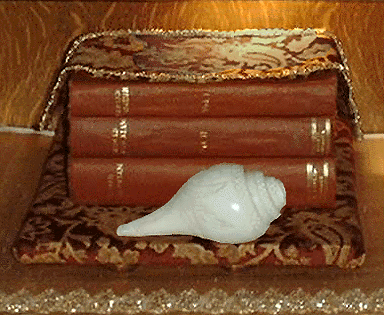
These were the books Srila Prabhupada brought with him from India. The first three volumes of the Srimad Bhagavatam that he had printed in Delhi between 1960 and 1965. We are fortunate to have a set of these in our home, however, I am afraid to handle them very much because they are so precious. I think they actually belong in a museum.
We share with you a free scanned pdf you can download to your computer
For a free download of these Original Srimad Bhagwatam’s please click on following links
These Srimad Bhagwatams are among the most valuable memorabilia one can have of Srila Prabhupada. The timing of their publication coincides directly with Srila Prabhupada’s departure for the Western world. He left India a very short time after the last volume was printed, and it seems obvious that the completion of this task signaled the time for his departure.
When one reads these original Bhagwatams, perhaps more than any of Srila Prabhupada’s other writings, you can feel the Vrindaban mood. Srila Prabhupada was there alone writing his purports, whereas the other Bhagavatams were translated and written while he was surrounded by many followers and his ISKCON movement was rapidly growing. This was quite a contrast to the circumstances surrounding his first books.
Although these books were not edited as the later ones were, and thus contain some typos and English imperfections, there is absolutely no less spiritual potency. In fact, whether its sentiment or realization,to my mind these early editions are preferable, and represent one of the strongest arguments for not making any changes or ‘improvements’ to the Srila Prabhupada’s books after his departure.
Every newcomer to Krsna Consciousness should have the opportunity to read these original Bhagwatams so they can get to know Srila Prabhupada in a more intimate way.