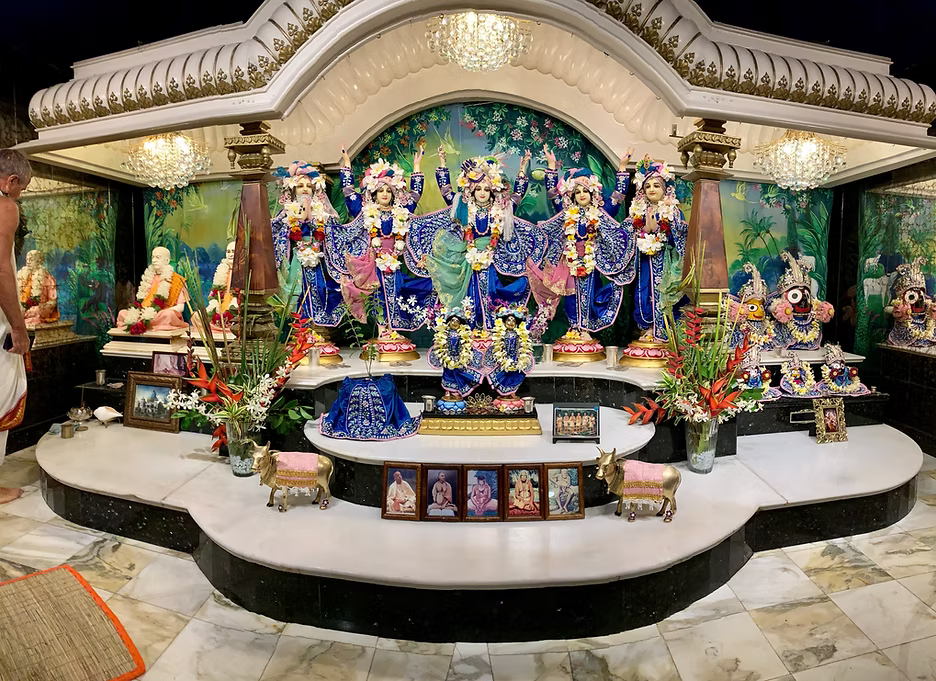
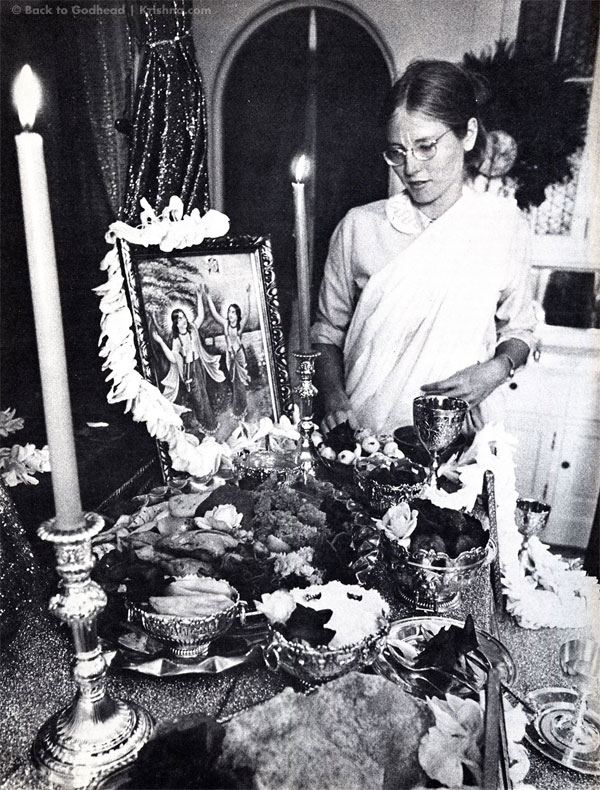
Altough I have been to Hawaii a few times, I never got the chance to visit the Hawaii Iskcon Temple. But I have always heard about the beautiful Pancha Tattva Deities, and that they were the first Pancha Tattva Deities Installed by Srila Prabhupada in all of ISKCON.
The ISKCON Hawaii Temple is a nonsectarian community dedicated to spiritual education and promoting unity and peace in the world through chanting of the mahã mãntra, distributing sanctified vegetarian food and propagating spiritual knowledge and practices based on the ancient Vedic teachings of Bhakti Yoga, as presented by His Divine Grace A.C.Bhaktivedanta Swami Prabhupada.
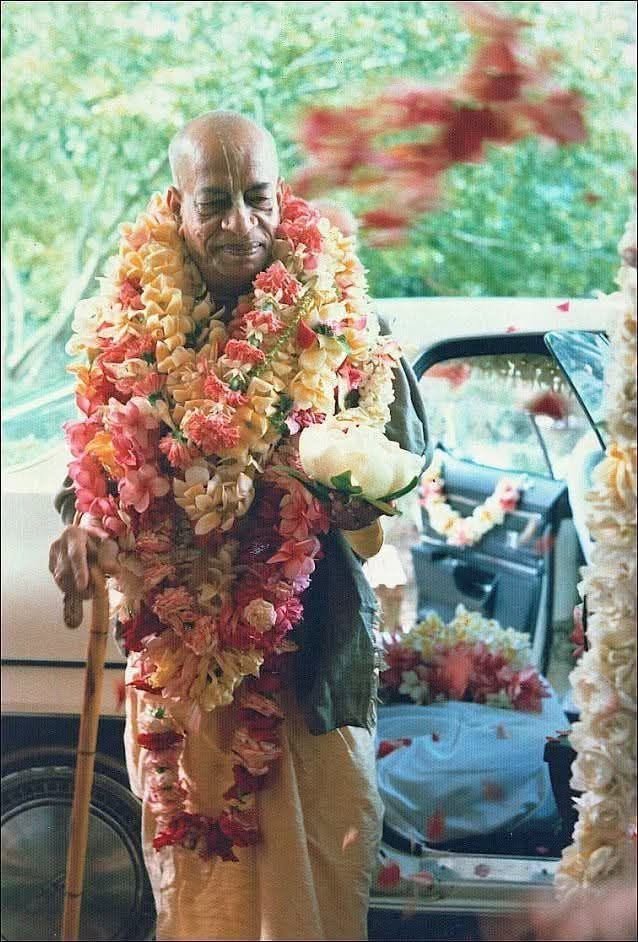
The first Pancha Tattva deities in Iskcon were installed in Honolulu, Hawaii in May 1972 by Iskcon Founder and Acarya: A. C. Bhaktivedanta Swami Prabhupada.
Home of the Pancha Tattva
The Pancha Tattva represent five divine aspects, each manifesting to share the profound blessing of love for God. These personalities appeared with unique roles in the sacred mission of distributing God’s love.
The Pancha Tattva represent five divine aspects, each manifesting to share the profound blessing of love for God. These personalities appeared with unique roles in the sacred mission of distributing God’s love.
Today as I was driving home from the hospital, (I had some blood drawn), this question popped into my mind: “What is life?”. I saw some patients there, which appeared on the verge of death. I thought of my own mortality, we are born, live for sometime, and eventually die. So what is this life?
Just for fun I asked Google this question ‘what is life’ and got this ridiculous answer: “Life is the quality or condition that distinguishes living organisms (plants, animals, humans, and microorganisms) from inorganic matter and dead bodies. (Google search) I almost laughed out loud. Oh ya, that really tells me everything.
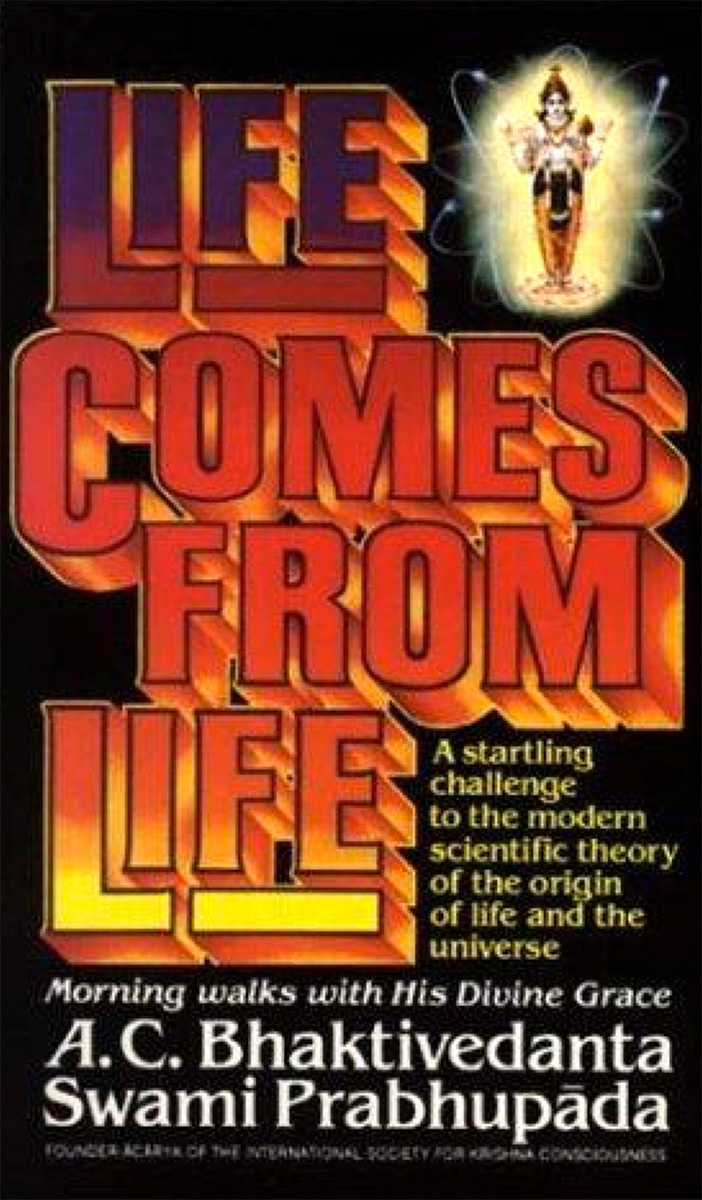
Then I remembered a book “Life comes from Life” that was published by the BBT back in 1979, based on morning walks by Srila Prabhupada.
“…This book is based on taped morning-walk conversations that Śrīla Prabhupāda had with some of his disciples during 1973, in the Los Angeles area. On those mornings when he focused on science, Śrīla Prabhupāda spoke mainly with his disciple Thoudam D. Singh, Ph.D. An organic chemist, Dr. Singh had directed the Bhaktivedanta Institute, an international center for advanced study and research in science, philosophy and theology.” (from forward)
I never really read that book, because my mind was not scientifically inclined. But from the Bhagavad-gita I learned these verses:
As the embodied soul continually passes, in this body, from boyhood to youth to old age, the soul similarly passes into another body at death. The self-realized soul is not bewildered by such a change. (Bg. 2.13)
For the soul there is never birth nor death. Nor, having once been, does he ever cease to be. He is unborn, eternal, ever-existing, undying and primeval. He is not slain when the body is slain. (Bg. 2.20)
Today we celebrate the Appearance of Lord Vamanadeva, the fifteenth Incarnation, wherin Krsna assumed the form of a dwarf brahmana.
“In the fifteenth incarnation, the Lord assumed the form of a dwarf-brāhmaṇa [Vāmana]…” (SB 1.19.19)
The following is a chapter summary from Srimad Bhagavatam, eight canto, chapter 18, entitled “Lord Vāmanadeva, the Dwarf Incarnation”, describing the Lord’s appearance and activities, and a verse from the First Canto.
Srimad-Bhagavatam By His Divine Grace A. C. Bhaktivedanta Swami Prabhupada Canto One, Chapter 19, Text 19
pañcadaśam—the fifteenth in the line; vāmanakam—the dwarf brāhmaṇa; kṛtvā—by assumption of; agāt—went; adhvaram—arena of sacrifice; baleḥ—of King Bali; pada-trayam—three steps only; yācamānaḥ—begging; pratyāditsuḥ—willing at heart to return; tri-piṣṭapam—the kingdom of the three planetary systems.
TRANSLATION
In the fifteenth incarnation, the Lord assumed the form of a dwarf-brāhmaṇa [Vāmana] and visited the arena of sacrifice arranged by Mahārāja Bali. Although at heart He was willing to regain the kingdom of the three planetary systems, He simply asked for a donation of three steps of land.
PURPORT
The Almighty God can bestow upon anyone the kingdom of the universe from a very small beginning, and similarly, He can take away the kingdom of the universe on the plea of begging a small piece of land.
Śrīmad-Bhāgavatam by His Divine Grace A. C. Bhaktivedanta Swami Prabhupāda Canto 8, Chapter 18
Lord Vāmanadeva, the Dwarf Incarnation
This chapter describes how Lord Vāmanadeva appeared and how He went to the sacrificial arena of Mahārāja Bali, who received Him well and fulfilled His desire by offering Him benedictions.
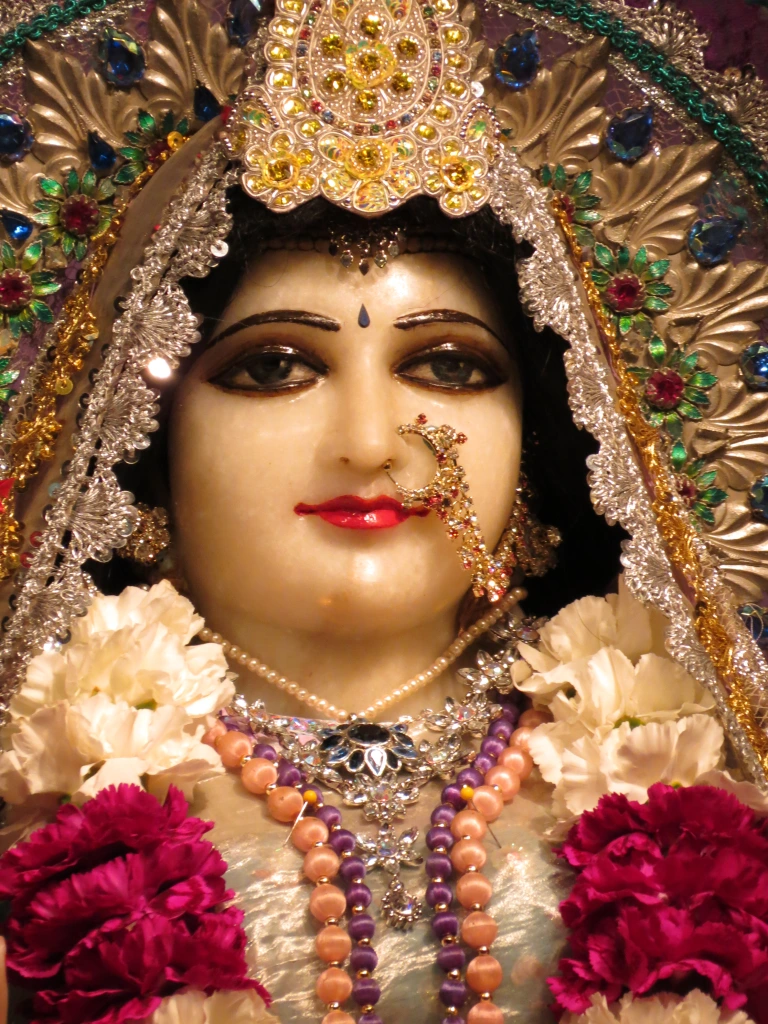
Today marks the Appearance of Srimati Radharani. We honor it with a half day fast, discussion on the glories of Srimati Radharani,, followed by a nice vegetarian feast.
The following are just a few of the many quotes from Srila Prabhupada which encourage us to approach Krishna through the mercy of Srimati Radharani, Krishna’s eternal consort. For those of us who feel that there is no hope of making spiritual progress in this lifetime, Srimati Radharani, Who is compassion personified, kindly comes to our rescue if we can humbly invoke Her divine blessings.
“I offer my respects to Radharani whose bodily complexion is like molten gold and who is the Queen of Vrndavana. You are the daughter of King Vrsabhanu, and You are very dear to Lord Krishna.” (Sri Radha Pranama)
“So this is our philosophy, to please Krishna through Radharani, and just today is the auspicious day of Radharani appearance. So we should offer puspanjali and pray to Radharani that ‘Radharani, kindly be merciful and tell about me to Your Krishna. To Your Krishna. Krishna is Yours.’ Krishna, Radha-Krishna. Krishna is not independent. Krishna is Radharani’s property. So you have to approach Krishna through Radharani. That is, today is the auspicious day. Worship Radharani very nicely and be happy.” (Srila Prabhupada Lecture, September 5, 1973)
“The beauty of Srimati Radharani’s eyes forcibly devours the beauty of newly grown blue lotus flowers, and the beauty of Her face surpasses that of an entire forest of fully blossomed lotuses. Her bodily luster seems to place even gold into a painful situation. Thus the wonderful, unprecedented beauty of Srimati Radharani is awakening in Vrindavana.” (Caitanya-caritamrita Antya 1.169)
“I emphatically say to you, O brothers, you will obtain your good fortune from the Supreme Lord Krishna only when Srimati Radharani becomes pleased with you.”(Prayer to the Lotus Feet of Krishna, September 13, 1965)
“Actually, because Krishna is the Supreme Personality of Godhead, it is very difficult to approach Him. But the devotees, taking advantage of His compassionate nature, which is represented by Radharani, always pray to Radharani for Krishna’s compassion.” (Nectar of Devotion, Chapter 22)
Srimati Radharani has twenty-five transcendental qualities. Her transcendental qualities are as follows:
1. She is sweetness personified2. She is a fresh young girl 3. Her eyes are always moving 4. She is always brightly smiling 5. She possesses all auspicious marks on her body 6. She can agitate Krishna by the flavor of Her person 7. She is expert in the art of singing 8. She can speak very nicely and sweetly 9. She is expert in presenting feminine attractions 10. She is modest and gentle 11. She is always very merciful 12. She is transcendentally cunning 13. She knows how to dress nicely 14. She is always shy 15. She is always respectful 16. She is always patient 17. She is very grave 18. She is enjoyed by Krishna 19. She is situated on the highest devotional platform 20. She is the abode of love of the residents of Gokula 21. She can give shelter to all kinds of devotees 22. She is always affectionate to superiors and inferiors 23. She is always obliged by the dealings of Her associates 24. She is the greatest amongst Krishna’s girlfriends 25. She always keeps Krishna under Her control
I was reading from the Caitanya-caritamrta, and these three verses and purports by His Divine Grace A. C Bhaktivedanta Swami explains much about the division we find in our ISKCON society today.
At first all the followers of Advaita Ācārya shared a single opinion. But later they followed two different opinions, as ordained by providence. (Cc Adi-lila 12.8)
Some of the disciples strictly accepted the orders of the ācārya, and others deviated, independently concocting their own opinions under the spell of daivī-māyā. (Cc Adi-lila 12.9)
The order of the spiritual master is the active principle in spiritual life. Anyone who disobeys the order of the spiritual master immediately becomes useless. (Cc Adi-lila 12.10)
The strangest thing happened this morning. While I was chanting my japa, I guess I was a little distracted because I was thinking about work, and the following verse from the Srimad Bhagavatam just popped into my head. I was trying to remember where this verse was…I was pretty sure it was in the First Canto…so I took the first canto off the shelf and just randomly opened it. And to my great surprise, it opened to the exact verse I was thinking about.
The supreme occupation [dharma] for all humanity is that by which men can attain to loving devotional service unto the transcendent Lord. Such devotional service must be unmotivated and uninterrupted to completely satisfy the self. (Srimad Bhagavatam 1.2.6)
These original books by Srila Prabhupada are definitely transcendental.
“The Spiritual Master is present wherever his sincere disciple is trying to serve his instructions. This is possible by the mercy of Krishna.
In your attempts to serve me, and in all your sincere devotional sentiments I am with you, as my Guru Maharaja is with me. Remember this always…I shall never leave you. You are my disciple and I am your Spiritual Master, so there is no question, as long as you follow my instructions, that I shall never leave you” (Srila Prabhupada)
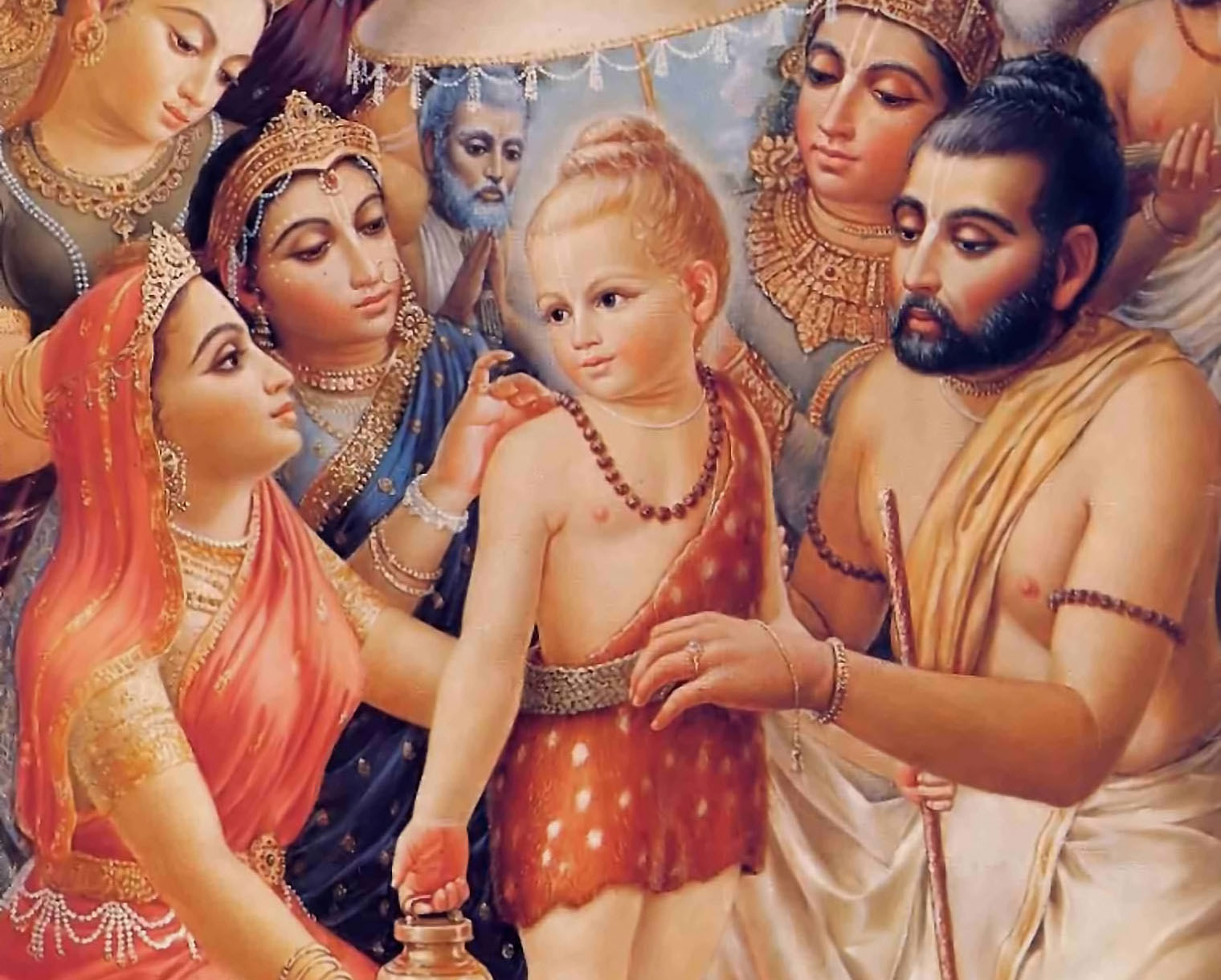
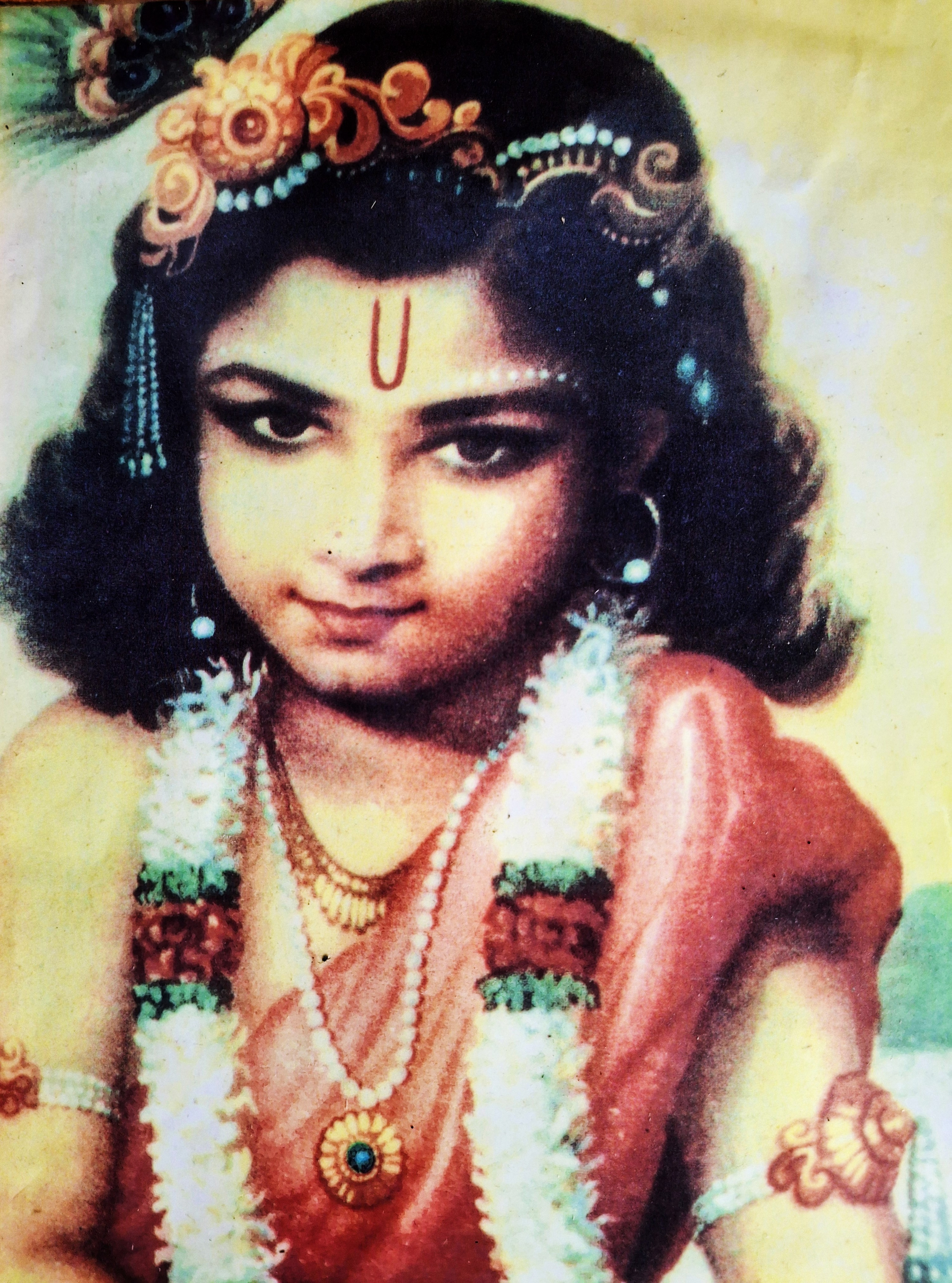
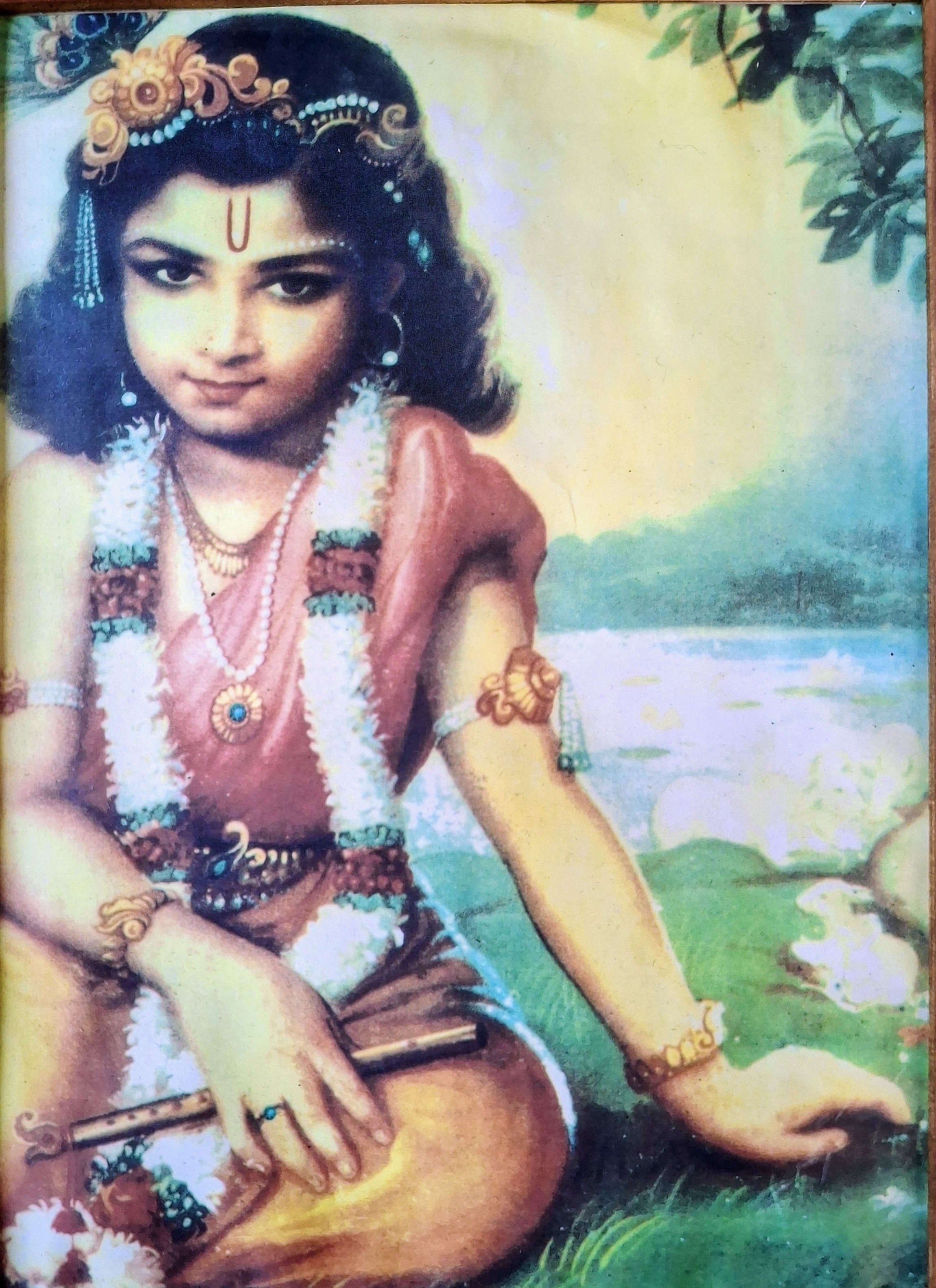
This is probably my favorite picture in our temple room. I don’t know much about the history of it, where it came from or how it appeared in our home, but it has always been hanging in our temple room. My wife Lokadrsti devi dasi, told me that this is a picture of Lord Caitanya in his childhood mood as Nimai. That’s about all I know, but I am enchanted by this painting, it is so beautiful!
The early pastimes of Lord Caitanya can be found in Adi-lila Volume 3, Chapter 13 of the Sri Caitanya-caritamrta. You can click on the following link to read the entire chapter.
Sri Caitanya-caritamrta
By His Divine Grace A. C. Bhaktivedanta Swami Prabhupada
The Advent of Lord Śrī Caitanya MahāprabhuCc. Ādi 13
Yesterday my wife read me this verse and purport from the Sri Caitanya-caritamrta (Cc. Madya-lila 16.186). It reminded me of the potency of the Holy Name of the Lord.
” ‘To say nothing of the spiritual advancement of persons who see the Supreme Person face to face, even a person born in a family of dog-eaters becomes immediately eligible to perform Vedic sacrifices if he once utters the holy name of the Supreme Personality of Godhead, or chants about Him, hears about His pastimes, offers Him obeisances or even remembers Him.’ “
PURPORT
This is a quotation from Śrīmad-Bhāgavatam (3.33.6). According to this verse, it doesn’t matter what position a person holds. One may be the lowest of the low—a caṇḍāla, or dog-eater—but if he takes to chanting and hearing the holy name of the Lord, he is immediately eligible to perform Vedic sacrifices. This is especially true in this age of Kali.
harer nāma harer nāma harer nāmaiva kevalam kalau nāsty eva nāsty eva nāsty eva gatir anyathā
(Bṛhan-nāradīya Purāṇa, 38.126)
A person born in a brāhmaṇa family cannot perform Vedic sacrifices until he is properly purified and has attained his sacred thread. However, according to this verse, it is understood that even a lowborn person can immediately perform sacrifices if he sincerely chants and hears the holy name of the Lord. Sometimes envious people ask how Europeans and Americans in this Kṛṣṇa consciousness movement can become brāhmaṇas and perform sacrifices. They do not know that the Europeans and Americans have already been purified by chanting the holy name of the Lord—Hare Kṛṣṇa, Hare Kṛṣṇa, Kṛṣṇa Kṛṣṇa, Hare Hare Hare Rāma, Hare Rāma, Rāma Rāma, Hare Hare. This is the proof. Śvādo ‘pi sadyaḥ savanāya kalpate. One may be born in a family of dog-eaters, but he can perform sacrifices simply by chanting the mahā-mantra.
Those who find fault in the Western Vaiṣṇavas should consider this statement from Śrīmad-Bhāgavatam and the commentary on this verse by Śrīla Jīva Gosvāmī. In this regard, Śrīla Jīva Gosvāmī has stated that to become a brāhmaṇa, one has to wait for purification and undergo the sacred thread ceremony, but a chanter of the holy name does not have to wait for the sacred thread ceremony. We do not allow devotees to perform sacrifices until they are properly initiated in the sacred thread ceremony. Yet according to this verse, an offenseless chanter of the holy name is already fit to perform a fire ceremony, even though he is not doubly initiated by the sacred thread ceremony. This is the verdict given by Lord Kapiladeva in His instructions to His mother, Devahūti. It was Lord Kapiladeva who instructed Devahūti in pure Sāṅkhya philosophy.
And from the Srimad Bhagavatam full text and purport
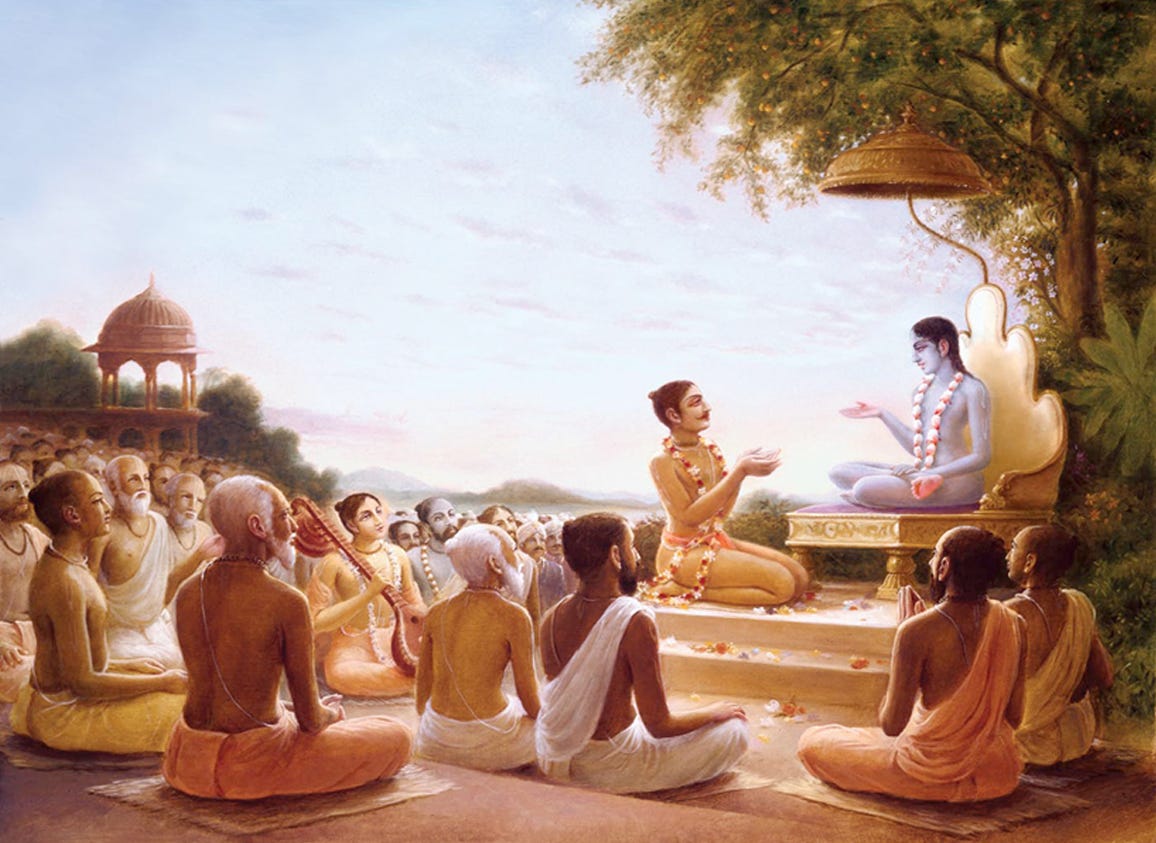
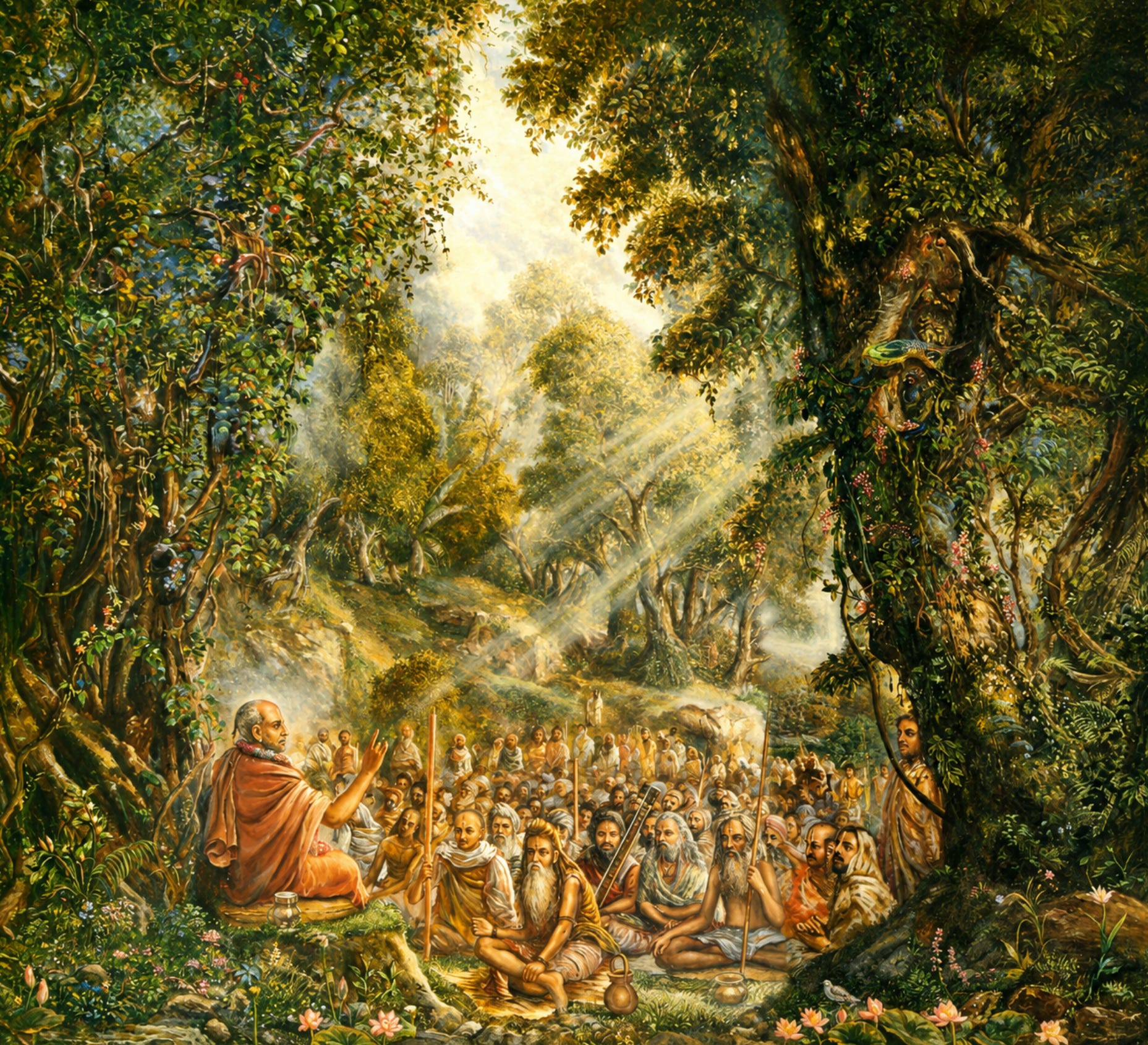
The sages at Naimisaranya: Were an assembly of 88,000 spiritual teachers, led by the prominent sage Shaunaka Rishi. who gathered in the sacred Naimisaranya forest in modern-day Uttar Pradesh, India.
Once, in a holy place in the forest of Naimiṣāraṇya, great sages headed by the sage Śaunaka assembled to perform a great thousand-year sacrifice for the satisfaction of the Lord and His devotees. (SB 1.1.4 )
The Arrival of Suta Goswami: While conducting their rituals, the storyteller and sage Suta Goswami arrived at the assembly and was warmly welcomed and given a high seat of honor (Vyasasana).
O expert and thoughtful men, relish Śrīmad-Bhāgavatam, the mature fruit of the desire tree of Vedic literatures. It emanated from the lips of Śrī Śukadeva Gosvāmī. Therefore this fruit has become even more tasteful, although its nectarean juice was already relishable for all, including liberated souls. (SB. 1. 1. 3 )
The Six Questions: Recognizing Suta Goswami’s pure character and deep scriptural knowledge, the sages asked him six fundamental questions regarding spiritual truth, which form the foundational framework of the
What is the absolute, ultimate benefit for all mankind?
What is the core essence hidden within all Vedic scriptures?
Why did the Supreme Lord take birth from Mother Devaki?
How do the secondary forms of the Lord (like Brahma and Rudra) create, maintain, and destroy the universe?
What are the complete activities and pastimes of Lord Hari’s various incarnations?
Where has true religion or spiritual shelter gone now that Lord Krishna has departed?
In the first chapter of the Śrīmad Bhagavatam, the sages ask Suta Goswami six questions. These questions are not only asked for the sage’s own sake. They are concerned about the situation of people who will be living in the age of Kali, and they want to get from Suta Goswami some knowledge that can help them find their way out of all the darkness and illusion of this age.
( Note; These six questions are asked in chapter one, and the answers are given in chapters two and three. These chapters are thus intimately connected.)
The Following is an excerpt from “Our Family Business”
By His Grace Vaisesika Dasa,
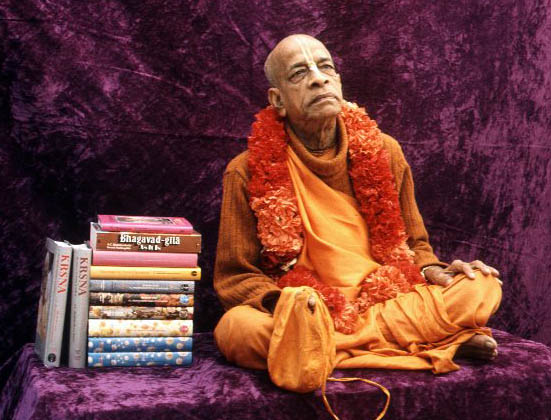
In ISKCON we hear devotees say “Books are the basis.” Śrīla Prabhupāda himself used this phrase in a letter to Maṇḍali Bhadra Dāsa dated January 20, 1972: “My first concern is that my books shall be published and distributed profusely all over the world. Practically, books are the basis of our movement. Without them our preaching has no effect.” He uses it again in a letter to Tuṣṭa Kṛṣṇa Swami (January 9, 1976): “Books are the basis of our movement. Whatever appreciation we are getting on account of our books, it is because we are following the path chalked out by exalted devotees.”
So what does it mean that Śrīla Prabhupāda’s books are the foundation – the basis – of ISKCON? We can begin to understand by reading the letter Śrīla Prabhupāda wrote to Dāmodara Dāsa on December 3, 1971:
I’m especially pleased to hear that your distribution of our books and magazines has increased. Go on in this way, increasing more and more. Each time someone reads some solid information about Kṛṣṇa his life becomes changed in some way. These literatures are the solid ground upon which our preaching stands, so I want that they should be available to everyone, as many as possible. So please try for this.
I saw this posted on Facebook, and thought we would share it here with all of you. In this article by Locan Ananda Prabhu, he again makes the argument for Arsa-prayoga, or no change.
Srila Prabhupada was recognized as a great Sanskrit scholar. His depth of knowledge was unfathomable. Not a single word of his should have been changed. That policy is called arsa-prayoga, and it guarantees that the spiritual head of our institution should never be dishonored by changing his words.
THE ROD OF CHASTISEMENT IS GONE!!!
by Locan Ananda Dasa
One of my favorite verses in the Bhagavad-Gita As It Is
was once found in Chapter 10, verse 38:
“Among punishments I am the rod of chastisement, and of those who seek victory, I am morality. Of secret things I am silence, and of the wise I am wisdom.” (B.g. 10.38, original)
Chapter 10 is entitled, “The Opulence of the Absolute” wherein Krishna enumerates some of His extraordinarily splendorous manifestations. On August 12, 1976, Srila Prabhupada was having an evening darshan in Tehran, the capital and largest city in Iran. He was talking about how ordinary people know little about the greatness of God. “They say, ‘God is great,’ but how great? That they do not know.” Srila Prabhupada then asked his secretary at the time, Harikesa dasa, to read selected verses from the Bhagavad-Gita, beginning with Chapter 10, verse 20:
“I am the Self, O Gudakesa, seated in the hearts of all creatures. I am the beginning, the middle and the end of all beings.” (B.g. 10.20)
Harikesa prabhu continued to read through the verses that followed, the chapter ending with verse 42:
“But what need is there, Arjuna, for all this detailed knowledge. With a single fragment of Myself I pervade and support this entire universe.” (B.g. 10.42)
When he finished the reading, Srila Prabhupada said, “That’s it. This is greatness. So we should not simply be satisfied ‘God is great.’ We must try to know how great He is. Then our God consciousness will be fixed up. It’s all right?”
‘Beyond Birth and Death’ is one of my favorite small books written by His Divine Grace A. C. Bhaktivedanta Swami. The first chapter is a good introduction to the philosophy of Krishna Consciousness. We have included the entire first chapter for those interested.
We Are Not These Bodies
(Chapter One from Beyond Birth & Death)
The very first step in self-realization is realizing one’s identity as separate from the body. “I am not this body but am spirit soul” is an essential realization for anyone who wants to transcend death and enter into the spiritual world beyond. It is not simply a matter of saying “I am not this body,” but of actually realizing it. This is not as simple as it may seem at first. Although we are not these bodies but are pure consciousness, somehow or other we have become encased within the bodily dress. If we actually want the happiness and independence that transcend death, we have to establish ourselves and remain in our constitutional position as pure consciousness.
“O descendant of Bharata, he who dwells in the body is eternal and can never be slain. Therefore you need not grieve for any creature.” (Bhagavad-gita 2.30)
Living in the bodily conception, our idea of happiness is like that of a man in delirium. Some philosophers claim that this delirious condition of bodily identification should be cured by abstaining from all action. Because these material activities have been a source of distress for us, they claim that we should actually stop these activities. Their culmination of perfection is in a kind of Buddhistic nirvāṇa, in which no activities are performed. Buddha maintained that due to a combination of material elements, this body has come into existence, and that somehow or other if these material elements are separated or dismantled, the cause of suffering is removed. If the tax collectors give us too much difficulty because we happen to possess a large house, one simple solution is to destroy the house. However, Bhagavad-gītā indicates that this material body is not all in all. Beyond this combination of material elements, there is spirit, and the symptom of that spirit is consciousness.
I was looking through my notebooks the other day, and I happened to find my very first devotee journal. I had written that there are six principles favorable to the execution of pure devotional service. And six activities that can spoil ones devotional service.This was a good reminder.
There are six principles favorable to the execution of pure devotional service:
(1) being enthusiastic,
(2) endeavoring with confidence,
(3) being patient,
(4) acting according to regulative principles [such as śravaṇaṁ kīrtanaṁ viṣṇoḥ smaraṇam (SB 7.5.23) — hearing, chanting and remembering Kṛṣṇa],
(5) abandoning the association of nondevotees, and
(6) following in the footsteps of the previous ācāryas.
These six principles undoubtedly assure the complete success of pure devotional service.
And the six activities that can spoil ones devotional service:
(1) Overeating or collecting more than needed
(2) Over endeavoring for mundane things
(3) talking unnecessarily about mundane subject matters
(4) Practicing the spiritual rules and regulations only for the sake of following them, or rejecting them and acting whimsically
(5) Associating with worldly minded persons who are not interested in Krsna consciousness
(6) Being greedy for mundane achievements
These were taken from The Nectar of Instruction and The Narada Bhakti Sutra
I find it interesting, how one morning, I will wake up and find it very easy and pleasing to chant Hare Krishna and preform my devotional activities, and the next day I find it difficult? I realized that it due to the influence of the three modes of material nature.
…Everyone should know that a living entity is eternally a servant and that unless one serves Krsna one has to serve illusion in different varieties of the three modes of material nature. (from Preface to Bhagavad-gita As It Is)
…In the Bhagavad-gita it is clearly explained that there are three kinds of activities according to the different modes of nature: the activities of goodness, of passion and of ignorance. (from Introduction to Bhagavad-gita As It Is)
The three modes of material nature is an important topic, so much so , that there is an entire chapter dedicated to it in the Bhagavad-gita.
Material nature consists of the three modes—goodness, passion and ignorance. When the living entity comes in contact with nature, he becomes conditioned by these modes. (Bg. 14.5)
PURPORT
The living entity, because he is transcendental, has nothing to do with this material nature. Still, because he has become conditioned by the material world, he is acting under the spell of the three modes of material nature. Because living entities have different kinds of bodies, in terms of the different aspects of nature, they are induced to act according to that nature. This is the cause of the varieties of happiness and distress.
This tells me, that I am not yet transcendental to the three modes, and I still have plenty of work to do.
We share with you a description of the three modes as outlined in chapter 14 of the Bhagavad-gita.
This morning I came downstairs and I saw on the kitchen counter, a small note left by my wife. It simply said “Happy Fathers Day”, and there was this quote by Srila Prabhupada:
“Please continue to engage yourself in Krishna’s service very sincerely and I am sure Krishna will help you in all ways to advance more and more. I am always praying that Krishna will give you strength to continue”. (Srila Prabhupada)
This small Fathers Day note got me thinking about Fathers. There is my biological father, then there is my Spiritual Father, Srila Prabhupada, and then there is the Supreme Father of us all, Krishna.
I found a few quotes From Srila Prabhupada’s books on our Surpreme Father Krishna:
Kṛṣṇa is very much anxious to take us back home, back to Godhead, but we are stubborn and do not wish to go. Therefore He is always looking for the opportunity to take us back home. He is just like an affectionate father.When a son who is a rascal leaves his father and goes loitering in the street, with no food and no shelter, and suffers very much, the father is always anxious to bring the boy back home. Similarly, Kṛṣṇa is the supreme father, and all the living entities within this material world are exactly like misled children of a wealthy man who have left home to loiter in the street. Therefore the greatest benefit one can bestow upon one’s fellow human being is to give him Kṛṣṇa consciousness. No kind of material profit will satisfy the living entity, but if he is given Kṛṣṇa consciousness he will actually be satisfied. A bewildered boy loitering in the street may be reminded, “My dear boy, why are you suffering so much? You are the son of a very rich man who has so much property. Why are you loitering in the street?” And if he comes to understand, “Yes, I am the son of this important man. Why shall I loiter in the street?” he may then return home. Therefore the best service is to inform those who have forgotten Kṛṣṇa, “You are part and parcel of Kṛṣṇa. You are the son of Kṛṣṇa, who is full in all opulence. Why are you rotting in this material world?” This is the greatest service. Māyā, illusion, is very strong, but it is the duty of every devotee of Kṛṣṇa to try to enlighten everyone to Kṛṣṇa consciousness. Kuntīdevī, for example, first said that although Kṛṣṇa, the Supreme Person, is within and without, to rascals and fools He is invisible. Therefore she points out, “Here is the Lord – Kṛṣṇa.” ( “Teachings of Queen Kunti”)
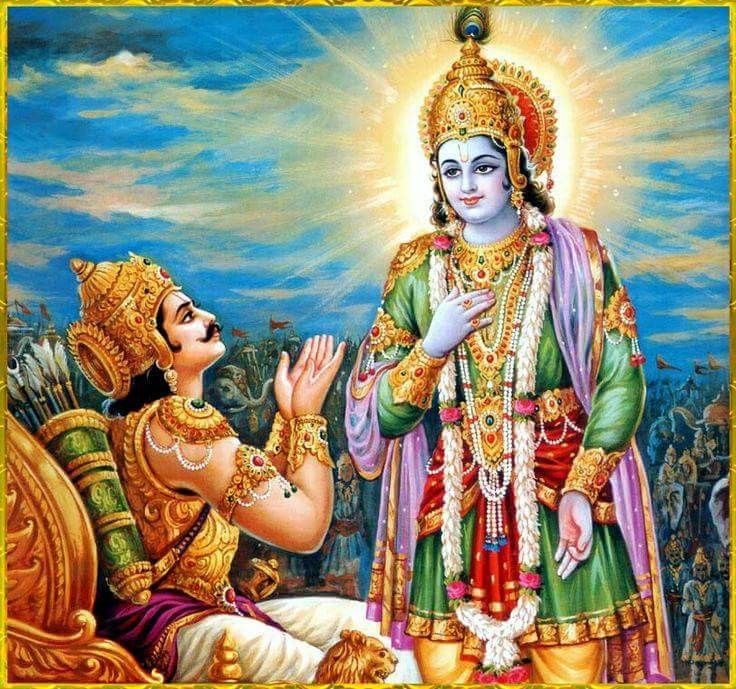
I have often pondered this question that Arjuna asks Krishna:
Arjuna said: O descendant of Vṛṣṇi, by what is one impelled to sinful acts, even unwillingly, as if engaged by force? (Bg. 3.36)
And Krishna answers:
The Blessed Lord said: It is lust only, Arjuna, which is born of contact with the material modes of passion and later transformed into wrath, and which is the all-devouring, sinful enemy of this world. (Bg. 3.37)
A living entity, as part and parcel of the Supreme, is originally spiritual, pure, and free from all material contaminations. Therefore, by nature he is not subjected to the sins of the material world. But when he is in contact with the material nature, he acts in many sinful ways without hesitation, and sometimes even against his will. As such, Arjuna’s question to Kṛṣṇa is very sanguine, as to the perverted nature of the living entities. Although the living entity sometimes does not want to act in sin, he is still forced to act. Sinful actions are not, however, impelled by the Supersoul within, but are due to another cause, as the Lord explains in the next verse. (from purport)
further explained:
…When a living entity comes in contact with the material creation, his eternal love for Kṛṣṇa is transformed into lust, in association with the mode of passion.
…Therefore, lust is the greatest enemy of the living entity, and it is lust only which induces the pure living entity to remain entangled in the material world.
Bhakti yoga is loosely defined as the yoga of Love and Devotion, and sometimes referred to as the “Yoga of the Heart”. But how do we practice it?
Actually it is very easy, and can be practiced anywhere 24/7, and doesn’t require a silent place or yoga mat. There are nine methods and they begin with hearing. When we hear or read about the Lord, we can simply think about the transcendental holy name, form, qualities, paraphernalia and pastimes of Lord Viṣṇu, We can chant the maha-mantra; Hare Krsna, Hare Krsna, Krsna Krsna, Hare Hare, Hare Rama, Hare Rama, Rama Rama, Hare Hare, anytime, any place, silently or out loud. (I like to softly chant with my breath). Just remembering the Lord in our daily activities is another way of practicing Bhakti yoga. There are nine processes in all, of practicing, and any one or all can lead to the path of perfection.
The Nine Processes of Devotional Service are described by Prahlada Maharaja in the 7th Canto of the Srimad Bhagavatam, chapter 5, text 24-25.
Prahlāda Mahārāja said: Hearing and chanting about the transcendental holy name, form, qualities, paraphernalia and pastimes of Lord Viṣṇu, remembering them, serving the lotus feet of the Lord, offering the Lord respectful worship with sixteen types of paraphernalia, offering prayers to the Lord, becoming His servant, considering the Lord one’s best friend, and surrendering everything unto Him (in other words, serving Him with the body, mind and words)—these nine processes are accepted as pure devotional service. One who has dedicated his life to the service of Kṛṣṇa through these nine methods should be understood to be the most learned person, for he has acquired complete knowledge. (SB 7.5.24-25)
The great personalities who attained perfection by practice of the nine processes are listed below
…While Kṛṣṇa was engaged in tending the cows in the forest of Vṛndāvana or on Govardhana Hill, the gopīs in the village were always absorbed in thinking of Him and discussing His different pastimes. This is the perfect example of Kṛṣṇa consciousness: to somehow or other remain always engrossed in thoughts of Kṛṣṇa. The vivid example is always present in the behavior of the gopīs; therefore Lord Caitanya declared that no one can worship the Supreme Lord by any method which is better than the method of the gopīs. The gopīs were not born in very high brāhmaṇa or kṣatriya families; they were born in the families of vaiśyas, and not in big mercantile communities but in the families of cowherd men. They were not very well educated, although they heard all sorts of knowledge from the brāhmaṇas, the authorities of Vedic knowledge. The gopīs’ only purpose was to remain always absorbed in thoughts of Kṛṣṇa.
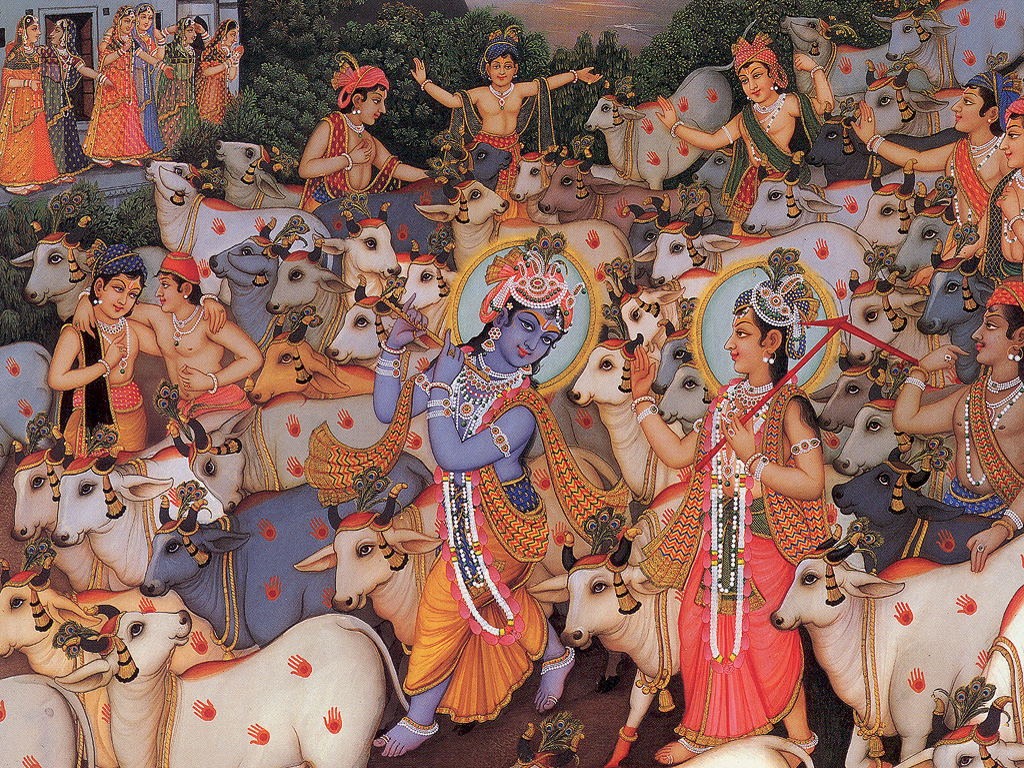
Kṛṣṇa was very pleased with the atmosphere of the forest where flowers bloomed and bees and drones hummed very jubilantly. While the birds, trees and branches were all looking very happy, Kṛṣṇa, tending the cows, accompanied by Śrī Balarāma and the cowherd boys, began to vibrate His transcendental flute. After hearing the vibration of the flute of Kṛṣṇa, the gopīs in Vṛndāvana remembered Him and began to talk amongst themselves about how nicely Kṛṣṇa was playing His flute. When the gopīs were describing the sweet vibration of Kṛṣṇa’s flute, they also remembered their pastimes with Him; thus their minds became disturbed, and they were unable to describe completely the beautiful vibrations. While discussing the transcendental vibration, they remembered also how Kṛṣṇa dressed, decorated with a peacock feather on His head, just like a dancing actor, and with blue flowers pushed over His ear. His garment glowed yellow-gold, and He was garlanded with a vaijayantī necklace. Dressed in such an attractive way, Kṛṣṇa filled up the holes of His flute with the nectar emanating from His lips. So they remembered Him, entering the forest of Vṛndāvana, which is always glorified by the footprints of Kṛṣṇa and His companions. Kṛṣṇa was very expert in playing the flute, and the gopīs were captivated by the sound vibration, which was not only attractive to them, but to all living creatures who heard it. One of the gopīs told her friends, “The highest perfection of the eyes is to see Kṛṣṇa and Balarāma entering the forest and playing Their flutes and tending the cows with Their friends.”
Persons who are constantly engaged in the transcendental meditation of seeing Kṛṣṇa, internally and externally, by thinking of Him playing the flute and entering the Vṛndāvana forest, have really attained the perfection of samādhi. Samādhi (trance) means absorption of all the activities of the senses on a particular object, and the gopīs indicate that the pastimes of Kṛṣṇa are the perfection of all meditation and samādhi. It is also confirmed in the Bhagavad-gītā that anyone who is always absorbed in the thought of Kṛṣṇa is the topmost of all yogīs. (KRSNA The Supreme Personality of Godhead, Vol 1, Chapter 21)