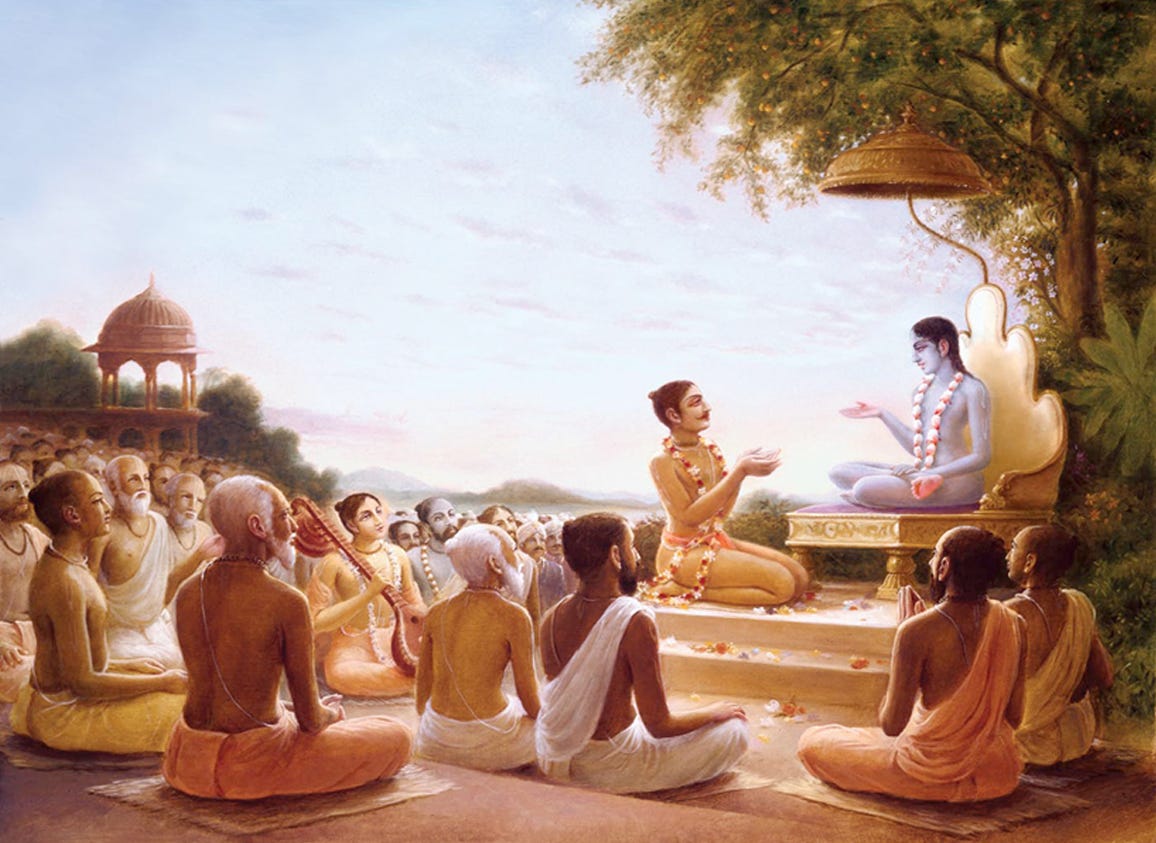
As I was reading from the Srimad Bhagavatam this morning about the passing of Bhīṣmadeva it was being described how “The perfect yogīs or mystics can leave the material body at their own sweet will at a suitable time and go to a suitable planet desired by them.” And how it is possiable to go beyond Saṁsāra, and go back to Godhead without any doubt?
…In the momentous hour of leaving his material body, Bhīṣmadeva set the glorious example concerning the important function of the human form of life. The subject matter which attracts the dying man becomes the beginning of his next life. Therefore, if one is absorbed in thoughts of the Supreme Lord Śrī Kṛṣṇa, he is sure to go back to Godhead without any doubt.
And what is Samsara?
Saṁsāra means material existence. That is called saṁsāra. Bhūtvā bhūtvā pralīyate (BG 8.19). You take your birth once in some form of body. You live for some time. Then you have to give up this body. Then you have to accept another body. Then again live for some time. Then give up that body. Again accept another body. In this way, it is going on. That is called saṁsāra, rotating within this material world. (Lecture on Gurvastakam at Upsala University by His Divine Grace -Stockholm, September 9, 1973)
The saṁsāra means repetition of different bodies. That is called saṁsāra. (Lecture on SB 1.2.4 -Rome, May 28, 1974)
Saṁsāra means this material entanglement. This is called saṁsāra. (Lecture on CC Madhya-lila 25.40-50 – San Francisco, January 24, 1967)
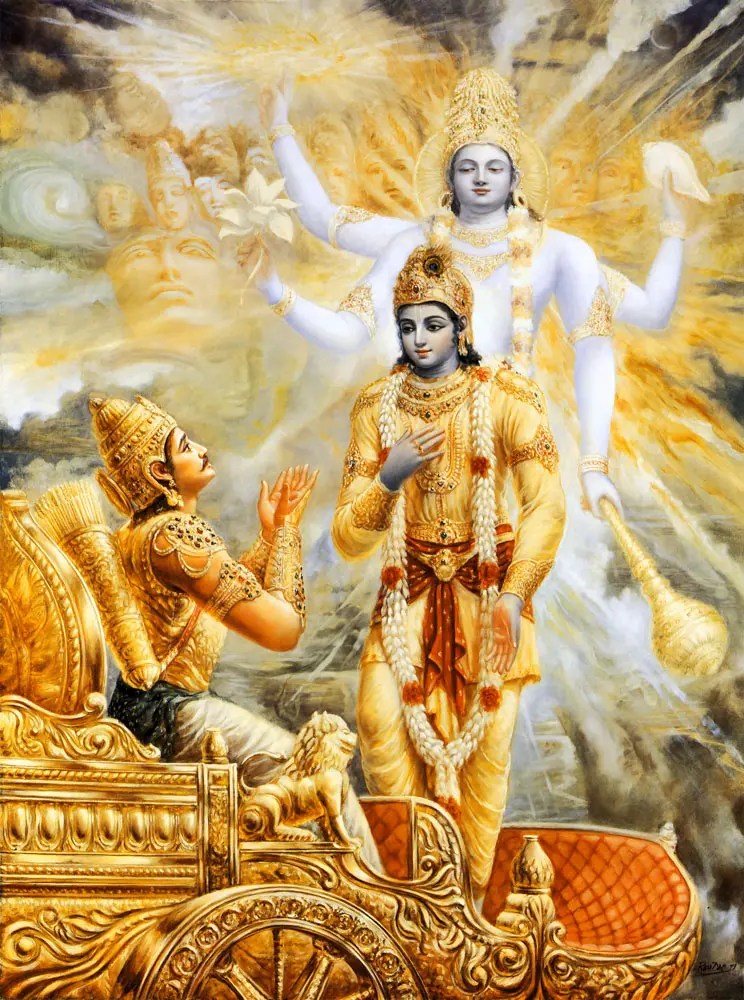
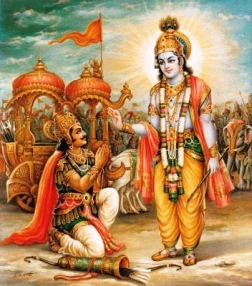
Last night I woke in the middle of the night , and couldn’t fall back asleep. While laying there, my mind just kinda went to thoughts of Krishna and Arjuna. Arjuna accepted Krishna as his spiritual master with these famous words from the Bhagavad-gita:
O Kṛṣṇa, I totally accept as truth all that You have told me. Neither the gods nor demons, O Lord, know Thy personality. (Bg 10.14)
This lead me to think of our relationship with our spiritual master His Divine Grace A. C. Bhaktivedanta Swami Prabhupada. And I came to the same conclusion as Arjuna. “I totally accept as truth all that You have told me“.
So I was thinking of our unique relationship with Srila Prabhupada. “Neither the gods nor demons, O Lord, know Thy personality”.Maybe the whole world outside of the circle of disciples and followers of His Divine Grace, cannot know his greatness and divine personality, but as disciples and followers, we can began to understand. Our relationship with Srila Prabhupada is much like that relationship between Krishna and Arjuna.
With that last thought, I fell back asleep, reflecting on Srila Prabhupada. -V
I thought I knew about all of Srila Prabhupada’s books, but this one has somehow escaped my attention until this morning. I am looking forward to reading it, and we thought I should share it with all of you. So we have included the entire book in this post. Hare Krishna!
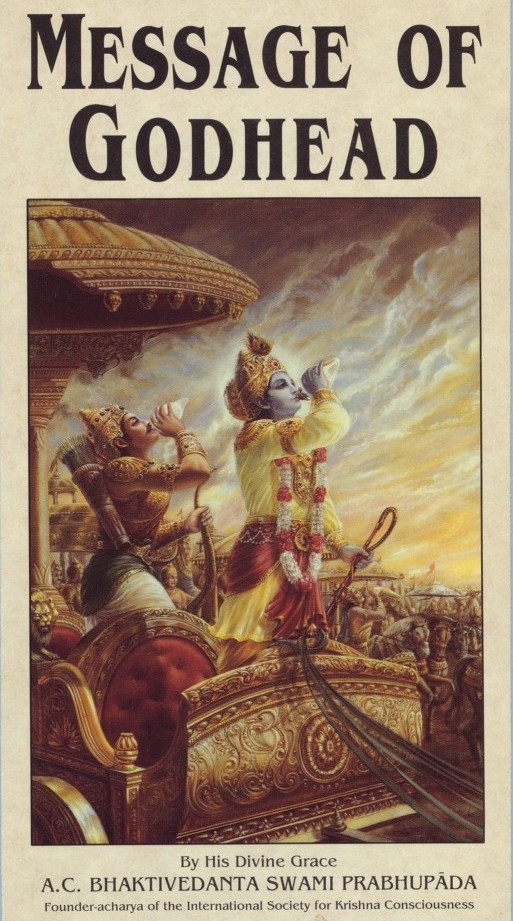
” Message of Godhead” is a short introductory book on Krishna consciousness written by His Divine Grace in the 1950’s and first published by the BBT in 1990.
Message of Godhead
by His Divine Grace A. C. Bhaktivedanta Swami Prabhupada
Introduction
At present, we are concerned primarily with two things: one, ourselves; and the other, the place where we live. In other words, we are concerned with two objects: namely, everything that is related to our gross and subtle bodies; and the world at large, with all its paraphernalia. But there are others above us, the transcendentalists, who are concerned not only with their body and mind and the world at large, but also with the transcendental subject that is above the body and mind and the world at large. The transcendentalists are very much concerned with the Absolute Truth, and much less with relative truths.
These transcendentalists (ordinarily known as saints, philosophers, reformers, messengers, and so forth) appear in various places in the world at various times. They render transcendental service to the Absolute Truth and to humanity, also, by preaching the message of the transcendental world. According to these transcendentalists, even lower animals like cats and dogs are also concerned primarily with two things, namely, themselves and the world at large. Living entities other than human beings have no capacity to understand transcendental subjects. The human being is therefore considered to be the highest of all creations, and we must understand the nature of this higher standing.
When man, who is the highest of all created beings, is fully developed in consciousness, he concerns himself not only with his own self and the world where he lives, but he tries to understand the Absolute Truth. The Absolute Truth regulates man as well as the world, and knowing Him, the transcendentalist regulates his activities on the right path. This regulating process is commonly known as a system of faith or religion. All over the civilized world we find some process or form of religion – when man is devoid of any such religion or of transcendental traits, he is nothing but a beast. This subject matter, which the religionists delineate according to different countries, times, and people, is more or less aimed at the objective of the Absolute Truth.
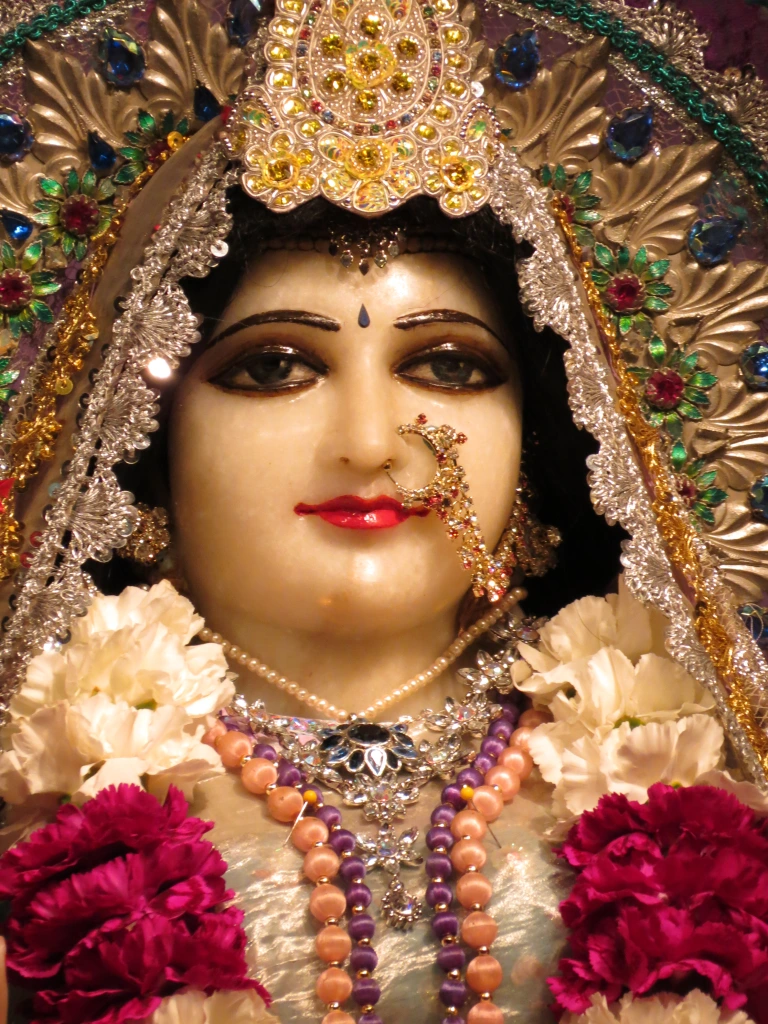
Srimati Radharani has twenty-five transcendental qualities. Her transcendental qualities are as follows:
1. She is sweetness personified2. She is a fresh young girl 3. Her eyes are always moving 4. She is always brightly smiling 5. She possesses all auspicious marks on her body 6. She can agitate Krishna by the flavor of Her person 7. She is expert in the art of singing 8. She can speak very nicely and sweetly 9. She is expert in presenting feminine attractions 10. She is modest and gentle 11. She is always very merciful 12. She is transcendentally cunning 13. She knows how to dress nicely 14. She is always shy 15. She is always respectful 16. She is always patient 17. She is very grave 18. She is enjoyed by Krishna 19. She is situated on the highest devotional platform 20. She is the abode of love of the residents of Gokula 21. She can give shelter to all kinds of devotees 22. She is always affectionate to superiors and inferiors 23. She is always obliged by the dealings of Her associates 24. She is the greatest amongst Krishna’s girlfriends 25. She always keeps Krishna under Her control
The strangest thing happened this morning. While I was chanting my japa, I guess I was a little distracted because I was thinking about work, and the following verse from the Srimad Bhagavatam just popped into my head. I was trying to remember where this verse was…I was pretty sure it was in the First Canto…so I took the first canto off the shelf and just randomly opened it. And to my great surprise, it opened to the exact verse I was thinking about.
The supreme occupation [dharma] for all humanity is that by which men can attain to loving devotional service unto the transcendent Lord. Such devotional service must be unmotivated and uninterrupted to completely satisfy the self. (Srimad Bhagavatam 1.2.6)
These original books by Srila Prabhupada are definitely transcendental.
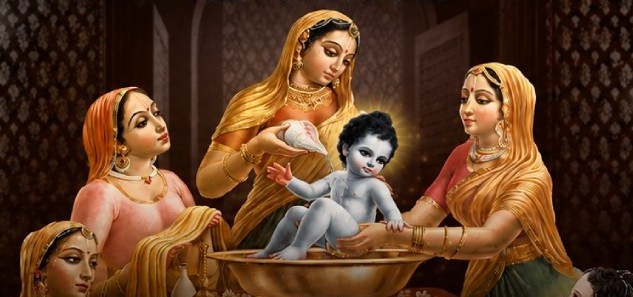
Today we celebrate the Appearance of Lord Krishna (Janmastami) with a full day fast, untill midnight.Lord Krishna’s birth is commemorated at midnight with devotional songs (bhajans), followed bya small ekadasi vegetarian feast.
Janmashtami means the celebration of the birth of Lord Krishna, derived from the Sanskrit words “janma” (birth) and “ashtami” (the eighth day)
On this day we like to read from the Krsna Book, so we have included an excerpt from the Krsna book, chapter 5 entitled “Meeting of Nanda and Vasudeva”.
KRSNA The Supreme Personality of Godhead
By His Divne Grace A. C. Bhaktivedanta Swami Prabhupada
Although Kṛṣṇa was the real son of Vasudeva and Devakī, because of Kaṁsa’s atrocious activities Vasudeva could not enjoy the birth ceremony of his son. But Nanda Mahārāja, the foster father, celebrated the birth ceremony of Kṛṣṇa very joyfully. The next day, it was declared that a male child was born of Yaśodā. According to Vedic custom, Nanda Mahārāja called for learned astrologers and brāhmaṇas to perform the birth ceremony. After the birth of a child, the astrologers calculate the moment of the birth and make a horoscope of the child’s future life. Another ceremony takes place after the birth of the child: the family members take baths, cleanse themselves and decorate themselves with ornaments and garlands; then they come before the child and the astrologer to hear of the future life of the child. Nanda Mahārāja and other members of the family dressed and sat down in front of the birth place. All the brāhmaṇas who were assembled there on this occasion chanted auspicious mantras, according to the rituals, while the astrologers performed the birth ceremony. All the demigods are also worshiped on this occasion, as well as the forefathers of the family. Nanda Mahārāja distributed 200,000 well decorated, dressed and ornamented cows to the brāhmaṇas. He not only gave cows in charity, but hills of grains, decorated with golden-bordered garments and many ornaments.
I have been going back and re-discovering some of the early articles in “Back to Godhead Magizine”. I am remembering how inspired I woud be each month, as another issue of BTG was released for distribution.
Lord Caitanya’s Mission and Precepts
Excerpted from ‘Back To Godhead’ Magazine, 1973 Vol. 1, No. 49 & 50a
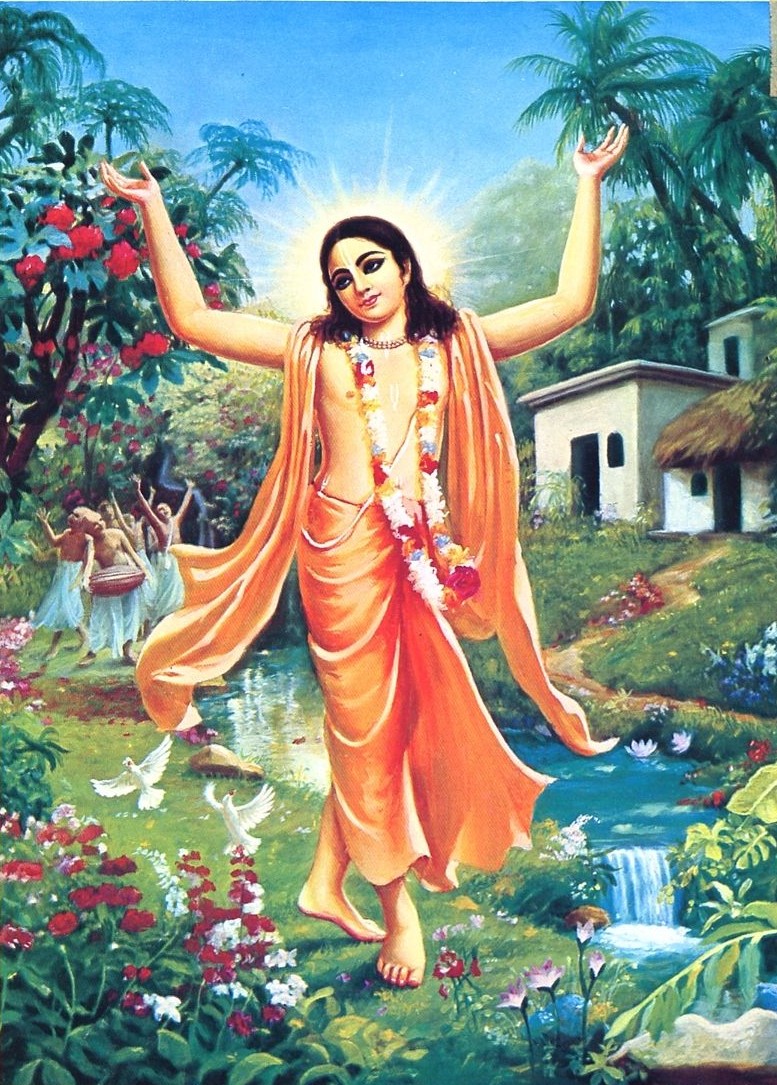
As foretold in Vedic scriptures, the Supreme Personality of Godhead appeared on earth 500 years ago in the form of Lord Caitanya, who is God Himself playing the role of a devotee of Godhead. The eight verses entitled Sri Sri Siksastakam, which were the only written instructions of Lord Caitanya, reveal the essence of the Krsna consciousness movement.
Sri Sri Siksastakam by Sri Krsna Caitanya Mahaprabhu
translated by His Divine Grace A.C. Bhaktivedanta Swami Prabhupada with purports by His Holiness Subaldasa Svami
Glory to the Sri Krsna sankirtana, which cleanses the heart of all the dust accumulated for years and extinguishes the fire of conditional life, of repeated birth and death. This sankirtana movement is the prime benediction for humanity at large because it spreads the rays of the benediction moon. It is the life of all transcendental knowledge. It increases the ocean of transcendental bliss, and it enables us to fully taste the nectar for which we are always anxious.
Purport
The conditioned soul is covered from time immemorial by the dirt of the accumulated reactions of his sinful activities. Due to the reactions of his past sins, he becomes further engaged in sinful activities and becomes more and more forgetful of his constitutional position as part and parcel of the Supreme Lord Sri Krsna. Due to forgetfulness of his spiritual nature, he identifies himself with the temporary material body and its paraphernalia. Thus, rather than serving Krsna in loving devotion, he is forced to serve maya, the limited mundane potency of the Lord. The living being is never independent in any stage of existence, either conditioned or liberated, but when he is under the control of maya he suffers, and when he is under the control of Krsna he enjoys life in the association of the Lord and His devotees.
The Sri Krsna sankirtana, or the congregational chanting of the holy names of God, is able to immediately cleanse the heart of all the dirt that accumulates there for millions of years. This is the result of just the dim reflection of the holy name. During the night, there is fear of thieves, ghosts, murderers, etc. In the morning, before the sun even rises on the horizon, it dispels all such fears by its first rays of light. In the same way, before the holy name makes its full appearance, it dispels the darkness of material ignorance and clears away heaps of sinful activities which have not yet manifested themselves. Thus one is freed from karmic reaction and placed on the liberated platform of life. In this way, the door to devotional service is opened.
The Following is an excerpt from “Our Family Business”
By His Grace Vaisesika Dasa,
In ISKCON we hear devotees say “Books are the basis.” Śrīla Prabhupāda himself used this phrase in a letter to Maṇḍali Bhadra Dāsa dated January 20, 1972: “My first concern is that my books shall be published and distributed profusely all over the world. Practically, books are the basis of our movement. Without them our preaching has no effect.” He uses it again in a letter to Tuṣṭa Kṛṣṇa Swami (January 9, 1976): “Books are the basis of our movement. Whatever appreciation we are getting on account of our books, it is because we are following the path chalked out by exalted devotees.”
So what does it mean that Śrīla Prabhupāda’s books are the foundation – the basis – of ISKCON? We can begin to understand by reading the letter Śrīla Prabhupāda wrote to Dāmodara Dāsa on December 3, 1971:
I’m especially pleased to hear that your distribution of our books and magazines has increased. Go on in this way, increasing more and more. Each time someone reads some solid information about Kṛṣṇa his life becomes changed in some way. These literatures are the solid ground upon which our preaching stands, so I want that they should be available to everyone, as many as possible. So please try for this.
‘Beyond Birth and Death’ is one of my favorite small books written by His Divine Grace A. C. Bhaktivedanta Swami. The first chapter is a good introduction to the philosophy of Krishna Consciousness. We have included the entire first chapter for those interested.
We Are Not These Bodies
(Chapter One from Beyond Birth & Death)
The very first step in self-realization is realizing one’s identity as separate from the body. “I am not this body but am spirit soul” is an essential realization for anyone who wants to transcend death and enter into the spiritual world beyond. It is not simply a matter of saying “I am not this body,” but of actually realizing it. This is not as simple as it may seem at first. Although we are not these bodies but are pure consciousness, somehow or other we have become encased within the bodily dress. If we actually want the happiness and independence that transcend death, we have to establish ourselves and remain in our constitutional position as pure consciousness.
“O descendant of Bharata, he who dwells in the body is eternal and can never be slain. Therefore you need not grieve for any creature.” (Bhagavad-gita 2.30)
Living in the bodily conception, our idea of happiness is like that of a man in delirium. Some philosophers claim that this delirious condition of bodily identification should be cured by abstaining from all action. Because these material activities have been a source of distress for us, they claim that we should actually stop these activities. Their culmination of perfection is in a kind of Buddhistic nirvāṇa, in which no activities are performed. Buddha maintained that due to a combination of material elements, this body has come into existence, and that somehow or other if these material elements are separated or dismantled, the cause of suffering is removed. If the tax collectors give us too much difficulty because we happen to possess a large house, one simple solution is to destroy the house. However, Bhagavad-gītā indicates that this material body is not all in all. Beyond this combination of material elements, there is spirit, and the symptom of that spirit is consciousness.
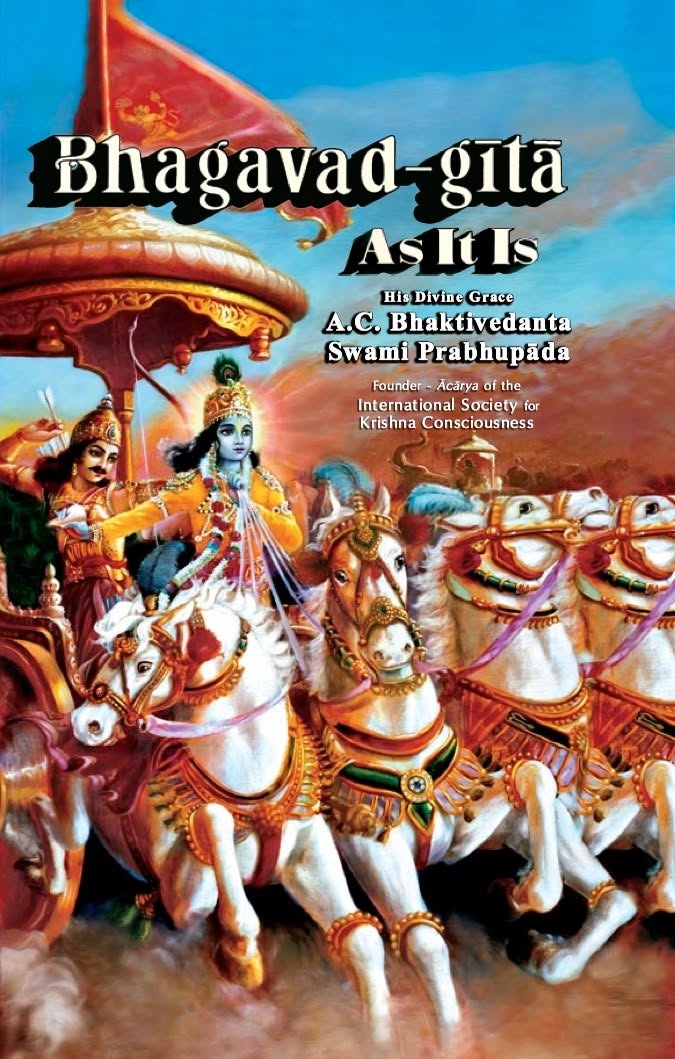
…One issue that many find shocking is the extent to which Srila Prabhupada’s Bhagavad-gita As It Is was edited without having been authorized by His Divine Grace, Srila Prabhupada. He was never a fan of extensive editing of any of his published works. What’s more, the over-edited edition published in 1983 removed thirty-two color pages that Srila Prabhupada insisted be included in his great opus. Three of those eliminated color pages were of the predecessor acaryas, namely Srila Bhaktisiddhanta Saraswati Thakur, Srila Gaura Kishora Das Babaji Maharaja and Srila Thakur Bhaktivinode.
Even the pocket Gita printed in India included all of the color plates found in the Macmillan edition.
If you are just hearing about this for the first time, please contact the GBC representative in your area and humbly request that this offense be rectified with the next printing. Doing so will attract Srila Prabhupada’s blessings. Do not fear when the cause is just.
A CRISIS IN LEADERSHIP
by Locan Ananda dasa
Many followers of Srila Prabhupada’s teachings have been calling for the worldwide reformation of the leadership of the International Society for Krishna Consciousness. The charge being made is that leaders and managers need to adhere more closely to the specific instructions of our Founder Acarya. There should be greater vigilance and the immediate correction of inappropriate behavior on the part of errant leaders.
The great mistake of modern civilization is to encroach upon others’ property as though it were one’s own and thereby create an unnecessary disturbance of the laws of nature.
We are witnessing a world in turmoil right now, with nations at war with each other. And I am reminded of the peace formula that Srila Prabhupada has given us. He first presented the peace formula in an early edition of Back to Godhead Magazine, then in the Bhagavad-gita, and it appeared in many small books and pamphlets. We share with you today, a sampling of the peace formula in some of the early small books.
“A person in full consciousness of Me, knowing Me to be the ultimate beneficiary of all sacrifices and austerities, the Supreme Lord of all planets and demigods, and the benefactor and well-wisher of all living entities, attains peace from the pangs of material miseries.” (Bhagavad-gita 5.29)
The politicians and diplomats are trying to establish peace in the world. We have the United Nations and many other organizations. They are working to establish real peace and tranquillity, to eliminate misunderstanding between man and man and nation and nation. But that is not happening. The defect is that the root is wrong. Everyone is thinking, “It is my country,” “It is my family,” “It is my society,” “It is my property.” This “my” is illusion. This “I-and-my” philosophy is māyā-illusion.
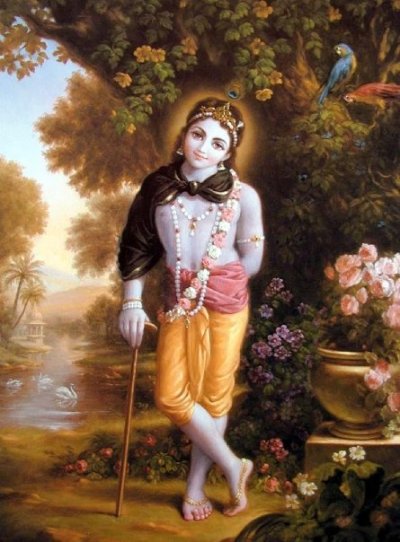
“My dear friend, there is one boy – His name is Govinda. He is standing on the bank of the Yamunā near the Keśi-ghāṭa, and He is playing on His flute. He is so beautiful, especially during this full-moon night. If you have any intentions to enjoy in this material world with your children, husband, or other family members, then please do not go there.”
The Vedic literature is unique among all the world’s scriptures because it details a practical process by which anyone can purify his or her consciousness and see God face to face. In a lecture, delivered in Los Angeles on August 15, 1972, Śrīla Prabhupāda explains, “One must actually be very eager to see God…. One must be very serious and think, ‘Yes, I have been informed about God. So if there is a God, I must see Him.'”
Excerpts from Lecture Los Angeles on August 15, 1972
Yesterday we shared with you the first printing of Srila Prabhupada’s epic translations of the Srimad Bhagavatam, and today we share with you his last.
For a Free PDF download of this special volume click on following link; SB-10-03-1980
Śrīmad-Bhāgavatam By His Divine Grace A.C. Bhaktivedanta Swami Prabhupada Tenth Canto, Part Three
Foward
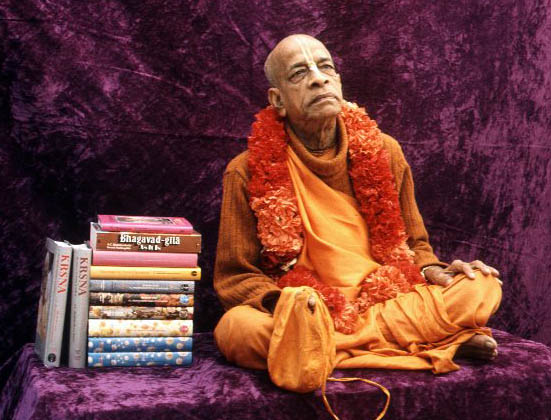
This is the final Śrīmad-Bhāgavatam volume translated by His Divine Grace A. C. Bhaktivedanta Swami Prabhupada, founder-acarya of the International Society for Krishna Consciousness. It is smaller than the earlier volumes because it ends where the renowned author stopped translating just before his departure from this mortal world on November 14, 1977, at the Krsna-Balarama Mandira in Vrndavana, India.
The first part of this volume was produced in the usual fashion. Srila Prabhupada would sit and read silently from the Sanskrit text and then speak the translation and commentary into his dictaphone. Later, due to illness, it became necessary for his disciples to assist him personally.
In these last days Srila Prabhupada was gravely ill. Unable to eat for weeks, his health had deteriorated, making even the slightest movement excruciatingly painful.
As he lay still, a devotee would softly read the Sanskrit to him. Another disciple, sitting on his bed, held the microphone to him, nearly touching his mouth. And then Srila Prabhupada would speak, voice sometimes barely audible.
These recordings, made in his quarters at the temple, constitute the balance of this book.
In these final moments, the physician attending His Divine Grace confided that an ordinary man in such critical condition would have been crying out from the intense pain. Srila Prabhupada’s disciples were awestruck as they watched their spiritual master work quietly, undisturbed.
In the last part of the book we find Srila Prabhupada’s usual clarity of thought, constant scriptural references, scrupulous attention to detail, and rigorous philosophical exposition fully intact, just as they were in the preceding twenty-nine volumes of the Śrīmad-Bhāgavatam.
Srila Prabhpada’s last days and this translation will stands an inspiring reminder that even the severest material circumstances cannot impede the activities of a pure devotee of the Supreme Personality of Godhead.
People often view this Krishna Consciousness Movement as a Hindu Religion. But it is not. Although it is attracting people of the Hindu faith, it is also attracting people from the all of the worlds faiths. It is the philosophy and science of God.
The Krishna consciousness movement has nothing to do with the Hindu religion or any system of religion.
“The ultimate goal of this movement is to educate people in how to love God. Caitanya Mahaprabhu approves the conclusion that the highest perfection of human life is to learn how to love God. The Krishna consciousness movement has nothing to do with the Hindu religion or any system of religion. No Christian gentleman will be interested in changing his faith from Christian to Hindu. Similarly, no Hindu gentleman of culture will be ready to change to the Christian faith. Such changing is for men who have no particular social status. But everyone will be interested in understanding the philosophy and science of God and taking it seriously. One should clearly understand that the Krishna consciousness movement is not preaching the so-called Hindu religion. We are giving a spiritual culture that can solve all the problems of life, and therefore it is being accepted all over the world.״ (Srila Prabhupada from Science of Self Realization.)
Our mission is to promote spiritual culture, not to protect Hindu dharma.
This morning I came downstairs and I saw on the kitchen counter, a small note left by my wife. It simply said “Happy Fathers Day”, and there was this quote by Srila Prabhupada:
“Please continue to engage yourself in Krishna’s service very sincerely and I am sure Krishna will help you in all ways to advance more and more. I am always praying that Krishna will give you strength to continue”. (Srila Prabhupada)
This small Fathers Day note got me thinking about Fathers. There is my biological father, then there is my Spiritual Father, Srila Prabhupada, and then there is the Supreme Father of us all, Krishna.
I found a few quotes From Srila Prabhupada’s books on our Surpreme Father Krishna:
Kṛṣṇa is very much anxious to take us back home, back to Godhead, but we are stubborn and do not wish to go. Therefore He is always looking for the opportunity to take us back home. He is just like an affectionate father.When a son who is a rascal leaves his father and goes loitering in the street, with no food and no shelter, and suffers very much, the father is always anxious to bring the boy back home. Similarly, Kṛṣṇa is the supreme father, and all the living entities within this material world are exactly like misled children of a wealthy man who have left home to loiter in the street. Therefore the greatest benefit one can bestow upon one’s fellow human being is to give him Kṛṣṇa consciousness. No kind of material profit will satisfy the living entity, but if he is given Kṛṣṇa consciousness he will actually be satisfied. A bewildered boy loitering in the street may be reminded, “My dear boy, why are you suffering so much? You are the son of a very rich man who has so much property. Why are you loitering in the street?” And if he comes to understand, “Yes, I am the son of this important man. Why shall I loiter in the street?” he may then return home. Therefore the best service is to inform those who have forgotten Kṛṣṇa, “You are part and parcel of Kṛṣṇa. You are the son of Kṛṣṇa, who is full in all opulence. Why are you rotting in this material world?” This is the greatest service. Māyā, illusion, is very strong, but it is the duty of every devotee of Kṛṣṇa to try to enlighten everyone to Kṛṣṇa consciousness. Kuntīdevī, for example, first said that although Kṛṣṇa, the Supreme Person, is within and without, to rascals and fools He is invisible. Therefore she points out, “Here is the Lord – Kṛṣṇa.” ( “Teachings of Queen Kunti”)
Having just attended the Ratha-yatra Festival in New York, my wife was reading to me from the Sri Caitanya-caritamrta some of Lord Caitanya’s pastimes. And there is this one very poignant sentence:
…By the Lord’s mercy one gets the association of a bona fide guru, and by the mercy of the guru, one gets a chance to render devotional service. Devotional service, the science of bhakti-yoga, carries one from this material world to the spiritual world. (from purport Madya-lila 13.18)
This sums up the benefits and results of devotional service or (bhakti-yoga).
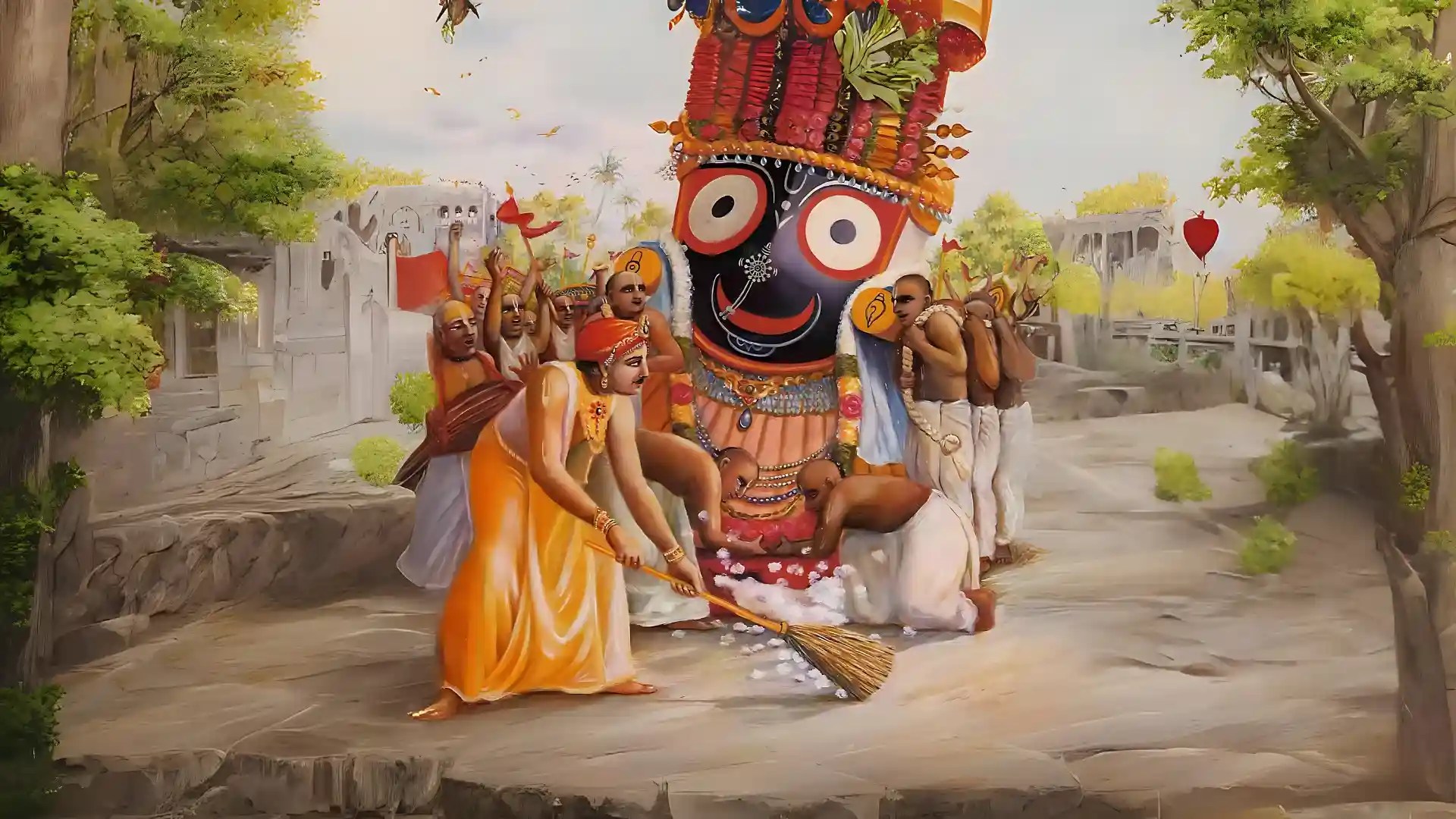
While the Lord was being carried from the throne to the car, King Prataparudra personally engaged in the Lord’s service by cleansing the road with a broom that had a golden handle. (Madhya-lila 13.15)
The King sprinkled the road with sandalwood-scented water. Although he was the owner of the royal throne, he engaged in menial service for the sake of Lord Jagannatha. (Madhya-lila 13.16)
Although the King was the most exalted respectable person, still he accepted menial service for the Lord; he, therefore, became a suitable candidate for receiving the Lord’s mercy. (Madhya-lila 13.17)
Upon seeing the King engaged in such menial service, Caitanya Mahaprabhu became very happy. Simply by rendering this service, the King received the mercy of the Lord. Madhya-lila 13.18)
I’m an old man now. Sometimes when I reminisce about my past, my life seems like a roller coaster ride of highs and lows, happiness and distress, gains and losses. Its the losses I remember the most, when I lost property, the house I built by hand, my wife and children, jobs, friends and loved one’s. Mostly is was my own undoing, I really can’t blame anyone but myself, because Srila Prabhupada has given us a rightous path to follow, if only I had stayed on the path.
I remember one day when it seemed I had lost everything again, and was helpless all around. I went over to my collection of Srila Prabhupada’s books, I closed my eyes and just randomly picked a book from the shelf. It was the First Canto Vol.1 of the Srimad Bhagavatam. I just blindly opened it and began to read from it. To my utter suprise, this is the verse and purport that was presented for me to read:
“My dear Vyāsa, even though a devotee of Lord Kṛṣṇa sometimes falls down somehow or other, he certainly does not undergo material existence like others [fruitive workers, etc.] because a person who has once relished the taste of the lotus feet of the Lord can do nothing but remember that ecstasy again and again.” (Srimad Bhagavatam 1.5.19)
A devotee of the Lord, due to wrong association, sometimes imitates the fruitive workers… Such foolish devotees are sometimes put into difficulty by the Lord Himself. As a special favor, He may remove all material paraphernalia. By such action, the bewildered devotee is forsaken by all friends and relatives, and so he comes to his senses again by the mercy of the Lord and is set right to execute his devotional service. (from Purport)
Reading this Text and Purport saved me. And I remembered the ecstasy of coming to Krishna Consciousness, and chanting Hare Krishna, seeing the deities in the temple for the first time, going on Sankirtan, and meeting Srila Prabhupada. I was reminded of the love I have for him and my good fortune in receiving this knowledge, and it gave me the courage to again take to the path of devotion. Miracles can happen. Krishna sent me a boat, and I got in it again. Hare Krishna! -V
The very first verse in the Introduction to the Bhagavad-git As It, is this this very important prayer:
om ajñāna-timirāndhasya jñānāñjana-śalākayā cakṣur unmīlitaṁ yena tasmai śrī-gurave namaḥ
“I was born in the darkest ignorance, and my spiritual master opened my eyes with the torch of knowledge. I offer my respectful obeisances unto him.“
I have always liked the simplicity of this verse, because that is exactly what Srila Prabhupada did when I read my first book. He opened my eyes with Knowledge.
…The Lord is the supreme spiritual master, and the bona fide representative of the Supreme Lord is also a spiritual master. The Lord from within enlightens the devotees by the effulgence of the nails of His lotus feet, and His representative, the spiritual master, enlightens from without. Only by thinking of the lotus feet of the Lord and always taking the spiritual master’s advice can one advance in spiritual life and understand Vedic knowledge.
yasya deve parā bhaktir yathā deve tathā gurau tasyaite kathitā hy arthāḥ prakāśante mahātmanaḥ (Śvetāśvatara Upaniṣad 6.23)
Thus the Vedas enjoin that for one who has unflinching faith in the lotus feet of the Lord, as well as in the spiritual master, the real import of Vedic knowledge can be revealed. (from purport SB 4.24.52)
“I was born in the darkest ignorance, and my spiritual master opened my eyes with the torch of knowledge. I offer my respectful obeisances unto him.” This gives the definition of the guru. Everyone is in the darkness of ignorance. Therefore everyone needs to be enlightened with transcendental knowledge. One who enlightens his disciple and saves him from rotting in the darkness of ignorance in this material world is a true guru.
Sometimes when I am sitting and reading from Srila Prabhupada’s Srimad Bhagavatam, a verse or sentence from the purport just jumps out from the page almost like it is in 3D, and I catch a glimpse of what the Spiritual World must be like. It is beyond even my imagination, but sometimes I catch a glimmer of light, through a transcendental window, by the grace of my spiritual master His Divine Grace A. C. Bhaktivedanta Swami Prabhupada.
…The transcendental abode of the Lord where the trees are all desire trees and the buildings are made of touchstone. The Lord Govinda is engaged there in herding the surabhi cows as His natural occupation.
“I worship Govinda, the primeval Lord, the first progenitor who is tending the cows, yielding all desire, in abodes built with spiritual gems, surrounded by millions of purpose trees, always served with great reverence and affection by hundreds of thousands of lakṣmīs or gopīs.” (Bs 5.29)
…The Lord Govinda is engaged there in herding the surabhi cows as His natural occupation. And those who are artists, overtaken by the beautiful creation, should better see to the beautiful face of the Lord for complete satisfaction. The face of the Lord is the embodiment of beauty. What they call beautiful nature is but His smile, and what they call the sweet songs of the birds are but specimens of the whispering voice of the Lord.
…God is available. and we can associate with Him according to our choice. The ability to choose, or our conscience, is given to us in the human form so we can utilize it. All the ingredients are there for us to cross the ocean of birth and death. This human body is a very nice boat, and we have a very good navigator, the spiritual master. We also have a very favorable wind the instructions of God. So we should take our chance and cross the ocean of birth and death. We can say, “Now here is an opportunity. Take it and be saved from birth, old age, disease, and death.” but if you don’t take advantage, what can we do?
…Man is the architect of his own destiny. In other words, our future destiny depends on our present action. This life is an opportunity to improve our next life, back to Godhead.
A Choice of Destinies
His Divine Grace A.C. Bhaktivedanta Swami Prabhupada speaks with Jon Nordheimer of the New York Times in a conversation recorded in September 1972 at New Vrindaban.
Full conversation
Srila Prabhupada: When we speak of Krsna, we mean God. Everyone has some vague idea of God, hut no clear idea. Therefore God descends to show what He is. If we speculate on God, someone will think one thing and another person will think another. This is the result of speculation. But if God Himself comes and shows Himself as He is and speaks about Himself, that is perfect knowledge. This Krsna consciousness movement is spreading that message.
In Bhagavad-gita, God Himself is speaking about Himself: I am like this; My form is like this; My activities are like this; My address is this and that. If you like, you can come back to Me. There is no restriction-everyone can come to Me.” All this information is there in Bhagavad-gita, where God speaks about Himself and presents Himself as He is. We have simply to take that information; then we can understand Him. And when we understand God. Krsna, we can go back to Him. It is a very simple thing. Krsna says.
janma karma ca me divyam evam yo vetti tattvatah tyaktva deham punar janma naiti mam eti so ‘rjuna
“One who knows the transcendental nature of My .appearance and activities does not, upon leaving the body. take his birth again in this material world, but attains My eternal abode. O Arjuna.” [Bhagavad-gita 4.9]
So God is there; that’s a fact. Anyone can go back to Him and live an eternal life full of bliss and knowledge simply by knowing about it. When God Himself comes, all great acaryas, stalwart men, accept Him: “Yes, He is God.” If we simply understand God, we make a solution to all our problems.