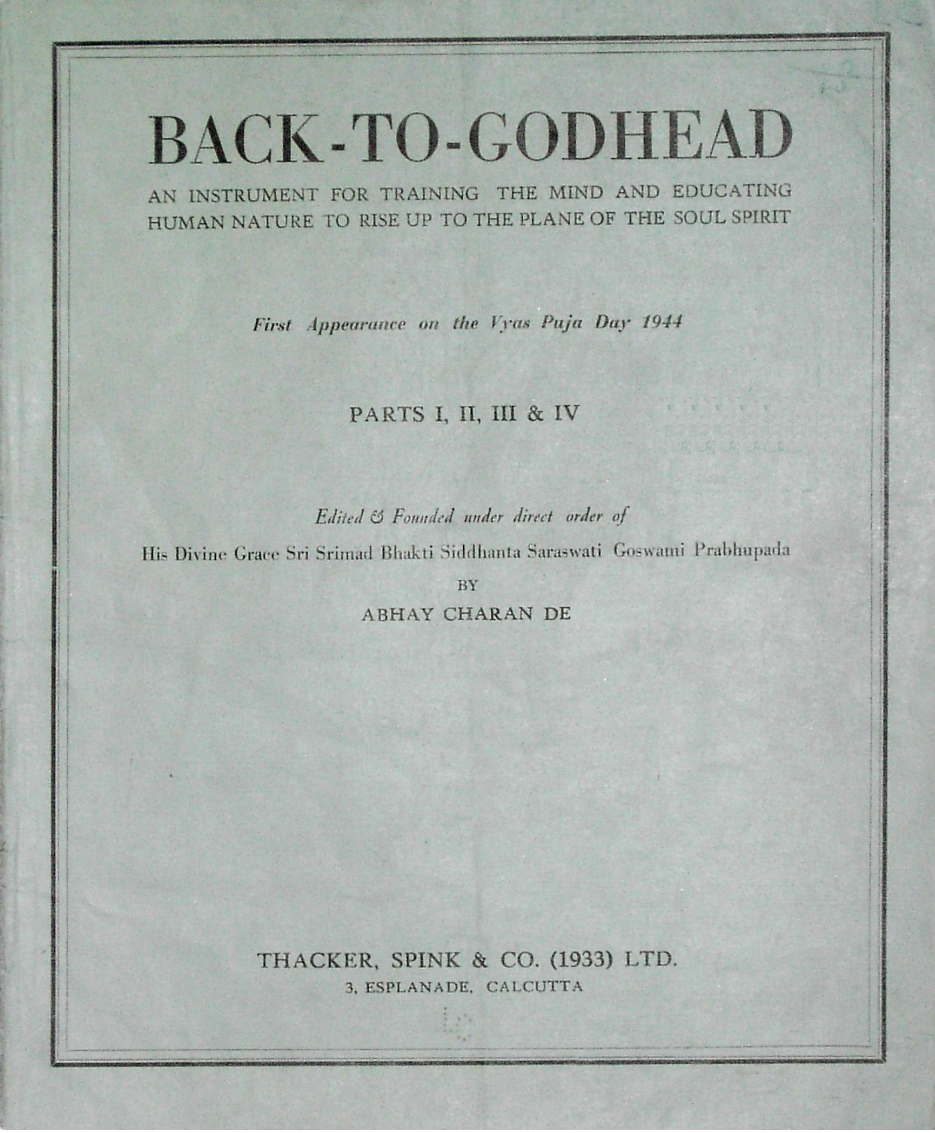
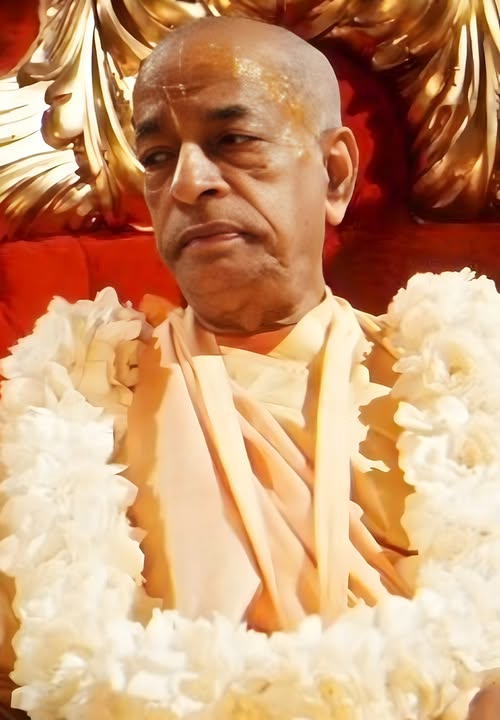
I found this interesting. This is the very first issue of “Back to Godhead” magazine published in 1944, India. Srila Prabhupada is explaining the purpose and mission of this publicationwith the following words:
…I wish that every one who is enlightened and educated of all nationality, may take active interest in this periodical publication for wide circulation as this paper will contain only the transcendental messages of the great savants of India and specially of Lord Chaitanya, the Godhead Incarnate Who descended for the deliverance of all fallen souls in the present age. My duty will be simply to repeat in the “BACK TO GODHEAD” just like an interpreter what I have heard from and what I have been ordered to deliver by my great spiritual master H.D.G. Bhakti Siddhanta Saraswati Goswami Prabhupada. Nothing will be manufactured by me by my mental concoction. Such words will descend as Sound Transcendental and when they are given proper serving reception by the aural channel, surely they will act like medicine to carry all back to home and “BACK TO GODHEAD.”
…The subject matters delineated in the pages of “Back to Godhead” may seem to be very dry in the beginning as the messages are from a different sphere altogether but still we have to give attention to the messages if we really mean to cure the disease of Nescience and go “BACK TO GODHEAD.”
…Godhead is One without a second and all living entities are His eternal subordinate transcendental servitors. Realization of this transcendental relation, will be the attempt of this paper and therefore there is no bar for any one in the world irrespective of colour, creed and nationality, to go back to Godhead.
Abhay Charan De, Editor and Founder.
You can view or download the scanned pages of this issue ofBack to Godheadby clinking on link
Or read the text of entire copy of this historic first issue that we have posted below
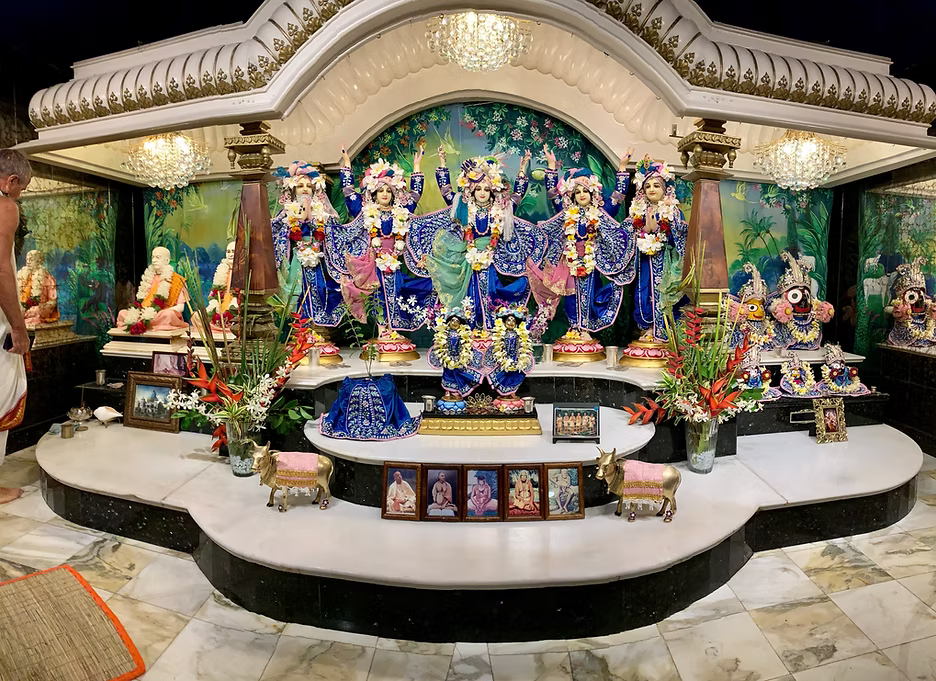
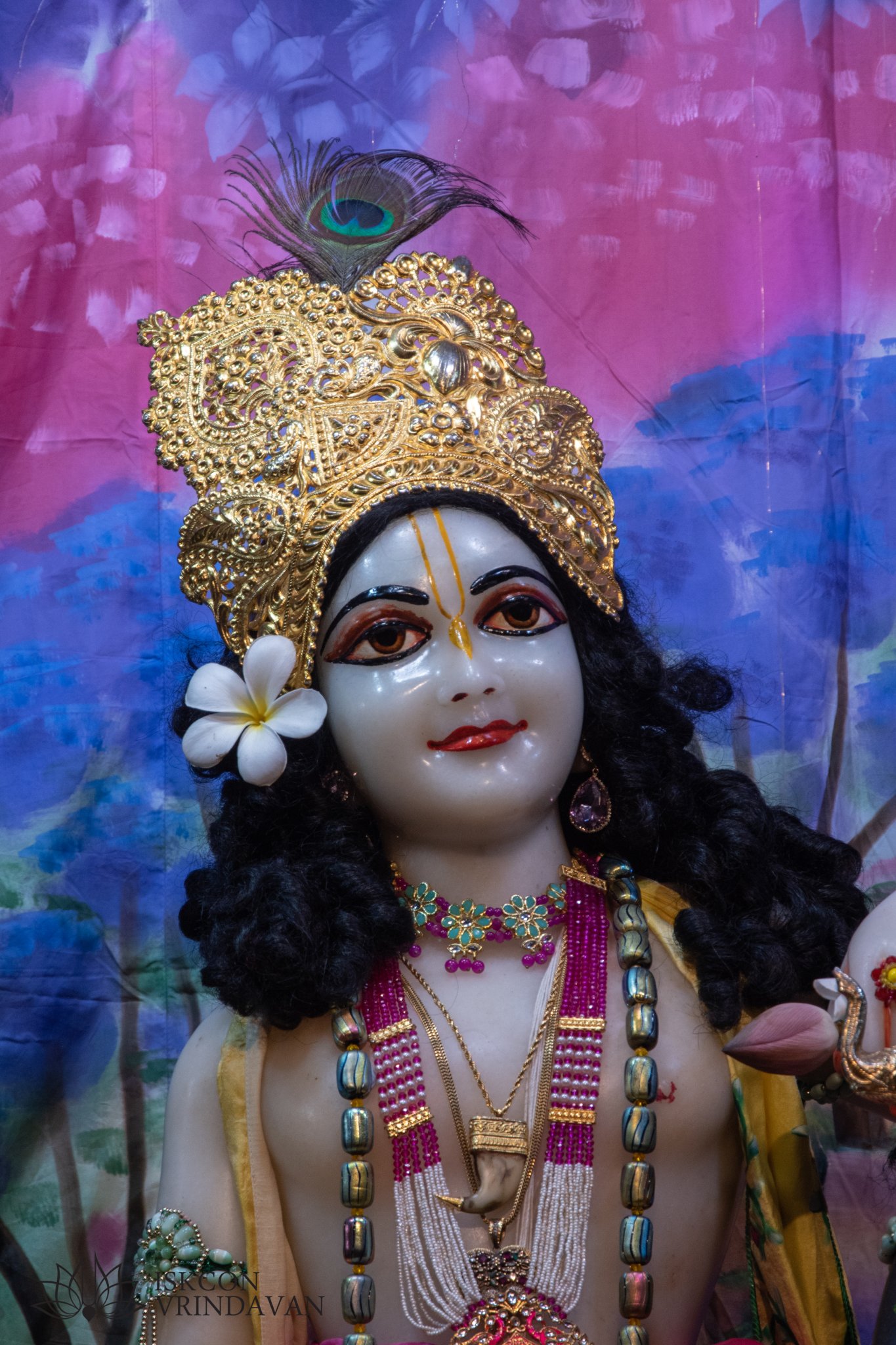
Altough I have been to Hawaii a few times, I never got the chance to visit the Hawaii Iskcon Temple. But I have always heard about the beautiful Pancha Tattva Deities, and that they were the first Pancha Tattva Deities Installed by Srila Prabhupada in all of ISKCON.
The ISKCON Hawaii Temple is a nonsectarian community dedicated to spiritual education and promoting unity and peace in the world through chanting of the mahã mãntra, distributing sanctified vegetarian food and propagating spiritual knowledge and practices based on the ancient Vedic teachings of Bhakti Yoga, as presented by His Divine Grace A.C.Bhaktivedanta Swami Prabhupada.
The first Pancha Tattva deities in Iskcon were installed in Honolulu, Hawaii in May 1972 by Iskcon Founder and Acarya: A. C. Bhaktivedanta Swami Prabhupada.
Home of the Pancha Tattva
The Pancha Tattva represent five divine aspects, each manifesting to share the profound blessing of love for God. These personalities appeared with unique roles in the sacred mission of distributing God’s love.
The Pancha Tattva represent five divine aspects, each manifesting to share the profound blessing of love for God. These personalities appeared with unique roles in the sacred mission of distributing God’s love.
Although the book “Life Comes From Life” has been on our bookshelf for many years, I never really opened it until today. Mostly because my mind was not so scientifically inclined.But when I opened it, and began reading from the Introduction, I could see, even though it was originally published by the BBT back in 1979, it is very relevant to today’s current events.
When I read these following words from the Introduction, to “Life Comes From Life” by Srila Prabhupada, I came to realize just how prophetic, his words were. -V
“…a veil of fantasy and deception can be created with such unprecedented expertise that it can become impossible for us to distinguish between substance and simulation, reality and illusion.…”
Life Comes From Life
Introduction
Once upon a time (as in a fairy tale), most of us believed that the food we ate was basically wholesome, nutritious and free from dangerous chemicals, that advertising may have been believable, and that product labels truly described the qualities and contents of what we fed ourselves and our families. Once upon a time, most of the world believed in the integrity of our heads of state, high-ranking political officials and local leaders. Once upon a time, we thought our children were getting a solid education in the public school system. Once upon a time, many of us believed atomic energy had “peacetime uses” that were perfectly safe and completely congruous with a happy and healthy society.
Yet in recent times our illusions have been shattered. Repeated exposes of widespread consumer fraud and grand political collusion and bribery have all but destroyed our former innocence. We now know that through mass marketing and the media, a veil of fantasy and deception can be created with such unprecedented expertise that it can become impossible for us to distinguish between substance and simulation, reality and illusion.
Today many scientists are propagating the doctrine that life originates from matter. However, they cannot provide proof, either experimentally or theoretically. In fact, they hold their stance essentially on faith, in the face of all sorts of scientific objections. Śrīla Prabhupāda points out that this groundless dogma has done great damage to moral and spiritual standards worldwide and has thus caused incalculable suffering.
It has been suggested that we do a post on Srutakirti Prabhu, a prominent disciple, and personal servant of His Divine Grace Srila Prabhupada. He has recently been traveling and speaking on his memories of Srila Prabhupada, and enlivening listeners with his personal remembrances.
Srutakirti Prabhu stands as one of the most revered personalities in the International Society for Krishna Consciousness (ISKCON), primarily known for his intimate service as Srila Prabhupada’s personal attendant. His unique position allowed him unprecedented access to the daily life and teachings of ISKCON’s founder, experiences he has generously shared through his writings, lectures, and personal interactions with devotees worldwide. His humility, dedication, and deep spiritual insights continue to inspire thousands of devotees as he maintains his service attitude into his senior years at the Krishna Balaram Mandir in Vrindavan.
Its funny how you can read Bhagavad-gita for years, and everytime you read from it, something new jumps out at you. For instance this morning, I happened upon a word I must have seen before, but never noticed: Kṛṣṇa-karma. I have seen karma-kāṇḍa before, and jñāna-kāṇḍa but never have I noticed the word Krsna-karma. I like this word.
I ran across this word Krsna-karma while reading from the purport to text 55 in the eleventh chapter of Bhagavad-gita. We share with you this very important text and purport.
Anyone who wants to approach the Supreme of all the Personalities of Godhead, on the Kṛṣṇaloka planet in the spiritual sky, and be intimately connected with the Supreme Personality, Kṛṣṇa, must take this formula, as is stated by the Supreme Himself. Therefore, this verse is considered to be the essence of Bhagavad-gītā. The Bhagavad-gītā is a book directed to the conditioned souls, who are engaged in the material world with the purpose of lording it over nature and who do not know of the real, spiritual life. The Bhagavad-gītā is meant to show how one can understand his spiritual existence and his eternal relationship with the Supreme Spiritual Personality and to teach one how to go back home, back to Godhead. Now here is the verse which clearly explains the process by which one can attain success in his spiritual activity: devotional service. As far as work is concerned, one should transfer his energy entirely to Kṛṣṇa conscious activities. No work should be done by any man except in relationship to Kṛṣṇa. This called Kṛṣṇa-karma. (from purport to Bg. 11.55)
I was thinking about the following verse the other day:
“The supreme occupation [dharma] for all humanity is that by which men can attain to loving devotional service unto the transcendent Lord. Such devotional service must be unmotivated and uninterrupted to completely satisfy the self.” ( SB 1.2.6)
And in some small way, I was feeling very fortunate. Over the years Srila Prabhupada has kept me engaged in devotional service to Krishna, as a wood worker building different pujari rooms for the Lords paraphernalia, construction projects, maintaining various web pages, gardening, offering food and water to the Lord, worshiping the Lord in our temple room, and washing the Lord’s plates and cups.
Sometimes I think I am just an insignificant servant of my spiritual master, but then I remember what Srila Prabhupada once said about devotional service:“If you had any idea of what you were doing, you would be fainting in ecstasy”. Not to often am I fainting in ecstasy, but I am nonetheless grateful every day, to perform some minimal devotional service.
…Everyone should engage himself in that transcendental loving service of the Lord, even in the present conditional state of material existence. That will gradually give one the clue to actual life and please him to complete satisfaction.” (Bg Introduction)
I was reading from the introduction to the Bhagavad-gita As It is…
the whole purpose of Bhagavad-gita is to revive our sanātana occupation, or sanātana-dharma, which is the eternal occupation of the living entity. We are temporarily engaged in different activities, but all of these activities can be purified when we give up all these temporary activities and take up the activities which are prescribed by the Supreme Lord. That is called our pure life.
The Lord is very kind to the living entities because they are His sons. Lord Krsna declares in Bhagavad-gita 14.4, “sarva-yonisu…aham bija-pradah pita pitā.” “I am the father of all.” Of course there are all types of living entities according to their various karmas, but here the Lord claims that He is the father of all of them. Therefore the Lord descends to reclaim all of these fallen, conditioned souls to call them back to the sanātana eternal sky so that the sanātana living entities may regain their eternal sanātana positions in eternal association with the Lord. The Lord comes Himself in different incarnations, or He sends His confidential servants as sons or His associates or ācāryas to reclaim the conditioned souls.
Therefore, sanatana-dharma does not refer to any sectarian process of religion. It is the eternal function of the eternal living entities in relationship with the eternal Supreme Lord. Sanātana-dharma refers, as stated previously, to the eternal occupation of the living entity. Rāmānujācārya has explained the word sanātana as “that which has neither beginning nor end,” so when we speak of sanātana-dharma, we must take it for granted on the authority of Sri Rāmānujācārya that it has neither beginning nor end.
So in some small way, I am feeling very fortunate.
As I was reading from the Srimad Bhagavatam this morning about the passing of Bhīṣmadeva it was being described how “The perfect yogīs or mystics can leave the material body at their own sweet will at a suitable time and go to a suitable planet desired by them.” And how it is possiable to go beyond Saṁsāra, and go back to Godhead without any doubt?
…In the momentous hour of leaving his material body, Bhīṣmadeva set the glorious example concerning the important function of the human form of life. The subject matter which attracts the dying man becomes the beginning of his next life. Therefore, if one is absorbed in thoughts of the Supreme Lord Śrī Kṛṣṇa, he is sure to go back to Godhead without any doubt.
And what is Samsara?
Saṁsāra means material existence. That is called saṁsāra. Bhūtvā bhūtvā pralīyate (BG 8.19). You take your birth once in some form of body. You live for some time. Then you have to give up this body. Then you have to accept another body. Then again live for some time. Then give up that body. Again accept another body. In this way, it is going on. That is called saṁsāra, rotating within this material world. (Lecture on Gurvastakam at Upsala University by His Divine Grace -Stockholm, September 9, 1973)
The saṁsāra means repetition of different bodies. That is called saṁsāra. (Lecture on SB 1.2.4 -Rome, May 28, 1974)
Saṁsāra means this material entanglement. This is called saṁsāra. (Lecture on CC Madhya-lila 25.40-50 – San Francisco, January 24, 1967)
Today we honor the disappearance day of Haridas Thakur.
Haridas Thakur is considered to be the namacarya, the spiritual master in chanting the holy name of Krsna. Though he was born in a low class, Muslim family, Lord Caitanya’s devotees respected him as being better than the best of brahmanas. He would not eat or sleep until he finished his daily quota of chanting the name of Krsna 300,000 times. Along with Lord Nityananda, Haridas Thakur spread the chanting of Krsna’s name throughout Bengal. In Jagannatha Puri, where Haridas Thakur spent his later days, Lord Caitanya would regularly send him prasadam and discuss with him topics of Krsna. Haridas Thakur died chanting Krsna’s name in the presence of Sri Caitanya Mahaprabhu. After Haridas Thakur’s death, Lord Caitanya carried his body to the sea and with His own hands buried him in the sand.
Sri Caitanya-caritamrta – 1975 Edition
The Glories of Srila Haridasa Thakura
Śrī Caitanya Mahāprabhu derives great pleasure from glorifying His devotees, and among the devotees, Haridāsa Ṭhākura is the foremost.
The transcendental qualities of Haridāsa Ṭhākura are innumerable and unfathomable. One may describe a portion of them, but to count them all is impossible.
In Caitanya-maṅgala, Śrīla Vṛndāvana dāsa Ṭhākura has described the attributes of Haridāsa Ṭhākura to some extent.
No one can describe all the qualities of Haridāsa Ṭhākura. One may say something about them just to purify himself.
O devotees of Śrī Caitanya Mahāprabhu, please hear something about the qualities of Haridāsa Ṭhākura that Śrīla Vṛndāvana dāsa Ṭhākura has not described in detail.
After leaving his home, Haridāsa Ṭhākura stayed for some time in the forest of Benāpola.
Haridāsa Ṭhākura constructed a cottage in a solitary forest. There he planted a tulasī plant, and in front of the tulasī he would chant the holy name of the Lord 300,000 times daily. He chanted throughout the entire day and night.
Last night I woke in the middle of the night , and couldn’t fall back asleep. While laying there, my mind just kinda went to thoughts of Krishna and Arjuna. Arjuna accepted Krishna as his spiritual master with these famous words from the Bhagavad-gita:
O Kṛṣṇa, I totally accept as truth all that You have told me. Neither the gods nor demons, O Lord, know Thy personality. (Bg 10.14)
This lead me to think of our relationship with our spiritual master His Divine Grace A. C. Bhaktivedanta Swami Prabhupada. And I came to the same conclusion as Arjuna. “I totally accept as truth all that You have told me“.
So I was thinking of our unique relationship with Srila Prabhupada. “Neither the gods nor demons, O Lord, know Thy personality”.Maybe the whole world outside of the circle of disciples and followers of His Divine Grace, cannot know his greatness and divine personality, but as disciples and followers, we can began to understand. Our relationship with Srila Prabhupada is much like that relationship between Krishna and Arjuna.
With that last thought, I fell back asleep, reflecting on Srila Prabhupada. -V
Today we celebrate the Appearance of Lord Vamanadeva, the fifteenth Incarnation, wherin Krsna assumed the form of a dwarf brahmana.
“In the fifteenth incarnation, the Lord assumed the form of a dwarf-brāhmaṇa [Vāmana]…” (SB 1.19.19)
The following is a chapter summary from Srimad Bhagavatam, eight canto, chapter 18, entitled “Lord Vāmanadeva, the Dwarf Incarnation”, describing the Lord’s appearance and activities, and a verse from the First Canto.
Srimad-Bhagavatam By His Divine Grace A. C. Bhaktivedanta Swami Prabhupada Canto One, Chapter 19, Text 19
pañcadaśam—the fifteenth in the line; vāmanakam—the dwarf brāhmaṇa; kṛtvā—by assumption of; agāt—went; adhvaram—arena of sacrifice; baleḥ—of King Bali; pada-trayam—three steps only; yācamānaḥ—begging; pratyāditsuḥ—willing at heart to return; tri-piṣṭapam—the kingdom of the three planetary systems.
TRANSLATION
In the fifteenth incarnation, the Lord assumed the form of a dwarf-brāhmaṇa [Vāmana] and visited the arena of sacrifice arranged by Mahārāja Bali. Although at heart He was willing to regain the kingdom of the three planetary systems, He simply asked for a donation of three steps of land.
PURPORT
The Almighty God can bestow upon anyone the kingdom of the universe from a very small beginning, and similarly, He can take away the kingdom of the universe on the plea of begging a small piece of land.
Śrīmad-Bhāgavatam by His Divine Grace A. C. Bhaktivedanta Swami Prabhupāda Canto 8, Chapter 18
Lord Vāmanadeva, the Dwarf Incarnation
This chapter describes how Lord Vāmanadeva appeared and how He went to the sacrificial arena of Mahārāja Bali, who received Him well and fulfilled His desire by offering Him benedictions.
I thought I knew about all of Srila Prabhupada’s books, but this one has somehow escaped my attention until this morning. I am looking forward to reading it, and we thought I should share it with all of you. So we have included the entire book in this post. Hare Krishna!
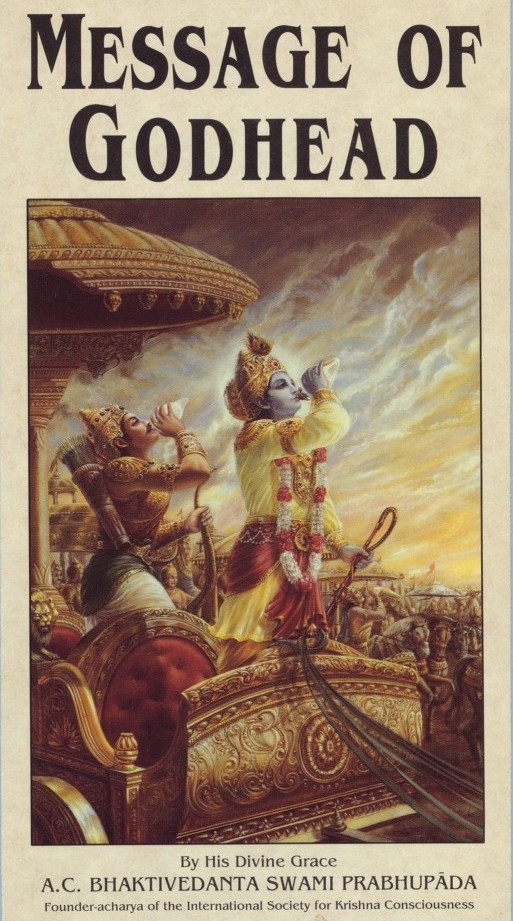
” Message of Godhead” is a short introductory book on Krishna consciousness written by His Divine Grace in the 1950’s and first published by the BBT in 1990.
Message of Godhead
by His Divine Grace A. C. Bhaktivedanta Swami Prabhupada
Introduction
At present, we are concerned primarily with two things: one, ourselves; and the other, the place where we live. In other words, we are concerned with two objects: namely, everything that is related to our gross and subtle bodies; and the world at large, with all its paraphernalia. But there are others above us, the transcendentalists, who are concerned not only with their body and mind and the world at large, but also with the transcendental subject that is above the body and mind and the world at large. The transcendentalists are very much concerned with the Absolute Truth, and much less with relative truths.
These transcendentalists (ordinarily known as saints, philosophers, reformers, messengers, and so forth) appear in various places in the world at various times. They render transcendental service to the Absolute Truth and to humanity, also, by preaching the message of the transcendental world. According to these transcendentalists, even lower animals like cats and dogs are also concerned primarily with two things, namely, themselves and the world at large. Living entities other than human beings have no capacity to understand transcendental subjects. The human being is therefore considered to be the highest of all creations, and we must understand the nature of this higher standing.
When man, who is the highest of all created beings, is fully developed in consciousness, he concerns himself not only with his own self and the world where he lives, but he tries to understand the Absolute Truth. The Absolute Truth regulates man as well as the world, and knowing Him, the transcendentalist regulates his activities on the right path. This regulating process is commonly known as a system of faith or religion. All over the civilized world we find some process or form of religion – when man is devoid of any such religion or of transcendental traits, he is nothing but a beast. This subject matter, which the religionists delineate according to different countries, times, and people, is more or less aimed at the objective of the Absolute Truth.
Today marks the Appearance of Srimati Radharani. We honor it with a half day fast, discussion on the glories of Srimati Radharani,, followed by a nice vegetarian feast.
The following are just a few of the many quotes from Srila Prabhupada which encourage us to approach Krishna through the mercy of Srimati Radharani, Krishna’s eternal consort. For those of us who feel that there is no hope of making spiritual progress in this lifetime, Srimati Radharani, Who is compassion personified, kindly comes to our rescue if we can humbly invoke Her divine blessings.
“I offer my respects to Radharani whose bodily complexion is like molten gold and who is the Queen of Vrndavana. You are the daughter of King Vrsabhanu, and You are very dear to Lord Krishna.” (Sri Radha Pranama)
“So this is our philosophy, to please Krishna through Radharani, and just today is the auspicious day of Radharani appearance. So we should offer puspanjali and pray to Radharani that ‘Radharani, kindly be merciful and tell about me to Your Krishna. To Your Krishna. Krishna is Yours.’ Krishna, Radha-Krishna. Krishna is not independent. Krishna is Radharani’s property. So you have to approach Krishna through Radharani. That is, today is the auspicious day. Worship Radharani very nicely and be happy.” (Srila Prabhupada Lecture, September 5, 1973)
“The beauty of Srimati Radharani’s eyes forcibly devours the beauty of newly grown blue lotus flowers, and the beauty of Her face surpasses that of an entire forest of fully blossomed lotuses. Her bodily luster seems to place even gold into a painful situation. Thus the wonderful, unprecedented beauty of Srimati Radharani is awakening in Vrindavana.” (Caitanya-caritamrita Antya 1.169)
“I emphatically say to you, O brothers, you will obtain your good fortune from the Supreme Lord Krishna only when Srimati Radharani becomes pleased with you.”(Prayer to the Lotus Feet of Krishna, September 13, 1965)
“Actually, because Krishna is the Supreme Personality of Godhead, it is very difficult to approach Him. But the devotees, taking advantage of His compassionate nature, which is represented by Radharani, always pray to Radharani for Krishna’s compassion.” (Nectar of Devotion, Chapter 22)
The strangest thing happened this morning. While I was chanting my japa, I guess I was a little distracted because I was thinking about work, and the following verse from the Srimad Bhagavatam just popped into my head. I was trying to remember where this verse was…I was pretty sure it was in the First Canto…so I took the first canto off the shelf and just randomly opened it. And to my great surprise, it opened to the exact verse I was thinking about.
The supreme occupation [dharma] for all humanity is that by which men can attain to loving devotional service unto the transcendent Lord. Such devotional service must be unmotivated and uninterrupted to completely satisfy the self. (Srimad Bhagavatam 1.2.6)
These original books by Srila Prabhupada are definitely transcendental.
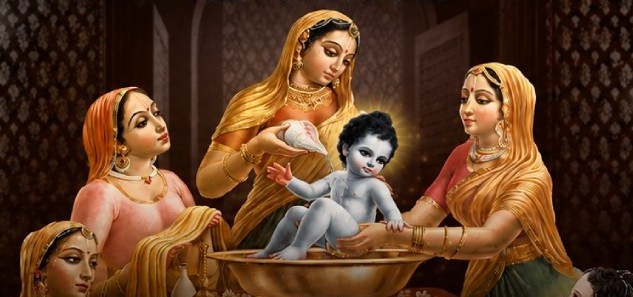
Today we celebrate the Appearance of Lord Krishna (Janmastami) with a full day fast, untill midnight.Lord Krishna’s birth is commemorated at midnight with devotional songs (bhajans), followed bya small ekadasi vegetarian feast.
Janmashtami means the celebration of the birth of Lord Krishna, derived from the Sanskrit words “janma” (birth) and “ashtami” (the eighth day)
On this day we like to read from the Krsna Book, so we have included an excerpt from the Krsna book, chapter 5 entitled “Meeting of Nanda and Vasudeva”.
KRSNA The Supreme Personality of Godhead
By His Divne Grace A. C. Bhaktivedanta Swami Prabhupada
Although Kṛṣṇa was the real son of Vasudeva and Devakī, because of Kaṁsa’s atrocious activities Vasudeva could not enjoy the birth ceremony of his son. But Nanda Mahārāja, the foster father, celebrated the birth ceremony of Kṛṣṇa very joyfully. The next day, it was declared that a male child was born of Yaśodā. According to Vedic custom, Nanda Mahārāja called for learned astrologers and brāhmaṇas to perform the birth ceremony. After the birth of a child, the astrologers calculate the moment of the birth and make a horoscope of the child’s future life. Another ceremony takes place after the birth of the child: the family members take baths, cleanse themselves and decorate themselves with ornaments and garlands; then they come before the child and the astrologer to hear of the future life of the child. Nanda Mahārāja and other members of the family dressed and sat down in front of the birth place. All the brāhmaṇas who were assembled there on this occasion chanted auspicious mantras, according to the rituals, while the astrologers performed the birth ceremony. All the demigods are also worshiped on this occasion, as well as the forefathers of the family. Nanda Mahārāja distributed 200,000 well decorated, dressed and ornamented cows to the brāhmaṇas. He not only gave cows in charity, but hills of grains, decorated with golden-bordered garments and many ornaments.
I have been going back and re-discovering some of the early articles in “Back to Godhead Magizine”. I am remembering how inspired I woud be each month, as another issue of BTG was released for distribution.
Lord Caitanya’s Mission and Precepts
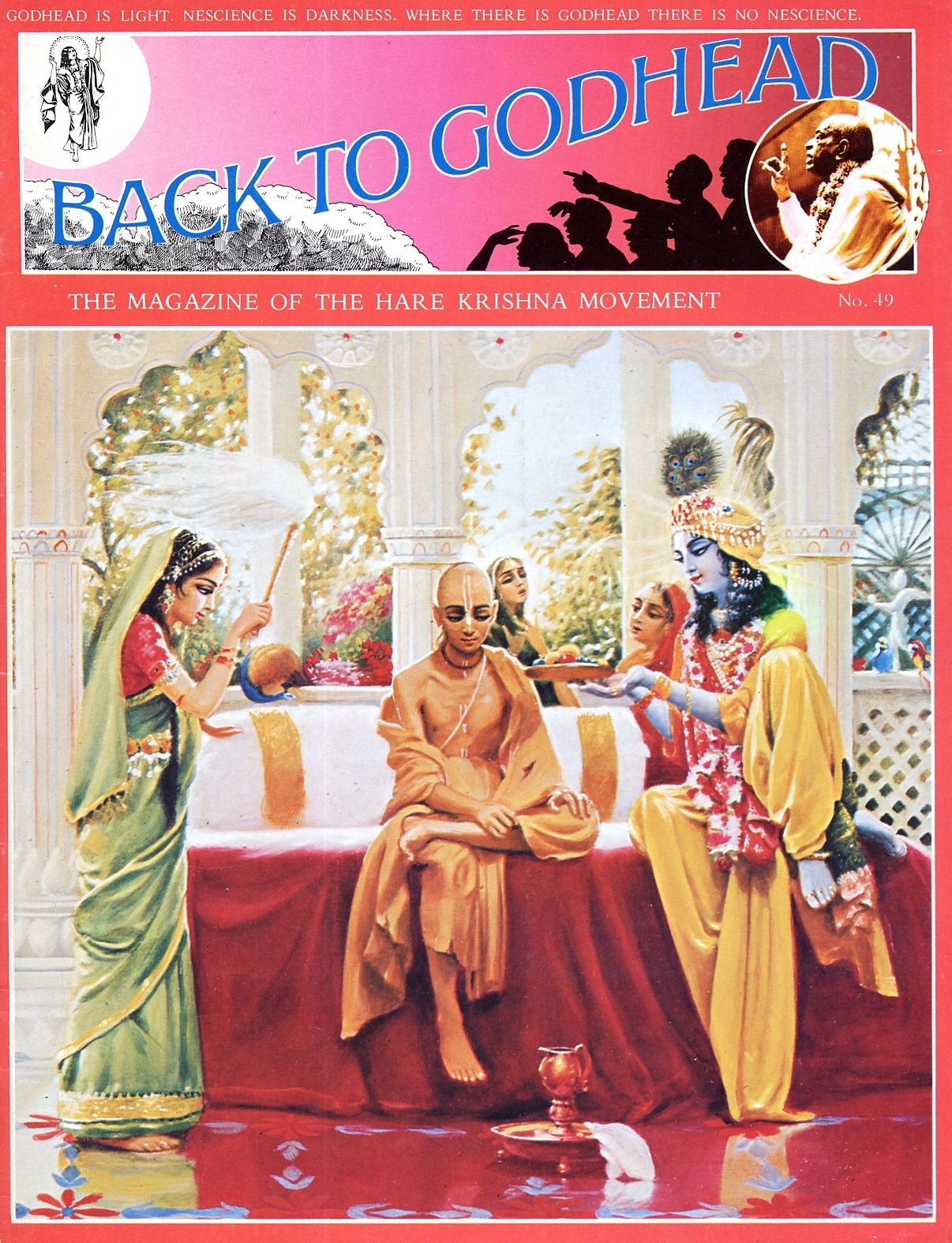
Excerpted from ‘Back To Godhead’ Magazine, 1973 Vol. 1, No. 49 & 50a
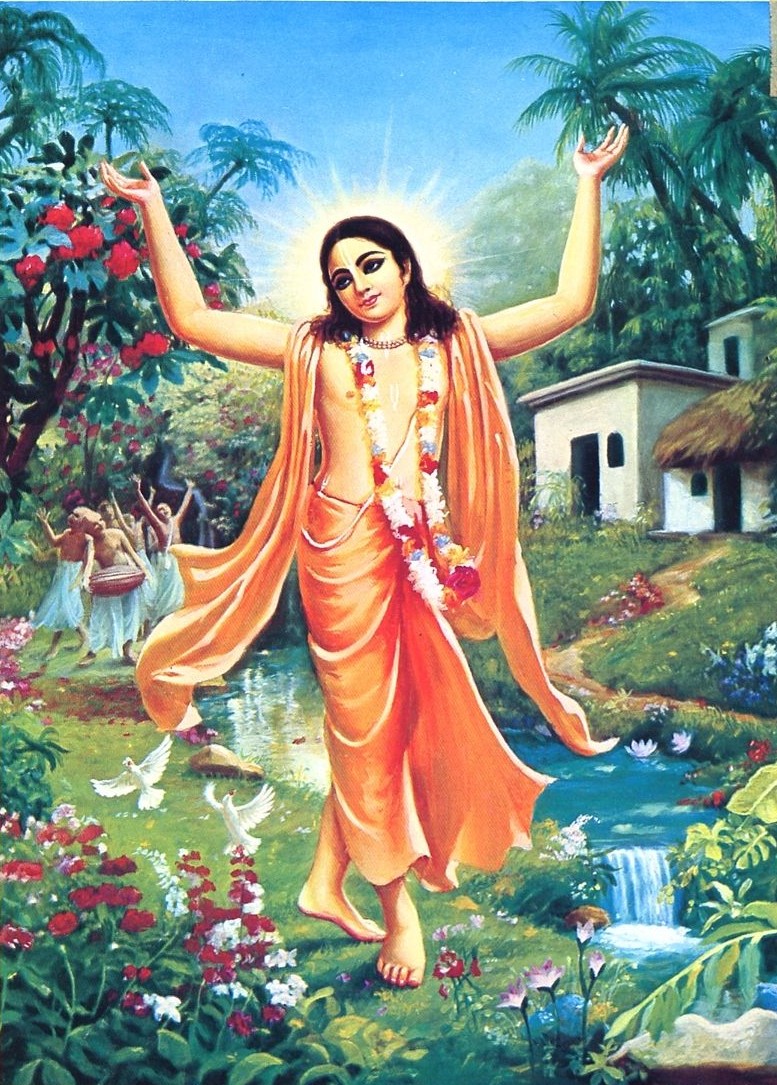
As foretold in Vedic scriptures, the Supreme Personality of Godhead appeared on earth 500 years ago in the form of Lord Caitanya, who is God Himself playing the role of a devotee of Godhead. The eight verses entitled Sri Sri Siksastakam, which were the only written instructions of Lord Caitanya, reveal the essence of the Krsna consciousness movement.
Sri Sri Siksastakam by Sri Krsna Caitanya Mahaprabhu
translated by His Divine Grace A.C. Bhaktivedanta Swami Prabhupada with purports by His Holiness Subaldasa Svami
Glory to the Sri Krsna sankirtana, which cleanses the heart of all the dust accumulated for years and extinguishes the fire of conditional life, of repeated birth and death. This sankirtana movement is the prime benediction for humanity at large because it spreads the rays of the benediction moon. It is the life of all transcendental knowledge. It increases the ocean of transcendental bliss, and it enables us to fully taste the nectar for which we are always anxious.
Purport
The conditioned soul is covered from time immemorial by the dirt of the accumulated reactions of his sinful activities. Due to the reactions of his past sins, he becomes further engaged in sinful activities and becomes more and more forgetful of his constitutional position as part and parcel of the Supreme Lord Sri Krsna. Due to forgetfulness of his spiritual nature, he identifies himself with the temporary material body and its paraphernalia. Thus, rather than serving Krsna in loving devotion, he is forced to serve maya, the limited mundane potency of the Lord. The living being is never independent in any stage of existence, either conditioned or liberated, but when he is under the control of maya he suffers, and when he is under the control of Krsna he enjoys life in the association of the Lord and His devotees.
The Sri Krsna sankirtana, or the congregational chanting of the holy names of God, is able to immediately cleanse the heart of all the dirt that accumulates there for millions of years. This is the result of just the dim reflection of the holy name. During the night, there is fear of thieves, ghosts, murderers, etc. In the morning, before the sun even rises on the horizon, it dispels all such fears by its first rays of light. In the same way, before the holy name makes its full appearance, it dispels the darkness of material ignorance and clears away heaps of sinful activities which have not yet manifested themselves. Thus one is freed from karmic reaction and placed on the liberated platform of life. In this way, the door to devotional service is opened.
It is interesting how the “Back to Godhead Magazine”, has changed and evolved over the years, since its early conception to the present day. We are going to explore some of these changes.
Back to Godhead
The Magazine of The Hare Krishna Movement
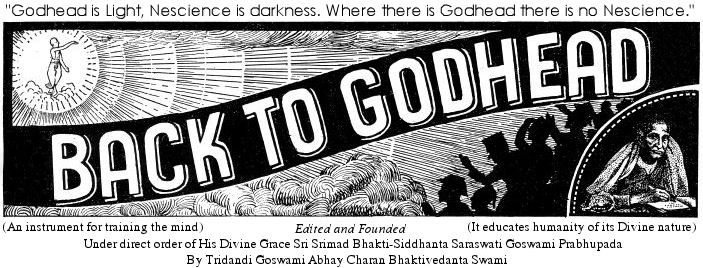
Back to Godhead magazine (BTG) was Srila Prabhupada’s first step towards fulfilling his Guru’s (Bhaktisiddhanta) order to preach Krishna consciousness in English. In February 1944 His Divine Grace A.C. Bhaktivedanta Swami Prabhupada published the first issue of BACK TO GODHEAD magazine. At his home in Calcutta, he wrote the articles, typed the manuscripts, and designed a logo essentially the same logo used on the covers of BACK TO GODHEAD today: an effulgent Lord Caitanya, shining light upon the souls of this world.
“From his front room at 6 Sita Kanta Banerjee, Abhay (as Srila Prabhupada was known) conceived, wrote, edited, and typed the manuscript for His magazine. He designed a logo, arranged in the style of a banner across the top of the page. In the upper left-hand corner was Lord Chaitanya, effulgent with rays of light, like rays from the sun. In the lower right were silhouettes of a crowd of people, in darkness but groping to receive light from Lord Chaitanya. And between Lord Chaitanya and the people, the title “BACK TO GODHEAD” appeared. In the lower right corner was a picture of Srila Bhaktisiddhanta Saraswati seated at his writing, looking up thoughtfully as he composed. Above the logo ran the motto ‘Godhead is Light, Nescience is darkness. Where there is Godhead there is no Nescience.'”
Srila Prabhupada’s design for his Back to Godhead magazine
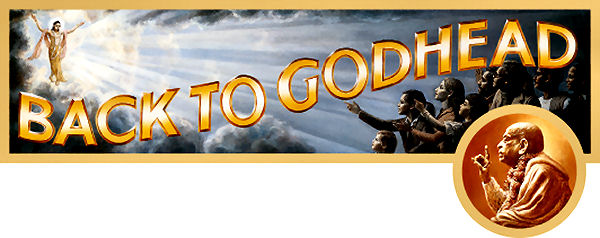
Although the logo went through several changes over the years, today it still matches Srila Prabhupada’s original idea. New color artwork of Lord Chaitanya and the people facing him replaced the original black and white design. The only difference is that by the desire of his disciples Srila Prabhupada, rather than his spiritual master (Srila Bhaktisiddhanta Saraswati), now sits across from Lord Chaitanya.
Today marks the auspicious appearance of Lord Balaram. We honor it with a half day fast and followed by a nice vegetarian feast.
Lord Balarama is Krishna’s elder brother and His appearance day takes place on the full moon day (purnima), two weeks before Krishna Janmashtami. Krishna and Balarama were the darlings of Vrindavan/ Vraja. Together They would spend the day enjoying the company of the cowherd boys in the forests of Vraja. Their wonderful pastimes are related in the tenth canto of Srimad-Bhagavatam, which Srila Prabhupada also translated as The Krishna Book. Lord Balarama is also considered the original spiritual master and His worship is therefore most important for Vaishnavas.
Lord Śrī Kṛṣṇa, the Personality of Godhead, along with Balarāma, played like a human being, and so masked He performed many superhuman acts. (Srimad Bhagavatam Canto One, Chapter 1, Text 20)
Balarāma means guru-tattva. Balarāma represents guru. Yasya prasādād bhagavat-prasādaḥ. If we want to understand Caitanya Mahāprabhu, if we want to understand Kṛṣṇa, then we must take shelter of Balarāma. Nāyam ātmā bala-hinena labhyaḥ. This bala-hinena labhyaḥ, this Vedic injunction, means “Without the mercy of Balarāma you cannot understand, you cannot realize your spiritual identification. So that Balarāma comes as Nityānanda Prabhu. Balarāma hailā nitāi. Therefore we must take shelter of Balarāma. (Lecture given by His Divine Grace A.C. Bhaktivedanta Swami Prabhupada Bhuvaneśvara, February 2, 1977)
Yesterday my wife read me this verse and purport from the Sri Caitanya-caritamrta (Cc. Madya-lila 16.186). It reminded me of the potency of the Holy Name of the Lord.
” ‘To say nothing of the spiritual advancement of persons who see the Supreme Person face to face, even a person born in a family of dog-eaters becomes immediately eligible to perform Vedic sacrifices if he once utters the holy name of the Supreme Personality of Godhead, or chants about Him, hears about His pastimes, offers Him obeisances or even remembers Him.’ “
PURPORT
This is a quotation from Śrīmad-Bhāgavatam (3.33.6). According to this verse, it doesn’t matter what position a person holds. One may be the lowest of the low—a caṇḍāla, or dog-eater—but if he takes to chanting and hearing the holy name of the Lord, he is immediately eligible to perform Vedic sacrifices. This is especially true in this age of Kali.
harer nāma harer nāma harer nāmaiva kevalam kalau nāsty eva nāsty eva nāsty eva gatir anyathā
(Bṛhan-nāradīya Purāṇa, 38.126)
A person born in a brāhmaṇa family cannot perform Vedic sacrifices until he is properly purified and has attained his sacred thread. However, according to this verse, it is understood that even a lowborn person can immediately perform sacrifices if he sincerely chants and hears the holy name of the Lord. Sometimes envious people ask how Europeans and Americans in this Kṛṣṇa consciousness movement can become brāhmaṇas and perform sacrifices. They do not know that the Europeans and Americans have already been purified by chanting the holy name of the Lord—Hare Kṛṣṇa, Hare Kṛṣṇa, Kṛṣṇa Kṛṣṇa, Hare Hare Hare Rāma, Hare Rāma, Rāma Rāma, Hare Hare. This is the proof. Śvādo ‘pi sadyaḥ savanāya kalpate. One may be born in a family of dog-eaters, but he can perform sacrifices simply by chanting the mahā-mantra.
Those who find fault in the Western Vaiṣṇavas should consider this statement from Śrīmad-Bhāgavatam and the commentary on this verse by Śrīla Jīva Gosvāmī. In this regard, Śrīla Jīva Gosvāmī has stated that to become a brāhmaṇa, one has to wait for purification and undergo the sacred thread ceremony, but a chanter of the holy name does not have to wait for the sacred thread ceremony. We do not allow devotees to perform sacrifices until they are properly initiated in the sacred thread ceremony. Yet according to this verse, an offenseless chanter of the holy name is already fit to perform a fire ceremony, even though he is not doubly initiated by the sacred thread ceremony. This is the verdict given by Lord Kapiladeva in His instructions to His mother, Devahūti. It was Lord Kapiladeva who instructed Devahūti in pure Sāṅkhya philosophy.
And from the Srimad Bhagavatam full text and purport
We often say “Chant and be Happy”, but there are offences to be considered. If we want to feel the full ecastscy derived from chanting the Holy names, we need to avoid them.
Remember that even if one feels they are being offensive, there is no need to stop chanting. By trying to chant sincerely and serving the spiritual master, we may be purified of our offenses and may be able to chant purely.
There are offenses to be considered while chanting the Hare Krishna mantra. Therefore simply by chanting Hare Krsna one does not become ecstatic. ( Cc. Adi-lila 8.24) 1) To blaspheme the devotees who have dedicated their lives for propagating the holy name of the Lord. 2) To consider the names of demigods like Lord Shiva or Lord Brahma to be equal to or independent of the name of the Lord Vishnu. 3) To disobey the orders of the spiritual master. 4) To blaspheme the vedic scriptures or scriptures in pursuance to the vedic version. 5) To consider the glories of chanting Hare Krishna to be an imagination. 6) To give some interpretations to the holy name of the Lord. 7) To commit sinful activities on the strength of the holy name. 8) To consider the chanting of Hare Krishna as one of the auspicious ritualistic activities which are offered in the Vedas as frutive activities (Karma kanda). 9) To instruct a faithless person about the glories of the holy name
10) To not have complete faith in the chanting of the holy name and to maintain material attachments, even after understanding so many instructions on this matter. It is also an offense to be inattentive while chanting.
Every devotee who claims to be Vaishnava must guard against these offenses in order to quickly achieve the desired success Krishna Prema!!!
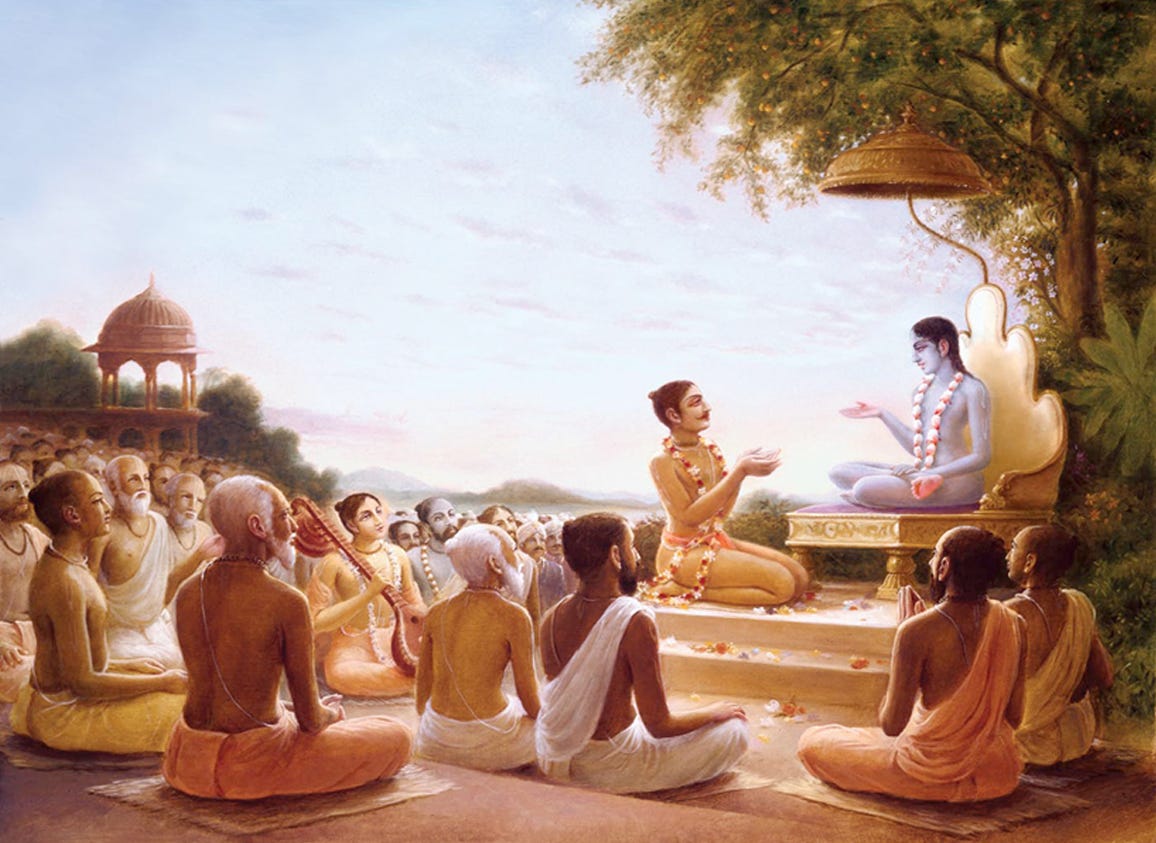
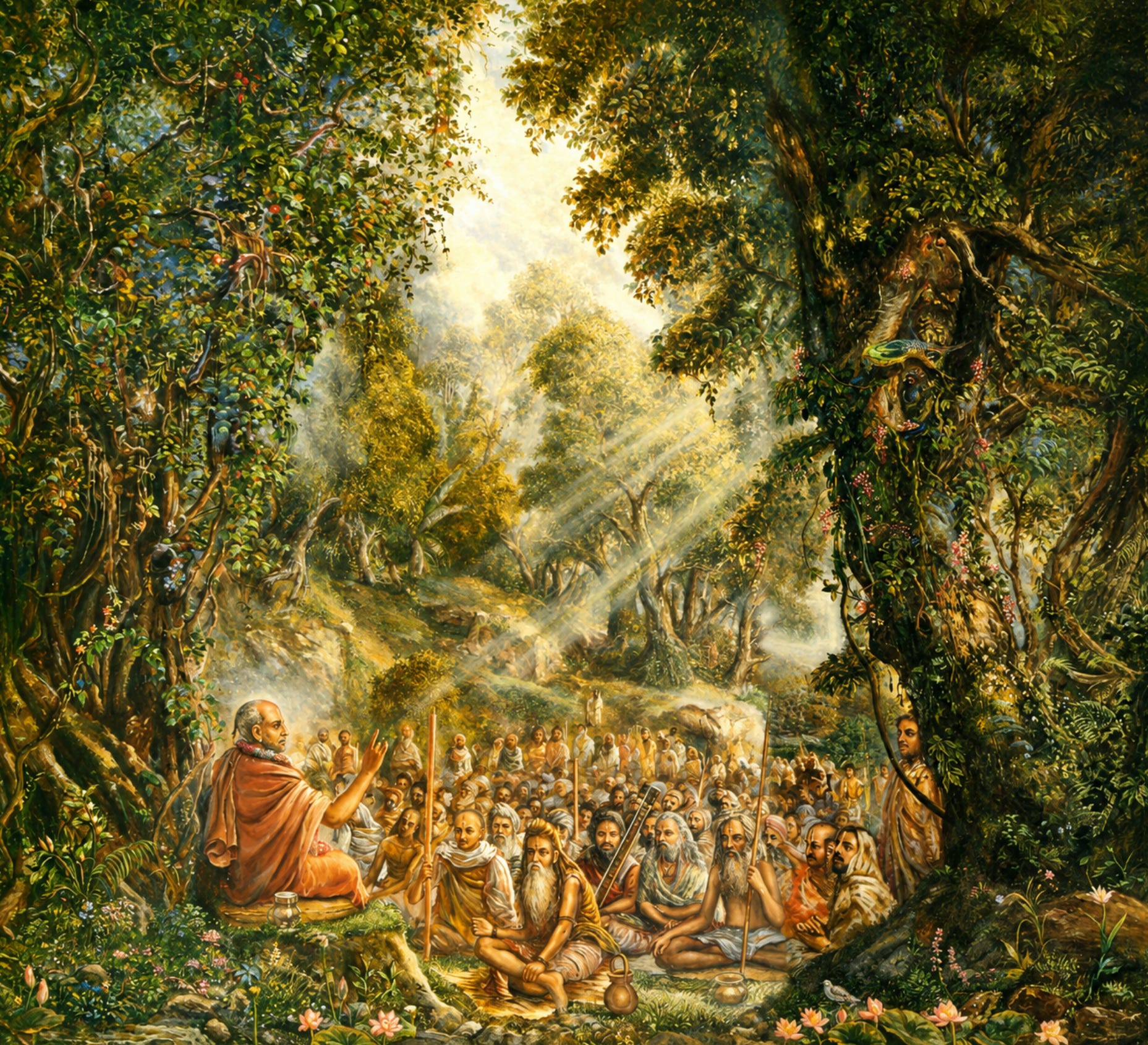
The sages at Naimisaranya: Were an assembly of 88,000 spiritual teachers, led by the prominent sage Shaunaka Rishi. who gathered in the sacred Naimisaranya forest in modern-day Uttar Pradesh, India.
Once, in a holy place in the forest of Naimiṣāraṇya, great sages headed by the sage Śaunaka assembled to perform a great thousand-year sacrifice for the satisfaction of the Lord and His devotees. (SB 1.1.4 )
The Arrival of Suta Goswami: While conducting their rituals, the storyteller and sage Suta Goswami arrived at the assembly and was warmly welcomed and given a high seat of honor (Vyasasana).
O expert and thoughtful men, relish Śrīmad-Bhāgavatam, the mature fruit of the desire tree of Vedic literatures. It emanated from the lips of Śrī Śukadeva Gosvāmī. Therefore this fruit has become even more tasteful, although its nectarean juice was already relishable for all, including liberated souls. (SB. 1. 1. 3 )
The Six Questions: Recognizing Suta Goswami’s pure character and deep scriptural knowledge, the sages asked him six fundamental questions regarding spiritual truth, which form the foundational framework of the
What is the absolute, ultimate benefit for all mankind?
What is the core essence hidden within all Vedic scriptures?
Why did the Supreme Lord take birth from Mother Devaki?
How do the secondary forms of the Lord (like Brahma and Rudra) create, maintain, and destroy the universe?
What are the complete activities and pastimes of Lord Hari’s various incarnations?
Where has true religion or spiritual shelter gone now that Lord Krishna has departed?
In the first chapter of the Śrīmad Bhagavatam, the sages ask Suta Goswami six questions. These questions are not only asked for the sage’s own sake. They are concerned about the situation of people who will be living in the age of Kali, and they want to get from Suta Goswami some knowledge that can help them find their way out of all the darkness and illusion of this age.
( Note; These six questions are asked in chapter one, and the answers are given in chapters two and three. These chapters are thus intimately connected.)