By the Lord’s Mercy

Having just attended the Ratha-yatra Festival in New York, my wife was reading to me from the Sri Caitanya-caritamrta some of Lord Caitanya’s pastimes. And there is this one very poignant sentence:

…By the Lord’s mercy one gets the association of a bona fide guru, and by the mercy of the guru, one gets a chance to render devotional service. Devotional service, the science of bhakti-yoga, carries one from this material world to the spiritual world. (from purport Madya-lila 13.18)

This sums up the benefits and results of devotional service or (bhakti-yoga).

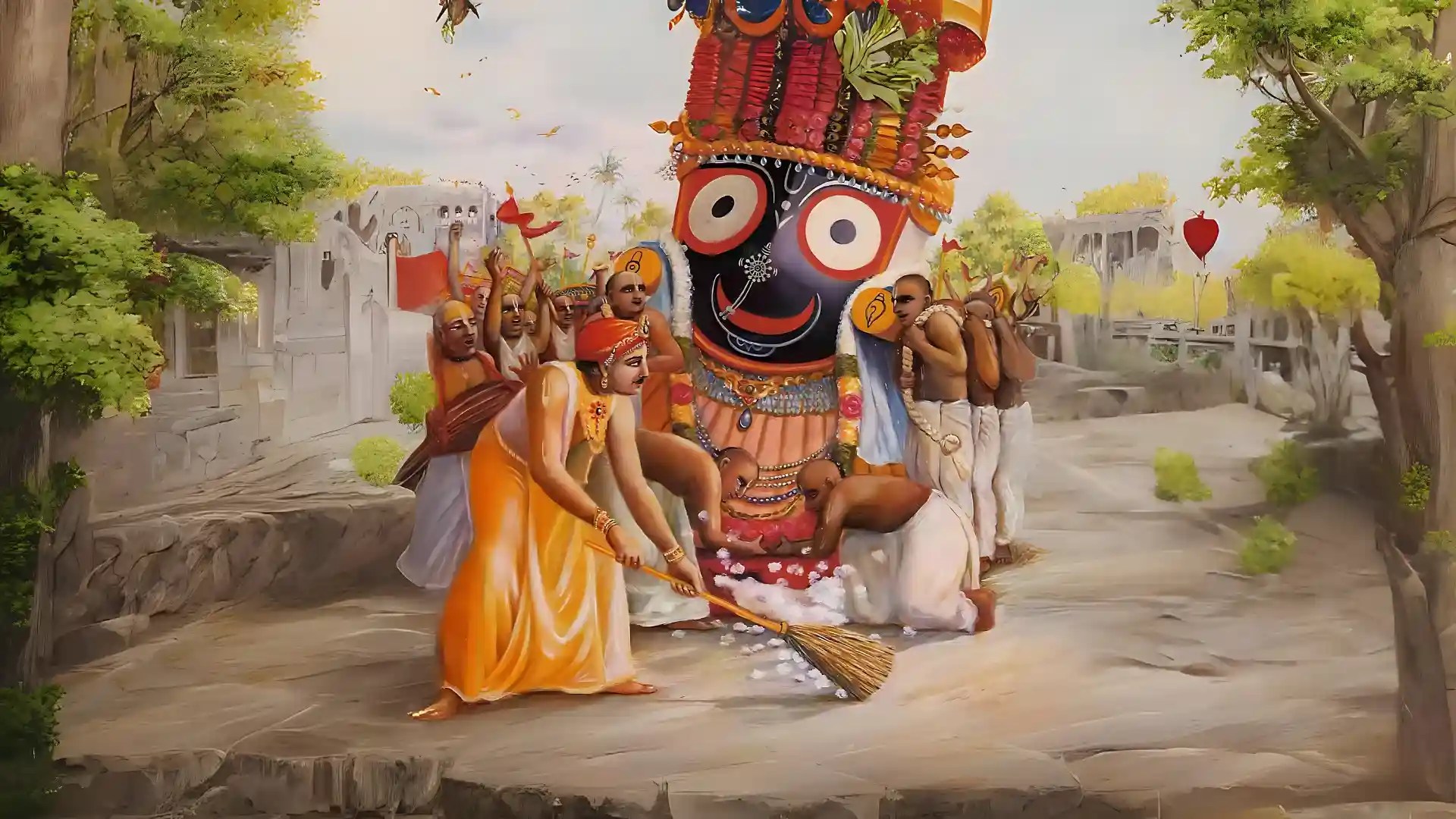
While the Lord was being carried from the throne to the car, King Prataparudra personally engaged in the Lord’s service by cleansing the road with a broom that had a golden handle. (Madhya-lila 13.15)

The King sprinkled the road with sandalwood-scented water. Although he was the owner of the royal throne, he engaged in menial service for the sake of Lord Jagannatha. (Madhya-lila 13.16)

Although the King was the most exalted respectable person, still he accepted menial service for the Lord; he, therefore, became a suitable candidate for receiving the Lord’s mercy. (Madhya-lila 13.17)

Upon seeing the King engaged in such menial service, Caitanya Mahaprabhu became very happy. Simply by rendering this service, the King received the mercy of the Lord. Madhya-lila 13.18)

PURPORT

More

New York Rathayatra Festival 2026

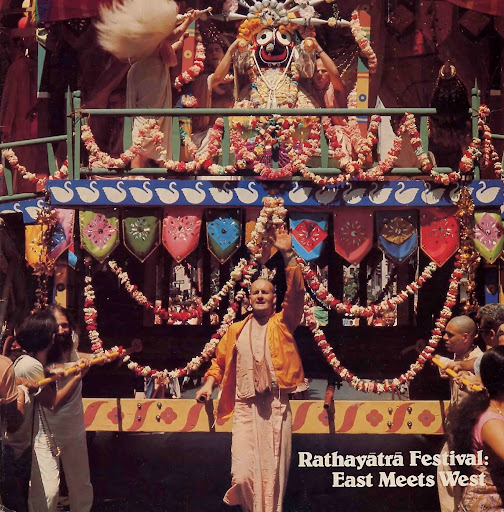
Today we are in New York City to celebrate the Rathayatra Festival. I am very excited because I last attended the NY festival 50 years ago in 1976 when the legendary Jayananda Thakur built the carts and Srila Prabhupada was carried down 5th Ave on Lady Subadra’s cart. It was a glorious day with ecstatic chanting, prasadam distribution, and a short lecture given by His Divine Grace at Washington Square park.

Interview with Jayananda Prabhu

(Back to Godhead magazine, June 1977)

BTG: Jayananda, how did you first get involved in Krishna consciousness?

Jayananda: I heard Srila Prabhupada speaking in San Francisco, and somehow I knew he didn’t want to cheat me. So I just wanted to work for him.

BTG: And now for ten years you’ve worked on the Ratha-yatra carts.

Jayananda: Yes.

BTG: What were the first Ratha-yatras like?

Jayananda: The first year, 1967, we just rented a flatbed truck and started out in the Haight-Ashbury district of San Francisco. We decorated the truck with flowers and put the Deities on the back, and the girls passed out fruit. A good crowd walked along with us at the beginning, and when we turned off Haight Street a smaller group of maybe fifty people came with us and we went all the way to the beach.

The second year (1968) we made our own cart, with saffron silk canopies, small ones. And we had the parade through Golden Gate Park to the beach. By that time the San Francisco temple had grown a little—we had maybe 30 devotees—and about 100 people came with us through the park. The chanting was very nice that year.

Then in 1969 we built a much bigger cart, with a tall silk canopy, like the ones they build in Jagannath Puri in India. But in 1970 we worked for two months straight and built the three big carts, basically the same ones we use now. Also, we had all kinds of publicity—TV, billboards, posters. And Srila Prabhupada came to that Ratha-yatra. So a lot of people came, maybe 12,000 people. It was big—a tremendous success. We had a few mishaps, though. One cart broke down in the middle of the parade. And it was a bitter cold day. But even though it was so cold at the beach, thousands of people stayed there with us and ate a lot of Krsna prasad (spiritual food offered to Krishna). We brought 20 50-gallon barrels of prasad, and they ate it all.

Later that year, the auditorium we used at the beach was torn down. So in 1971 we decided to end the parade in the park, at Lindley Meadow. That year and in 1972 and 1973, the parade was a little smaller than in 1970.

In 1974 Bhakta Das came to San Francisco to be temple president, and he decided to expand the Ratha-yatra. He spent more money on it than before, and maybe 20,000 people attended that year. The police remarked that we were the only group that could get such a large gathering together without creating a problem for them.

Srila Prabhupada came that year and gave a speech at the Meadow. He was sitting beneath the Jagannath Deities on Their opulent three-tiered stage. Even without much understanding everyone could appreciate that here was a majestic, awe-inspiring celebration. Another wonderful thing we started that year was the fairground-type booths at the Meadow. You could see the unlimited scope of the Vedic culture. We had a Deity worship booth, a transcendental art booth, a literature booth, and of course many booths selling food. Now that’s become a regular feature of the festival.

In 1975 I tried out making steel wheels, but the chariots were so heavy they flattened the steel and made the ride very bumpy for the Deities. So now we’re back to the standard wooden wheels.

BTG: What instructions has Srila Prabhupada given you about Ratha-yatra?

Jayananda: I never got much personal instruction. He just told me to make everything strong. I’m not a real visionary about it—I just built the carts.

BTG: Which Ratha-yatra do you think has been the best so far?

Jayananda: In New York last year (1976)—that was the most festive. Not until then had I experienced so many of the transcendental qualities of Ratha-yatra. You know—for a parade there’s nothing like Fifth Avenue; it’s the most important street in the world. And when we went to Washington Square Park to pull the carts home, hours after the parade had finished, thousands of people were still there chanting. They were everywhere. People were coming out of their apartments and coming out of bars shouting “Hare Krishna!” Only in New York could you get such a response.

BTG: Tell us, from your own experience, what the public gets out of Ratha-yatra.

Jayananda: The impact is so powerful that everyone’s affected. In New York there were thousands of people out on the streets, and they were astounded. It’s not that I’m claiming it; the people were interviewed on TV and that’s what they said. Also I remember one man with his girl friend (she didn’t like us at all) who told me some time after the festival that when he saw the carts coming down the street he felt a parade had just come down from heaven, and that he often remembers the carts and the chanting with pleasure.

So people are hit by it. It’s so far beyond their usual experience. You can’t measure the impact. All year long they do more or less the same things. Maybe they catch a few parades, like the Thanksgiving Day parade. They stand and watch some big balloons go by. But it’s all the same. Then, when you have a whole troupe of devotees singing and dancing around these lofty, transcendental chariots—then the people are transformed. They used to be mundane creatures, but when they see the Ratha-yatra, they’re angels. It brings out the best in people to see Lord Jagannath smiling at them. I tell you, at first their faces looked like they hadn’t changed in 25 years, and then all of a sudden it was like glass cracking, and you’d see the whole face transformed just by a few moment’s association.

And what to speak of those who take part?! Ratha-yatra encourages everybody to take part. “Come on, walk with us, dance, grab a rope and pull!” We don’t say, “Don’t touch.” No—”Join in, have fun.” By our nature we all want to participate. Nobody wants to be a bystander. And those who take part are purified of all their sinful karmic reactions just by chanting Hare Krishna and seeing Lord Jagannath.

BTG: Are there people who regard it as idol worship?

Jayananda: Yes—they may feel that before, but the impact of the festival is so strong that after it they feel otherwise. They see Lord Jagannath, and they see how merciful He is, and they can feel that it’s not idol worship. And if they read Srila Prabhupada’s books, then they’ll understand logically how Lord Jagannath is not an idol. Of course, at the festival there are always a few fault-finders. Last year in New York one of them had a bullhorn and was shouting, so one of our men poured water down it and that stopped him.

BTG: What is your understanding of the purpose of Ratha-yatra?

Jayananda: To celebrate the pastimes of Krishna. Krishna’s so kind; He comes to earth and displays so many wonderful pastimes. Ratha-yatra celebrates His going to Kuru-kshetra with Balaram and Subhadra, and His meeting there with the residents of Vrindavan, where He was born. The expressions of love shared between the Lord and His devotees make that one of the sweetest pastimes. Ratha-yatra offers a chance for so many people to be engaged in Krishna consciousness. People don’t come to our temples much, but millions are out on the streets. Now here’s a chance for them to advance in spiritual life—here comes Lord Jagannath’s festival! They’re touched—they become part of the transcendental vibration, and they’re purified.

Also, for the devotees it’s very beneficial—maybe more for me. Ratha-yatra is the service that’s given me so many of my realizations, the flowering of whatever Krishna consciousness I have. It’s not a long-term occupation. It happens all at once, like a big explosion, in the summer. It brings together so many devotees all working together under the spiritual master with one plan. And all the transcendental paraphernalia is there—the Deities, the prasad, the chanting, the booths, the theater—it’s such a surcharged atmosphere. You never forget it.

For a devotee to be able to participate in Ratha-yatra is very good for his Krishna consciousness. When you have these festivals, it gives you a big, powerful event to look forward to, and to work towards. It helps your devotion.

BTG: How about the future growth of Ratha-yatra?

Jayananda: One thing that’s important is that all the temples should celebrate this wonderful festival. But it isn’t practical for each center to construct three carts. So now in Los Angeles we’re putting together a traveling party that can go from city to city, with displays and carts that you can assemble and take apart. Then the great expense will be eliminated. Also, we’ll have year-round Ratha-yatras—the South in the winter, the North in the summer. It can be expanded so people will be hearing about Ratha-yatra all year round—and that will be the perfection of their lives!

BTG: It sounds wonderful! Thank you very much, Jayananda.

Jayananda: Thank you. Hare Krishna.

More
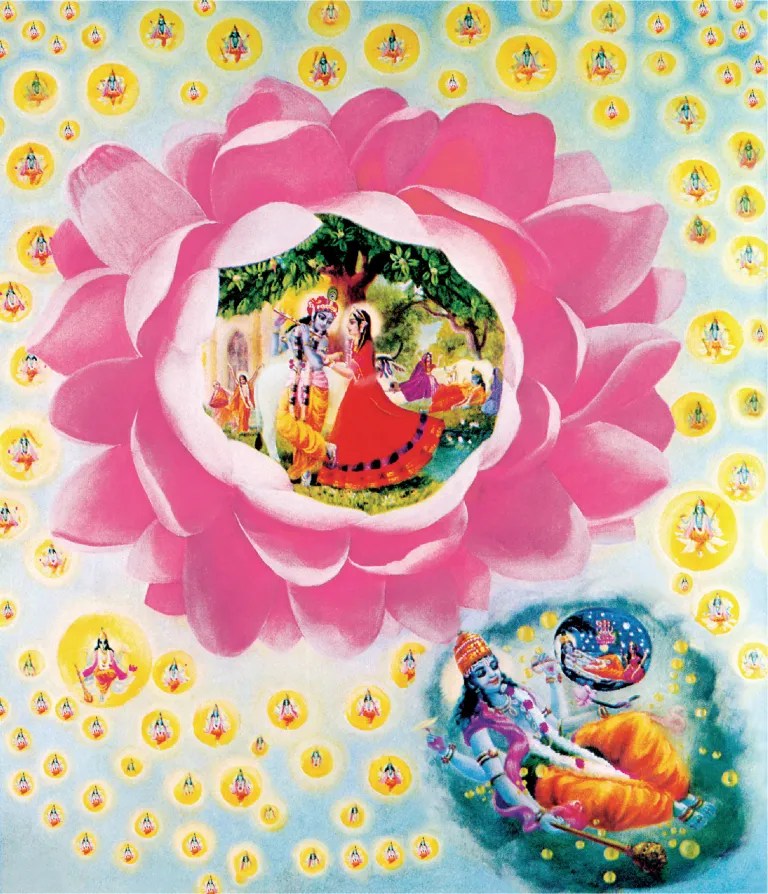
Ecatasy of Rememberance

I’m an old man now. Sometimes when I reminisce about my past, my life seems like a roller coaster ride of highs and lows, happiness and distress, gains and losses. Its the losses I remember the most, when I lost property, the house I built by hand, my wife and children, jobs, friends and loved one’s. Mostly is was my own undoing, I really can’t blame anyone but myself, because Srila Prabhupada has given us a rightous path to follow, if only I had stayed on the path.

I remember one day when it seemed I had lost everything again, and was helpless all around. I went over to my collection of Srila Prabhupada’s books, I closed my eyes and just randomly picked a book from the shelf. It was the First Canto Vol.1 of the Srimad Bhagavatam. I just blindly opened it and began to read from it. To my utter suprise, this is the verse and purport that was presented for me to read:

My dear Vyāsa, even though a devotee of Lord Kṛṣṇa sometimes falls down somehow or other, he certainly does not undergo material existence like others [fruitive workers, etc.] because a person who has once relished the taste of the lotus feet of the Lord can do nothing but remember that ecstasy again and again.” (Srimad Bhagavatam 1.5.19)

A devotee of the Lord, due to wrong association, sometimes imitates the fruitive workers… Such foolish devotees are sometimes put into difficulty by the Lord Himself. As a special favor, He may remove all material paraphernalia. By such action, the bewildered devotee is forsaken by all friends and relatives, and so he comes to his senses again by the mercy of the Lord and is set right to execute his devotional service. (from Purport)

Reading this Text and Purport saved me. And I remembered the ecstasy of coming to Krishna Consciousness, and chanting Hare Krishna, seeing the deities in the temple for the first time, going on Sankirtan, and meeting Srila Prabhupada. I was reminded of the love I have for him and my good fortune in receiving this knowledge, and it gave me the courage to again take to the path of devotion. Miracles can happen. Krishna sent me a boat, and I got in it again. Hare Krishna! -V

full text and purport

More

Torchlight of Knowledge

The very first verse in the Introduction to the Bhagavad-git As It, is this this very important prayer:

om ajñāna-timirāndhasya
jñānāñjana-śalākayā
cakṣur unmīlitaṁ yena
tasmai śrī-gurave namaḥ

I was born in the darkest ignorance, and my spiritual master opened my eyes with the torch of knowledge. I offer my respectful obeisances unto him.

I have always liked the simplicity of this verse, because that is exactly what Srila Prabhupada did when I read my first book. He opened my eyes with Knowledge.

…The Lord is the supreme spiritual master, and the bona fide representative of the Supreme Lord is also a spiritual master. The Lord from within enlightens the devotees by the effulgence of the nails of His lotus feet, and His representative, the spiritual master, enlightens from without. Only by thinking of the lotus feet of the Lord and always taking the spiritual master’s advice can one advance in spiritual life and understand Vedic knowledge.

yasya deve parā bhaktir yathā deve tathā gurau tasyaite kathitā hy arthāḥ prakāśante mahātmanaḥ (Śvetāśvatara Upaniṣad 6.23)

Thus the Vedas enjoin that for one who has unflinching faith in the lotus feet of the Lord, as well as in the spiritual master, the real import of Vedic knowledge can be revealed. (from purport SB 4.24.52)

“I was born in the darkest ignorance, and my spiritual master opened my eyes with the torch of knowledge. I offer my respectful obeisances unto him.” This gives the definition of the guru. Everyone is in the darkness of ignorance. Therefore everyone needs to be enlightened with transcendental knowledge. One who enlightens his disciple and saves him from rotting in the darkness of ignorance in this material world is a true guru.

More

The Essence of Everything is the Supreme Lord

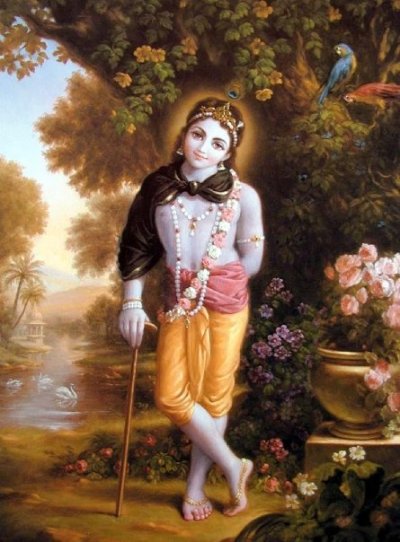
govinda with cows

click on image to enlarge

Sometimes when I am sitting and reading from Srila Prabhupada’s Srimad Bhagavatam, a verse or sentence from the purport just jumps out from the page almost like it is in 3D, and I catch a glimpse of what the Spiritual World must be like. It is beyond even my imagination, but sometimes I catch a glimmer of light, through a transcendental window, by the grace of my spiritual master His Divine Grace A. C. Bhaktivedanta Swami Prabhupada.

…The transcendental abode of the Lord where the trees are all desire trees and the buildings are made of touchstone. The Lord Govinda is engaged there in herding the surabhi cows as His natural occupation.

“I worship Govinda, the primeval Lord, the first progenitor who is tending the cows, yielding all desire, in abodes built with spiritual gems, surrounded by millions of purpose trees, always served with great reverence and affection by hundreds of thousands of lakṣmīs or gopīs.” (Bs 5.29)

…The Lord Govinda is engaged there in herding the surabhi cows as His natural occupation. And those who are artists, overtaken by the beautiful creation, should better see to the beautiful face of the Lord for complete satisfaction. The face of the Lord is the embodiment of beauty. What they call beautiful nature is but His smile, and what they call the sweet songs of the birds are but specimens of the whispering voice of the Lord.

More

Dissapearance Day of Jayananda Thakur


Remembering Jayananda
by Vyasasan das
__________________

There are some things about becoming a devotee I will never forget, for instance; receiving my first book, relishing my first plate of prasadam, seeing the deities in the temple for the first time, meeting Srila Prabhupada, Visnujhana Swami and Jayananda das bramachari.

The first time I meet Jayananda, was in 1975 in San Diego. I had been traveling with the RDTSKP for the last few months, since I joined. I was very much enjoying being a devotee, and traveling and putting on festivals, distributing prasadam, books and the Holy Name. By this time I had meet a number of Sannyasis; including Tamal Krsna Goswami, Gurudas Swami, Tripuari Swami, Vishnujana Swami, etc. and was very impressed by their character, and position.

One morning after Bhagavatam class we were all sitting down on the floor taking our breakfast. I was looking over at all the assembled sannyasis; there must have been seven of them eating together. They all had on nice orange clothing, and were eating off beautiful silver plates, and I was thinking, “Ya, that’s what I want. I want to be a Hare Krishna Sannyasa. Devotees will offer me respectful obeisances when they see me, and I will always get the best accommodations and best prasadam”. So I was thinking like this… when in walks in this guy in a greasy hooded sweatshirt, ripped doti, hands and face covered with dirt and grease, (it turns out he just changed the oil in 6 sankirtan vans), and he walks over to the prasadam table and starts filling a plate.

So I ask the devotee sitting next to me, “Who is that guy, is he supposed to be here?” I thought it was some bum wearing a dhoti. But the devotee replied; “Oh, that’s Jayananda Prabhu, he’s a really advanced devotee”. Well I was looking at Jayananda who was eagerly feasting on the morning prasadam, and I was looking over at the sannyasis who were carefully moving the prasadam around the silver plates, and I just wasn’t that sure?

As fate would have it, right after we finished our breakfast, I was told that I would be traveling with Jayananda. So with my head in hand I slowly went over to the sankirtan van he would be driving and opened the passenger side door. He greeted me with a huge radiant smile and an ear shattering “Hari Bol” and offered me some halava he had in a plastic bag. I liked him immediately. There was something about him that instilled me with faith and confidence. I couldn’t stop smiling the whole day as he told me stories about Srila Prabhupada, and his adventures when he was a taxi cab driver. As the weeks turned into months, I came to recognize that he was in fact a very advanced disciple of Srila Prabhupada.

He had such great love for Srila Prabhupada, and he worked all day every day, performing his service with such great joy and devotion. There was nothing he wouldn’t do, no service was beneath him. And it reminded me of a quote I read when I was back in college; that “The master is the servant in disguise”.

Meeting Jayananda das bramachari (as he was known back then), was a lesson to me; “Don’t judge a book by its cover”. On the outside he seemed a little tattered, but inside, he had a heart of gold. And I am reminded that when Srila Prabhupada was present, and when Krishna Himself was present, not everyone recognized that here is Krishna, here is God. Here is Srila Prabhupada; here is the pure devotee of the Lord. Similarly, I could not, with my materially motivated vision, recognize who is an advanced devotee. But the truth was revealed to me as I began my association with the legendary Jayananda Thakur.

In loving memory
Vyasasan das
May 25, 2010
(Disappearance day of Jayananda Prabhu)

More

The Humble Sage Sees With Equal Vision

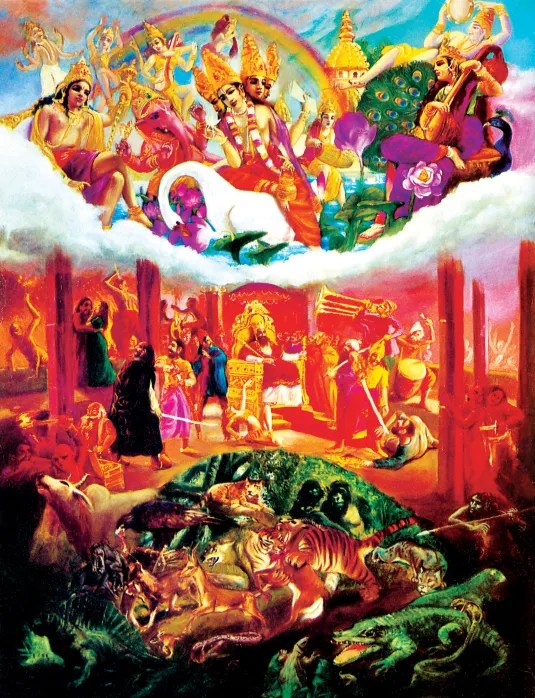
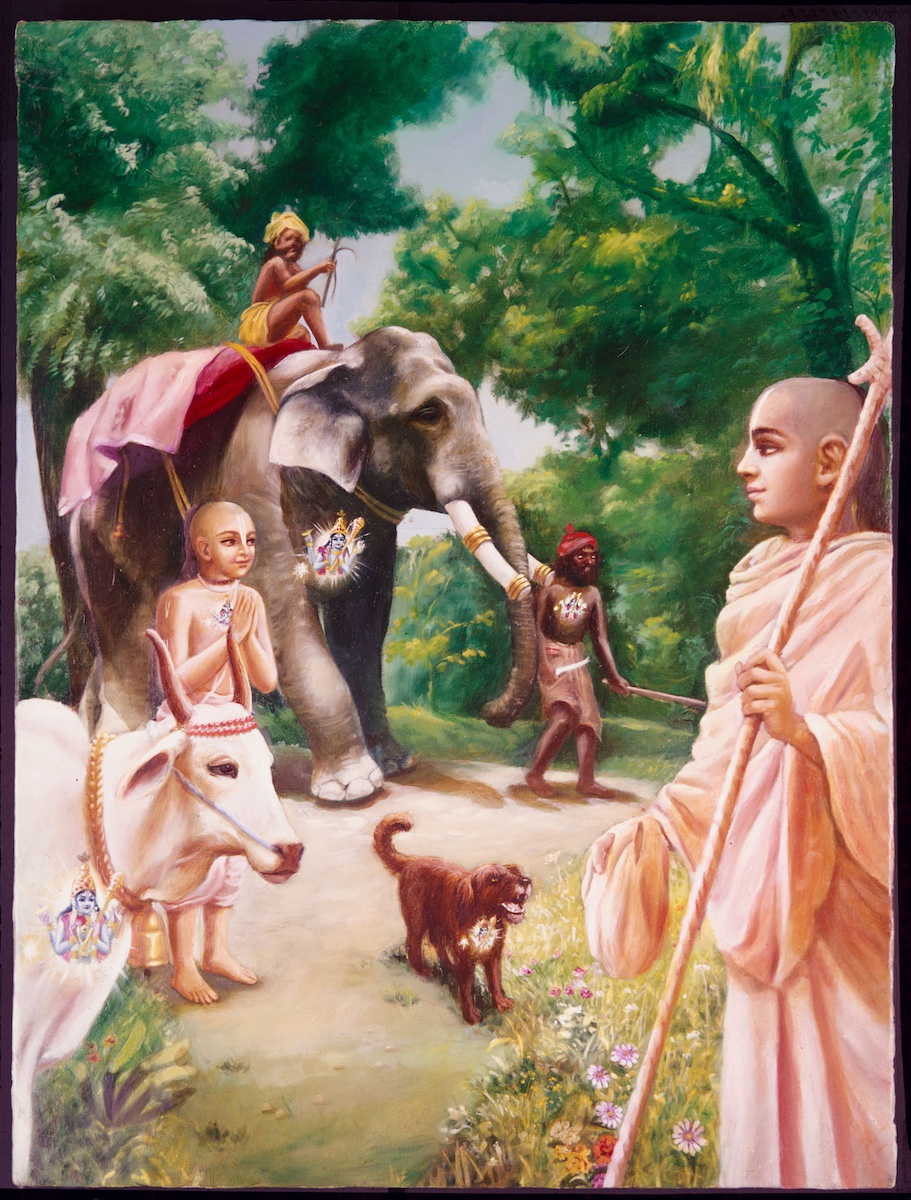
I remember the very first time I opened the Bhagavad-gita, I focused on the pictures and captions. I wasn’t really ready to read it yet, it seemed way above my level of intelligence, and there were words I couldn’t pronounce or understand, but the pictures spoke to me. I thought this image, as simplistic as it was, spoke a very profound and powerful message.

Bhagavad-gita As It Is

by A. C. Bhaktivedanta Swami Prabhupada

vidyā-vinaya-sampanne
brāhmaṇe gavi hastini
śuni caiva śva-pāke ca
paṇḍitāḥ sama-darśinaḥ

vidyā—education; vinaya—gentleness; sampanne—fully equipped; brāhmaṇe—in the brāhmaṇa; gavi—in the cow; hastini—in the elephant; śuni—in the dog; ca—and; eva—certainly; śvapāke—in the dog-eater (the outcaste); ca—respectively; paṇḍitāḥ—those who are so wise; sama-darśinaḥ—do see with equal vision.

TRANSLATION

The humble sage, by virtue of true knowledge, sees with equal vision a learned and gentle brāhmaṇa, a cow, an elephant, a dog and a dog-eater [outcaste]. (Bg 5.18)

PURPORT

A Kṛṣṇa conscious person does not make any distinction between species or castes. The brāhmaṇa and the outcaste may be different from the social point of view, or a dog, a cow, or an elephant may be different from the point of view of species, but these differences of body are meaningless from the viewpoint of a learned transcendentalist. This is due to their relationship to the Supreme, for the Supreme Lord, by His plenary portion as Paramātmā, is present in everyone’s heart. Such an understanding of the Supreme is real knowledge. As far as the bodies are concerned in different castes or different species of life, the Lord is equally kind to everyone because He treats every living being as a friend yet maintains Himself as Paramātmā regardless of the circumstances of the living entities. The Lord as Paramātmā is present both in the outcaste and in the brāhmaṇa, although the body of a brāhmaṇa and that of an outcaste are not the same. The bodies are material productions of different modes of material nature, but the soul and the Supersoul within the body are of the same spiritual quality. The similarity in the quality of the soul and the Supersoul, however, does not make them equal in quantity, for the individual soul is present only in that particular body, whereas the Paramātmā is present in each and every body. A Kṛṣṇa conscious person has full knowledge of this, and therefore he is truly learned and has equal vision. The similar characteristics of the soul and Supersoul are that they are both conscious, eternal and blissful. But the difference is that the individual soul is conscious within the limited jurisdiction of the body, whereas the Supersoul is conscious of all bodies. The Supersoul is present in all bodies without distinction.

The Sublime Mission of the International Society for Krishna Consciousness

His Divine Grace
A.C. Bhaktivedanta Swami Prabhupada

I have been carrying around a little piece of paper in my wallet, with the words yare dekha, tare kaha on it. I finally went to Vaniquotes to see what these words implied.

yāre dekha, tāre kaha ‘kṛṣṇa’-upadeśa āmāra ājñāya guru hañā tāra’ ei deśa (Cc Madhya 7.128)

“Instruct everyone to follow the orders of Lord Śrī Kṛṣṇa as they are given in the Bhagavad-gītā and Śrīmad-Bhāgavatam. In this way become a spiritual master and try to liberate everyone in this land.”

…the sublime mission of the International Society for Krishna Consciousness. Many people come and inquire whether they have to give up family life to join the Society, but that is not our mission. One can remain comfortably in his residence. We simply request everyone to chant the mahā-mantra: Hare Kṛṣṇa, Hare Kṛṣṇa, Kṛṣṇa Kṛṣṇa, Hare Hare/ Hare Rāma, Hare Rāma, Rāma Rāma, Hare Hare.

…The real purpose of human life is to attain the spiritual platform and return to Godhead. That is the summum bonum of spiritual realization. The Kṛṣṇa consciousness movement is trying to elevate human society to the perfection of life by pursuing the method described by Śrī Caitanya Mahāprabhu in His advice to the brāhmaṇa Kūrma. That is, one should stay at home, chant the Hare Kṛṣṇa mantra and preach the instructions of Kṛṣṇa as they are given in the Bhagavad-gita and Srimad Bhagavatam. (from purport)

“Whomever you meet, simply talk with him about the instructions given by Kṛṣṇa or tell him of narrations about Kṛṣṇa.” (SB 4.23.38)

More

A whole Civilization Will Die Tonight

I am sure by now, everyone has heard about Donald Trumps tweets from his social media.

I really don’t want to focus my attention on such insane speak, but it was to horrific to ignore.

“A whole civilization will die tonight, never to be brought back again” (April 7)

A civilization that has been around for some 5,000 years, since the time of the Pandavas. It is simply madness. And can only be described as demonic behavior.

From the pages of the Bhagavad-gita, there is a description of the demoniac personality…

The demoniac person thinks: “So much wealth do I have today, and I will gain more according to my schemes. So much is mine now, and it will increase in the future, more and more. He is my enemy, and I have killed him; and my other enemy will also be killed. I am the lord of everything, I am the enjoyer, I am perfect, powerful and happy. I am the richest man, surrounded by aristocratic relatives. There is none so powerful and happy as I am. I shall perform sacrifices, I shall give some charity, and thus I shall rejoice.” In this way, such persons are deluded by ignorance. (Bg 16. 13-14)

Following such conclusions, the demoniac, who are lost to themselves and who have no intelligence, engage in unbeneficial, horrible works meant to destroy the world. (Bg 16.9)

full text and purports

More

Material and Spiritual Worlds

I am often of two minds. As a practicing devotee, I know that I should focus my mind on spiritual matters, but I am also living in this material world in a material body. Therefore much of my time and energy is engaged in material activities, like watching world news for example. It is like driving by a roadside accident and wanting to look at the damage, but knowing I should keep my eyes on the road.

I try to understand that “I am not this body, I am Spirit soul” and yet every day I feel the pains of ageing. I try to focus on the teachings of the Bhagavad-gita and the Srimad Bhagavatam, but my mind is drawn to events of this world. My heart aches for the suffering of others, and my only solace is the teachings of the Bhagavad-gita and Srimad Bhagavatam.

In Bhagavad-gītā it is stated that one who is advanced in spiritual knowledge is not disturbed by the pains and pleasures of the material body. The material body is completely separate from the spirit soul, and the pains and pleasures of the body are superfluous. The practice of austerity and penance is meant for understanding the distinction between the body and the soul and how the soul can be unaffected by the pleasures and pains of the body…” (from purport SB 5.10.9)

Everyone in this material world is distressed by miserable conditions, but Śrīla Prabodhānanda Sarasvatī says that this world is full of happiness. How is this possible? He answers, yat-kāruṇya-katākṣa-vaibhavavatāṁ taṁ gauram eva stumaḥ. A devotee accepts the distress of this material world as happiness only due to the causeless mercy of Śrī Caitanya Mahāprabhu. By His personal behavior, Śrī Caitanya Mahāprabhu showed that He was never distressed but always happy in chanting the Hare Kṛṣṇa mahā-mantra. One should follow in the footsteps of Śrī Caitanya Mahāprabhu and engage constantly in chanting the mahā-mantra—Hare Kṛṣṇa, Hare Kṛṣṇa, Kṛṣṇa Kṛṣṇa, Hare Hare/ Hare Rāma, Hare Rāma, Rāma Rāma, Hare Hare. Then he will never feel the distresses of the world of duality. In any condition of life one will be happy if he chants the holy name of the Lord. (from purport SB 6.17.30)

One should live in the material world very expertly. The material world is known as the world of duality because one sometimes has to act impiously and sometimes has to act piously. Although one does not want to act impiously, the world is so fashioned that there is always danger (padaṁ padaṁ yad vipadām [SB 10.14.58]). Thus even when performing devotional service a devotee has to create many enemies. Prahlāda Mahārāja himself had experience of this, for even his father became his enemy. A devotee should expertly manage to think always of the Supreme Lord so that the reactions of suffering cannot touch him (from purport SB 7.10.13)

Trying to advance in spiritual life outside the association of fellow devotees can be difficult. the Sanskrit word Smṛtyā means remembering Kṛṣṇa always. Life should be molded in such a way that one cannot remain alone without thinking of Kṛṣṇa. We should live in Kṛṣṇa so that while eating, sleeping, walking and working we remain only in Kṛṣṇa. Our Kṛṣṇa consciousness society recommends that we arrange our living so that we can remember Kṛṣṇa. (from purport SB 4.22.24)

Or as I like to say: “Its Drama or its Rama”

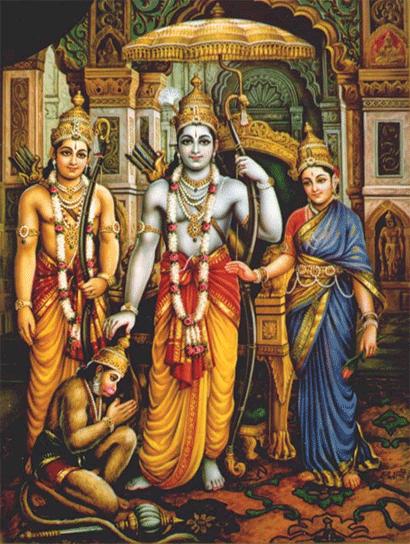
Appearance of Lord Ramacharya (Rama Navami)

So today marks the appearance day of Lord Ramacandra, otherwise known as Rama-Navami. We honor it with a full day fast, followed by an nice vegetarian feast. It is nice to remember the Lord by extra chanting of His holy names, and with readings throughout the day of the glorious pastimes of the Lord.

Ramachandra, or Lord Rama, is one of Krishna’s many avatars on earth. He appeared during a previous age, Treta-yuga, and ruled as emperor of the world. A chronicle of His activities is presented extensively in the epic Ramayana, and concisely in the ninth canto of the Srimad-Bhagavatam, a biography of Krishna’s many incarnations.

Ramachandra’s life is considered to be exemplary in every way. Followers of India’s Vedic culture see Him as the ideal king, the most powerful warrior, and the most faithful husband. It is said that He ruled His kingdom just as a loving father cares for his children. Lord Rama’s nobility, integrity, decency, and virtue are spoken of with reverence even today.

He appeared as the eldest son of Maharaja Dasarath, along with brothers Bharata, Lakshmana, and Shatrughna—also incarnations of the Supreme Person. He married Sita devi, daughter of King Janaka, after breaking the bow of Siva in the contest for Sita’s hand. On the day of Ramachandra’s coronation, however, due to royal intrigue, He was banished to the forest for fourteen years, and Lakshmana and Sita accompanied Him there.

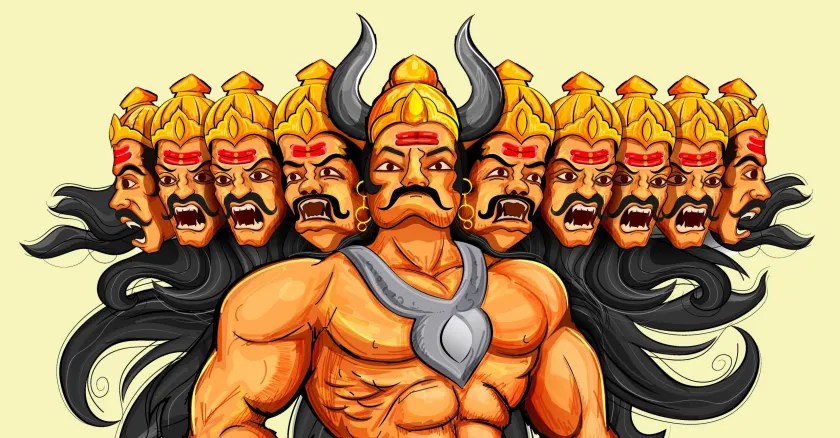
Ravana, king of Lanka, kidnapped Sita when Rama was absent from Their forest home. Subsequently, Rama and Lakshmana organized an army of forest-dwelling simians, vanaras—including the great devotee Hanuman— to attack Lanka. He then killed Ravana, rescued Sita, and triumphantly returned to His capital city, Ayodhya.

In the eighteenth incarnation, the Lord appeared as King Rāma. In order to perform some pleasing work for the demigods, He exhibited superhuman powers by controlling the Indian Ocean and then killing the atheist King Rāvaṇa, who was on the other side of the sea.” (Srimad Bhagavatam 1.3.22)

Full text and purport

More

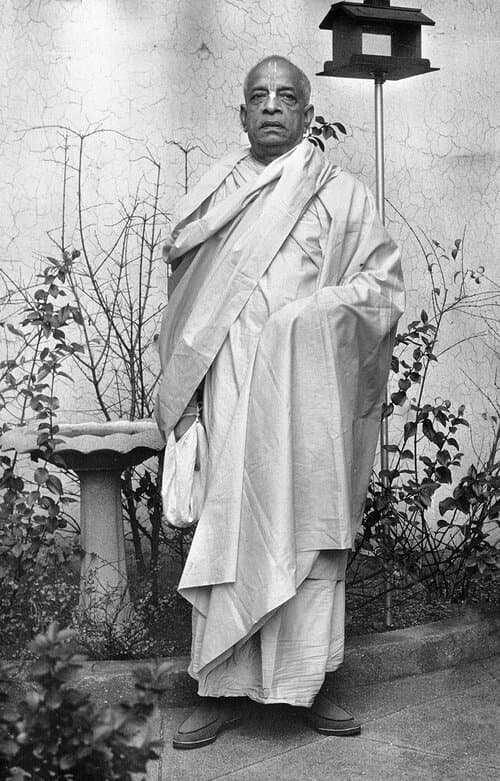
His Divine Grace A.C. Bhaktivedanta Swami Prabhupada

His Divine Grace A.C. Bhaktivedanta Swami Prabhupada
Founder-Acarya of the International Society for Krishna Consciousness

“He lives forever by his divine instruction, and the followers live with him”

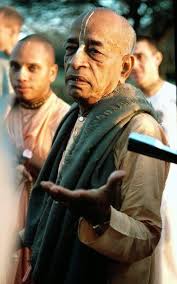
His Divine Grace A.C. Bhaktivedanta Swami Prabhupada (1896-1977), Founder-Acharya of the International Society for Krishna Consciousness, otherwise knon as The Hare Krishna Movement, and affectionately know as Srila Prabhupada by his followers, is the extraordinary person who dedicated his life to teaching the world about Krishna consciousness, ancient India’s most noble message of spiritual wisdom.

In 1965, at the age of 69, on the order of his spiritual master Srila Bhaktisiddhanta Saraswati Thakura, representing a line of teachers dating back to Lord Krishna Himself, Srila Prabhupada sailed from India to New York to share Lord Krishna’s message.

This English translation and commentary is the work of His Divine Grace A. C. Bhaktivedanta Swami Prabhupada, the world’s most distinguished scholar and teacher of Indian religious and philosophical thought. He himself is a disciplic descendant of Sri Caitanya, and his intimate familiarity with the precepts of Caitanya Mahaprabhu eminently qualifies him to present this important classic to the English-speaking world. The ease and clarity with which he expounds upon Sri Caitanya’s precepts lures even a reader totally unfamiliar with Indian religious tradition into a genuine understanding and appreciation of this profound and monumental work.

Srila Prabhupada himself considered his most important work to be the translation and publishing of his books. From the period of 1966 till 1977, Srila Prabhupada translated and wrote purports to nearly all of the 18,000 verses of Srimad-Bhagavatam, 700 verses of Bhagavad-gita, and 17 volumes of Sri Caitanya-caritamrita. He published a monthly magazine, Back to Godhead, which at one point was distributed in excess of one million copies per month. His published books number 160. Millions of copies have been distributed around the world in 28 major languages. Highly respected by academicians for their authoritativeness, depth and clarity, they are used as standard course material in numerous colleges and universities in India and the USA. In 1972, Srila Prabhupada founded The Bhaktivedanta Book Trust for publishing his works exclusively, and The Bhaktivedanta Book Trust went on to become the world’s largest publisher of books in the field of Indian religion and philosophy.

Goloka Vrndavana

Sharma-village-cows-krishna-gopies-gopas-gopas-cowherd-men

click on beautiful image to enlarge

This morning as I was finishing the Tenth Chapter of the Second Canto, the following verse and purport jumped out at me from the pages. And I realized for the thousandth time, what great good fortune we have in that we can hear directly from the pure devotee of the Lord, about the eternal pastimes of the Lord, through the pages of the Srimad Bhagavatam.

Of the three types of Transcendentalist’s, namely the jñānī, the yogī and the bhakta, or the impersonalist, the meditator and the devotee. It is only the devotee who can factually know the Lord as He is and thus be trained in the bona fide service of the Lord and be allowed to enter into the direct association of the Lord in so many capacities. The highest glorious association with the Lord is made possible in the planet of Goloka Vṛndāvana, where Lord Kṛṣṇa enjoys Himself with the gopīs and His favorite animals, the surabhi cows.

… The impersonalist is satisfied simply by understanding the all-pervasive influence of the Lord. This is called Brahman realization. Greater than the impersonalist is the mystic who sees the Lord situated in his heart as Paramātmā, the partial representation of the Lord. But there are pure devotees who take part in the direct pleasure (ānanda) potency of the Lord by factual reciprocation of loving service. The Lord in His abode called the Vaikuṇṭha planets, which are eternal manifestations, always remains with His associates and enjoys transcendental loving services by His pure devotees in different transcendental humors.

So we are pleased to present the following Texts and Purports

More

Eternal Servants (Sanatana-dharma)

click on image to enlarge

I remember some years ago (1979), Bob Dylan released this song entitled “Gotta Serve Somebody”. I’m sure many of you remember it.

[Chorus]
But you’re going to have to serve somebody, yes indeed
You’re going to have to serve somebody
Well, it may be the devil or it may be the Lord
But you’re going to have to serve somebody

I chose to serve the Lord, Krishna. Service ts our eternal nature, our dharma. And like Bob says “You’re going to have to serve somebody”

The following are some quotes from the Srimad Bhagavatam, ant the Bhagavad-gita, on our eternal relationship (sanātana-dharma) with the Lord.

At the last stage of one’s life, one should be bold enough not to be afraid of death. But one must cut off all attachment to the material body and everything pertaining to it and all desires thereof. (SB 2.1.15)

The foolishness of gross materialism is that people think of making a permanent settlement in this world, although it is a settled fact that one has to give up everything here that has been created by valuable human energy. Great statesmen, scientists, philosophers, etc., who are foolish, without any information of the spirit soul, think that this life of a few years only is all in all and that there is nothing more after death. This poor fund of knowledge, even in the so-called learned circles of the world, is killing the vitality of human energy, and the awful result is being keenly felt. And yet the foolish materialistic men do not care about what is going to happen in the next life. The preliminary instruction in the Bhagavad-gītā is that one should know that the identity of the individual living entity is not lost even after the end of this present body, which is nothing but an outward dress only. As one changes an old garment, so the individual living being also changes his body, and this change of body is called death. Death is therefore a process of changing the body at the end of the duration of the present life. An intelligent person must be prepared for this and must try to have the best type of body in the next life. The best type of body is a spiritual body, which is obtained by those who go back to the kingdom of God or enter the realm of Brahman. (from purport)

Full text and purports

More

Good and Evil

This morning as I was waking up, I was reminded that just yesterday, America and Israel declared war on Iran.

As much as I would like not to meditate on politics, it almost seems unavoidable, because it affects us all.

People are suffering, and starving and dying everyday in places like Ukraine, Gaza, Venezuela, Iran, and not to mention thousands of other places in the world.

It is too easy to just look away, and write it off as Karma.

As a devotee, I try to see this world through the lens of the Vedas, particularly the Bhagavad-gita and the Srimad Bhagavatam.

And I was thinking how different we all are, but connected as well; brothers and sisters, parents and children, friends and neighbors. All connected like drops of water in the ocean, or sparks from the same fire.

I went to the seventh chapter of the Bhagavad-gita, entitled “Knowledge of the Absolute”, in hopes of a better understanding of world events.

na māṁ duṣkṛtino mūḍhāḥ
prapadyante narādhamāḥ
māyayāpahṛta-jñānā
āsuraṁ bhāvam āśritāḥ

na—not; mām—unto Me; duṣkṛtinaḥ—miscreants; mūḍhāḥ—foolish; prapadyante—surrender; narādhamāḥ—lowest among mankind; māyayā—by the illusory energy; apahṛta—stolen by illusion; jñānāḥ—knowledge; asuram—demonic; bhāvam—nature; āśritāḥ—accepting.

TRANSLATION

Those miscreants who are grossly foolish, lowest among mankind, whose knowledge is stolen by illusion, and who partake of the atheistic nature of demons, do not surrender unto Me. (Bg. 7.15)

PURPORT

More

Perfection of All Yogas

When we speak of yoga we refer to linking up our consciousness with the Supreme Absolute Truth. Such a process is named differently by various practitioners in terms of the particular method adopted. When the linking up process is predominantly in fruitive activities, it is called karma-yoga, when it is predominantly empirical, it is called jñāna-yoga, and when it is predominantly in a devotional relationship with the Supreme Lord, it is called bhakti-yoga. Bhakti-yoga or Kṛṣṇa consciousness is the ultimate perfection of all yogas, as will be explained in the following verse.

And of all yogīs, he who always abides in Me with great faith, worshiping Me in transcendental loving service, is most intimately united with Me in yoga and is the highest of all. (Bhagavad-gita 6.47)

The culmination of all kinds of yoga practices lies in bhakti-yoga. All other yogas are but means to come to the point of bhakti in bhakti-yoga. Yoga actually means bhakti-yoga; all other yogas are progressions toward the destination of bhakti-yoga. From the beginning of karma-yoga to the end of bhakti-yoga is a long way to self-realization. Karma-yoga, without fruitive results, is the beginning of this path. When karma-yoga increases in knowledge and renunciation, the stage is called jñāna-yoga. When jñāna-yoga increases in meditation on the Supersoul by different physical processes, and the mind is on Him, it is called aṣṭāṅga-yoga. And, when one surpasses the aṣṭāṅga-yoga and comes to the point of the Supreme Personality of Godhead Kṛṣṇa, it is called bhakti-yoga, the culmination. Factually, bhakti-yoga is the ultimate goal, but to analyze bhakti-yoga minutely one has to understand these other yogas. The yogī who is progressive is therefore on the true path of eternal good fortune. One who sticks to a particular point and does not make further progress is called by that particular name: karma-yogī, jñāna-yogī or dhyāna-yogī, rāja-yogī, haṭha-yogī, etc. If one is fortunate enough to come to the point of bhakti-yoga, it is to be understood that he has surpassed all the other yogas. Therefore, to become Kṛṣṇa conscious is the highest stage of yoga, just as, when we speak of Himalayan, we refer to the world’s highest mountains, of which the highest peak, Mount Everest, is considered to be the culmination.

Full text and purport

More

The Song of God

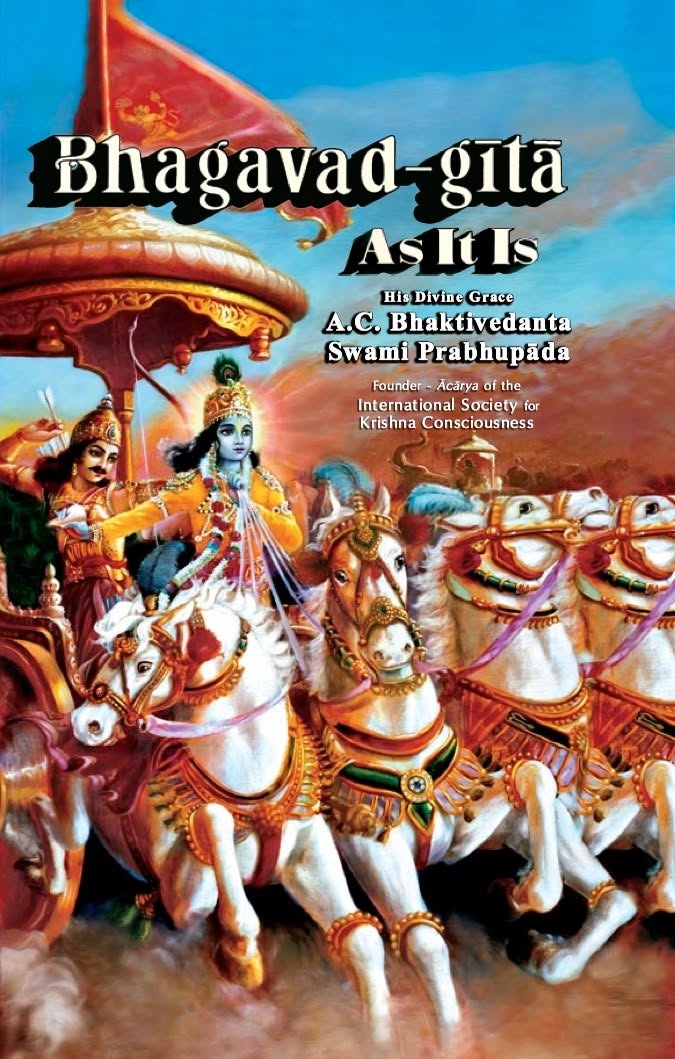
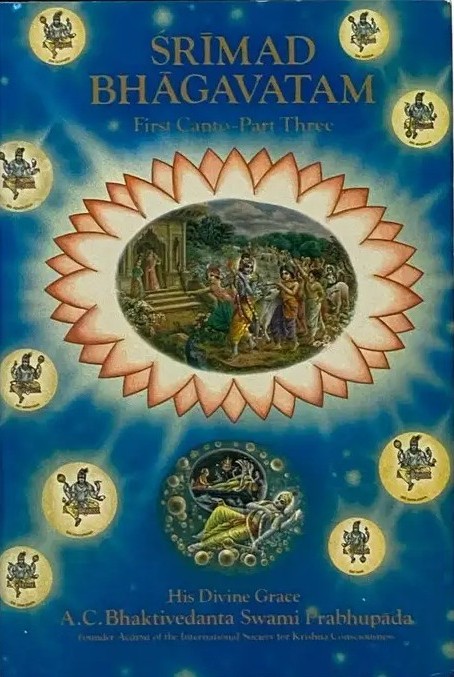
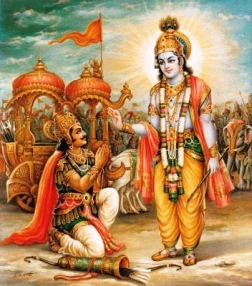
Whenever I think about the Bhagavad-gita, this image comes to mind. It is the “Song of God”, the words spoken by the Supreme Personality of Godhead to His dear friend and disciple Arjuna.

Bhagavad-gītā As It Is 1972 Edition
By His Divine Grace A. C. Bhaktivedanta Swami Prabhupāda
Chapter Ten, Text 12-13

arjuna uvāca

paraṁ brahma paraṁ dhāma
pavitraṁ paramaṁ bhavān
puruṣaṁ śāśvataṁ divyam
ādi-devam ajaṁ vibhum

āhus tvām ṛṣayaḥ sarve
devarṣir nāradas tathā
asito devalo vyāsaḥ
svayaṁ caiva bravīṣi me

Arjuna said: You are the Supreme Brahman, the ultimate, the supreme abode and purifier, the Absolute Truth and the eternal divine person. You are the primal God, transcendental and original, and You are the unborn and all-pervading beauty. All the great sages such as Nārada, Asita, Devala, and Vyāsa proclaim this of You, and now You Yourself are declaring it to me.

PURPORT

In these two verses the Supreme Lord gives a chance to the modern philosopher, for here it is clear that the Supreme is different from the individual soul. Arjuna, after hearing the essential four verses of Bhagavad-gītā in this chapter, became completely free from all doubts and accepted Kṛṣṇa as the Supreme Personality of Godhead. He at once boldly declares, “You are Parambrahma, the Supreme Personality of Godhead.” And previously Kṛṣṇa states that He is the originator of everything and everyone. Every demigod and every human being is dependant on Him. Men and demigods, out of ignorance, think that they are absolute and independant of the Supreme Lord Kṛṣṇa. That ignorance is removed perfectly by the discharge of devotional service. This is already explained in the previous verse by the Lord. Now by His grace, Arjuna is accepting Him as the Supreme Truth, in concordance with the Vedic injunction. It is not because Kṛṣṇa is an intimate friend of Arjuna that he is flattering Him by calling Him the Supreme Personality of Godhead, the Absolute Truth. Whatever Arjuna says in these two verses is confirmed by Vedic truth. Vedic injunctions affirm that only one who takes to devotional service to the Supreme Lord can understand Him, whereas others cannot. Each and every word of this verse spoken by Arjuna is confirmed by Vedic injunction.

More

Srimad Bhagavatam 7.5.23-24

The following is one of the most quoted verses by Srila Prabhupada, from the Srimad Bhagavatam, and it is also one of the longest purports as well. Very important verse!

śravaṇaṁ kīrtanaṁ viṣṇoḥ
smaraṇaṁ pāda-sevanam
arcanaṁ vandanaṁ dāsyaṁ
sakhyam ātma-nivedanam

iti puṁsārpitā viṣṇau
bhaktiś cen nava-lakṣaṇā
kriyeta bhagavaty addhā
tan manye ‘dhītam uttamam

śrī-prahrādaḥ uvācaPrahlāda Mahārāja said; śravaṇamhearing; kīrtanamchanting; viṣṇoḥ—of Lord Viṣṇu (not anyone else); smaraṇamremembering; pāda-sevanamserving the feet; arcanamoffering worship (with ṣoḍaśopacāra, the sixteen kinds of paraphernalia); vandanaṁoffering prayers; dāsyambecoming the servant; sakhyambecoming the best friend; ātma-nivedanamsurrendering everything, whatever one has; iti—thus; puṁsā arpitā—offered by the devotee; viṣṇau—unto Lord Viṣṇu (not to anyone else); bhaktiḥ—devotional service; cet—if; nava-lakṣaṇā—possessing nine different processes; kriyeta—one should perform; bhagavatiunto the Supreme Personality of Godhead; addhā—directly or completely; tat—that; manyeI consider; adhītamlearning; uttamamtopmost.

Prahlāda Mahārāja said: Hearing and chanting about the transcendental holy name, form, qualities, paraphernalia and pastimes of Lord Viṣṇu, remembering them, serving the lotus feet of the Lord, offering the Lord respectful worship with sixteen types of paraphernalia, offering prayers to the Lord, becoming His servant, considering the Lord one’s best friend, and surrendering everything unto Him (in other words, serving Him with the body, mind and words)—these nine processes are accepted as pure devotional service. One who has dedicated his life to the service of Kṛṣṇa through these nine methods should be understood to be the most learned person, for he has acquired complete knowledge.

When Prahlāda Mahārāja was asked by his father to say something from whatever he had learned, he considered that what he had learned from his spiritual master was the best of all teachings…(from purport)

Full text and purport

More

The Bhagavad-gita in Ten Points

Thank you to whoever posted this on Facebook. I didn’t catch the name of person posting this, but this is real good!

THE BHAGAVAD GITA IN TEN POINTS

On July 13, 1947 Srila Prabhupada wrote a letter to Raja Mohendra Pratap and explained the Bhagavad-gita to him in ten points. The following is Srila Prabhupada’s summary of ten conclusions in the Bhagavad-gita.


1) God is one and everything is in Him and He is in everything.

2) To render transcendental service unto God is to serve everything that be, just like to water the root of the tree is to water the different branches and numerous leaves of the tree or to supply food to the stomach is to vitalize all the senses and the sense organs of the body.

3) The parts are automatically served when the Whole is served but when the parts are served the whole may not be served or not served at all.

4) The parts and the Whole being eternally related, it is the eternal duty of the parts to render service unto the Whole.

5) A recipient of the services of the parts, God’s sat-cit-ananda vigraha, i.e., the all-attractive Cognizant and all-blissful Personality eternal. He can reveal Himself by His own potency without any help of the external potency called maya in order to be cognizable by the limited potency of the parts and as such He is not only the greatest of all but he is the smallest of all. That is His prerogative.

6) He is better realized when He by His causeless mercy agrees to descend in this mortal world but He is never realized by the partial speculations of the empiric philosophers, however systematic and long-termed it may be.

7) Sri Krishna is the Personality of Godhead and is the Summum Bonum Cause of all Causes proved by fact and figures in the statement of Bhagavad-gita, but He reserves the right of not being exposed to the sensual speculations of the empiric philosophers.

One should therefore surrender unto Him if one wants to know Him as He is and that is the real process to approach the Infinite by the infinitesimals.

9) Sri Krishna is easily available by the religion of love, i.e., by love and service as conceived by the damsels of Vraja who had practically no education whatsoever and much less any claim for high class birthright.

10) The highest service that can be rendered to the mankind is, therefore, to preach the philosophy and religion of Bhagavad-gita for all the times, all the places and all the people.

Happy New Year!

Happy New Year to all are readers. Wishing you all a prosperous new year filled with happiness and love. And may your Krishna Consciousness increase with each passing day.

When I think of New Years, I am reminded of what a short time a year is in the greater scheme of eternity. In the Bhagavad-gita there is a brief description of the duration of time in the material universe.

…The duration of the material universe is limited. It is manifested in cycles of kalpas. A kalpa is a day of Brahmā, and one day of Brahmā consists of a thousand cycles of four yugas or ages: Satya, Tretā, Dvāpara, and Kali. The cycle of Satya is characterized by virtue, wisdom and religion, there being practically no ignorance and vice, and the yuga lasts 1,728,000 years. In the Tretā-yuga vice is introduced, and this yuga lasts 1,296,000 years. In the Dvāpara-yuga there is an even greater decline in virtue and religion, vice increasing, and this yuga lasts 864,000 years. And finally in Kali-yuga (the yuga we have now been experiencing over the past 5,000 years) there is an abundance of strife, ignorance, irreligion and vice, true virtue being practically nonexistent, and this yuga lasts 432,000 years. (from purport Bg 8.17)

Even if I could grasp the extent of time in the material universe, that is just a fraction of the unlimited eternal time that continues after the termination of the yuga.

…Then the process is set rolling again. These four yugas, rotating a thousand times, comprise one day of Brahmā, the creator god, and the same number comprise one night. Brahmā lives one hundred of such “years” and then dies. These “hundred years” by earth calculations total to 311 trillion and 40 million earth years. By these calculations the life of Brahmā seems fantastic and interminable, but from the viewpoint of eternity it is as brief as a lightning flash. In the causal ocean there are innumerable Brahmās rising and disappearing like bubbles in the Atlantic. Brahmā and his creation are all part of the material universe, and therefore they are in constant flux. (from purport Bg 8.17)

The above calculations Srila Prabhupada uses and I quote;

…seems fantastic and interminable, but from the viewpoint of eternity it is as brief as a lightning flash.

Wow!

Previous Older Entries

108 Imporant Slokas from the 1972 Bhagavad-gita As It Is

Click on image to go to Post

Click on image to go to Post

The Hare Krishna Cookbook

Songs of the Vaisnava Acaryas

Bhagavad-gita As It Is 1972 Edition “Online”

click on image

click on image to visit site

Srimad Bhagavatam Online

click on image

Raja-Vidya the King of Knowledge

click on image

click on image

Blog Stats

  • 4,729,477 hits

Enter your email address to subscribe to this blog and receive notifications of new posts by email.

Join 3,895 other subscribers

Important Slokas from the Brahma-samhita

click on image

click on image

Slokas from the Sri Isopanisad

click on image

click on image

Prayers By Queen Kunti (Slokas)

click on image

Gajendra’s Prayers of Surrender (Slokas)

click on image

A Short Statement of the Philosophy of Krishna Consciousness

click on image

click on image

July 9th Letter

click on image

click on image

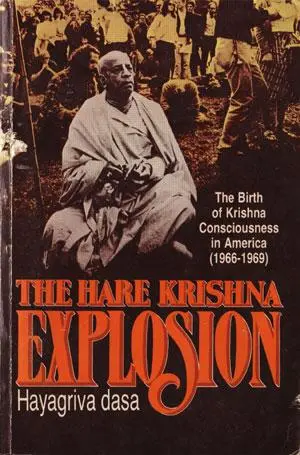
The Hare Krishna Explosion

Reference Material/Study Guide

click on image

click on image

  • LINKS