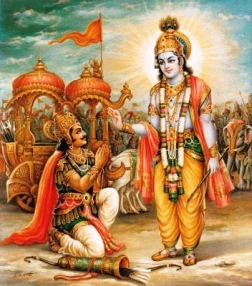
The very first verse in the Introduction to the Bhagavad-git As It, is this this very important prayer:
om ajñāna-timirāndhasya
jñānāñjana-śalākayā
cakṣur unmīlitaṁ yena
tasmai śrī-gurave namaḥ
“I was born in the darkest ignorance, and my spiritual master opened my eyes with the torch of knowledge. I offer my respectful obeisances unto him.“
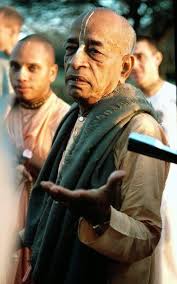
I have always liked the simplicity of this verse, because that is exactly what Srila Prabhupada did when I read my first book. He opened my eyes with Knowledge.
…The Lord is the supreme spiritual master, and the bona fide representative of the Supreme Lord is also a spiritual master. The Lord from within enlightens the devotees by the effulgence of the nails of His lotus feet, and His representative, the spiritual master, enlightens from without. Only by thinking of the lotus feet of the Lord and always taking the spiritual master’s advice can one advance in spiritual life and understand Vedic knowledge.
yasya deve parā bhaktir yathā deve tathā gurau tasyaite kathitā hy arthāḥ prakāśante mahātmanaḥ (Śvetāśvatara Upaniṣad 6.23)
Thus the Vedas enjoin that for one who has unflinching faith in the lotus feet of the Lord, as well as in the spiritual master, the real import of Vedic knowledge can be revealed. (from purport SB 4.24.52)
“I was born in the darkest ignorance, and my spiritual master opened my eyes with the torch of knowledge. I offer my respectful obeisances unto him.” This gives the definition of the guru. Everyone is in the darkness of ignorance. Therefore everyone needs to be enlightened with transcendental knowledge. One who enlightens his disciple and saves him from rotting in the darkness of ignorance in this material world is a true guru.
Srimad Bhagavatam 4.24.52
padā śarat-padma-palāśa-rociṣā nakha-dyubhir no ‘ntar-aghaṁ vidhunvatā pradarśaya svīyam apāsta-sādhvasaṁ padaṁ guro mārga-gurus tamo-juṣām
TRANSLATION
My dear Lord, Your two lotus feet are so beautiful that they appear like two blossoming petals of the lotus flower which grows during the autumn season. Indeed, the nails of Your lotus feet emanate such a great effulgence that they immediately dissipate all the darkness in the heart of a conditioned soul. My dear Lord, kindly show me that form of Yours which always dissipates all kinds of darkness in the heart of a devotee. My dear Lord, You are the supreme spiritual master of everyone; therefore all conditioned souls covered with the darkness of ignorance can be enlightened by You as the spiritual master.
PURPORT
Lord Śiva has thus described the bodily features of the Lord authoritatively. Now he wants to see the lotus feet of the Lord. When a devotee wants to see the transcendental form of the Lord, he begins his meditation on the Lord’s body by first looking at the feet of the Lord. Srimad Bhagavatam is considered to be the transcendental sound form of the Lord, and the twelve cantos are divided in accordance with the transcendental form of the Lord. The First and Second Cantos of Srimad Bhagavatam are called the two lotus feet of the Lord. It is therefore suggested by Lord Śiva that one should first try to see the lotus feet of the Lord. This also means that if one is serious about reading Srimad Bhagavatam, he must begin by seriously studying the First and Second Cantos.
The beauty of the lotus feet of the Lord is compared to the petals of a lotus flower which grows in the autumn season. By nature’s law, in autumn the dirty or muddy waters of rivers and lakes become very clean. At that time the lotus flowers growing in the lakes appear very bright and beautiful. The lotus flower itself is compared to the lotus feet of the Lord, and the petals are compared to the nails of the feet of the Lord. The nails of the feet of the Lord are very bright, as Brahma-saṁhitā testifies. Ānanda-cinmaya-sad-ujjvala-vigrahasya: (BS 5.32) every limb of the transcendental body of the Lord is made of ānanda-cinmaya-sad-ujjvala. Thus every limb is eternally bright. As sunshine dissipates the darkness of this material world, the effulgence emanating from the body of the Lord immediately dries up the darkness in the heart of the conditioned soul. In other words, everyone serious about understanding the transcendental science and seeing the transcendental form of the Lord must first of all attempt to see the lotus feet of the Lord by studying the First and Second Cantos of Srimad Bhagavatam. When one sees the lotus feet of the Lord, all kinds of doubts and fears within the heart are vanquished.
In Bhagavad-gita it is said that in order to make spiritual progress, one must become fearless. Abhayaṁ sattva-saṁśuddhiḥ (Bg 16.1). Fearfulness is the result of material involvement. It is also said in Srimad Bhagavatam (SB 11.2.37), bhayaṁ dvitīyābhiniveśataḥ syāt: fearfulness is a creation of the bodily conception of life. As long as one is absorbed in the thought that he is this material body, he is fearful, and as soon as one is freed from this material conception, he becomes brahma-bhūta (SB 4.30.20), or self-realized, and immediately becomes fearless. Brahma-bhūtaḥ prasannātmā (Bg 18.54). Without being fearless, one cannot be joyful. The bhaktas, the devotees, are fearless and always joyful because they are constantly engaged in the service of the lotus feet of the Lord. It is also said: evaṁ prasanna-manaso bhagavad-bhakti-yogataḥ bhagavat-tattva-vijñānaṁ mukta-saṅgasya jāyate (SB 1.2.20)
By practicing bhagavad-bhakti-yoga, one becomes fearless and joyful. Unless one becomes fearless and joyful, he cannot understand the science of God. Bhagavat-tattva-vijñānaṁ mukta-saṅgasya jāyate. This verse refers to those who are completely liberated from the fearfulness of this material world. When one is so liberated, he can really understand the transcendental features of the form of the Lord. Lord Śiva therefore advises everyone to practice bhagavad-bhakti-yoga. As will be clear in the following verses, by doing so one can become really liberated and enjoy spiritual bliss.
It is also stated: oṁ ajñāna-timirāndhasya jñānāñjana-śalākayā cakṣur unmīlitaṁ yena tasmai śrī-gurave namaḥ
The Lord is the supreme spiritual master, and the bona fide representative of the Supreme Lord is also a spiritual master. The Lord from within enlightens the devotees by the effulgence of the nails of His lotus feet, and His representative, the spiritual master, enlightens from without. Only by thinking of the lotus feet of the Lord and always taking the spiritual master’s advice can one advance in spiritual life and understand Vedic knowledge. yasya deve parā bhaktir yathā deve tathā gurau tasyaite kathitā hy arthāḥ prakāśante mahātmanaḥ [ŚU 6.23]
Thus the Vedas (Śvetāśvatara Upaniṣad 6.23) enjoin that for one who has unflinching faith in the lotus feet of the Lord, as well as in the spiritual master, the real import of Vedic knowledge can be revealed.