I was thinking about the following verse the other day:
“The supreme occupation [dharma] for all humanity is that by which men can attain to loving devotional service unto the transcendent Lord. Such devotional service must be unmotivated and uninterrupted to completely satisfy the self.” ( SB 1.2.6)
And in some small way, I was feeling very fortunate. Over the years Srila Prabhupada has kept me engaged in devotional service to Krishna, as a wood worker building different pujari rooms for the Lords paraphernalia, construction projects, maintaining various web pages, gardening, offering food and water to the Lord, worshiping the Lord in our temple room, and washing the Lord’s plates and cups.
Sometimes I think I am just an insignificant servant of my spiritual master, but then I remember what Srila Prabhupada once said about devotional service:“If you had any idea of what you were doing, you would be fainting in ecstasy”. Not to often am I fainting in ecstasy, but I am nonetheless grateful every day, to perform some minimal devotional service.
…Everyone should engage himself in that transcendental loving service of the Lord, even in the present conditional state of material existence. That will gradually give one the clue to actual life and please him to complete satisfaction.” (Bg Introduction)
I was reading from the introduction to the Bhagavad-gita As It is…
the whole purpose of Bhagavad-gita is to revive our sanātana occupation, or sanātana-dharma, which is the eternal occupation of the living entity. We are temporarily engaged in different activities, but all of these activities can be purified when we give up all these temporary activities and take up the activities which are prescribed by the Supreme Lord. That is called our pure life.
The Lord is very kind to the living entities because they are His sons. Lord Krsna declares in Bhagavad-gita 14.4, “sarva-yonisu…aham bija-pradah pita pitā.” “I am the father of all.” Of course there are all types of living entities according to their various karmas, but here the Lord claims that He is the father of all of them. Therefore the Lord descends to reclaim all of these fallen, conditioned souls to call them back to the sanātana eternal sky so that the sanātana living entities may regain their eternal sanātana positions in eternal association with the Lord. The Lord comes Himself in different incarnations, or He sends His confidential servants as sons or His associates or ācāryas to reclaim the conditioned souls.
Therefore, sanatana-dharma does not refer to any sectarian process of religion. It is the eternal function of the eternal living entities in relationship with the eternal Supreme Lord. Sanātana-dharma refers, as stated previously, to the eternal occupation of the living entity. Rāmānujācārya has explained the word sanātana as “that which has neither beginning nor end,” so when we speak of sanātana-dharma, we must take it for granted on the authority of Sri Rāmānujācārya that it has neither beginning nor end.
So in some small way, I am feeling very fortunate.
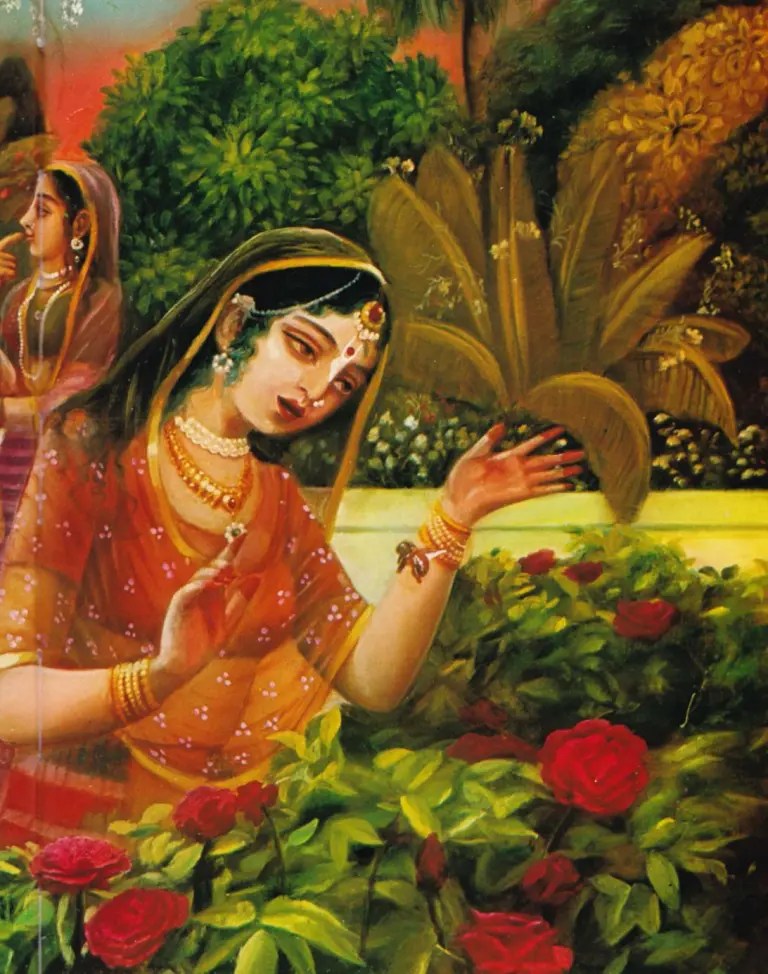
I have always enjoyed this pastime of Srimati Radharani’s talks with the Bumblebee. Every time I see a bumblebee in my garden I am reminded of these talks.
The pastimes of Lord Kṛṣṇa are uncommonly full of transcendental potency. It is a characteristic of such pastimes that they do not fall within the jurisdiction of experimental logic and arguments. (Cc. Antya 19.103)
When transcendental love of Kṛṣṇa awakens in one’s heart, even a learned scholar cannot comprehend one’s activities. (Cc. Antya 19.104)
“The activities and symptoms of that exalted personality in whose heart love of Godhead has awakened cannot be understood even by the most learned scholar.” (Cc. Antya 19.105)
The evidence of the truth of these talks is found in Śrīmad-Bhāgavatam. There, in the section of the Tenth Canto known as the Bhramara-gītā, “the Song to the Bumblebee,” Śrīmatī Rādhārāṇī speaks insanely in ecstatic love for Kṛṣṇa. (Cc. Antya 19.107)
Just try to hear these topics with faith, for there is great pleasure even in hearing them. That hearing will destroy all miseries pertaining to the body, mind and other living entities, and the unhappiness of false arguments as well. (Cc. Antya 19.110)
The Song to the Bumblebee
When Uddhava arrived from Mathurā carrying a message for the gopīs, the gopīs began talking about Kṛṣṇa and crying. Then one important gopī saw a bumblebee and began speaking to it like someone mad, thinking that the bee was a messenger of Uddhava’s or was someone very dear to him and Kṛṣṇa. The verses are as follows:
“My dear bumblebee, you are a very cunning friend of Uddhava and Kṛṣṇa. You are very expert in touching people’s feet, but I am not going to be misled by this. You appear to have sat on the breasts of one of Kṛṣṇa’s friends, for I see that you have kuṅkuma dust on your mustache. Kṛṣṇa is now engaged in flattering all His young girl friends in Mathurā. Therefore, now that He can be called a friend of the residents of Mathurā, He does not need the help of the residents of Vṛndāvana. He has no reason to satisfy us gopīs. Since you are the messenger of such a person as He, what is the use of your presence here? Certainly Kṛṣṇa would be ashamed of your presence in this assembly.”
How has Kṛṣṇa offended the gopīs so that they want to reject Him from their minds? The answer is given as follows:
As I was reading from the Srimad Bhagavatam this morning about the passing of Bhīṣmadeva it was being described how “The perfect yogīs or mystics can leave the material body at their own sweet will at a suitable time and go to a suitable planet desired by them.” And how it is possiable to go beyond Saṁsāra, and go back to Godhead without any doubt?
…In the momentous hour of leaving his material body, Bhīṣmadeva set the glorious example concerning the important function of the human form of life. The subject matter which attracts the dying man becomes the beginning of his next life. Therefore, if one is absorbed in thoughts of the Supreme Lord Śrī Kṛṣṇa, he is sure to go back to Godhead without any doubt.
And what is Samsara?
Saṁsāra means material existence. That is called saṁsāra. Bhūtvā bhūtvā pralīyate (BG 8.19). You take your birth once in some form of body. You live for some time. Then you have to give up this body. Then you have to accept another body. Then again live for some time. Then give up that body. Again accept another body. In this way, it is going on. That is called saṁsāra, rotating within this material world. (Lecture on Gurvastakam at Upsala University by His Divine Grace -Stockholm, September 9, 1973)
The saṁsāra means repetition of different bodies. That is called saṁsāra. (Lecture on SB 1.2.4 -Rome, May 28, 1974)
Saṁsāra means this material entanglement. This is called saṁsāra. (Lecture on CC Madhya-lila 25.40-50 – San Francisco, January 24, 1967)
The strangest thing happened this morning. While I was chanting my japa, I guess I was a little distracted because I was thinking about work, and the following verse from the Srimad Bhagavatam just popped into my head. I was trying to remember where this verse was…I was pretty sure it was in the First Canto…so I took the first canto off the shelf and just randomly opened it. And to my great surprise, it opened to the exact verse I was thinking about.
The supreme occupation [dharma] for all humanity is that by which men can attain to loving devotional service unto the transcendent Lord. Such devotional service must be unmotivated and uninterrupted to completely satisfy the self. (Srimad Bhagavatam 1.2.6)
These original books by Srila Prabhupada are definitely transcendental.
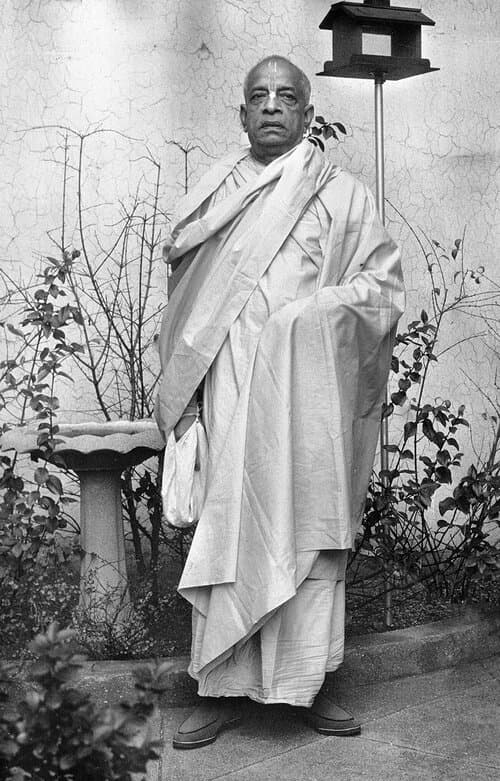
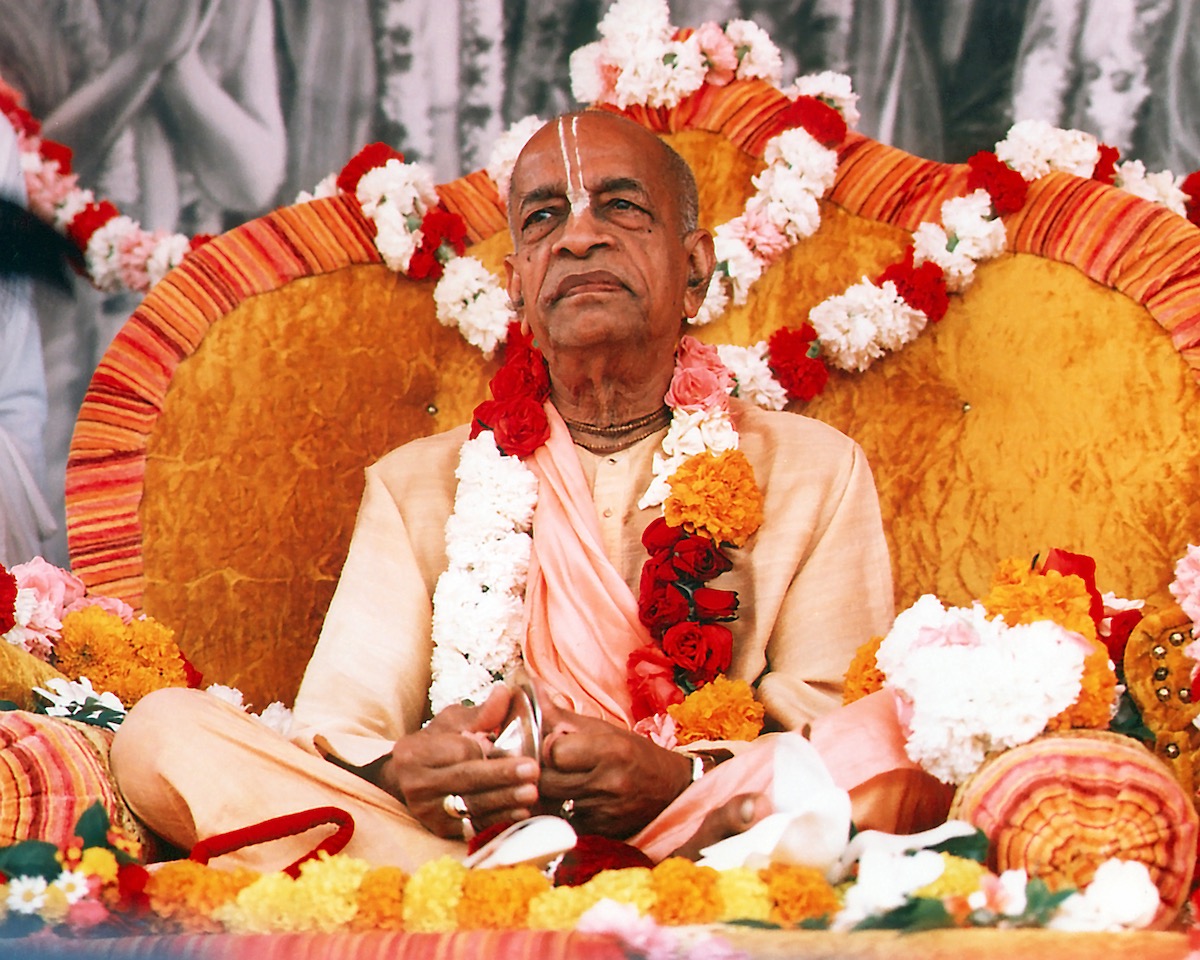
His Divine Grace A.C. Bhaktivedanta Swami Prabhupada
I have been carrying around a little piece of paper in my wallet, with the words yare dekha, tare kaha on it. I finally went to Vaniquotes to see what these words implied.
yāre dekha, tāre kaha ‘kṛṣṇa’-upadeśa āmāra ājñāya guru hañā tāra’ ei deśa (Cc Madhya 7.128)
“Instruct everyone to follow the orders of Lord Śrī Kṛṣṇa as they are given in the Bhagavad-gītā and Śrīmad-Bhāgavatam. In this way become a spiritual master and try to liberate everyone in this land.”
…the sublime mission of the International Society for Krishna Consciousness. Many people come and inquire whether they have to give up family life to join the Society, but that is not our mission. One can remain comfortably in his residence. We simply request everyone to chant the mahā-mantra: Hare Kṛṣṇa, Hare Kṛṣṇa, Kṛṣṇa Kṛṣṇa, Hare Hare/ Hare Rāma, Hare Rāma, Rāma Rāma, Hare Hare.
…The real purpose of human life is to attain the spiritual platform and return to Godhead. That is the summum bonum of spiritual realization. The Kṛṣṇa consciousness movement is trying to elevate human society to the perfection of life by pursuing the method described by Śrī Caitanya Mahāprabhu in His advice to the brāhmaṇa Kūrma. That is, one should stay at home, chant the Hare Kṛṣṇa mantra and preach the instructions of Kṛṣṇa as they are given in the Bhagavad-gita and Srimad Bhagavatam. (from purport)
“Whomever you meet, simply talk with him about the instructions given by Kṛṣṇa or tell him of narrations about Kṛṣṇa.” (SB 4.23.38)
The following is one of the most quoted verses by Srila Prabhupada, from the Srimad Bhagavatam, and it is also one of the longest purports as well. Very important verse!
śrī-prahrādaḥ uvāca—Prahlāda Mahārāja said; śravaṇam—hearing; kīrtanam—chanting; viṣṇoḥ—of LordViṣṇu (not anyone else); smaraṇam—remembering; pāda-sevanam—serving the feet; arcanam—offering worship (with ṣoḍaśopacāra, the sixteen kinds of paraphernalia); vandanaṁ—offering prayers; dāsyam—becoming the servant; sakhyam—becoming the best friend; ātma-nivedanam—surrendering everything, whatever one has; iti—thus; puṁsā arpitā—offered by the devotee; viṣṇau—unto Lord Viṣṇu (not to anyone else); bhaktiḥ—devotional service; cet—if; nava-lakṣaṇā—possessing nine different processes; kriyeta—one should perform; bhagavati—unto the Supreme Personality of Godhead; addhā—directly or completely; tat—that; manye—I consider; adhītam—learning; uttamam—topmost.
Prahlāda Mahārāja said: Hearing and chanting about the transcendental holy name, form, qualities, paraphernalia and pastimes of Lord Viṣṇu, remembering them, serving the lotus feet of the Lord, offering the Lord respectful worship with sixteen types of paraphernalia, offering prayers to the Lord, becoming His servant, considering the Lord one’s best friend, and surrendering everything unto Him (in other words, serving Him with the body, mind and words)—these nine processes are accepted as pure devotional service. One who has dedicated his life to the service of Kṛṣṇa through these nine methods should be understood to be the most learned person, for he has acquired complete knowledge.
When Prahlāda Mahārāja was asked by his father to say something from whatever he had learned, he considered that what he had learned from his spiritual master was the best of all teachings…(from purport)
Sometime ago, I ran across this wonderful web site Prabhupada.io. It has it all, images, text, conversations, lectures, letters, etc. It is truly an Archive of Srila Prabhupada’s Original unedited words. Highly Recommended!
Building a Sacred Digital Archive for the Next 10,000 Years
The path to creating Prabhupada.io began with a simple recognition: Srila Prabhupada’s teachings are not merely books—they are eternal law books that deserve preservation and accessibility for millennia to come.
The Vision: A True Digital Archive
What distinguishes a true digital archive from a mere collection of files? It requires, among other things:
Comprehensive indexing that reveals the interconnected web of spiritual knowledge
Clean, searchable source texts extracted with care from the original works
Intuitive navigation that serves both newcomers and scholars
Open accessibility that removes barriers between seekers and sacred wisdom
Future-proof architecture built to endure for generations
Who is that smiling women in the middle? Why its Lady Subhadra!
Subhadra : Daughter of Vasudeva and sister of Lord Śrī Krsna. She was not only a very dear daughter of Vasudeva, but also a very dear sister to both Krsna and Baladeva. The two brothers and sister are represented in the famous Jagannatha temple of Puri, and the temple is still visited by thousands of pilgrims daily. This temple is in remembrance of the Lord’s visit at Kuruksetra during an occasion of solar eclipse and His subsequent meeting with the residents of Vrndavana. The meeting of Radha and Krsna during this occasion is a very pathetic story, and Lord Śrī Caitanya, in the ecstasy of Rādhārāṇī, always pined for Lord Śrī Krsna at Jagannatha Puri. While Arjuna was at Dvaraka, he wanted to have Subhadra as his queen, and he expressed his desire to Lord Krsna. Śrī Krsna knew that His elder brother, Lord Baladeva, was arranging her marriage elsewhere, and since He did not dare to go against the arrangement of Baladeva, He advised Arjuna to kidnap Subhadra. So when all of them were on a pleasure trip on the Raivata Hill, Arjuna managed to kidnap Subhadra according to the plan of Śrī Krsna. Śrī Baladeva was very angry at Arjuna, and He wanted to kill him, but Lord Krsna implored His brother to excuse Arjuna. Then Subhadra was duly married with Arjuna, and Abhimanyu was born of Subhadra. At the premature death of Abhumanyu, Subhadra was very mortified, but on the birth of Pariksit she was happy and solaced. (from purport to SB 1.13.3-4)
I have been reading the Krsna Book lately, and just yesterday we were reading chapter 14 “Prayers Offered by Lord Brahma to Lord Krsna”, and I was reminded this was the last chapter Srila Prabhupada was working on in the Srimad Bhagavatam series before his passing. So I had another look at the Tenth Canto, part 3, and thought it a good idea to share it with all our readers.
This is the final Śrīmad-Bhāgavatam volume translated by His Divine Grace A. C. Bhaktivedanta Swami Prabhupada, Founder-Acarya of the International Society for Krishna Consciousness, before his untimely departure. We share it with you as a free PDF download. You can click on the above link to view the complete volume or save it to your computer.
Foward
This is the final Śrīmad-Bhāgavatam volume translated by His Divine Grace A. C. Bhaktivedanta Swami Prabhupada, founder-acarya of the International Society for Krishna Consciousness. It is smaller than the earlier volumes because it ends where the renowned author stopped translating just before his departure from this mortal world on November 14, 1977, at the Krsna-Balarama Mandira in Vrndavana, India.
This morning when I opened my computer I saw this Headline;“Middle East braces for week that could determine the course of the Gaza war”. And I was reminded of all the conflict at present in the world. Then I opened the Srimad Bhagavatam and began reading the Preface by Srila Prabhupada and it seemed so timely.
Śrīmad-Bhāgavatam by His Divine Grace A. C. Bhaktivedanta Swami Prabhupāda
Preface
We must know the present need of human society. And what is that need? Human society is no longer bounded by geographical limits to particular countries or communities. Human society is broader than in the Middle Ages, and the world tendency is toward one state or one human society. The ideals of spiritual communism, according to Śrīmad-Bhāgavatam, are based more or less on the oneness of the entire human society, nay, of the entire energy of living beings. The need is felt by great thinkers to make this a successful ideology. Śrīmad-Bhāgavatam will fill this need in human society. It begins, therefore, with the aphorism of Vedānta philosophy janmādy asya yataḥ (Bhag. 1.1.1.) to establish the ideal of a common cause.
Human society, at the present moment, is not in the darkness of oblivion. It has made rapid progress in the field of material comforts, education and economic development throughout the entire world. But there is a pinprick somewhere in the social body at large, and therefore there are large-scale quarrels, even over less important issues. There is need of a clue as to how humanity can become one in peace, friendship and prosperity with a common cause. Śrīmad-Bhāgavatam will fill this need, for it is a cultural presentation for the respiritualization of the entire human society.
Here in the West Mothers Day is being celebrated; a day to honor our Mothers.
…According to scriptures also, there are seven mothers: (1) the real mother, (2) the wife of the spiritual master, (3) the wife of a brāhmaṇa, (4) the wife of the king, (5) the cow, (6) the nurse, and (7) the earth. All of them are mothers.
Srimad Bhagavatam By His Divine Grace A.C. Bhaktivedanta Swaim Prabhupada from Canto 1, Chapter 11, Text 28-
praviṣṭaḥ—after entering; tu—but; gṛham—houses; pitroḥ—of the father; pariṣvaktaḥ—embraced; sva-mātṛbhiḥ—by His own mothers; vavande—offered obeisances; śirasā—His head; sapta—seven; devakī—Devakī; pramukhā—headed by; mudā—gladly.
After entering the house of His father, He was embraced by the mothers present, and the Lord offered His obeisances unto them by placing His head at their feet. The mothers were headed by Devakī [His real mother].
It appears that Vasudeva, the father of Lord Kṛṣṇa, had completely separate residential quarters where he lived with his eighteen wives, out of whom Śrīmatī Devakī is the real mother of Lord Kṛṣṇa. But in spite of this, all other stepmothers were equally affectionate to Him, as will be evident from the following verse. Lord Kṛṣṇa also did not distinguish His real mother from His stepmothers, and He equally offered His obeisances unto all the wives of Vasudeva present on the occasion. According to scriptures also, there are seven mothers: (1) the real mother, (2) the wife of the spiritual master, (3) the wife of a brāhmaṇa, (4) the wife of the king, (5) the cow, (6) the nurse, and (7) the earth. All of them are mothers. Even by this injunction of the śāstras, the stepmother, who is the wife of the father, is also as good as the mother because the father is also one of the spiritual masters. Lord Kṛṣṇa, the Lord of the universe, plays the part of an ideal son just to teach others how to treat their stepmothers.
tāḥ—all of them; putram—the son; aṅkam—the lap; āropya—having placed on; sneha-snuta—moistened by affection; payodharāḥ—breasts filled up; harṣa—delight; vihvalita-ātmānaḥ—overwhelmed by; siṣicuḥ—wet; netrajaiḥ—from the eyes; jalaiḥ—water.
The mothers, after embracing their son, sat Him on their laps. Due to pure affection, milk sprang from their breasts. They were overwhelmed with delight, and the tears from their eyes wetted the Lord.
When Lord Kṛṣṇa was at Vṛndāvana even the cows would become moistened by affection towards Him, and He would draw milk from the nipples of every affectionate living being, so what to speak of the stepmothers who were already as good as His own mother.
So today is the Appearance Day of Lord Vamanadeva, as well as the Appearance Day of Srila Jiva Goswami. The following is the entire 18th chapter, of the Srimad Bhagavatam, canto 8, texts 1-32, which describe the appearance of Lord Vamanadeva.
Lord Vāmanadeva, the Dwarf Incarnation
TEXT 1
Śukadeva Gosvāmī said: After Lord Brahmā had thus spoken, glorifying the Supreme Lord’s activities and prowess, the Supreme Personality of Godhead, who is never subject to death like an ordinary living being, appeared from the womb of Aditi. His four hands were decorated with a conchshell, club, lotus and disc, He was dressed in yellow garments, and His eyes appeared like the petals of a blooming lotus.
PURPORT
The word amṛta-bhūḥ is significant in this verse. The Lord sometimes appears like an ordinary child taking birth, but this does not mean that He is subject to birth, death or old age. One must be very intelligent to understand the appearance and activities of the Supreme Lord in His incarnations. This is confirmed in Bhagavad-gītā (4.9): janma karma ca me divyam evaṁ yo vetti tattvataḥ. One should try to understand that the Lord’s appearance and disappearance and His activities are all divyam, or transcendental. The Lord has nothing to do with material activities. One who understands the appearance, disappearance and activities of the Lord is immediately liberated. After giving up his body, he never again has to accept a material body, but is transferred to the spiritual world (tyaktvā dehaṁ punar janma naiti mām eti so ’rjuna [Bg. 4.9]).
Today we honor the Appearance day of Lord Nṛsiṁhadeva, with a fast till sunset, followed by a nice vegetarian feast. We include the following texts from the Śrīmad-Bhāgavatam. So shortly after the Lord killed Hiraṇyakaśipu, and his armies, the Lord sat Himself on the throne of Hiraṇyakaśipu, and was offered prayers by all the assembled saintly persons and demigods.
…The Lord not only killed Hiraṇyakaśipu, the King of the demons, but also killed many of his followers. When there was no one else to fight, the Lord, roaring with anger, sat down on Hiraṇyakaśipu’s throne.
The entire universe was thus relieved of the rule of Hiraṇyakaśipu, and everyone was jubilant in transcendental bliss. Then all the demigods, headed by Lord Brahmā, approached the Lord. These included the great saintly persons, the Pitās, the Siddhas, the Vidyādharas, the Nāgas, the Manus, the prajāpatis, the Gandharvas, the Cāraṇas, the Yakṣas, the Kimpuruṣas, the Vaitālikas, the Kinnaras and also many other varieties of beings in human form. All of them stood not far from the Supreme Personality of Godhead and began offering their prayers unto the Lord, whose spiritual effulgence was brilliant as He sat on the throne. (from the chapter summary)
Śrīmad-Bhāgavatam By His Divine Grace A. C. Bhaktivedanta Swami Prabhupāda Canto 7, Chapter Eight, Text 35-56
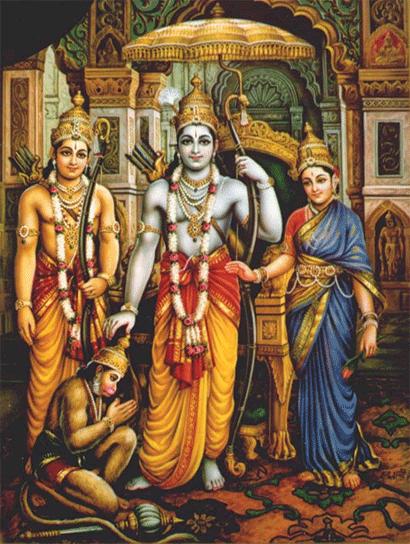
So today marks the appearance day of Lord Ramacandra, otherwise known as Rama-Navami. We honor it with a half or full day fast, followed by an nice vegetarian feast, with readings throughout the day of the glorious pastimes of the Lord.
Srimad Bhagavatam By His Divine Grace A.C. Bhaktivedanta Swami Prabhupada Canto 1, Chapter 3, Text 22
nara—human being; devatvam—divinity; āpannaḥ—having assumed the form of; sura—the demigods; kārya—activities; cikīrṣayā—for the purpose of performing; samudra—the Indian Ocean; nigraha-ādīni—controlling, etc.; cakre—did perform; vīryāṇi—superhuman prowess; ataḥ param—thereafter.
In the eighteenth incarnation, the Lord appeared as King Rāma. In order to perform some pleasing work for the demigods, He exhibited superhuman powers by controlling the Indian Ocean and then killing the atheist King Rāvaṇa, who was on the other side of the sea.
Purport The Personality of Godhead Śrī Rāma assumed the form of a human being and appeared on the earth for the purpose of doing some pleasing work for the demigods or the administrative personalities to maintain the order of the universe. Sometimes great demons and atheists like Rāvaṇa and Hiraṇyakaśipu and many others become very famous due to advancing material civilization by the help of material science and other activities with a spirit of challenging the established order of the Lord. For example, the attempt to fly to other planets by material means is a challenge to the established order. The conditions of each and every planet are different, and different classes of human beings are accommodated there for particular purposes mentioned in the codes of the Lord. But, puffed up by tiny success in material advancement, sometimes the godless materialists challenge the existence of God. Rāvaṇa was one of them, and he wanted to deport ordinary men to the planet of Indra (heaven) by material means without consideration of the necessary qualifications. He wanted a staircase to be built up directly reaching the heavenly planet so that people might not be required to undergo the routine of pious work necessary to enter that planet. He also wanted to perform other acts against the established rule of the Lord. He even challenged the authority of Śrī Rāma, the Personality of Godhead, and kidnapped His wife, Sītā. Of course Lord Rāma came to chastise this atheist, answering the prayer and desire of the demigods. He therefore took up the challenge of Rāvaṇa, and the complete activity is the subject matter of the Rāmāyaṇa. Because Lord Rāmacandra was the Personality of Godhead, He exhibited superhuman activities which no human being, including the materially advanced Rāvaṇa, could perform. Lord Rāmacandra prepared a royal road on the Indian Ocean with stones that floated on the water. The modern scientists have done research in the area of weightlessness, but it is not possible to bring in weightlessness anywhere and everywhere. But because weightlessness is the creation of the Lord by which He can make the gigantic planets fly and float in the air, He made the stones even within this earth to be weightless and prepared a stone bridge on the sea without any supporting pillar. That is the display of the power of God.
Prahlāda Mahārāja, the Saintly Son of Hiraṇyakaśipu
Today we honor the appearance day of Lord Nṛsiṁhadeva, with a fast until sunset, followed by a nice vegetarian feast. We share with you the Seventh Canto of the Srimad Bhagavatam-Part One which describes the pastimes of Pralada Maharaja and his Demonic father Hiranyakasipu. I have included in this post, the entire scanned copy of Canto 7, Vol. 1. You can download by following the link below (it will take a few moments to open).
Śrīmad-Bhāgavatam Canto 7, Vol.1 “The Science of God” by His Divine Grace A. C. Bhaktivedanta Swami Prabhupāda
click the following link to veiw or save the entire scanned copy of SB-07-01-1976
dvitīyaṁ tu bhavāyāsya rasātala-gatāṁ mahīm uddhariṣyann upādatta yajñeśaḥ saukaraṁ vapuḥ
dvitīyam—the second; tu—but; bhavāya—for the welfare; asya—of this earth; rasātala—of the lowest region; gatām—having gone; mahīm—the earth; uddhariṣyan—lifting; upādatta—established; yajñeśaḥ—the proprietor or the supreme enjoyer; saukaram—hoggish; vapuḥ—incarnation.
TRANSLATION
The supreme enjoyer of all sacrifices accepted the incarnation of a boar [the second incarnation], and for the welfare of the earth He lifted the earth from the nether regions of the universe.
PURPORT
The indication is that for each and every incarnation of the Personality of Godhead, the particular function executed is also mentioned. There cannot be any incarnation without a particular function, and such functions are always extraordinary. They are impossible for any living being to perform. The incarnation of the boar was to take the earth out of Pluto’s region of filthy matter. Picking up something from a filthy place is done by a boar, and the all-powerful Personality of Godhead displayed this wonder to the asuras, who had hidden the earth in such a filthy place. There is nothing impossible for the Personality of Godhead, and although He played the part of a boar, by the devotees He is worshiped, staying always in transcendence.
…The dealings of Lord Kṛṣṇa and Bhīṣmadeva on the Battlefield of Kurukṣetra are interesting because the activities of Lord Śrī Kṛṣṇa appeared to be partial to Arjuna and at enmity with Bhīṣmadeva; but factually all this was especially meant to show special favor to Bhīṣmadeva, a great devotee of the Lord. The astounding feature of such dealings is that a devotee can please the Lord by playing the part of an enemy.
Srimad Bhagavatam
By His Divine Grace A.C. Bhaktivedanta Swami Prabhupada
First Canto, Chapter 9, Text 38
I received this email this morning from Yasodanandana Prabhu:
Dear Prabhus
Please accept my obeisances.
All Glories to Srila Prabhupada.
There are original, unrevised, first edition, unadulterated, bona fide sets of Srimad-Bhagavatam available. This has been confirmed and duly reconfirmed by devotees in England, Australia and America. I humbly suggest that you should take advantage of this opportunity while they are still available.
With regards,
Yours in Srila Prabhupada’s service and in the service of His bona fide disciples.
“This Srimad Bhagavatam is as brilliant as the sun, and it has arisen just after the departure of Lord Krishna to His own abode, accompanied by religion, knowledge, etc. Persons who have lost their vision due to the dense darkness of ignorance in the Age of Kali shall get light from this Srimad Bhagavatam.” (Srimad-Bhagavatam 1.3.43)
I would like to offer my humble obeisances to Jitarati Prabhu, and all the devotees involved in printing and distributing this beautiful set of Srimad Bhagavatam’s. I am gladdened by the news that the court case was finally settled, and all parties involved, have agreed to work together for the pleasure of Srila Prabhupada! -Vyasasan das
BBT Court Case Against Jitarati’s Bhagavatam-Set, Finally Settled
by Jitarrati das
BBT India and Jitarati Das court case amicably settled in Bombay High Court!
Justice Kathawala before whom the matter of printing the Srimad Bhagavatam 10 volumes by Jitarati Das came up on 16th May 2018, requested the parties to try to mediate and settle the matter out of court and come back to him.
BBT India represented by HH Gopal Krishna Goswami, HG Bhima Das and Ananda Tirtha Dasa mediated with Jitarati Das and has settled the matter. Both parties have resolved their differences and have agreed to work together for the pleasure of Srila Prabhupada.
BBT India will print and make available the Srimad Bhagavatam in 10 volumes format (Nine Cantos and Krishna Book) WITHOUT 11th and 12th Canto. Jitarati Das has agreed to distribute the present printed sets outside of India by developing a new market outside of ISKCON circles.
This court settlement was recorded by the Justice and the suit is closed.
Unfortunately, I have been following the News of late, and with some personal disgust, have had to watch the Republican Tax Bill, which was written in secret, and pushed through the House and Senate for final signing, become law. It puts the country into more debt, while giving a tax break to the very rich and largest corporations. The new tax bill lowers the tax rate for top earners, and gives a massive tax cut to corporations. Starting on Jan. 1, 2018, big businesses’ tax rate would fall from 35 percent to just 21 percent, the largest one-time rate cut in U.S. history for the nation’s largest companies. Seems like the swamp didn’t get drained after all.
O best of kings, please get up! Get up! Just see this world surrounded by water and infested with rogues and so-called kings. This world is very much afraid, and it is your duty to protect her.
“Whenever an ācārya comes, following the superior orders of the Supreme Personality of Godhead or His representative, he establishes the principles of religion, as enunciated in Bhagavad-gītā. Religion means abiding by the orders of the Supreme Personality of Godhead… Unfortunately, when the ācārya disappears, rogues and nondevotees take advantage and immediately begin to introduce unauthorized principles in the name of so-called svāmīs, yogīs, philanthropists, welfare workers and so on.
The main business of human society is to think of the Supreme Personality of Godhead at all times, to become His devotees, to worship the Supreme Lord and to bow down before Him. The ācārya, the authorized representative of the Supreme Lord, establishes these principles, but when he disappears, things once again become disordered. The perfect disciples of the ācārya try to relieve the situation by sincerely following the instructions of the spiritual master. At the present moment practically the entire world is afraid of rogues and nondevotees; therefore this Kṛṣṇa consciousness movement is started to save the world from irreligious principles. Everyone should cooperate with this movement in order to bring about actual peace and happiness in the world. (from Purport to SB4.28.48)