Its funny how you can read Bhagavad-gita for years, and everytime you read from it, something new jumps out at you. For instance this morning, I happened upon a word I must have seen before, but never noticed: Kṛṣṇa-karma. I have seen karma-kāṇḍa before, and jñāna-kāṇḍa but never have I noticed the word Krsna-karma. I like this word.
I ran across this word Krsna-karma while reading from the purport to text 55 in the eleventh chapter of Bhagavad-gita. We share with you this very important text and purport.
Anyone who wants to approach the Supreme of all the Personalities of Godhead, on the Kṛṣṇaloka planet in the spiritual sky, and be intimately connected with the Supreme Personality, Kṛṣṇa, must take this formula, as is stated by the Supreme Himself. Therefore, this verse is considered to be the essence of Bhagavad-gītā. The Bhagavad-gītā is a book directed to the conditioned souls, who are engaged in the material world with the purpose of lording it over nature and who do not know of the real, spiritual life. The Bhagavad-gītā is meant to show how one can understand his spiritual existence and his eternal relationship with the Supreme Spiritual Personality and to teach one how to go back home, back to Godhead. Now here is the verse which clearly explains the process by which one can attain success in his spiritual activity: devotional service. As far as work is concerned, one should transfer his energy entirely to Kṛṣṇa conscious activities. No work should be done by any man except in relationship to Kṛṣṇa. This called Kṛṣṇa-karma. (from purport to Bg. 11.55)
I was thinking about the following verse the other day:
“The supreme occupation [dharma] for all humanity is that by which men can attain to loving devotional service unto the transcendent Lord. Such devotional service must be unmotivated and uninterrupted to completely satisfy the self.” ( SB 1.2.6)
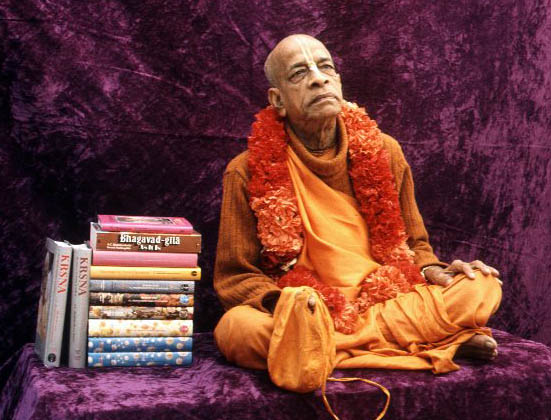
And in some small way, I was feeling very fortunate. Over the years Srila Prabhupada has kept me engaged in devotional service to Krishna, as a wood worker building different pujari rooms for the Lords paraphernalia, construction projects, maintaining various web pages, gardening, offering food and water to the Lord, worshiping the Lord in our temple room, and washing the Lord’s plates and cups.
Sometimes I think I am just an insignificant servant of my spiritual master, but then I remember what Srila Prabhupada once said about devotional service:“If you had any idea of what you were doing, you would be fainting in ecstasy”. Not to often am I fainting in ecstasy, but I am nonetheless grateful every day, to perform some minimal devotional service.
…Everyone should engage himself in that transcendental loving service of the Lord, even in the present conditional state of material existence. That will gradually give one the clue to actual life and please him to complete satisfaction.” (Bg Introduction)
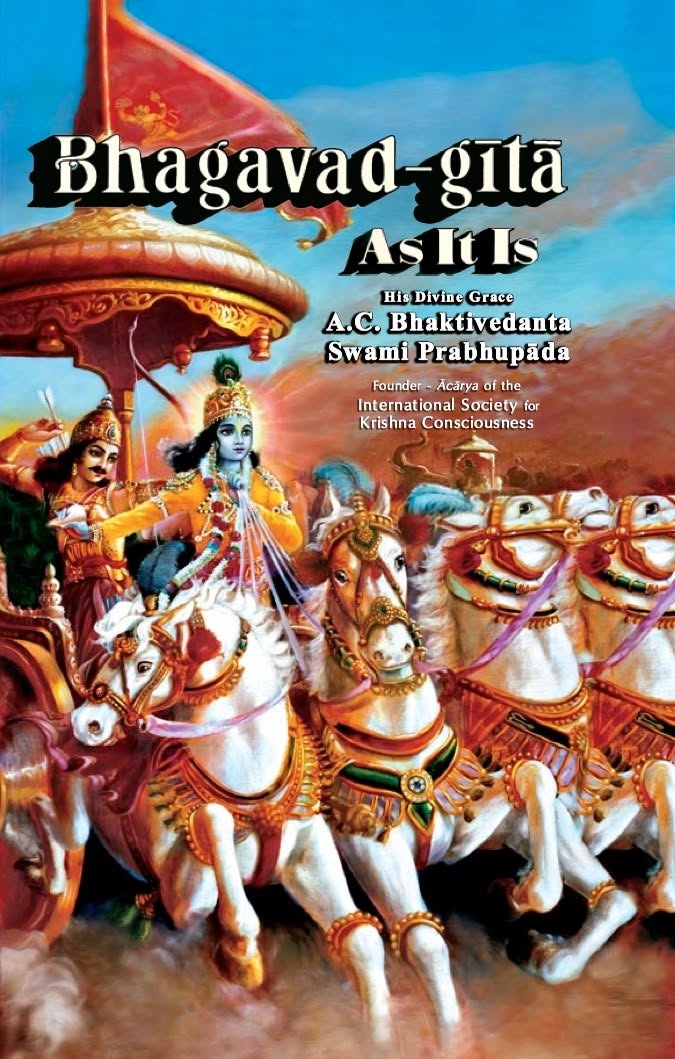
I was reading from the introduction to the Bhagavad-gita As It is…
the whole purpose of Bhagavad-gita is to revive our sanātana occupation, or sanātana-dharma, which is the eternal occupation of the living entity. We are temporarily engaged in different activities, but all of these activities can be purified when we give up all these temporary activities and take up the activities which are prescribed by the Supreme Lord. That is called our pure life.
The Lord is very kind to the living entities because they are His sons. Lord Krsna declares in Bhagavad-gita 14.4, “sarva-yonisu…aham bija-pradah pita pitā.” “I am the father of all.” Of course there are all types of living entities according to their various karmas, but here the Lord claims that He is the father of all of them. Therefore the Lord descends to reclaim all of these fallen, conditioned souls to call them back to the sanātana eternal sky so that the sanātana living entities may regain their eternal sanātana positions in eternal association with the Lord. The Lord comes Himself in different incarnations, or He sends His confidential servants as sons or His associates or ācāryas to reclaim the conditioned souls.
Therefore, sanatana-dharma does not refer to any sectarian process of religion. It is the eternal function of the eternal living entities in relationship with the eternal Supreme Lord. Sanātana-dharma refers, as stated previously, to the eternal occupation of the living entity. Rāmānujācārya has explained the word sanātana as “that which has neither beginning nor end,” so when we speak of sanātana-dharma, we must take it for granted on the authority of Sri Rāmānujācārya that it has neither beginning nor end.
So in some small way, I am feeling very fortunate.
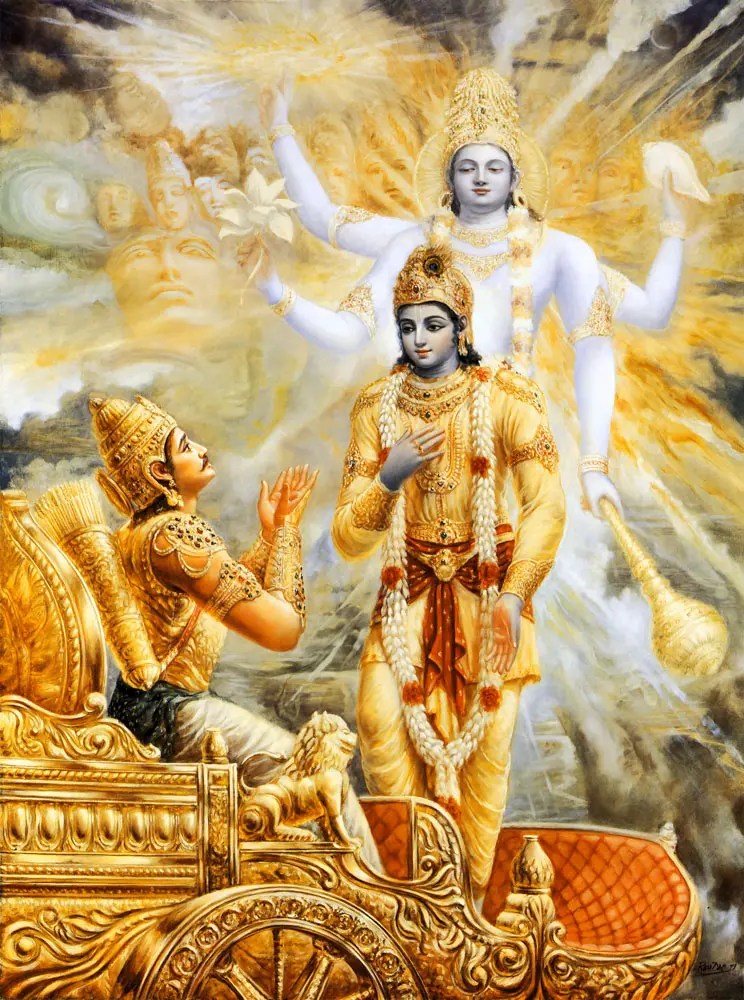
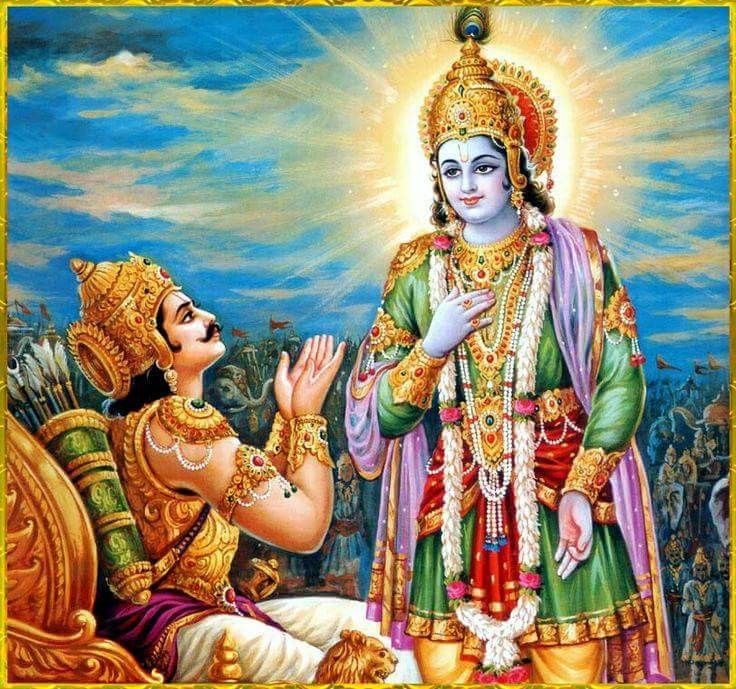
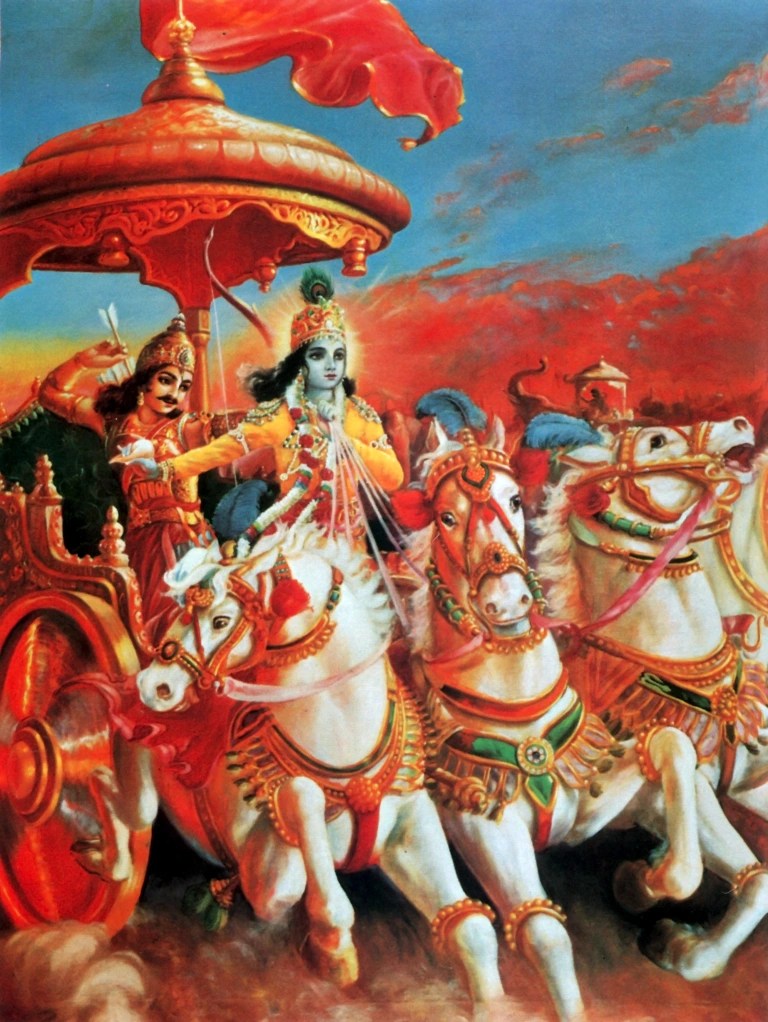
Last night I woke in the middle of the night , and couldn’t fall back asleep. While laying there, my mind just kinda went to thoughts of Krishna and Arjuna. Arjuna accepted Krishna as his spiritual master with these famous words from the Bhagavad-gita:
O Kṛṣṇa, I totally accept as truth all that You have told me. Neither the gods nor demons, O Lord, know Thy personality. (Bg 10.14)
This lead me to think of our relationship with our spiritual master His Divine Grace A. C. Bhaktivedanta Swami Prabhupada. And I came to the same conclusion as Arjuna. “I totally accept as truth all that You have told me“.
So I was thinking of our unique relationship with Srila Prabhupada. “Neither the gods nor demons, O Lord, know Thy personality”.Maybe the whole world outside of the circle of disciples and followers of His Divine Grace, cannot know his greatness and divine personality, but as disciples and followers, we can began to understand. Our relationship with Srila Prabhupada is much like that relationship between Krishna and Arjuna.
With that last thought, I fell back asleep, reflecting on Srila Prabhupada. -V
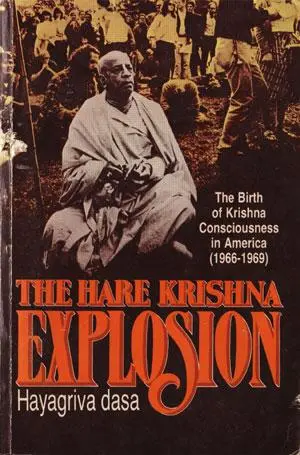
I thought I knew about all of Srila Prabhupada’s books, but this one has somehow escaped my attention until this morning. I am looking forward to reading it, and we thought I should share it with all of you. So we have included the entire book in this post. Hare Krishna!
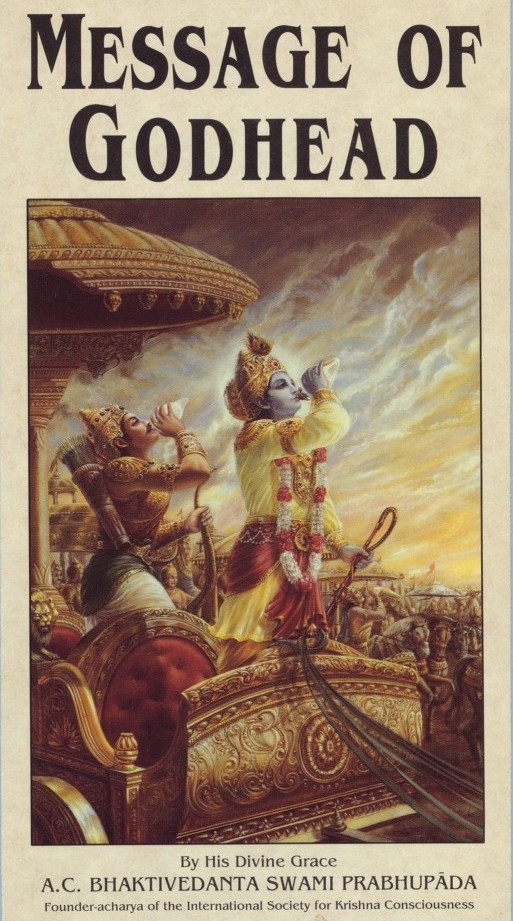
” Message of Godhead” is a short introductory book on Krishna consciousness written by His Divine Grace in the 1950’s and first published by the BBT in 1990.
Message of Godhead
by His Divine Grace A. C. Bhaktivedanta Swami Prabhupada
Introduction
At present, we are concerned primarily with two things: one, ourselves; and the other, the place where we live. In other words, we are concerned with two objects: namely, everything that is related to our gross and subtle bodies; and the world at large, with all its paraphernalia. But there are others above us, the transcendentalists, who are concerned not only with their body and mind and the world at large, but also with the transcendental subject that is above the body and mind and the world at large. The transcendentalists are very much concerned with the Absolute Truth, and much less with relative truths.
These transcendentalists (ordinarily known as saints, philosophers, reformers, messengers, and so forth) appear in various places in the world at various times. They render transcendental service to the Absolute Truth and to humanity, also, by preaching the message of the transcendental world. According to these transcendentalists, even lower animals like cats and dogs are also concerned primarily with two things, namely, themselves and the world at large. Living entities other than human beings have no capacity to understand transcendental subjects. The human being is therefore considered to be the highest of all creations, and we must understand the nature of this higher standing.
When man, who is the highest of all created beings, is fully developed in consciousness, he concerns himself not only with his own self and the world where he lives, but he tries to understand the Absolute Truth. The Absolute Truth regulates man as well as the world, and knowing Him, the transcendentalist regulates his activities on the right path. This regulating process is commonly known as a system of faith or religion. All over the civilized world we find some process or form of religion – when man is devoid of any such religion or of transcendental traits, he is nothing but a beast. This subject matter, which the religionists delineate according to different countries, times, and people, is more or less aimed at the objective of the Absolute Truth.
The Following is an excerpt from “Our Family Business”
By His Grace Vaisesika Dasa,
In ISKCON we hear devotees say “Books are the basis.” Śrīla Prabhupāda himself used this phrase in a letter to Maṇḍali Bhadra Dāsa dated January 20, 1972: “My first concern is that my books shall be published and distributed profusely all over the world. Practically, books are the basis of our movement. Without them our preaching has no effect.” He uses it again in a letter to Tuṣṭa Kṛṣṇa Swami (January 9, 1976): “Books are the basis of our movement. Whatever appreciation we are getting on account of our books, it is because we are following the path chalked out by exalted devotees.”
So what does it mean that Śrīla Prabhupāda’s books are the foundation – the basis – of ISKCON? We can begin to understand by reading the letter Śrīla Prabhupāda wrote to Dāmodara Dāsa on December 3, 1971:
I’m especially pleased to hear that your distribution of our books and magazines has increased. Go on in this way, increasing more and more. Each time someone reads some solid information about Kṛṣṇa his life becomes changed in some way. These literatures are the solid ground upon which our preaching stands, so I want that they should be available to everyone, as many as possible. So please try for this.
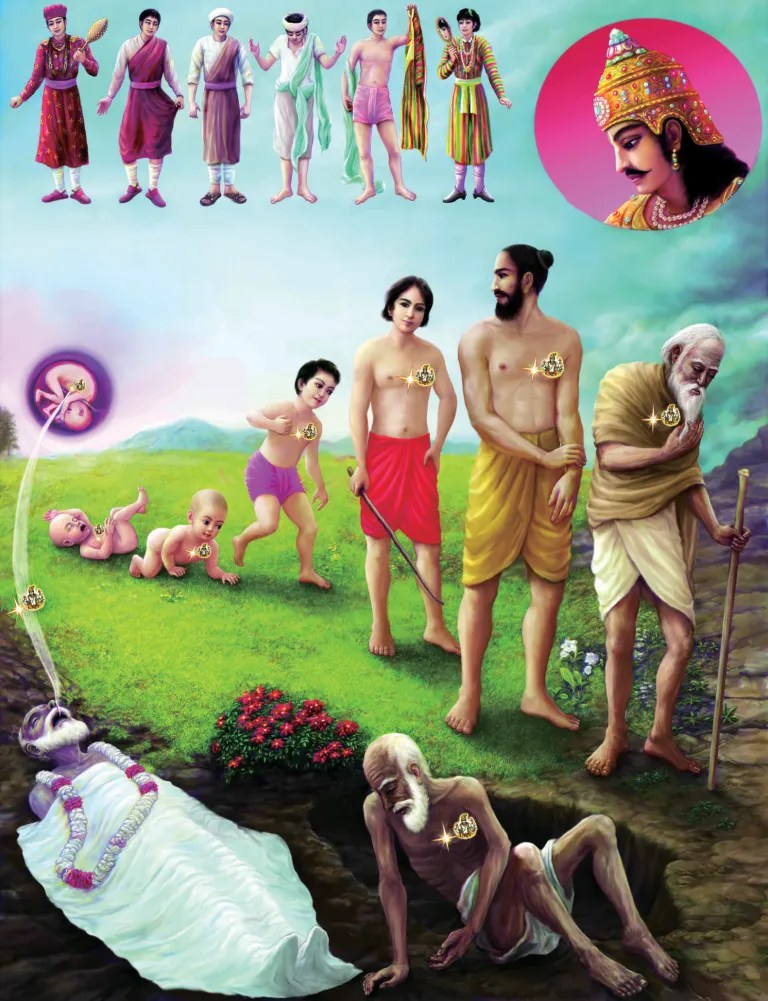
Well today is my birthday. 72 years ago on this day I was in a small baby’s body, but today I am in an old man’s body. But I’m still the same person, although it seems like I have lived many different lives, as a child, as a student, as a devotee, as a husband and father, grandfather, and retired woodworker. Lived and traveled to so many places, had so many different life experiences, and so it seems, I have lived many lives.
I am reminded of some of the famous important verses from the Bhagavad-gita:
As the embodied soul continually passes, in this body, from boyhood to youth to old age, the soul similarly passes into another body at death. The self-realized soul is not bewildered by such a change. (Bg 2.13)
For the soul there is never birth nor death. Nor, having once been, does he ever cease to be. He is unborn, eternal, ever-existing, undying and primeval. He is not slain when the body is slain. (Bg 2.20)
Full texts and purports will follow at end of post, but I wanted to mention some well known persons who I share a birthday with.
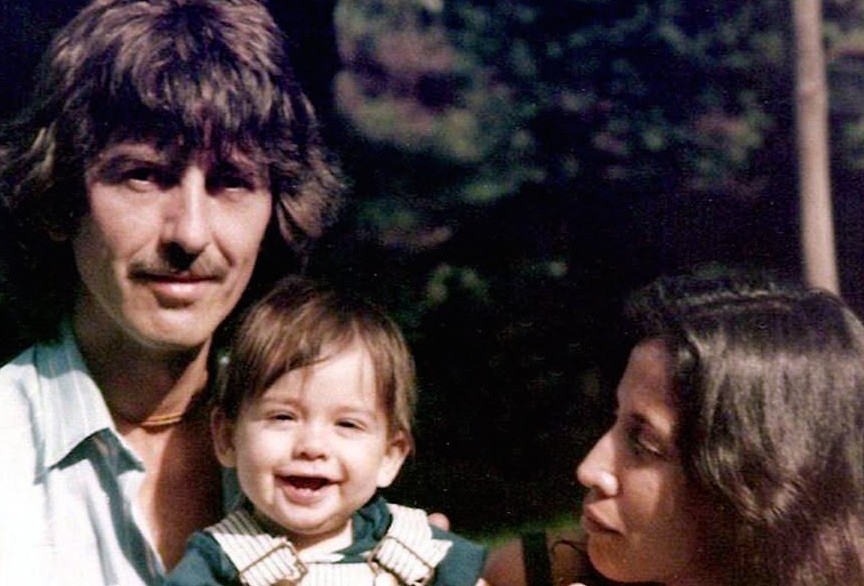
On this day in 1978, Dhani Harrison appeared, who we all know as the son of George and Olivia Harrison, turns 48 today.
And one of my favorite musicians Jerry Garcia was born on August 1, 1942, in San Francisco, California. He was the co-founder, lead guitarist, and vocalist of the Grateful Dead.
Jerry Garcia and Srila Prabhupada intersected through 1960’s counterculture, notably via the Grateful Dead playing at the 1967 Mantra-Rock concert. The Grateful Dead performed alongside Big Brother and the Holding Company and Allen Ginsberg at the historic San Francisco Avalon Ballroom benefit concert, which helped introduce A. C. Bhaktivedanta Swami and the Hare Krishna Movement to the West coast.
…One issue that many find shocking is the extent to which Srila Prabhupada’s Bhagavad-gita As It Is was edited without having been authorized by His Divine Grace, Srila Prabhupada. He was never a fan of extensive editing of any of his published works. What’s more, the over-edited edition published in 1983 removed thirty-two color pages that Srila Prabhupada insisted be included in his great opus. Three of those eliminated color pages were of the predecessor acaryas, namely Srila Bhaktisiddhanta Saraswati Thakur, Srila Gaura Kishora Das Babaji Maharaja and Srila Thakur Bhaktivinode.
Even the pocket Gita printed in India included all of the color plates found in the Macmillan edition.
If you are just hearing about this for the first time, please contact the GBC representative in your area and humbly request that this offense be rectified with the next printing. Doing so will attract Srila Prabhupada’s blessings. Do not fear when the cause is just.
A CRISIS IN LEADERSHIP
by Locan Ananda dasa
Many followers of Srila Prabhupada’s teachings have been calling for the worldwide reformation of the leadership of the International Society for Krishna Consciousness. The charge being made is that leaders and managers need to adhere more closely to the specific instructions of our Founder Acarya. There should be greater vigilance and the immediate correction of inappropriate behavior on the part of errant leaders.
The great mistake of modern civilization is to encroach upon others’ property as though it were one’s own and thereby create an unnecessary disturbance of the laws of nature.
We are witnessing a world in turmoil right now, with nations at war with each other. And I am reminded of the peace formula that Srila Prabhupada has given us. He first presented the peace formula in an early edition of Back to Godhead Magazine, then in the Bhagavad-gita, and it appeared in many small books and pamphlets. We share with you today, a sampling of the peace formula in some of the early small books.
“A person in full consciousness of Me, knowing Me to be the ultimate beneficiary of all sacrifices and austerities, the Supreme Lord of all planets and demigods, and the benefactor and well-wisher of all living entities, attains peace from the pangs of material miseries.” (Bhagavad-gita 5.29)
The politicians and diplomats are trying to establish peace in the world. We have the United Nations and many other organizations. They are working to establish real peace and tranquillity, to eliminate misunderstanding between man and man and nation and nation. But that is not happening. The defect is that the root is wrong. Everyone is thinking, “It is my country,” “It is my family,” “It is my society,” “It is my property.” This “my” is illusion. This “I-and-my” philosophy is māyā-illusion.
I find it interesting, how one morning, I will wake up and find it very easy and pleasing to chant Hare Krishna and preform my devotional activities, and the next day I find it difficult? I realized that it due to the influence of the three modes of material nature.
…Everyone should know that a living entity is eternally a servant and that unless one serves Krsna one has to serve illusion in different varieties of the three modes of material nature. (from Preface to Bhagavad-gita As It Is)
…In the Bhagavad-gita it is clearly explained that there are three kinds of activities according to the different modes of nature: the activities of goodness, of passion and of ignorance. (from Introduction to Bhagavad-gita As It Is)
The three modes of material nature is an important topic, so much so , that there is an entire chapter dedicated to it in the Bhagavad-gita.
Material nature consists of the three modes—goodness, passion and ignorance. When the living entity comes in contact with nature, he becomes conditioned by these modes. (Bg. 14.5)
PURPORT
The living entity, because he is transcendental, has nothing to do with this material nature. Still, because he has become conditioned by the material world, he is acting under the spell of the three modes of material nature. Because living entities have different kinds of bodies, in terms of the different aspects of nature, they are induced to act according to that nature. This is the cause of the varieties of happiness and distress.
This tells me, that I am not yet transcendental to the three modes, and I still have plenty of work to do.
We share with you a description of the three modes as outlined in chapter 14 of the Bhagavad-gita.
Yesterday I was reading from the Srimad Bhagavatam, and there was something from the purport that caught my attention, and had me read and re-read the purport many times.
As a cow, bound through the nose by a long rope, is conditioned, so also human beings are bound by different Vedic injunctions and are conditioned to obey the orders of the Supreme. (SB 1.13.42)
Every living being, whether a man or an animal or a bird, thinks that he is free by himself, but actually no one is free from the severe laws of the Lord. The laws of the Lord are severe because they cannot be disobeyed in any circumstance. The man-made laws may be evaded by cunning outlaws, but in the codes of the supreme lawmaker there is not the slightest possibility of neglecting the laws…
… The statutory laws of the state are imperfect imitation replicas of religious codes. The secular state, or the godless state, allows the citizens to break the laws of God, but restricts them from disobeying the laws of the state; the result is that the people in general suffer more by breaking the laws of God than by obeying the imperfect laws made by man…
…The factual position of the living being is, however, that he is the eternal servitor of the Supreme Lord…
…But in the conditioned material world, every living being wants to be the Lord of other living beings, and thus by the illusion of māyā this mentality of lording it over becomes a cause of further extension of conditional life. (from Purport)
I think of the sad state of the world today, where Gods laws are being broken. There are slaughter houses for animals, where billions of living creatures are cruelly murdered every day, there is mass genocide taking place in the Middle East and other parts of the world where humans are killed or left homeless. Where people are controlled by dictators, warlords, and unscrupulous leaders. Again I am reminded of “Mans inhumanity to man and beast”. Breaking the laws of God, can only result in more suffering for the living conditioned souls.
The very first verse in the Introduction to the Bhagavad-git As It, is this this very important prayer:
om ajñāna-timirāndhasya jñānāñjana-śalākayā cakṣur unmīlitaṁ yena tasmai śrī-gurave namaḥ
“I was born in the darkest ignorance, and my spiritual master opened my eyes with the torch of knowledge. I offer my respectful obeisances unto him.“
I have always liked the simplicity of this verse, because that is exactly what Srila Prabhupada did when I read my first book. He opened my eyes with Knowledge.
…The Lord is the supreme spiritual master, and the bona fide representative of the Supreme Lord is also a spiritual master. The Lord from within enlightens the devotees by the effulgence of the nails of His lotus feet, and His representative, the spiritual master, enlightens from without. Only by thinking of the lotus feet of the Lord and always taking the spiritual master’s advice can one advance in spiritual life and understand Vedic knowledge.
yasya deve parā bhaktir yathā deve tathā gurau tasyaite kathitā hy arthāḥ prakāśante mahātmanaḥ (Śvetāśvatara Upaniṣad 6.23)
Thus the Vedas enjoin that for one who has unflinching faith in the lotus feet of the Lord, as well as in the spiritual master, the real import of Vedic knowledge can be revealed. (from purport SB 4.24.52)
“I was born in the darkest ignorance, and my spiritual master opened my eyes with the torch of knowledge. I offer my respectful obeisances unto him.” This gives the definition of the guru. Everyone is in the darkness of ignorance. Therefore everyone needs to be enlightened with transcendental knowledge. One who enlightens his disciple and saves him from rotting in the darkness of ignorance in this material world is a true guru.
I have often pondered this question that Arjuna asks Krishna:
Arjuna said: O descendant of Vṛṣṇi, by what is one impelled to sinful acts, even unwillingly, as if engaged by force? (Bg. 3.36)
And Krishna answers:
The Blessed Lord said: It is lust only, Arjuna, which is born of contact with the material modes of passion and later transformed into wrath, and which is the all-devouring, sinful enemy of this world. (Bg. 3.37)
A living entity, as part and parcel of the Supreme, is originally spiritual, pure, and free from all material contaminations. Therefore, by nature he is not subjected to the sins of the material world. But when he is in contact with the material nature, he acts in many sinful ways without hesitation, and sometimes even against his will. As such, Arjuna’s question to Kṛṣṇa is very sanguine, as to the perverted nature of the living entities. Although the living entity sometimes does not want to act in sin, he is still forced to act. Sinful actions are not, however, impelled by the Supersoul within, but are due to another cause, as the Lord explains in the next verse. (from purport)
further explained:
…When a living entity comes in contact with the material creation, his eternal love for Kṛṣṇa is transformed into lust, in association with the mode of passion.
…Therefore, lust is the greatest enemy of the living entity, and it is lust only which induces the pure living entity to remain entangled in the material world.
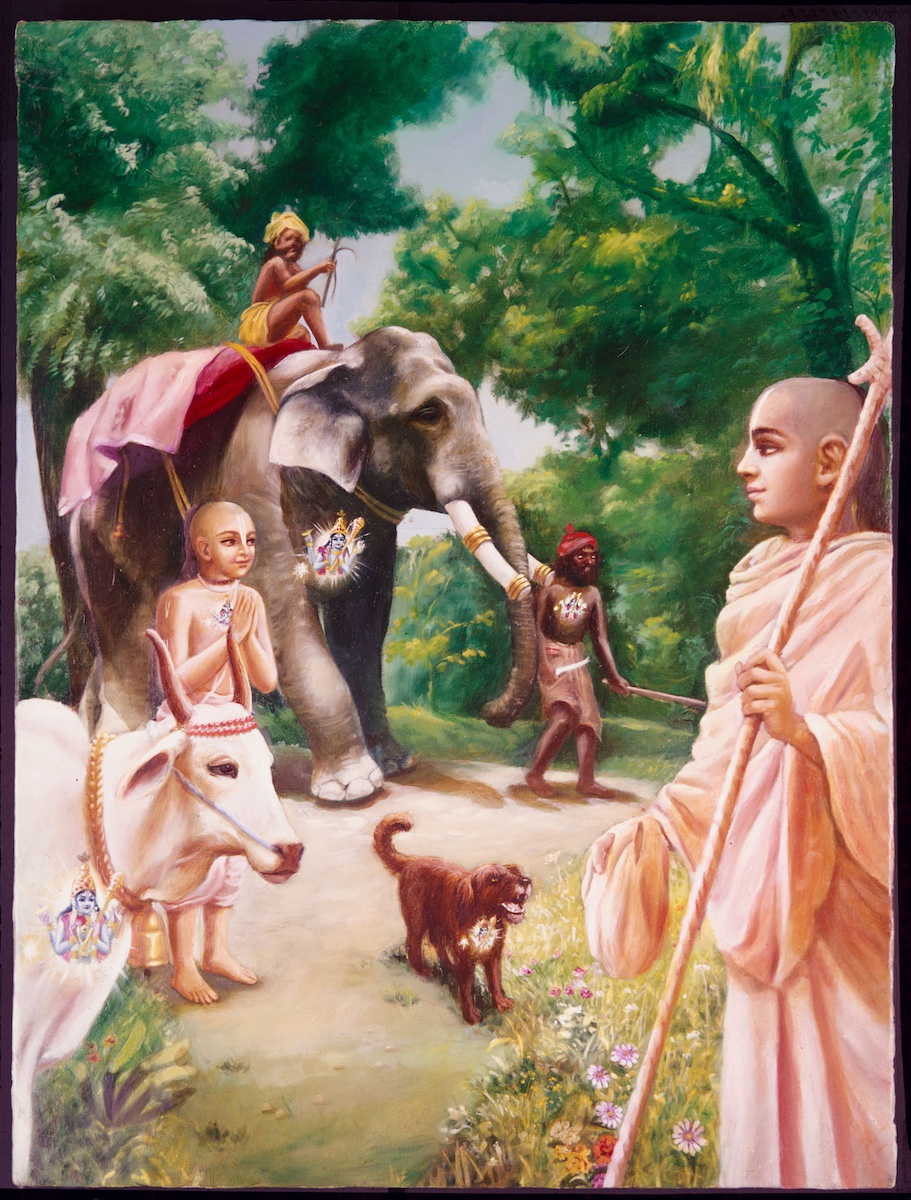
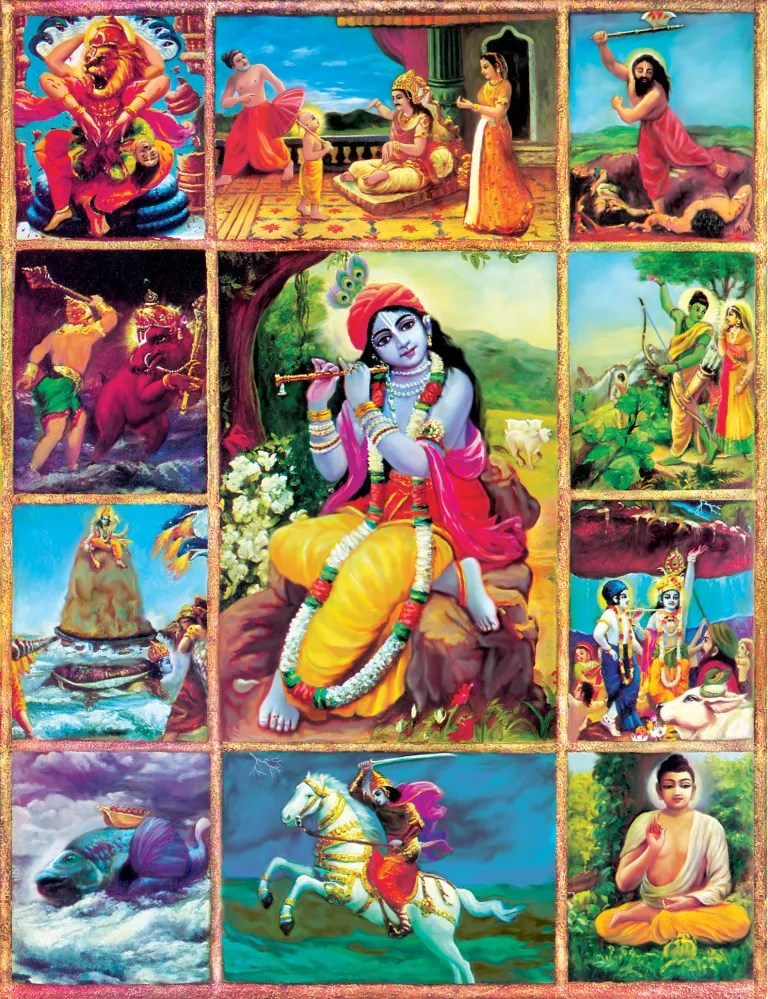
I remember the very first time I opened the Bhagavad-gita, I focused on the pictures and captions. I wasn’t really ready to read it yet, it seemed way above my level of intelligence, and there were words I couldn’t pronounce or understand, but the pictures spoke to me. I thought this image, as simplistic as it was, spoke a very profound and powerful message.
Bhagavad-gita As It Is
by A. C. Bhaktivedanta Swami Prabhupada
vidyā-vinaya-sampanne brāhmaṇe gavi hastini śuni caiva śva-pāke ca paṇḍitāḥ sama-darśinaḥ
vidyā—education; vinaya—gentleness; sampanne—fully equipped; brāhmaṇe—in the brāhmaṇa; gavi—in the cow; hastini—in the elephant; śuni—in the dog; ca—and; eva—certainly; śvapāke—in the dog-eater (the outcaste); ca—respectively; paṇḍitāḥ—those who are so wise; sama-darśinaḥ—do see with equal vision.
TRANSLATION
The humble sage, by virtue of true knowledge, sees with equal vision a learned and gentle brāhmaṇa, a cow, an elephant, a dog and a dog-eater [outcaste]. (Bg 5.18)
PURPORT
A Kṛṣṇa conscious person does not make any distinction between species or castes. The brāhmaṇa and the outcaste may be different from the social point of view, or a dog, a cow, or an elephant may be different from the point of view of species, but these differences of body are meaningless from the viewpoint of a learned transcendentalist. This is due to their relationship to the Supreme, for the Supreme Lord, by His plenary portion as Paramātmā, is present in everyone’s heart. Such an understanding of the Supreme is real knowledge. As far as the bodies are concerned in different castes or different species of life, the Lord is equally kind to everyone because He treats every living being as a friend yet maintains Himself as Paramātmā regardless of the circumstances of the living entities. The Lord as Paramātmā is present both in the outcaste and in the brāhmaṇa, although the body of a brāhmaṇa and that of an outcaste are not the same. The bodies are material productions of different modes of material nature, but the soul and the Supersoul within the body are of the same spiritual quality. The similarity in the quality of the soul and the Supersoul, however, does not make them equal in quantity, for the individual soul is present only in that particular body, whereas the Paramātmā is present in each and every body. A Kṛṣṇa conscious person has full knowledge of this, and therefore he is truly learned and has equal vision. The similar characteristics of the soul and Supersoul are that they are both conscious, eternal and blissful. But the difference is that the individual soul is conscious within the limited jurisdiction of the body, whereas the Supersoul is conscious of all bodies. The Supersoul is present in all bodies without distinction.
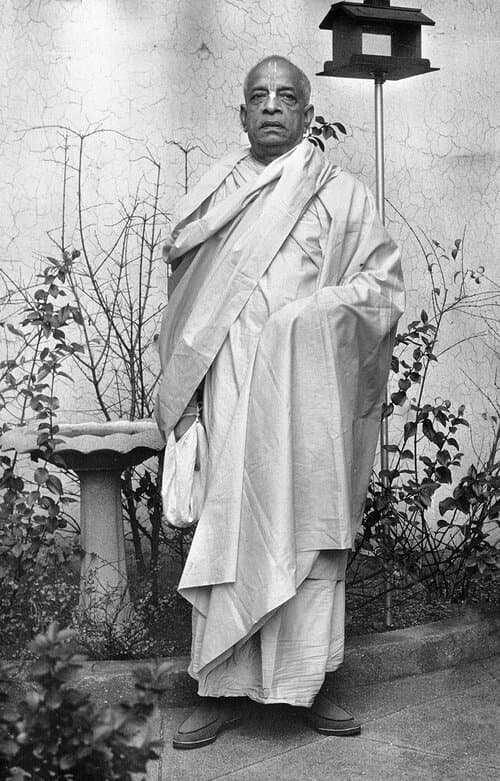
His Divine Grace A.C. Bhaktivedanta Swami Prabhupada
I have been carrying around a little piece of paper in my wallet, with the words yare dekha, tare kaha on it. I finally went to Vaniquotes to see what these words implied.
yāre dekha, tāre kaha ‘kṛṣṇa’-upadeśa āmāra ājñāya guru hañā tāra’ ei deśa (Cc Madhya 7.128)
“Instruct everyone to follow the orders of Lord Śrī Kṛṣṇa as they are given in the Bhagavad-gītā and Śrīmad-Bhāgavatam. In this way become a spiritual master and try to liberate everyone in this land.”
…the sublime mission of the International Society for Krishna Consciousness. Many people come and inquire whether they have to give up family life to join the Society, but that is not our mission. One can remain comfortably in his residence. We simply request everyone to chant the mahā-mantra: Hare Kṛṣṇa, Hare Kṛṣṇa, Kṛṣṇa Kṛṣṇa, Hare Hare/ Hare Rāma, Hare Rāma, Rāma Rāma, Hare Hare.
…The real purpose of human life is to attain the spiritual platform and return to Godhead. That is the summum bonum of spiritual realization. The Kṛṣṇa consciousness movement is trying to elevate human society to the perfection of life by pursuing the method described by Śrī Caitanya Mahāprabhu in His advice to the brāhmaṇa Kūrma. That is, one should stay at home, chant the Hare Kṛṣṇa mantra and preach the instructions of Kṛṣṇa as they are given in the Bhagavad-gita and Srimad Bhagavatam. (from purport)
“Whomever you meet, simply talk with him about the instructions given by Kṛṣṇa or tell him of narrations about Kṛṣṇa.” (SB 4.23.38)
I am sure by now, everyone has heard about Donald Trumps tweets from his social media.
I really don’t want to focus my attention on such insane speak, but it was to horrific to ignore.
“A whole civilization will die tonight, never to be brought back again” (April 7)
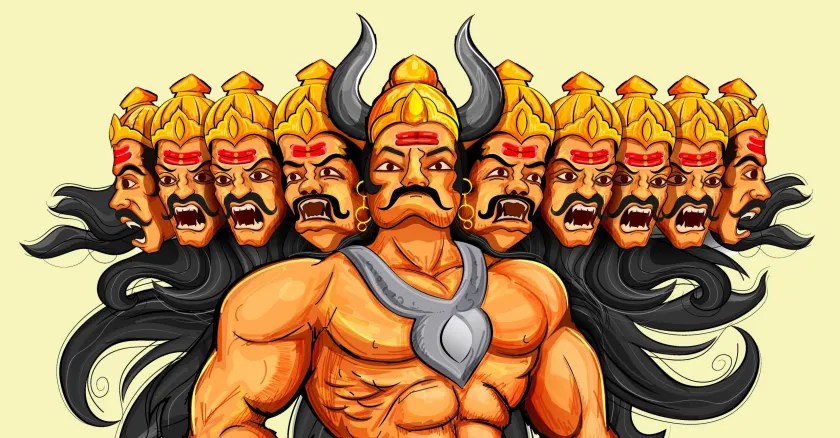
A civilization that has been around for some 5,000 years, since the time of the Pandavas. It is simply madness. And can only be described as demonic behavior.
From the pages of the Bhagavad-gita, there is a description of the demoniac personality…
The demoniac person thinks: “So much wealth do I have today, and I will gain more according to my schemes. So much is mine now, and it will increase in the future, more and more. He is my enemy, and I have killed him; and my other enemy will also be killed. I am the lord of everything, I am the enjoyer, I am perfect, powerful and happy. I am the richest man, surrounded by aristocratic relatives. There is none so powerful and happy as I am. I shall perform sacrifices, I shall give some charity, and thus I shall rejoice.” In this way, such persons are deluded by ignorance. (Bg 16. 13-14)
Following such conclusions, the demoniac, who are lost to themselves and who have no intelligence, engage in unbeneficial, horrible works meant to destroy the world. (Bg 16.9)
This is a very important verse, and often quoted by Srila Prabhupada in Lectures.
“One who knows the transcendental nature of My appearance and activities does not, upon leaving the body, take his birth again in this material world, but attains My eternal abode, O Arjuna.” (Bg 4.9)
…“The one Supreme Personality of Godhead is eternally engaged in many, many transcendental forms in relationships with His unalloyed devotees.”
…the devotee, simply by understanding the transcendental nature of the body and activities of the Lord, attains the abode of the Lord after ending this body and does not run the risk of returning again to this material world.
…One can attain the perfect stage of liberation from birth and death simply by knowing the Lord, the Supreme Personality of Godhead. (from purport)
The world seems to be in a state of chaos, what with cities being bombed, thousands of people being displaced, and left without home, power, heat, food or water. There is death and destruction in so many places around the globe. It is ‘man’s inhumanity to man”, and I often wonder how is it possible that man can act in such deplorable and sinful way
Those who are demoniac do not know what is to be done and what is not to be done. Neither cleanliness nor proper behavior nor truth is found in them. (Bg. 16.7)
Following such conclusions, the demoniac, who are lost to themselves and who have no intelligence, engage in unbeneficial, horrible works meant to destroy the world. (Bg. 16.9)
PURPORT
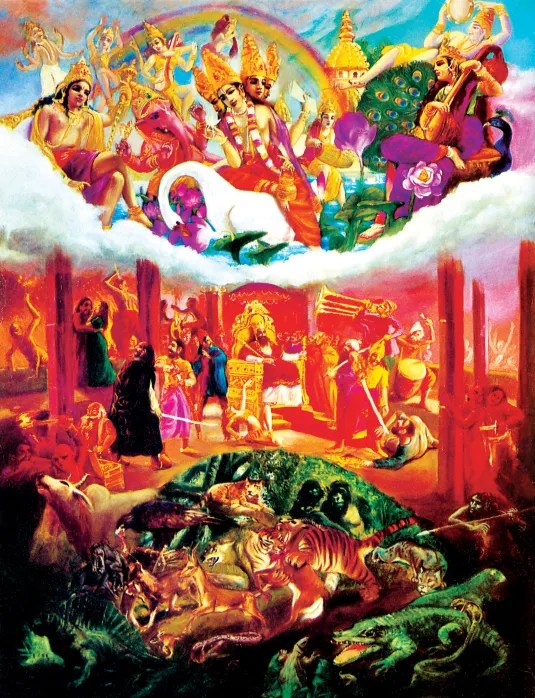
The demoniac are engaged in activities that will lead the world to destruction. The Lord states here that they are less intelligent. The materialists, who have no concept of God, think that they are advancing. But, according to Bhagavad-gītā, they are unintelligent and devoid of all sense. They try to enjoy this material world to the utmost limit and therefore always engage in inventing something for sense gratification. Such materialistic inventions are considered to be advancement of human civilization, but the result is that people grow more and more violent and more and more cruel, cruel to animals and cruel to other human beings. They have no idea how to behave toward one another. Animal killing is very prominent amongst demoniac people. Such people are considered the enemies of the world because ultimately they will invent or create something which will bring destruction to all. Indirectly, this verse anticipates the invention of nuclear weapons, of which the whole world is today very proud. At any moment war may take place, and these atomic weapons may create havoc. Such things are created solely for the destruction of the world, and this is indicated here. Due to godlessness, such weapons are invented in human society; they are not meant for the peace and prosperity of the world.
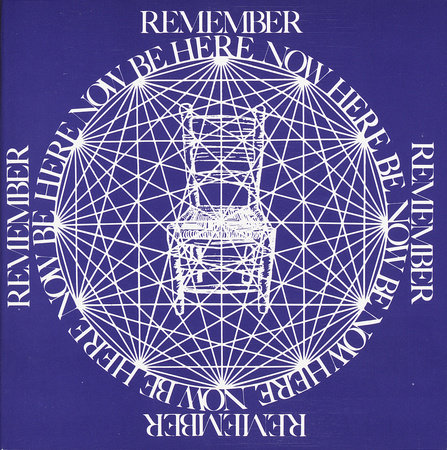
Today most people have heard of yoga and meditation, but I remember when I first took up yoga back in 1972, it was not so widely known. I was first introduced to it from the book “Be Here Now”. It was a very simplistic book, but it was full of ideas, quotes and images, that opened my mind to a world of spiritual thought. It introduced me to yoga, meditation, the concept of vegetarianism, spirituality, and the need of a Guru or Spiritual Master. I began to take seriously ideas that were introduced, such as self realization, living a more pure life, developing our relationship with God, finding out who is God, and finding my spiritual master (guru). So for me, the book was the beginning of my journey, as it was for many, so indeed it was a huge success, it that regard.
Maybe I was sincere, or maybe just lucky, but I soon found my eternal Spiritual Master, His Divine Grace A.C. Bhaktivedanta Swami Prabhupada, and he answered all my questions. He told me who is God (Krsna), what my relationship with him is (sanatan-dharma), the process for self realization (bhakti-yoga), and how to get out of this temporary material world and return home back to Godhead.
When I first began my practice of Yoga, it was purely as a spiritual Practice. Nowadays, people will take it up for many different reasons, such as weight loss, fitness, relaxation, or social acceptance and community. But I still see it as a spiritual practice. The daily asanas, which are good for my ageing body, are an offering, and the breathing is a mindful prayer.
The word Yoga means “Union”. To link our consciousness with a Higher Consciousness.
Yoga means “linking” with the Supreme. The Bhagavad-gītā describes several systems—karma-yoga (work), jñāna-yoga (knowledge), dhyāna-yoga (meditation), and aṣṭāṅga-yoga (eightfold path)—but ultimately declares bhakti-yoga, devotional service, to be the highest.
“Of all yogīs, he who always abides in Me with great faith, worshiping Me in transcendental loving service, is most intimately united with Me in yoga, and is the highest of all.” (Bg. 6.47) So one who thinks of the Supreme Lord always is the greatest yogi, the supermost jnani, and the greatest devotee at the same time.
This morning as I was finishing the Tenth Chapter of the Second Canto, the following verse and purport jumped out at me from the pages. And I realized for the thousandth time, what great good fortune we have in that we can hear directly from the pure devotee of the Lord, about the eternal pastimes of the Lord, through the pages of the Srimad Bhagavatam.
Of the three types of Transcendentalist’s, namely the jñānī, the yogī and the bhakta, or the impersonalist, the meditator and the devotee. It is only the devotee who can factually know the Lord as He is and thus be trained in the bona fide service of the Lord and be allowed to enter into the direct association of the Lord in so many capacities. The highest glorious association with the Lord is made possible in the planet of Goloka Vṛndāvana, where Lord Kṛṣṇa enjoys Himself with the gopīs and His favorite animals, the surabhi cows.
… The impersonalist is satisfied simply by understanding the all-pervasive influence of the Lord. This is called Brahman realization. Greater than the impersonalist is the mystic who sees the Lord situated in his heart as Paramātmā, the partial representation of the Lord. But there are pure devotees who take part in the direct pleasure (ānanda) potency of the Lord by factual reciprocation of loving service. The Lord in His abode called the Vaikuṇṭha planets, which are eternal manifestations, always remains with His associates and enjoys transcendental loving services by His pure devotees in different transcendental humors.
So we are pleased to present the following Texts and Purports
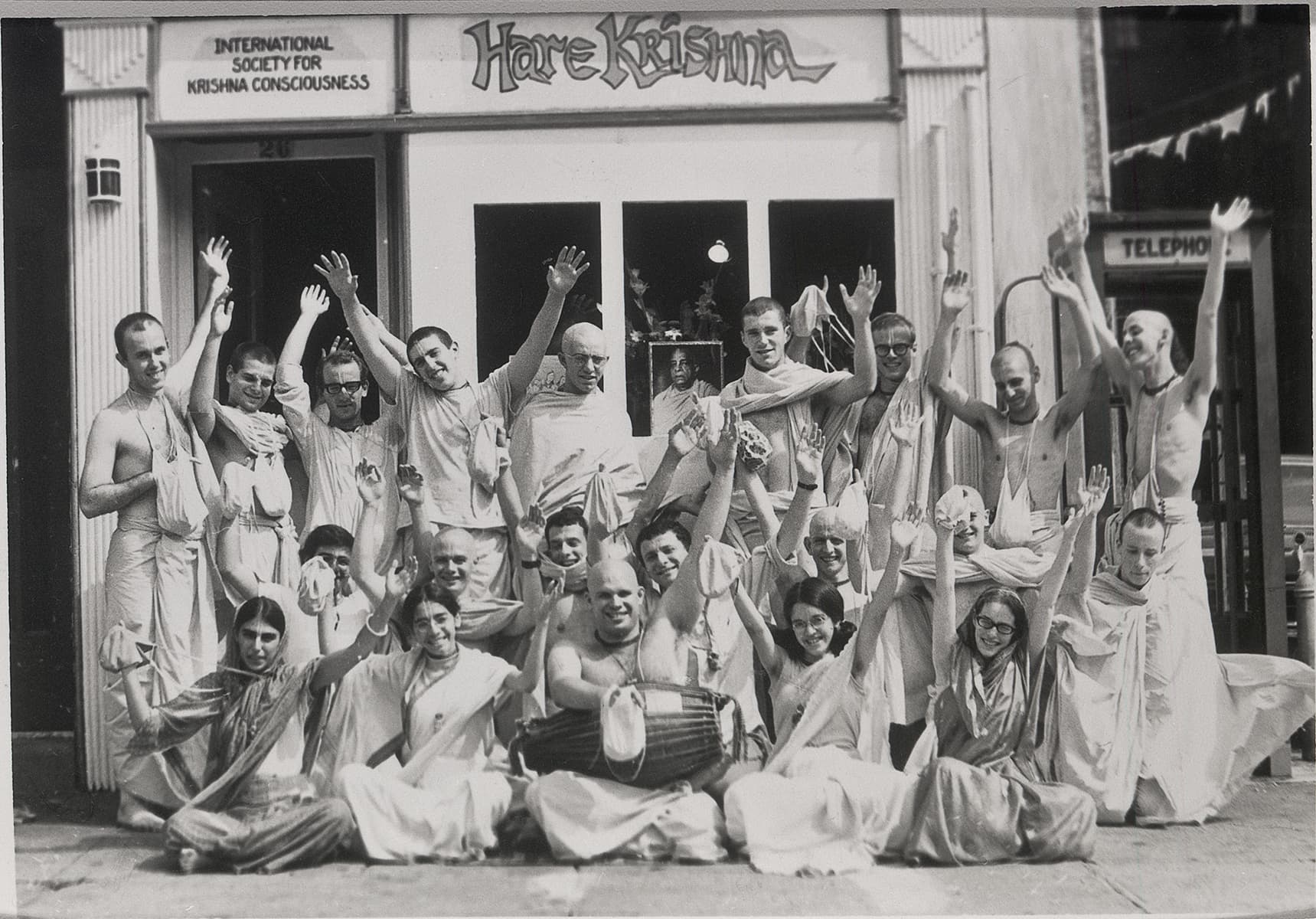
It has been interesting to see how this Hare Krishna Movement (ISKCON) has changed and developed since the early days. When this movement started it was like a family, a small family of dedicated devotees, with one scripture, one God (Krsna), one mantra (Hare Krishna, Hare Krishna, Krishna Krishna, Hare Hare, Hare Rama, Hare Rama, Rama Rama, Hare Hare), and one spiritual master (Srila Prabhupada). Then it became an International family with branches all around the world.
Now this society has become a huge movement, with new temples and congregations springing up all over the world, with different branches and camps, and so many new Spiritual Masters. It is inspiring to see the growth of this society, even though at times does not resemble the Original. What with the changes to our sacred books, and outside influences from all sides. It has created some division amongst our ranks. But there is one thing we can all agree on is, and I quote from the last paragraph from the introduction of the Bhagavad-gita:
“In this present day, man is very eager to have one scripture, one God, one religion, and one occupation. So let there be one common scripture for the whole world-Bhagavad-gītā. And let there be one God only for the whole world-Śrī Kṛṣṇa. And one mantra only-Hare Kṛṣṇa, Hare Kṛṣṇa, Kṛṣṇa Kṛṣṇa, Hare Hare/ Hare Rāma, Hare Rāma, Rāma Rāma, Hare Hare. And let there be one work only-the service of the Supreme Personality of Godhead.“
The Branches of the Caitanya Tree
Thus the branches of the Caitanya tree formed a cluster or society, with great branches covering all the universe. (Sri Caitanya-caritmrta Adi 9.18)
PURPORT
Our International Society for Krishna Consciousness is one of the branches of the Caitanya tree.
Śrī Caitanya Mahaprabhu was also the gardener, and as He poured the water of His mercy on the tree, all the branches and subbranches grew, day after day. (Adi 12.5)
The fruits of love of Godhead that grew on those branches of the Caitanya tree were so large that they flooded the entire world with love of Krsna. (Adi 12.6)