The Essence of Everything is the Supreme Lord

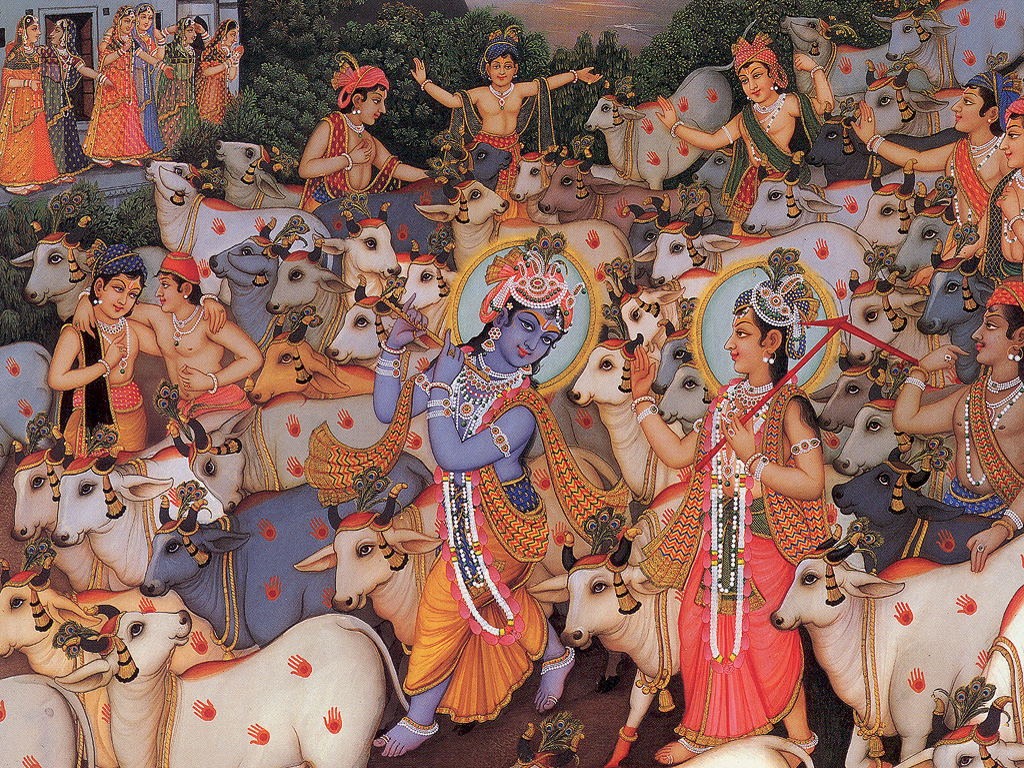
govinda with cows

click on image to enlarge

Sometimes when I am sitting and reading from Srila Prabhupada’s Srimad Bhagavatam, a verse or sentence from the purport just jumps out from the page almost like it is in 3D, and I catch a glimpse of what the Spiritual World must be like. It is beyond even my imagination, but sometimes I catch a glimmer of light, through a transcendental window, by the grace of my spiritual master His Divine Grace A. C. Bhaktivedanta Swami Prabhupada.

…The transcendental abode of the Lord where the trees are all desire trees and the buildings are made of touchstone. The Lord Govinda is engaged there in herding the surabhi cows as His natural occupation.

“I worship Govinda, the primeval Lord, the first progenitor who is tending the cows, yielding all desire, in abodes built with spiritual gems, surrounded by millions of purpose trees, always served with great reverence and affection by hundreds of thousands of lakṣmīs or gopīs.” (Bs 5.29)

…The Lord Govinda is engaged there in herding the surabhi cows as His natural occupation. And those who are artists, overtaken by the beautiful creation, should better see to the beautiful face of the Lord for complete satisfaction. The face of the Lord is the embodiment of beauty. What they call beautiful nature is but His smile, and what they call the sweet songs of the birds are but specimens of the whispering voice of the Lord.

More

Prayers and Songs

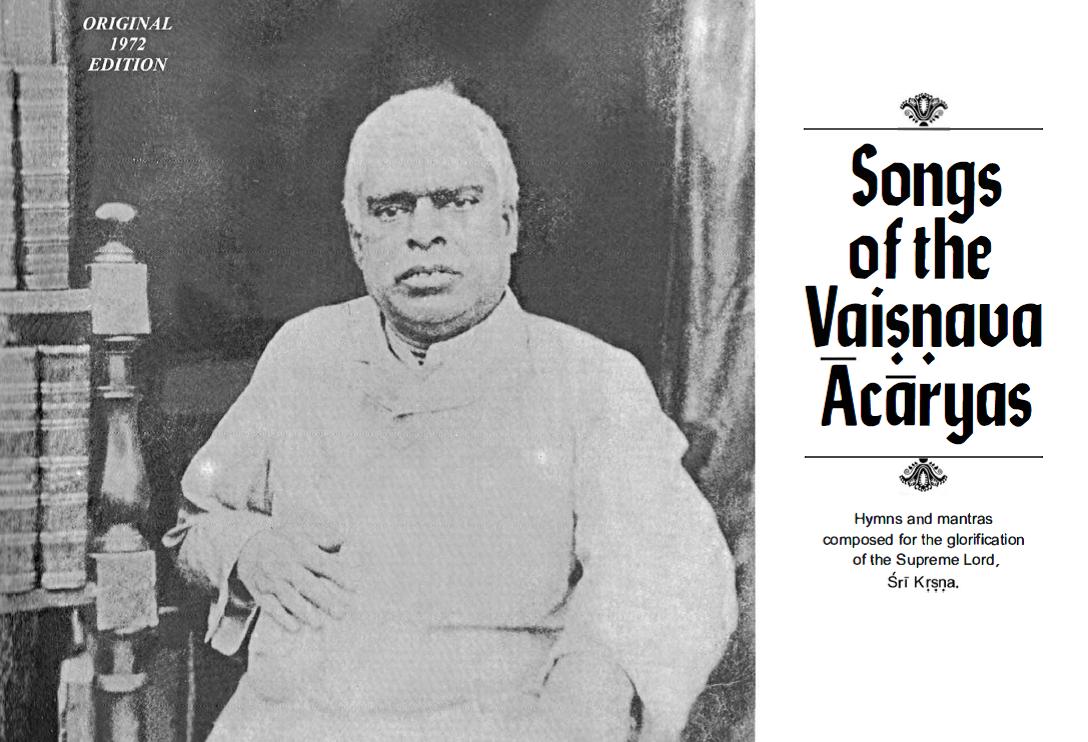
I find it interesting that the older I get, the easier it is to pray. Its not hard, and I kinda enjoy it. It tones down my passionate nature, calms my mind, and makes me feel safe. It is one of my favorite books in our temple room, “The Songs of the Vaisnava Acaryas”. (click on link to download)

Foward to The Songs of the Vaisnava Acaryas

by His Divine Grace A C Bhaktivedanta Swami Prabhupada

The International Society for Krishna Consciousness was established in New York in the year 1966. After my arrival in the United States in September of 1965, I personally underwent a difficult struggle, and in 1966 I rented a storefront and apartment at 26 Second Avenue. When ISKCON was incorporated, a boy named Chuck Barnett joined me, along with a few others, to form the nucleus for the institution’s future development. At this time I used to chant the Hare Kṛṣṇa mahā-mantra underneath a tree in Tompkin’s Square Park in New York. Śrīmān Barnett and another boy, Bruce, were the first to begin dancing in front of me, and others in the audience joined them. The New York Times published a report of this, with our picture and a headline declaring that I was attracting the younger generation to the Hare Kṛṣṇa movement.

Later both Chuck and Bruce, along with others, became my initiated disciples, and still later, in 1970, both took sannyāsa, receiving the names Acyutānanda Svāmī and Brahmānanda Svāmī. Now Brahmānanda is preaching in Africa, and Acyutānanda is preaching in India.

When I became sick in 1967, I left the United States and returned to India. Śrīmān Acyutānanda could not remain separated from me, and therefore he joined me in Vṛndāvana when I was staying there. Since then, Acyutānanda Svāmī has worked very hard in India. He has preached extensively in Calcutta and other parts of Bengal, he has learned how to sing in Bengali and play mṛdaṅga like an expert professional, and now he has compiled this book of Bengali songs with English explanations.

I am greatly pleased to see this collection of songs composed by Ṭhākura Bhaktivinoda, Narottama dāsa, and other great ācāryas of the Gauḍīya Vaiṣṇava community (sampradāya). Songs composed by the ācāryas are not ordinary songs. When chanted by pure Vaiṣṇavas who follow the rules and regulations of Vaiṣṇava character, they are actually effective in awakening the Kṛṣṇa consciousness dormant in every living entity. I have advised Srīmān Acyutānanda Svāmī to sing more songs of the Vaiṣṇava padāvalī and record them in books so that my disciples and others in the Western countries may take advantage of this chanting and thus advance in Krsṇa consciousness more and more.

I confer all my blessings upon Acyutānanda Svāmī for his genuine attempt to advance in Krsṇa consciousness. I hope he will thus advance more and more and never be hampered by māyā. We should always remember the danger of māyā’s influence and endeavor to save ourselves from her great power. We must therefore always merge in the transcendental mellow of kīrtana-rasa, for kīrtana-rasa is the safest situation within this material world. Hare Kṛṣṇa.

A.C. Bhaktivedanta Swami
1974

The Power of the Holy Name


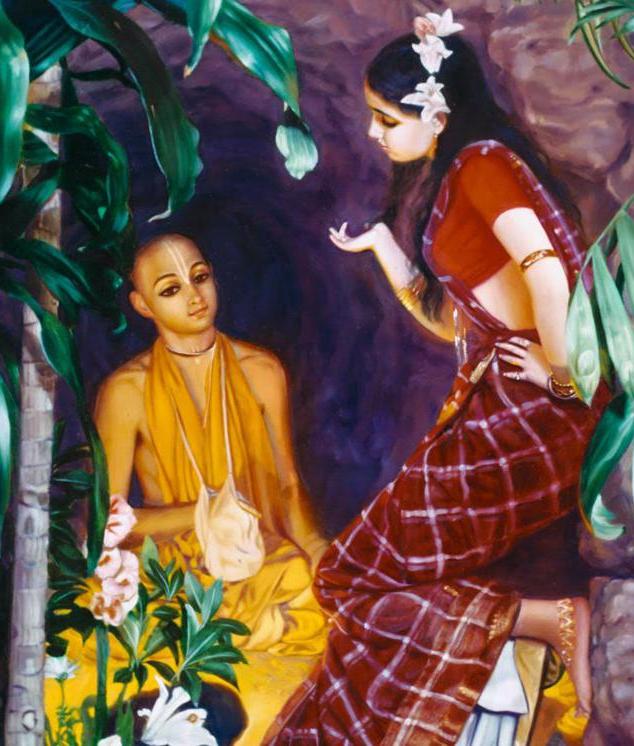
The story of Haridasa Thakura and Maya Devi is a famous Vaishnava tale from the Sri Caitanya-caritamrta detailing how the pure, steadfast devotion of Haridasa Thakura (known as the Namacharya or “Master of the Holy Name”) effortlessly defeated the personified external illusion of the material world.

The Attempted Seduction
While Haridasa Thakura was chanting the holy names in a secluded cave near Shantipur, the local Zamindar, Ramachandra Khan, became envious of his spiritual influence. He hired a beautiful and famous local courtesan, who later revealed herself to be the incarnation of Maya Devi (the material illusion), to seduce him and destroy his vows.

The Test of Faith
Maya Devi visited Haridasa Thakura on a full-moon night, attempting to use her beauty and sweet words to allure him. Despite her charms, Haridasa Thakura’s mind remained completely fixed on chanting the Hare Krishna maha-mantra. He told her he would gladly engage with her after finishing his daily vow of chanting a fixed number of holy names.

The Transformation
Maya Devi returned for three consecutive nights. Astounded that the chanting of the holy names prevented his mind from wavering in the slightest, she finally admitted defeat. Recognizing the purity of his devotion, she fell at his feet, begged for spiritual mercy, and was ultimately initiated by Haridasa Thakura into chanting the Hare Krishna maha-mantra.

More

A Choice of Destinies

Srila Prabhupada Vani

…God is available. and we can associate with Him according to our choice. The ability to choose, or our conscience, is given to us in the human form so we can utilize it. All the ingredients are there for us to cross the ocean of birth and death. This human body is a very nice boat, and we have a very good navigator, the spiritual master. We also have a very favorable wind the instructions of God. So we should take our chance and cross the ocean of birth and death. We can say, “Now here is an opportunity. Take it and be saved from birth, old age, disease, and death.” but if you don’t take advantage, what can we do?

…Man is the architect of his own destiny. In other words, our future destiny depends on our present action. This life is an opportunity to improve our next life, back to Godhead.

A Choice of Destinies

His Divine Grace A.C. Bhaktivedanta Swami Prabhupada speaks with Jon Nordheimer of the New York Times in a conversation recorded in September 1972 at New Vrindaban.

Full conversation

Srila Prabhupada: When we speak of Krsna, we mean God. Everyone has some vague idea of God, hut no clear idea. Therefore God descends to show what He is. If we speculate on God, someone will think one thing and another person will think another. This is the result of speculation. But if God Himself comes and shows Himself as He is and speaks about Himself, that is perfect knowledge. This Krsna consciousness movement is spreading that message.

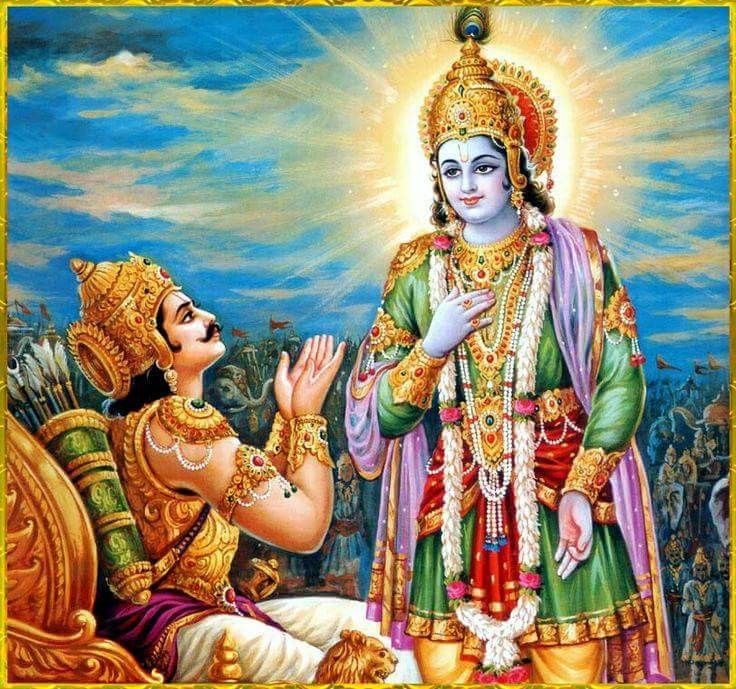
In Bhagavad-gita, God Himself is speaking about Himself: I am like this; My form is like this; My activities are like this; My address is this and that. If you like, you can come back to Me. There is no restriction-everyone can come to Me.” All this information is there in Bhagavad-gita, where God speaks about Himself and presents Himself as He is. We have simply to take that information; then we can understand Him. And when we understand God. Krsna, we can go back to Him. It is a very simple thing. Krsna says.

janma karma ca me divyam
evam yo vetti tattvatah
tyaktva deham punar janma
naiti mam eti so ‘rjuna

“One who knows the transcendental nature of My .appearance and activities does not, upon leaving the body. take his birth again in this material world, but attains My eternal abode. O Arjuna.” [Bhagavad-gita 4.9]

So God is there; that’s a fact. Anyone can go back to Him and live an eternal life full of bliss and knowledge simply by knowing about it. When God Himself comes, all great acaryas, stalwart men, accept Him: “Yes, He is God.” If we simply understand God, we make a solution to all our problems.

More

No Personal Motivation

Srila Prabhupada warns about the danger of personal motivation
compiled by: Yasodanandana Dasa

But the question may be raised as to why is it that we have seen so many devotees, even senior devotees with many years of direct physical association with the acarya, Srila Prabhupada, were [and are] seemingly incapable of clearly understanding Krishna Consciousness philosophy, with so many examples of distortion, blatant philosophical deviations, concoctions, misrepresentations etc. What is the reason for this? The acarya, Srila Prabhupada, explains:

In my books I have tried to explain clearly this simultaneously one and different philosophy acinta beda beda tattva propounded by Lord Caitanya Mahaprabhu. But sometimes it happens that this philosophy is given a self-interested interpretation. As soon as personal motivation comes in it is not possible for one to understand our Krishna Consciousness philosophy. (Srila Prabhupada letter, September 21, 1970)

Srila Prabhupada describes the key of success for the mission of Lord Caitanya

“…Hundreds of people join in our Sankirtana Party daily in downtown Calcutta, and I am confident that this mission of Lord Caitanya’s will be successful if only we continue to push on this great movement, without any personal motivation. Hope this finds you and your good wife and child in good health…” (Srila Prabhupada letter, September 19, 1970)

More

Forced to Act?

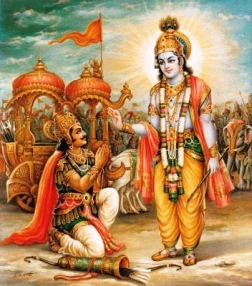
I have often pondered this question that Arjuna asks Krishna:

Arjuna said: O descendant of Vṛṣṇi, by what is one impelled to sinful acts, even unwillingly, as if engaged by force? (Bg. 3.36)

And Krishna answers:

The Blessed Lord said: It is lust only, Arjuna, which is born of contact with the material modes of passion and later transformed into wrath, and which is the all-devouring, sinful enemy of this world. (Bg. 3.37)

A living entity, as part and parcel of the Supreme, is originally spiritual, pure, and free from all material contaminations. Therefore, by nature he is not subjected to the sins of the material world. But when he is in contact with the material nature, he acts in many sinful ways without hesitation, and sometimes even against his will. As such, Arjuna’s question to Kṛṣṇa is very sanguine, as to the perverted nature of the living entities. Although the living entity sometimes does not want to act in sin, he is still forced to act. Sinful actions are not, however, impelled by the Supersoul within, but are due to another cause, as the Lord explains in the next verse. (from purport)

further explained:

…When a living entity comes in contact with the material creation, his eternal love for Kṛṣṇa is transformed into lust, in association with the mode of passion.

…Therefore, lust is the greatest enemy of the living entity, and it is lust only which induces the pure living entity to remain entangled in the material world.

More

What is Bhakti Yoga

What is Bhakti Yoga?

Bhakti yoga is loosely defined as the yoga of Love and Devotion, and sometimes referred to as the “Yoga of the Heart”. But how do we practice it?

Actually it is very easy, and can be practiced anywhere 24/7, and doesn’t require a silent place or yoga mat. There are nine methods and they begin with hearing. When we hear or read about the Lord, we can simply think about the transcendental holy name, form, qualities, paraphernalia and pastimes of Lord Viṣṇu, We can chant the maha-mantra; Hare Krsna, Hare Krsna, Krsna Krsna, Hare Hare, Hare Rama, Hare Rama, Rama Rama, Hare Hare, anytime, any place, silently or out loud. (I like to softly chant with my breath). Just remembering the Lord in our daily activities is another way of practicing Bhakti yoga. There are nine processes in all, of practicing, and any one or all can lead to the path of perfection.

The Nine Processes of Devotional Service are described by Prahlada Maharaja in the 7th Canto of the Srimad Bhagavatam, chapter 5, text 24-25.

Prahlāda Mahārāja said: Hearing and chanting about the transcendental holy name, form, qualities, paraphernalia and pastimes of Lord Viṣṇu, remembering them, serving the lotus feet of the Lord, offering the Lord respectful worship with sixteen types of paraphernalia, offering prayers to the Lord, becoming His servant, considering the Lord one’s best friend, and surrendering everything unto Him (in other words, serving Him with the body, mind and words)—these nine processes are accepted as pure devotional service. One who has dedicated his life to the service of Kṛṣṇa through these nine methods should be understood to be the most learned person, for he has acquired complete knowledge. (SB 7.5.24-25)

The great personalities who attained perfection by practice of the nine processes are listed below

More

The Greatest Welfare Activity in the Human Society

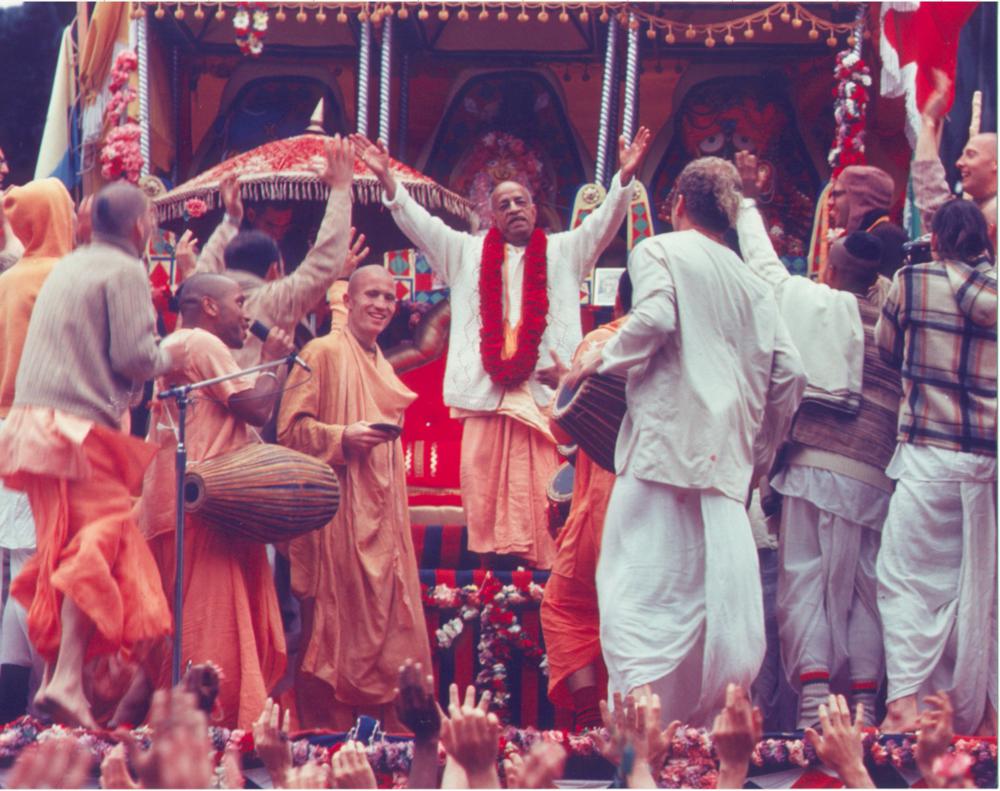
…Our, this Krsna consciousness movement is the greatest welfare activities in the human society. We are giving information to every man, without any discrimination of cast, creed, or color, that every human being especially, not only human being, all living entities, including the animals, beasts, birds, trees, aquatics—everyone—they can achieve to the highest perfection of life by this Krsna consciousness. But especially the extra intelligence of the human being can be utilized to realize Krsna. If we don’t do that, we are missing a great opportunity. So our request to everyone is to understand this philosophy of Krsna consciousness. If anyone wants to understand this philosophy through philosophical angle of vision or scientific angle of vision, we have got immense volumes of books. You can read and try to understand what is this great movement, Krsna consciousness. But you can also, without reading books, without taking any trouble, if you simply agree to chant this maha-mantra, Hare Krsna, Hare Krsna, Krsna Krsna, Hare Hare, Hare Rama, Hare Rama, Rama Rama, Hare Hare, you get the same result. Even a child can join. Actually we have experienced that a child, a dog, an animal, everyone takes part in this movement. During the Lord Caitanya’s movement, when He passed through a great forest known as Jharikhanda... Central India there is a great forest. Along with Him, the tigers, the elephants, the deers, everyone danced and chanted Krsna Krsna mantra. It is so nice, and it is so spiritual, the very vibration will immediately enthuse your ecstasy in spiritual consciousness.

…So if we want to have eternal life, full of knowledge and blissfulness, then we must take to Krsna consciousness. (Ratha-yatra lecture San Franscisco June 27, 1971)

The Highest Perfection

click on image to enlarge

While Kṛṣṇa was engaged in tending the cows in the forest of Vṛndāvana or on Govardhana Hill, the gopīs in the village were always absorbed in thinking of Him and discussing His different pastimes. This is the perfect example of Kṛṣṇa consciousness: to somehow or other remain always engrossed in thoughts of Kṛṣṇa. The vivid example is always present in the behavior of the gopīs; therefore Lord Caitanya declared that no one can worship the Supreme Lord by any method which is better than the method of the gopīs. The gopīs were not born in very high brāhmaṇa or kṣatriya families; they were born in the families of vaiśyas, and not in big mercantile communities but in the families of cowherd men. They were not very well educated, although they heard all sorts of knowledge from the brāhmaṇas, the authorities of Vedic knowledge. The gopīs’ only purpose was to remain always absorbed in thoughts of Kṛṣṇa.

Kṛṣṇa was very pleased with the atmosphere of the forest where flowers bloomed and bees and drones hummed very jubilantly. While the birds, trees and branches were all looking very happy, Kṛṣṇa, tending the cows, accompanied by Śrī Balarāma and the cowherd boys, began to vibrate His transcendental flute. After hearing the vibration of the flute of Kṛṣṇa, the gopīs in Vṛndāvana remembered Him and began to talk amongst themselves about how nicely Kṛṣṇa was playing His flute. When the gopīs were describing the sweet vibration of Kṛṣṇa’s flute, they also remembered their pastimes with Him; thus their minds became disturbed, and they were unable to describe completely the beautiful vibrations. While discussing the transcendental vibration, they remembered also how Kṛṣṇa dressed, decorated with a peacock feather on His head, just like a dancing actor, and with blue flowers pushed over His ear. His garment glowed yellow-gold, and He was garlanded with a vaijayantī necklace. Dressed in such an attractive way, Kṛṣṇa filled up the holes of His flute with the nectar emanating from His lips. So they remembered Him, entering the forest of Vṛndāvana, which is always glorified by the footprints of Kṛṣṇa and His companions. Kṛṣṇa was very expert in playing the flute, and the gopīs were captivated by the sound vibration, which was not only attractive to them, but to all living creatures who heard it. One of the gopīs told her friends, “The highest perfection of the eyes is to see Kṛṣṇa and Balarāma entering the forest and playing Their flutes and tending the cows with Their friends.”

Persons who are constantly engaged in the transcendental meditation of seeing Kṛṣṇa, internally and externally, by thinking of Him playing the flute and entering the Vṛndāvana forest, have really attained the perfection of samādhi. Samādhi (trance) means absorption of all the activities of the senses on a particular object, and the gopīs indicate that the pastimes of Kṛṣṇa are the perfection of all meditation and samādhi. It is also confirmed in the Bhagavad-gītā that anyone who is always absorbed in the thought of Kṛṣṇa is the topmost of all yogīs. (KRSNA The Supreme Personality of Godhead, Vol 1, Chapter 21)

108 Imporant Slokas from the 1972 Bhagavad-gita As It Is

Click on image to go to Post

Click on image to go to Post

The Hare Krishna Cookbook

Songs of the Vaisnava Acaryas

Bhagavad-gita As It Is 1972 Edition “Online”

click on image

click on image to visit site

Srimad Bhagavatam Online

click on image

Raja-Vidya the King of Knowledge

click on image

click on image

Blog Stats

  • 4,715,257 hits

Enter your email address to subscribe to this blog and receive notifications of new posts by email.

Join 3,894 other subscribers

Important Slokas from the Brahma-samhita

click on image

click on image

Slokas from the Sri Isopanisad

click on image

click on image

Prayers By Queen Kunti (Slokas)

click on image

Gajendra’s Prayers of Surrender (Slokas)

click on image

A Short Statement of the Philosophy of Krishna Consciousness

click on image

click on image

July 9th Letter

click on image

click on image

The Hare Krishna Explosion

Reference Material/Study Guide

click on image

click on image

  • LINKS