Today we celebrate the Appearance of Lord Krishna (Janmastami) with a full day fast, untill midnight. Lord Krishna’s birth is commemorated at midnight with devotional songs (bhajans), followed by a small ekadasi vegetarian feast.
Janmashtami means the celebration of the birth of Lord Krishna, derived from the Sanskrit words “janma” (birth) and “ashtami” (the eighth day)
On this day we like to read from the Krsna Book, so we have included an excerpt from the Krsna book, chapter 5 entitled “Meeting of Nanda and Vasudeva”.
KRSNA The Supreme Personality of Godhead
By His Divne Grace A. C. Bhaktivedanta Swami Prabhupada
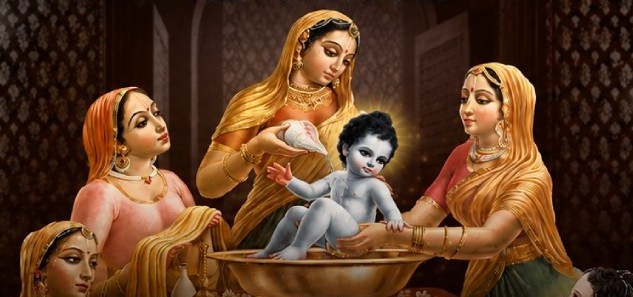
Although Kṛṣṇa was the real son of Vasudeva and Devakī, because of Kaṁsa’s atrocious activities Vasudeva could not enjoy the birth ceremony of his son. But Nanda Mahārāja, the foster father, celebrated the birth ceremony of Kṛṣṇa very joyfully. The next day, it was declared that a male child was born of Yaśodā. According to Vedic custom, Nanda Mahārāja called for learned astrologers and brāhmaṇas to perform the birth ceremony. After the birth of a child, the astrologers calculate the moment of the birth and make a horoscope of the child’s future life. Another ceremony takes place after the birth of the child: the family members take baths, cleanse themselves and decorate themselves with ornaments and garlands; then they come before the child and the astrologer to hear of the future life of the child. Nanda Mahārāja and other members of the family dressed and sat down in front of the birth place. All the brāhmaṇas who were assembled there on this occasion chanted auspicious mantras, according to the rituals, while the astrologers performed the birth ceremony. All the demigods are also worshiped on this occasion, as well as the forefathers of the family. Nanda Mahārāja distributed 200,000 well decorated, dressed and ornamented cows to the brāhmaṇas. He not only gave cows in charity, but hills of grains, decorated with golden-bordered garments and many ornaments.
In the material world we possess riches and wealth in many ways, but sometimes not in very honest and pious ways, because that is the nature of accumulating wealth. According to Vedic injunction, therefore, such wealth should be purified by giving cows and gold in charity to the brāhmaṇas. A newborn child is also purified by giving grains in charity to the brāhmaṇas. In this material world it is to be understood that we are always living in a contaminated state. We therefore have to purify the duration of our lives, our possession of wealth and ourselves. The duration of life is purified by taking daily bath and cleansing the body inside and outside and accepting the ten kinds of purificatory processes. By austerities, by worship of the Lord, and by distribution of charity, we can purify the possession of wealth. We can purify ourselves by studying the Vedas, by striving for self-realization and by understanding the Supreme Absolute Truth. It is therefore stated in the Vedic literature that by birth everyone is born a śūdra, and by accepting the purificatory process one becomes twice-born. By studies of the Vedas one can become vipra, which is the preliminary qualification for becoming a brāhmaṇa. When one understands the Absolute Truth in perfection, he is called a brāhmaṇa. And when the brāhmaṇa reaches further perfection, he becomes a Vaiṣṇava or a devotee.
In that ceremony, all the brāhmaṇas assembled began to chant different kinds of Vedic mantras to invoke all good fortune for the child. There are different kinds of chanting known as sūta, māgadha, vandī, and virudāvalī. Along with this chanting of mantras and songs, bugles and kettledrums sounded outside the house. On this occasion, the joyous vibrations could be heard in all the pasturing grounds and all the houses. Within and outside of the houses there were varieties of artistic paintings, done with rice pulp, and scented water was sprinkled everywhere, even on the roads and streets. Ceilings and roofs were decorated with different kinds of flags, festoons and green leaves. The gates were made of green leaves and flowers. All the cows, bulls and calves were smeared with a mixture of oil and turmeric and painted with minerals like red oxide, yellow clay and manganese. They wore garlands of peacock feathers, and were covered with nice colored dresses and gold necklaces.
When all the ecstatic cowherd men heard that Nanda Mahārāja, father of Kṛṣṇa, was celebrating the birth ceremony of his son, they became spontaneously joyful. They dressed themselves with very costly garments and ornamented their bodies with different kinds of earrings and necklaces and wore great turbans on their heads. After dressing themselves in this gorgeous way, they took various kinds of presentations and thus approached the house of Nanda Mahārāja.
As soon as they heard that mother Yaśodā had given birth to a child, all the cowherd women became overwhelmed with joy, and they also dressed themselves with various kinds of costly garments and ornaments and smeared scented cosmetics on their bodies.
As the dust on the lotus flower exhibits the exquisite beauty of the flower, all the gopīs (cowherd girls) applied the dust of kuṅkuma on their lotus-like faces. These beautiful gopīs took their different presentations and very soon reached the house of Mahārāja Nanda. Overburdened with their heavy hips and swollen breasts, the gopīs could not proceed very quickly towards the house of Nanda Mahārāja, but out of ecstatic love for Kṛṣṇa they began to proceed as quickly as possible. Their ears were decorated with pearl rings, their necks were decorated with jewel padlocks, their lips and eyes were decorated with different kinds of lipstick and ointment, and their hands were decorated with nice golden bangles. As they were very hastily passing over the stone road, the flower garlands which were decorating their bodies fell to the ground, and it appeared that a shower of flowers was falling from the sky. From the movement of the different kinds of ornaments on their bodies, they were looking still more beautiful. In this way, they all reached the house of Nanda-Yaśodā and blessed the child: “Dear child, You live long just to protect us.” While they were blessing child Kṛṣṇa in this way, they offered a mixture of turmeric powder with oil, yogurt, milk and water. They not only sprinkled this mixture on the body of child Kṛṣṇa but on all other persons who were present there. Also on that auspicious occasion, there were different bands of expert musicians playing.
When the cowherd men saw the pastimes of the cowherd women, they became very joyful, and in response they also began to throw yogurt, milk, clarified butter and water upon the bodies of the gopīs. Then both parties began to throw butter on each other’s bodies. Nanda Mahārāja was also very happy to see the pastimes of the cowherd men and women, and he became very liberal in giving charity to the different singers who were assembled there. Some singers were reciting great verses from the Upaniṣads and Purāṇas, some were glorifying the family ancestors, and some were singing very sweet songs. There were also many learned brāhmaṇas present, and Nanda Mahārāja, being very satisfied on this occasion, began to give them different kinds of garments, ornaments, and cows in charity.
It is very important to note in this connection how wealthy the inhabitants of Vṛndāvana were simply by raising cows. All the cowherd men belonged to the vaiśya community, and their business was to protect the cows and cultivate crops. By their dress and ornaments and by their behavior, it appears that although they were in a small village, they still were rich in material possessions. They possessed such an abundance of various kinds of milk products that they were throwing butter lavishly on each other’s bodies without restriction. Their wealth was in milk, yogurt, clarified butter and many other milk products, and by trading their agricultural products, they were rich in various kinds of jewelry, ornaments and costly dresses. Not only did they possess all these things, but they could give them away in charity, as did Nanda Mahārāja.
Thus Nanda Mahārāja, the foster father of Lord Kṛṣṇa, began to satisfy the desires of all the men assembled there. He respectively received them and gave them in charity whatever they desired. The learned brāhmaṇas, who had no other source of income, were completely dependent of the vaiśya and kṣatriya communities for their maintenance, and they received gifts on such festive occasions as birthdays, marriages, etc. While Nanda Mahārāja was worshiping Lord Viṣṇu on this occasion and was trying to satisfy all the people there, his only desire was that the newborn child Kṛṣṇa would be happy. Nanda Mahārāja had no knowledge that this child was the origin of Viṣṇu, but he was praying to Lord Viṣṇu to protect Him.
Rohiṇīdevī, mother of Balarāma, was the most fortunate wife of Vasudeva. She was away from her husband, yet just to congratulate Mahārāja Nanda on the occasion of the birth ceremony of his son, Kṛṣṇa, she dressed herself very nicely. Wearing a garland, a necklace and other bodily ornaments, she appeared on the scene and moved hither and thither. According to the Vedic system, a woman whose husband is not at home does not dress herself very nicely. But although Rohiṇī’s husband was away, she still dressed herself on this occasion.
From the opulence of the birth ceremony of Kṛṣṇa, it is very clear that at that time Vṛndāvana was rich in every respect. Because Lord Kṛṣṇa took birth in the house of King Nanda and mother Yaśodā, the goddess of fortune was obliged to manifest her opulences in Vṛndāvana. It appeared that Vṛndāvana had already become a site for the pastimes of the goddess of fortune.