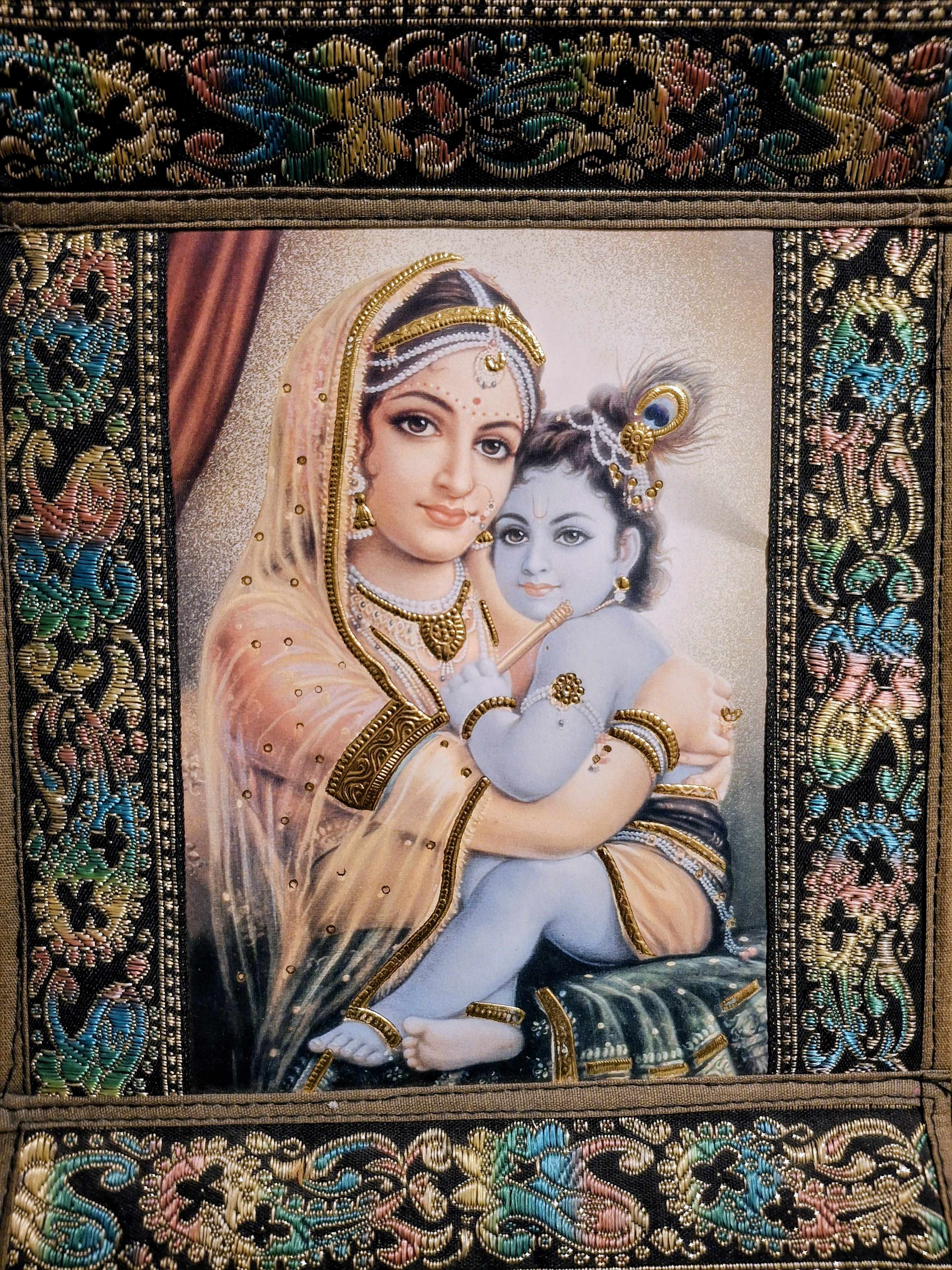
I love this month of Damodara (Kartik). Every evening we sing the Damodarastakam Prayers and offer a candle to the Lord. I am sure everyone has a favorite verse. The verse that melts my heart is verse 5.
idaḿ te mukhāmbhojam atyanta-nīlair vṛtaḿ kuntalaiḥ snigdha-raktaiś ca gopyā muhuś cumbitaḿ bimba-raktādharaḿ me manasy āvirāstām alaḿ lakṣa-lābhaiḥ
O Lord, the cheeks of Your blackish lotus face, which is encircled by locks of curling hair, have become reddened like bimba fruit due to Mother Yasoda’s kisses. What more can I describe than this? Millions of opulences are of no use to me, but may this vision constantly remain in my mind.
I remember singing this song with Visnujana Swami, and he has given a nice purport to the verse I found on KKSongs.
The poet demonstrates in this verse that longing for the association of the Lord in the heart is the best means to achieve Him. The longing to see the beautiful lotus face of the Lord, which is supremely enchanting, is stated first (idam te mukhambhojam). The indescribably sweet face of Sri Krishna resembles a lotus flower in full bloom. Simply by seeing His face, which is the treasure house of supreme bliss, all anxiety and distress disappear. Therefore, may that lotus face (mukhambhojam) manifest within the mind even just once (manasy avirastam), or again and again (muhuh), or constantly (sada). The concept of sada is carried over from the previous verse to give its definitive conclusion in this verse. All three meanings are intended.
That lotus face is always surrounded (vrtam) by curling hair (kuntalaih) which is a very dark blue color (atyanta-nilair). It is tinged with a reddish hue (raktaih) and is shining (snigdha). The curly locks encircling Krishna’s face bounce as He moves here and there, just as a lotus flower is surrounded by hovering honey bees. This is the meaning suggested by vrtan. His lotus face is kissed again and again by Mother Yasoda (gopya). The word muhuh (again and again), defines the supremely fortunate gopi (gopya) who repeatedly kisses that divine lotus face (muhus cumbitam).
Furthermore, Krishna’s lotus face is adorned with crimson red lips like the bimba fruit (bimba-raktadharam). That form is so completely enchanting and satisfying that millions of other attainments (laksa-labhaih) are simply useless (alam). They have no value. This is the meaning of the verse. (Visnujana Swami)
This Month of Damodara or Kartik, has always been my favorite month for many reasons. The weather is usually good, there is a harvest moon, the trees change color, and we get to sing the Sri Damodararastaka prayers and offer a candle or ghee lamp every evening. It is the best month for spiritual advancement, as we are reminded of Krishna‘s childhood pastimes.
Kartik: Month of Prayer and Giving
Kartik, or the month of Damodar, is considered the best of months and is most auspicious for spiritual advancement. In the Skanda Purana it is stated:
“As Satya-yuga is the best of yugas, as the Vedas are the best of scriptures, as Ganga is the best of rivers, so Kartik is the best of months, the most dear to Lord Sri Krishna.”.
Also in the Skanda Purana it is stated:
“A person who offers a ghee lamp to Lord Krishna during Kartik burns away a collection of sins as big as Mt. Meru or Mt. Mandara, will not take birth again in this world and attains to the eternal spiritual realm where there is no suffering. Even if there are no mantras, no piety, and no purity, everything becomes perfect by such an offering.”
The Padma Purana describes the month of Kartik as Krishna’s favorite month. Devotional activities performed during this holy month are rewarded with greater spiritual results than usual so devotees often take vows to increase their spiritual practices or to simplify their material needs for the entire month. It is a way that they can remember Krishna more and increase their service to Him.
Kartik, also known as the month of Damodara, is a month for deepening one’s love for Krishna. It is proclaimed in the Purana’s to be the holiest month of the year.
“Among all twelve months, the month of Kartik is dear to Lord Krishna. If somebody performs a little worship of Lord Sri Hari in this month, that devotee is offered His own abode.” – Padma Purana
We are now in the month of Damodara (Kartika). In honor and in celebration of the month of Damodara, we will be focusing our attention on the pastimes of Krishna in Vrndavan. Especially Krishna’s childhood pastimes. The following is the first verse from the Damodarastkam prayer which is sung morning and evening, and it is customary to offer a candle or gee lamp as well to a picture of Lord Krsna and Mother Yasoda.
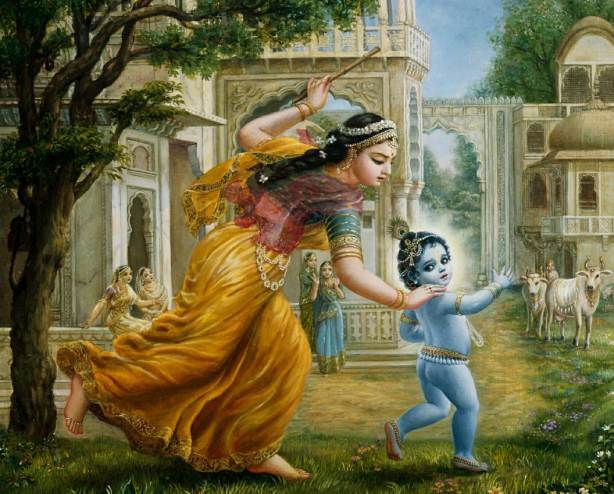
“To the supreme controller who possesses an eternal form of blissful knowledge, whose glistening earrings swing to and fro, who manifested Himself in Gokula, who stole the butter that the gopis kept hanging from the rafters of their storerooms and who then quickly jumped up and ran in retreat in fear of Mother Yasoda, but was ultimately caught-to that Supreme Lord, Sri Damodara, I offer my humble obeisances.“ (Sri Damodarastakam verse 1)
Once, seeing that her maidservant was engaged in different household work, mother Yashoda personally churned butter. While she churned butter, she sang the wonderful childhood pastimes of her son Krishna and relished thinking of Him. At that time Krishna appeared there and was hungry. He wanted her to stop churning the butter and feed Him first.
Mother Yashoda took her son on her lap and started feeding Him. While Krishna was sucking the milk, mother Yashoda smiled and enjoyed the beauty of Her child Krishna. Suddenly, the milk which was on the stove began to boil over. Just to stop the milk from spilling, mother Yashoda at once put Krishna aside and went to the stove. Left in that state by His mother, Krishna became very angry, and His lips and eyes became red in rage. He pressed His teeth and lips, and taking up a piece of stone, He immediately broke the butter pot. He took butter out of it, and with false tears in His eyes, He began to eat the butter in a secluded place.
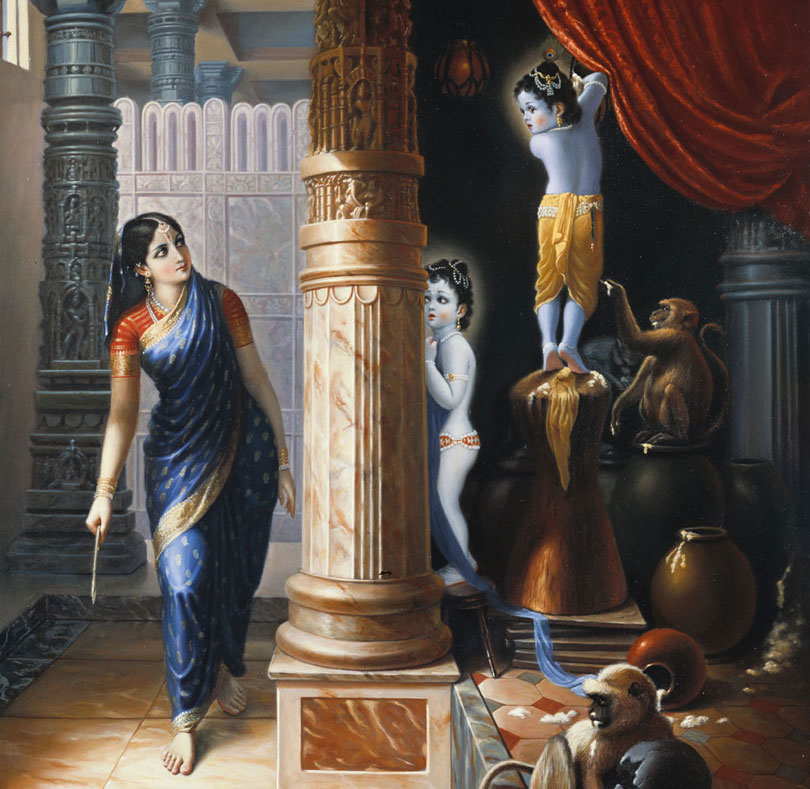
In the meantime, mother Yashoda returned to the churning place after setting the overflowing milk pan in order. She saw the broken pot, in which the churned yogurt had been kept. Since she could not find her boy, she concluded that the broken pot was His work. She smiled as she thought, “The child is very clever. After breaking the pot He has left this place, fearing punishment.” After she sought all over, she found her son sitting on a big wooden grinding mortar, which was kept upside down. He was taking butter from a pot which was hanging from the ceiling on a swing, and He was feeding it to the monkeys.
She saw Krishna looking this way and that way in fear of her because He was conscious of His naughty behavior. After seeing her son so engaged, she very silently approached Him from behind. Krishna, however, saw her coming toward Him with a stick in her hand, and He immediately got down from the grinding mortar and began to flee in fear. Mother Yashoda chased Him to all corners, trying to capture the Supreme Personality of Godhead, who is never approached even by the meditations of great yogis. In other words, the Supreme Personality of Godhead, Krishna, who is never caught by the yogis and speculators, was playing just like a little child for such a great devotee as mother Yashoda. Mother Yashoda, however, could not easily catch the fast-running child because of her thin waist and heavy body. Still she tried to follow Him as fast as possible. Her hair loosened, and the flowers in her hair fell to the ground. Although she was tired, she somehow reached her naughty child and captured Him. When He was caught, Krishna was almost on the point of crying. He smeared His hands over His eyes, which were anointed with black eye cosmetics. The child saw His mother’s face while she stood over Him, and His eyes became restless from fear. (from Krsna Book Chapter 9)
This month of Kartika or the month of Damodara, has always been very dear. It is probably because Radha Damodara were the first worshipable Radha Krishna deities I had the good fortune to serve. When I joined the Hare Krishna movement, I was assigned to the Radha Damodara Traveling Sankirtan Party (RDTSP). I traveled with the bus party for the first year of my devotional career, and when the bus party broke up, I was re-assigned to the Gita Nagari farm, where I was engaged for some time as a carpenter building the new temple for the Radha Damodara deities who reside there. I guess we always remember our first love. -V
Worship of Sri Sri Radha-Damodara
Radharani is especially keen to hear Krishna’s pastimes, but She is particularly attracted to the Damodara pastime. Charmed by Damodara’s mood of surrender in agreeing to be bound by Mother Yasoda’s love, Sri Radha longs to have that same exchange with Krishna. She desires to express such intense love for Krishna that He will also agree to be bound by Her love. Appreciating this mood of Mother Yasoda to enhance Her own feelings for Krishna, She resolves to experience this same reciprocation of love.” (Srimad Bhagavatam 10.9.20 Purport) Radha-Damodara thus refers to Radharani’s mood of intense attraction for this pastime between Damodara and Mother Yasoda.
Neither Lord Brahma, nor Lord Siva, nor even the goddess of fortune, who is always the better half of the Supreme Lord, can obtain from the Supreme Personality of Godhead, the deliverer from this material world, such mercy as recieved by mother Yasoda. (Srimad Bhagavan 10.9.20)
All the gopī friends of Yaśodā and Rohiṇī enjoyed the naughty childish activities of Kṛṣṇa and Balarāma in Vṛndāvana. In order to enjoy further transcendental bliss, they all assembled and went to mother Yaśodā to lodge complaints against the restless boys. When Kṛṣṇa was sitting before mother Yaśodā, all the elderly gopīs began to lodge complaints against Him so that Kṛṣṇa could hear. They said, “Dear Yaśodā, why don’t you restrict your naughty Kṛṣṇa? He comes to our houses along with Balarāma every morning and evening, and before the milking of the cows They let loose the calves, and the calves drink all the milk of the cows. So when we go to milk the cows, we find no milk, and we have to return with empty pots. If we warn Kṛṣṇa and Balarāma about doing this, They simply smile charmingly. We cannot do anything. Also, your Kṛṣṇa and Balarāma find great pleasure in stealing our stock of yogurt and butter from wherever we keep it. When Kṛṣṇa and Balarāma are caught stealing the yogurt and butter, They say, ’Why do you charge Us with stealing? Do you think that butter and yogurt are in scarcity in Our house?’ Sometimes They steal butter, yogurt and milk and distribute them to the monkeys. When the monkeys are well fed and do not take any more, then your boys chide, ’This milk and butter and yogurt are useless–even the monkeys won’t take it.’ And They break the pots and throw them hither and thither. If we keep our stock of yogurt, butter and milk in a solitary dark place, your Kṛṣṇa and Balarāma find it in the darkness by the glaring effulgence of the ornaments and jewels on Their bodies. If by chance They cannot find the hidden butter and yogurt, They go to our little babies and pinch their bodies so that they cry, and then They go away. If we keep our stock of butter and yogurt high on the ceiling, hanging on a swing, although it is beyond Their reach, They arrange to reach it by piling all kinds of wooden crates over the grinding machine. And if They cannot reach, They make a hole in the pot. We think therefore that you better take all the jeweled ornaments from the bodies of your children.”
We are now in the month of Damodara (Kartika). In honor and in celebration of the month of Damodara, we will be focusing our attention on the pastimes of Krishna in Vrndavan. Especially Krishna’s childhood pastimes. The following is the first verse from the Damodarastkam prayer which is sung morning and evening, and it is customary to offer a candle or gee lamp as well to a picture of Lord Krsna and Mother Yasoda.
“To the supreme controller who possesses an eternal form of blissful knowledge, whose glistening earrings swing to and fro, who manifested Himself in Gokula, who stole the butter that the gopis kept hanging from the rafters of their storerooms and who then quickly jumped up and ran in retreat in fear of Mother Yasoda, but was ultimately caught-to that Supreme Lord, Sri Damodara, I offer my humble obeisances.“ (Sri Damodarastakam verse 1)
Last night was the full moon (purnima), the harvest moon, which marks the month of Kartika, or as I like to say, the month of Damodara. As always during this month, we sing the Damodara prayers (Sri Damodararastaka) daily and light a candle to offer. It is also a good time to read from the KRSNA Book and just delight in the childhood pastimes of Lord Krishna.
Included below are the lyrics and translations from the original “Songs of the Vaisnava Acaryas” song book.
A few days ago on the full moon (purnima) we started the month of Kartika, or as I like to say, the month of Damodara. As always during this month, we sing the Damodara prayers (Sri Damodararastaka) daily and light a candle to offer. It is also a good time to read from the KRSNA Book and just delight in the childhood pastimes of Lord Krishna.
Included below are the lyrics and translations from the original “Songs of the Vaisnava Acaryas” song book.
“To the supreme controller who possesses an eternal form of blissful knowledge, whose glistening earrings swing to and fro, who manifested Himself in Gokula, who stole the butter that the gopis kept hanging from the rafters of their storerooms and who then quickly jumped up and ran in retreat in fear of Mother Yasoda, but was ultimately caught-to that Supreme Lord, Sri Damodara, I offer my humble obeisances.“
We are now in the month of Damodara (Kartika). In honor and in celebration of the month of Damodara, we will be focusing our attention on the pastimes of Krishna in Vrndavan. Especially Krishna’s childhood pastimes. The following song is sung morning and evening and it is customary to offer a candle or gee lamp as well to a picture of Lord Krsna and Mother Yasoda.
We are now in the month of Damodara (Kartika). In honor and in celebration of the month of Damodara, we will be focusing our attention on the pastimes of Krishna in Vrndavan. Especially Krishna’s childhood pastimes. The following song is sung morning and evening and it is customary to offer a candle or gee lamp as well to a picture of Lord Krsna and Mother Yasoda.
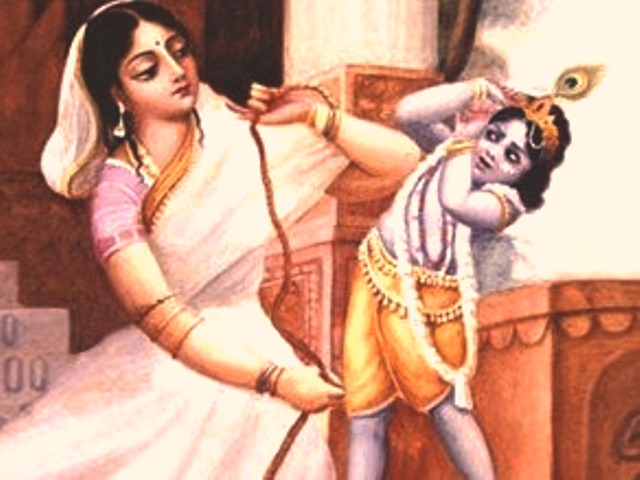
” Upon seeing His mothers whipping stick, He cried and rubbed His eyes again and again with His two lotus hands. His eyes were fearful and His breathing quick, and as Mother Yasoda bound His belly with ropes, He shivered in fright and His pearl necklace shook. To this Supreme Lord, Sri Damodara, who is bound with His devotee’s love, I offer my humble obeisances.” (Damodarastakam)
Following song lyrics is a link of Vishnujana Swami chanting the Damodara Prayers
” Upon seeing His mothers whipping stick, He cried and rubbed His eyes again and again with His two lotus hands. His eyes were fearful and His breathing quick, and as Mother Yasoda bound His belly with ropes, He shivered in fright and His pearl necklace shook. To this Supreme Lord, Sri Damodara, who is bound with His devotee’s love, I offer my humble obeisances.” (Damodarastakam)
We are now in the month of Damodara (Kartika). In honor and in celebration of the month of Damodara, we will be focusing our attention on the pastimes of Krishna in Vrndavan. Especially Krishna’s childhood pastimes. The following song is sung morning and evening and it is customary to offer a candle or gee lamp as well to a picture of Lord Krsna and Mother Yasoda.
Following song lyrics is a link of Vishnujana Swami chanting the Damodara Prayers
We will be posting some of Lord Krishna’s childhood pastimes durning this month of Damodara (Kartika)
All the gopī friends of Yaśodā and Rohiṇī enjoyed the naughty childish activities of Kṛṣṇa and Balarāma in Vṛndāvana. In order to enjoy further transcendental bliss, they all assembled and went to mother Yaśodā to lodge complaints against the restless boys. When Kṛṣṇa was sitting before mother Yaśodā, all the elderly gopīs began to lodge complaints against Him so that Kṛṣṇa could hear. They said, “Dear Yaśodā, why don’t you restrict your naughty Kṛṣṇa? He comes to our houses along with Balarāma every morning and evening, and before the milking of the cows They let loose the calves, and the calves drink all the milk of the cows. So when we go to milk the cows, we find no milk, and we have to return with empty pots. If we warn Kṛṣṇa and Balarāma about doing this, They simply smile charmingly. We cannot do anything. Also, your Kṛṣṇa and Balarāma find great pleasure in stealing our stock of yogurt and butter from wherever we keep it. When Kṛṣṇa and Balarāma are caught stealing the yogurt and butter, They say, ’Why do you charge Us with stealing? Do you think that butter and yogurt are in scarcity in Our house?’ Sometimes They steal butter, yogurt and milk and distribute them to the monkeys. When the monkeys are well fed and do not take any more, then your boys chide, ’This milk and butter and yogurt are useless–even the monkeys won’t take it.’ And They break the pots and throw them hither and thither. If we keep our stock of yogurt, butter and milk in a solitary dark place, your Kṛṣṇa and Balarāma find it in the darkness by the glaring effulgence of the ornaments and jewels on Their bodies. If by chance They cannot find the hidden butter and yogurt, They go to our little babies and pinch their bodies so that they cry, and then They go away. If we keep our stock of butter and yogurt high on the ceiling, hanging on a swing, although it is beyond Their reach, They arrange to reach it by piling all kinds of wooden crates over the grinding machine. And if They cannot reach, They make a hole in the pot. We think therefore that you better take all the jeweled ornaments from the bodies of your children.”
1) To the supreme controller who possesses an eternal form of blissful knowledge, whose glistening earrings swing to and fro, who manifested Himself in Gokula, who stole the butter that the gopis kept hanging from the rafters of their storerooms and who then quickly jumped up and ran in retreat in fear of Mother Yasoda, but was ultimately caught-to that Supreme Lord, Sri Damodara, I offer my humble obeisances.
2) Upon seeing His mothers whipping stick, He cried and rubbed His eyes again and again with His two lotus hands. His eyes were fearful and His breathing quick, and as Mother Yasoda bound His belly with ropes, He shivered in fright and His pearl necklace shook, To this Supreme Lord, Sri Damodara, who is bound with His devotee’s love, I offer my humble obeisances.
The beauty of Transcendental subject matter is that it never gets old, but rather, becomes more relishable with every reading. For instance, every year we celebrate the month of Damodara or Kartika, with the reading of “Mother Yasoda Binds Lord Krsna”, and singing the Damodarastka prayers, and every year, it becomes more enjoyable and spiritually enlivening. That is the nature of Spiritual Subject Matter.
Kṛṣṇa, the Supreme Personality of Godhead
By His Divine Grace A. C. Bhaktivedanta Swami Prabhupāda
Chapter Nine
Mother Yaśodā Binds Lord Kṛṣṇa
Once upon a time, seeing that her maidservant was engaged in different household duties, mother Yaśodā personally took charge of churning butter. And while she churned butter, she sang the childhood pastimes of Kṛṣṇa and enjoyed thinking of her son.
The end of her sari was tightly wrapped while she churned, and on account of her intense love for her son, milk automatically dripped from her breasts which moved as she labored very hard, churning with two hands. The bangles and bracelets on her hands tinkled as they touched each other, and her earrings and breasts shook. There were drops of perspiration on her face, and the flower garland which was on her head scattered here and there. Before this picturesque sight, Lord Kṛṣṇa appeared as a child. He felt hungry, and out of love for His mother, He wanted her to stop churning. He indicated that her first business was to let Him suck her breast and then churn butter later.
Today being Purnima (the Full Moon), is also the End of Kartika, Sri Krsna Rasa-yatra (the purnima or full moon of Damodara month is the second full moon of the autumn season, and rasa lila is again celebrated), Tulasi-Saligrama Vivaha (this is the celebration of the marriage ceremony of Srimati Tulsi Devi and Lord Sri Krishna), and the Last Day of Caturmasya.
In honor of this auspicious day, we are posting the Introduction to the Rasa Dance, Chapter 29 of the Krsna Book.
…The appearance of the moon increased Kṛṣṇa’s desire to dance with the gopīs. The forests were filled with fragrant flowers. The atmosphere was cooling and festive. When Lord Kṛṣṇa began to blow His flute, the gopīs all over Vṛndāvana became enchanted. Their attraction to the vibration of the flute increased a thousand times due to the rising full moon, the red horizon, the calm and cool atmosphere, and the blossoming flowers. All these gopīs were by nature very much attracted to Kṛṣṇa’s beauty, and when they heard the vibration of His flute, they became apparently lustful to satisfy the senses of Kṛṣṇa.
Immediately upon hearing the vibration of the flute, they all left their respective engagements and proceeded to the spot where Kṛṣṇa was standing. While they ran very swiftly, all their earrings swung back and forth. They all rushed toward the place known as Vaṁśīvaṭa. Some of them were engaged in milking cows, but they left their milking business half finished and immediately went to Kṛṣṇa. One of them had just collected milk and put it in a milk pan on the oven to boil, but she did not care whether the milk overboiled and spilled–she immediately left to go see Kṛṣṇa. Some of them were breast feeding their small babies, and some were engaged in distributing food to the members of their families, but they left all such engagements and immediately rushed towards the spot where Kṛṣṇa was playing His flute. Some were engaged in serving their husbands, and some were themselves engaged in eating, but neither caring to serve their husbands nor eat, they immediately left. Some of them wanted to decorate their faces with cosmetic ointments and to dress themselves very nicely before going to Kṛṣṇa, but unfortunately they could not finish their cosmetic decorations nor put on their dresses in the right way because of their anxiety to meet Kṛṣṇa immediately. Their faces were decorated hurriedly and were haphazardly finished; some even put the lower part of their dresses on the upper part of their bodies and the upper part on the lower part.
While all the gopīs were hurriedly leaving their respective places, their husbands, brothers and fathers were all struck with wonder to know where they were going. Being young girls, they were protected either by husbands, elderly brothers or fathers. All their guardians forbade them to go to Kṛṣṇa, but they disregarded them. When a person becomes attracted by Kṛṣṇa and is in full Kṛṣṇa consciousness, he does not care for any worldly duties, even though very urgent. Kṛṣṇa consciousness is so powerful that it gives everyone relief from all material activities. Śrīla Rūpa Gosvāmī has written a very nice verse wherein one gopī advises another, “My dear friend, if you desire to enjoy the company of material society, friendship and love, then please do not go to see this smiling boy Govinda, who is standing on the bank of the Yamunā and playing His flute, His lips brightened by the beams of the full moonlight.” Śrīla Rūpa Gosvāmī indirectly instructs that one who has been captivated by the beautiful smiling face of Kṛṣṇa has lost all attraction for material enjoyments. This is the test of advancement in Kṛṣṇa consciousness: a person advancing in Kṛṣṇa consciousness must lose interest in material activities and personal sense gratification.
“O Lord, although You are able to give all kinds of benedictions, I do not pray to You for liberation, nor eternal life in Vaikuntha, nor any other boon. My only prayer is that Your childhood pastimes may constantly appear in my mind. O Lord, I do not even want to know Your feature of Paramatma. I simply wish that Your childhood pastimes may ever be enacted in my heart.” (Damodarasatka prayers)
Continuining our month long attempt to stay focused on the childhood pastimes of Krsna, during this month of Damodara (Kartika), we bring you another exciting chapter from; Kṛṣṇa, the Supreme Personality of Godhead. Today we are posting the chapter entitled “Subduing Kāliya”
Kṛṣṇa, the Supreme Personality of Godhead By His Divine Grace A. C. Bhaktivedanta Swami Prabhupāda
Chapter Sixteen
Subduing Kāliya
When He understood that the water of the Yamunā was being polluted by the black serpent Kāliya, Lord Kṛṣṇa took action against him and made him leave the Yamunā and go elsewhere, and thus the water became purified.
So…continuining our month long attempt to stay focused on the childhood pastimes of Krsna, during this month of Damodara (Kartika), we bring you another exciting chapter from; Kṛṣṇa, the Supreme Personality of Godhead. Today we are posting the chapter entitled “Killing the Demons Vatsāsura and Bakāsura”.
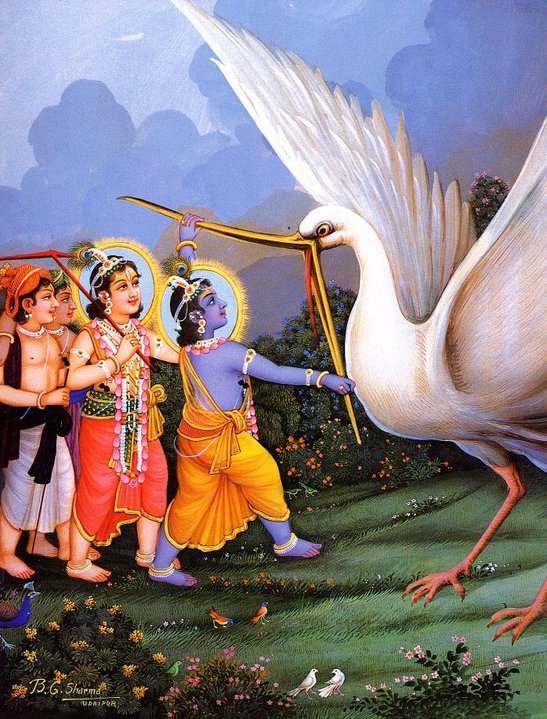
…All the cowherd boys would daily go to the bank of the river Yamunā to water their calves. Usually, when the calves drank water from the Yamunā, the boys also drank. One day, after drinking, when they were sitting on the bank of the river, they saw a huge animal which looked something like a duck and was as big as a hill. Its top was as strong as a thunderbolt. When they saw that unusual animal, they became afraid of it. The name of this beast was Bakāsura, and he was a friend of Kaṁsa’s. He appeared on the scene suddenly and immediately attacked Kṛṣṇa with his pointed, sharp beaks and quickly swallowed Him up. When Kṛṣṇa was thus swallowed, all the boys, headed by Balarāma, became almost breathless, as if they had died. But when the Bakāsura demon was swallowing up Kṛṣṇa, he felt a burning fiery sensation in his throat. This was due to the glowing effulgence of Kṛṣṇa. The demon quickly threw Kṛṣṇa up and tried to kill Him by pinching Him in his beaks. Bakāsura did not know that although Kṛṣṇa was playing the part of a child of Nanda Mahārāja, He was still the original father of Lord Brahmā, the creator of the universe. The child of mother Yaśodā, who is the reservoir of pleasure for the demigods and who is the maintainer of saintly persons, caught hold of the beaks of the great gigantic duck and, before His cowherd boy friends, bifurcated his mouth, just as a child very easily splits a blade of grass. From the sky, the denizens of the heavenly planets showered flowers like the cāmeli, the most fragrant of all flowers, as a token of their congratulations. Accompanying the showers of flowers was a vibration of bugles, drums and conchshells.
This description of Krishna killing the demon Bakasura by bifurcating his mouth, has always intriged me, and after years of hearing and reading this story I finially decided to look up the word bifurcate.
bi·fur·cate
verb
past tense: bifurcated; past participle: bifurcated
ˈbīfərˌkāt/
divide into two branches or forks.
“just below Cairo the river bifurcates”
(from Merriam Webster dictionary)
The beauty of Transcendental subject matter is that it never gets old, but rather, becomes more relishable with every reading. For instance, every year we celebrate the month of Damodara or Kartika, with the reading of “Mother Yasoda Binds Lord Krsna”, and singing the Damodarastka prayers, and every year, it becomes more enjoyable and spiritually enlivening. That is the nature of Spiritual Subject Matter.
Kṛṣṇa, the Supreme Personality of Godhead By His Divine Grace A. C. Bhaktivedanta Swami Prabhupāda
Chapter Nine
Mother Yaśodā Binds Lord Kṛṣṇa
Once upon a time, seeing that her maidservant was engaged in different household duties, mother Yaśodā personally took charge of churning butter. And while she churned butter, she sang the childhood pastimes of Kṛṣṇa and enjoyed thinking of her son.
A friend sent me this pdf file, proclaiming the glories of the the month of Damodara or Kartika. Click on the following link to view or save it to your computer.
When Kṛṣṇa and His devotees meet, the meeting is technically called yoga, or linking up with the Lord. (Nectar of Devotion Chapter 39)
Durning the month of Damadora (Kartika) I like to focus my attention on the childhood pastimes of Krsna in Vrndavan. So with this in mind we decided to post a chapter from the Nectar of Devotion which focus’s on the Lords relationships with His devotees in the fraternal mellow or better known as friendship.
When a devotee is permanently situated in devotional service, and by different symptoms of ecstasy he has developed and matured a fraternal mellow or flavor in relationship with the Personality of Godhead, his feeling is called fraternal love of Godhead.
The impetus for such fraternal love of God is God Himself. When one is liberated and discovers his eternal relationship with the Supreme Lord, the Lord Himself becomes the impetus for increasing fraternal love. The eternal associates of the Lord in Vṛndāvana have described this as follows: “The Lord, Hari, whose bodily hue is like the indranīla jewel, whose smiling is as beautiful as the kunda flower, whose silk dress is as yellow as golden autumn foliage, whose chest is beautified with garlands of flowers and who is always playing upon His flute—this enemy of the Agha demon is always attracting our hearts by wandering about Vṛndāvana.” (Nectar of Devotion Chapter 41)