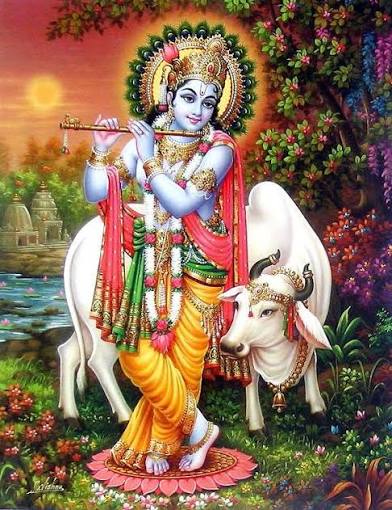
“My dear friend, there is one boy – His name is Govinda. He is standing on the bank of the Yamunā near the Keśi-ghāṭa, and He is playing on His flute. He is so beautiful, especially during this full-moon night. If you have any intentions to enjoy in this material world with your children, husband, or other family members, then please do not go there.”
The Vedic literature is unique among all the world’s scriptures because it details a practical process by which anyone can purify his or her consciousness and see God face to face. In a lecture, delivered in Los Angeles on August 15, 1972, Śrīla Prabhupāda explains, “One must actually be very eager to see God…. One must be very serious and think, ‘Yes, I have been informed about God. So if there is a God, I must see Him.'”
Excerpts from Lecture Los Angeles on August 15, 1972
Prabhupada: People sometimes ask, “Have you seen God?” or “Can you show me God?” Sometimes we meet these questions. So the answer is “Yes, I am seeing God. You can also see God; everyone can see God. But you must have the qualification.”
…Sinful rascals, fools, the lowest of mankind – they inquire like that: “Can you show me God?” What qualification have you acquired by which you can see God? Here is the qualification: tac chraddadhānā munayaḥ. One must first of all be faithful (śraddadhāna). One must actually be very much eager to see God. Not that one takes it as a frivolous thing – “Can you show me God?” – or as some magic. They think God is magic. No. One must be very serious and think, “Yes, I have been informed about God. So if there is a God, I must see Him.”
There is a story in this connection. It is very instructive, so try to hear. One professional reciter was publicly reciting the Śrīmad-Bhāgavatam, and he was describing that Kṛṣṇa is very highly decorated with all kinds of jewels when He goes to tend the cows in the forest. So, there was a thief in that meeting, and he thought, “Why not go to Vṛndāvana and plunder this boy? He’s in the forest with so many valuable jewels. I can go there and catch the child and take all the jewels.” This was his intention. So he was serious. “I must find that boy,” he thought. “Then in one night I shall become a millionaire.”
The thief’s qualification was his feeling: “I must see Kṛṣṇa! I must see Kṛṣṇa!” That anxiety, that eagerness, made it possible for him to actually see Kṛṣṇa in Vṛndāvana. He saw Kṛṣṇa in just the same way as the Bhāgavatam reader had described. Then the thief said, “Oh, You are such a nice boy, Kṛṣṇa.” He began to flatter Him; he thought that by flattering Him he would easily take all the jewels. Then he proposed his real business: “May I take some of these ornaments? You are so rich.”
“No, no, no,” said Kṛṣṇa. “My mother will be angry! I cannot give them away.” Kṛṣṇa was playing just like a child.
So the thief became more and more eager for Kṛṣṇa to give Him the jewels, but by Kṛṣṇa’s association he was becoming purified. Then at last Kṛṣṇa said, “All right, you can take them.” Then the thief became a devotee immediately, because by Kṛṣṇa’s association he had been completely purified. So somehow or other you should come in contact with Kṛṣṇa. Then you’ll be purified.
The gopīs are another example of great eagerness to see Kṛṣṇa. The gopīs came to Kṛṣṇa, being captivated by His beautiful features. They were young girls, and Kṛṣṇa was so beautiful. Actually they were lusty when they came to Kṛṣṇa, but Kṛṣṇa is so pure that they became first-class devotees. There is no comparison to the gopīs’ devotion, because they loved Kṛṣṇa with heart and soul. That is the qualification. They loved Kṛṣṇa so much that they didn’t care for family or reputation when they went out in the dead of night. Kṛṣṇa’s flute was sounding, and they were all fleeing their homes. Their fathers, their brothers, their husbands all said, “Where are you going? Where are you going in this dead of night?” But the gopīs didn’t care. They neglected their children, their family, everything. Their only thought was, “We must go to Kṛṣṇa.”
This eagerness is required. We must be very, very eager to see Kṛṣṇa. Many gopīs who were forcibly stopped from going to Kṛṣṇa lost their lives because of their great feelings of separation. So this eagerness is wanted; then you can see God. Whether you are lusty or a thief or a murderer or whatever it may be – somehow or other you must develop this eagerness, this desire: “I must see Kṛṣṇa.” Then Kṛṣṇa will be seen.
The first thing Kṛṣṇa is looking for is how eager you are to see Him. Kṛṣṇa will respond. If you are actually eager to see Kṛṣṇa – whether you are lusty, or you want to steal His ornaments, or some way or other you have become attracted to Kṛṣṇa – then it is sure your efforts will be successful.
But you must desire Kṛṣṇa only. In this connection, Rūpa Gosvāmī has written a verse: smerāṁ bhaṅgī-traya-paricitāṁ sāci-vistīrṇa-dṛṣṭiṁvaṁśī-nyastādhara-kiśalayām ujjvalāṁ candrakeṇagovindākhyāṁ hari-tanum itaḥ keśi-tīrthopakaṇṭhemā prekṣiṣṭhās tava yadi sakhe bandhu-saṅge ‘sti raṅgaḥ
The idea is that one gopī is advising another gopī, “My dear friend, there is one boy – His name is Govinda. He is standing on the bank of the Yamunā near the Keśi-ghāṭa, and He is playing on His flute. He is so beautiful, especially during this full-moon night. If you have any intentions to enjoy in this material world with your children, husband, or other family members, then please do not go there.” Bhaṅgī-traya: Kṛṣṇa always stands in a three-curved way with His flute. That is Kṛṣṇa’s tri-bhaṅga form, bending in three places. So the one gopī says to the other, “If you think that you’ll enjoy your life more in this material world, then do not go to see Kṛṣṇa. Do not go there.” The idea is that if you once see Kṛṣṇa, then you’ll forget all this nonsensical materialistic enjoyment. That is seeing Kṛṣṇa.
When Dhruva Mahārāja saw Kṛṣṇa, he said, svāmin kṛtārtho ‘smi varaṁ na yāce: (Cc Madhya 22.42) “My dear Lord, I don’t want anything else.” Dhruva Mahārāja went to see Kṛṣṇa to get the kingdom of his father, and when he saw Kṛṣṇa, Kṛṣṇa offered, “Now, whatever benediction you want, you take.” Dhruva said, “My dear Lord, I no longer have any desire.” That is seeing Kṛṣṇa.
So, if you’re eager to see Kṛṣṇa, regardless of whatever motive you have, somehow or other, due to your eagerness, you’ll see Kṛṣṇa. That is the only qualification.
Also there is another verse in this connection:
Sri Caitanya-caritamrta
Adi-lila chapter 5, Text 224
smerāṁ bhaṅgī-traya-paricitāṁ sāci-vistīrṇa-dṛṣṭiṁ vaṁśī-nyastādhara-kiśalayām ujjvalāṁ candrakeṇa govindākhyāṁ hari-tanum itaḥ keśi-tīrthopakaṇṭhe mā prekṣiṣṭhās tava yadi sakhe bandhu-saṅge ’sti raṅgaḥ
“My dear friend, if you are indeed attached to your worldly friends, do not look at the smiling face of Lord Govinda as He stands on the bank of the Yamunā at Keśīghāṭa. Casting sidelong glances, He places His flute to His lips, which seem like newly blossomed twigs. His transcendental body, bending in three places, appears very bright in the moonlight.”
PURPORT
This is a verse quoted from the Bhakti-rasāmṛta-sindhu (1.2.239) in connection with practical devotional service. Generally people in their conditioned life engage in the pleasure of society, friendship and love. This so-called love is lust, not love. But people are satisfied with such a false understanding of love. Vidyāpati, a great and learned poet of Mithilā, has said that the pleasure derived from friendship, society and family life in the material world is like a drop of water, but our hearts desire pleasure like an ocean. Thus the heart is compared to a desert of material existence that requires the water of an ocean of pleasure to satisfy its dryness. If there is a drop of water in the desert, one may indeed say that it is water, but such a minute quantity of water has no value. Similarly, in this material world no one is satisfied in the dealings of society, friendship and love. Therefore if one wants to derive real pleasure within his heart, he must seek the lotus feet of Govinda. In this verse Rūpa Gosvāmī indicates that if one wants to be satisfied in the pleasure of society, friendship and love, he need not seek shelter at the lotus feet of Govinda, for if one takes shelter under His lotus feet he will forget that minute quantity of so-called pleasure. One who is not satisfied with that so-called pleasure may seek the lotus feet of Govinda, who stands on the shore of the Yamunā at Keśītīrtha, or Keśīghāṭa, in Vṛndāvana and attracts all the gopīs to His transcendental loving service.