14 Jun 2014
by The Hare Krishna Movement
in A.C. Bhaktivedanta Swami Prabhupada, Demigod, Demons, Devaki
Tags: A.C. Bhaktivedanta Swami Prabhupada, Anantadeva, Baladeva, demigods, Devaki, devaki's womb, Garbha-stuti prayers, Jarasandha, Kamsa, Lord Krsna, saktas, Sankarsana, Srimad Bhagavatam, Vaisnavas, yogamaya

click on image for full size resolution
This morning I was reading Chapter Two in the Krsna Book, the chapter entitled “Prayers by the Demigods for Lord Kṛṣṇa in the Womb” and I was reminded of this above image from the Tenth Canto of Srimad Bhagavatam, that I like very much. So I thought I would share this image with you, along with the brief chapter description. Hare Krishna!
…when the Supreme Personality of Godhead entered the womb of Devakī to kill Kaṁsa, all the demigods understood that the Lord was living within Devakī’s womb, and therefore in veneration they offered Him the Garbha-stuti prayers. (from chapter description SB 10.2)
More
07 Jun 2014
by The Hare Krishna Movement
in A.C. Bhaktivedanta Swami Prabhupada, Dream, Srila Prabhupada's Books, Uncategorized
Tags: A.C. Bhaktivedanta Swami Prabhupada, awakenes to discover the self, deep sleep, dreaming, dreams, human form of life, Krsna, Le Reve, original creator, Srimad Bhagavatam, Supreme Lord, The Dream, The Supreme Personality of Godhead, The Wynn, vasudevah sarvam, wynn las vegas, Wynn theater

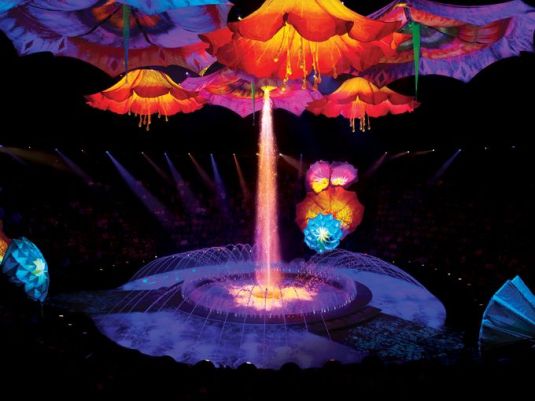
Recently we were in Las Vegas for a wedding celebration, and after dinner we went to the show “Le Reve” at the Wynn. “Le Reve” is French for; “The Dream”. It was the most amazing theatrical performance we have seen in years. My mind was swept away by the magnificence of the production, and it was in fact, dream-like. I was transported to another dimension; phantasmagoria. A.C. Bhaktivedanta Swami uses this word in his books, to describe the dream-like nature of this material world.
I would highly recommend seeing Le Reve at the Wynn, if you are in Las Vegas, and as always…recommend reading the books by His Divne Grace A. C. Bhaktivedanta Swami Prabhupada for further advancement and enlightenment in life.
When a person is in deep sleep, he dreams and sees in himself many other objects, such as great mountains and rivers or perhaps even the entire universe, although they are far away. Sometimes when one awakens from a dream he sees that he is in a human form, lying in his bed in one place. Then he sees himself, in terms of various conditions, as belonging to a particular nationality, family and so on. All the conditions of deep sleep, dreaming and wakefulness are but energies of the Supreme Personality of Godhead. One should always remember the original creator of these conditions, the Supreme Lord, who is unaffected by them. (SB 6.16.53-54_
More
13 May 2014
by The Hare Krishna Movement
in A.C. Bhaktivedanta Swami Prabhupada, Lord Nrsimhadeva, Nrsimha
Tags: A.C. Bhaktiveanta Swami Prabhupada, appearance day of lord nrsimhdeva, Lord Nrsimha, Nrsimhadeva, Pralada, Srimad Bhagavatam, Supreme Personality of Godhead

Today we honor the Appearance day of Lord Nṛsiṁhadeva, with a fast till sunset and the following text from the Śrīmad-Bhāgavatam. So shortly after the Lord killed Hiraṇyakaśipu, and his armies, the Lord sat Himself on the throne of Hiraṇyakaśipu, and was offered prayers by all the assembled saintly persons and demigods.
…The Lord not only killed Hiraṇyakaśipu, the King of the demons, but also killed many of his followers. When there was no one else to fight, the Lord, roaring with anger, sat down on Hiraṇyakaśipu’s throne.
The entire universe was thus relieved of the rule of Hiraṇyakaśipu, and everyone was jubilant in transcendental bliss. Then all the demigods, headed by Lord Brahmā, approached the Lord. These included the great saintly persons, the Pitās, the Siddhas, the Vidyādharas, the Nāgas, the Manus, the prajāpatis, the Gandharvas, the Cāraṇas, the Yakṣas, the Kimpuruṣas, the Vaitālikas, the Kinnaras and also many other varieties of beings in human form. All of them stood not far from the Supreme Personality of Godhead and began offering their prayers unto the Lord, whose spiritual effulgence was brilliant as He sat on the throne. (from the chapter summary)
More
20 Mar 2014
by The Hare Krishna Movement
in A.C. Bhaktivedanta Swami Prabhupada, Spring, Srimad Bhagavatam
Tags: A.C. Bhaktivedanta Swami Prabhupada, enchantment with material energy, material existence, SB 4.25.18, Spring, spring air, spring fever, Srimad Bhagavatam, waterfall

click on image to enlarge
Like many of you, I am happy about the first day of Spring. It was a long hard winter for many places in the country and I am sure that most everyone welcomes the coming of spring. The following is a verse from the Srimad Bhagavatam which describes our enchantment with the material existence. A symptom of this enchantment is our spring fever.
The branches of the trees standing on the bank of the lake received particles of water carried by the spring air from the falls coming down from the icy mountain. (SB 4.25.18)
…The spring air (kusumākara) is smell. All these varieties of enjoyment make life very pleasing, and thus we become captivated by material existence. (from purport)
Full text and purport More
03 Mar 2014
by The Hare Krishna Movement
in A.C. Bhaktivedanta Swami Prabhupada, Places of Pilgrimage, Sadhu, Srimad Bhagavatam, Vidura
Tags: A. C. Bhaktivedanta Swami Prabhuada, ananta-linga, arca forms, archa-vigraha form, forms of the Lord, holy places, Holy places of pilgrimage, idols, pilgrimage, pilgrims, SB 3.1.17-18, Srimad Bhagavatam, Vidura

click on image to enlarge
With the coming of Spring I am always inclined to travel. Spring always seems like a good season to began a journey. With this in mind, I was reading this morning from the Srimad Bhagavatam about how Vidura left the home of his brother to devote himself completely to the transcendental loving service of the Lord.
Places of pilgrimages are meant for eradicating the sins of the pilgrims, and they are distributed all over the universe just to give facility to all concerned for attaining pure existence and God realization. One should not be satisfied, however, merely by visiting the places of pilgrimage and performing one’s prescribed duties; he should be eager to meet the great souls who are already there, engaged in the service of the Lord. In each and every place of pilgrimage, the Lord is present in His various transcendental forms.
In the land of Bhāratavarṣa (India) there are many hundreds and thousands of places of pilgrimage distributed all over the country, and by traditional practice the common man visits such holy places during all seasons of the year. Some of the arcā representations of the Lord situated in different places of pilgrimage… There are millions and billions of such arcā forms of the Lord distributed all over the universe. All these arcā-mūrtis are summarized in the Caitanya-caritāmṛta in the following words:
“The Lord has so distributed Himself all over the universe just to give pleasure to the devotees, to give the common man facility to eradicate his sins, and to establish religious principles in the world.” (from purports to SB 3.1.17-18)
More
22 Feb 2014
by The Hare Krishna Movement
in A.C. Bhaktivedanta Swami Prabhupada, Ananda, Spiritual World
Tags: A.C. Bhaktivedanta Swami Prabhupada, all-pervasive, ananda, Bg 18.55, bhagavad-gita, bhakta, Brahman realization, impersonalist, jnani, Lord in the heart, mystics, Paramatma, pleasure potency, pure devotees, SB 2.10.44, Srimad Bhagavatam, the devotee, the impersonalist, the meditator, transcendental humors, Vaikuntha planets, yogi

click on beautiful image to enlarge
This morning as I was finishing the Tenth Chapter of the Second Canto, the following verse and purport jumped out at me from the pages. And I realized for the thousandth time, what great good fortune we have in that we can hear directly from the pure devotee of the Lord, about the eternal pastimes of the Lord, through the pages of the Srimad Bhagavatam.
Of the three types of Transcendentalist’s, namely the jñānī, the yogī and the bhakta, or the impersonalist, the meditator and the devotee. It is only the devotee who can factually know the Lord as He is and thus be trained in the bona fide service of the Lord and be allowed to enter into the direct association of the Lord in so many capacities. The highest glorious association with the Lord is made possible in the planet of Goloka Vṛndāvana, where Lord Kṛṣṇa enjoys Himself with the gopīs and His favorite animals, the surabhi cows.
… The impersonalist is satisfied simply by understanding the all-pervasive influence of the Lord. This is called Brahman realization. Greater than the impersonalist is the mystic who sees the Lord situated in his heart as Paramātmā, the partial representation of the Lord. But there are pure devotees who take part in the direct pleasure (ānanda) potency of the Lord by factual reciprocation of loving service. The Lord in His abode called the Vaikuṇṭha planets, which are eternal manifestations, always remains with His associates and enjoys transcendental loving services by His pure devotees in different transcendental humors.
So we are pleased to present the following Texts and Purports More
18 Feb 2014
by The Hare Krishna Movement
in A.C. Bhaktivedanta Swami Prabhupada, Paramatma, Srimad Bhagavatam
Tags: A.C. Bhaktivedanta Swami Prabhupada, devotee, Lord Krsna, Lord within the heart, lust anger and hankering, material association, Paramatma, Personality of Godhead, self-realized souls, spiritual master, Srimad Bhagavatam, Sukadeva Goswami

A friend of mine was asking me how we could realize Paramātmā or the Lord within the heart? How would I explain it to someone? I immediately thought of the following verses from the Second Canto of the Srimad Bhagavatam, and I replied to his question by saying ‘by reading about the glories of the Lord and chanting His names, we can begin to purify our hearts and come to understand through His mercy, the Lord within our hearts’. After getting home and looking up these verses…it was clear I gave him the correct answer.
O greatly fortunate Śukadeva Gosvāmī, please continue narrating Śrīmad-Bhāgavatam so that I can place my mind upon the Supreme Soul, Lord Kṛṣṇa, and, being completely freed from material qualities, thus relinquish this body.
Persons who hear Śrīmad-Bhāgavatam regularly and are always taking the matter very seriously will have the Personality of Godhead Śrī Kṛṣṇa manifested in their hearts within a short time.
The sound incarnation of Lord Kṛṣṇa, the Supreme Soul [i.e. Śrīmad-Bhāgavatam], enters into the heart of a self-realized devotee, sits on the lotus flower of his loving relationship, and thus cleanses the dust of material association, such as lust, anger and hankering. Thus it acts like autumnal rains upon pools of muddy water. (Srimad Bhagavatam 2.8.3-5)
Full test and purports More
26 Jan 2014
by The Hare Krishna Movement
in A.C. Bhaktivedanta Swami Prabhupada, Srila Prabhupada's Books, Srimad Bhagavatam
Tags: A.C. Bhaktivedanta Swami Prabhupada, all pervading personality of Godhead, BBT, Canto Two Chapter One, cosmic manifestation, om namo bhagavate vasudevaya, planetary systems, post creation, Second Canto, Srila Prabhupada's books, Srimad Bhagavatam, The Cosmic Manifestation, The First Step in God Realization, universal body of the Lord

Śrīmad-Bhāgavatam
By His Divine Grace A. C. Bhaktivedanta Swami Prabhupāda
Canto Two, Chapter One
The First Step in God Realization
More
22 Jan 2014
by The Hare Krishna Movement
in A.C. Bhaktivedanta Swami Prabhupada, Free Downloads, Free eBooks, Srila Prabhupada's Books, Srimad Bhagavatam
Tags: A.C. Bhaktivedanta Swami Prabhupada, free download of prabhupadas books, original books by srila prabhupada, Second Canto, second canto part one, second canto part two, Srimad Bhagavatam
Free Download of Second Canto of Srimad Bhagavatam

Click on underlined links below to view or save More
11 Jan 2014
by The Hare Krishna Movement
in A.C. Bhaktivedanta Swami Prabhupada, Books by Srila Prabhupada, Free Downloads, Free eBooks, Srila Prabhupada's Books, Srimad Bhagavatam
Tags: 1972 original edition, A.C. Bhaktivedanta Swami Prabhupada, Bhaktivedanta Book Trust, copyright 1972 Bhaktivedanta Book Trust, First Canto, free pdf download srimad-bhagavatam, free scanned copy first canto, SB 1.1, SB 1.2, SB 1.3, Srimad Bhagavatam

For a Free pdf download of the entire First Canto of the Srimad-Bhagavatam Original 1972 Editions (scanned copiess), click on the following underlined links;
More
04 Jan 2014
by The Hare Krishna Movement
in A.C. Bhaktivedanta Swami Prabhupada, Deitie, Radha Raman
Tags: A.C. Bhaktivedanta Swami Prabhupada, impersonal or void, meditation, meditation on the form of the lord, process of meditation, Radha Raman, sac-cid-ananda-vigraha, Srimad Bhagavatam, Universal Form, virat-rupa, yoga

The process of meditation should begin from the lotus feet of the Lord and progress to His smiling face. The meditation should be concentrated upon the lotus feet, then the calves, then the thighs, and in this way higher and higher. The more the mind becomes fixed upon the different parts of the limbs, one after another, the more the intelligence becomes purified. (SB 2.2.13)
…The process of meditation recommended in the Śrīmad-Bhāgavatam is not to fix one’s attention on something impersonal or void. The meditation should concentrate on the person of the Supreme Godhead, either in His virāṭ-rūpa, the gigantic universal form, or in His sac-cid-ānanda-vigraha [Bs. 5.1], as described in the scriptures. There are authorized descriptions of Viṣṇu forms, and there are authorized representations of Deities in the temples. Thus one can practice meditating upon the Deity, concentrating his mind on the lotus feet of the Lord and gradually rising higher and higher, up to His smiling face.
Full text and purport More
02 Jan 2014
by The Hare Krishna Movement
in A.C. Bhaktivedanta Swami Prabhupada, Books by Srila Prabhupada, Srimad Bhagavatam
Tags: A.C. Bhaktivedanta Swami Prabhupada, glorification of Your lotus feet, hearing from the pure devotee, Krsna, lotus feet, prabhupada vani, pure devotees, rememberance of the Lord, saffron particles, SB 4.20.25, Srimad Bhagavatam

click on image to enlarge
This following verse reminds me of the importance of reading Srila Prabhupada’s books every day. Hearing from the pure devotee of the Lord, is so powerful that it can revive the living entity’s memory of his eternal relationship with the Supreme Personality of Godhead.
My dear Lord, You are glorified by the selected verses uttered by great personalities. Such glorification of Your lotus feet is just like saffron particles. When the transcendental vibration from the mouths of great devotees carries the aroma of the saffron dust of Your lotus feet, the forgetful living entity gradually remembers his eternal relationship with You. Devotees thus gradually come to the right conclusion about the value of life. My dear Lord, I therefore do not need any other benediction but the opportunity to hear from the mouth of Your pure devotee.
Reading the books of His Divine Grace A.C. Bhaktivedanta Swami Prabhupada is hearing from the mouth of the pure devotee.
More
16 Dec 2013
by The Hare Krishna Movement
in A.C. Bhaktivedanta Swami Prabhupada, Chanting Hare Krishna, Narada Muni, Srila Prabhupada, Srimad Bhagavatam
Tags: A.C. Bhaktivedanta Swami Prtabhupada, bona fide representative, chanting Hare Krishna, chanting the glories of the Lord, devotee, Narada Muni, sincere devotee of the lord, Srila Prabhupada, Srimad Bhagavatam, traveling all over the world

click on image to enlarge
The following is a nice verse from the Srimad Bhagavatam spoken by Narada Muni. As I was looking for an image for this post, I thought I should put up a picture of Him. But then it hit me, this verse could have just as easily been spoken by Srila Prabhupada! In fact it was.
Thus I began chanting the holy name and fame of the Lord by repeated recitation, ignoring all the formalities of the material world. Such chanting and remembering of the transcendental pastimes of the Lord are benedictory. So doing, I traveled all over the earth, fully satisfied, humble and unenvious.
The life of a sincere devotee of the Lord is thus explained in a nutshell by Nārada Muni by his personal example. Such a devotee, after his initiation by the Lord or His bona fide representative, takes very seriously chanting of the glories of the Lord and traveling all over the world so that others may also hear the glories of the Lord. Such devotees have no desire for material gain. They are conducted by one single desire: to go back to Godhead. This awaits them in due course on quitting the material body. Because they have the highest aim of life, going back to Godhead, they are never envious of anyone, nor are they proud of being eligible to go back to Godhead. Their only business is to chant and remember the holy name, fame and pastimes of the Lord and, according to personal capacity, to distribute the message for others’ welfare without motive of material gain.
full text More
13 Dec 2013
by The Hare Krishna Movement
in A.C. Bhaktivedanta Swami Prabhupada, Bhagavad-gita
Tags: A.C. Bhaktivedanta Swami Prabhupada, actions and reactions, bhagavad-gita, chess, karma, law of karma, player and his playthings, Srimad Bhagavatam, the player

As a player sets up and disperses his playthings according to his own sweet will, so the supreme will of the Lord brings men together and separates them. (Srimad Bhagavatam 1.13.43)
…Generally the law of karma is that one is awarded the result of one’s own actions…A rich man gets his son born with a silver spoon in his mouth, but the child who came as the rich man’s son deserved such a place, and therefore he is placed there by the will of the Lord… but in special cases, by the will of the Lord, such resultant actions are changed also. But this change can be affected by the will of the Lord only, and no other. Therefore, the example of the player cited in this verse is quite appropriate, for the Supreme Will is absolutely free to do whatever He likes, and because He is all-perfect, there is no mistake in any of His actions or reactions. These changes of resultant actions are especially rendered by the Lord when a pure devotee is involved. (from purport)
Full Text and purport + reference verses More
01 Dec 2013
by The Hare Krishna Movement
in A.C. Bhaktivedanta Swami Prabhupada, Kali Yuga, Srimad Bhagavatam, Vedas
Tags: A.C. Bhaktivedanta Swami Prabhupada, anomalies, enlightened in spiritual knowledge, future anomalies, Kaili age, Kali, Kali-yuga, millennium, spiritual knowldege, spiritual master, Srila Vyasadeva, Srimad Bhagavatam, Vyasadeva

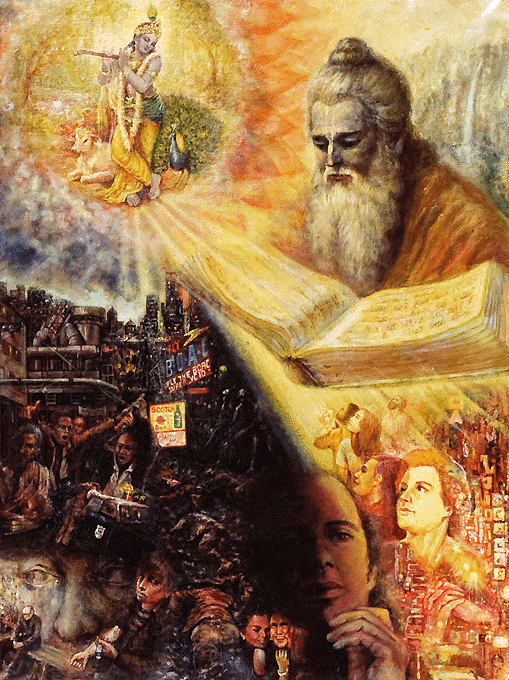
The great sage Vyāsadeva saw anomalies in the duties of the millennium. This happens on the earth in different ages, due to unseen forces in the course of time.
The great sages like Vyāsadeva are liberated souls, and therefore they can see clearly past and future. Thus he could see the future anomalies in the Kali age, and accordingly he made arrangement for the people in general so that they can execute a progressive life in this age, which is full of darkness. The people in general in this age of Kali are too much interested in matter, which is temporary. Because of ignorance they are unable to evaluate the assets of life and be enlightened in spiritual knowledge.
…The unmanifested forces of time are so powerful that they reduce all matter to oblivion in due course. In Kali-yuga, the last millennium of a round of four millenniums, the power of all material objects deteriorates by the influence of time. In this age the duration of the material body of the people in general is much reduced, and so is the memory. The action of matter has also not so much incentive. The land does not produce food grains in the same proportions as it did in other ages. The cow does not give as much milk as it used to give formerly. The production of vegetables and fruits is less than before. As such, all living beings, both men and animals, do not have sumptuous, nourishing food. Due to want of so many necessities of life, naturally the duration of life is reduced, the memory is short, intelligence is meager, mutual dealings are full of hypocrisy and so on.
Srimad Bhagavatam
By His Divine Grace A. C. Bhaktivedanta Swami Prabhupada
Canto One, Chapter 4, Texts 16, 17-18
full text and purport More
18 Nov 2013
by The Hare Krishna Movement
in A.C. Bhaktivedanta Swami Prabhupada, Free Downloads, Free eBooks, Srimad Bhagavatam
Tags: A.C. Bhaktivedanta Swami Prabhupada, Bhaktivedanta purports, final srimad bhagavatam volume, Founder Acarya, International Society for Krishna Consciousness, Krsna Balarama Mandira, prabhupada, SB 10.3, Srimad Bhagavatam, translated by His Divine Grace

This is the final Śrīmad-Bhāgavatam volume translated by His Divine Grace A. C. Bhaktivedanta Swami Prabhupada, Founder-Acarya of the International Society for Krishna Consciousness, before his untimely departure. We share it with you as a free PDF download. You can click on following link to view the complete volume or save it to your computer.
click on following link; Srimad Bhagavatam Tenth Canto Part 3
More
30 Oct 2013
by The Hare Krishna Movement
in A.C. Bhaktivedanta Swami Prabhupada, Childhood Pastimes of Krsna, Krsna Consciousness, Spiritual World, Srimad Bhagavatam, Vrndavana
Tags: A.C. Bhaktivedanta Swami Prabhupada, asura, Bakasura, BBT, Bhaktivedanta purports, cowheard boys, fruit vendor, go carana, Gokula, Krishna and Balarama, Krsna, Mother Yasoda, Nanda, Nanda Maharaja, pastimes of krsna, SB 10.11, Srimad Bhagavatam, Vatsasura, yamala arjunas, Yasoda

Today is Rama Ekadasi (fast from grains and beans), so on this auspicious day, in the auspicious month of Damodara, we wanted to do a special post. The following is the entire 11th chapter of the Tenth Canto of Srimad Bhagavatam entitled “The Childhood Pastimes of Kṛṣṇa”.
The following two verses are just an example of the nectar one will find in the following chapter…
…The gopīs would say, “If You dance, my dear Kṛṣṇa, then I shall give You half a sweetmeat.” By saying these words or by clapping their hands, all the gopīs encouraged Kṛṣṇa in different ways. At such times, although He was the supremely powerful Personality of Godhead, He would smile and dance according to their desire, as if He were a wooden doll in their hands. Sometimes He would sing very loudly, at their bidding. In this way, Kṛṣṇa came completely under the control of the gopīs.(Text 7)
…To pure devotees throughout the world who could understand His activities, the Supreme Personality of Godhead, Kṛṣṇa, exhibited how much He can be subdued by His devotees, His servants. In this way He increased the pleasure of the Vrajavāsīs by His childhood activities. (Text 9)
Srimad Bhagavatam
By His Divine Grace A. C. Bhaktivedanta Swami Prabhupada
Canto 10, Chapter 11
More
22 Oct 2013
by The Hare Krishna Movement
in A.C. Bhaktivedanta Swami Prabhupada, Damodara, Kartika, Srila Prabhupada's Books, Srimad Bhagavatam
Tags: A.C. Bhaktivedanta Swami Prabhupada, austerities, bagavata, bhakta, black ointment around His eyes, Damodara, Krsna, Mother Yasoda, Mother Yasoda Binds Lord Krsna, mystics, Paramatma, penances, SB 10.9, Srila Prabhupada, Srimad Bhagavatam, yogis
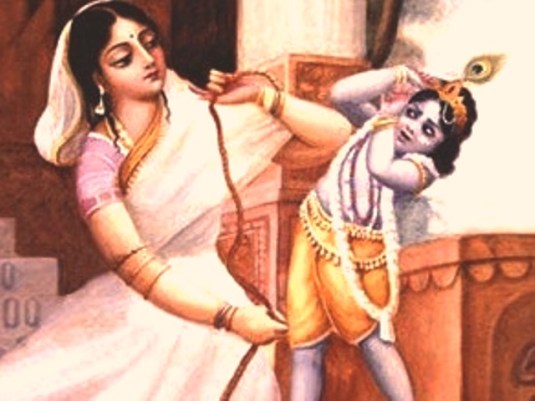
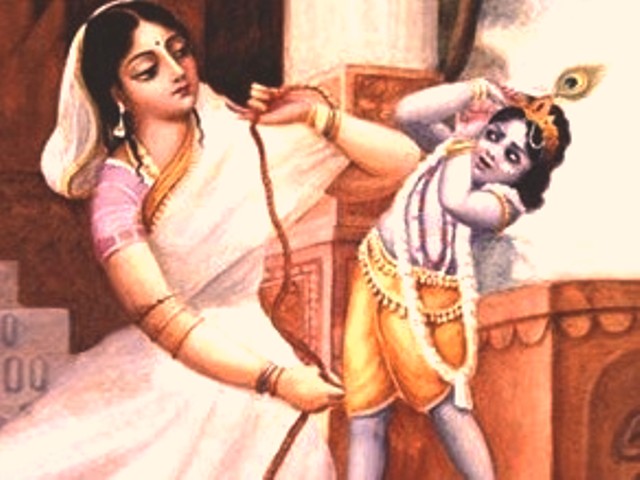
In celebration of the month of Damodara (Kartika) we are focusing our attention on the pastimes of Krishna in Vrndavan. Especially Krishna’s childhood pastimes. So with this in mind we are posting the entire 9th chapter from the Tenth Canto of Srila Prabhupada’s Srimad Bhagavatam entitled Mother Yaśodā Binds Lord Kṛṣṇa.
When caught by mother Yaśodā, Kṛṣṇa became more and more afraid and admitted to being an offender. As she looked upon Him, she saw that He was crying, His tears mixing with the black ointment around His eyes, and as He rubbed His eyes with His hands, He smeared the ointment all over His face. Mother Yaśodā, catching her beautiful son by the hand, mildly began to chastise Him. (SB 10.9.11)
Yogīs, mystics, want to catch Kṛṣṇa as Paramātmā, and with great austerities and penances they try to approach Him, yet they cannot. Here we see, however, that Kṛṣṇa is going to be caught by Yaśodā and is running away in fear. This illustrates the difference between the bhakta and the yogī. Yogīs cannot reach Kṛṣṇa, but for pure devotees like mother Yaśodā, Kṛṣṇa is already caught. (from purport to SB 10.9.9)
Srimad-Bhagavatam
By His Divine Grace A.C. Bhaktivedanta Swami Prabhupada
Tenth Canto, Chapter 9
More
08 Oct 2013
by The Hare Krishna Movement
in A.C. Bhaktivedanta Swami Prabhupada, Back to Godhead, Bhagavad-gita
Tags: A.C. Bhaktivedanta Swami Prabhupada, Arjuna, as it is, bhagavad-gita, Bhaktivedanta purports, Krishna, Lord Krsna, mental agonies, Puranas, Srila Prabhupada, Srimad Bhagavatam, Upanisads, Vedanta-sutras, Vedic literatures, Vedic wisdom

1973 Back to Godhead cover
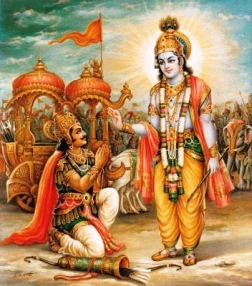
This morning I was reading from the Srimad Bhagavatam Canto 1, Chapter 15, Text 27, wherein Srila Prabhupada was describing the glories and importance of the the Bhagavad-gita As It Is. The following is some excerpts from this amazing purport, followed by full text and purport. I found this one purport to be a very nice synopsis of the entire Bhagavad-gita As It Is.
…The Lord left behind Him the instructions of the Bhagavad-gītā not for the benefit of Arjuna alone, but also for all time and in all lands. The Bhagavad-gītā, being spoken by the Supreme Personality of Godhead, is the essence of all Vedic wisdom. It is nicely presented by the Lord Himself for all who have very little time to go through the vast Vedic literatures like the Upaniṣads, Purāṇas and Vedānta-sūtras.
…the Bhagavad-gītā can be consulted in all critical times, not only for solace from all kinds of mental agonies, but also for the way out of great entanglements which may embarrass one in some critical hour.
…The merciful Lord left behind Him the great teachings of the Bhagavad-gītā so that one can take the instructions of the Lord even when He is not visible to material eyesight.
…There is no difference between the sound representation of the Lord and the Lord Himself. One can derive the same benefit from the Bhagavad-gītā as Arjuna did in the personal presence of the Lord.
…The Bhagavad-gītā begins with the problems of life by discriminating the soul from the elements of matter and proves by all reason and argument that the soul is indestructible in all circumstances and that the outer covering of matter, the body and the mind, change for another term of material existence which is full of miseries. The Bhagavad-gītā is therefore meant for terminating all different types of miseries, and Arjuna took shelter of this great knowledge, which had been imparted to him during the Kurukṣetra battle. (from Purport to SB 1.15.27)
Full verse and purport More
Previous Older Entries Next Newer Entries