29 Apr 2015
by The Hare Krishna Movement
in A.C. Bhaktivedanta Swami Prabhupada, Srimad Bhagavatam Index
Tags: A. C. Bhakthvedanta Swami Prabhupada, guide to Srimad Bhagavatam Srila Prabhupada, Jan Alexander, Srimad Bhagavatam, Srimadbhagavatam Index
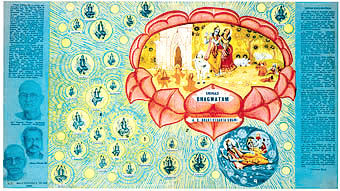
Sometime back one of our readers submitted this Index on the Srimad-Bhagavatam, and asked if I could post it. It is truly a very impressive piece of work, and represents a great deal of time and study. We applaud the effort that Jan has put into this Index, and with great pleasure we post it here, in the hopes that others can benefit.
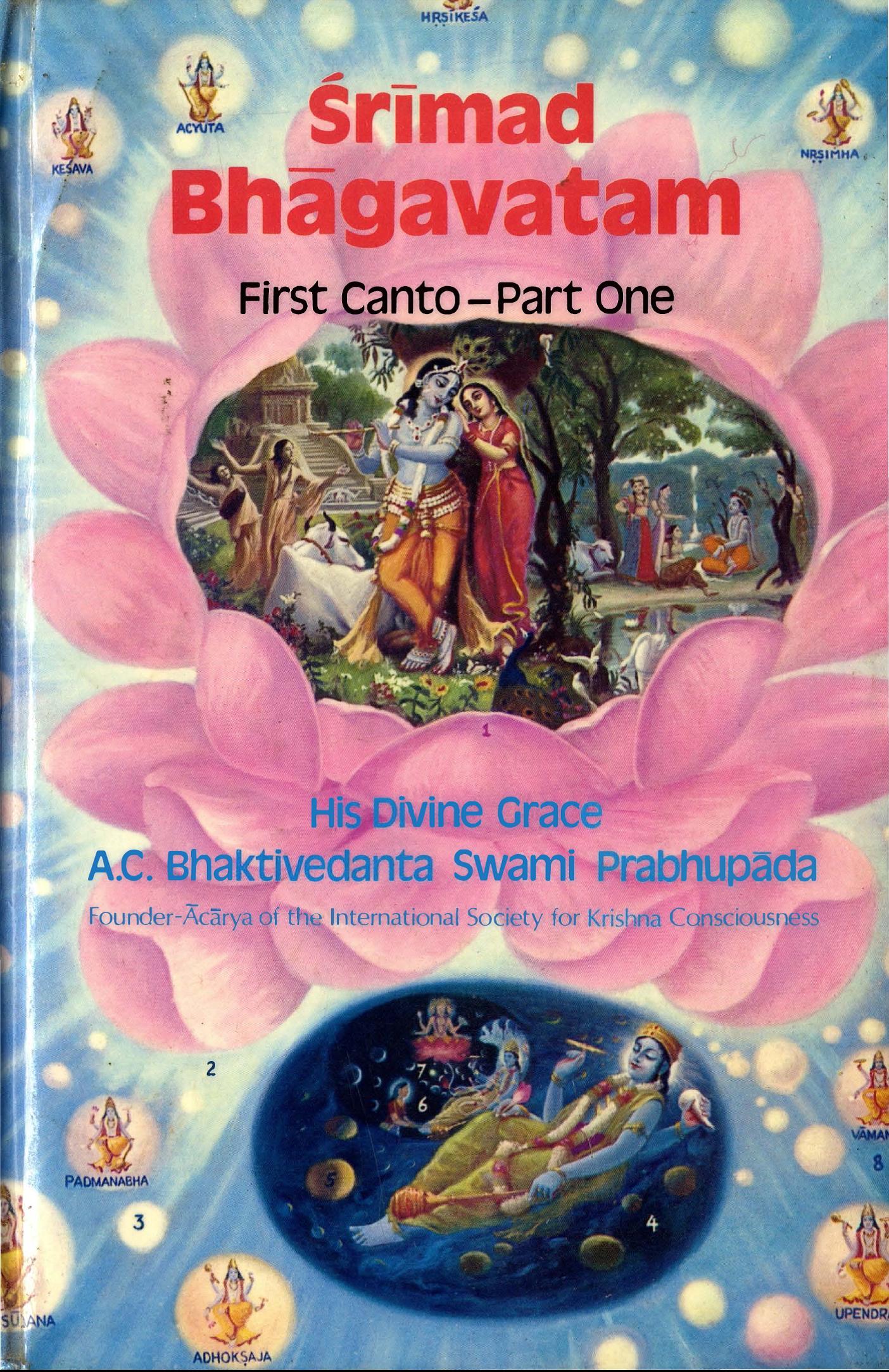
Srimad-Bhagavatam Index, Notes, Topical Guide
compiled by Jan Alexander
This was written to help me find, understand and remember the massive truth found in the Srimad-Bhagavatam. Every abbrieviated, shortened, misused, form of the Supreme Personality of Godhead’s name, fame, and pastimes is just in attempt to cram the Srimad-Bhagavatam into this being that I am. I hope that this will be of great help to others who are studying the Srimad-Bhagavatam. I offer this handful of rice to the Lord.
– Jan Alexander
This file is so large we will have to post it in parts. The first part is #1 – letter E
More
28 Mar 2015
by The Hare Krishna Movement
in A.C. Bhaktivedanta Swami Prabhupada, Rama, Srimad Bhagavatam
Tags: A.C. Bhaktivedanta Swami Prabhupada, Bharata, Laksmana, Lord Ramacandra, Maharaja Dasratha, mother Sita, Rama, Ramayana, Ravana kidnapped Sita, Satrughnna, Sita, Srimad Bhagavatam, the Absolute Truth Himself, The Supreme Personality of Godhead, visnu-tattva
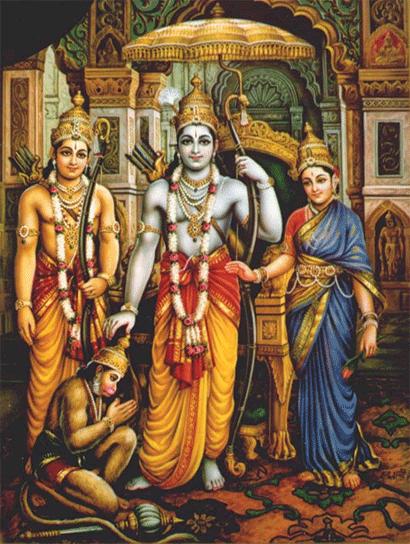
In honor of the Appearance day of Lord Ramacandra, we are posting the entire tenth chapter from the ninth Canto of Srimad Bhagavatam entitled “The Pastimes of the Supreme Lord, Rāmacandra”.
Śrīmad-Bhāgavatam
By His Divine Grace A. C. Bhaktivedanta Swami Prabhupāda
Canto Nine, Chapter Ten
More
28 Feb 2015
by The Hare Krishna Movement
in A.C. Bhaktivedanta Swami Prabhupada, Kali Yuga, Science of Self Realization
Tags: A.C. Bhaktiveanta Swami Prabhupada, dvapara-yuga, human life, Kali, Kali-yuga, satya-yuga, SB1.1.21, SB1.1.22, self realization, self-realization in the age of kali, Srimad Bhagavatam, Treta-yuga

Kali Yuga
Last week we did a post entitled In the Age of Kali and are continuing it here today. We begin with the description of the previous ages from Srimad Bhagavatam 1.1.21 followed by further descriptions of the age from text 1.1.22.
One thing that jumped out at me from my reading this morning was from the purport to text22, wherein Srila Prabhupada points out: “…people do not realize that this brief life, is but a moment on our great journey towards self-realization.” That put things in perspective for me.
This age of Kali is not at all suitable for self-realization as was Satya-yuga, the golden age, or Tretā- or Dvāpara-yugas, the silver and copper ages. For self-realization, the people in Satya-yuga, living a lifetime of a hundred thousand years, were able to perform prolonged meditation. And in Tretā-yuga, when the duration of life was ten thousand years, self-realization was attained by performance of great sacrifice. And in the Dvāpara-yuga, when the duration of life was one thousand years, self-realization was attained by worship of the Lord. But in the Kali-yuga, the maximum duration of life being one hundred years only and that combined with various difficulties, the recommended process of self-realization is that of hearing and chanting of the holy name, fame, and pastimes of the Lord. (purport SB 1.1.21)
The age of Kali is very dangerous for the human being. Human life is simply meant for self-realization, but due to this dangerous age, men have completely forgotten the aim of life. In this age, the life span will gradually decrease. People will gradually lose their memory, finer sentiments, strength, and better qualities. …And so this age is very difficult for those who want to utilize this life for self-realization. The people are so busy with sense gratification that they completely forget about self-realization. Out of madness they frankly say that there is no need for self-realization because they do not realize that this brief life is but a moment on our great journey towards self-realization. (purport 1.1.22)
Full Text and purports More
12 Feb 2015
by The Hare Krishna Movement
in A.C. Bhaktivedanta Swami Prabhupada, Chanting Hare Krishna, Mantra Meditation
Tags: A.C. Bhaktivedanta Swami Prabhupada, birth and death, chanting Hare Krishna, chanting the holy name of Kṛṣṇa, feared by fear personified, SB1.1.14, Srimad Bhagavatam
It seems there is world wide fear over the outbreak of the Coronavirus disease (COVID-19). Most people infected with the COVID-19 virus will experience mild to moderate respiratory illness and recover without requiring special treatment. Older people, such as myself , and those with underlying medical problems like cardiovascular disease, diabetes, chronic respiratory disease, and cancer are more likely to develop serious illness. But I refuse to live in fear, although we have accepted a self imposed quarantine, I have gone about my business working alone in my woodworking shop, and chanting the holy name. Hare Krishna! -V
Living beings who are entangled in the complicated meshes of birth and death can be freed immediately by even unconsciously chanting the holy name of Kṛṣṇa, which is feared by fear personified. (SB 1.1.14)
… It is stated herein that the name of Kṛṣṇa is feared even by fear personified. This indicates that the name of Kṛṣṇa is nondifferent from Kṛṣṇa. Therefore, the name of Kṛṣṇa is as powerful as Lord Kṛṣṇa Himself. There is no difference at all. Anyone, therefore, can take advantage of the holy names of Lord Śrī Kṛṣṇa even in the midst of greatest dangers. The transcendental name of Kṛṣṇa, even though uttered unconsciously or by force of circumstances, can help one obtain freedom from the hurdle of birth and death. (from purport)
Full tent and purport More
30 Jan 2015
by The Hare Krishna Movement
in A.C. Bhaktivedanta Swami Prabhupada, Varaha
Tags: A.C. Bhaktivedanta Swami Prabhupada, agni-hotra, frog-philosophers, His tusks, Lord Boar, Lord Varāha (Boar), O descendant of Bharata, O lifter of the earth, O sinless Vidura, SB 3.13, Srimad Bhagavatam, The Appearance of Lord Varaha, The sage Maitreya, Vidhura

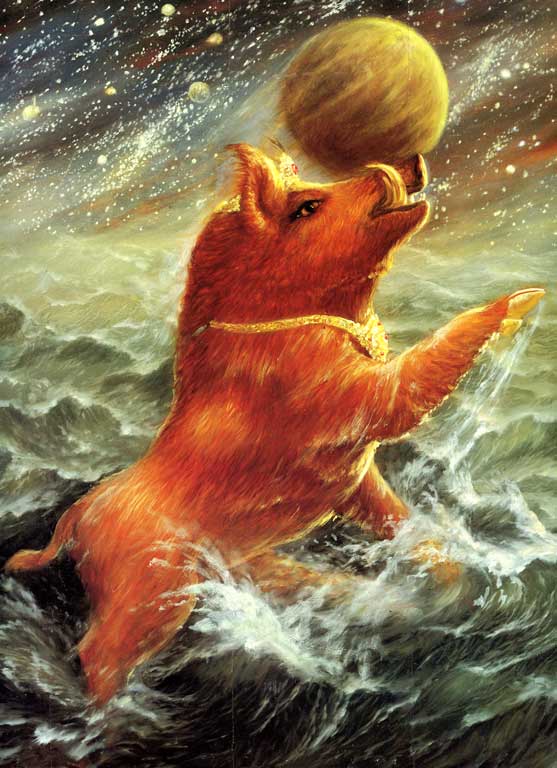
Varahadeva lifts the Earth
Today marks Bhaimi Ekadasi (fast from grains & Beans), but it is a special Ekadasi in that we fast till noon today for Varahadeva, and feast tomorrow.
In honor of the Appearance of Lord Varahadeva [Varaha Dvadasi] tomorrow, we are posting the entire chapter entitled “The Appearance of Lord Varāha” from the Srimad Bhagavatam.
Śrīmad-Bhāgavatam
By His Divine Grace A. C. Bhaktivedanta Swami Prabhupāda
Canto Three, Chapter 13
The Appearance of Lord Varāha
More
25 Jan 2015
by The Hare Krishna Movement
in A.C. Bhaktivedanta Swami Prabhupada, Srimad Bhagavatam, Time
Tags: A.C. Bhaktivedanta Swami Prabhupada, Asita, Atri, Bṛhadaśva, Bharadvāja and Paraśurāma and disciples, Dhaumya, Gautama, Gṛtsamada, Hūṇa, Indrapramada, Kakṣīvān, Kauśika, Kirāta, Mahabhrata, members of the Khasa races, Narada, Parvata Muni, Pulinda, Pulkaśa, SB 1.9.6-7, SB 2.4.18, Srimad Bhagavatam, Trita, Vasiṣṭha, Vyāsa the incarnation of God, Yavana, Śumbha, Ābhīra, Āndhra

One thing I have often found interesting when reading books like the Srimad Bhagavatam and the Maha Bharata, is how far back the recorded oral histories go. Often Millions of Years. On our last visit to Mexico we were learning some about the Mayan culture, and how Millions of people vanished some 5,000 years ago. Which happens to coincide with the ancient Battle of Kurukestra which took place in India.
Also Srila Prabhupada has mentioned so many places in his books about how at one time, all the different parts of the world were ruled by one king.
…In the modern age people are under the impression that during the Vedic period or the prehistoric ages America and many other parts of the world had not been discovered, but that is not a fact. Pṛthu Mahārāja ruled over the world many thousands of years before the so-called prehistoric age, and it is clearly mentioned here that in those days not only were all the different parts of the world known, but they were ruled by one king, Mahārāja Pṛthu. (from purport to SB 4.21.12)
An interesting link ended up in my mailbox this morning which I share with all of you describing some of the common spiritual cultures on differing sides of the world.
Baffling Links to Ancient India: History is full of misnomers; one such term is the New World, as applied to the Americas. The landing of Columbus in 1492 undoubtedly created a new life on the continents, but it neither created nor discovered a new world. Many centuries ago Asian migrants had come to the western shore in substantial numbers. What if the popular idea that Tibetans and American Indians have much in common in terms of their spiritual culture is largely a result of another historical scenario?
What if Hindus and Hopis, Advantins and Aztecs, Tibetan Monks and Mayans were part of one world culture – a spiritual one?
Click on Link Links to Ancient India for more information
We also include a few brief excerpts form the Srimad Bhagavatam describing this one world culture which existed thousands of years ago.
More
18 Jan 2015
by The Hare Krishna Movement
in A.C. Bhaktivedanta Swami Prabhupada, Chapter a Day
Tags: A. C. Bhakthvedanta Swami Prabhupada, bhagavad-gita, Brahma, brahmaji, Cause of All Causes, chad, chapter a day, demigod, disciplic succession, jnanam, Krsna, Lord Brahma, Narada, Narada Muni, parampara system, quailified spiritual master, Srila Prabhupada, Srimad Bhagavatam, transcendental knowledge, Vedic literture
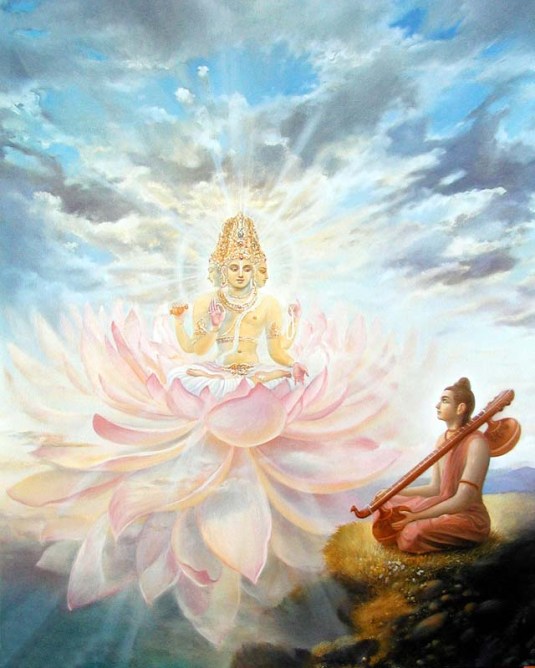
As we continue to update one of our other sites Śrīmad-Bhāgavatam by posting a chapter at a time, of that great literary work by His Divine Grace Srila Prabhupada, we will continue to share the progress with our readers here at The Hare Krishna Movement.
Śrīmad-Bhāgavatam: Canto 2: “The Cosmic Manifestation”
By His Divine Grace A. C. Bhaktivedanta Swami Prabhupāda
Canto Two, Chapter 5
More
09 Jan 2015
by The Hare Krishna Movement
in A.C. Bhaktivedanta Swami Prabhupada, Prahlada Maharaja, Srila Prabhupada's Books, Srimad Bhagavatam
Tags: A. C. Bhakthvedanta Swami Prabhupada, books by Srila Prabhupada, even though irregularly composed, fame, form and pastimes of the unlimited Supreme Lord, impious life, kaumara acaret pranjo, misdirected civilization, Preface to Srimad Bhagavatam, SB.7.6.1, sri prahrada uvaca, Srimad Bhagavatam, that literature which is full with descriptions of the transcendental glories of the name, transcendental literature
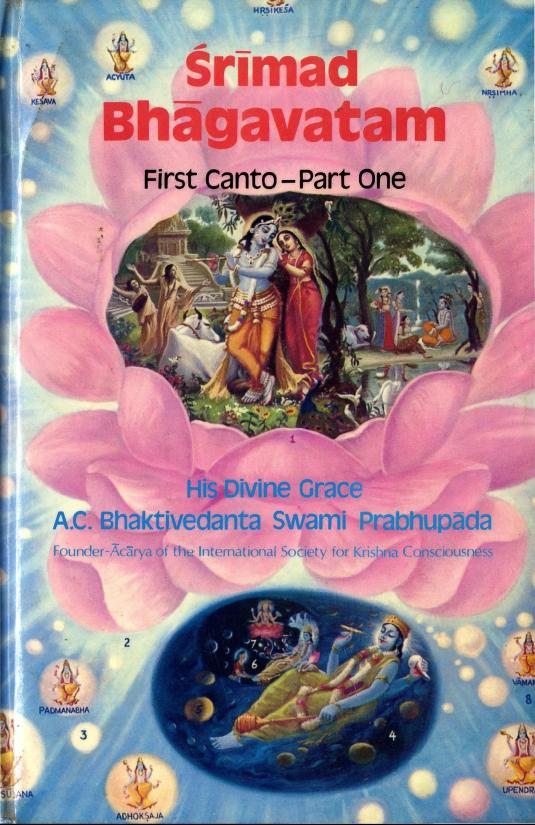
It seems that every time I start a new volume of the Srimad Bhagavatam, I open it and read the Preface first. I must have read the preface now many times, but every time I read it, it seems fresh and new. One could argue that it because my memory is poor, or, that is just the nature of transcendental literature. But what is interesting is to me this morning, is how I never looked up the verse that Srila Prabhupada quotes in his Preface:
kaumāra ācaret prājñodharmān bhāgavatān ihadurlabhaṁ mānuṣaṁ janmatad apy adhruvam arthadam (Bhāg. 7.6.1)
This morning I was curious, so I went to the Seventh Canto, Chapter 6, Text 1, and it read:
Prahlāda Mahārāja said: One who is sufficiently intelligent should use the human form of body from the very beginning of life—in other words, from the tender age of childhood—to practice the activities of devotional service, giving up all other engagements. The human body is most rarely achieved, and although temporary like other bodies, it is meaningful because in human life one can perform devotional service. Even a slight amount of sincere devotional service can give one complete perfection.
Full text and purport follows the Preface More
06 Jan 2015
by The Hare Krishna Movement
in A.C. Bhaktivedanta Swami Prabhupada, Chapter a Day, Srimad Bhagavatam
Tags: A. C. Bhakthvedanta Swami Prabhupada, accepting the shelter of a bona fide spiritual master, Asvatthama, atomic bomb, Bhaktivedanta purports, Brahma, brahmastra, causless mercy, chad, chapter a day, chaste, creation of material world, existing, Krsna, Maharaja Pariksit, material world, satim, SB. 2.4, spiritual master, Srimad Bhagavatam, Sukadiva Gosvami, Suta Gosvami, suta uvaca, the process of creation, uttara
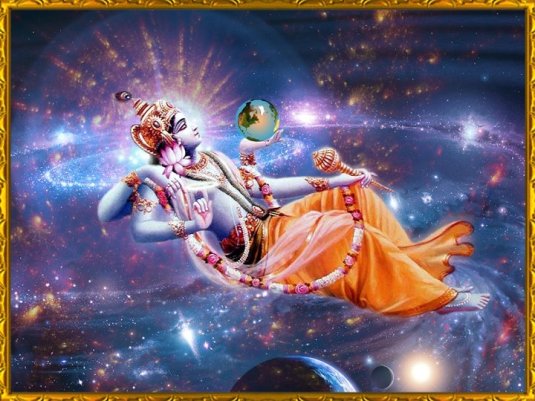
click on image to enlarge
As we continue to update our (one of our other sites) Śrīmad-Bhāgavatam by posting a chapter at a time, of that great literary work by His Divine Grace Srila Prabhupada, we will continue to share the progress with our readers here at The Hare Krishna Movement.
Śrīmad-Bhāgavatam
By His Divine Grace A. C. Bhaktivedanta Swami Prabhupāda
Canto Two, Chapter Four
The Process of Creation
More
09 Dec 2014
by The Hare Krishna Movement
in A.C. Bhaktivedanta Swami Prabhupada, B. G. Sharma Art, Krishna Consciousness, Krsna, Krsna Consciousness, Srimad Bhagavatam
Tags: A.C. Bhaktivedanta Swami Prabhupada, Arjuna, arjuna's arrows, awakened to love of God, Battlefield of Kurukṣetra, Goloka Vrndavana, Krsna, lotuslike face of Krsna, love of God, material contaminations, pleasing to the eyes of the seer, SB3.2.20, spiritual sky, Srimad Bhagavatam, the beauty of the Lord, transcendental sky, Vaikuntha planets

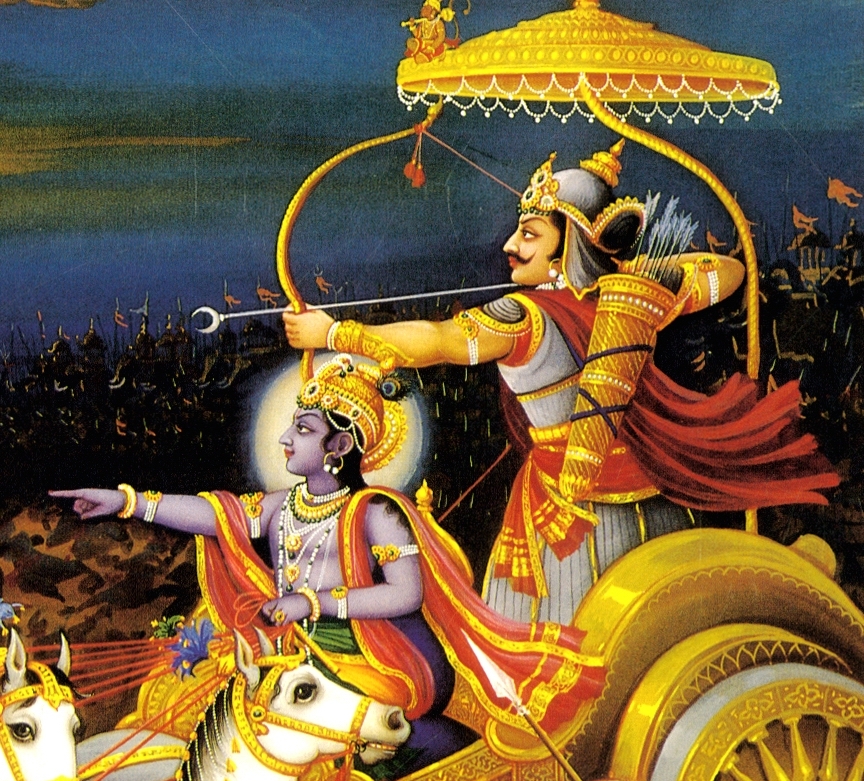
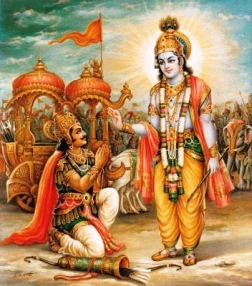
Certainly others who were fighters on the Battlefield of Kurukṣetra were purified by the onslaught of Arjuna’s arrows, and while seeing the lotuslike face of Kṛṣṇa, so pleasing to the eyes, they achieved the abode of the Lord. (SB 3.2.20)
This morning as I was reading from the Srimad-Bhagavatam, the words “pleasing to the eyes of the seer” jumped out at me. And I was reminded again how just by appreciating the beauty of the Lord, one can attain success in life, as the following purport explains.
“…All the warriors who fought against Arjuna but who were able to see the lotuslike face of the Lord on the battlefront achieved the abode of the Lord, exactly as the devotees of the Lord do. The words “pleasing to the eyes of the seer” are very significant. When the warriors from the other side of the battlefield saw Lord Kṛṣṇa at the front, they appreciated His beauty, and their dormant instinct of love of God was awakened.
This love of God is awakened by the association of pure devotees of the Lord… Those who saw the beautiful face of the Lord on the Battlefield of Kurukṣetra were purified first by Arjuna when he made his onslaught with arrows… All the activities of a pure devotee are executed on behalf of the Lord because a pure devotee of the Lord has nothing to do for his personal interest. Arjuna’s killing was as good as killing by the Lord Himself. As soon as Arjuna shot an arrow at an enemy, that enemy became purified of all material contaminations and became eligible to be transferred to the spiritual sky… those who awakened to love of God were transferred to the planets of the transcendental sky.
Those whose love of God is awakened to the fullest extent go back to the Goloka Vṛndāvana planet in the spiritual sky, whereas persons who have just awakened to love of Godhead by accident or association are transferred to the Vaikuṇṭha planets. Essentially there is no material difference between Goloka and Vaikuṇṭha, but in the Vaikuṇṭhas the Lord is served in unlimited opulence, whereas in Goloka the Lord is served in natural affection.” (from purport to SB 3.2.20)
Full Text and Purport More
04 Dec 2014
by The Hare Krishna Movement
in A.C. Bhaktivedanta Swami Prabhupada, Gopis, Vrindavan, Vrndavana
Tags: A.C. Bhaktivedanta Swami, ecstasy, gopis, great demigods like Brahma and Siva, krsna and the gopis, Lord Krsna, notorious as a teasing friend, Prabhupada books, SB3.2.14, Srimad Bhagavatam, The damsels of Vraja, transcendental love, unalloyed affection, Vrindaban, Vrndavana

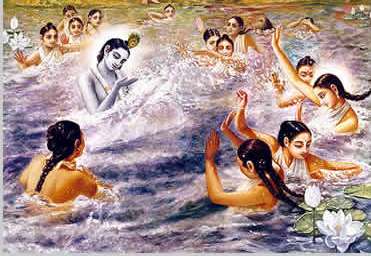
…In His boyhood at Vṛndāvana, Lord Kṛṣṇa was notorious as a teasing friend in transcendental love to all the girls His age. His love for them was so intense that there is no comparison to that ecstasy, and the damsels of Vraja were so much attached to Him that their affection excelled that of the great demigods like Brahmā and Śiva. Lord Kṛṣṇa finally admitted His defeat before the transcendental affection of the gopīs and declared that He was unable to repay them for their unalloyed affection. (from purport SB 3.2.14)
More
21 Nov 2014
by The Hare Krishna Movement
in A.C. Bhaktivedanta Swami Prabhupada, Adhoksaja, Buddha, Maitreya
Tags: A. C. Bhaktivedant, adhoksaja, adhoksaja means knowledge perceived by material senses, aksaja, buddha, club, conch, disk, incarnations, Krsna Is The Source of All Incarnations, Lord Adhoksaja, Lord Visnu, lotus, Maitreya, Maitreya Buddha, science of transcendence, Srimad Bhagavatam, twinty-four forms, Vidura, Vidura talks with Maitreya, Visnu

Adhokṣaja
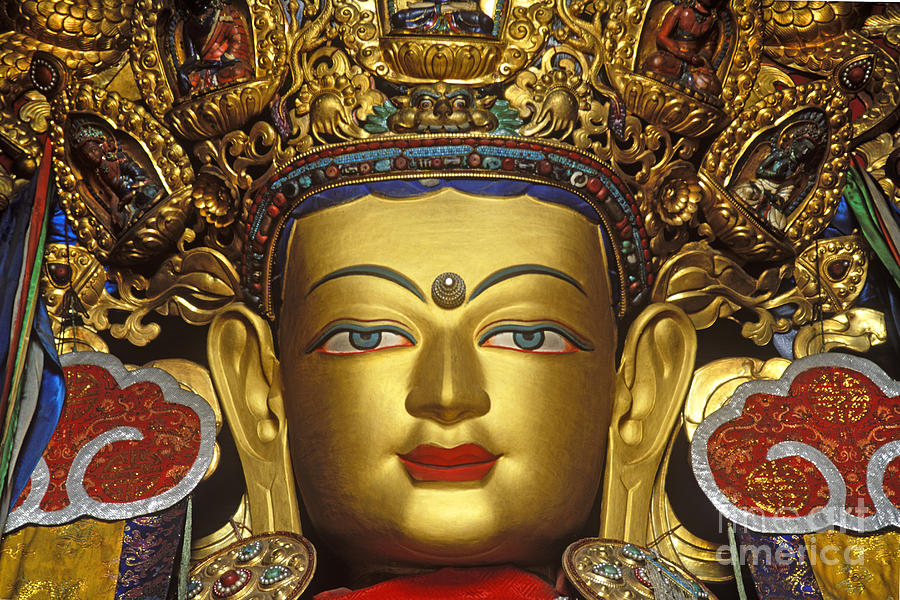
If one were to do an image search on the Internet, of Maitreya; who is a character in the Srimad Bhagavatam, and the main person in our Previous post entitled “Vidura’s Talks with Maitreya”, the images that come up are of the Maitreya Buddha. It is interesting to note that In the Vedas, Adhokṣaja is one of the twenty-four forms of Lord Viṣṇu. Also in the Srimad Bhagavatam in the First Canto, Chapter Three, entitled “Kṛṣṇa Is the Source of All Incarnations”, Buddha is one of the incarnations to appear in this age. I thought it interesting to do a post on Adhokṣaja with some selected text from Srila Prabhupada’s books.
Maitreya Muni, who was experienced in the science of Transcendence, could understand that Vidura’s mind was fully absorbed in Transcendence. Adhokṣaja means that which transcends the limits of sense perception or sensuous experience. The Lord is transcendental to our sense experience, but He reveals Himself to the sincere devotee. Because Vidura was always absorbed in thought of the Lord, Maitreya could estimate Vidura’s transcendental value. He appreciated the valuable inquiries of Vidura and thus thanked him with great honor. (SB 3.5.18, Purport)
The Lord is explained here to be adhokṣaja, beyond the reach of all material calculation. Akṣaja means “the measurement of our senses,” and adhokṣaja means “that which is beyond the measurement of our senses.” (SB 3.19.25, Purport)
More
25 Oct 2014
by The Hare Krishna Movement
in A.C. Bhaktivedanta Swami Prabhupada, Damodara, Gopis, Srimad Bhagavatam
Tags: A.C. Bhaktivedanta Swami Prabhupada, affection of the gopis, damsels of Vraja, ecstasy, gopis, Krsna, Lord Krsna, remembrance of Lord Krsna, SB3.2.14, Srimad Bhagavatam, transcendental love, Vrndavana

click on image to enlarge
In our attempt to stay focused on the childhood pastimes of Lord Krsna throughout this month of Damodara, we were reading from the Third Canto of the Srimad-Bhagavatam, chapter 2, entitled; “Remembrance of Lord Kṛṣṇa”. The great devotee Uddhava, was asked by Vidura, to speak on the messages of Lord Krsna. The following is but one of the verses and purports from this famous chapter.
…In His boyhood at Vṛndāvana, Lord Kṛṣṇa was notorious as a teasing friend in transcendental love to all the girls His age. His love for them was so intense that there is no comparison to that ecstasy, and the damsels of Vraja were so much attached to Him that their affection excelled that of the great demigods like Brahmā and Śiva. Lord Kṛṣṇa finally admitted His defeat before the transcendental affection of the gopīs and declared that He was unable to repay them for their unalloyed affection. (from purport to SB 3.2.14)
Full text and purport More
21 Oct 2014
by The Hare Krishna Movement
in A.C. Bhaktivedanta Swami Prabhupada, Lord Rsabhadeva, Srimad Bhagavatam, Threefold Miseries, Transcendental Knowledge, Varnasrama Dharma
Tags: A.C. Bhaktiveanta Swami Prabhupada, amhita, devotional service, eternal blissful life, living entities, Lord Rsabhadeva, material bodies, rsabha uvaca, Srimad Bhagavatam, transcendental knowledge
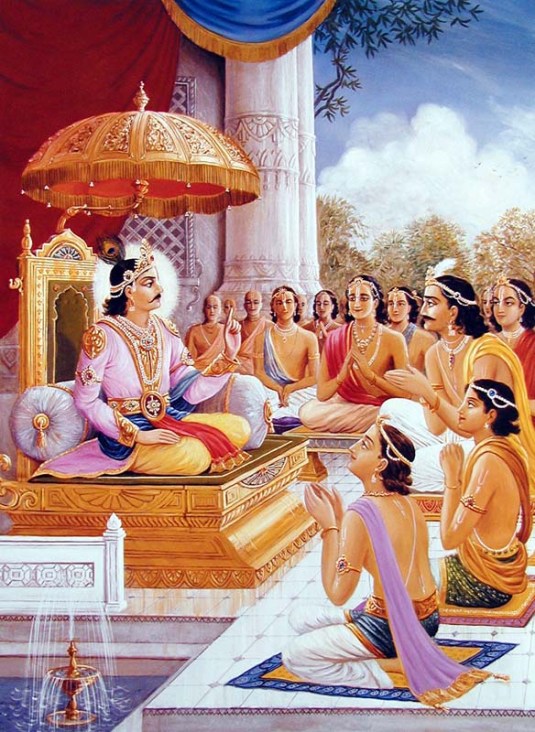
This morning by chance, I happened upon the teachings of Lord Rsabhadeva to His sons. It was in an old notebook that I opened just to see what was inside. Inside were prayers from the Vaisnava Songbook, the Brahma-samhita, Teachings of Pralada Maharaja, and these teachings of Lord Rsabhadeva. It was Sri Gandhari’s old gurukula study notebook, and what she was studying 30 years ago was very useful and timely today. It was just what I needed to read this morning and I share it with you today. It is verses 1-27, from the Fifth Canto of the Srimad Bhagavatam, chapter five.
Lord Ṛṣabhadeva told His sons: My dear boys, of all the living entities who have accepted material bodies in this world, one who has been awarded this human form should not work hard day and night simply for sense gratification, which is available even for dogs and hogs that eat stool. One should engage in penance and austerity to attain the divine position of devotional service. By such activity, one’s heart is purified, and when one attains this position, he attains eternal, blissful life, which is transcendental to material happiness and which continues forever.
More
18 Oct 2014
by The Hare Krishna Movement
in A.C. Bhaktivedanta Swami Prabhupada, Dharma, Dream
Tags: A. C. Bhaktivedanta Swami Pabhupada, dharma, happiness, living being's eternal occupation, occupation, root meaning of the word dharma, Srimad Bhagavatam, Supreme Lord, that which sustains

This morning I awoke early, and before rising, I was just going over the dreams in my head. I was dreaming about the following verse from the Srimad Bhagavatam.
“The supreme occupation [dharma] for all humanity is that by which men can attain to loving devotional service unto the transcendent Lord. Such devotional service must be unmotivated and uninterrupted to completely satisfy the self.” (SB 1.2.6)
I have been very much absorbed in my worldly occupation of late, writing up contracts, submitting bills, paying employees etc. and have mostly been waking up with thoughts of work. But this morning I was dreaming about a specific verse from the Srimad Bhagavatam. Interesting! So I went to the Bhagavatam, and read the purport to this verse.
…We have purposely denoted dharma as occupation because the root meaning of the word dharma is “that which sustains one’s existence.” A living being’s sustenance of existence is to coordinate his activities with his eternal relation with the Supreme Lord Kṛṣṇa. Kṛṣṇa is the central pivot of living beings, and He is the all-attractive living entity or eternal form amongst all other living beings or eternal forms. Each and every living being has his eternal form in the spiritual existence, and Kṛṣṇa is the eternal attraction for all of them. Kṛṣṇa is the complete whole, and everything else is His part and parcel. The relation is one of the servant and the served. It is transcendental and is completely distinct from our experience in material existence. This relation of servant and the served is the most congenial form of intimacy. One can realize it as devotional service progresses. Everyone should engage himself in that transcendental loving service of the Lord, even in the present conditional state of material existence. That will gradually give one the clue to actual life and please him to complete satisfaction.
Somehow I feel more satisfied, more complete, after my reading.
Full Verse and Purport More
17 Oct 2014
by The Hare Krishna Movement
in A.C. Bhaktivedanta Swami Prabhupada, Srila Prabhupada's Books, Srimad Bhagavatam
Tags: A.C. Bhaktivedanta Swami Prabhupada, Bhaktivedanta purports, brahmajyoti effulgence, Brhaspati, conditioned soul, intelligent man, Lord Brahma, Lord Siva, Maharaja Pariksit, material world, pure devotional service, SB 2.3, Sri Sukadeva Gosvami, Srimad Bhagavatam, threshold of death, Vedas
click on image to enlarge
As we continue to update our (one of our other sites) Śrīmad-Bhāgavatam by posting a chapter at a time, of that great literary work by His Divine Grace Srila Prabhupada, we will continue to share the progress with our readers here at The Hare Krishna Movement.
Śrīmad-Bhāgavatam
by His Divine Grace A. C. Bhaktivedanta Swami Prabhupāda
Canto 2, Chapter Three
Pure Devotional Service: The Change in Heart
More
03 Oct 2014
by The Hare Krishna Movement
in A.C. Bhaktivedanta Swami Prabhupada, Back to Godhead, Founder-Acarya, Srila Prabhupada, The Hare Krishna Movement
Tags: A.C. Bhaktivedanta Swami Prabhupada, Back to Godhead Magazine, bhagavad-gita, BTG, discipline of God consciousness, God consciousness, Hare Krsna, Hare Rama, krsna consciousness, Srimad Bhagavatam, The Hare Krishna Movement, the krsna consciousness movement
click on image to enlarge
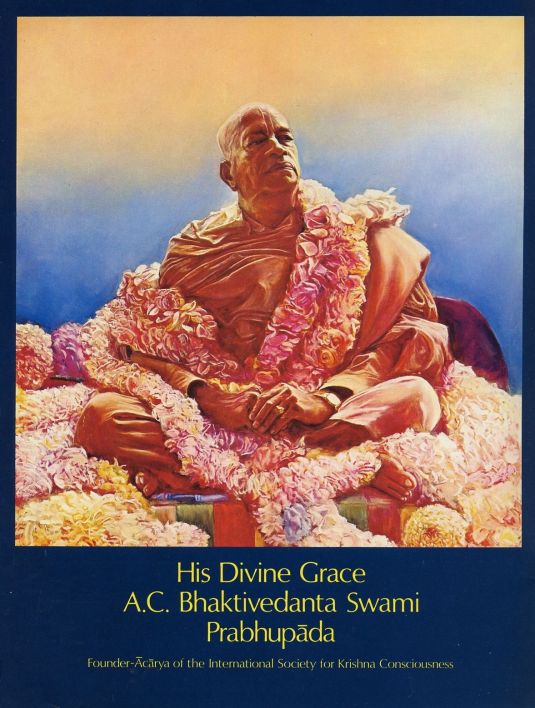
The Krsna Consciousness Movement
Excerpted from Back to Godhead Magazine Vol. 1, No. 48
The Krsna consciousness movement is now being increasingly recognized throughout the world as a spiritual force of great potency, purity and importance to human society. With the simultaneous publication of the first two cantos of Srimad-Bhagavatam and the complete 1,000-page edition of Bhagavad-gita As It Is, the public is becoming increasingly aware that the boys and girls whom they see chanting and dancing on their city streets are students of a most serious discipline of God consciousness which is established on the basis of a philosophical system of considerable completeness, consistency and depth.
Hare Krsna Hare Krsna Krsna Krsna Hare Hare
Hare Rama Hare Rama Rama Rama Hare Hare
More
02 Sep 2014
by The Hare Krishna Movement
in A.C. Bhaktivedanta Swami Prabhupada, B. G. Sharma Art, Radha Krishna, Radhastami, Srimati Radharani
Tags: A.C. Bhaktivedanta Swami Prabhupada, appearance day of srimati radharani, beauty of krsna, beauty of radharani, Lord Caitanya, Radha, Radha-Krsna, Radharani, Ramananda Raya, SB 2.3.23, Spiritual world, Srila Prabhupada, Srimad Bhagavatam, Srimati Radharani

click on image to enlarge
So today being the appearance day of Srimati Radharani, my mind has been absorbed in thoughts of Radha and Krsna. It is described that she is the beloved consort of Krsna, Krsna’s pleasure potency, and the spiritual energy of Krsna.
…Lord Caitanya requested Rāmānanda Rāya to explain something more: “What are the transcendental features of Kṛṣṇa and Rādhārāṇī, and what are the transcendental features of the reciprocation of Their feelings, and what is the love between Them? If you kindly describe all this to Me, I will be very much obliged. But for you, no one can describe such things.” (Teachings of Lord Caitanya Chapter 30)
…In the Caitanya-caritāmṛta it is said that when Kṛṣṇa comes before Rādhārāṇī, She becomes so much engladdened by seeing the beauty of Kṛṣṇa that She becomes more beautiful, and as soon as Rādhārāṇī becomes beautiful, Kṛṣṇa becomes engladdened and He becomes more beautiful. So unlimitedly there is competition of becoming more beautiful. That is the state. Competition. Because in the spiritual world everything is unlimited. So unlimitedly both of them becoming beautiful and both of them enjoying unlimitedly. ((Lecture on SB 1.2.8 New Vrindaban, September 6, 1972)
…Śrīmatī Rādhārāṇī is a tenderhearted feminine counterpart of the supreme whole, resembling the perfectional stage of the worldly feminine nature. Therefore, the mercy of Rādhārāṇī is available very readily to the sincere devotees, and once She recommends such a devotee to Lord Kṛṣṇa, the Lord at once accepts the devotee’s admittance into His association. (Srimad-Bhagavatam Canto 2, Chapter 3, Text 23)
…She is Kṛṣṇa. Kṛṣṇa divided Himself into His energy and Himself. That energy, original spiritual energy, is Rādhārāṇī. ((Lecture on SB 2.1.1-5 Melbourne, June 26, 1974)
More
15 Aug 2014
by The Hare Krishna Movement
in A.C. Bhaktivedanta Swami Prabhupada, Festivals, Janmastami, Krishna, Krsna Consciousness, Krsna God, KRSNA The Supreme Personality of Godhead
Tags: A.C. Bhaktivedanta Swami Prabhupada, birth of Lord Krishna, Janmastami, janmastami festival, Krishna, Krsna, Krsna Book, Sri Krishna Janmastami, Srimad Bhagavatam

click on image to enlarge
With the advent of Lord Krsna’s birthday celebration (Janmastami) rapidly approaching, it seemed fitting that we do a post on the birth of Lord Krsna. So the following is the entire third chapter from the Krsna Book entitled “The Birth of Lord Kṛṣṇa”.
…As stated in the Bhagavad-gītā, the Lord says that His appearance, birth, and activities, are all transcendental, and one who understands them factually becomes immediately eligible to be transferred to the spiritual world. The Lord’s appearance or birth is not like that of an ordinary man who is forced to accept a material body according to his past deeds. The Lord’s appearance is explained in the Second Chapter: He appears out of His own sweet pleasure. When the time was mature for the appearance of the Lord, the constellations became very auspicious. The astrological influence of the star known as Rohiṇī was also predominant because this star is considered to be very auspicious. Rohiṇī is under the direct supervision of Brahmā. According to the astrological conclusion, besides the proper situation of the stars, there are auspicious and inauspicious moments due to the different situations of the different planetary systems. At the time of Kṛṣṇa’s birth, the planetary systems were automatically adjusted so that everything became auspicious. ( from Kṛṣṇa, the Supreme Personality of Godhead Chapter 3)
Full Chapter More
22 Jul 2014
by The Hare Krishna Movement
in A.C. Bhaktivedanta Swami Prabhupada, Srimad Bhagavatam
Tags: A.C. Bhaktivedanta Swami Prabhupada, Bhagavata-dharma, Brahmaloka, conditioned souls, fruitive activities, heavenly planets, incarnation, kingdom of God, Krsna, Lord Brahma, material ezistence, material world, meditate upon the virat-rupa, Patalaloka, phantasmagoria, Spiritual world, sri suka uvaca, Sri Sukadeva Gosvami, Srimad Bhagavatam, The Lord in the Heart, virat-rupa
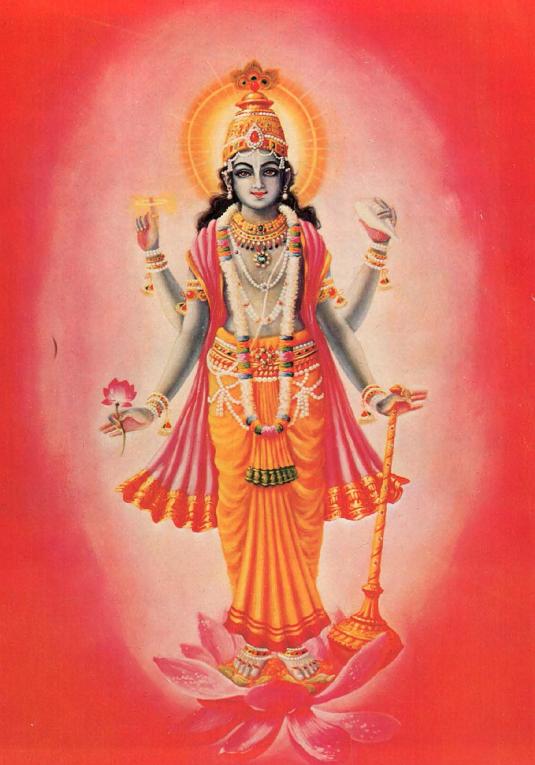
Śrīmad-Bhāgavatam
By His Divine Grace A. C. Bhaktivedanta Swami Prabhupāda
Canto Two, Chapter 2
The Lord in the Heart
Full Chapter More
Previous Older Entries Next Newer Entries