Indignities of Old Age

I guess you could say I have reached old age. I am 72 now and am semi-retired. It is nice to have more free time, where I don’t need to drive to work every morning, where I’m not under the control of some boss, and can pretty much decide what I want to do every day. But this so called free time in old age is not really freedom. Every day I look at the calendar, to check my appointments. One day it is the dentist to get my lose teeth pulled and fitted for dentures, or to again see the doctor about my different medical conditions, and believe me none of this is free.

Then there is the pain and suffering. There is a tiredness and weakness and in some, a loss of memory. These are what I refer to as the indignities of old age.

But in reality we are not this body. We are Spirit soul.

“For the soul there is never birth or death. Nor, having once been, does he ever cease to be. He is unborn, eternal, ever-existing, undying and primeval. He is not slain when the body is slain.” (Bg 2.20)

As the embodied soul continually passes, in this body, from boyhood to youth to old age, the soul similarly passes into another body at death. The self-realized soul is not bewildered by such a change. (Bg 2.13)

One should try to understand the distress of accepting birth, death, old age and disease. There are descriptions in various Vedic literatures of birth. In the Srimad Bhagavatam the world of the unborn, the child’s stay in the womb of the mother, its suffering, etc., are all very graphically described. It should be thoroughly understood that birth is distressful. Because we forget how much distress we have suffered within the womb of the mother, we do not make any solution to the repetition of birth and death. Similarly at the time of death, there are all kinds of sufferings, and they are also mentioned in the authoritative scriptures. These should be discussed. And as far as disease and old age are concerned, everyone gets practical experience. No one wants to be diseased, and no one wants to become old, but there is no avoiding these. Unless we have a pessimistic view of this material life, considering the distresses of birth, death, old age and disease, there is no impetus for our making advancement in spiritual life. (from purport to Bg 13. 8-12)

Intelligent persons who are endeavoring for liberation from old age and death take refuge in Me in devotional service. They are actually Brahman because they entirely know everything about transcendental and fruitive activities. (Bg 7.29)

Purport

Birth, death, oldage and diseases affect this material body, but not the spiritual body. There is no birth, death, old age and disease for the spiritual body, so one who attains a spiritual body, becomes one of the associates of the Supreme Personality of Godhead and engages in eternal devotional service, is really liberated. Aham brahmāsmi: I am spirit. It is said that one should understand that he is Braham—spirit soul. This Brahman conception of life is also in devotional service, as described in this verse. The pure devotees are transcendentally situated on the Brahman platform, and they know everything about transcendental and material activities.

When the embodied being is able to transcend these three modes, he can become free from birth, death, oldage and their distresses and can enjoy nectar even in this life. (Bg 14.20)

Purport

How one can stay in the transcendental position, even in this body, in full Krsna consciousness, is explained in this verse. The Sanskrit word dehi means embodied. Although one is within this material body, by his advancement in spiritual knowledge he can be free from the influence of the modes of nature. He can enjoy the happiness of spiritual life even in this body because, after leaving this body, he is certainly going to the spiritual sky. But even in this body he can enjoy spiritual happiness. In other words, devotional service in Kṛṣṇa consciousness is the sign of liberation from this material entanglement, and this will be explained in the Eighteenth Chapter. When one is freed from the influence of the modes of material nature, he enters into devotional service.

One who is intelligent should be eager to solve these four principal problems—birth, death, old age and disease. No one wants to die, but there is no remedy. Everyone has to die… . There is no stoppage of death, and there is no stoppage of birth. Nor can diseases be stopped, nor can old age, despite all of the latest inventions in medicine.

…where is the solution to these four problems of birth, death, old age and disease? That solution is Krsna consciousness.

“One who knows the transcendental nature of My appearance and activities does not, upon leaving the body, take his birth again in this material world, but attains My eternal abode, O Arjuna.” (Bg. 4.9)

Lord Krishna’s Appearance Day Lecture

Lord Krishna’s Appearance Day Lecture
By His Divine Grace A.C. Bhaktivedanta Swami Prabhupada
(London, August 21, 1973)

Prabhupāda: His Excellency, the High Commissioner; ladies and gentlemen, I thank you very much for your coming here and participating in this ceremony, Janmāṣṭamī, advent of Kṛṣṇa. The subject matter I’ve been ordered to speak on is advent of Kṛṣṇa. Kṛṣṇa says in the Bhagavad-gītā,

janma karma me divyaṁ
yo jānāti tattvataḥ
tyaktvā dehaṁ punar janma
naiti mām eti kaunteya
(BG 4.9)

This fact, that we can achieve such a stage of life when we can stop our birth and death… Sa ‘mṛtatvāya kalpate. This morning, I was explaining this verse:

yaṁ hi na vyathayanty ete
puruṣaṁ puruṣarsabha
sama-duḥkha-sukhaṁ dhīraṁ
so ‘mṛtatvāya kalpate

Amrtatva means immortality. So the modern civilization, they have no idea, either the great philosopher, great politician or great scientist, that it is possible to attain the stage of immortality. Amṛtatva. We are all amṛta. In the Bhagavad-gītā it is said, na jāyate na mrīyate vā kadācin. We living entities, we never die, never take birth. Nityaḥ śāśvato yaṁ, na hanyate hanyamāne śarīre (BG 2.20). Every one of us, we are eternal, nityaḥ śāśvato; Purāṇa, the oldest. And after annihilation of this body, we do not die. Na hanyate. The body is finished, but I have to accept another body. Tathā dehāntara prāptir dhīras tatra na muhyati. Dehino ‘smin yathā dehe kaumāraṁ yauvanaṁ jarā (BG 2.13).

This simple thing, at the present moment, they are lacking knowledge, that we, all living entities, part and parcel of Kṛṣṇa, we are eternal, we are blissful, and we are cognizant. Kṛṣṇa is described in the Vedic śāstras:

More

Chanting Hare Krsna

visnujhana swami

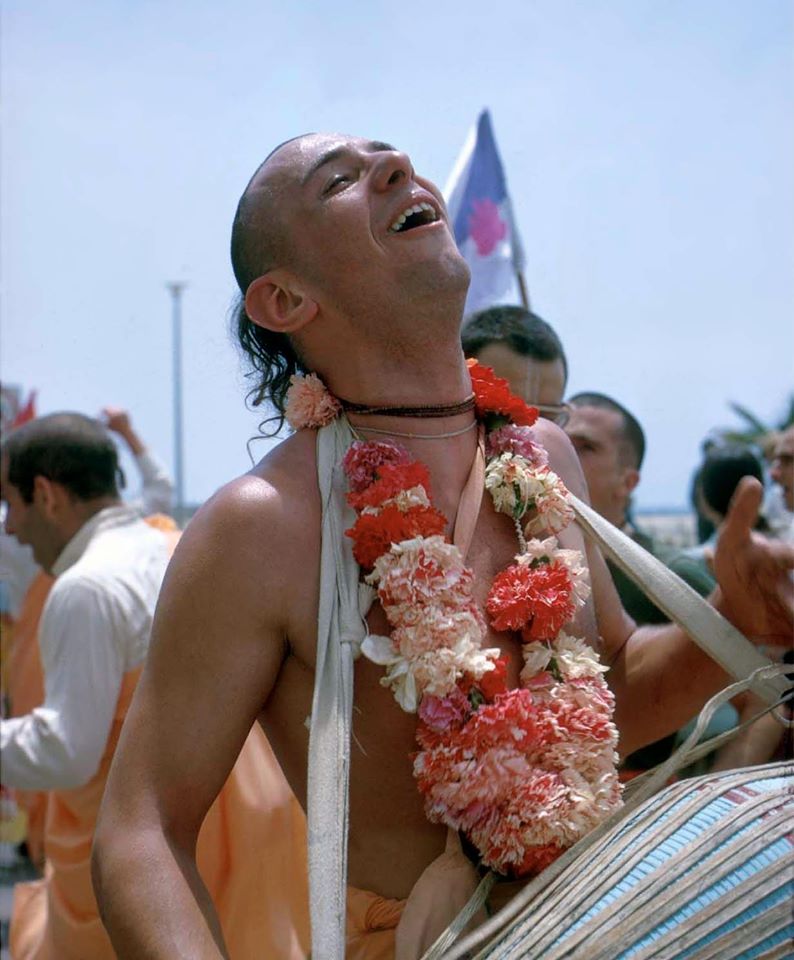
It seems there is world wide fear over the outbreak of the Coronavirus disease (COVID-19). Most people infected with the COVID-19 virus will experience mild to moderate respiratory illness and recover without requiring special treatment. Older people, such as myself , and those with underlying medical problems like cardiovascular disease, diabetes, chronic respiratory disease, and cancer are more likely to develop serious illness. But I refuse to live in fear, although we have accepted a self imposed quarantine, I have gone about my business working alone in my woodworking shop, and chanting the holy name. Hare Krishna! -V

Living beings who are entangled in the complicated meshes of birth and death can be freed immediately by even unconsciously chanting the holy name of Kṛṣṇa, which is feared by fear personified. (SB 1.1.14)

… It is stated herein that the name of Kṛṣṇa is feared even by fear personified. This indicates that the name of Kṛṣṇa is nondifferent from Kṛṣṇa. Therefore, the name of Kṛṣṇa is as powerful as Lord Kṛṣṇa Himself. There is no difference at all. Anyone, therefore, can take advantage of the holy names of Lord Śrī Kṛṣṇa even in the midst of greatest dangers. The transcendental name of Kṛṣṇa, even though uttered unconsciously or by force of circumstances, can help one obtain freedom from the hurdle of birth and death. (from purport)

Full tent and purport More

The Evolutionary Process

The evolutionary process

The evolutionary process

In the course of the evolutionary process, which is caused by fruitive activities due to undesirable material sense gratification, I have received this human form of life, which can lead to the heavenly planets, to liberation, to the lower species, or to rebirth among human beings. (SB7.13.25)

…All living entities within this material world are undergoing the cycle of birth and death according to the laws of nature. This struggle of birth and death in different species may be called the evolutionary process, but in the Western world it has been wrongly explained. Darwin’s theory of evolution from animal to man is incomplete because the theory does not present the reverse condition, namely evolution from man to animal.

Human life, which is obtained in the course of the evolutionary process, is a chance for elevation (svargāpavarga) or for degradation (tiraścām punar asya ca). If one uses this human form of life properly, he can elevate himself to the higher planetary systems, where material happiness is many thousands of times better than on this planet, or one may cultivate knowledge by which to become free from the evolutionary process and be reinstated in one’s original spiritual life. This is called apavarga, or liberation. (from purport to SB 7.13.25)

Some years back I was reading from one book and the author was explaining how within each of us, we have the Keys to the gates of the Kingdom of Heaven, and we also have the Keys to the gates of Hell. It is our choice at every moment which we choose to use. Or as the saying goes “It is Rama, or it is Drama”.

Full text and purport More

The Living Entities (Prajā)

Prajah, living entities who take birth in the material universe

Here is a word for your vaisnava vocabulary; Prajah.

Prajā means the living being who has taken his birth in the material world. Actually the living being has no birth and no death, but because of his separation from the service of the Lord and due to his desire to lord it over material nature, he is offered a suitable body to satisfy his material desires. In doing so, one becomes conditioned by the laws of material nature, and the material body is changed in terms of his own work. The living entity thus transmigrates from one body to another in 8,400,000 species of life.

As Krishna points out in the Bhagavad-gita:

It should be understood that all species of life, O son of Kuntī, are made possible by birth in this material nature, and that I am the seed-giving father. (Bg 14-4)

Full verse and purport More

Black Friday / Material Fever

Consumerism is a kind of Material Fever

The problems of material existence-birth, old age, disease and death-cannot be counteracted by accumulation of wealth and economic development. In many parts of the world there are states which are replete with all facilities of life, which are full of wealth, and economically developed, yet the problems of material existence are still present.

If economic development and material comforts could drive away one’s lamentations for family, social, national or international inebrieties, then Arjuna would not have said that even an unrivalled kingdom on earth or supremacy like that of the demigods in the heavenly planets would not be able to drive away his lamentations. He sought, therefore, refuge in Kṛṣṇa consciousness, and that is the right path for peace and harmony.

Bhagavad-gita As It Is – Macmillan 1972 Edition
By His Divine Grace A.C. Bhaktivedanta Swami Prabhupada
Chapter 2, Text 8

na hi prapaśyāmi mamāpanudyād
yac chokam ucchoṣaṇam indriyāṇām
avāpya bhūmāv asapatnam ṛddhaṁ
rājyaṁ surāṇām api cādhipatyam

na—do not; hi—certainly; prapaśyāmi—I see; mama—my; apanudyāt—they can drive away; yat—that; śokam—lamentation; ucchoṣaṇam—drying up; indriyāṇām—of the senses; avāpya—achieving; bhūmau—on the earth; asapatnam—without rival; ṛddham—prosperous; rājyam—kingdom; surāṇām—of the demigods; api—even; ca—also; ādhipatyam—supremacy.

Translation

I can find no means to drive away this grief which is drying up my senses. I will not be able to destroy it even if I win an unrivalled kingdom on the earth with sovereignty like that of the demigods in heaven.

Purport

Although Arjuna was putting forward so many arguments based on knowledge of the principles of religion and moral codes, it appears that he was unable to solve his real problem without the help of the spiritual master, Lord Śrī Kṛṣṇa. He could understand that his so-called knowledge was useless in driving away his problems, which were drying up his whole existence; and it was impossible for him to solve such perplexities without the help of a spiritual master like Lord Kṛṣṇa. Academic knowledge, scholarship, high position, etc., are all useless in solving the problems of life; help can only be given by a spiritual master like Kṛṣṇa. Therefore, the conclusion is that a spiritual master who is one hundred percent Kṛṣṇa conscious is the bona fide spiritual master, for he can solve the problems of life. Lord Caitanya said that one who is master in the science of Kṛṣṇa consciousness, regardless of his social position, is the real spiritual master.

More

108 Imporant Slokas from the 1972 Bhagavad-gita As It Is

Click on image to go to Post

Click on image to go to Post

The Hare Krishna Cookbook

Songs of the Vaisnava Acaryas

Bhagavad-gita As It Is 1972 Edition “Online”

click on image

click on image to visit site

Srimad Bhagavatam Online

click on image

Raja-Vidya the King of Knowledge

click on image

click on image

Blog Stats

  • 4,908,016 hits

Enter your email address to subscribe to this blog and receive notifications of new posts by email.

Join 3,889 other subscribers

Important Slokas from the Brahma-samhita

click on image

click on image

Slokas from the Sri Isopanisad

click on image

click on image

Prayers By Queen Kunti (Slokas)

click on image

Gajendra’s Prayers of Surrender (Slokas)

click on image

A Short Statement of the Philosophy of Krishna Consciousness

click on image

click on image

July 9th Letter

click on image

click on image

The Hare Krishna Explosion

Reference Material/Study Guide

click on image

click on image

  • LINKS