The Advent of Kali-yuga

We are a little over 5,000 years into the fourth yuga of time known as Kali-yuga. At the present moment we have just passed through a little over five thousand years of the Kali-yuga, which lasts (432,000 years). Before this there was Dvapara-yuga (800,000 years), and before that there was Treta-yuga (1,200,000 years) and previous to that age there was Satya-yuga (1,728,000 years).

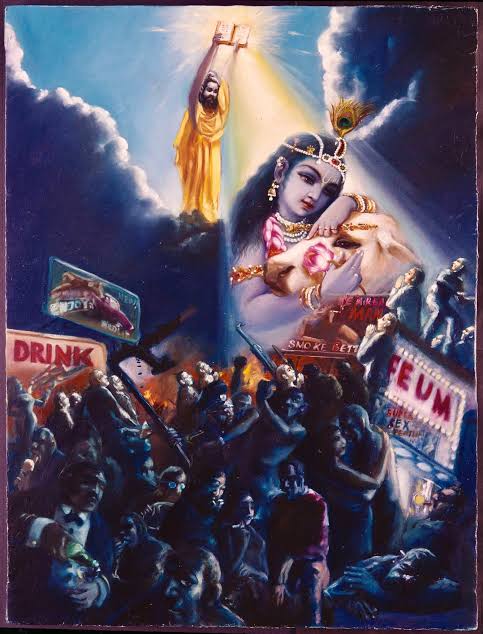
For anyone who has been watching the News, we can see just by watching the Weather that there are seasonal changes taking place around the world. We are witnessing flooding where previously it was dry, forest fires are burning up large areas of land across the globe, earthquakes, mud slides, tsunami type waves, and practically every day we are hearing about airplane crashes, and near cataclysmic events. There is violent social and political upheaval, wars and mass genocide taking place around the world. These are some of the inauspicious omens that were foretold in the Srimad Bhagavatam at the very beginning of this Kali-yuga, over 5,000 years ago.

We share with you some of these predictions that were observed by Maharaja Yudhisthira at the beginning of this age of Kali.

A few months passed, and Arjuna did not return. Maharaja Yudhisthira then began to observe some inauspicious omens, which were fearful in themselves. (SB 1.14.2)

PURPORT

Lord Sri Krsna the Supreme Personality of Godhead is ad infinitum, more powerful than the most powerful sun of our experience. Millions and billions of suns are created by Him and annihilated by Him within His one breathing period. In the material world the sun is considered to be the source of all productivity and material energy, and due to the sun only we can have the necessities of life. Therefore, during the personal presence of the Lord on the earth, all paraphernalia of our peace and prosperity, especially religion and knowledge, were in full display because of the Lord’s presence, just as there is a full flood of light in the presence of the glowing sun. Maharaja Yudhisthira observed some discrepancies in his kingdom, and therefore he became very anxious about Arjuna, who was long absent, and there was also no news about Dvarka’s well-being. He suspected the disappearance of Lord Kṛṣṇa, otherwise there would have been no possibility of fearful omens.

He saw that the direction of eternal time had changed, and this was very fearful. There were disruptions in the seasonal regularities. The people in general had become very greedy, angry and deceitful. And he saw that they were adopting foul means of livelihood. (SB 1.14.3)

PURPORT

When civilization is disconnected from the loving relation of the Supreme Personality of Godhead, symptoms like changes of seasonal regulations, foul means of livelihood, greed, anger and fraudulence become rampant. The change of seasonal regulations refers to the atmosphere of one season becoming manifest in another season, for example the rainy season being transferred to autumn, or the fruits and flowers of one season fructifying in another season. A godless man is invariably greedy, angry and fraudulent. Such a man can earn his livelihood by any means, black or white. During the reign of Maharaja Yudhisthira, all the above symptoms were conspicuous by their absence. But Mahārāja Yudhiṣṭhira was astonished to experience even a slight change in the godly atmosphere of his kingdom, and at once he suspected the disappearance of the Lord. Foul means of livelihood implies deviation from one’s occupational duty. There are prescribed duties for everyone, such as the brahmana, kstriya, vaisya, and sudra, but any one of them who deviates from his prescribed duty and declares another’s duty to be his own is following a foul and improper duty. A man becomes too greedy for wealth and power when he has no higher objective in life and when he thinks that this earthly life of a few years is all in all. Ignorance is the cause for all these anomalies in human society, and to remove this ignorance, especially in this age of degradation, the powerful sun is there to distribute light in the shape of Srimad Bhagavatam.

All ordinary transactions and dealings became polluted with cheating, even between friends. And in familial affairs, there was always misunderstanding between fathers and mothers and sons, and between well-wishers and between brothers. Even between husband and wife there was always strain and quarrel. (SB 1.14.4)

PURPORT

A conditioned living being is endowed with four principles of malpractice, namely errors, insanity, inability and cheating. These are signs of imperfection, and out of the four the propensity to cheat others is most prominent. And this cheating practice is there in the conditioned souls because the conditioned souls are primarily in the material world imbued with an unnatural desire to lord it over the material world. A living being in his pure state is not conditioned by the laws because in his pure state he is conscious that a living being is eternally subservient to the Supreme Being, and thus it is always good for him to remain subservient, instead of falsely trying to lord it over the property of the Supreme Lord. In the conditioned state the living being is not satisfied even if he actually becomes the lord of all that he surveys, which he never becomes, and therefore he becomes the victim of all kinds of cheating, even with his nearest and most intimate, relations. In such an unsatisfactory state of affairs, there is no harmony, even between father and sons or between husband and wife. But all these contending difficulties can be mitigated by one process, and that is devotional service of the Lord. The world of hypocrisy can be checked only by counteraction of devotional service of the Lord and nothing else. Maharaja Yudhisthira, having observed the disparities, conjectured the disappearance of the Lord from the earth.

In course of time it came to pass that people in general became accustomed to greed, anger, pride, etc. Maharaja Yudhisthira, observing all these omens, spoke to his younger brother. (SB 1.14.5)

PURPORT

A pious king like Maharaja Yudhisthira at once became perturbed when there were such inhuman symptoms as greed, anger, irreligiosity and hypocrisy rampant in society. And it appears from this statement that all these symptoms of degraded society were unknown to the people of the time, and it was astonishing for them to have experienced them with the advent of the Kali-yuga or the age of quarrel.

More

The Pāṇḍavas Retire Timely

Five Pandavas and Drapadi

click on image to enlarge

The following is the entire 15th chapter of the First Canto of the Srimad Bhagavatam entitled “The Pandavas Retire Timely”. I so enjoy reading this First Canto, I read it over and over again. All of Srila Prabhupada’s purports are so laden with transcendental realization I feel as though I am there with Srila Sukadeva Goswami or with the Sages of Naimisaranya hearing this Srimad Bhagavatam spoken in its pure essence.

Śrīmad-Bhāgavatam
By His Divine Grace A. C. Bhaktivedanta Swami Prabhupāda
Canto One, Chapter Fifteen

The Pāṇḍavas Retire Timely

More

Gotta Serve Somebody

king rsabha

This morning as I was reading from the Srimad Bhagavatam 1.12.6 about Mahārāja Yudhiṣṭhira, who was the King and a liberated soul durning the time of Lord Krishna. How he did not take any pleasure in a his vast kingdom, good wife, obedient brothers, happy subjects and prosperous world. He was satisfied only by rendering loving service for the satisfaction of the Lord. As is stated in following verse:

O brāhmaṇas, the opulence of the King was so enchanting that the denizens of heaven aspired for it. But because he was absorbed in the service of the Lord, nothing could satisfy him except the Lord’s service.

As I was reading from the purport to this verse a song by Bob Dylan kept going through my head…

But you’re gonna have to serve somebody, yes indeed
You’re gonna have to serve somebody
Well, it may be the devil or it may be the Lord
But you’re gonna have to serve somebody

…which was kinda cool because it coincided with the reading. So I share with you, the complete verse and purport by Srila Prabhupada, as well as the song lyrics by Bob Dylan.

More

Dhṛtarāṣṭra Quits Home

Vidura and Dhrtarastra

When they saw Vidura return to the palace, all the inhabitants—Mahārāja Yudhiṣṭhira, his younger brothers, Dhṛtarāṣṭra, Sātyaki, Sañjaya, Kṛpācārya, Kuntī, Gāndhārī, Draupadī, Subhadrā, Uttarā, Kṛpī, many other wives of the Kauravas, and other ladies with children—all hurried to him in great delight. It so appeared that they had regained their consciousness after a long period.

With great delight they all approached him, as if life had returned to their bodies. They exchanged obeisances and welcomed each other with embraces.

Due to anxieties and long separation, they all cried out of affection. King Yudhiṣṭhira then arranged to offer sitting accommodations and a reception.

After Vidura ate sumptuously and took sufficient rest, he was comfortably seated. Then the King began to speak to him, and all who were present there listened… (SB 1.13.3-7)

King Yudhiṣṭhira was expert in reception also, even in the case of his family members. Vidura was well received by all the family members by exchange of embraces and obeisances. After that, bathing and arrangements for a sumptuous dinner were made, and then he was given sufficient rest. After finishing his rest, he was offered a comfortable place to sit, and then the King began to talk about all happenings, both family and otherwise. That is the proper way to receive a beloved friend, or even an enemy. According to Indian moral codes, even an enemy received at home should be so well received that he will not feel any fearful situation. An enemy is always afraid of his enemy, but this should not be so when he is received at home by his enemy. This means that a person, when received at home, should be treated as a relative, so what to speak of a family member like Vidura, who was a well-wisher for all the members of the family. Thus Yudhiṣṭhira Mahārāja began to speak in the presence of all the other members.
(SB 1.13.7 purport)

full chapter More

The Whole System of Human Civilization is to Guide the People to Become God Conscious

click on image to enlarge

…But this Kṛṣṇa consciousness movement is so nice that even caṇḍālas can be also raised to the platform of brāhmaṇa. Even if a caṇḍāla is trained up as a devotee, he can be better than a qualified brāhmaṇa. These are the shastric injunctions. The yavanas’ names are there also. Yavana-mleccha means generally they are meat-eaters, especially cow meat, cow flesh eaters. They are called yavana-mlecchas. So the higher caste, they cannot become meat-eaters. Meat-eating is there. That is for the lower class, not for the higher class. If anyone gives up meat-eating or the bad habits of lower class, illicit sex, meat-eating, intoxication, gambling, and if he’s trained how to become a qualified brāhmaṇa, then he can be accepted.

…So our this movement is not for the kṛpaṇas. It is meant for the brāhmaṇas. We want to become ourself brāhmaṇa, and we want to make others also brāhmaṇa. Because there is need of brāhmaṇa at the present moment. The whole human society is now running by the śūdras, all śūdras. Kalau śūdra-sambhavaḥ. In this Kali-yuga, everyone is a śūdra. Maybe born of a brāhmaṇa family, but because he has no culture… The first culture is garbhādhāna-saṁskāra. If garbhādhāna-saṁskāra is not observed even in a brāhmaṇa family, he becomes immediately śūdra. This is the statement of the śāstra. So nobody is observing garbhādhāna-saṁskāra. Therefore, according to śāstra, everyone is a śūdra. Now because everyone is śūdra, therefore he cannot be trained up as brāhmaṇa? No. He can be trained up. Caṇḍālo ‘pi dvija-śreṣṭho hari-bhakti-parāyaṇaḥ. If that śūdra or caṇḍāla can be turned into a devotee of Kṛṣṇa, hari-bhakti-parāyaṇaḥ, then under training he can become better than brāhmaṇa.

Lecture by His Divine Grace A.C. Bhaktivedanta Swami Prabhupada
Māyāpura, June 15, 1973 More

No One Can Know the Plan of the Lord [Śrī Kṛṣṇa]

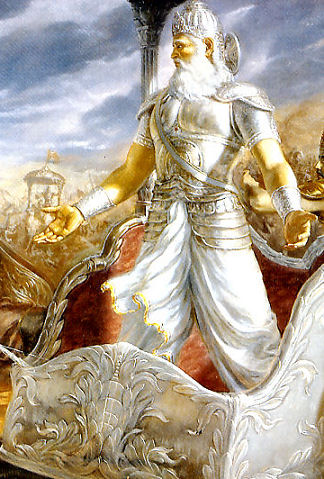
Bhishmadeva

Even a great fighter like Bhīṣma could not win the Battle of Kurukṣetra because the Lord wanted to show that vice cannot conquer virtue, regardless of who tries to execute it.

Srimad-Bhagavatam
By His Divine Grace A.C. Bhaktivedanta Swami Prabhupada

Canto 1″Creation”, Chapter 9, Text 16
The Passing Away of Bhismadeva in the Presence of Lord Krsna

na hy asya karhicid rājan
pumān veda vidhitsitam
yad vijijñāsayā yuktā
muhyanti kavayo ‘pi hi

na—never; hi—certainly; asya—His; karhicit—whatsoever; rājan—O King; pumān—anyone; veda—knows; vidhitsitam—plan; yat—which; vijijñāsayā—with exhaustive inquiries; yuktāḥ—being engaged; muhyanti—bewildered; kavayaḥ—great philosophers; api—even; hi—certainly.

O King, no one can know the plan of the Lord [Śrī Kṛṣṇa]. Even though great philosophers inquire exhaustively, they are bewildered.

The bewilderment of Mahārāja Yudhiṣṭhira over his past sinful acts and the resultant sufferings, etc., is completely negated by the great authority Bhīṣma (one of the twelve authorized persons). Bhīṣma wanted to impress upon Mahārāja Yudhiṣṭhira that since time immemorial no one, including such demigods as Śiva and Brahmā, could ascertain the real plan of the Lord. So what can we understand about it? More

108 Imporant Slokas from the 1972 Bhagavad-gita As It Is

Click on image to go to Post

Click on image to go to Post

The Hare Krishna Cookbook

Songs of the Vaisnava Acaryas

Bhagavad-gita As It Is 1972 Edition “Online”

click on image

click on image to visit site

Srimad Bhagavatam Online

click on image

Raja-Vidya the King of Knowledge

click on image

click on image

Blog Stats

  • 4,911,016 hits

Enter your email address to subscribe to this blog and receive notifications of new posts by email.

Join 3,888 other subscribers

Important Slokas from the Brahma-samhita

click on image

click on image

Slokas from the Sri Isopanisad

click on image

click on image

Prayers By Queen Kunti (Slokas)

click on image

Gajendra’s Prayers of Surrender (Slokas)

click on image

A Short Statement of the Philosophy of Krishna Consciousness

click on image

click on image

July 9th Letter

click on image

click on image

The Hare Krishna Explosion

Reference Material/Study Guide

click on image

click on image

  • LINKS