12 Jul 2014
by The Hare Krishna Movement
in A.C. Bhaktivedanta Swami Prabhupada, Nectar of Devotion, Nectar of Devotion
Tags: A.C. Bhaktivedanta Swami Prabhupada, Acyutananda, bhakti, bhakti means devotional service, Gurudas, Janaki, lecture on Nectar of Devotion, Malati, Mukunda, Nectar of Devotion, prabhupada, Srila Prabhupada, Syamasundara, Yamuna

click on image to enlarge
The Nectar of Devotion
given by His Divine Grace A. C. Bhaktivedanta Swami Prabhupada
Vṛndāvana, October 16, 1972
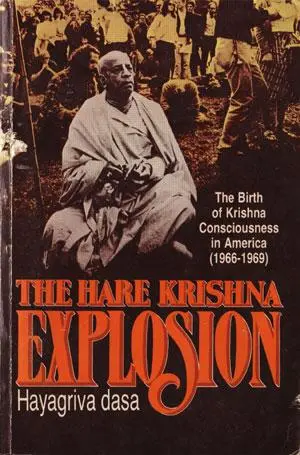
Pradyumna (reading): “The Nectar of Devotion is a summary study of Bhakti-rasāmṛta-sindhu, which was written in Sanskrit by Śrīla Rūpa Gosvāmī Prabhupāda. He was the chief of the six Gosvāmīs who were the direct disciples of Lord Caitanya Mahāprabhu. When he first met Lord Caitanya, Śrīla Rūpa Gosvāmī Prabhupāda was engaged as a minister in the Muhammadan government of Bengal. He and his brother Sanātana were then named Sākara Mallika and Dabira Khāsa respectively, and they held responsible posts as ministers of Nawab Hussain Shah. At that time, five hundred years ago, the Hindu society was very rigid and if a member of the brāhmaṇa caste accepted the service of a Muhammadan ruler he was at once rejected from brāhmaṇa society. That was the position of the two brothers, Dabira Khāsa and Sākara Mallika. They belonged to the highly situated sārasvata-brāhmaṇa…”
More
11 Jul 2014
by The Hare Krishna Movement
in A.C. Bhaktivedanta Swami Prabhupada, B. G. Sharma Art, Bhagavad-gita
Tags: A.C. Bhaktivedanta Swami Prabhupada, Arjuna, Bg2.10, Bg2.11, Bg2.12, bhagavad-gita, God, illusion, impersonal Brahman, individual soul, Krsna, maya, mayavadi theory, saintly persons, Sharaman, supreme authority, Supreme Lord, the blessed Lord said, The Krishna Art of B. G. Sharma

click on image to enlarge
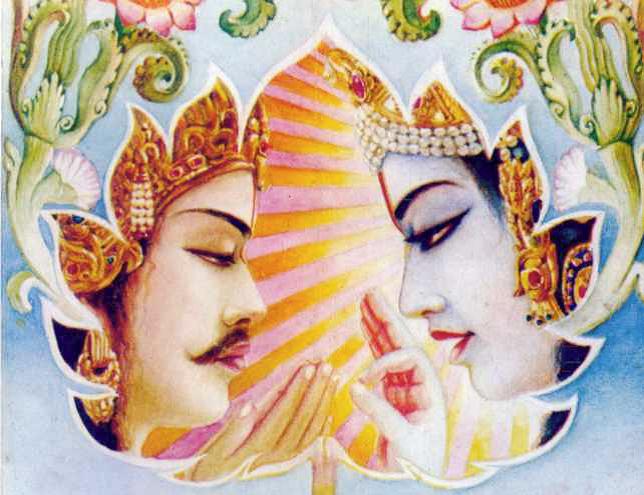
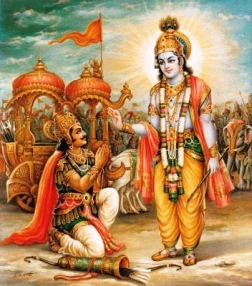
…at that time Kṛṣṇa, smiling, in the midst of both the armies, spoke the following words to the grief-stricken Arjuna.
The Blessed Lord said: While speaking learned words, you are mourning for what is not worthy of grief. Those who are wise lament neither for the living nor the dead.
Never was there a time when I did not exist, nor you, nor all these kings; nor in the future shall any of us cease to be. (Bg. 2.10-12)
Full text and purports More
10 Jul 2014
by The Hare Krishna Movement
in A.C. Bhaktivedanta Swami Prabhupada, Spiritual Master, Srila Prabhupada, Srimad Bhagavatam
Tags: A.C. Bhaktivedanta Swami Prabhupada, captain of the ship, good navigator, guru, human form of life, instructions of Krsna, mercy of Krsna, ocean of nescience, spiritual master, Srila Prabhupada, srila prabhupada's murti, strong boat
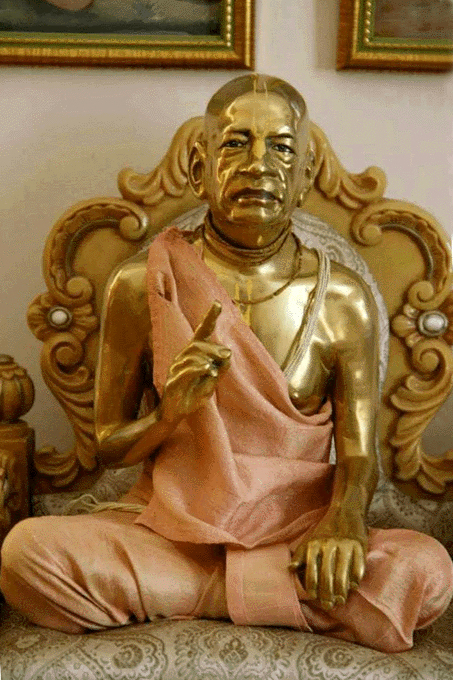
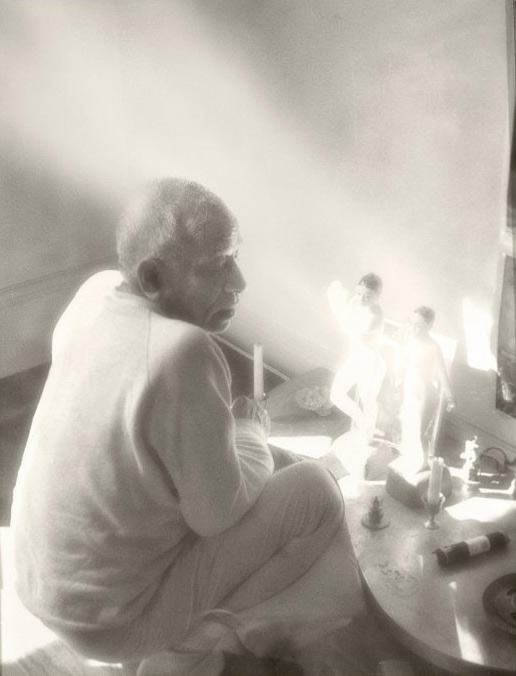
This morning I saw this image of Srila Prabhupada’s murti while I was surfing on Sampradaya Sun. I like it very much and just wanted to include it here on our page.
…When one wants to cross a large ocean, he requires a strong boat. It is said that this human form of life is a good boat by which one can cross the ocean of nescience. In the human form of life one can obtain the guidance of a good navigator, the spiritual master. One also gets a favorable wind by the mercy of Kṛṣṇa, and that wind is the instructions of Kṛṣṇa. The human body is the boat, the instructions of Lord Kṛṣṇa are the favorable winds, and the spiritual master is the navigator. The spiritual master knows well how to adjust the sails to catch the winds favorably and steer the boat to its destination. If, however, one does not take advantage of this opportunity, one wastes the human form of life. Wasting time and life in this way is the same as committing suicide.
More
09 Jul 2014
by The Hare Krishna Movement
in A.C. Bhaktivedanta Swami Prabhupada, Bhagavad-gita, Spiritual World, Vrindavan, Vrndavana
Tags: A.C. Bhaktivedanta Swami Prabhupada, abode of lord krsna, as it is, Bhagavad Gita, Goloka, goloka vrndavan, Krsna, sac-cid-ananda-vigraha, Spiritual Life, spiritual sky, Spiritual world, Syamasundara, Vrindavan, Vrndavana
click on image to enlarge
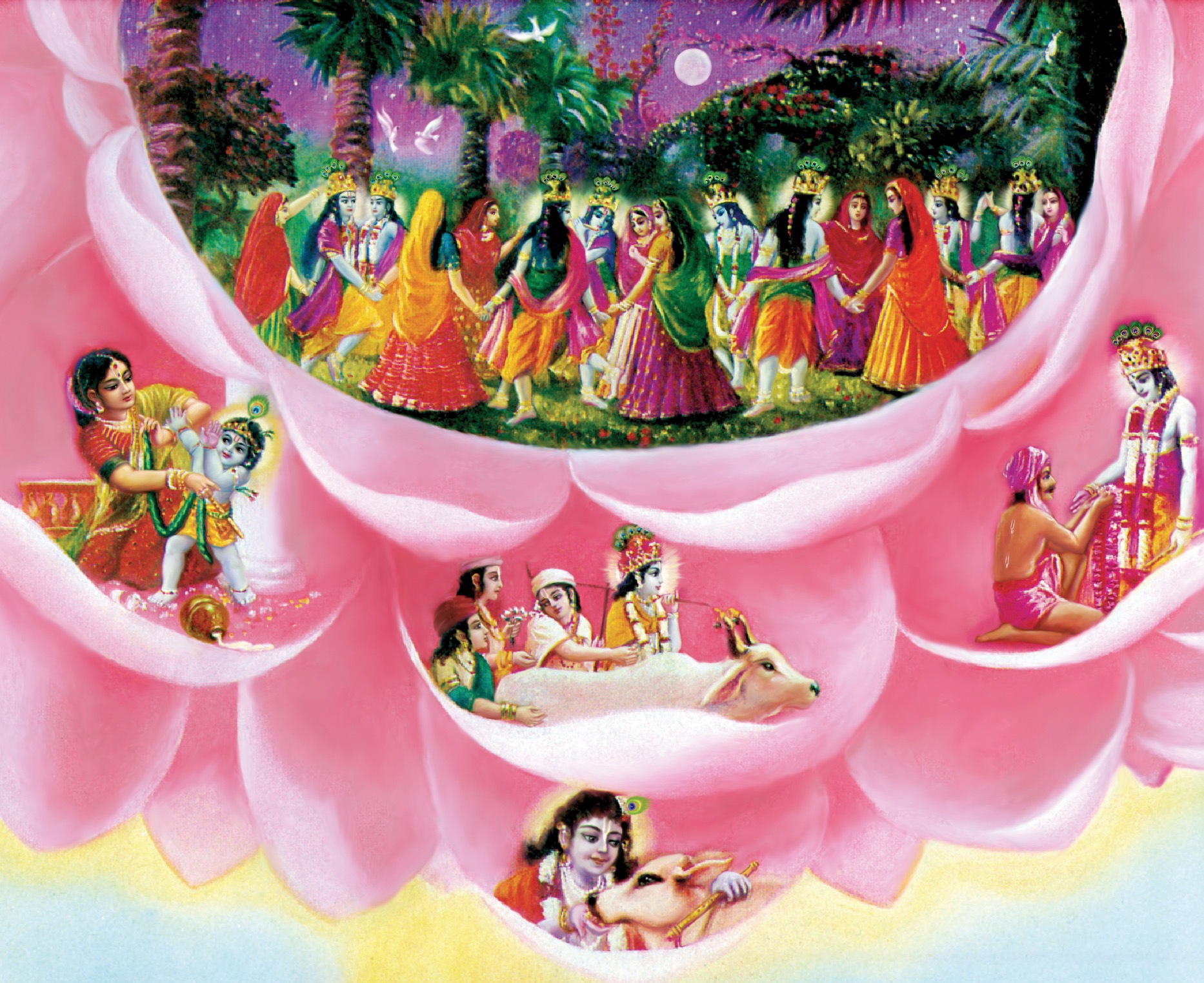
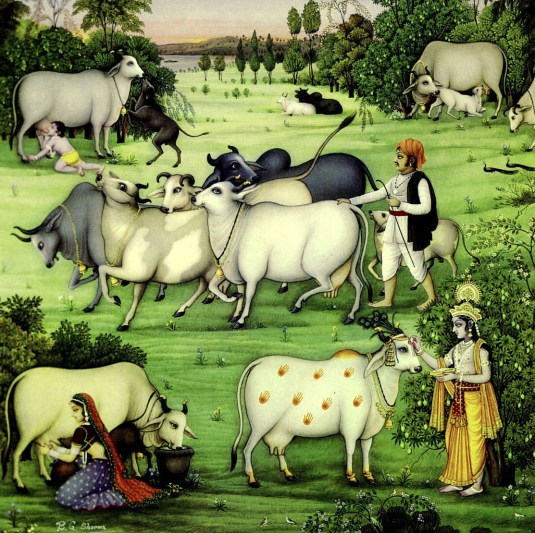
…The Lord descends to this mortal world to show His pastimes in Vṛndāvana, which are full of happiness. When Lord Śrī Kṛṣṇa was in Vṛndāvana, His activities with His cowherd boy friends, with His damsel friends, with the inhabitants of Vṛndāvana and with the cows were all full of happiness. The total population of Vṛndāvana knew nothing but Kṛṣṇa. But Lord Kṛṣṇa even discouraged His father Nanda Mahārāja from worshiping the demigod Indra because He wanted to establish the fact that people need not worship any demigod. They need only worship the Supreme Lord because their ultimate goal is to return to His abode. (from Introduction to the Bhagavad-gita As It Is)
More
06 Jul 2014
by The Hare Krishna Movement
in A.C. Bhaktivedanta Swami Prabhupada, Deity Worship, Letters by Srila Prabhupada
Tags: A.C. Bhaktivedanta Swami Prabhupada, heathenism, idol worship, installed deity, Krishna, Laksmi-Narayana, Letters by Srila Prabhupada, murtis, Radha Krishna deity, Radha-Krishna murtis, Radha-Krishna worship, regulative principles, Vrindaban

Deity Worship is so important to our preaching mission and the development of our Krsna consciousness, and there are so many letters written by Srila Prabhupada to his disciples explaining its importance. I have only posted just a very few letters here.
…Proper Deity worship, with all attention to cleanliness, is of the utmost importance. If you can please the Deity by your sincere service, then your temple will flourish. To be able to personally serve the Deity is a great privilege and such a person is very fortunate indeed. So you continue in this way and Krishna will surely bless you. (Letter to Hladini, Dec. 29, 1970)
I am very glad to learn that Harivilasa has given you a Pair of Radha Krishna Murtis, so it appears that Radha Krishna is very kind on you, because you went to Vrindaban, to live there but circumstantially, you could not live there, and you left. Krishna has given you New Vrindaban, as well as He has, out of His good will, He has come to you. It is very surprising. So please welcome the Deity and install Him in a nice throne. I think Vamanadeva will be able to prepare a nice throne, and you have seen the New York Deities’ dress and process of worship, so you can do in that way. There is nothing to be added new. The same principle should be followed, and the Deities should always be well-dressed in clothing and some ornaments and flowers and incense. The Deities should always be attractive. And the more we are engaged in decorating the Deities, washing the room, the more we are engaged in Deity worship, the more we become purified. That is practical. Brahmananda is also taking care of my Deity in New York, and he is practically experiencing and doing it. So if necessary you can take some information from him also. (Letter to Kirtananda, Sept 22, 1968)
…Actually, although Radha-Krishna is worshiped in Vrindaban which is like a simple village, but we worship Laksmi-Narayana, and the worship is accepted by the Radha-Krishna Deity. Actually, in our present status, we can not worship Radha-Krishna. But as all the Visnu Murtis are situated in Krishna, therefore, our Radha-Krishna worship is transferred to Visnu, Lord Narayana. Visnu worship is the regulative devotional principles, and Radha-Krishna worship is spontaneous service of eternal feelings. Therefore, as Laksmi-Narayana is the Deity of great opulences, similarly our Radha-Krishna Murtis also should be worshiped with great pomp and dignity. Krishna will give you the proper intelligence to do this very nicely. (Letter to Satsvarupa, Feb. 12, 1969)
… Our Deity worship is not heathenism. If we keep Forms of the Lord without worshiping the Deity under regulative principles, it will gradually turn into idol worship, which is an offense. The Deity of the Lord and the Lord Himself are identical. Krishna can act through the Deity perfectly. As I have given several times the example, the mailbox can act perfectly as the post office because it is authorized. Similarly, when the Deity is installed under authorized regulative principles, the Deity is as good as Krishna Himself. (Letter to Syamasundara, July 15, 1969)
Full Letters More
03 Jul 2014
by The Hare Krishna Movement
in A.C. Bhaktivedanta Swami Prabhupada, Lectures, Srimad Bhagavatam
Tags: A.C. Bhaktivedanta Swami Prabhupada, His messages, in everyones heart and the benefactor of the truthful, lecture on Bhagavatam, let them hear about Krsna, material enjoyment, Paramatma, Personality of Godhead, properly heard and chanted, Spiritual Life, Srila Prabhupada, srnvatam sva kathah, supersoul

click on image to enlarge
Just Give Them Chance to Hear About Krishna
I have not bribed these American and European boys to become Krishna conscious. I have no money. When I went to America, I had only seven dollars. One hour’s expenditure in New York. There is no question of bribing them. But they heard about Krishna. I was reading Bhagavad-gita on the street, in the park, and chanting. They heard, and they came to me. They became attracted. Why? (Srila Prabhupada)
Lecture by His Divine Grace A.C. Bhaktivedanta Swami Prabhupada
Srimad-Bhagavatam 1.2.17 Vrndavana, October 28, 1972
More
03 Jul 2014
by The Hare Krishna Movement
in A.C. Bhaktivedanta Swami Prabhupada, Demigod, Durga, Laksmi, Sarasvati, Srimad Bhagavatam, Uma
Tags: 1972 Edititon, A.C. Bhaktivedanta Swami Prabhupada, as it is, bhagavad-gita, demigods, God, goddess durga, goddess of fortune, goddess of learning, intelligence to see God, Laksmi, Lord Shiva, mother of the universe, Siva, Srimad Bhagavatam, Supreme Personality of Godhead, the Mother of the Universe, Uma the wife of Lord Shiva

Sarasvatī, the Goddess of Learning
click on image to enlarge
The other day I was doing some service at the Hare Krishna Temple here in New Vrindavan, West Virginia, and I ran into some Indian guests. After we greeted each other one of them asked me “when did you become a Hindu?” “I never became a Hindu” I replied, “I am a Hare Krishna devotee, a disciple of His Divine Grace A. C. Bhaktivedanta Swami Prabhupada. I am not a Hindu. I worship the Supreme Personality of Godhead Lord Kṛṣṇa.”
So just to make things a little clearer…both to myself and others, I did some research from Srila Prabhupada’s books to find the proper understanding of Goddess Worship, or worship of the demigods.
…Worship of demigods is discouraged herein because even the greatest demigods like Brahmā and Śiva only represent part of the opulence of the Supreme Lord. (Bg 10.42)
…The goddess of fortune, Lakṣmī, and all-powerful demigods like Brahmā and Śiva are engaged in the worship of Viṣṇu or Lord Kṛṣṇa; therefore who can be more powerful than Mukunda (Lord Kṛṣṇa) to be factually called the Supreme Personality of Godhead? The goddess of fortune, Lakṣmījī, Lord Brahmā and Lord Śiva are not independently powerful; they are powerful as expansions of the Supreme Lord, and all of them are engaged in the transcendental loving service of the Lord, and so also are the living entities. (from purport SB 1.18.21)
…Both the living entity and the demigods are subordinate to the will of the Supreme Personality of Godhead…not a blade of grass moves without the will of the Supreme Personality of Godhead. Generally, persons who are distressed in the material world go to the demigods, as they are advised in the Vedic literature. A person wanting some particular thing may worship such and such a demigod. For example, a diseased person is recommended to worship the sun-god; a person wanting education may worship the goddess of learning, Sarasvatī; and a person wanting a beautiful wife may worship the goddess Umā, the wife of Lord Śiva. In this way there are recommendations in the śāstras (Vedic scriptures) for different modes of worship of different demigods. And because a particular living entity wants to enjoy a particular material facility, the Lord inspires him with a strong desire to achieve that benediction from that particular demigod, and so he successfully receives the benediction. The particular mode of the devotional attitude of the living entity toward a particular type of demigod is also arranged by the Supreme Lord. The demigods cannot infuse the living entities with such an affinity, but because He is the Supreme Lord or the Supersoul who is present in the heart of all living entities, Kṛṣṇa gives impetus to man to worship certain demigods. (from purport Bg 7.21)
…Everyone thinks that his intelligence is perfect. Sometimes one employs his intelligence in the worship of Umā, the wife of Lord Śiva, in order to obtain a beautiful wife. Sometimes, when one wants to become as learned as Lord Brahmā, he employs his intelligence in the worship of the goddess of learning, Sarasvatī. Sometimes, when one wishes to become as opulent as Lord Viṣṇu, he worships the goddess of fortune, Lakṣmī.
Intelligence should be employed in the service of the Supreme Personality of Godhead. As soon as one uses his intelligence in this way, the goddess of fortune automatically becomes favorable to him. The goddess of fortune, Lakṣmī, never remains without her husband, Lord Viṣṇu. Consequently, when one worships Lord Viṣṇu he automatically obtains the favor of the goddess of fortune. (from purport SB 4.25.28)
Full text and purports from above excerpts More
01 Jul 2014
by The Hare Krishna Movement
in A.C. Bhaktivedanta Swami Prabhupada, Bhagavad-gita, Bhagavad-gita, Krsna Consciousness, Lectures
Tags: A.C. Bhaktivedanta Swami Prabhupada, as it is, Bg 9.34, bhagavad-gita, economically, God, God's party, Just always think of Me, just worship Me, krsna consciousness, lectures on Bhagavad gita, man-mana bava mad-bhakto, materialists, political field, politically, socially or religiously, spiritualism, spiritualists
Engage your mind always in thinking of Me, offer obeisances and worship Me. Being completely absorbed in Me, surely you will come to Me. (Bg 9.34)
This is perhaps my favorite sloka from the Bhagavad-gita As It Is. “Always think of Me”, this for me is the essence of Krsna consciousness. Srila Prabhupada once said that “Krsna consciousness is so simple, you can miss it”. Thinking of Krsna, is Krsna consciousness. We have posted one of two lectures Srila Prabhupada gave on this very important verse.
Bhagavad-gītā Lecture 9.34
By His Divine Grace A. C. Bhaktivedanta Swami Prabhupada
New York, December 26, 1966
Prabhupāda:
man-manā bhava mad-bhakto
mad-yājī māṁ namaskuru
mām evaiṣyasi yuktvaivam
ātmānaṁ mat-parāyaṇaḥ
[Bg. 9.34]
This śloka, this verse we have already finished. The conclusion of the Ninth Chapter of Śrīmad Bhagavad-gītā, that, the Lord says that, man-manā bhava mad-bhaktaḥ. “Just always think of Me. Just become My devotee. And, if you want to worship, just worship Me.”
Full Lecture More
29 Jun 2014
by The Hare Krishna Movement
in A.C. Bhaktivedanta Swami Prabhupada, Caaitanya-caritamrta, Sri Caitanya-Caritamrta, Srimati Radharani, Vaisnava Vocabulary
Tags: A.C. Bhaktivedanta Swami Prabhupada, ananda, aradhana, blissfulness, cit, devi, gopis The Supreme Personality of Godhead, His devotees, hladini, hladini energy, hladini-shakti, hlādinī—pleasure potency, krsna mayi, Krsna pleasure, lovely abode of Lord Krsna, pleasure potency, Radha Radhika, resplendent and most beautiful, sat, sat cit ananda, worship

click on image to enlarge
This morning there was this nagging voice that kept saying “read Adi-lila chapter 4, of the Sri Caitanya-caritamrta” I haven’t read from the Caitanya-caritamrta for a while because I was re-reading the Bhagavad-gita and Krsna Book and because it is summer, I am busy with work. But today is Sunday and my time is a bit more relaxed. So I responded to the nagging voice…and pulled Vol. 1 from the shelf. As I read I became more and more enlivened and the words jumped out at me…. Śrīmatī Rādhārāṇī, who is the attraction for the all-attractive. What is attracting the All Attractive? Srimati Radharani!
And the other thing that jumped out at me was the word hlādinī. Here is another word for your vaishnava vocabulary. So today is a two part post from the Sri Caitanya-caritamrta, describing the hladini energy, and the attractiveness of Srimati Radharani.
Lord Kṛṣṇa enchants the world, but Śrī Rādhā enchants even Him. Therefore She is the supreme goddess of all. (Adi 4.95)
Śrī Rādhā is the full power, and Lord Kṛṣṇa is the possessor of full power. The two are not different, as evidenced by the revealed scriptures. (Adi 4.96)
Śrīmatī Rādhārāṇī is as fully spiritual as Kṛṣṇa. No one should consider Her to be material. She is definitely not like the conditioned souls, who have material bodies, gross and subtle, covered by material senses. She is all-spiritual, and both Her body and mind are of the same spiritual embodiment. Because Her body is spiritual, Her senses are also spiritual. Thus Her body, mind and senses fully shine in love of Kṛṣṇa. She is the personified hlādinī-śakti (the pleasure-giving energy of the Lord’s internal potency), and therefore She is the only source of enjoyment for Śrī Kṛṣṇa.
Śrī Kṛṣṇa cannot enjoy anything that is internally different from Him. Therefore Rādhā and Śrī Kṛṣṇa are identical. The sandhinī portion of Śrī Kṛṣṇa’s internal potency has manifested the all-attractive form of Śrī Kṛṣṇa, and the same internal potency, in the hlādinī feature, has presented Śrīmatī Rādhārāṇī, who is the attraction for the all-attractive. No one can match Śrīmatī Rādhārāṇī in the transcendental pastimes of Śrī Kṛṣṇa. (from purport Adi 4.71)
…All the desires of Lord Kṛṣṇa rest in Śrīmatī Rādhārāṇī. (from purport)
Some notes on the hlādinī potency More
27 Jun 2014
by The Hare Krishna Movement
in A.C. Bhaktivedanta Swami Prabhupada, Krishna Nectar, Krsna Consciousness
Tags: A.C. Bhaktivedanta Swami Prabhupada, celebrated flute, cowherd boys, friends of krsna, Krishna, Krsna, remembrance of Lord Krsna, SB 3.2.27, Srimad Bhagavatam, Third Canto, transcendental flute, transcendental pleasure, Yamuna river
click on image to enlarge
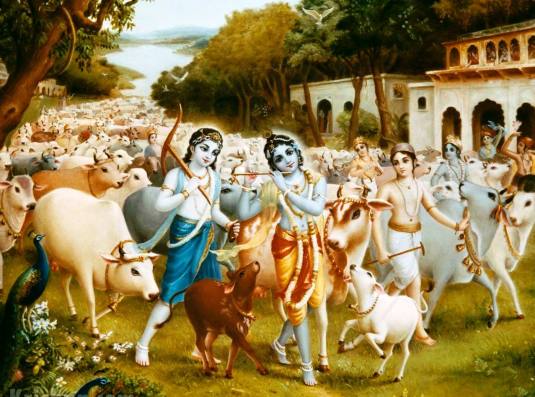
This morning I was reading from the Srimad Bhagavatam Third Canto, Chapter Two. It was so enlivening, that I read out-loud, the entire chapter. The following is just three verses and purports from the chapter entitled ” Remembrance of Lord Kṛṣṇa”.
In His childhood, the Almighty Lord was surrounded by cowherd boys and calves, and thus He traveled on the shore of the Yamunā River, through gardens densely covered with trees and filled with vibrations of chirping birds. (SB 3.2.27)
…the Lord used to play His celebrated flute. The sound vibrated by His flute would give His friends such transcendental pleasure that they would forget all the talks of the brahmānanda which is so praised by the impersonalists. These cowherd boys, as will be explained by Śukadeva Gosvāmī, were living entities who had accumulated heaps of pious acts and thus were enjoying with the Lord in person and were hearing His transcendental flute. The Brahma-saṁhitā (5.30) confirms the Lord’s blowing His transcendental flute. (from purport to SB 3.2.29)
veṇuṁ kvaṇantam aravinda-dalāyatākṣaṁ
barhāvataṁsam asitāmbuda-sundarāṅgam
kandarpa-koṭi-kaminīya-viśeṣa-śobhaṁ
govindam ādi-puruṣaṁ tam ahaṁ bhajāmi
Brahmājī said, “I worship Govinda, the primeval Lord, who plays on His transcendental flute. His eyes are like lotus flowers, He is decorated with peacock plumes, and His bodily color resembles a fresh black cloud although His bodily features are more beautiful than millions of cupids.” These are the special features of the Lord.
More
25 Jun 2014
by The Hare Krishna Movement
in A.C. Bhaktivedanta Swami Prabhupada, Primeval
Tags: A.C. Bhaktivedanta Swami Prabhupada, ancient, antediluvian, Bg. 2.20, bhagavad-gita, earliest, first, having existed from the beginning, history of the world, original, prehistoric, primeval, primeval forest, primordial, primordial forms of life, primordial matter, pristine, virgin

This morning I was reading from the Bhagavad-gita As It Is 1972 Edition by His Divine Grace A. C. Bhaktivedanta Swami Prabhupada, and for the thousandth time I read the word “primeval”, as in the following verse; “For the soul there is never birth nor death. Nor, having once been, does he ever cease to be. He is unborn, eternal, ever-existing, undying and primeval. He is not slain when the body is slain” (Bg 2.20). I always figured that I understood that word ‘primeval’ and never felt the need to look it up. But this morning I paused and asked myself “what is primeval?” I really didn’t know. So that is the basis for todays post.
Definition, examples More
16 Jun 2014
by The Hare Krishna Movement
in A.C. Bhaktivedanta Swami Prabhupada, Patanjali Muni, Yoga
Tags: A.C. Bhaktivedanta Swami Prabhupada, monist, Patanjali Muni, patanjali system, Patanjali system of yoga, patanjali yoga sutras, samadhi, superself, theory of oneness, trance, transcendental pleasure, yoga, yoga practice, yoga principle, yogi

This morning my body was stiff when I woke from sleep, as I have been working rather hard lately, and I thought that I would do my morning Yoga out on the deck as the Sun was rising. Going through all the different asanas, my mind was thinking about the actual meaning of the word yoga (union with God). So after my shower I opened the Bhagavad-gita As It Is and read chapter six entitled “Sankhya-yoga”.
I guess you could say I felt some pleasure while performing my hatha-yoga asanas, as the stiffness left my body and blood circulation returned, and then from my reading I could understand that this was understandable and acceptable.
…There is an acceptance of transcendental pleasure in the Patañjali system, but the monists do not accept this transcendental pleasure out of fear of jeopardizing the theory of oneness. The duality of knowledge and knower is not accepted by the nondualist, but in this verse transcendental pleasure—realized through transcendental senses—is accepted. And this is corroborated by the Patañjali Muni, the famous exponent of the yoga system. The great sage declares in his Yoga-sūtras: puruṣārtha-śūnyānāṁ guṇānāṁ pratiprasavaḥ kaivalyaṁ svarūpa-pratiṣṭhā vā citi-śaktir iti.
This citi-śakti, or internal potency, is transcendental. Puruṣārtha means material religiosity, economic development, sense gratification and, at the end, the attempt to become one with the Supreme. This “oneness with the Supreme” is called kaivalyam by the monist. But according to Patañjali, this kaivalyam is an internal, or transcendental, potency by which the living entity becomes aware of his constitutional position. In the words of Lord Caitanya, this state of affairs is called ceto-darpaṇa-mārjanam, or clearance of the impure mirror of the mind. This “clearance” is actually liberation, or bhava-mahādāvāgni-nirvāpaṇam. The theory of nirvāṇa—also preliminary—corresponds with this principle. In the Bhāgavatam this is called svarūpeṇa vyavasthitiḥ. The Bhagavad-gītā also confirms this situation in this verse. (from purport to Bg. 6.20-23)
Maybe I just use the philosophy to justify my enjoyment of yoga-asanas, or perhaps controlling the mind, body and senses, is the preliminary path leading to liberation, freedom from all miseries.
As a lamp in a windless place does not waver, so the transcendentalist, whose mind is controlled, remains always steady in his meditation on the transcendent Self. (Bg. 6.19)

The stage of perfection is called trance, or samādhi, when one’s mind is completely restrained from material mental activities by practice of yoga. This is characterized by one’s ability to see the self by the pure mind and to relish and rejoice in the self. In that joyous state, one is situated in boundless transcendental happiness and enjoys himself through transcendental senses. Established thus, one never departs from the truth, and upon gaining this he thinks there is no greater gain. Being situated in such a position, one is never shaken, even in the midst of greatest difficulty. This indeed is actual freedom from all miseries arising from material contact.
(Bg. 6.20-23)
More
15 Jun 2014
by The Hare Krishna Movement
in A.C. Bhaktivedanta Swami Prabhupada, Bhagavad-gita, Father, Letters by Srila Prabhupada
Tags: A.C. Bhaktivedanta Swami Prabhupada, disciplic succession, eternal father, father, fathers, Fathers day, God, Krishna, Krsna, original father, spiritual master, supreme father
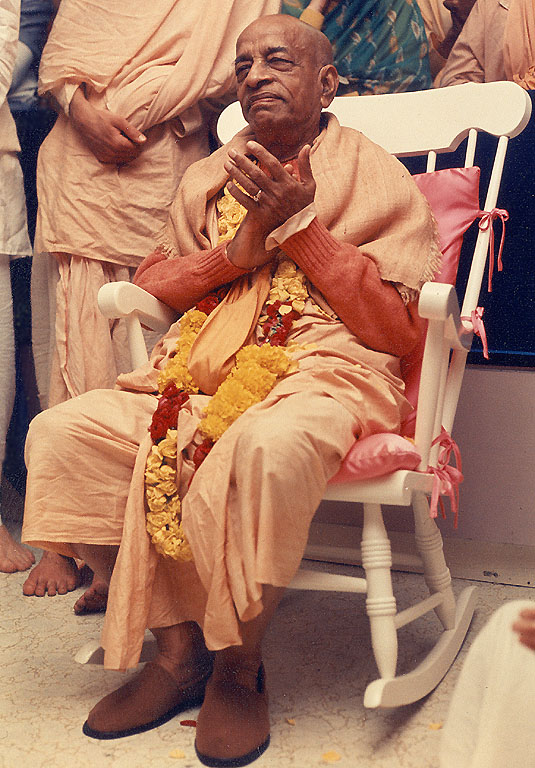
Here in the West people are celebrating Fathers day. So today we honor our our Father with some quotes on Father.
…To accept Kṛṣṇa as father means “My father is there. I have no anxiety.” (Morning Walk — April 26, 1976, Melbourne)
…I am your Spiritual Father, and Krishna is your Spiritual Husband. A girl can never forget either her father or her husband.
(Letter to Jadurani — Stinson Beach, Calif 8 July, 1967)
…The Lord is very kind to the living entities because they are His sons. Lord Kṛṣṇa declares in Bhagavad-gītā, “sarva-yoniṣu…ahaṁ bīja-pradaḥ pitā.” “I am the father of all.”
You are the father of this complete cosmic manifestation, the worshipable chief, the spiritual master. No one is equal to You, nor can anyone be one with You. Within the three worlds, You are immeasurable.
You are the Supreme Lord, to be worshiped by every living being. Thus I fall down to offer You my respects and ask Your mercy. Please tolerate the wrongs that I may have done to You and bear with me as a father with his son, or a friend with his friend, or a lover with his beloved. (Bg 11. 43-44)
More
14 Jun 2014
by The Hare Krishna Movement
in A.C. Bhaktivedanta Swami Prabhupada, Demigod, Demons, Devaki
Tags: A.C. Bhaktivedanta Swami Prabhupada, Anantadeva, Baladeva, demigods, Devaki, devaki's womb, Garbha-stuti prayers, Jarasandha, Kamsa, Lord Krsna, saktas, Sankarsana, Srimad Bhagavatam, Vaisnavas, yogamaya

click on image for full size resolution
This morning I was reading Chapter Two in the Krsna Book, the chapter entitled “Prayers by the Demigods for Lord Kṛṣṇa in the Womb” and I was reminded of this above image from the Tenth Canto of Srimad Bhagavatam, that I like very much. So I thought I would share this image with you, along with the brief chapter description. Hare Krishna!
…when the Supreme Personality of Godhead entered the womb of Devakī to kill Kaṁsa, all the demigods understood that the Lord was living within Devakī’s womb, and therefore in veneration they offered Him the Garbha-stuti prayers. (from chapter description SB 10.2)
More
13 Jun 2014
by The Hare Krishna Movement
in Back to Godhead, Cow Protection, Taru das
Tags: A.C. Bhaktivedanta Swami Prabhupada, Back to Godhead Magazine, BTG, bull as father and symbol of religion, bull protection, cow protection, devotional service, farming for Krsna, Farms, gigantic industrial enterprises, godless civilization, Kirtananda Swami, Krsna conscious farming communities, oxen, Srila Prabhupada

Farming With Krsna in Mind
Excerpted from Back to Godhead Magazine Vol. 12, No. 11 1977
I just spent the day here at New Vrindavan farm community, discussing plans for the future cow protection program, which will include an Ox barn and training for teams of young oxen, for use in plowing, wood harvesting, and pulling carts and wagons. It was all very inspiring and I am very much eger to become more deeply involved in this important aspect of our philosophy. Personally I have plans to work with some young oxen, build an ox cart, and put them to work. What is that saying…”when the father is employed the family will prosper”…so it is time to engage the bulls in some meaningful activity so the family will prosper and they will become joyful once again.
With this idea in mind, we post this older article from the Back to Godhead Magazine.
“Naturally, cow protection includes bull protection. The bull is our father and the symbol of religion. At present a few boys are working the oxen and hauling wood, plowing fields, and cutting hay. Of course, we do have tractors, but we want to develop skill working the oxen. They are our future.”
“Human prosperity flourishes by natural gifts, and not by gigantic industrial enterprises, “says His Divine Grace A.C. Bhaktivedanta Swami Prabhupada, who has founded many Krsna-conscious farming communities all over the world. “The gigantic industrial enterprises are products of a godless civilization, and they cause the destruction of the noble aims of human life…. What we need, therefore, is to be obedient to the laws of the Lord and achieve the perfection of human life by devotional service to Him. “Here’s a look at two ‘ ISKCON farms in action.
More
09 Jun 2014
by The Hare Krishna Movement
in A.C. Bhaktivedanta Swami Prabhupada, Bhagavad-gita, Devotional Service, Dharma, Spiritual Life
Tags: A.C. Bhaktivedanta Swami Prabhupada, active state, Bhagavad Gita, devotee as a conjugal lover, devotee as friend, devotee as parent, devotional service, eternal relationship with the Lord, passive state, relationship, svarupa, transcendental friendship

click on image to enlarge
I have always loved this picture since the first time I opened the Bhagavad-gita some 42 years ago. It is a beautiful image of life in the Spiritual Sky, and also, it is a nice graphic description of the 5 types of relationships one can have with the Supreme Lord. The following is a short description, from the Introduction to the Bhagavad-gita As It Is, about the eternal nature, and the 5 types of relationships on can have with the Lord.
…In this material world we find that everything is temporary. It comes into being, stays for some time, produces some by-products, dwindles and then vanishes. That is the law of the material world, whether we use as an example this body, or a piece of fruit or anything. But beyond this temporary world there is another world of which we have information. This world consists of another nature which is sanātana, eternal. Jīva is also described as sanātana, eternal, and the Lord is also described as sanātana in the Eleventh Chapter. We have an intimate relationship with the Lord, and because we are all qualitatively one—the sanātana-dhāma, or sky, the sanātana Supreme Personality and the sanātana living entities—the whole purpose of Bhagavad-gītā is to revive our sanātana occupation, or sanātana-dharma, which is the eternal occupation of the living entity. We are temporarily engaged in different activities, but all of these activities can be purified when we give up all these temporary activities and take up the activities which are prescribed by the Supreme Lord. That is called our pure life.
…That destination is called the sanātana sky, the eternal spiritual sky. (from Introduction to Bhagavad-gita As It Is)
More
08 Jun 2014
by The Hare Krishna Movement
in A.C. Bhaktivedanta Swami Prabhupada, Balarama, Krishna, Krishna Consciousness, Krishna Nectar, KRSNA The Supreme Personality of Godhead, Krsna-katha
Tags: A.C. Bhaktivedanta Swami Prabhupada, Balarama, gopis, Krishna, Krsna, Krsna and Balarama, krsna and balarama nectar, Krsna's flute, land of vrndavana, pastimes of krsna and balarama, pastimes of krsna and balarama in the forest of vrndavan, Rama, Spiritual Life, Vrndavan

When I saw this beautiful image of Krsna and Balarama, my mind immediately went to the Krsna Book. So I pulled out some of the pastimes of the two transcendental brothers to share with you today.
…Accompanied by the cowherd boys and Balarāma, Kṛṣṇa brought forward the cows and played on His flute through the forest of Vṛndāvana, which was full of flowers, vegetables, and pasturing grass. The Vṛndāvana forest was as sanctified as the clear mind of a devotee and was full of bees, flowers and fruits. There were chirping birds and clear water lakes with waters that could relieve one of all fatigues. Sweet flavored breezes blew always, refreshing the mind and body. Kṛṣṇa, with His friends and Balarāma, entered the forest and, seeing the favorable situation, enjoyed the atmosphere to the fullest extent. Kṛṣṇa saw all the trees, overloaded with fruits and fresh twigs, coming down to touch the ground as if welcoming Him by touching His lotus feet. He was very pleased by the behavior of the trees, fruits and flowers, and He began to smile realizing their desires. (Chapter 15 Killing of Dhenukasura)
…One day, when Kṛṣṇa, along with Balarāma, was maintaining the calves in the forest, They saw some cows grazing on the top of Govardhana Hill. The cows could see down into the valley where the calves were being taken care of by the boys. Suddenly, on sighting their calves, the cows began to run towards them. They leaped downhill with joined front and rear legs. The cows were so melted with affection for their calves that they did not care about the rough path from the top of Govardhana Hill down to the pasturing ground. They began to approach the calves with their milk bags full of milk, and they raised their tails upwards. When they were coming down the hill, their milk bags were pouring milk on the ground out of intense maternal affection for the calves, although they were not their own calves. These cows had their own calves, and the calves that were grazing beneath Govardhana Hill were larger; they were not expected to drink milk directly from the milk bag but were satisfied with the grass. Yet all the cows came immediately and began to lick their bodies, and the calves also began to suck milk from the milk bags. There appeared to be a great bondage of affection between the cows and calves. (Chapter 13 The Stealing of the Boys and Calves by Brahma)
…Kṛṣṇa was very pleased with the atmosphere of the forest where flowers bloomed and bees and drones hummed very jubilantly. While the birds, trees and branches were all looking very happy, Kṛṣṇa, tending the cows, accompanied by Śrī Balarāma and the cowherd boys… (Chapter 21 The Gopīs Attracted by the Flute)
More
07 Jun 2014
by The Hare Krishna Movement
in A.C. Bhaktivedanta Swami Prabhupada, Dream, Srila Prabhupada's Books, Uncategorized
Tags: A.C. Bhaktivedanta Swami Prabhupada, awakenes to discover the self, deep sleep, dreaming, dreams, human form of life, Krsna, Le Reve, original creator, Srimad Bhagavatam, Supreme Lord, The Dream, The Supreme Personality of Godhead, The Wynn, vasudevah sarvam, wynn las vegas, Wynn theater

Recently we were in Las Vegas for a wedding celebration, and after dinner we went to the show “Le Reve” at the Wynn. “Le Reve” is French for; “The Dream”. It was the most amazing theatrical performance we have seen in years. My mind was swept away by the magnificence of the production, and it was in fact, dream-like. I was transported to another dimension; phantasmagoria. A.C. Bhaktivedanta Swami uses this word in his books, to describe the dream-like nature of this material world.
I would highly recommend seeing Le Reve at the Wynn, if you are in Las Vegas, and as always…recommend reading the books by His Divne Grace A. C. Bhaktivedanta Swami Prabhupada for further advancement and enlightenment in life.
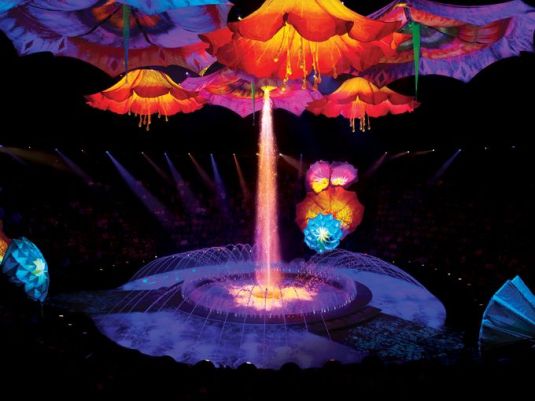
When a person is in deep sleep, he dreams and sees in himself many other objects, such as great mountains and rivers or perhaps even the entire universe, although they are far away. Sometimes when one awakens from a dream he sees that he is in a human form, lying in his bed in one place. Then he sees himself, in terms of various conditions, as belonging to a particular nationality, family and so on. All the conditions of deep sleep, dreaming and wakefulness are but energies of the Supreme Personality of Godhead. One should always remember the original creator of these conditions, the Supreme Lord, who is unaffected by them. (SB 6.16.53-54_
More
06 Jun 2014
by The Hare Krishna Movement
in A.C. Bhaktivedanta Swami Prabhupada, Bhagavad-gita, Bhagavad-gita As It Is 1972 Edition
Tags: A.C. Bhaktivedanta Swami Prabhupada, back home, back to Godhead, conditioned souls, essence of bhagavad gita, eternal relationship with the Supreme Lord, Krishna and Arjuna, Krsna, Krsnaloka planet, spiritual existence, spiritual personality, spiritual sky, Supreme Personality of Godhead
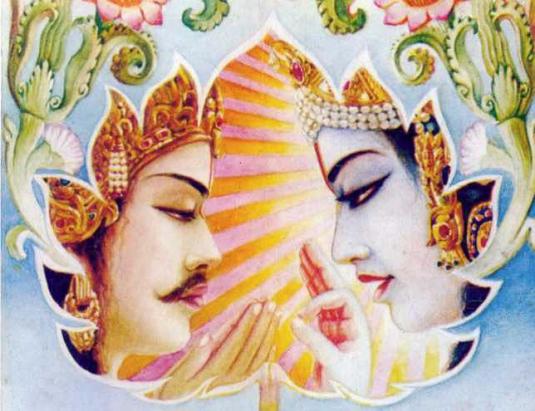
Sometimes when reading the Bhagavad-gita As It Is by His Divine Grace A. C. Bhaktivedanta Swami Prabhupada, a verse or purport will just jump out at me, as it did this morning. No matter how many times I read the Bhagavad-gita, because it is transcendental literature, it is everfresh and new. Every reading has new and deeper realizations…as was the case with this important verse and purport.
My dear Arjuna, one who is engaged in My pure devotional service, free from the contaminations of previous activities and from mental speculation, who is friendly to every living entity, certainly comes to Me. (Bg 11.55)
Anyone who wants to approach the Supreme of all the Personalities of Godhead, on the Kṛṣṇaloka planet in the spiritual sky, and be intimately connected with the Supreme Personality, Kṛṣṇa, must take this formula, as is stated by the Supreme Himself. Therefore, this verse is considered to be the essence of Bhagavad-gītā. The Bhagavad-gītā is a book directed to the conditioned souls, who are engaged in the material world with the purpose of lording it over nature and who do not know of the real, spiritual life. The Bhagavad-gītā is meant to show how one can understand his spiritual existence and his eternal relationship with the Supreme Spiritual Personality and to teach one how to go back home, back to Godhead. Now here is the verse which clearly explains the process by which one can attain success in his spiritual activity: devotional service….
More
27 May 2014
by The Hare Krishna Movement
in A.C. Bhaktivedanta Swami Prabhupada, Lectures, Wedding Ceremony
Tags: A.C. Bhaktivedanta Swami Prabhupada, devotees, Hamsaduta, Hare Krishna wedding, Himavati, Krsna consciousness movement, prabhupada, Rukmini, Satsvarupa, vedic wedding, wedding ceremony, wedding peformed by prabhupada

click on image to enlarge
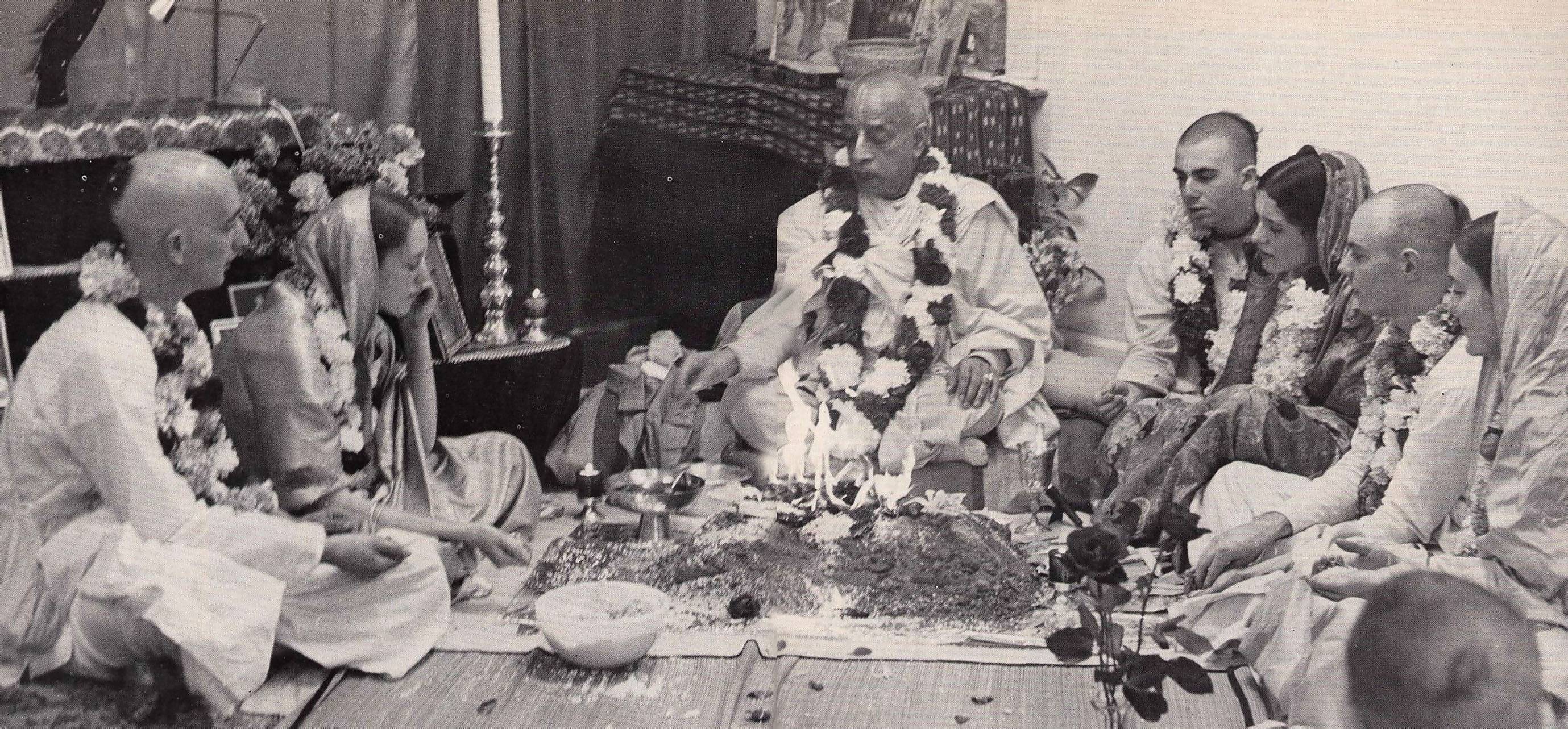
Wedding Ceremony and Lecture
given by His Divine Grace A. C. Bhaktivedanta Swami Prabhupada
Boston, May 6, 1969
More
Previous Older Entries Next Newer Entries