05 Nov 2014
by The Hare Krishna Movement
in A.C. Bhaktivedanta Swami Prabhupada, Damodara, Kartika, KRSNA The Supreme Personality of Godhead
Tags: A.C. Bhaktivedanta Swami, A.C. Bhaktivedanta Swami Prabhupada, brahmanas, gopis, handcart, hither and thither, Krishna, Krishna's childhood pastimes, Krsna, Nanda Maharaja, Supreme Personality of Godhead, Vedic hymns, Yasoda, YMother Yasoda

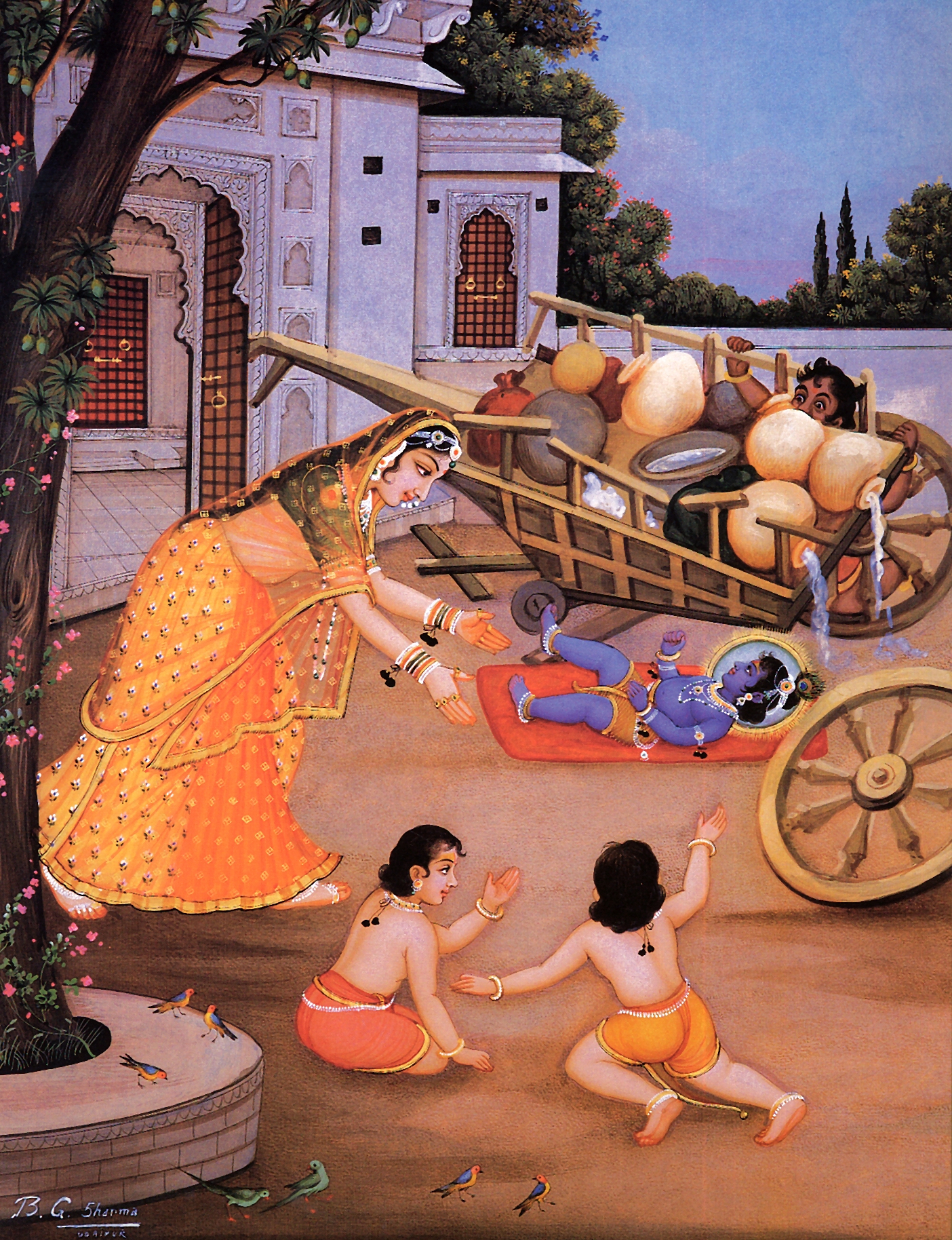
Continuining our month long attempt to stay focused on the childhood pastimes of Krsna, during this month of Damodara (Kartika), we bring you another exciting chapter from; Kṛṣṇa, the Supreme Personality of Godhead. Today we are posting the chapter entitled “The Salvation of Tṛṇāvarta”.
…Baby Kṛṣṇa had been placed underneath a hand-driven cart, and while He was kicking His legs, He accidentally touched the wheel of the cart, and it collapsed. Various kinds of utensils and brass and metal dishes had been piled up in the handcart, and they all fell down with a great noise. The wheel of the cart separated from the axle, and the spokes of the wheel were all broken and scattered hither and thither. Mother Yaśodā and all the gopīs, as well as Mahārāja Nanda and the cowherd men, were astonished as to how the cart could have collapsed by itself.
…If someone takes advantage of hearing the pastimes of the Lord, the material contamination of dust, accumulated in the heart due to long association with material nature, can be immediately cleansed. Lord Caitanya also instructed that simply by hearing the transcendental name of Lord Kṛṣṇa, one can cleanse the heart of all material contamination. There are different processes for self-realization, but this process of devotional service–of which hearing is the most important function–when adopted by any conditioned soul, will automatically cleanse him of the material contamination and enable him to realize his real constitutional position. (Kṛṣṇa, the Supreme Personality of Godhead)
Full Chapter More
25 Oct 2014
by The Hare Krishna Movement
in A.C. Bhaktivedanta Swami Prabhupada, Damodara, Gopis, Srimad Bhagavatam
Tags: A.C. Bhaktivedanta Swami Prabhupada, affection of the gopis, damsels of Vraja, ecstasy, gopis, Krsna, Lord Krsna, remembrance of Lord Krsna, SB3.2.14, Srimad Bhagavatam, transcendental love, Vrndavana

click on image to enlarge
In our attempt to stay focused on the childhood pastimes of Lord Krsna throughout this month of Damodara, we were reading from the Third Canto of the Srimad-Bhagavatam, chapter 2, entitled; “Remembrance of Lord Kṛṣṇa”. The great devotee Uddhava, was asked by Vidura, to speak on the messages of Lord Krsna. The following is but one of the verses and purports from this famous chapter.
…In His boyhood at Vṛndāvana, Lord Kṛṣṇa was notorious as a teasing friend in transcendental love to all the girls His age. His love for them was so intense that there is no comparison to that ecstasy, and the damsels of Vraja were so much attached to Him that their affection excelled that of the great demigods like Brahmā and Śiva. Lord Kṛṣṇa finally admitted His defeat before the transcendental affection of the gopīs and declared that He was unable to repay them for their unalloyed affection. (from purport to SB 3.2.14)
Full text and purport More
20 Oct 2014
by The Hare Krishna Movement
in A.C. Bhaktivedanta Swami Prabhupada, B. G. Sharma Art, Childhood Pastimes of Krsna, Kartika, Krishna Consciousness, KRSNA The Supreme Personality of Godhead, Nalakuvara and Manigriva
Tags: A.C. Bhaktivedanta Swami Prabhupada, art of B.B. Sharma, B.G. Sharma, demigods, ecstatic love, Gokula, Krishna's childhood pastimes, Krsna, Krsna The Supreme Personality of Godhead, liberated, Lord Krsna, lotus feet of the Lord, Mother Yasoda, Nalakurvara and Manigriva, Narada Muni, ropes of Yasoda, wooden grinding mortar
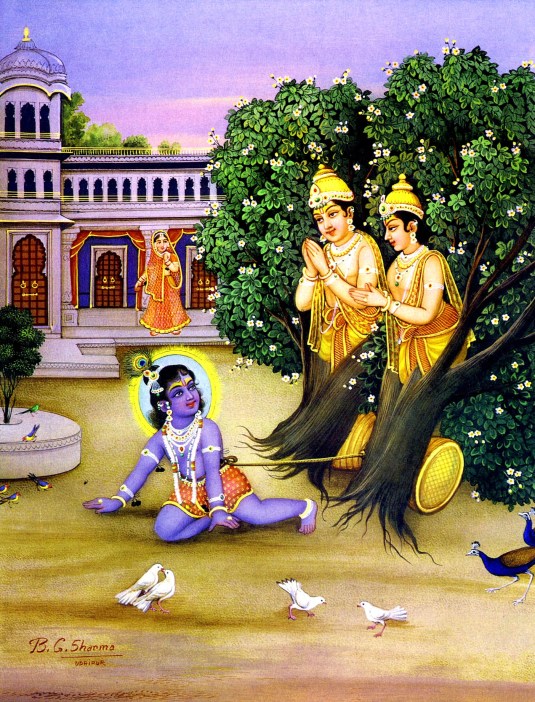
click on image to enlarge
“O Lord Damodara, in Your form as a baby, Mother Yasoda bound You to a grinding stone with a rope for tying cows, You then freed the sons of Kuvera, Manigriva, and Nalakuvera, who were cursed to stand as trees, and You gave them the chance to become Your devotees. Please bless me in this same way, I have no desire for liberation into Your effulgence.” (Damodarastka Prayers)
So…continuining our month long attempt to stay focused on the childhood pastimes of Krsna, during this month of Damodara (Kartika), we bring you another exciting chapter from; Kṛṣṇa, the Supreme Personality of Godhead. Today we are posting the chapter entitled “The Deliverance of Nalakūvara and Maṇigrīva”.
Kṛṣṇa, the Supreme Personality of Godhead
By His Divine Grace A. C. Bhaktivedanta Swami Prabhupāda
Chapter Ten
The Deliverance of Nalakūvara and Maṇigrīva
The story of the cursing of Nalakūvara and Maṇigrīva and their deliverance by Kṛṣṇa, under the all-blissful desire of the great sage Nārada, is here described.
More
14 Oct 2014
by The Hare Krishna Movement
in A.C. Bhaktivedanta Swami Prabhupada, Damodara, Kartika, Krishna Consciousness, Krsna Consciousness, KRSNA The Supreme Personality of Godhead
Tags: A.C. Bhaktivedanta Swami Prabhupada, damodarastka prayers, Kartika, Krsna, Krsna The Supreme Personality of Godhead, month of Damodara, Mother Yasoda Binds Lord Krsna, spiritual subject matter, spiritually enlivening, transcendental subject matter

click on image to enlarge
The beauty of Transcendental subject matter is that it never gets old, but rather, becomes more relishable with every reading. For instance, every year we celebrate the month of Damodara or Kartika, with the reading of “Mother Yasoda Binds Lord Krsna”, and singing the Damodarastka prayers, and every year, it becomes more enjoyable and spiritually enlivening. That is the nature of Spiritual Subject Matter.
Kṛṣṇa, the Supreme Personality of Godhead
By His Divine Grace A. C. Bhaktivedanta Swami Prabhupāda
Chapter Nine
Mother Yaśodā Binds Lord Kṛṣṇa
Once upon a time, seeing that her maidservant was engaged in different household duties, mother Yaśodā personally took charge of churning butter. And while she churned butter, she sang the childhood pastimes of Kṛṣṇa and enjoyed thinking of her son.
More
12 Oct 2014
by The Hare Krishna Movement
in A.C. Bhaktivedanta Swami Prabhupada, Books by Srila Prabhupada, Mukunda=mala-stotra
Tags: A.C. Bhaktivedanta Swami Prabhupada, and death, books by prabhupada, disease, four principal miseries—birth, Krsna, lotus feet, mukunda mala stotra, mukunda murdhna, old age, spirit soul, sutra 3

This evening I was reading from the “Mukunda mala storta”. Using a Sanskrit edition published by Śrīla Bhaktivinoda Ṭhākura in 1895, Śrīla Prabhupāda began translating the Mukunda-mālā-stotra in the late 1950’s. But after completing six verses with commentary, he suspended it to work on the Śrīmad-Bhāgavatam. He never resumed it. The following is verse 3 with Srila Prabhupāda’s translations and purport. It is a very sweet verse, and powerful purport.
O Lord Mukunda! I bow down my head to Your Lordship and respectfully ask You to fulfill this one desire of mine: that in each of my future births I will, by Your Lordship’s mercy, always remember and never forget Your lotus feet.
…To forget one’s relationship with the Lord and thus to remain overwhelmed by material hankerings is the most condemned mode of life. This is exactly the nature of animal life. When the living entity is born in a species of lower animals, he completely forgets his relationship with the Lord and therefore remains always busy in the matter of eating, sleeping, fearing, and mating. Modern civilization promotes such a life of forgetfulness, with an improved economic condition for eating and so on. Various agents of the external energy make explicit propaganda to try to root out the very seed of divine consciousness. But this is impossible to do, because although circumstances may choke up a living being’s divine consciousness for the time being, it cannot be killed. In his original identity the living entity is indestructible, and so also are his original spiritual qualities. One can kill neither the spirit soul nor his spiritual qualities. To remember the Lord and desire to serve Him are the spiritual qualities of the spirit soul. One can curb down these spiritual qualities by artificial means, but they will be reflected in a perverted way on the mirror of material existence. The spiritual quality of serving the Lord out of transcendental affinity will be pervertedly reflected as love for wine, women, and wealth in different forms. The so-called love of material things—even love for one’s country, community, religion, or family, which is accepted as a superior qualification for civilized human beings—is simply a perverted reflection of the love of Godhead dormant in every soul. The position of King Kulaśekhara is therefore the position of a liberated soul, because he does not want to allow his genuine love of God to become degraded into so-called love for material things. (from purport)
More
24 Sep 2014
by The Hare Krishna Movement
in A.C. Bhaktivedanta Swami Prabhupada, Founder-Acarya, Lectures
Tags: A. C. Bhaktivedanta Swami Pabhupada, as it is, astanga yogi, avajananti, bhagavad-gita, bhakti yoga, bhakti yogi, devotion, Govinda, hatha yogi, in yoga, jnana yogi, karma yogi, Krsna, krsnaconsciousness, Lecture by Srila Prabhupada, Rama, The Supreme Personality of Godhead, transcendental loving service, Vasudeva, yoga, yoginam api sarvesam, yogis

Devotion – The Highest Yoga
A lecture given by His Divine Grace A.C. Bhaktivedanta Swami Prabhupada
Founder-Acarya of the International Society for Krishna Consciousness
1968
The word yoga has become synonymous in Western vernacular with a lithe figure, radiant health, peace of mind, and other material benefits. But the original meaning of the Sanskrit term carries a different, higher import: linking with the Supreme. In this lecture from 1968, Srila Prabhupada distinguishes the true goal of yoga—loving devotion to the Supreme Lord—from the physical and psychological elements of yoga practice.
Full Lecture More
24 Sep 2014
by The Hare Krishna Movement
in Back to Godhead, Narahari das, Simple Living, Spiritual Life
Tags: Back to Godhead Magazine, bonafide religion, BTG, chant Hare Krsna, every town and village, God, Iskcon, Krsna, Narahari, narahari das, read Srila Prabhupada's books daily, Sailing Back to Godhead, Spiritual Life, spiritual master, Srila Prabhupada, The Hare Krishna Movement, the hare krsna's, transcendental knowledge

Yesterday I was cleaning out the abandoned barn at Bahulavan, which is now being put back together again, and I found an old issue of Back to Godhead Magazine mixed in with so much debris. I pulled it out, cleaned it off, and added it to my collection of Back to Godhead Magazines. I had always heard of this famous sailing ship, and finally got a chance to see it.
Sailing Back to Godhead
Article excerpted from Back to Godhead Magazine Vol. 16, No. 6, 1981
A teakwood ketch and a devotee’s determination help bring Lord Krsna’s message to the Hawaiian Islands.
“…Krsna consciousness is the only established religion I know of that openly respects all other bonafide religions. My wife and I chant Hare Krsna and read Srila Prabhupada’s books daily. It’s added a dimension to my life that I feel is essential.”
More
23 Sep 2014
by The Hare Krishna Movement
in A.C. Bhaktivedanta Swami Prabhupada, Places of Pilgrimage, Srimad Bhagavatam
Tags: A.C. Bhaktivedanta Swami Prabhupada, duty of a pilgrim, Krsna, pilgrim, pilgrim's journey, pilgrim's progress, post office, postal system, postboxes, SB 3.1.18, traveling as a pilgrim

This morning I was reading from the 3rd Canto of the Srimad-Bhagavatam about Vidura and the beginning of his journey to the great places of pilgrimage. The following is excerpted from some of my reading.
He began to travel alone, thinking only of Kṛṣṇa, through various holy places like Ayodhyā, Dvārakā and Mathurā. He traveled where the air, hill, orchard, river and lake are all pure and sinless and where the forms of the Unlimited decorate the temples. Thus he performed the pilgrim’s progress. (SB 3.1.18)
…Places of pilgrimages are meant for eradicating the sins of the pilgrims, and they are distributed all over the universe just to give facility to all concerned for attaining pure existence and God realization. One should not be satisfied, however, merely by visiting the places of pilgrimage and performing one’s prescribed duties; he should be eager to meet the great souls who are already there, engaged in the service of the Lord. In each and every place of pilgrimage, the Lord is present in His various transcendental forms.
…The first and foremost duty of a pilgrim is to satisfy the Supreme Lord Hari. While traveling as a pilgrim, one should not be worried about pleasing society. There is no need to depend on social formalities or occupation or dress. One should remain always absorbed in the function of pleasing the Lord. Thus sanctified by thought and action, one is able to realize the Supreme Lord by the process of a pilgrim’s journey.
More
20 Sep 2014
by The Hare Krishna Movement
in A.C. Bhaktivedanta Swami Prabhupada, Bhagavad-gita, Draupadi
Tags: A.C. Bhaktivedanta Swami Prabhupada, Bg 1.2, Bhagavad-gita As It Is, blindness, Dhrtarastra, Draupadi, Duhsasana, King Yudhisthira, Krsna, Pandavas, progressive path of human life, SB 3.1.6, SB 3.1.7, spiritual blindness, Spiritual Life, spiritual vision

click on image to enlarge
The Insulting of Draupadi
I have always found this story of the disrobing of Draupadī, the wife of the godly King Yudhiṣṭhira, to be and example of how Krsna always protects his pure devotees. This incident contributes greatly to the Great Battle of Kurukṣetra, which almost completely annihilated the Kuru’s. And is a very good example of Spiritual Blindness. The following is a few select verses from the Srimad-Bhagavatam and Bhagavad-gita As It Is.
Dhṛtarāṣṭra was blind from birth, but his blindness in committing impious activities to support his dishonest sons was a greater blindness than his physical lack of eyesight. The physical lack of sight does not bar one from spiritual progress. But when one is blind spiritually, even though physically fit, that blindness is dangerously detrimental to the progressive path of human life. (SB 3.1.7 purport)
Dhṛtarāṣṭra was blind from birth. Unfortunately, he was also bereft of spiritual vision. He knew very well that his sons were equally blind in the matter of religion, and he was sure that they could never reach an understanding with the Pāṇḍavas, who were all pious since birth. (Bg 1.2 purport)
More
16 Sep 2014
by The Hare Krishna Movement
in A.C. Bhaktivedanta Swami Prabhupada, Caaitanya-caritamrta, Caitanya Mahaprabhu, Sri Caitanya-Caritamrta, Srimati Radharani
Tags: Adi1.5, buddhi yogam, devotee, esoteric, God, isvarah sarva-bhutanam, Krsna, magnum opus, philosophy, Radharani, scientist, servant of God, spiritual master, spiritual philosophy, spiritual science, Sri Krsna Caitanya Mahaprabhu, tesam satata-yuktanam

click on image to enlarge
Lately, I have been absorbed in reading Sri Caitanya-caritamrta. For me it is a hard book to pick up, but after I begin reading…it is a hard book to put down. Sometimes it seems so esoteric (1 intelligible only to those with special knowledge. 2 intended only for the initiated), but I cannot help but to be thrown into complete and utter awe of the masterful writing, it seems to be Srila Prabhupada’s magnum opus (1 great work of art, literture. 2 the most important work of an artist, writer, etc.). Yes, I have the Oxford Dictionary open on my desk.
The loving affairs of Śrī Rādhā and Kṛṣṇa are transcendental manifestations of the Lord’s internal pleasure-giving potency. Although Rādhā and Kṛṣṇa are one in Their identity, They separated Themselves eternally. Now these two transcendental identities have again united, in the form of Śrī Kṛṣṇa Caitanya. I bow down to Him, who has manifested Himself with the sentiment and complexion of Śrīmatī Rādhārāṇī although He is Kṛṣṇa Himself. (Śrī Caitanya-caritāmṛta, Ādi-līlā 1.5)
The following is a Lecture given on this important verse, and the complete text.
…You cannot understand God, or Kṛṣṇa, without being a faithful servant. This is the secret. And if we become faithful servant under the guidance of proper spiritual master, then we can understand what is Kṛṣṇa, what is Parabrahman, and what is loving affairs with Rādhārāṇī, what is Śrī Kṛṣṇa Caitanya Mahāprabhu. These things are revealed. It is not acquired by so-called mundane knowledge. That is not possible… So we should always remain faithful servant of Kṛṣṇa. And Kṛṣṇa is within everyone’s heart, and He will be pleased by your service, and then He will reveal Himself, what He is. Otherwise it is not possible. (from Śrī Caitanya-caritāmṛta Lecture Ādi-līlā 1.5)
Adi-lila 1.5 Lecture and Verse More
09 Sep 2014
by The Hare Krishna Movement
in A.C. Bhaktivedanta Swami Prabhupada, Back to Godhead, Soul, Spiritual Life
Tags: A. C. Bhaktivedanta Swami Pabhupada, Back to Godhead Magazine, Bhagavata-dharma, BTG, God, Krsna, part and parcel of God, relationship with God, sons of God, soul, Supreme Lord Krishna, wandering soul

Which Way Home for the Wandering Soul?
A lecture by His Divine Grace A.C. Bhaktivedanta Swami Prabhupada
Founder-Acarya of the International Society for Krishna Consciousness
Excerpted from Back to Godhead Magazine Vol. 18, No. 10, 1983
Ladies and gentlemen, thank you very much for kindly participating in this Krsna consciousness movement, which is spreading bhagavata-dharma. Bhagavata-dharma means “the activities performed in relationship with the Supreme Lord.” The Lord is Bhagavan, the Supreme Personality of Godhead, and the devotee is bhagavata, one who acts in relationship with Bhagavan.
More
04 Sep 2014
by The Hare Krishna Movement
in A.C. Bhaktivedanta Swami Prabhupada, Om, Srimati Radharani
Tags: a-kara, A.C. Bhaktivedanta Swami Prabhupada, aum, bhagavad-gita, devotee, entourage, His name fame, Krsna, ma-kara, Om, omkara, omkara is the resting place of everything, pastimes, potencies, sarva visva dhama, Sri Caitanya Caritamrta, Srimati Radharani, u-kara

The other day as I was doing some research on Srimati Radharani, for her appearance day post, I ran across the following;
…Oṁkāra is a combination of the letters a, u and m. A-kāreṇocyate kṛṣṇaḥ the letter a (a-kāra) refers to Kṛṣṇa, who is sarva-lokaika-nāyakaḥ, the master of all living entities and planets, material and spiritual. Nāyaka means “leader.” He is the supreme leader (nityo nityānāṁ cetanaś cetanānām (Kaṭha Upaniṣad 2.2.13)). The letter u (u-kāra) indicates Śrīmatī Rādhārāṇī, the pleasure potency of Kṛṣṇa, and m (ma-kāra) indicates the living entities (jīvas). Thus oṁ is the complete combination of Kṛṣṇa, His potency and His eternal servitors. In other words, oṁkāra represents Kṛṣṇa, His name, fame, pastimes, entourage, expansions, devotees, potencies and everything else pertaining to Him. As Caitanya Mahāprabhu states in the present verse of Śrī Caitanya-caritāmṛta, sarva-viśva-dhāma: oṁkāra is the resting place of everything, just as Kṛṣṇa is the resting place of everything (brahmaṇo hi pratiṣṭhāham) (CC Adi 7.128, Purport)
More
15 Aug 2014
by The Hare Krishna Movement
in A.C. Bhaktivedanta Swami Prabhupada, Festivals, Janmastami, Krishna, Krsna Consciousness, Krsna God, KRSNA The Supreme Personality of Godhead
Tags: A.C. Bhaktivedanta Swami Prabhupada, birth of Lord Krishna, Janmastami, janmastami festival, Krishna, Krsna, Krsna Book, Sri Krishna Janmastami, Srimad Bhagavatam

click on image to enlarge
With the advent of Lord Krsna’s birthday celebration (Janmastami) rapidly approaching, it seemed fitting that we do a post on the birth of Lord Krsna. So the following is the entire third chapter from the Krsna Book entitled “The Birth of Lord Kṛṣṇa”.
…As stated in the Bhagavad-gītā, the Lord says that His appearance, birth, and activities, are all transcendental, and one who understands them factually becomes immediately eligible to be transferred to the spiritual world. The Lord’s appearance or birth is not like that of an ordinary man who is forced to accept a material body according to his past deeds. The Lord’s appearance is explained in the Second Chapter: He appears out of His own sweet pleasure. When the time was mature for the appearance of the Lord, the constellations became very auspicious. The astrological influence of the star known as Rohiṇī was also predominant because this star is considered to be very auspicious. Rohiṇī is under the direct supervision of Brahmā. According to the astrological conclusion, besides the proper situation of the stars, there are auspicious and inauspicious moments due to the different situations of the different planetary systems. At the time of Kṛṣṇa’s birth, the planetary systems were automatically adjusted so that everything became auspicious. ( from Kṛṣṇa, the Supreme Personality of Godhead Chapter 3)
Full Chapter More
05 Aug 2014
by The Hare Krishna Movement
in A.C. Bhaktivedanta Swami Prabhupada, Bhagavad-gita, Soul
Tags: A.C. Bhaktivedanta Swami Prabhupada, Arjuna, Bg2.12, Bg2.30, bhagavad-gita, boyhood to youth to old age, dehino smin yatha dehe, eternal soul, ever existing soul, for the soul there is never birth or death, Krsna, krsna consciousness, reincarnation, science of the soul science of self realization, soul, soul passes into another body, soul slokas, Srila Prabhupada, unborn

This morning I was thinking about the soul and its eternal journey. So I went to Srila Prabhupada’s Bhagavad-gita As It Is and found some of the important slokas that pertained to the subject of the soul.
As the embodied soul continually passes, in this body, from boyhood to youth to old age, the soul similarly passes into another body at death. The self-realized soul is not bewildered by such a change. (Bg. 2.13)
For the soul there is never birth nor death. Nor, having once been, does he ever cease to be. He is unborn, eternal, ever-existing, undying and primeval. He is not slain when the body is slain. (Bg. 2.20)
As a person puts on new garments, giving up old ones, similarly, the soul accepts new material bodies, giving up the old and useless ones. (Bg. 2.22)
The soul can never be cut into pieces by any weapon, nor can he be burned by fire, nor moistened by water, nor withered by the wind. (Bg. 2.23)
More
22 Jul 2014
by The Hare Krishna Movement
in A.C. Bhaktivedanta Swami Prabhupada, Srimad Bhagavatam
Tags: A.C. Bhaktivedanta Swami Prabhupada, Bhagavata-dharma, Brahmaloka, conditioned souls, fruitive activities, heavenly planets, incarnation, kingdom of God, Krsna, Lord Brahma, material ezistence, material world, meditate upon the virat-rupa, Patalaloka, phantasmagoria, Spiritual world, sri suka uvaca, Sri Sukadeva Gosvami, Srimad Bhagavatam, The Lord in the Heart, virat-rupa
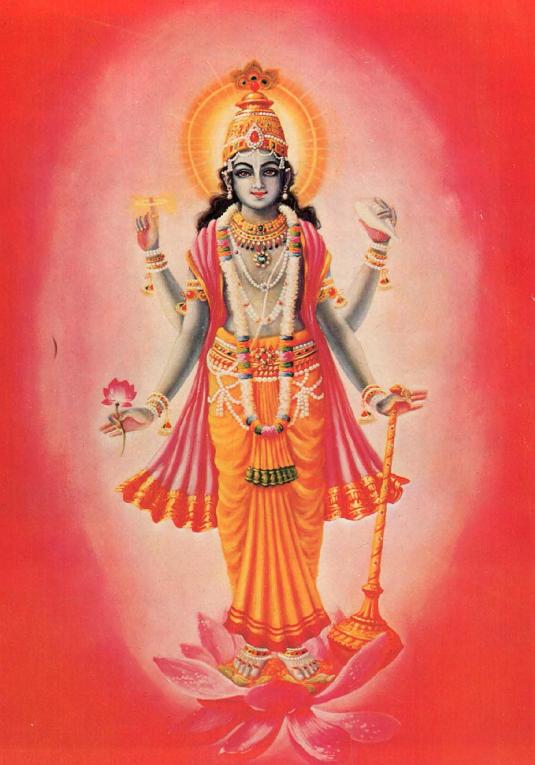
Śrīmad-Bhāgavatam
By His Divine Grace A. C. Bhaktivedanta Swami Prabhupāda
Canto Two, Chapter 2
The Lord in the Heart
Full Chapter More
17 Jul 2014
by The Hare Krishna Movement
in A.C. Bhaktivedanta Swami Prabhupada, Demons, Krishna Nectar, KRSNA The Supreme Personality of Godhead
Tags: A.C. Bhaktivedanta Swami Prabhupada, Aghasura, aghasura demon, demon, inhabitants of Vrndavana, Krsna, Krsna and Balarama, Krsna Book, Krsna The Supreme Personality of Godhead, mahima, mahima-siddhi, mystic powers, Vrndavan, yoga system, yogic siddhi
click on image to enlarge
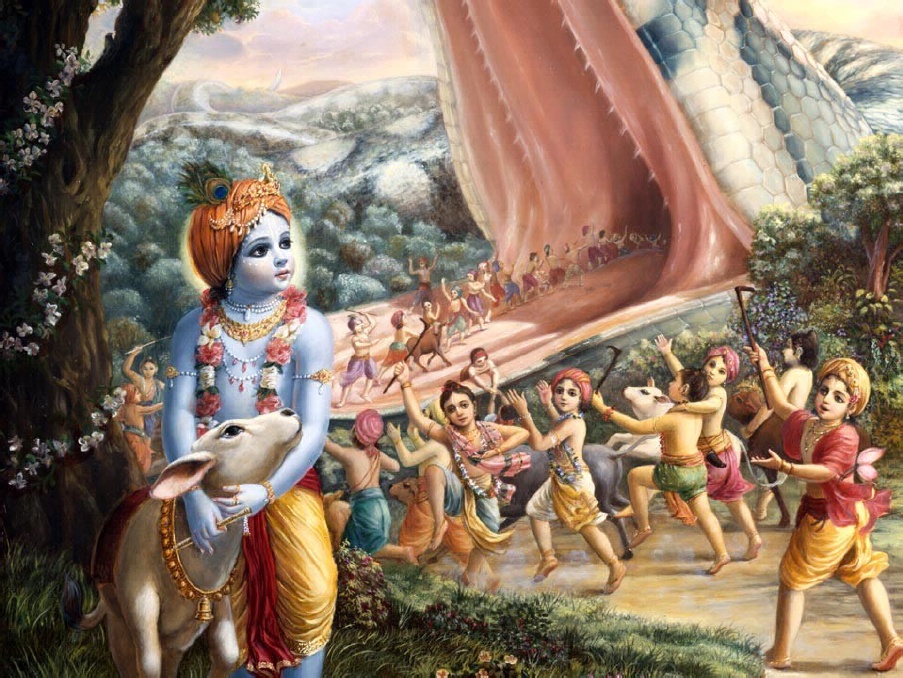
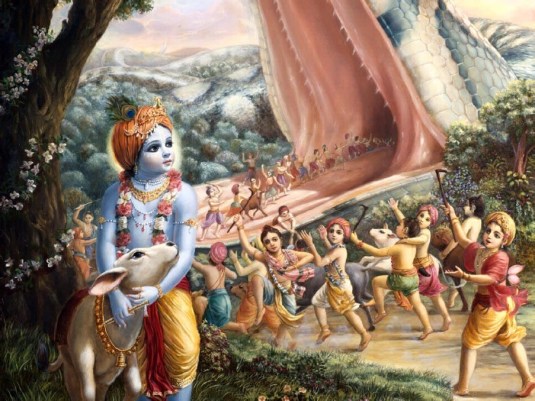
This is one of my favorite stories from the Krsna Book. I always enjoyed how fearless the cowherd boys were. They were free of any fear. This is the benefit of Krsna Consciousness; “Any material arrangement for protecting oneself from death is always unsure, but if one is in Kṛṣṇa consciousness, then immortality is confidently assured.”
…Aghāsura, thus deciding to kill all the inhabitants of Vṛndāvana, expanded himself by the yogic siddhi called mahimā. The demons are generally expert in achieving almost all kinds of mystic powers. In the yoga system, by the perfection called mahimā-siddhi, one can expand himself as he desires. The demon Aghāsura expanded himself up to eight miles and assumed the shape of a very fat serpent. Having attained this wonderful body, he stretched his mouth open just like a mountain cave. Desiring to swallow all the boys at once, including Kṛṣṇa and Balarāma, he sat on the path.
The demon in the shape of a big fat serpent expanded his lips from land to sky; his lower lip was touching the ground, and his upper lip was touching the clouds. His jaws appeared like a big mountain cave, without limitation, and his teeth appeared just like mountain summits. His tongue appeared to be a broad traffic way, and he was breathing just like a hurricane. His eyes were blazing like fire. At first the boys thought that the demon was a statue, but after examining it they saw that it was a big serpent lying down on the road and widening his mouth. The boys began to talk among themselves: “Dear friends, this figure appears to be a great animal, and he is sitting in such a posture just to swallow us all. Just see—is it not a big snake that has widened his mouth to eat all of us?”
More
11 Jul 2014
by The Hare Krishna Movement
in A.C. Bhaktivedanta Swami Prabhupada, B. G. Sharma Art, Bhagavad-gita
Tags: A.C. Bhaktivedanta Swami Prabhupada, Arjuna, Bg2.10, Bg2.11, Bg2.12, bhagavad-gita, God, illusion, impersonal Brahman, individual soul, Krsna, maya, mayavadi theory, saintly persons, Sharaman, supreme authority, Supreme Lord, the blessed Lord said, The Krishna Art of B. G. Sharma

click on image to enlarge
…at that time Kṛṣṇa, smiling, in the midst of both the armies, spoke the following words to the grief-stricken Arjuna.
The Blessed Lord said: While speaking learned words, you are mourning for what is not worthy of grief. Those who are wise lament neither for the living nor the dead.
Never was there a time when I did not exist, nor you, nor all these kings; nor in the future shall any of us cease to be. (Bg. 2.10-12)
Full text and purports More
09 Jul 2014
by The Hare Krishna Movement
in A.C. Bhaktivedanta Swami Prabhupada, Bhagavad-gita, Spiritual World, Vrindavan, Vrndavana
Tags: A.C. Bhaktivedanta Swami Prabhupada, abode of lord krsna, as it is, Bhagavad Gita, Goloka, goloka vrndavan, Krsna, sac-cid-ananda-vigraha, Spiritual Life, spiritual sky, Spiritual world, Syamasundara, Vrindavan, Vrndavana
click on image to enlarge
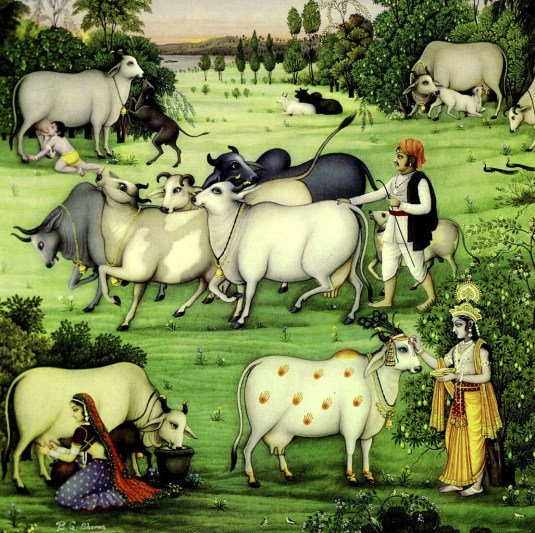
…The Lord descends to this mortal world to show His pastimes in Vṛndāvana, which are full of happiness. When Lord Śrī Kṛṣṇa was in Vṛndāvana, His activities with His cowherd boy friends, with His damsel friends, with the inhabitants of Vṛndāvana and with the cows were all full of happiness. The total population of Vṛndāvana knew nothing but Kṛṣṇa. But Lord Kṛṣṇa even discouraged His father Nanda Mahārāja from worshiping the demigod Indra because He wanted to establish the fact that people need not worship any demigod. They need only worship the Supreme Lord because their ultimate goal is to return to His abode. (from Introduction to the Bhagavad-gita As It Is)
More
27 Jun 2014
by The Hare Krishna Movement
in A.C. Bhaktivedanta Swami Prabhupada, Krishna Nectar, Krsna Consciousness
Tags: A.C. Bhaktivedanta Swami Prabhupada, celebrated flute, cowherd boys, friends of krsna, Krishna, Krsna, remembrance of Lord Krsna, SB 3.2.27, Srimad Bhagavatam, Third Canto, transcendental flute, transcendental pleasure, Yamuna river
click on image to enlarge
This morning I was reading from the Srimad Bhagavatam Third Canto, Chapter Two. It was so enlivening, that I read out-loud, the entire chapter. The following is just three verses and purports from the chapter entitled ” Remembrance of Lord Kṛṣṇa”.
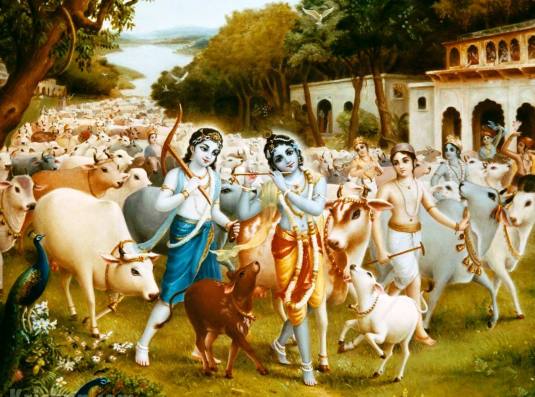
In His childhood, the Almighty Lord was surrounded by cowherd boys and calves, and thus He traveled on the shore of the Yamunā River, through gardens densely covered with trees and filled with vibrations of chirping birds. (SB 3.2.27)
…the Lord used to play His celebrated flute. The sound vibrated by His flute would give His friends such transcendental pleasure that they would forget all the talks of the brahmānanda which is so praised by the impersonalists. These cowherd boys, as will be explained by Śukadeva Gosvāmī, were living entities who had accumulated heaps of pious acts and thus were enjoying with the Lord in person and were hearing His transcendental flute. The Brahma-saṁhitā (5.30) confirms the Lord’s blowing His transcendental flute. (from purport to SB 3.2.29)
veṇuṁ kvaṇantam aravinda-dalāyatākṣaṁ
barhāvataṁsam asitāmbuda-sundarāṅgam
kandarpa-koṭi-kaminīya-viśeṣa-śobhaṁ
govindam ādi-puruṣaṁ tam ahaṁ bhajāmi
Brahmājī said, “I worship Govinda, the primeval Lord, who plays on His transcendental flute. His eyes are like lotus flowers, He is decorated with peacock plumes, and His bodily color resembles a fresh black cloud although His bodily features are more beautiful than millions of cupids.” These are the special features of the Lord.
More
17 Jun 2014
by The Hare Krishna Movement
in A.C. Bhaktivedanta Swami Prabhupada, Bhagavad-gita, Krsna, Krsna Consciousness, Meditation, Yoga, Yogi
Tags: A.C. Bhaktiveanta Swami Prabhupada, bhakti yoga, Govinda, Krsna, krsna consciousness, meditation, Nrismha, Rama, Syamasundara, Varaha, yoga, yogas, yogi, yoginam api sarvesam

“Of all yogis, he who abides in Me with great faith is the highest of all.”
It is by great fortune that one comes to Kṛṣṇa consciousness on the path of bhakti-yoga to become well situated according to the Vedic direction. The ideal yogī concentrates his attention on Kṛṣṇa, who is called Śyāmasundara, who is as beautifully colored as a cloud, whose lotus-like face is as effulgent as the sun, whose dress is brilliant with jewels and whose body is flower garlanded. Illuminating all sides is His gorgeous luster, which is called the brahmajyoti. He incarnates in different forms such as Rāma, Nṛsiṁha, Varāha and Kṛṣṇa, the Supreme Personality of Godhead, and He descends like a human being, as the son of Mother Yaśodā, and He is known as Kṛṣṇa, Govinda and Vāsudeva. He is the perfect child, husband, friend and master, and He is full with all opulences and transcendental qualities. If one remains fully conscious of these features of the Lord, he is called the highest yogī. (from purport to Bg. 6.47)
This is more or less a continuation of yesterdays post Freedom From All Miseries as it is the last verse in the Chapter 6, entitled; “Sankhya-yoga”. This is one of the very best verses and purports in the Bhagavad-gita for study if one is an aspiring yogi…
…The culmination of all kinds of yoga practices lies in bhakti-yoga. All other yogas are but means to come to the point of bhakti in bhakti-yoga. Yoga actually means bhakti-yoga; all other yogas are progressions toward the destination of bhakti-yoga. From the beginning of karma-yoga to the end of bhakti-yoga is a long way to self-realization. Karma-yoga, without fruitive results, is the beginning of this path. When karma-yoga increases in knowledge and renunciation, the stage is called jñāna-yoga. When jñāna-yoga increases in meditation on the Supersoul by different physical processes, and the mind is on Him, it is called aṣṭāṅga-yoga. And, when one surpasses the aṣṭāṅga-yoga and comes to the point of the Supreme Personality of Godhead Kṛṣṇa, it is called bhakti-yoga, the culmination. Factually, bhakti-yoga is the ultimate goal, but to analyze bhakti-yoga minutely one has to understand these other yogas. The yogī who is progressive is therefore on the true path of eternal good fortune. (from purport to Bg. 6.47)
More
Previous Older Entries Next Newer Entries