21 Jan 2015
by The Hare Krishna Movement
in A.C. Bhaktivedanta Swami Prabhupada, Mahatma, Spiritual Master, Srila Prabhupada, The Hare Krishna Movement
Tags: A.C. Bhaktivedanta Swami Prabhupada, always chanting My glories, chanting the flories of the lord, divine nature, great soul, Krsna, krsna consciousness, mahatma, mahatmanas tu mam partha, Srila Prabhupada, Supreme Personality of Godhead, The Hare Krishna Movement, thoes who are not deluded, transcendental qualities
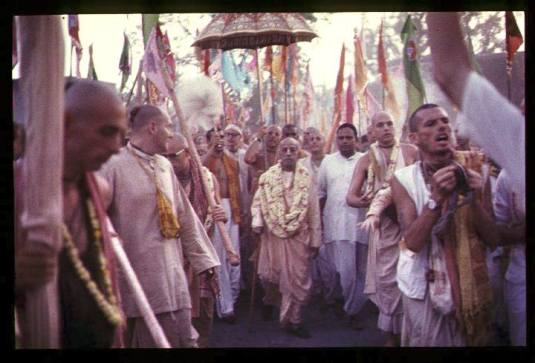
This morning I happened upon the above picture of Srila Prabhupada, and my mind immediately thought of the following two verses from the Bhagavad-gita:
O son of Pṛthā, those who are not deluded, the great souls, are under the protection of the divine nature. They are fully engaged in devotional service because they know Me as the Supreme Personality of Godhead, original and inexhaustible. (Bg 9. 13)
Always chanting My glories, endeavoring with great determination, bowing down before Me, these great souls perpetually worship Me with devotion. (Bg 9.14)
…In this verse the description of mahātmā is clearly given. The first sign of the mahātmā is that he is already situated in the divine nature…The mahātmā does not divert his attention to anything outside Kṛṣṇa because he knows perfectly well that Kṛṣṇa is the original Supreme Person, the cause of all causes. There is no doubt about it. Such a mahātmā, or great soul, develops through association with other mahātmās, pure devotees.
…The mahātmā cannot be manufactured by rubber-stamping an ordinary man. His symptoms are described here: a mahātmā is always engaged in chanting the glories of the Supreme Lord Kṛṣṇa, the Personality of Godhead. He has no other business. He is always engaged in the glorification of the Lord. In other words, he is not an impersonalist. When the question of glorification is there, one has to glorify the Supreme Lord, praising His holy name, His eternal form, His transcendental qualities and His uncommon pastimes. One has to glorify all these things; therefore a mahātmā is attached to the Supreme Personality of Godhead. (from purports)
I find that for me personally, thinking about Srila Prabhupada is one of the best forms of meditation, is good for my Krishna consciousness, and makes me feel very fortunate to be a part of The Hare Krishna Movement.
Full text and purport More
18 Jan 2015
by The Hare Krishna Movement
in A.C. Bhaktivedanta Swami Prabhupada, Chapter a Day
Tags: A. C. Bhakthvedanta Swami Prabhupada, bhagavad-gita, Brahma, brahmaji, Cause of All Causes, chad, chapter a day, demigod, disciplic succession, jnanam, Krsna, Lord Brahma, Narada, Narada Muni, parampara system, quailified spiritual master, Srila Prabhupada, Srimad Bhagavatam, transcendental knowledge, Vedic literture
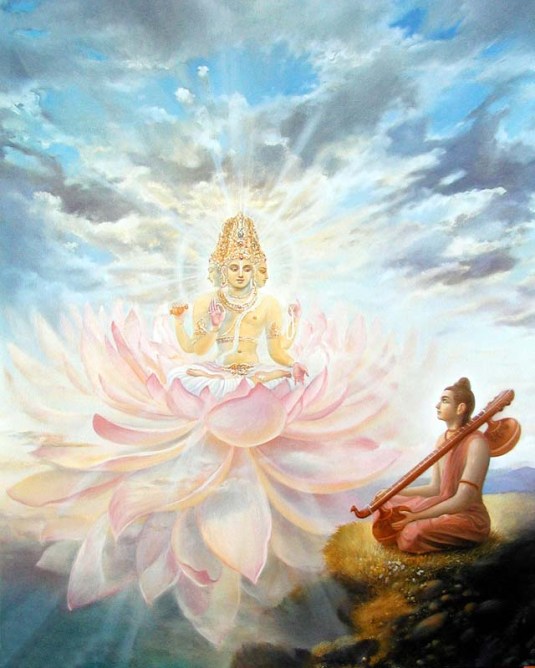
As we continue to update one of our other sites Śrīmad-Bhāgavatam by posting a chapter at a time, of that great literary work by His Divine Grace Srila Prabhupada, we will continue to share the progress with our readers here at The Hare Krishna Movement.
Śrīmad-Bhāgavatam: Canto 2: “The Cosmic Manifestation”
By His Divine Grace A. C. Bhaktivedanta Swami Prabhupāda
Canto Two, Chapter 5
More
13 Jan 2015
by The Hare Krishna Movement
in A.C. Bhaktivedanta Swami Prabhupada, Cow Protection, Krishna, Krishna Consciousness, Krishna Nectar, Spiritual Life, Spiritual World
Tags: caste, cow protection, cowherd boys and calves, cowherding, forest of Vrndavan, Krsna, mercantile and agricultural community, Nanda Manaraja, river yamuna, SB3.2.27, SB3.2.28, SB3.2.29, vaisya

This morning I was reading from the Srimad Bhagavatam, Canto 3, Chapter 2, and I just stopped and re-read the following three verses and purports a second time, as they were so visually attractive. Srila Prabhupada in his purport, was painting a beautiful picture of the spiritual world.
In His childhood, the Almighty Lord was surrounded by cowherd boys and calves, and thus He traveled on the shore of the Yamunā River, through gardens densely covered with trees and filled with vibrations of chirping birds. (SB 3.2.27)
…The forests on the shore of the Yamunā are all beautiful gardens full of trees of mango, jackfruit, apples, guava, oranges, grapes, berries, palmfruit and so many other plants and fragrant flowers. And because the forest was on the bank of the Yamunā, naturally there were ducks, cranes and peacocks on the branches of the trees. All these trees and birds and beasts were pious living entities born in the transcendental abode of Vṛndāvana just to give pleasure to the Lord and His eternal associates, the cowherd boys. (from purport)
Canto Three, Chapter 2, Text 27-29 More
06 Jan 2015
by The Hare Krishna Movement
in A.C. Bhaktivedanta Swami Prabhupada, Chapter a Day, Srimad Bhagavatam
Tags: A. C. Bhakthvedanta Swami Prabhupada, accepting the shelter of a bona fide spiritual master, Asvatthama, atomic bomb, Bhaktivedanta purports, Brahma, brahmastra, causless mercy, chad, chapter a day, chaste, creation of material world, existing, Krsna, Maharaja Pariksit, material world, satim, SB. 2.4, spiritual master, Srimad Bhagavatam, Sukadiva Gosvami, Suta Gosvami, suta uvaca, the process of creation, uttara
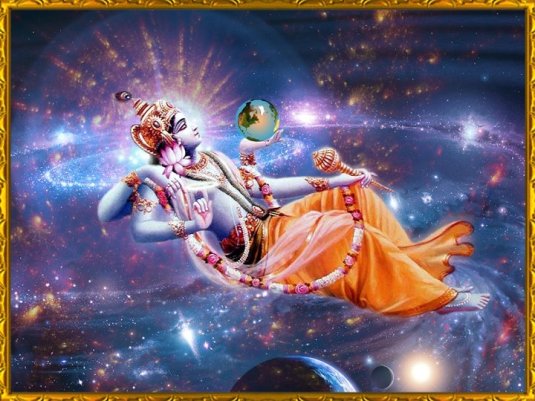
click on image to enlarge
As we continue to update our (one of our other sites) Śrīmad-Bhāgavatam by posting a chapter at a time, of that great literary work by His Divine Grace Srila Prabhupada, we will continue to share the progress with our readers here at The Hare Krishna Movement.
Śrīmad-Bhāgavatam
By His Divine Grace A. C. Bhaktivedanta Swami Prabhupāda
Canto Two, Chapter Four
The Process of Creation
More
01 Jan 2015
by The Hare Krishna Movement
in A.C. Bhaktivedanta Swami Prabhupada, Bhagavad-gita, Goloka Vrndaban, Spiritual World, Transcendental Knowledge, Yoga, Yogi
Tags: Bg 6.15, Bhagavad-gita As It Is 1972 Edition, bhakti yoga, brahmajyoti, cessation of material existence, Goloka Vrndavana, His Divine Grace A.C. Bhaktivedanta Swami Prabhupada, kingdom of God, Krsna, mystic transcendentalist, Prabhupada books, Sankhya-yoga, supreme abode, yoga
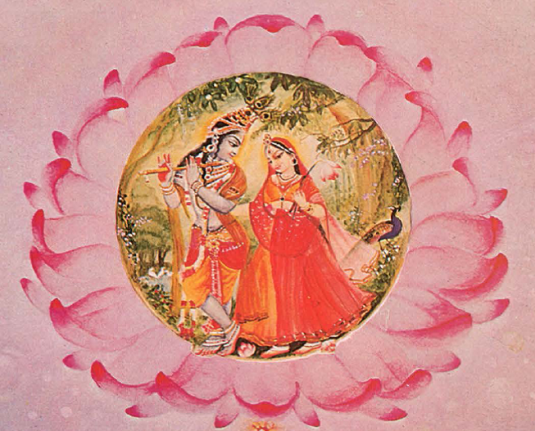
With the beginning of a new year, I am always apt to take up my studies with renewed enthusiasm, a resolution and firmness of purpose, to read more from Srila Prabhupada’s books, and to delve more deeply into the practice of bhakti-yoga. This morning I was reading about the spiritual sky; Goloka Vṛndāvana.
The abode of Lord Śrī Kṛṣṇa is described in the Bhagavad-gītā, Fifteenth Chapter, sixth verse:
na tad bhāsayate sūryo na śaśāṅko na pāvakaḥ
yad gatvā na nivartante tad dhāma paramaṁ mama
“That abode of Mine is not illumined by the sun or moon, nor by electricity. And anyone who reaches it never comes back to this material world.” (Bg. 15.6)
This verse gives a description of that eternal sky. Of course we have a material conception of the sky, and we think of it in relationship to the sun, moon, stars and so on, but in this verse the Lord states that in the eternal sky there is no need for the sun nor for the moon nor fire of any kind because the spiritual sky is already illuminated by the brahmajyoti, the rays emanating from the Supreme Lord. We are trying with difficulty to reach other planets, but it is not difficult to understand the abode of the Supreme Lord. This abode is referred to as Goloka. In the Brahma-saṁhitā it is beautifully described: Goloka eva nivasaty akhilātma-bhūtaḥ. The Lord resides eternally in His abode Goloka, yet He can be approached from this world, and to this end the Lord comes to manifest His real form, sac-cid-ānanda-vigraha. When He manifests this form, there is no need for our imagining what He looks like. To discourage such imaginative speculation, He descends and exhibits Himself as He is, as Śyāmasundara. Unfortunately, the less intelligent deride Him because He comes as one of us and plays with us as a human being. But because of this we should not consider that the Lord is one of us. It is by His potency that He presents Himself in His real form before us and displays His pastimes, which are prototypes of those pastimes found in His abode. (from Introduction to the Bhagavad-gita As It Is)
…The ultimate goal in practicing yoga is now clearly explained. Yoga practice is not meant for attaining any kind of material facility; it is to enable the cessation of all material existence. One who seeks an improvement in health or aspires after material perfection is no yogī according to Bhagavad-gītā. Nor does cessation of material existence entail one’s entering into “the void,” which is only a myth. There is no void anywhere within the creation of the Lord. Rather, the cessation of material existence enables one to enter into the spiritual sky, the abode of the Lord. (from purport to Bg 6.15)
More
31 Dec 2014
by The Hare Krishna Movement
in A.C. Bhaktivedanta Swami Prabhupada, Bhagavata Dharma Discourses, New Vrindavan, Srimad Bhagavatam, Srimad Bhagavatam
Tags: A. C. Bhakthvedanta Swami Prabhupada, A.C. Bhaktivedanta Swami Prabhupada New Vrindaban, atheist class, Bhagavata Dharma Discourses at New Vrindavan, Bible or Veda or Koran, dharmah svansthitah pumsam, God, grhamedhi, human society, information of the soul, Krsna, New Vrindavan, religious institution, SB 1.2.8
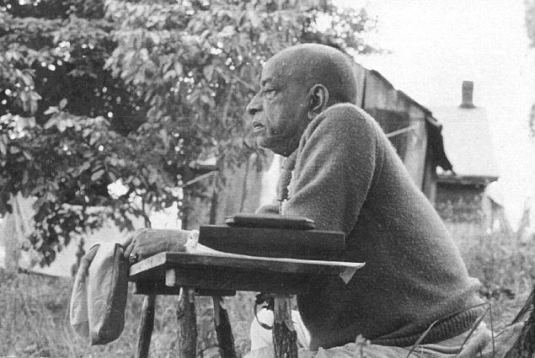
Srila Prabhupada at New Vrindavan West Virginia
Continuning with our “Bhagavata Dharma Discourses” series given at New Vrindavan, 1972.
Śrīmad-Bhāgavatam Lecture
Given by His Divine Grace A. C. Bhaktivedanta Swami Prabhupada
Canto One, Chapter 2, Text 8
New Vrindaban, September 6, 1972
More
29 Dec 2014
by The Hare Krishna Movement
in A.C. Bhaktivedanta Swami Prabhupada, Arrival Lecture
Tags: arrival address, Arrival Lecture, Bhaktisiddhanta Thakura, Bhaktivinoda Thakura, Caitanya Mahaprabhu, chanting Hare Krishna, every town and village. His name as Krsna Caitanya, Krsna, Krsna's servant, My name will be broadcast, six gosvamis, Spiritual world, Srila Prabhupada lecture

click on image to enlarge
Arrival Lecture
By His Divine Grace A. C. Bhaktivedanta Swami Prabhupada
Los Angeles, May 18, 1972
To hear the Lecture
Prabhupada: (airport noises) (leads Prema-dhvani; says “Los Angeles bhakta-vrnda ki jaya!”) So my dear boys and girls, about six years ago I came to your country single-handed, with this pair of cymbals. Now you are so many chanting Hare Krsna. That is my success. It was the prediction of Lord Caitanya Mahaprabhu:
prthivite ache yata nagaradi grama
sarvatra pracara hoibe mora nama
Lord Caitanya desired that “In all the towns, in as many towns and villages as there are on the surface of the globe, My name will be broadcast.” He is Krsna Himself, svayam krsna, krsna caitanya-namine, simply changing His name as Krsna Caitanya. So His prediction will never go in vain. That’s a fact. So my plan was that “I shall go to America. America is the leading country of the world. If I can convince (the) younger generation of America, they will take up.” I am old man. I came here at the age of seventy years; now I am seventy-six. So my warning is already there. In nineteen hundred and seventy-one, I had a severe heart attack. You know, all. So the mission of Caitanya Mahaprabhu is now in your hands. You are American boys and girls, very intelligent and graced by Krsna. You are not poverty-stricken. You have enough resources, prestige. Everything materially, you are all well-equipped. If you kindly take this Krsna consciousness movement seriously, your country will be saved, and the whole world will be saved.
More
27 Dec 2014
by The Hare Krishna Movement
in A.C. Bhaktivedanta Swami Prabhupada, Krishna Nectar, Nectar of Devotion
Tags: A. C. Bhaktivedanta Swami Prabhuapada, bluish cloud, bluish hue of a cloud, bodily features of Krsna, devotee, ecstatic love, Krishna, Krsna, Nectar of Devotion, personal feature of Lord Krsna, remembering Krsna, Srimati Radharani

Attraction and Remembrance
“My dear friend, I was just going to the bank of the Yamunā, and all of a sudden a very nice boy whose complexion is like a dark blue cloud became visible in front of My eyes. He glanced over Me in a way that I cannot describe. But since this has occurred, I am sorry that I can no longer engage My mind in the duties of My household affairs.” This is an instance of preliminary attraction for Kṛṣṇa. (Nectar of Devotion Chapter 44)
Once while Kṛṣṇa was out walking, one of the associates of Rādhārāṇī told Her: “My dear friend, do You think that this walking personality is a tāmala tree? If He is a tāmala tree, then how is it possible for Him to walk and be so beautiful? Then, this personality might be a cloud. But if He’s a cloud, then where is the beautiful moon within? Under the circumstances, I think it may be granted that this person is the same enchanting Personality of Godhead by whose flute vibration the three worlds are captivated. He must be the same Mukunda who is standing before Govardhan Hill.” This is another instance of an argumentative presentation of ecstatic love. (NOD Chapter 30)
One devotee said that even when he was not very attentive he would sometimes, seemingly out of madness, remember the lotus feet of Kṛṣṇa within his heart. This is an instance of remembrance resulting from constant practice. In other words, devotees who are constantly thinking of the lotus feet of Kṛṣṇa, even if they are momentarily inattentive, will see the figure of Lord Kṛṣṇa appearing within their hearts.
More
10 Dec 2014
by The Hare Krishna Movement
in A.C. Bhaktivedanta Swami Prabhupada, Brahma-samhita, Goloka Vrndaban, Krsna Consciousness, Krsna God, Spiritual World
Tags: gopis, His Lordship, His lotus feet, His moonlike face is the drinking vessel for eyes which hanker after all that is beautiful, Krsna, Laksmis, Lord Govinda, spiritual gems, The Lord’s chest is the abode of the goddess of fortune, touchstone, transcendental abode of the Lord, Vedic literatures
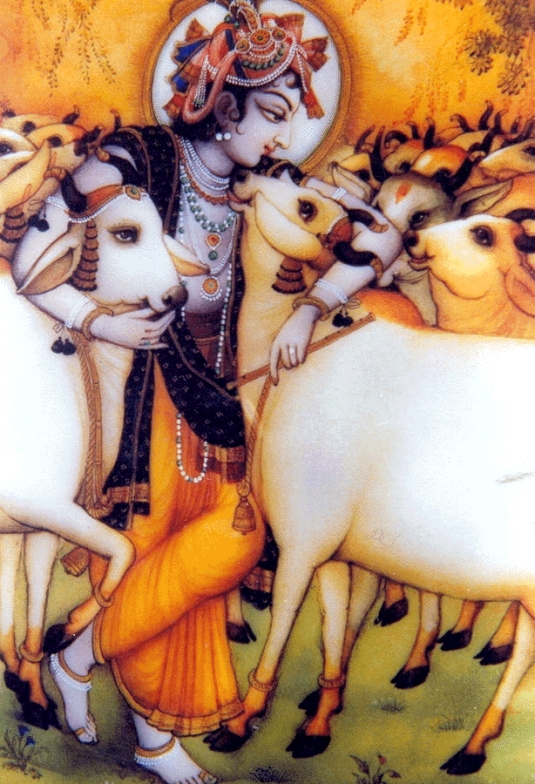
Sometimes when I am sitting and reading from Srila Prabhupada’s Srimad Bhagavatam, a verse or sentence from the purport just jumps out from the page almost like it is in 3D, and I catch a glimpse of what the Spiritual World must be like. It is beyond even my imagination, but sometimes I catch a glimmer of light, through a transcendental window, by the grace of my spiritual master His Divine Grace A. C. Bhaktivedanta Swami Prabhupada.
…The transcendental abode of the Lord where the trees are all desire trees and the buildings are made of touchstone. The Lord Govinda is engaged there in herding the surabhi cows as His natural occupation.
“I worship Govinda, the primeval Lord, the first progenitor who is tending the cows, yielding all desire, in abodes built with spiritual gems, surrounded by millions of purpose trees, always served with great reverence and affection by hundreds of thousands of lakṣmīs or gopīs.” (Bs 5.29)
…The Lord Govinda is engaged there in herding the surabhi cows as His natural occupation. And those who are artists, overtaken by the beautiful creation, should better see to the beautiful face of the Lord for complete satisfaction. The face of the Lord is the embodiment of beauty. What they call beautiful nature is but His smile, and what they call the sweet songs of the birds are but specimens of the whispering voice of the Lord.
More
09 Dec 2014
by The Hare Krishna Movement
in A.C. Bhaktivedanta Swami Prabhupada, Bhakti Yoga, Chanting Hare Krishna, Hare Krishna Maha Mantra, Maha-mantra, Meditation, Yoga
Tags: A. C. Bhakthvedanta Swami Prabhupada, chanting Hare Krishna, Hare Hare, Hare Krishna, Hare Rama, illusory struggle against material nature, Krishna Krishna, Krsna, purport to chanting hare krishna, Rama Rama, Srila Prabhupada, transcendental vibration by chanting of Hare Krishna

click on image to enlarge
Chanting the Hare Krishna Mantra
By His Divine Grace A. C. Bhaktivedanta Swami Prabhupada
“This transcendental vibration by chanting of Hare Krishna, Hare Krishna, Krishna Krishna, Hare Hare/ Hare Rama, Hare Rama, Rama Rama, Hare Hare, is the sublime method for reviving our Krishna consciousness. As living spiritual soul, we are all originally Krishna conscious entities, but due to our association with matter from time immemorial, our consciousness is now polluted by material atmosphere. In this polluted concept of life we are all trying to exploit the resources of material nature, but actually we are becoming more and more entangled in our complexities. This illusion is called maya, or hard struggle for existence, for winning over the stringent laws of material nature. This illusory struggle against material nature can at once be stopped by revival of our Krishna consciousness.
More
09 Dec 2014
by The Hare Krishna Movement
in A.C. Bhaktivedanta Swami Prabhupada, B. G. Sharma Art, Krishna Consciousness, Krsna, Krsna Consciousness, Srimad Bhagavatam
Tags: A.C. Bhaktivedanta Swami Prabhupada, Arjuna, arjuna's arrows, awakened to love of God, Battlefield of Kurukṣetra, Goloka Vrndavana, Krsna, lotuslike face of Krsna, love of God, material contaminations, pleasing to the eyes of the seer, SB3.2.20, spiritual sky, Srimad Bhagavatam, the beauty of the Lord, transcendental sky, Vaikuntha planets

Certainly others who were fighters on the Battlefield of Kurukṣetra were purified by the onslaught of Arjuna’s arrows, and while seeing the lotuslike face of Kṛṣṇa, so pleasing to the eyes, they achieved the abode of the Lord. (SB 3.2.20)
This morning as I was reading from the Srimad-Bhagavatam, the words “pleasing to the eyes of the seer” jumped out at me. And I was reminded again how just by appreciating the beauty of the Lord, one can attain success in life, as the following purport explains.
“…All the warriors who fought against Arjuna but who were able to see the lotuslike face of the Lord on the battlefront achieved the abode of the Lord, exactly as the devotees of the Lord do. The words “pleasing to the eyes of the seer” are very significant. When the warriors from the other side of the battlefield saw Lord Kṛṣṇa at the front, they appreciated His beauty, and their dormant instinct of love of God was awakened.
This love of God is awakened by the association of pure devotees of the Lord… Those who saw the beautiful face of the Lord on the Battlefield of Kurukṣetra were purified first by Arjuna when he made his onslaught with arrows… All the activities of a pure devotee are executed on behalf of the Lord because a pure devotee of the Lord has nothing to do for his personal interest. Arjuna’s killing was as good as killing by the Lord Himself. As soon as Arjuna shot an arrow at an enemy, that enemy became purified of all material contaminations and became eligible to be transferred to the spiritual sky… those who awakened to love of God were transferred to the planets of the transcendental sky.
Those whose love of God is awakened to the fullest extent go back to the Goloka Vṛndāvana planet in the spiritual sky, whereas persons who have just awakened to love of Godhead by accident or association are transferred to the Vaikuṇṭha planets. Essentially there is no material difference between Goloka and Vaikuṇṭha, but in the Vaikuṇṭhas the Lord is served in unlimited opulence, whereas in Goloka the Lord is served in natural affection.” (from purport to SB 3.2.20)
Full Text and Purport More
19 Nov 2014
by The Hare Krishna Movement
in A.C. Bhaktivedanta Swami Prabhupada, Maitreya, Srimad Bhagavatam, Vidura
Tags: A.C. Bhaktivedanta Swami Ppabhupada, all-inclusive welfare service, essence of all topics, human society, jnais, karmis, King of all kings, Krsna, Krsna-katha, Maitreya Muni, miseries of material existence, O great sage, O my Lord, saints, sri suka uvaca, Sukadeva Gosvami, Supreme King of all kings, Supreme Lord, topics of the Lord, transcendental loving service, Vidura, welfare for all people, yogis

I have been reading, with rapt attention, from Volume One, of the Third Canto, of Srimad Bhagavatam, by His Divine Grace A. C. Bhaktivedanta Swami Prabhupada, each morning. As I was reading this morning the words “…all-inclusive welfare service for the entire human society”, just kinda jumped out at me, as did the words “…greatest welfare service for the world”. I am reminded of the importance of hearing Srimad Bhagavatam every day, and of our good fortune to be able to partake in this transcendental conversation (kṛṣṇa-kathā). There are many topics for different persons in different modes of material nature, but the essential topics are those in relationship with the Supreme Lord.
Śukadeva Gosvāmī said: Vidura, the best amongst the Kuru dynasty, who was perfect in devotional service to the Lord, thus reached the source of the celestial Ganges River [Hardwar], where Maitreya, the great, fathomless learned sage of the world, was seated. Vidura, who was perfect in gentleness and satisfied in transcendence, inquired from him. (SB 3.5.1)
The great sage Maitreya Muni is described here as bhagavān because he surpassed all ordinary human beings in learning and experience. Thus his selection of the greatest welfare service for the world is considered authoritative. The all-inclusive welfare service for the entire human society is devotional service to the Lord, and, as requested by Vidura, the sage described the same very appropriately. (purport 3.5.17)
Śrīmad-Bhāgavatam: Canto 3: “The Status Quo”
By His Divine Grace A. C. Bhaktivedanta Swami Prabhupāda
Canto Three, Chapter Five, Text 1-17
Vidura’s Talks with Maitreya
More
06 Nov 2014
by The Hare Krishna Movement
in A.C. Bhaktivedanta Swami Prabhupada, Krishna Consciousness, Krishna's flute, KRSNA The Supreme Personality of Godhead, Rasa Dance, Tulasi-saligram Vivaha
Tags: A.C. Bhaktivedanta Swami Prabhupada, autumn season, Caturmasya, full moon in autum, full moonlight, gopis, Kartika, Kṛṣṇa, Krsna, krsna consciousness, Purnima, rasa dance, rasa-lila, Sri Krsna Rasa-yatra, Srimati Tulsi Devi, The Rasa Dance, The Supreme Personality of Godhead, Tulasi-Saligrama Vivaha

Today being Purnima (the Full Moon), is also the End of Kartika, Sri Krsna Rasa-yatra (the purnima or full moon of Damodara month is the second full moon of the autumn season, and rasa lila is again celebrated), Tulasi-Saligrama Vivaha (this is the celebration of the marriage ceremony of Srimati Tulsi Devi and Lord Sri Krishna), and the Last Day of Caturmasya.
In honor of this auspicious day, we are posting the Introduction to the Rasa Dance, Chapter 29 of the Krsna Book.
…The appearance of the moon increased Kṛṣṇa’s desire to dance with the gopīs. The forests were filled with fragrant flowers. The atmosphere was cooling and festive. When Lord Kṛṣṇa began to blow His flute, the gopīs all over Vṛndāvana became enchanted. Their attraction to the vibration of the flute increased a thousand times due to the rising full moon, the red horizon, the calm and cool atmosphere, and the blossoming flowers. All these gopīs were by nature very much attracted to Kṛṣṇa’s beauty, and when they heard the vibration of His flute, they became apparently lustful to satisfy the senses of Kṛṣṇa.
Immediately upon hearing the vibration of the flute, they all left their respective engagements and proceeded to the spot where Kṛṣṇa was standing. While they ran very swiftly, all their earrings swung back and forth. They all rushed toward the place known as Vaṁśīvaṭa. Some of them were engaged in milking cows, but they left their milking business half finished and immediately went to Kṛṣṇa. One of them had just collected milk and put it in a milk pan on the oven to boil, but she did not care whether the milk overboiled and spilled–she immediately left to go see Kṛṣṇa. Some of them were breast feeding their small babies, and some were engaged in distributing food to the members of their families, but they left all such engagements and immediately rushed towards the spot where Kṛṣṇa was playing His flute. Some were engaged in serving their husbands, and some were themselves engaged in eating, but neither caring to serve their husbands nor eat, they immediately left. Some of them wanted to decorate their faces with cosmetic ointments and to dress themselves very nicely before going to Kṛṣṇa, but unfortunately they could not finish their cosmetic decorations nor put on their dresses in the right way because of their anxiety to meet Kṛṣṇa immediately. Their faces were decorated hurriedly and were haphazardly finished; some even put the lower part of their dresses on the upper part of their bodies and the upper part on the lower part.
While all the gopīs were hurriedly leaving their respective places, their husbands, brothers and fathers were all struck with wonder to know where they were going. Being young girls, they were protected either by husbands, elderly brothers or fathers. All their guardians forbade them to go to Kṛṣṇa, but they disregarded them. When a person becomes attracted by Kṛṣṇa and is in full Kṛṣṇa consciousness, he does not care for any worldly duties, even though very urgent. Kṛṣṇa consciousness is so powerful that it gives everyone relief from all material activities. Śrīla Rūpa Gosvāmī has written a very nice verse wherein one gopī advises another, “My dear friend, if you desire to enjoy the company of material society, friendship and love, then please do not go to see this smiling boy Govinda, who is standing on the bank of the Yamunā and playing His flute, His lips brightened by the beams of the full moonlight.” Śrīla Rūpa Gosvāmī indirectly instructs that one who has been captivated by the beautiful smiling face of Kṛṣṇa has lost all attraction for material enjoyments. This is the test of advancement in Kṛṣṇa consciousness: a person advancing in Kṛṣṇa consciousness must lose interest in material activities and personal sense gratification.
Full Chapter More
05 Nov 2014
by The Hare Krishna Movement
in A.C. Bhaktivedanta Swami Prabhupada, Damodara, Kartika, KRSNA The Supreme Personality of Godhead
Tags: A.C. Bhaktivedanta Swami, A.C. Bhaktivedanta Swami Prabhupada, brahmanas, gopis, handcart, hither and thither, Krishna, Krishna's childhood pastimes, Krsna, Nanda Maharaja, Supreme Personality of Godhead, Vedic hymns, Yasoda, YMother Yasoda

Continuining our month long attempt to stay focused on the childhood pastimes of Krsna, during this month of Damodara (Kartika), we bring you another exciting chapter from; Kṛṣṇa, the Supreme Personality of Godhead. Today we are posting the chapter entitled “The Salvation of Tṛṇāvarta”.
…Baby Kṛṣṇa had been placed underneath a hand-driven cart, and while He was kicking His legs, He accidentally touched the wheel of the cart, and it collapsed. Various kinds of utensils and brass and metal dishes had been piled up in the handcart, and they all fell down with a great noise. The wheel of the cart separated from the axle, and the spokes of the wheel were all broken and scattered hither and thither. Mother Yaśodā and all the gopīs, as well as Mahārāja Nanda and the cowherd men, were astonished as to how the cart could have collapsed by itself.
…If someone takes advantage of hearing the pastimes of the Lord, the material contamination of dust, accumulated in the heart due to long association with material nature, can be immediately cleansed. Lord Caitanya also instructed that simply by hearing the transcendental name of Lord Kṛṣṇa, one can cleanse the heart of all material contamination. There are different processes for self-realization, but this process of devotional service–of which hearing is the most important function–when adopted by any conditioned soul, will automatically cleanse him of the material contamination and enable him to realize his real constitutional position. (Kṛṣṇa, the Supreme Personality of Godhead)
Full Chapter More
25 Oct 2014
by The Hare Krishna Movement
in A.C. Bhaktivedanta Swami Prabhupada, Damodara, Gopis, Srimad Bhagavatam
Tags: A.C. Bhaktivedanta Swami Prabhupada, affection of the gopis, damsels of Vraja, ecstasy, gopis, Krsna, Lord Krsna, remembrance of Lord Krsna, SB3.2.14, Srimad Bhagavatam, transcendental love, Vrndavana

click on image to enlarge
In our attempt to stay focused on the childhood pastimes of Lord Krsna throughout this month of Damodara, we were reading from the Third Canto of the Srimad-Bhagavatam, chapter 2, entitled; “Remembrance of Lord Kṛṣṇa”. The great devotee Uddhava, was asked by Vidura, to speak on the messages of Lord Krsna. The following is but one of the verses and purports from this famous chapter.
…In His boyhood at Vṛndāvana, Lord Kṛṣṇa was notorious as a teasing friend in transcendental love to all the girls His age. His love for them was so intense that there is no comparison to that ecstasy, and the damsels of Vraja were so much attached to Him that their affection excelled that of the great demigods like Brahmā and Śiva. Lord Kṛṣṇa finally admitted His defeat before the transcendental affection of the gopīs and declared that He was unable to repay them for their unalloyed affection. (from purport to SB 3.2.14)
Full text and purport More
20 Oct 2014
by The Hare Krishna Movement
in A.C. Bhaktivedanta Swami Prabhupada, B. G. Sharma Art, Childhood Pastimes of Krsna, Kartika, Krishna Consciousness, KRSNA The Supreme Personality of Godhead, Nalakuvara and Manigriva
Tags: A.C. Bhaktivedanta Swami Prabhupada, art of B.B. Sharma, B.G. Sharma, demigods, ecstatic love, Gokula, Krishna's childhood pastimes, Krsna, Krsna The Supreme Personality of Godhead, liberated, Lord Krsna, lotus feet of the Lord, Mother Yasoda, Nalakurvara and Manigriva, Narada Muni, ropes of Yasoda, wooden grinding mortar
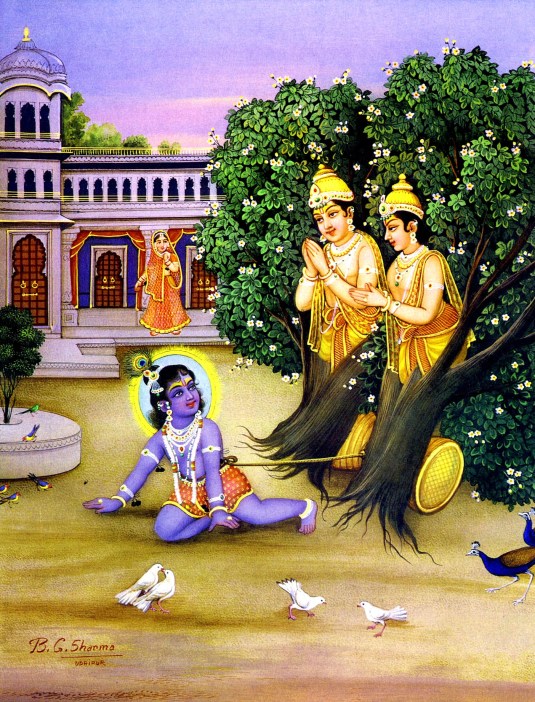
click on image to enlarge
“O Lord Damodara, in Your form as a baby, Mother Yasoda bound You to a grinding stone with a rope for tying cows, You then freed the sons of Kuvera, Manigriva, and Nalakuvera, who were cursed to stand as trees, and You gave them the chance to become Your devotees. Please bless me in this same way, I have no desire for liberation into Your effulgence.” (Damodarastka Prayers)
So…continuining our month long attempt to stay focused on the childhood pastimes of Krsna, during this month of Damodara (Kartika), we bring you another exciting chapter from; Kṛṣṇa, the Supreme Personality of Godhead. Today we are posting the chapter entitled “The Deliverance of Nalakūvara and Maṇigrīva”.
Kṛṣṇa, the Supreme Personality of Godhead
By His Divine Grace A. C. Bhaktivedanta Swami Prabhupāda
Chapter Ten
The Deliverance of Nalakūvara and Maṇigrīva
The story of the cursing of Nalakūvara and Maṇigrīva and their deliverance by Kṛṣṇa, under the all-blissful desire of the great sage Nārada, is here described.
More
14 Oct 2014
by The Hare Krishna Movement
in A.C. Bhaktivedanta Swami Prabhupada, Damodara, Kartika, Krishna Consciousness, Krsna Consciousness, KRSNA The Supreme Personality of Godhead
Tags: A.C. Bhaktivedanta Swami Prabhupada, damodarastka prayers, Kartika, Krsna, Krsna The Supreme Personality of Godhead, month of Damodara, Mother Yasoda Binds Lord Krsna, spiritual subject matter, spiritually enlivening, transcendental subject matter

click on image to enlarge
The beauty of Transcendental subject matter is that it never gets old, but rather, becomes more relishable with every reading. For instance, every year we celebrate the month of Damodara or Kartika, with the reading of “Mother Yasoda Binds Lord Krsna”, and singing the Damodarastka prayers, and every year, it becomes more enjoyable and spiritually enlivening. That is the nature of Spiritual Subject Matter.
Kṛṣṇa, the Supreme Personality of Godhead
By His Divine Grace A. C. Bhaktivedanta Swami Prabhupāda
Chapter Nine
Mother Yaśodā Binds Lord Kṛṣṇa
Once upon a time, seeing that her maidservant was engaged in different household duties, mother Yaśodā personally took charge of churning butter. And while she churned butter, she sang the childhood pastimes of Kṛṣṇa and enjoyed thinking of her son.
More
12 Oct 2014
by The Hare Krishna Movement
in A.C. Bhaktivedanta Swami Prabhupada, Books by Srila Prabhupada, Mukunda=mala-stotra
Tags: A.C. Bhaktivedanta Swami Prabhupada, and death, books by prabhupada, disease, four principal miseries—birth, Krsna, lotus feet, mukunda mala stotra, mukunda murdhna, old age, spirit soul, sutra 3

This evening I was reading from the “Mukunda mala storta”. Using a Sanskrit edition published by Śrīla Bhaktivinoda Ṭhākura in 1895, Śrīla Prabhupāda began translating the Mukunda-mālā-stotra in the late 1950’s. But after completing six verses with commentary, he suspended it to work on the Śrīmad-Bhāgavatam. He never resumed it. The following is verse 3 with Srila Prabhupāda’s translations and purport. It is a very sweet verse, and powerful purport.
O Lord Mukunda! I bow down my head to Your Lordship and respectfully ask You to fulfill this one desire of mine: that in each of my future births I will, by Your Lordship’s mercy, always remember and never forget Your lotus feet.
…To forget one’s relationship with the Lord and thus to remain overwhelmed by material hankerings is the most condemned mode of life. This is exactly the nature of animal life. When the living entity is born in a species of lower animals, he completely forgets his relationship with the Lord and therefore remains always busy in the matter of eating, sleeping, fearing, and mating. Modern civilization promotes such a life of forgetfulness, with an improved economic condition for eating and so on. Various agents of the external energy make explicit propaganda to try to root out the very seed of divine consciousness. But this is impossible to do, because although circumstances may choke up a living being’s divine consciousness for the time being, it cannot be killed. In his original identity the living entity is indestructible, and so also are his original spiritual qualities. One can kill neither the spirit soul nor his spiritual qualities. To remember the Lord and desire to serve Him are the spiritual qualities of the spirit soul. One can curb down these spiritual qualities by artificial means, but they will be reflected in a perverted way on the mirror of material existence. The spiritual quality of serving the Lord out of transcendental affinity will be pervertedly reflected as love for wine, women, and wealth in different forms. The so-called love of material things—even love for one’s country, community, religion, or family, which is accepted as a superior qualification for civilized human beings—is simply a perverted reflection of the love of Godhead dormant in every soul. The position of King Kulaśekhara is therefore the position of a liberated soul, because he does not want to allow his genuine love of God to become degraded into so-called love for material things. (from purport)
More
24 Sep 2014
by The Hare Krishna Movement
in A.C. Bhaktivedanta Swami Prabhupada, Founder-Acarya, Lectures
Tags: A. C. Bhaktivedanta Swami Pabhupada, as it is, astanga yogi, avajananti, bhagavad-gita, bhakti yoga, bhakti yogi, devotion, Govinda, hatha yogi, in yoga, jnana yogi, karma yogi, Krsna, krsnaconsciousness, Lecture by Srila Prabhupada, Rama, The Supreme Personality of Godhead, transcendental loving service, Vasudeva, yoga, yoginam api sarvesam, yogis

Devotion – The Highest Yoga
A lecture given by His Divine Grace A.C. Bhaktivedanta Swami Prabhupada
Founder-Acarya of the International Society for Krishna Consciousness
1968
The word yoga has become synonymous in Western vernacular with a lithe figure, radiant health, peace of mind, and other material benefits. But the original meaning of the Sanskrit term carries a different, higher import: linking with the Supreme. In this lecture from 1968, Srila Prabhupada distinguishes the true goal of yoga—loving devotion to the Supreme Lord—from the physical and psychological elements of yoga practice.
Full Lecture More
24 Sep 2014
by The Hare Krishna Movement
in Back to Godhead, Narahari das, Simple Living, Spiritual Life
Tags: Back to Godhead Magazine, bonafide religion, BTG, chant Hare Krsna, every town and village, God, Iskcon, Krsna, Narahari, narahari das, read Srila Prabhupada's books daily, Sailing Back to Godhead, Spiritual Life, spiritual master, Srila Prabhupada, The Hare Krishna Movement, the hare krsna's, transcendental knowledge

Yesterday I was cleaning out the abandoned barn at Bahulavan, which is now being put back together again, and I found an old issue of Back to Godhead Magazine mixed in with so much debris. I pulled it out, cleaned it off, and added it to my collection of Back to Godhead Magazines. I had always heard of this famous sailing ship, and finally got a chance to see it.
Sailing Back to Godhead
Article excerpted from Back to Godhead Magazine Vol. 16, No. 6, 1981
A teakwood ketch and a devotee’s determination help bring Lord Krsna’s message to the Hawaiian Islands.
“…Krsna consciousness is the only established religion I know of that openly respects all other bonafide religions. My wife and I chant Hare Krsna and read Srila Prabhupada’s books daily. It’s added a dimension to my life that I feel is essential.”
More
Previous Older Entries Next Newer Entries













 The Hare Krishna Movement