Continuing with our series of a True account entitled Perfect Questions, Perfect Answers… A search for meaning carries Bob Cohen, a young American Peace Corps worker halfway around the world, to an ancient village in the midst of West Bengal. There, in a small bamboo hut, he finds a teacher who is able to tell him everything he ever wanted to know.
…The spiritual master has to take the responsibility for all the sinful activities of his disciples…He takes responsibility for all the fallen souls. That idea is also in the Bible. Jesus Christ took all the sinful reactions of the people and sacrificed his life. That is the responsibility of a spiritual master.
Perfect Questions Perfect Answers
By His Divine Grace A.C. Bhaktivedanta Swami Prabhupada
February 29, 1972, evening
Chapter Six
The verses 30 and 32 from the Brahma-samita are sung in the morning Srngara Arati in all ISKCON temples, while the first track of the 1970 album “Radha Krsna Temple” is played. Srila Prabhupada enjoyed this track very much and was so moved that he said that this track will play at all ISKCON temples for the Srngara Arati. As a result, no one ever leads kirtan for this song, as it is played through that track.
Govinda
The Radha Krsna Temple Album
Sung by Yamuna devi
Produced by George Harrison
veṇum—the flute; kvaṇantam—playing; aravinda-dala—(like) lotus petals; āyata—blooming; akṣam—whose eyes; barha—a peacock’s feather; avataṁsam—whose ornament on the head; asita-ambuda—(tinged with the hue of) blue clouds; sundara—beautiful; aṅgam—whose figure; kandarpa—of Cupids; koṭi—millions; kamanīya—charming; viśeṣa—unique; śobham—whose loveliness; govindam—Govinda; ādi-puruṣam—the original person; tam—Him; aham—I; bhajāmi—worship.
I worship Govinda, the primeval Lord, who is adept in playing on His flute, with blooming eyes like lotus petals with head decked with peacock’s feather, with the figure of beauty tinged with the hue of blue clouds, and His unique loveliness charming millions of Cupids.
aṅgāni—the limbs; yasya—of whom; sakala-indriya—of all the organs; vṛtti-manti—possessing the functions; paśyanti—see; pānti—maintain; kalayanti—manifest; ciram—eternally,; jaganti—the universes; ānanda—bliss; cit—truth; maya—full of; sat—substantiality; ujjvala—full of dazzling splendor; vigrahasya—whose form; govindam—Govinda; ādi-puruṣam—the original person; tam—Him; aham—I; bhajāmi—worship.
I worship Govinda, the primeval Lord, whose transcendental form is full of bliss, truth, substantiality and is thus full of the most dazzling splendor. Each of the limbs of that transcendental figure possesses in Himself, the full-fledged functions of all the organs, and eternally sees, maintains and manifests the infinite universes, both spiritual and mundane.
I like reading the articles written by Sriman Rupanuga Prabhu, as he has a very good appreciation for the potency and attributes of Srila Prabhupada. So we took the liberty of posting another one here to share with our readers.
…The conclusion is that in the same way Lord Krsna is identical with His words in the Gita, even though He spoke them long ago, Srila Prabhupada is actually present in his purports, even though he is no longer physically present. And those purports are as much sastra as the verses they explain. Those books are as good as Deities in the temple. They are not the playthings of editors, but the literary incarnations of God and His most confidential servants. Therefore, they must be approached with all respect and reverence.
Srila Prabhupada’s books and recordings are a consistent and constant source of revelation for anyone who follows him. If one is able to follow Srila Prabhupada’s instructions to chant 16 rounds, follow the four regulative principles, systematically study his teachings and then help others do the same, that person will undoubtedly remember Lord Krsna at the time of death. Such a bhakta may be unable to discover a guru fully qualified to give diksa and specific name. Those who factually meet the standards required by Srila Prabhupada to become a genuine spiritual master may be few and far between. But by honestly and seriously accepting Srila Prabhupada as siksa guru, anyone can obtain freedom from the material conception of life, be inspired to action in Krsna consciousness, and learn to think of Srila Prabhupada and Lord Krsna always.
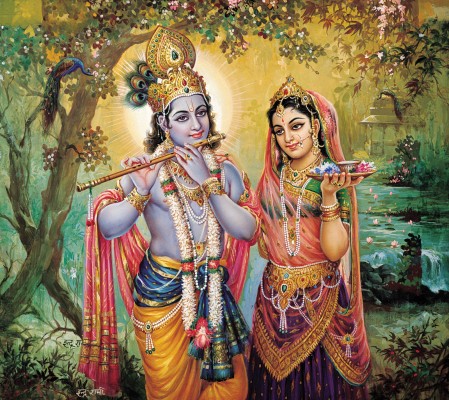
This is perhaps the first picture I ever saw of Radha & Krishna. I remember thinking at the time: “This is the most beautiful picture I have ever seen in my life.” Since then I have been fortunate to have relished so many other beautiful pictures of Radha and Krishna, but one always remembers his first love. Srila Prabhupada by his causless mercy, has given us so much in the way of Art, Music, Knowledge, etc. that I am simply in awe!
Transcendental Art
Excrpted from Back to Godhead Magazine 1971, Vol. 1, No. 39
One of the basic principles of Krsna consciousness is that one may utilize whatever talent he has in the service of the Supreme Lord. And it is a symptom of a bona fide spiritual master that he is expert in engaging everyone in practical transcendental devotional service. His Divine Grace A.C. Bhaktivedanta Swami Prabhupada has thus engaged a number of very talented artists in the service of the Lord by asking them to use their natural artistic inclination in painting pictures of the Supreme Godhead. According to all the revealed Vedic scriptures, God is not formless or void, but on the contrary He has the most attractive personal form. In fact He has many transcendental forms. Krsna appears and expands Himself in multi expansions and incarnations, and these are described in Vedic literatures such as Bhagavad-gita and Srimad-Bhagavatam.
As devotees, or rather as disciples of His Divine Grace A.C. Bhaktivedanta Swami Prabhupada, we do not accept the theory of “The End of the World”. There is too much scriptural evidence to counter such a speculative conclusion. There is ample description of “Time”, as given in the Vedic Scriptures such as the Bhagavad-gita and the Srimad Bhagavatam to confirm that there is no end to this age for another 427,000 years.
Once when Srila Prabhupada was asked by one devotee…
Lokamangala dasa: In your books you explain that we are in the Kali-yuga age. Is the Kali-yuga age coming to a close now?
Srila Prabhupada: No. It will continue for another 427,000 years. The duration of Kali-yuga is 432,000 years. Out of that, we have passed only 5,000 years. The balance is 427,000 years. And during this time the condition of society will be worse-not better but worse. In the last stage of Kali-yuga there will be no food grains, no milk, no fruits. It will be a very horrible time. People will kill their own children and eat them, just like animals. The last stage of Kali-yuga will be like that. So before coming to that stage, better to take Krsna consciousness and go back to Krsna. That is our program. We don’t wish to wait for the worst things. The worst things are already happening, and it will be still worse. Instead of waiting for that time, better to become perfect by chanting Hare Krsna and go back home, back to Godhead. That is our position.
Also in the books we find:
At the present moment we have just passed through five thousand years of the Kali-yuga, which lasts 432,000 years. Before this there was Dvāpara-yuga (800,000 years), and before that there was Tretā-yuga (1,200,000 years). Thus, some 2,005,000 years ago, Manu spoke the Bhagavad-gītā to his disciple and son Mahārāja lkṣvāku, the King of this planet earth. The age of the current Manu is calculated to last some 305,300,000 years, of which 120,400,000 have passed. (Bhagavad-gita 4.1)
The duration of the material universe is limited. It is manifested in cycles of kalpas. A kalpa is a day of Brahmā, and one day of Brahmā consists of a thousand cycles of four yugas or ages: Satya, Tretā, Dvāpara, and Kali. The cycle of Satya is characterized by virtue, wisdom and religion, there being practically no ignorance and vice, and the yuga lasts 1,728,000 years. In the Tretā-yuga vice is introduced, and this yuga lasts 1,296,000 years. In the Dvāpara-yuga there is an even greater decline in virtue and religion, vice increasing, and this yuga lasts 864,000 years. And finally in Kali-yuga (the yuga we have now been experiencing over the past 5,000 years) there is an abundance of strife, ignorance, irreligion and vice, true virtue being practically nonexistent, and this yuga lasts 432,000 years. In Kali-yuga vice increases to such a point that at the termination of the yuga the Supreme Lord Himself appears as the Kalki avatara, vanquishes the demons, saves His devotees, and commences another Satya-yuga. Then the process is set rolling again. These four yugas, rotating a thousand times, comprise one day of Brahmā, the creator god, and the same number comprise one night. Brahmā lives one hundred of such “years” and then dies. These “hundred years” by earth calculations total to 311 trillion and 40 million earth years. By these calculations the life of Brahmā seems fantastic and interminable, but from the viewpoint of eternity it is as brief as a lightning flash. In the causal ocean there are innumerable Brahmās rising and disappearing like bubbles in the Atlantic. Brahmā and his creation are all part of the material universe, and therefore they are in constant flux.(Bhagavad-gita 8.17)
There are four yugas: Satya-yuga, Tretā-yuga, Dvāpara-yuga and Kali-yuga. During the first yuga, Satya-yuga, people were very pious. Everyone practiced the mystic yoga system for spiritual understanding and realization of God. Because everyone was always absorbed in samādhi, no one was interested in material sense enjoyment. During Tretā-yuga, people enjoyed sense pleasure without tribulations. Material miseries began in Dvāpara-yuga, but they were not very stringent. Stringent material miseries really began from the advent of Kali-yuga. (Srimad Bhagavatam 5.17.12)
After the Battle of Kurukṣetra, at which Bhagavad-gītā was spoken, Kali-yuga continues for 432,000 years, of which only 5,000 years have passed. Thus there is still a balance of 427,000 years to come. Of these 427,000 years, the 10,000 years of the saṅkīrtana movement inaugurated by Śrī Caitanya Mahāprabhu 500 years ago provide the opportunity for the fallen souls of Kali-yuga to take to the Kṛṣṇa consciousness movement, chant the Hare Kṛṣṇa mahā-mantra and thus be delivered from the clutches of material existence and return home, back to Godhead. (Srimad Bhagavatam 8.5.23)
The ultimate result of devotional service is to develop genuine love for the Supreme Personality…And love is the only word that can be properly used to indicate the relation between Lord Kṛṣṇa and the living entities.
Loving devotional service to the Lord begins with hearing about the Lord. There is no difference between the Lord and the subject matter heard about Him. Therefore, hearing about Him means immediate contact with Him by the process of vibration of the transcendental sound…
…The conclusion is that simply by hearing the Vedic literature Śrīmad-Bhāgavatam, one can have direct connection with the Supreme Personality of Godhead Śrī Kṛṣṇa, and thereby one can attain the highest perfection of life by transcending worldly miseries, illusion and fearfulness. These are practical tests for one who has actually given a submissive hearing to the readings of the Śrīmad-Bhāgavatam.
A yogī is greater than the ascetic, greater than the empiricist and greater than the fruitive worker. Therefore, O Arjuna, in all circumstances, be a yogī.
And of all yogīs, he who always abides in Me with great faith, worshiping Me in transcendental loving service, is most intimately united with Me in yoga and is the highest of all.
Bhagavad-gītā As It Is 1972 Edition
By His Divine Grace A. C. Bhaktivedanta Swami Prabhupāda
Chapter Six
Continuing with our series of a True account entitled Perfect Questions, Perfect Answers… A search for meaning carries Bob Cohen, a young American Peace Corps worker halfway around the world, to an ancient village in the midst of West Bengal. There, in a small bamboo hut, he finds a teacher who is able to tell him everything he ever wanted to know.
Perfect Questions, Perfect Answers
By His Divine Grace A. C. Bhaktivedanta Swami Prabhupada
Chapter 5
Becoming Pure
February 29, 1972
Bob: Thank you so much for allowing me to ask my questions.
Śrīla Prabhupāda: That is my mission. People should understand the science of God. Unless we cooperate with the Supreme Lord, our life is baffled. I have given the example many times that a screw which has fallen from a machine has no value. But when the same screw is again attached to the machine, it has value. Similarly, we are part and parcel of God. So without God, what is our value? No value! We should again come back to our position of attachment to God. Then we have value.
Bob: I met a fellow today who came in the afternoon. His reason for coming—you may find it humorous—was that he heard the hippies were in Māyāpur.
…Śrī Nārada Muni in his previous life was just an ordinary maidservant’s son, so how he became so perfectly transformed into the spiritual body of eternal life, bliss and knowledge is certainly important. Śrī Vyāsadeva desired him to disclose the facts for everyone’s satisfaction.
Vyāsadeva himself was the disciple of Nāradajī, and therefore it was natural to be anxious to hear what Nārada did after initiation from the spiritual masters. He wanted to follow in Nārada’s footsteps in order to attain to the same perfect stage of life. This desire to inquire from the spiritual master is an essential factor to the progressive path. This process is technically known as sad-dharma-pṛcchā.
The life of a sincere devotee of the Lord is thus explained in a nutshell by Nārada Muni by his personal example. Such a devotee, after his initiation by the Lord or His bona fide representative, takes very seriously chanting of the glories of the Lord and traveling all over the world so that others may also hear the glories of the Lord. Such devotees have no desire for material gain. They are conducted by one single desire: to go back to Godhead. This awaits them in due course on quitting the material body. Because they have the highest aim of life, going back to Godhead, they are never envious of anyone, nor are they proud of being eligible to go back to Godhead. Their only business is to chant and remember the holy name, fame and pastimes of the Lord and, according to personal capacity, to distribute the message for others’ welfare without motive of material gain. (from Purports to 6th chapter)
The following is the Translations from the entire 6th Chapter the First Canto of Srimad Bhagavatam describing Srila Narada Muni’s transformation from a simple and gentle maidservants son to his platform of spiritual perfection and realization.
The following letter arrived in our mail box and because it is a very good question we have attempted to answer it here.
Dear Hare Krishna Movement
I understand that the Hare Krishna mantra should be received through a proper disciplic succession for it to be “active”
My question is, how can this be achieved? Is it sufficient to read about the mantra in books by His Divine Grace A.C. Bhaktivedanta Swami Prabhupada? Or is there a need to in person receive the mantra from a authentic disciple? If so, where can information be found on who such disciples are and how to contact them?
Thanks and best regards
Our Reply is as follows:
Dear _____
Thank you for your very important question. If you would take a moment and view the following YouTube… or listen to it while you read the purport given by Srila Prabhupada. By the end of it I assure you, that you will have received the Hare Krishna Mantra through the proper disciplic succession from the proper person who is a pure devotee of Krishna, the representative of Krishna. and is the direct link to the parampara (disciplic succession).
The Hare Krishna Maha Mantra
Purport to the Hare Krishna Maha Mantra
By His Divine Grace A.C. Bhaktivedanta Swami Prabhupada,
Founder and Acharya of the Krishna Consciousness Movement
New York, New York, USA 1966
As explained on the cover of the record album, this transcendental vibration– by chanting of Hare Krishna, Hare Krishna, Krishna Krishna, Hare/ Hare Rama, Hare Rama, Rama, Hare Hare – is the sublime method for reviving our Krishna consciousness. As living spiritual souls we are all originally Krsna conscious entities, but due to our association with matter since time immemorial, our consciousness is now polluted by material atmosphere. In this polluted concept of life, we are all trying to exploit the resources of material nature, but actually we are becoming more and more entangled in our complexities.
Translation
from the 1974 Edition of “Songs of the Vaisnava Acaryas”
Sri Rādhā-Mādhava have their loving pastimes in the groves (kuñja) of Vrndavana. Gopī-jana-vallabha means “one who attracts and reciprocates loving pastimes with the gopis. Giri-vara-dhārī is Krishna’s name in the pastime of lifting Goverdhana Hill. Yaśodā-nandana is the son of Yasoda (“nanda” means son and is also the name of Krishna’s father, so Krishna is also Nanda-nandana). Braja-jana-rañjana means the attractive darling of the inhabitants of Vrndavana. He is always playing in the groves (vana) on the bank (tira) of the Yamuna River, therefore Krishna is also known as Yāmuna-tīra-vana-cārī.
Srila Prabhupada was very fond of this song and sang it just before his lectures. In Allahabad and Gorakhpur Srila Prabhupada fell into a trance after singing the first two lines, and after some time he came back into external consciousness and said, “Now just chant Hare Krsna.” Srila Prabhupada said that this song is “a picture of Vrndavana. Everything is there–Srimati Radharani, Vrndavana, Govardhana, Yasoda, and all the cowherd boys.”
Purport by His Divine Grace A.C. Bhaktivedanta Swami Prabhupada More
click on above image to buy Srila Prabhupada’s original books
A Short Statement of the Philosophy of the Hare Krishna Movement
The Hare Krishna Movement is a worldwide community of devotees practicing bhakti-yoga, the eternal science of loving service to God. The movement was founded in the western world in 1966 by His Divine Grace A.C. Bhaktivedanta Swami Prabhupada, a pure devotee of God representing an unbroken chain of spiritual masters originating with Lord Krsna Himself.
Although the Movement has changed in many ways since the physical departure of Srila Prabhupada, still the principles, and practice has remained the same. And Srila Prabhupada is still the Spiritual Master for the Hare Krishna Movement.
“As long as the Spiritual master is physically present , the disciple should serve the physical body of the Spiritual master, and when the spiritual master is no longer physically existing, the disciple should serve the instructions of the spiritual master.” (Srimad Bhagavatam Purport 4.28.47)
The following eight principles are the basis of the Krsna consciousness movement. More
“When I was alone in your New York, I was thinking, who will listen to me in this horrible, sinful place? All right, I shall stay little longer, at least I can distribute a few of my books, that is something. But Krishna was all along preparing something I could not see, and He brought you to me one by one, sincere American boys and girls, to be trained-up for doing the work of Lord Caitanya Mahaprabhu. Now I can see that it is a miracle. Otherwise, your city of New York, one single old man, with only a few books to sell for barely getting eatables, how he can survive, what to speak of introducing God-consciousness movement for saving the humankind? That is Krishna’s miracle. Now I can see it.” (Letter to: Sudama — Bombay 23 December, 1972)
Even from the material point of view, A.C. Bhaktivedanta Swami’s writing is extraordinarily beautiful. But from the spiritual perspective Srila Prabhupada’s translations and purports are like ecstatic transcendental windows to the Spiritual World.
…Kṛṣṇa, at that time, was sitting on an upside-down wooden mortar for grinding spices and was distributing milk preparations such as yogurt and butter to the monkeys as He liked. Because of having stolen, He was looking all around with great anxiety, suspecting that He might be chastised by His mother. Mother Yaśodā, upon seeing Him, very cautiously approached Him from behind.(Bhaktivedanta Translation)
…Mother Yaśodā was able to trace Kṛṣṇa by following His butter-smeared footprints. She saw that Kṛṣṇa was stealing butter, and thus she smiled. (From the Bhaktivedanta Purports)
Śrī Īśopaniṣad The knowledge that brings one nearer to the Supreme Personality of Godhead, Krishna
The following are all eighteen mantras and the invocation from Śrī Īśopaniṣad from the original first edition, which was first published by ISKCON Books in 1969. For those of you who like to recite and memorize important slokas, we have compiled this list of the mantras along with the Roman transliteration, and English equivalents. You can click on the ‘print icon’ at bottom of post to print out the entire collection, and you can click on link at bottom for a free pdf download of entire book along with original Sanskrit Text and full Purports by His Divine Grace A.C. Bhaktivedanta Swami Prabhupada.
This is Text 2 in our series on The Nectar of Instruction or the Upadeśāmṛta which was originally given to us by Rūpa Gosvāmī, to guide our activities, as we advance in our Krsna Consciousness. The original Text was translated by His Divine Grace A.C. Bhaktivedanta Swami Prabhupada with purports given, so that we may become pure Vaiṣṇavas.
…Kṛṣṇa conscious devotees know very well that this material world is designed by the complete arrangement of the Lord to fulfill all the necessities of life for all living beings, without their having to encroach upon the life or rights of one another. This complete arrangement affords the proper quota of wealth for everyone according to his real needs, and thus everyone may live peacefully according to the principle of plain living and high thinking. Unfortunately, materialists who have neither faith in the plan of God nor any aspiration for higher spiritual development misuse their God-given intelligence only to augment their material possessions. They devise many systems—such as capitalism and materialistic communism—to advance their material position. They are not interested in the laws of God or in a higher goal. Always anxious to fulfill their unlimited desires for sense gratification, they are conspicuous by their ability to exploit their fellow living beings.
Today is a very auspicious day on the Vaisnave Calender, as it marks the end of Kartika, the end of Caturmasya, the Full Moon (Purnima) of the Month of Damodara, the Krsna Rasa-yatra, the Marriage of Tulasi & Salagrama, and the Appearance of Nimbarkacarya.
Just a word about Krsna Rasa-yatra from the Vaisnava Calendar …”The purnima or full moon of Damodara month is the second full moon of the autumn season, and rasa lila is again celebrated. This second rasa yatra is celebrated more in Bengal, whereas the first one is celebrated more in Vrndavana.
On this day one should perform full worship of Radha and Krsna with many flowers, and place them in a rasa mandapa surrounded by the gopis.”
In honor of all the auspiciousness, we are posting a chapter from Srila Prabhupada’s Kṛṣṇa Book entitled “The Rāsa Dance: Introduction”. Hare Krishna!
…While churning the butter, mother Yaśodā was singing about the childhood activities of Kṛṣṇa. It was formerly a custom that if one wanted to remember something constantly, he would transform it into poetry or have this done by a professional poet. It appears that mother Yaśodā did not want to forget Kṛṣṇa’s activities at any time. Therefore she poeticized all of Kṛṣṇa’s childhood activities, such as the killing of Pūtanā, Aghāsura, Śakaṭāsura and Tṛṇāvarta, and while churning the butter, she sang about these activities in poetical form. This should be the practice of persons eager to remain Kṛṣṇa conscious twenty-four hours a day. This incident shows how Kṛṣṇa conscious mother Yaśodā was. To stay in Kṛṣṇa consciousness, we should follow such persons. (SB 10.9.1-2)
…The Lord descends to this mortal world to show His pastimes in Vṛndāvana, which are full of happiness. When Lord Śrī Kṛṣṇa was in Vṛndāvana, His activities with His cowherd boy friends, with His damsel friends, with the inhabitants of Vṛndāvana and with the cows were all full of happiness. The total population of Vṛndāvana knew nothing but Kṛṣṇa. But Lord Kṛṣṇa even discouraged His father Nanda Mahārāja from worshiping the demigod Indra because He wanted to establish the fact that people need not worship any demigod. They need only worship the Supreme Lord because their ultimate goal is to return to His abode.
The abode of Lord Śrī Kṛṣṇa is described in the Bhagavad-gītā, Fifteenth Chapter, sixth verse: More
The following 25 verses (slokas) Prayers by Queen Kunti from the Srimad Bhagavatam were often quoted by Srila Prabhupada when giving lectures, and are so important that an entire book was published from the purports to these verses entitled “Teachings of Queen Kunti”. We encourage our readers to download the entire book by following the link at bottom of post for a free pdf file. You can also print these important slokas by clicking on the print icon following the post for easy reference to memorizing these famous slokas.
Srimad Bhagavatam
By His Divine Grace A.C. Bhaktivedanta Swami Prabhupada
Canto One, Chapter 8, Text 18-43










 The Hare Krishna Movement