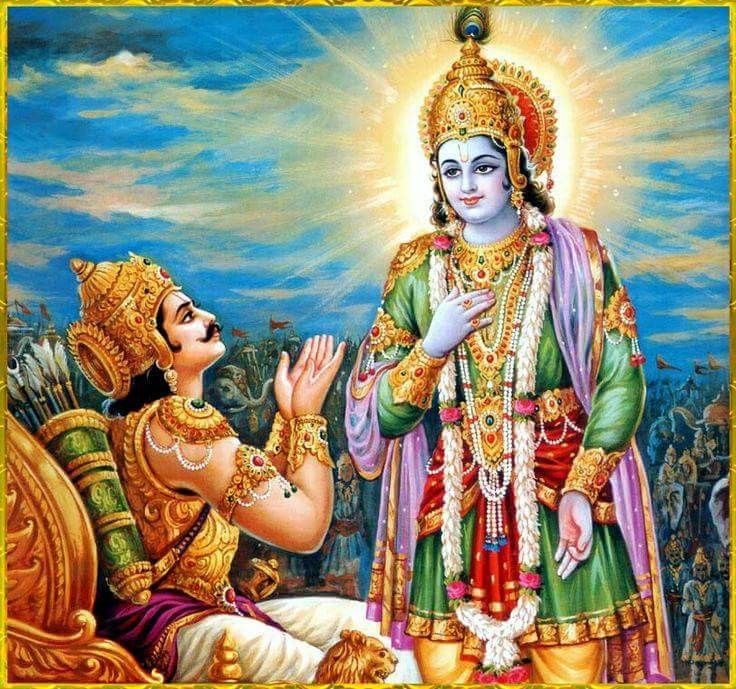
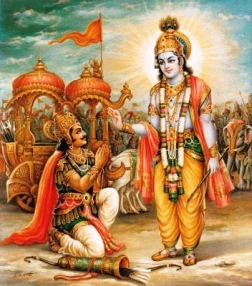
I have often pondered this question that Arjuna asks Krishna:
Arjuna said: O descendant of Vṛṣṇi, by what is one impelled to sinful acts, even unwillingly, as if engaged by force? (Bg. 3.36)
And Krishna answers:
The Blessed Lord said: It is lust only, Arjuna, which is born of contact with the material modes of passion and later transformed into wrath, and which is the all-devouring, sinful enemy of this world. (Bg. 3.37)
A living entity, as part and parcel of the Supreme, is originally spiritual, pure, and free from all material contaminations. Therefore, by nature he is not subjected to the sins of the material world. But when he is in contact with the material nature, he acts in many sinful ways without hesitation, and sometimes even against his will. As such, Arjuna’s question to Kṛṣṇa is very sanguine, as to the perverted nature of the living entities. Although the living entity sometimes does not want to act in sin, he is still forced to act. Sinful actions are not, however, impelled by the Supersoul within, but are due to another cause, as the Lord explains in the next verse. (from purport)
further explained:
…When a living entity comes in contact with the material creation, his eternal love for Kṛṣṇa is transformed into lust, in association with the mode of passion.
…Therefore, lust is the greatest enemy of the living entity, and it is lust only which induces the pure living entity to remain entangled in the material world.
Bhakti yoga is loosely defined as the yoga of Love and Devotion, and sometimes referred to as the “Yoga of the Heart”. But how do we practice it?
Actually it is very easy, and can be practiced anywhere 24/7, and doesn’t require a silent place or yoga mat. There are nine methods and they begin with hearing. When we hear or read about the Lord, we can simply think about the transcendental holy name, form, qualities, paraphernalia and pastimes of Lord Viṣṇu, We can chant the maha-mantra; Hare Krsna, Hare Krsna, Krsna Krsna, Hare Hare, Hare Rama, Hare Rama, Rama Rama, Hare Hare, anytime, any place, silently or out loud. (I like to softly chant with my breath). Just remembering the Lord in our daily activities is another way of practicing Bhakti yoga. There are nine processes in all, of practicing, and any one or all can lead to the path of perfection.
The Nine Processes of Devotional Service are described by Prahlada Maharaja in the 7th Canto of the Srimad Bhagavatam, chapter 5, text 24-25.
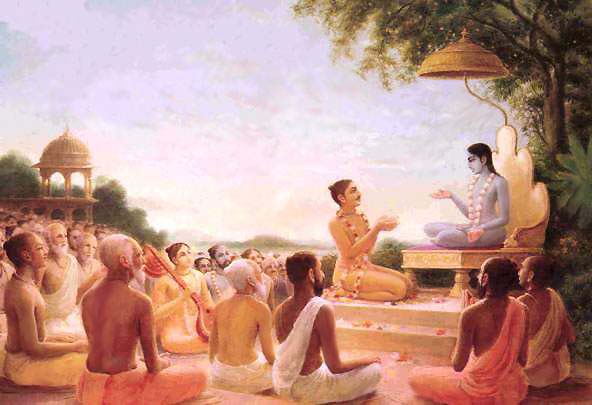
Prahlāda Mahārāja said: Hearing and chanting about the transcendental holy name, form, qualities, paraphernalia and pastimes of Lord Viṣṇu, remembering them, serving the lotus feet of the Lord, offering the Lord respectful worship with sixteen types of paraphernalia, offering prayers to the Lord, becoming His servant, considering the Lord one’s best friend, and surrendering everything unto Him (in other words, serving Him with the body, mind and words)—these nine processes are accepted as pure devotional service. One who has dedicated his life to the service of Kṛṣṇa through these nine methods should be understood to be the most learned person, for he has acquired complete knowledge. (SB 7.5.24-25)
The great personalities who attained perfection by practice of the nine processes are listed below
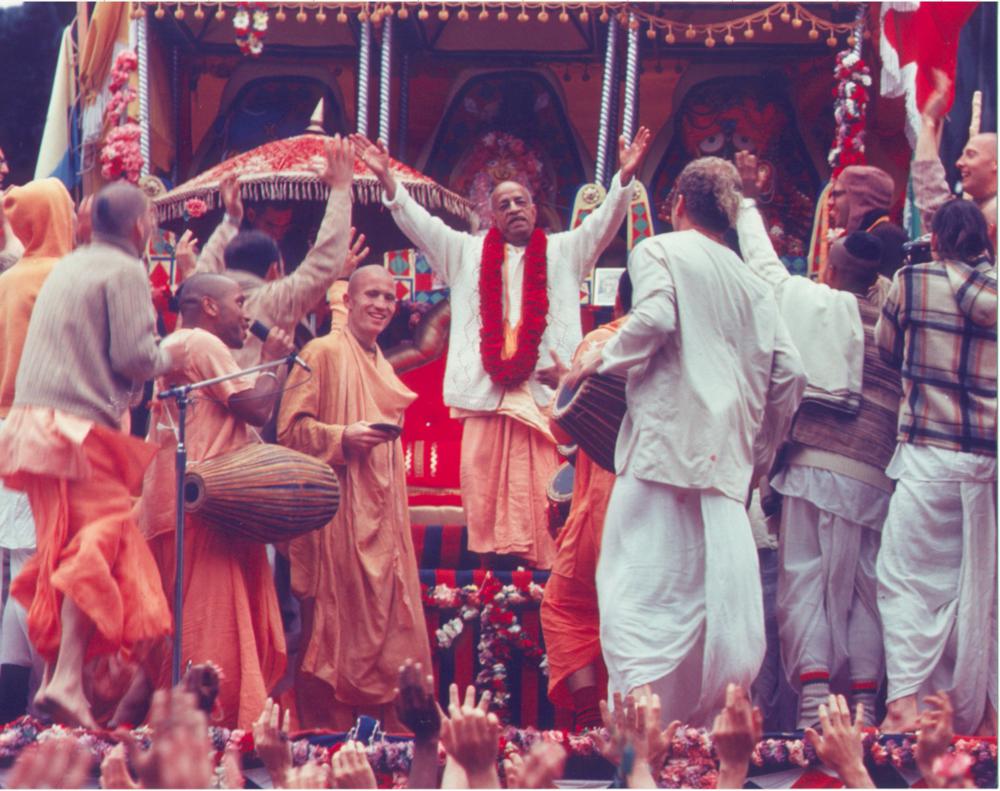
…Our, this Krsna consciousness movement is the greatest welfare activities in the human society. We are giving information to every man, without any discrimination of cast, creed, or color, that every human being especially, not only human being, all living entities, including the animals, beasts, birds, trees, aquatics—everyone—they can achieve to the highest perfection of life by this Krsna consciousness. But especially the extra intelligence of the human being can be utilized to realize Krsna. If we don’t do that, we are missing a great opportunity. So our request to everyone is to understand this philosophy of Krsna consciousness. If anyone wants to understand this philosophy through philosophical angle of vision or scientific angle of vision, we have got immense volumes of books. You can read and try to understand what is this great movement, Krsna consciousness. But you can also, without reading books, without taking any trouble, if you simply agree to chant this maha-mantra, Hare Krsna, Hare Krsna, Krsna Krsna, Hare Hare, Hare Rama, Hare Rama, Rama Rama, Hare Hare, you get the same result. Even a child can join. Actually we have experienced that a child, a dog, an animal, everyone takes part in this movement. During the Lord Caitanya’s movement, when He passed through a great forest known as Jharikhanda... Central India there is a great forest. Along with Him, the tigers, the elephants, the deers, everyone danced and chanted Krsna Krsna mantra. It is so nice, and it is so spiritual, the very vibration will immediately enthuse your ecstasy in spiritual consciousness.
…So if we want to have eternal life, full of knowledge and blissfulness, then we must take to Krsna consciousness. (Ratha-yatra lecture San Franscisco June 27, 1971)
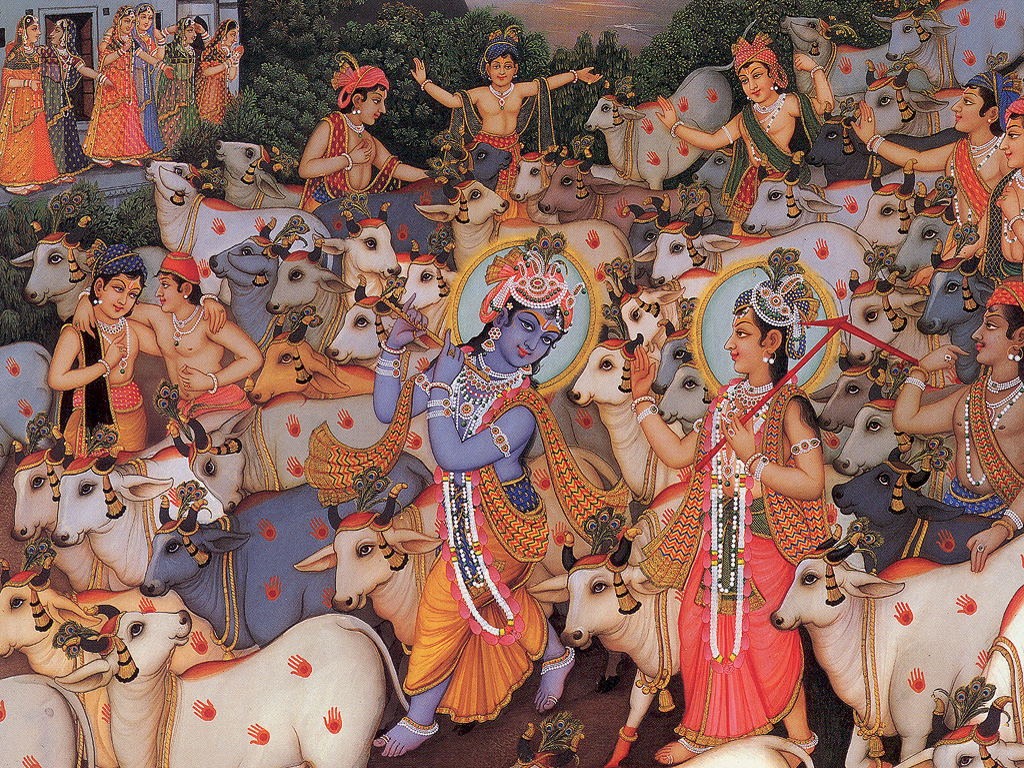
…While Kṛṣṇa was engaged in tending the cows in the forest of Vṛndāvana or on Govardhana Hill, the gopīs in the village were always absorbed in thinking of Him and discussing His different pastimes. This is the perfect example of Kṛṣṇa consciousness: to somehow or other remain always engrossed in thoughts of Kṛṣṇa. The vivid example is always present in the behavior of the gopīs; therefore Lord Caitanya declared that no one can worship the Supreme Lord by any method which is better than the method of the gopīs. The gopīs were not born in very high brāhmaṇa or kṣatriya families; they were born in the families of vaiśyas, and not in big mercantile communities but in the families of cowherd men. They were not very well educated, although they heard all sorts of knowledge from the brāhmaṇas, the authorities of Vedic knowledge. The gopīs’ only purpose was to remain always absorbed in thoughts of Kṛṣṇa.
Kṛṣṇa was very pleased with the atmosphere of the forest where flowers bloomed and bees and drones hummed very jubilantly. While the birds, trees and branches were all looking very happy, Kṛṣṇa, tending the cows, accompanied by Śrī Balarāma and the cowherd boys, began to vibrate His transcendental flute. After hearing the vibration of the flute of Kṛṣṇa, the gopīs in Vṛndāvana remembered Him and began to talk amongst themselves about how nicely Kṛṣṇa was playing His flute. When the gopīs were describing the sweet vibration of Kṛṣṇa’s flute, they also remembered their pastimes with Him; thus their minds became disturbed, and they were unable to describe completely the beautiful vibrations. While discussing the transcendental vibration, they remembered also how Kṛṣṇa dressed, decorated with a peacock feather on His head, just like a dancing actor, and with blue flowers pushed over His ear. His garment glowed yellow-gold, and He was garlanded with a vaijayantī necklace. Dressed in such an attractive way, Kṛṣṇa filled up the holes of His flute with the nectar emanating from His lips. So they remembered Him, entering the forest of Vṛndāvana, which is always glorified by the footprints of Kṛṣṇa and His companions. Kṛṣṇa was very expert in playing the flute, and the gopīs were captivated by the sound vibration, which was not only attractive to them, but to all living creatures who heard it. One of the gopīs told her friends, “The highest perfection of the eyes is to see Kṛṣṇa and Balarāma entering the forest and playing Their flutes and tending the cows with Their friends.”
Persons who are constantly engaged in the transcendental meditation of seeing Kṛṣṇa, internally and externally, by thinking of Him playing the flute and entering the Vṛndāvana forest, have really attained the perfection of samādhi. Samādhi (trance) means absorption of all the activities of the senses on a particular object, and the gopīs indicate that the pastimes of Kṛṣṇa are the perfection of all meditation and samādhi. It is also confirmed in the Bhagavad-gītā that anyone who is always absorbed in the thought of Kṛṣṇa is the topmost of all yogīs. (KRSNA The Supreme Personality of Godhead, Vol 1, Chapter 21)
In honor of the appearance day of Lord Nrsimha, we are fasting untill Sunset and posting a beautiful verse and purport from the Srimad Bhagavatam 5.18.8 glorifying the Lord and his devotees.
I offer my respectful obeisances unto Lord Nṛsiṁhadeva, the source of all power. O my Lord who possesses nails and teeth just like thunderbolts, kindly vanquish our demon like desires for fruitive activity in this material world. Please appear in our hearts and drive away our ignorance so that by Your mercy we may become fearless in the struggle for existence in this material world.
PURPORT
In Śrīmad-Bhāgavatam (SB 4.22.39) Sanat-kumāra speaks the following words to Mahārāja Pṛthu:
yat-pāda-paṅkaja-palāśa-vilāsa-bhaktyā karmāśayaṁ grathitam udgrathayanti santaḥ tadvan na rikta-matayo yatayo ‘pi ruddha- srotogaṇās tam araṇaṁ bhaja vāsudevam
“Devotees always engaged in the service of the toes of the Lord’s lotus feet can very easily become free from hard-knotted desires for fruitive activities. Because this is very difficult, the nondevotees—the jñānīs and yogīs—cannot stop the waves of sense gratification, although they try to do so. Therefore you are advised to engage in the devotional service of Kṛṣṇa, the son of Vasudeva.”
Every living being within this material world has a strong desire to enjoy matter to his fullest satisfaction. For this purpose, the conditioned soul must accept one body after another, and thus his strongly fixed fruitive desires continue. One cannot stop the repetition of birth and death without being completely desireless. Therefore Śrīla Rūpa Gosvāmī describes pure bhakti (devotional service) as follows:
“One should render transcendental loving service to the Supreme Lord Kṛṣṇa favorably and without desire for material profit or gain through fruitive activities or philosophical speculation. That is called pure devotional service.”
Unless one is completely freed of all material desires, which are caused by the dense darkness of ignorance, one cannot fully engage in the devotional service of the Lord. Therefore we should always offer our prayers to Lord Nṛsiṁhadeva, who killed Hiraṇyakaśipu, the personification of material desire. Hiraṇya means “gold,” and kaśipu means “a soft cushion or bed.” Materialistic persons always desire to make the body comfortable, and for this they require huge amounts of gold. Thus Hiraṇyakaśipu was the perfect representative of materialistic life. He was therefore the cause of great disturbance to the topmost devotee, Prahlāda Mahārāja, until Lord Nṛsiṁhadeva killed him. Any devotee aspiring to be free of material desires should offer his respectful prayers to Nṛsiṁhadeva as Prahlāda Mahārāja did in this verse.
Remembering Jayananda by Vyasasan das __________________
There are some things about becoming a devotee I will never forget, for instance; receiving my first book, relishing my first plate of prasadam, seeing the deities in the temple for the first time, meeting Srila Prabhupada, Visnujhana Swami and Jayananda das bramachari.
The first time I meet Jayananda, was in 1975 in San Diego. I had been traveling with the RDTSKP for the last few months, since I joined. I was very much enjoying being a devotee, and traveling and putting on festivals, distributing prasadam, books and the Holy Name. By this time I had meet a number of Sannyasis; including Tamal Krsna Goswami, Gurudas Swami, Tripuari Swami, Vishnujana Swami, etc. and was very impressed by their character, and position.
One morning after Bhagavatam class we were all sitting down on the floor taking our breakfast. I was looking over at all the assembled sannyasis; there must have been seven of them eating together. They all had on nice orange clothing, and were eating off beautiful silver plates, and I was thinking, “Ya, that’s what I want. I want to be a Hare Krishna Sannyasa. Devotees will offer me respectful obeisances when they see me, and I will always get the best accommodations and best prasadam”. So I was thinking like this… when in walks in this guy in a greasy hooded sweatshirt, ripped doti, hands and face covered with dirt and grease, (it turns out he just changed the oil in 6 sankirtan vans), and he walks over to the prasadam table and starts filling a plate.
So I ask the devotee sitting next to me, “Who is that guy, is he supposed to be here?” I thought it was some bum wearing a dhoti. But the devotee replied; “Oh, that’s Jayananda Prabhu, he’s a really advanced devotee”. Well I was looking at Jayananda who was eagerly feasting on the morning prasadam, and I was looking over at the sannyasis who were carefully moving the prasadam around the silver plates, and I just wasn’t that sure?
As fate would have it, right after we finished our breakfast, I was told that I would be traveling with Jayananda. So with my head in hand I slowly went over to the sankirtan van he would be driving and opened the passenger side door. He greeted me with a huge radiant smile and an ear shattering “Hari Bol” and offered me some halava he had in a plastic bag. I liked him immediately. There was something about him that instilled me with faith and confidence. I couldn’t stop smiling the whole day as he told me stories about Srila Prabhupada, and his adventures when he was a taxi cab driver. As the weeks turned into months, I came to recognize that he was in fact a very advanced disciple of Srila Prabhupada.
He had such great love for Srila Prabhupada, and he worked all day every day, performing his service with such great joy and devotion. There was nothing he wouldn’t do, no service was beneath him. And it reminded me of a quote I read when I was back in college; that “The master is the servant in disguise”.
Meeting Jayananda das bramachari (as he was known back then), was a lesson to me; “Don’t judge a book by its cover”. On the outside he seemed a little tattered, but inside, he had a heart of gold. And I am reminded that when Srila Prabhupada was present, and when Krishna Himself was present, not everyone recognized that here is Krishna, here is God. Here is Srila Prabhupada; here is the pure devotee of the Lord. Similarly, I could not, with my materially motivated vision, recognize who is an advanced devotee. But the truth was revealed to me as I began my association with the legendary Jayananda Thakur.
In loving memory Vyasasan das May 25, 2010 (Disappearance day of Jayananda Prabhu)
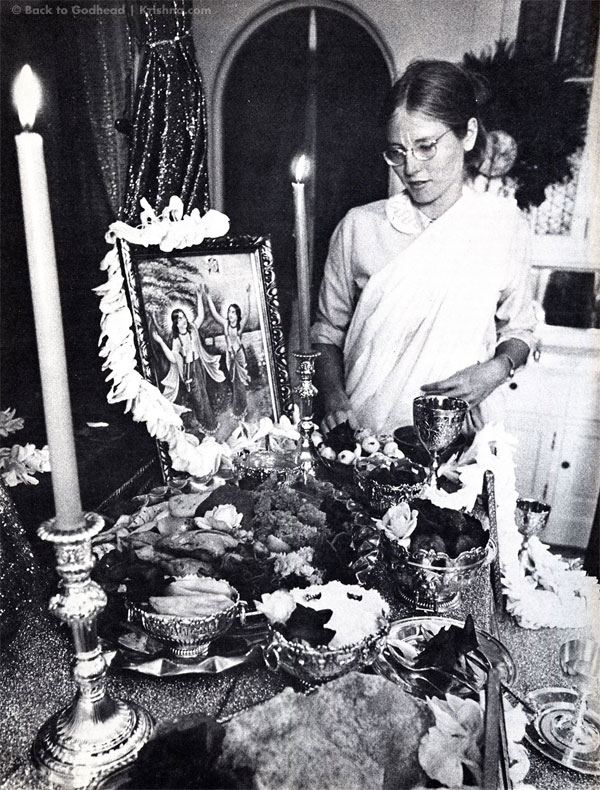
Krishna Prasadam is spiritually sanctified food offered to Lord Krishna with love and devotion, considered His mercy (prasada). It is believed to purify the heart, cleanse sinful reactions, and spiritualize the soul. Vegetarian, sattvic food (free from meat, onion, garlic) is offered in a devoted, clean manner before consumption.
Food prepared for and offered to Krishna with love and devotion becomes completely spiritualized. Such food is called Krishna prasadam, which means “the mercy of Lord Krishna.” (The Hare Krishna Cookbook)
Lord Caitanya said of prasadam…”now that they have been prepared for Krishna and offered to Him with devotion, these foods have acquired extraordinary tastes and uncommon fragrances. Just taste them and see the difference! Apart from the taste, even the fragrance pleases the mind and makes one forget any other fragrance. Therefore, it should be understood that the spiritual nectar of Krishna’s lips must have touched these ordinary foods and imparted to them all their transcendental qualities.”
Eating only food offered to Krishna is the perfection of vegetarianism. In the Bhagavad-gita Lord Krishna says that unless one eats only food that has been offered to Him in sacrifice, one will suffer the reactions of karma. He also states, “If one offers Me with love and devotion a leaf, a flower, a fruit, or water, I will accept it.”
The spiritual master is always offering Kṛṣṇa four kinds of delicious food . When the spiritual master sees that the devotees are satisfied by eating bhagavat-prasāda, he is satisfied. I offer my respectful obeisances unto the lotus feet of such a spiritual master.(Śrī Śrī Gurv-aṣṭaka)
I was at the Vancouver temple on 16 Avenue and had been living at the temple for a few months when I heard that Srila Prabhupada was coming to L.A. I’d never seen Prabhupada before so I got very excited as I knew that I must meet him! I asked Bahudak, who was the temple president, that I wanted to go to meet Prabhupada. He said, “If you want to please Prabhupada, you stay here and do your service.” So I said, “OK, prabhu.” (yeah, right) As soon as he left I ran upstairs to the brahmacari ashram and just grabbed my red coat. I ran out the back door into the alley and escaped! I didn’t have any money and I was in Canada. During those years the hippie movement was very prominent therefore the US customs made it difficult to enter the US without money. So there I am, shaved head, dhoti, tilak, bead bag and penniless! The boarder guards started laughing and said “looks like we got ourselves a strange Mormon!” Within that laughter It seemed as though Krishna’s yogamaya took over and they waved me past. At this point a great triumph overwhelmed me as I had made it across the border! I start hitchhiking and got almost to the Oregon state line the first night, where I was dropped off in the middle of nowhere. I crawled under a barbed wire fence and slept snuggly under a tree that seemed to have a God-made cradle under it’s protective branches. Around sunrise I was rudely awakened by a slight tremor and loud heavy breathing. I was afraid to open my eyes! I mustered up the courage to do so and there just inches away from my face, stood a huge bull! Unluckily, I had my bright red coat on and the bull was preparing to charge! I immediately started praying to Krishna to please save me!
I really like this particular prayer/song, because this prayer offers respectful obeisances to the spiritual master, to the vaisnavas, the six goswamis, the pancha tattva, Radha and Krishna, and the gopis. Its all there in one prayer.
Maṅgalācaraṇa Prayers
vande ’haṁ śrī-guroḥ śrī-yuta-pada-kamalaṁ śrī-gurun vaiṣṇavāṁś ca śrī-rūpaṁ sāgrajātaṁ saha-gaṇa-raghunāthānvitaṁ taṁ sa-jīvam sādvaitaṁ sāvadhūtaṁ parijana-sahitaṁ kṛṣṇa-caitanya-devaṁ śrī-rādhā-kṛṣṇa-pādān saha-gaṇa-lalitā-śrī-viśākhānvitāṁś ca
I offer my respectful obeisances unto the lotus feet of my spiritual master and unto the feet of all Vaiṣṇavas. I offer my respectful obeisances unto the lotus feet of Śrīla Rūpa Gosvāmī along with his elder brother Sanātana Gosvāmī, as well as Raghunātha Dāsa and Raghunātha Bhaṭṭa, Gopāla Bhaṭṭa, and Śrīla Jīva Gosvāmī. I offer my respectful obeisances to Lord Kṛṣṇa Caitanya and Lord Nityānanda along with Advaita Ācārya, Gadādhara, Śrīvāsa, and other associates. I offer my respectful obeisances to Śrīmatī Rādhārāṇī and Śrī Kṛṣṇa along with Their associates, Śrī Lalitā and Viśākhā.
Purport to the Maṅgalācaraṇa Prayers by His Divine Grace A.C. Bhaktivedanta Swami Prabhupada Los Angeles, January 8, 1969
I posted this some years ago, but this morning I happened upon it again, and so enjoyed it, we thought we would post it again. In this treatise Ajitananda Prabhu describes how Srila Prabhupada perfectly displayed the twenty-six qualities of a pure devotee of Lord Krishna.
In Praise of Srila Prabhupada . by Ajitananda dasa ________________
His Divine Grace A.C. Bhaktivedanta Swami Prabhupada, who successfully distributed the message of Lord Krsna throughout the world, was not an ordinary conditioned soul, governed by the harsh laws of material nature. Although to the unenlightened he may have appeared to exhibit commonplace characteristics, it is evident through the careful study of his life and activities, that Srila Prabhupada perfectly displayed the twenty-six qualities of a pure devotee of Lord Krsna. We learn from Vedic literature that one who possesses these qualities is necessarily free from material bondage, and enjoys an eternal position in the intimate association of the Supreme Lord. Such a great soul is very rarely found within this material realm, and owing to his unparalleled purity and exalted status, he is worshipable by the entire world. Individually, and as a collective society of aspiring devotees, we must always strive to appreciate Srila Prabhupada’s divine qualities, teach this application to others, and perform all of our devotional activities for his satisfaction. This treatise is an imperfect but hopeful attempt to please Srila Prabhupada by illustrating, in a practical way, how he perfectly displayed the twenty-six qualities of a pure devotee of Lord Krsna.
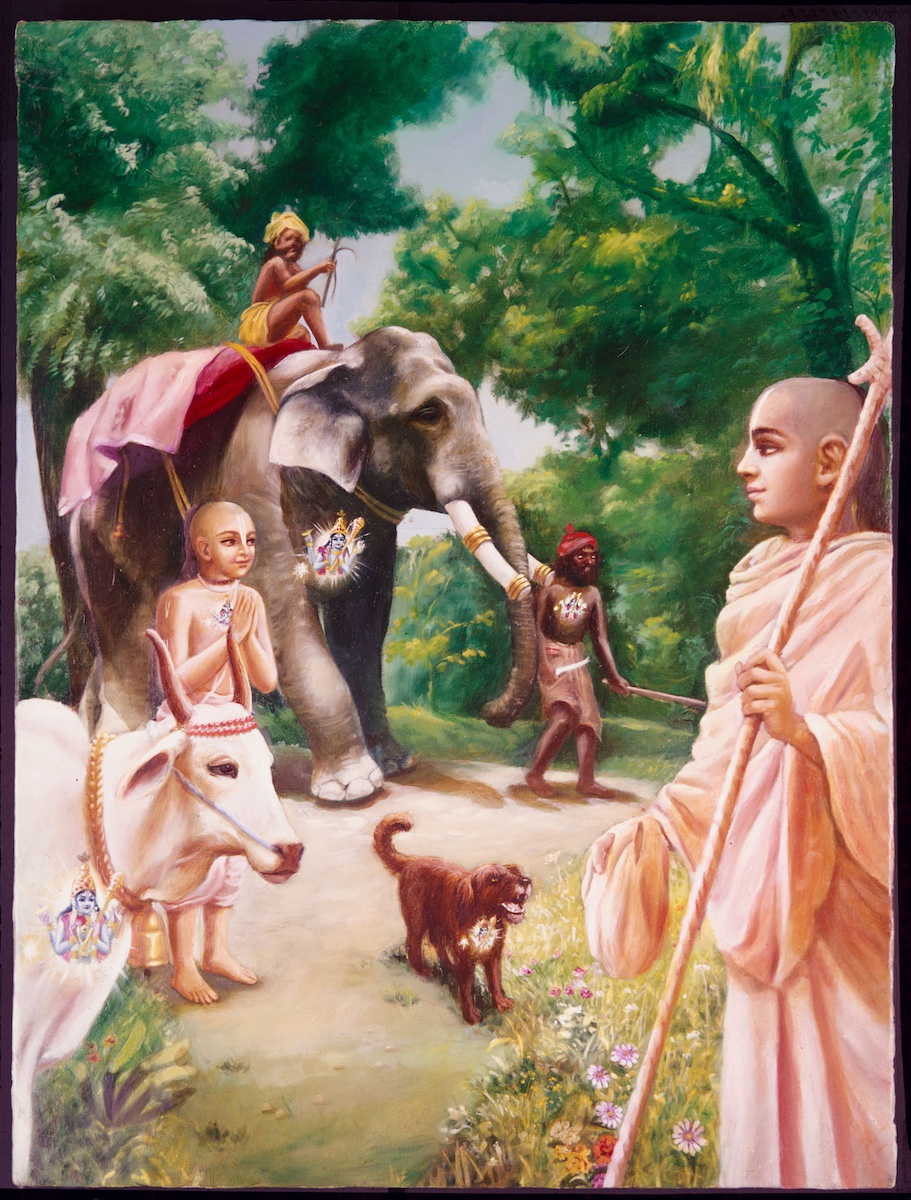
I remember the very first time I opened the Bhagavad-gita, I focused on the pictures and captions. I wasn’t really ready to read it yet, it seemed way above my level of intelligence, and there were words I couldn’t pronounce or understand, but the pictures spoke to me. I thought this image, as simplistic as it was, spoke a very profound and powerful message.
Bhagavad-gita As It Is
by A. C. Bhaktivedanta Swami Prabhupada
vidyā-vinaya-sampanne brāhmaṇe gavi hastini śuni caiva śva-pāke ca paṇḍitāḥ sama-darśinaḥ
vidyā—education; vinaya—gentleness; sampanne—fully equipped; brāhmaṇe—in the brāhmaṇa; gavi—in the cow; hastini—in the elephant; śuni—in the dog; ca—and; eva—certainly; śvapāke—in the dog-eater (the outcaste); ca—respectively; paṇḍitāḥ—those who are so wise; sama-darśinaḥ—do see with equal vision.
TRANSLATION
The humble sage, by virtue of true knowledge, sees with equal vision a learned and gentle brāhmaṇa, a cow, an elephant, a dog and a dog-eater [outcaste]. (Bg 5.18)
PURPORT
A Kṛṣṇa conscious person does not make any distinction between species or castes. The brāhmaṇa and the outcaste may be different from the social point of view, or a dog, a cow, or an elephant may be different from the point of view of species, but these differences of body are meaningless from the viewpoint of a learned transcendentalist. This is due to their relationship to the Supreme, for the Supreme Lord, by His plenary portion as Paramātmā, is present in everyone’s heart. Such an understanding of the Supreme is real knowledge. As far as the bodies are concerned in different castes or different species of life, the Lord is equally kind to everyone because He treats every living being as a friend yet maintains Himself as Paramātmā regardless of the circumstances of the living entities. The Lord as Paramātmā is present both in the outcaste and in the brāhmaṇa, although the body of a brāhmaṇa and that of an outcaste are not the same. The bodies are material productions of different modes of material nature, but the soul and the Supersoul within the body are of the same spiritual quality. The similarity in the quality of the soul and the Supersoul, however, does not make them equal in quantity, for the individual soul is present only in that particular body, whereas the Paramātmā is present in each and every body. A Kṛṣṇa conscious person has full knowledge of this, and therefore he is truly learned and has equal vision. The similar characteristics of the soul and Supersoul are that they are both conscious, eternal and blissful. But the difference is that the individual soul is conscious within the limited jurisdiction of the body, whereas the Supersoul is conscious of all bodies. The Supersoul is present in all bodies without distinction.
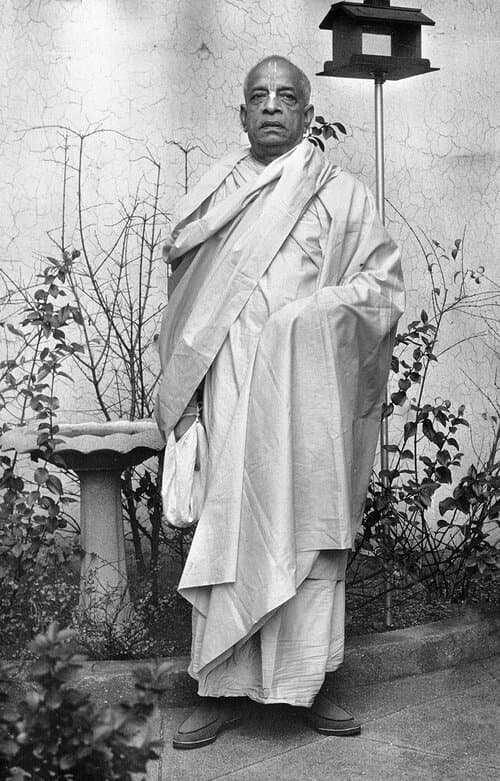
His Divine Grace A.C. Bhaktivedanta Swami Prabhupada
I have been carrying around a little piece of paper in my wallet, with the words yare dekha, tare kaha on it. I finally went to Vaniquotes to see what these words implied.
yāre dekha, tāre kaha ‘kṛṣṇa’-upadeśa āmāra ājñāya guru hañā tāra’ ei deśa (Cc Madhya 7.128)
“Instruct everyone to follow the orders of Lord Śrī Kṛṣṇa as they are given in the Bhagavad-gītā and Śrīmad-Bhāgavatam. In this way become a spiritual master and try to liberate everyone in this land.”
…the sublime mission of the International Society for Krishna Consciousness. Many people come and inquire whether they have to give up family life to join the Society, but that is not our mission. One can remain comfortably in his residence. We simply request everyone to chant the mahā-mantra: Hare Kṛṣṇa, Hare Kṛṣṇa, Kṛṣṇa Kṛṣṇa, Hare Hare/ Hare Rāma, Hare Rāma, Rāma Rāma, Hare Hare.
…The real purpose of human life is to attain the spiritual platform and return to Godhead. That is the summum bonum of spiritual realization. The Kṛṣṇa consciousness movement is trying to elevate human society to the perfection of life by pursuing the method described by Śrī Caitanya Mahāprabhu in His advice to the brāhmaṇa Kūrma. That is, one should stay at home, chant the Hare Kṛṣṇa mantra and preach the instructions of Kṛṣṇa as they are given in the Bhagavad-gita and Srimad Bhagavatam. (from purport)
“Whomever you meet, simply talk with him about the instructions given by Kṛṣṇa or tell him of narrations about Kṛṣṇa.” (SB 4.23.38)
I am sure by now, everyone has heard about Donald Trumps tweets from his social media.
I really don’t want to focus my attention on such insane speak, but it was to horrific to ignore.
“A whole civilization will die tonight, never to be brought back again” (April 7)
A civilization that has been around for some 5,000 years, since the time of the Pandavas. It is simply madness. And can only be described as demonic behavior.
From the pages of the Bhagavad-gita, there is a description of the demoniac personality…
The demoniac person thinks: “So much wealth do I have today, and I will gain more according to my schemes. So much is mine now, and it will increase in the future, more and more. He is my enemy, and I have killed him; and my other enemy will also be killed. I am the lord of everything, I am the enjoyer, I am perfect, powerful and happy. I am the richest man, surrounded by aristocratic relatives. There is none so powerful and happy as I am. I shall perform sacrifices, I shall give some charity, and thus I shall rejoice.” In this way, such persons are deluded by ignorance. (Bg 16. 13-14)
Following such conclusions, the demoniac, who are lost to themselves and who have no intelligence, engage in unbeneficial, horrible works meant to destroy the world. (Bg 16.9)
This is a very important verse, and often quoted by Srila Prabhupada in Lectures.
“One who knows the transcendental nature of My appearance and activities does not, upon leaving the body, take his birth again in this material world, but attains My eternal abode, O Arjuna.” (Bg 4.9)
…“The one Supreme Personality of Godhead is eternally engaged in many, many transcendental forms in relationships with His unalloyed devotees.”
…the devotee, simply by understanding the transcendental nature of the body and activities of the Lord, attains the abode of the Lord after ending this body and does not run the risk of returning again to this material world.
…One can attain the perfect stage of liberation from birth and death simply by knowing the Lord, the Supreme Personality of Godhead. (from purport)
When I first began reading this verse from the Srimad Bhagavatam this morning, I thought it was just about hearing, but as I read and re read the purport, it was also about love.
“Simply by giving aural reception to this Vedic literature, the feeling for loving devotional service to Lord Kṛṣṇa, the Supreme Personality of Godhead, sprouts up at once to extinguish the fire of lamentation, illusion and fearfulness.” (Srimad Bhagavatam 1.7.7.)
There are various senses, of which the ear is the most effective. This sense works even when a man is deep asleep. One can protect himself from the hands of an enemy while awake, but while asleep one is protected by the ear only. The importance of hearing is mentioned here in connection with attaining the highest perfection of life, namely, getting free from three material pangs…
…And it is definitely suggested herein that simply by hearing the message of Śrīmad-Bhāgavatam one gets attachment for the Supreme Personality of Godhead Śrī Kṛṣṇa, and as soon as this is effected the symptoms of the material diseases disappear. Śrīla Vyāsadeva saw the all-perfect Personality of Godhead, and in this statement the all-perfect Personality of Godhead Śrī Kṛṣṇa is clearly confirmed.
The ultimate result of devotional service is to develop genuine love for the Supreme Personality. Love is a word which is often used in relation with man and woman. And love is the only word that can be properly used to indicate the relation between Lord Kṛṣṇa and the living entities.
Loving devotional service to the Lord begins with hearing about the Lord. (from purport)
I am often of two minds. As a practicing devotee, I know that I should focus my mind on spiritual matters, but I am also living in this material world in a material body. Therefore much of my time and energy is engaged in material activities, like watching world news for example. It is like driving by a roadside accident and wanting to look at the damage, but knowing I should keep my eyes on the road.
I try to understand that “I am not this body, I am Spirit soul” and yet every day I feel the pains of ageing. I try to focus on the teachings of the Bhagavad-gita and the Srimad Bhagavatam, but my mind is drawn to events of this world. My heart aches for the suffering of others, and my only solace is the teachings of the Bhagavad-gita and Srimad Bhagavatam.
In Bhagavad-gītā it is stated that one who is advanced in spiritual knowledge is not disturbed by the pains and pleasures of the material body. The material body is completely separate from the spirit soul, and the pains and pleasures of the body are superfluous. The practice of austerity and penance is meant for understanding the distinction between the body and the soul and how the soul can be unaffected by the pleasures and pains of the body…” (from purport SB 5.10.9)
Everyone in this material world is distressed by miserable conditions, but Śrīla Prabodhānanda Sarasvatī says that this world is full of happiness. How is this possible? He answers, yat-kāruṇya-katākṣa-vaibhavavatāṁ taṁ gauram eva stumaḥ. A devotee accepts the distress of this material world as happiness only due to the causeless mercy of Śrī Caitanya Mahāprabhu. By His personal behavior, Śrī Caitanya Mahāprabhu showed that He was never distressed but always happy in chanting the Hare Kṛṣṇa mahā-mantra. One should follow in the footsteps of Śrī Caitanya Mahāprabhu and engage constantly in chanting the mahā-mantra—Hare Kṛṣṇa, Hare Kṛṣṇa, Kṛṣṇa Kṛṣṇa, Hare Hare/ Hare Rāma, Hare Rāma, Rāma Rāma, Hare Hare. Then he will never feel the distresses of the world of duality. In any condition of life one will be happy if he chants the holy name of the Lord. (from purport SB 6.17.30)
One should live in the material world very expertly. The material world is known as the world of duality because one sometimes has to act impiously and sometimes has to act piously. Although one does not want to act impiously, the world is so fashioned that there is always danger (padaṁ padaṁ yad vipadām [SB 10.14.58]). Thus even when performing devotional service a devotee has to create many enemies. Prahlāda Mahārāja himself had experience of this, for even his father became his enemy. A devotee should expertly manage to think always of the Supreme Lord so that the reactions of suffering cannot touch him (from purport SB 7.10.13)
Trying to advance in spiritual life outside the association of fellow devotees can be difficult. the Sanskrit word Smṛtyā means remembering Kṛṣṇa always. Life should be molded in such a way that one cannot remain alone without thinking of Kṛṣṇa. We should live in Kṛṣṇa so that while eating, sleeping, walking and working we remain only in Kṛṣṇa. Our Kṛṣṇa consciousness society recommends that we arrange our living so that we can remember Kṛṣṇa. (from purport SB 4.22.24)
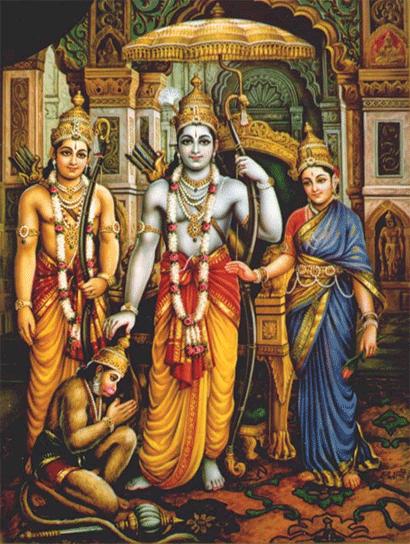
So today marks the appearance day of Lord Ramacandra, otherwise known as Rama-Navami. We honor it with a full day fast, followed by an nice vegetarian feast. It is nice to remember the Lord by extra chanting of His holy names, and with readings throughout the day of the glorious pastimes of the Lord.
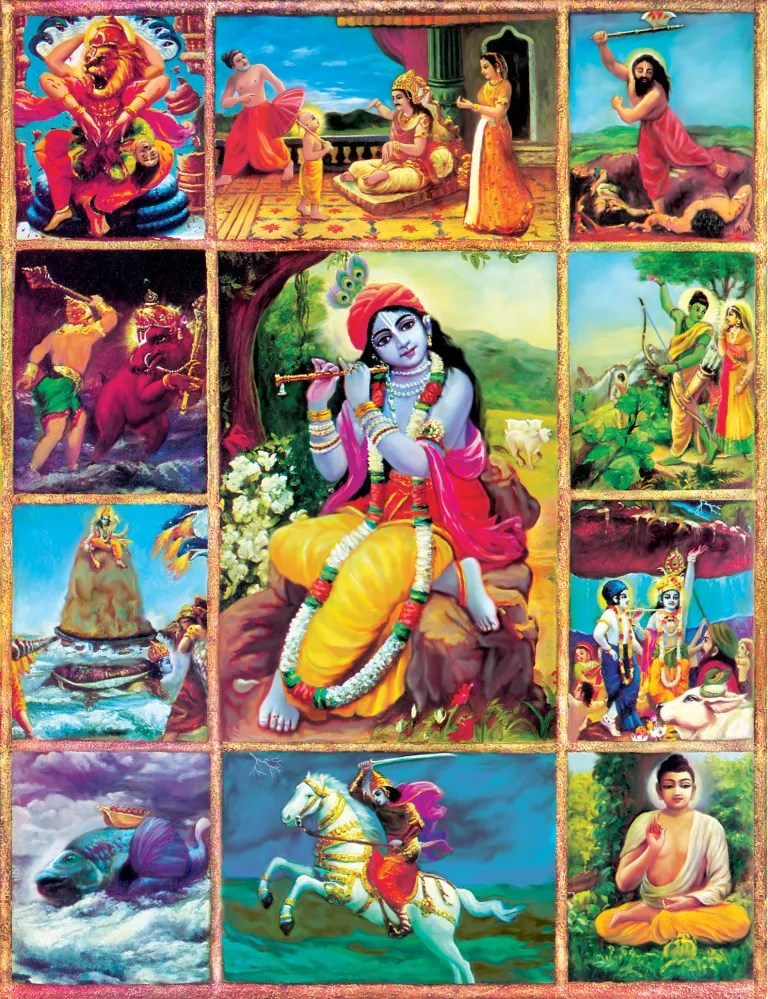
Ramachandra, or Lord Rama, is one of Krishna’s many avatars on earth. He appeared during a previous age, Treta-yuga, and ruled as emperor of the world. A chronicle of His activities is presented extensively in the epic Ramayana, and concisely in the ninth canto of the Srimad-Bhagavatam, a biography of Krishna’s many incarnations.
Ramachandra’s life is considered to be exemplary in every way. Followers of India’s Vedic culture see Him as the ideal king, the most powerful warrior, and the most faithful husband. It is said that He ruled His kingdom just as a loving father cares for his children. Lord Rama’s nobility, integrity, decency, and virtue are spoken of with reverence even today.
He appeared as the eldest son of Maharaja Dasarath, along with brothers Bharata, Lakshmana, and Shatrughna—also incarnations of the Supreme Person. He married Sita devi, daughter of King Janaka, after breaking the bow of Siva in the contest for Sita’s hand. On the day of Ramachandra’s coronation, however, due to royal intrigue, He was banished to the forest for fourteen years, and Lakshmana and Sita accompanied Him there.
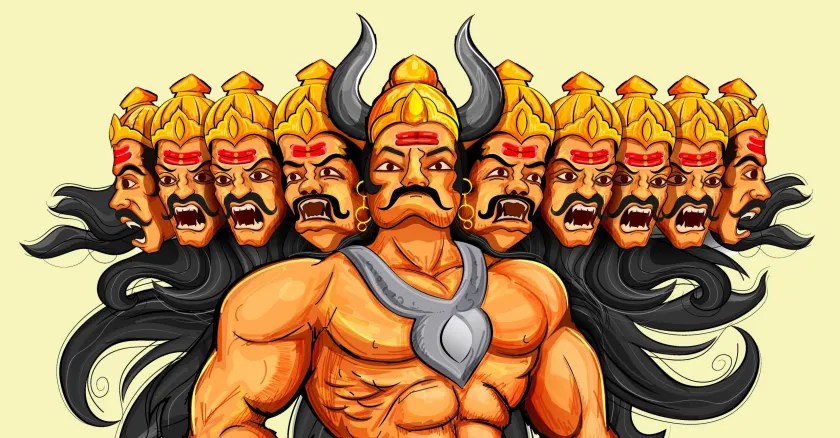
Ravana, king of Lanka, kidnapped Sita when Rama was absent from Their forest home. Subsequently, Rama and Lakshmana organized an army of forest-dwelling simians, vanaras—including the great devotee Hanuman— to attack Lanka. He then killed Ravana, rescued Sita, and triumphantly returned to His capital city, Ayodhya.
“In the eighteenth incarnation, the Lord appeared as King Rāma. In order to perform some pleasing work for the demigods, He exhibited superhuman powers by controlling the Indian Ocean and then killing the atheist King Rāvaṇa, who was on the other side of the sea.” (Srimad Bhagavatam 1.3.22)
We are living is Crazy Times at the moment. War is breaking out all over the world, with demonic leaders bombing their neighbors, the rich getting richer, at the expense of the poor, and animals being mercilessly killed in slaughter houses around the globe. How can we expect peace and happiness?
The peace for which you are hankering in life after life, moment after moment—that you’ll get at that time, when your desires are purified, and dovetailed with the Lord. One who desires sense gratification, the enjoyment of material satisfaction, will never be happy. That is not possible. If you want peace, if you want happiness, if you want perfection in your life, then just begin to dovetail your desires, activities, and potentials with the Supreme Personality of Godhead. Then you will see what real happiness is, and can tell who is really crazy.
Who Is Crazy? (Original) by Swami A.C. Bhaktivedanta
Lord Sri Krishna says, “My dear Arjuna, there are different classes of men. One class of men, they are sleeping. And another class of men, they are awake. They are not sleeping.” And how is this so? This chanting, which we have performed just now, is the wakening process for the sleeping soul. The soul is sleeping, covered by this material body. These bodily activities are in the sleeping stage. Just as we see dreams in the sleeping stage, similarly, all these bodily activities are dreams. Just think for yourself: how many incidents have there been in your past life? If you think of them, they will appear just like dreams. At least for myself this is the case. I was born in India, educated, then married, then I had very good days with my wife, got some children, some of whom died, some of whom are living, some of whom are married; now they have begotten children. All this occurred in my past life. Now it is all a dream. I have no connection with it. Similarly, in dreams I sometimes find that I have become a king. Oh, there are so many riches and so much opulence. Then, as soon as the dream is over, I come home and all is gone.
So actually, these bodily activities which we are now engaged in are not our actual life. Therefore, the Vedic mantra says, “O human race, please wake up. Just utilize the opportunity which you now have.” You have a special opportunity. And what is that? This human form of life. Utilize it; don’t waste it. Don’t go on sleeping. This very same matter is taken up by Sri Krishna. Those who are accustomed to the yoga process know this. The first principle of the yoga process is to control the senses. This is so for every process. In any bona fide process for spiritual realization, the first principle is to control the senses. This is because the senses are dragging us into the darkest region of life. But we do not realize this.
“So I cannot speak. I am feeling weak. I was to go to other places like Chandigarh, but I canceled the program because the condition of my health is very deteriorating. So I preferred to come to Vrindavan. If death takes place, let it take here. So there is nothing new to be said. Whatever I have to speak, I have spoken in my books. Now you try to understand it and continue your endeavor. Whether I am present or not present, it doesn’t matter. As Krsna is living eternally, similarly, the living being also lives eternally.
On My Behalf Srila Prabhupada’s Initiation System by Sriman Gauridasa Pandita Prabhu
Srila Prabhupada arrived in Sri Vrindavan Dhama on May 17th 1977 to prepare to ‘leave his body.’ He made all of the arrangements for the future of his movement. He formed his Will, the Temple Property Trusts, he gave instructions for the Bhaktivedanta Book Trust and the GBC and he established his initiation system for the future of ISKCON.
Due to some unseen good fortune I got the opportunity to serve Srila Prabhupada, at that time. Actually, I began to personally serve him in Bombay as one of his guards and then went with him to Hrsikesh to ‘regain his failing health’ on the advice of one of the life members, Mahadevia Kartikeya.
Things were like heaven in Hrsikesh serving Srila Prabhupada. We were staying in a two story house right on the bank of the Holy Ganges River. We had the best Jalebi maker (Vedic sweets) in the world, according to Srila Prabhupada, right across the street. We used to have fruit, yogurt and hot Jalebis for breakfast. Srila Prabhupada said that hot Jalebis could cure the common cold.
I used to enjoy taking Japa Walks in the Himalayan Mountains. The forests are lush, filled with singing birds, and wandering devotees. Some Shivite’s live in the cave’s and only leave to bath in the Ganga. They eat only what is offered to them.
I used to also enjoy taking walks up along the Ganges Bank and then jump in the rushing Holy River and ride a log back to Srila Prabhupada’s house chanting all the way.
This reminded me of when Visnujana Swami was pulled by a rope in the water by the boat in Bengal as he chanted the Holy names of the Lord ~ Om Namo Bhagavate Vasudevia…etc.
We used to Perform Hari Nama Sankirtan in the Market Place just down from our house on the Ganga. We would chant until about 5pm then take the kirtan back to the rooftop of our house. Then at about 5:30pm Srila Prabhupada would give his darshan to the general public. Although we did not advertise the darshan; the room was always full of interested guests every night. Srila Prabhupada preached to them in his unique and charming way. He used his great Vaisnava wit to charm the crowds and inspire them to take to Krishna Consciousness. Most everyone left convinced, a few maybe not, but everyone who saw Srila Prabhupada felt that he was a perfect gentleman and a great and loving host. He always paid attention to everyone and made sure all guests received Prasadam. Srila Prabhupada also taught us each how to cook a basic meal of rice, dahl, and chapatis. The mercy of Srila Prabhupada was flowing like the Ganges at this time. And actually, it still is!
Yes, things were ecstatic in Hrisikesh, until that night when Srila Prabhupada first told us that he was going to leave his body.
All of the sudden the great weather turned stormy with thunder and lightening and the power was going off all night long. At about 2:30am Upendra Prabhu came downstairs and told us that Srila Prabhupada had been sitting up all night, and had just said that he was going to leave the planet! Srila Prabhupada said:
“Tomorrow we will go to Vrindavan; better to die in Vrindavan.”
The world seems to be in a state of chaos, what with cities being bombed, thousands of people being displaced, and left without home, power, heat, food or water. There is death and destruction in so many places around the globe. It is ‘man’s inhumanity to man”, and I often wonder how is it possible that man can act in such deplorable and sinful way
Those who are demoniac do not know what is to be done and what is not to be done. Neither cleanliness nor proper behavior nor truth is found in them. (Bg. 16.7)
Following such conclusions, the demoniac, who are lost to themselves and who have no intelligence, engage in unbeneficial, horrible works meant to destroy the world. (Bg. 16.9)
PURPORT
The demoniac are engaged in activities that will lead the world to destruction. The Lord states here that they are less intelligent. The materialists, who have no concept of God, think that they are advancing. But, according to Bhagavad-gītā, they are unintelligent and devoid of all sense. They try to enjoy this material world to the utmost limit and therefore always engage in inventing something for sense gratification. Such materialistic inventions are considered to be advancement of human civilization, but the result is that people grow more and more violent and more and more cruel, cruel to animals and cruel to other human beings. They have no idea how to behave toward one another. Animal killing is very prominent amongst demoniac people. Such people are considered the enemies of the world because ultimately they will invent or create something which will bring destruction to all. Indirectly, this verse anticipates the invention of nuclear weapons, of which the whole world is today very proud. At any moment war may take place, and these atomic weapons may create havoc. Such things are created solely for the destruction of the world, and this is indicated here. Due to godlessness, such weapons are invented in human society; they are not meant for the peace and prosperity of the world.