29 Feb 2012
by The Hare Krishna Movement
in A.C. Bhaktivedanta Swami Prabhupada, Bhagavad-gita, Divine and Demoniac Natures
Tags: A.C. Bhaktivedanta Swami Prabhupada. As It Is, anger, Bg. 16. 10-12, bhagavad-gita, Demoniac, Divine, greed, human civilization, lust, Original 1972 Edition, sense gratificiation, The Divine and Demoneac Natures
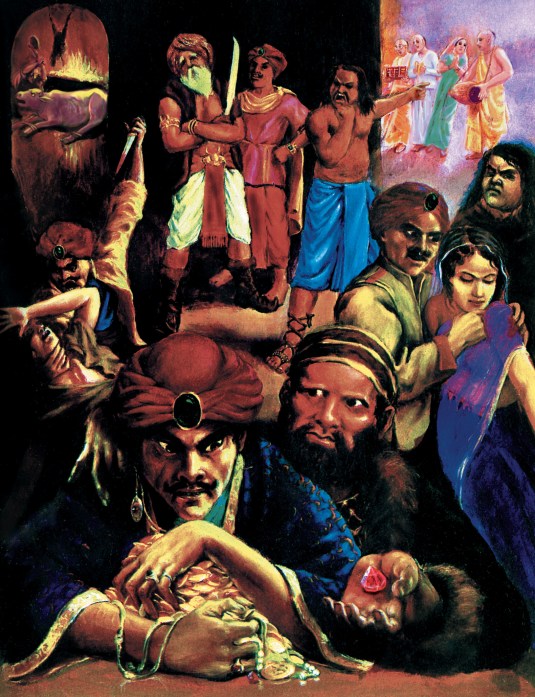
They believe that to gratify the senses unto the end of life is the prime necessity of human civilization. Thus there is no end to their anxiety. Being bound by hundreds and thousands of desires, by lust and anger, they secure money by illegal means for sense gratification.
Bhagavad-gītā As It Is
By His Divine Grace A. C. Bhaktivedanta Swami Prabhupāda
Chapter 16, Text 10-12
The Divine and Demoniac Natures
TEXT 10
kāmam āśritya duṣpūraṁ
dambha-māna-madānvitāḥ
mohād gṛhītvāsad-grāhān
pravartante ’śuci-vratāḥ
kāmam—lust; āśritya—taking shelter of; duṣpūram—insatiable; dambha—pride; māna—false prestige; mada-anvitāḥ—absorbed in conceit; mohāt—by illusion; gṛhītvā—taking; asat—nonpermanent; grāhān—things; pravartante—flourish; aśuci—unclean; vratāḥ—avowed.
The demoniac, taking shelter of insatiable lust, pride and false prestige, and being thus illusioned, are always sworn to unclean work, attracted by the impermanent.
Purport
The demoniac mentality is described here. The demons’ lust is never satiated. They will go on increasing and increasing their insatiable desires for material enjoyment. Although they are always full of anxieties on account of accepting nonpermanent things, they still continue to engage in such activities out of illusion. They have no knowledge and cannot tell that they are heading the wrong way. Accepting nonpermanent things, such demoniac people create their own God, create their own hymns and chant accordingly. The result is that they become more and more attracted to two things—sex enjoyment and accumulation of material wealth. The word aśuci-vratāḥ, unclean vow, is very significant in this connection. Such demoniac people are only attracted by wine, women, gambling and meat eating; those are their aśuci, unclean habits. Induced by pride and false prestige, they create some principles of religion which are not approved by the Vedic injunctions. Although such demoniac people are most abominable in the world, still, by artificial means, the world creates a false honor for them. Although they are gliding toward hell, they consider themselves very much advanced.
More
26 Feb 2012
by The Hare Krishna Movement
in Kali Yuga, People, Srimad Bhagavatam
Tags: A.C. Bhaktivedanta Swami Prabhupada, kingdom of God, life on earth, living entities, material creation, nature of the Lord, overpopulation, SB 3.3.14, Srimad Bhagavatam

…The earth is never overburdened. The heaviest mountains and oceans on the face of the earth hold more living entities than there are human beings, and they are not overburdened. If a census were taken of all the living beings on the surface of the earth, certainly it would be found that the number of humans is not even five percent of the total number of living beings.
…The material creation is meant for fulfilling the desire of the Lord, and His desire is that the conditioned souls who are unfit to enter into the kingdom of God have a chance to improve their conditions for entering. The entire process of cosmic arrangement is intended just to give a chance to the conditioned souls to enter the kingdom of God, and there is an adequate arrangement for their maintenance by the nature of the Lord…
Srimad Bhagavatam
By His Divine Grace A.C. Bhaktivedanta Swami Prabhupada
Third Canto, Chapter 3, Text 14
kiyān bhuvo ’yaṁ kṣapitoru-bhāro
yad droṇa-bhīṣmārjuna-bhīma-mūlaiḥ
ṣṭādaśākṣauhiṇiko mad-aṁśair
āste balaṁ durviṣahaṁ yadūnām
kiyān—what is this; bhuvaḥ—of the earth; ayam—this; kṣapita—abated; uru—very great; bhāraḥ—burden; yat—which; droṇa—Droṇa; bhīṣma—Bhīṣma; arjuna—Arjuna; bhīma—Bhīma; mūlaiḥ—with the help; aṣṭādaśa—eighteen; akṣauhiṇikaḥ—phalanxes of military strength (vide Bhāg. 1.16.34); mat-aṁśaiḥ—with My descendants; āste—are still there; balam—great strength; durviṣaham—unbearable; yadūnām—of the Yadu dynasty.
[After the end of the Battle of Kurukṣetra, the Lord said:] The abatement of the earth’s great burden, eighteen akṣauhiṇīs, has now been effected with the help of Droṇa, Bhīṣma, Arjuna and Bhīma. But what is this? There is still the great strength of the Yadu dynasty, born of Myself, which may be a more unbearable burden.
Purport
It is a wrong theory that due to an increase in population the world becomes overburdened and therefore there are wars and other annihilating processes. The earth is never overburdened. The heaviest mountains and oceans on the face of the earth hold more living entities than there are human beings, and they are not overburdened. If a census were taken of all the living beings on the surface of the earth, certainly it would be found that the number of humans is not even five percent of the total number of living beings. If the birthrate of human beings is increasing, then the birthrate of other living beings is increasing proportionately. The birthrate of lower animals—beasts, aquatics, birds, etc.—is far greater than that of human beings. There is an adequate arrangement for food for all the living beings all over the earth by the order of the Supreme Lord, and He can arrange more and more if there is actually a disproportionate increase of living beings.
More
26 Feb 2012
by The Hare Krishna Movement
in Remembering Srila Prabhupada, Spiritual Life, Srila Prabhupada
Tags: Bahushiras das, Krishna, Memories-Anecedotes of a Modern-day Saint, Remembering Srila Prabhupada, Siddhanta das, Srila Prabhupada, When Lord Krishna Garlanded Prabhupada
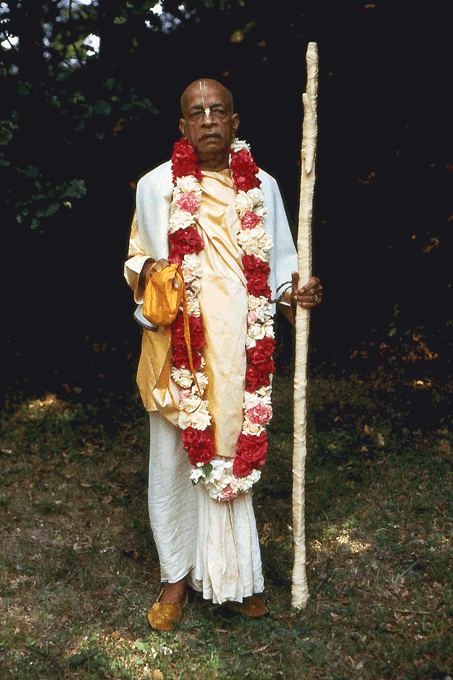
When Lord Krishna Garlanded Prabhupada
Bahushiras Das Adhikary
The following narration is from the visionary Memories series of Shriman Siddhanta das Adhikary. It is the remembrance of Shriman Bahushiras das Adhikary given in DVD 44 and in vol. 3, p. 334 of the book Memories-Anecdotes of a Modern-Day Saint.
After Shrila Prabhupada’s disappearance, [Patita Pavana das] asked if I’d like to assist Satswarupa’s Lilamrita project by interviewing people in India who had known Shrila Prabhupada. One of them was Acharya Prabhakar Misra, Prabhupada’s first disciple. Acharya Prabhakar Misra was clean-cut, well-behaved and articulate. His demeanor impressed me. He held a MA and PhD and was a very cultured Sanskrit scholar and teacher. In Jhansi, Prabhupada had told Acharya Prabhakar. “I met you because I saw you in a dream and I knew that I was supposed to come here.” Prabhupada and he would do bhajan together. They’d hold Rathayatra festivals and they’d have programme in villages in the area.
Acharya Prabhakar said that on Shri Krishna Janmashtami in 1954, he had to go to Delhi. When he returned to Jhansi, he took a little rest, woke up at 1:00 am and heard Shrila Prabhupada ecstatically playing mridanga in the temple room. Prabhupada was chanting in total bliss. Acharya Prabhakar went upstairs and saw Shrila Prabhupada bouncing around the temple room performing kirtan. Prabhupada was wearing a kadamba flower garland that went all the way down to his feet. Kadamba flowers are very rare in Jhansi and when they are available they are usually the size of a golf ball. But the ones Prabhupada was wearing were big, the size of tennis balls. And he said that the atmosphere right down to the atoms in the room was not material, aprakrita. The place was surcharged with the fragrance of the heavenly planets. Acharya Prabhakar wanted to ask Shrila Prabhupada, “Where did this garland come from? It is not available from the market.” But Shrila Prabhupada would not answer. His Divine Grace just kept on performing kirtan, bouncing round the room and chanting. The next morning Acharya Prabhakar asked Shrila Prabhupada, “Where did you get the garland, why did it have such a rich fragrance, and why were you feeling so blissful?”
Shrila Prabhupada told him, “I was chanting to Krishna and feeling some love for Him. And He appeared and gave me this garland. I went to touch His feet and He disappeared. Because of that I was dancing around the temple room.” Shrila Prabhupada was crying.
More
24 Feb 2012
by The Hare Krishna Movement
in Devotee's, Diksha, Guru & Disciple, Siksa, Vyasasan das
Tags: A.C. Bhaktivedanta Swami Prabhupada, disciple, guru, Gurus and Godbrothers, Iskcon, Krsna, spiritual master, Srila Prabhupada, The Hare Krishna Movement, Vyasasan das
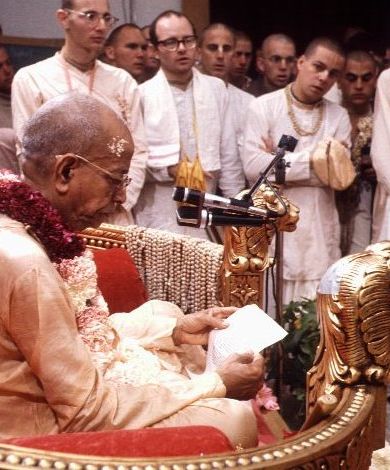
Gurus and Godbrothers
By Vyasasan das
Dear Srila Prabhupada,
Please accept my most humble obeisances, and kindly forgive my offences. In my last letter to you, which I titled “Return to the Hare Krishna Movement”, I was addressing some of the changes I witnessed to your movement since my return in 2006. I expressed some of my disappointments and concerns, and yet I still have faith in this mission of yours.
It was interesting to see which of my older God brothers was still practicing their Krsna Consciousness within the framework of ISKCON, who had remained and who had left. I read one very sad statistic the other day on the Internet, and am sorry to report that 95% of your initiated disciples are no longer practicing their KRSNA Consciousness within the structure of ISKCON. I was very alarmed by this, because it indicates to me there is a fatal flaw in the way the society is being managed.
This is not to say that they are not still practicing their Krsna Consciousness, for “once a devotee always a devotee”, or as is stated in the Srimad Bhagavatam 1.5.19, a person who has once relished the taste of the lotus feet of the Lord can do nothing but remember that ecstasy again and again, but sadly most are not practicing their faith within the structure of ISKCON.
More
22 Feb 2012
by The Hare Krishna Movement
in Bhagavad-gita, Book Changes, Devotee's, Satyaraja das
Tags: A.C. Bhaktivedanta Swami Prabhupada, Allen Ginsberg, Bhagavad-gita As It Is, Brahmananda das, Bruce Scharf, Macmillan Edition, prabhupada, Rayarama das, Satyaraja das, Srila Prabhupada's Bhagavad-gita

To purchase a copy of the original 1972 Macmillan Edition of Srila Prabhupada’s Bhagavad-gita As It Is, click on image to visit online store
The surprising events surrounding the initial publication of Srila Prabhupada’s Bhagavad-gita As It Is.
The Macmillan Miracle
By Sriman Satyaraja Prabhu
The Bhagavad-gita was important to Srila Prabhupada. He saw it as the perfect book to convey Krishna consciousness, as it consists of the Lord’s own words and His interactions with His loving devotee. In 1939, just seven years after Prabhupada was initiated by his spiritual master, he wrote a lengthy introduction to the book in English, presaging his full translation and commentary, which appeared soon after he began his mission in the West.
When Prabhupada arrived in New York in 1965, he gave priority to his work on the Gita. In India he had already completed a translation, spanning well over a thousand pages, but it was stolen. In March 1966, Prabhupada was adjusting to life in the Western world when he met with another loss: his typewriter, cassette recorder, and several books were taken from him. But he was resilient and determined to complete his work. In 1967 he finished the new manuscript, again over a thousand pages, and resolved to get a major publisher so that his message would be heard throughout the world.
At the time, Allen Ginsberg, famous poet of the Beat Generation, was visiting the New York temple, and he was enjoying a friendly relationship with Srila Prabhupada. Since Ginsberg was an experienced published author, Prabhupada asked him to show the manuscript to his benefactors, which Ginsberg did. But they were unimpressed, claiming the book had little commercial value.
Prabhupada then gave the manuscript to Rayarama Dasa, an early disciple with some experience in the publishing world. Rayarama, too, was unsuccessful in his attempts, his contacts explaining their hesitation in much the same way that Ginsberg’s did.
More
21 Feb 2012
by The Hare Krishna Movement
in Lectures, The Hare Krishna Movement
Tags: actual religion, bhagavad-gita, devotional service, His Divine Grace A.C. Bhaktivedanta Swami Prabhupada, krsna consciousness, love for God, Song of God, Srila Prabhupada lecture
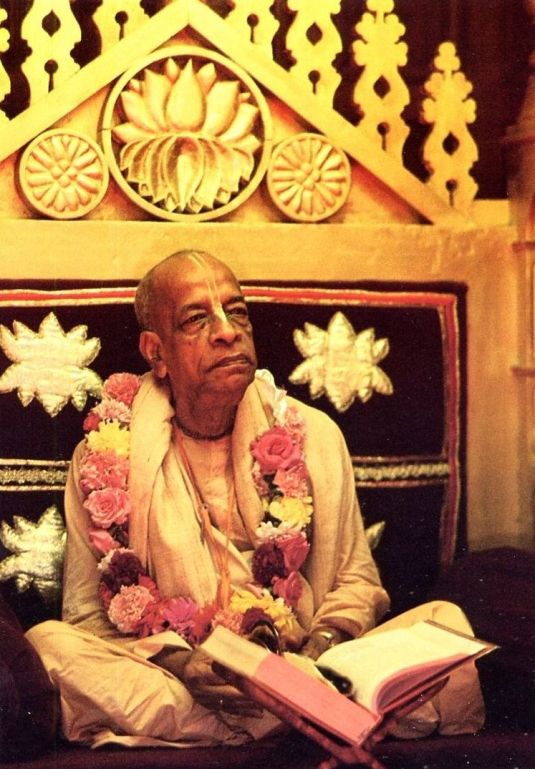
…so far our movement is concerned, you know, more or less, about our movement. But you should know that this is the most scientific, authorized movement in the human society, because the movement is based on the authority of Bhagavad-gita. Bhagavad-gita is spoken by the Supreme Personality of Godhead for the benefit of the whole human society.
“Actual Religion means to understand God and to develop your Love for God”
Lecture by His Divine Grace A.C. Bhaktivedanta Swami Prabhupada
New York, April 5, 1973
Ladies and Gentlemen, I thank you very much for kindly receiving me in this honorable way. According to our Vaisnava philosophy, whatever honor is offered to the spiritual master, that is transferred to the Supreme Personality of Godhead. Yasya prasadad bhagavat-prasado yasyaprasadan na gatih kuto ’pi. Our this philosophy, Vaisnava philosophy, it teaches that if you please your spiritual master, then God is also pleased. Because the spiritual master is the most confidential servant of God, therefore by honoring the spiritual master, the Supreme Personality of Godhead is honored. Just like in English language there is the word, “If you love me, love my dog.” So the spiritual master is the “dog” of God; therefore if the spiritual master is patted, God is very much pleased.
More
20 Feb 2012
by The Hare Krishna Movement
in Shiva, Srimad Bhagavatam
Tags: A.C. Bhaktivedanta Swami Prabhupada, Lord Siva, Maha Shivaratri, SB 4.4.14, Shiva, Sivaratri, Srimad Bhagavatam
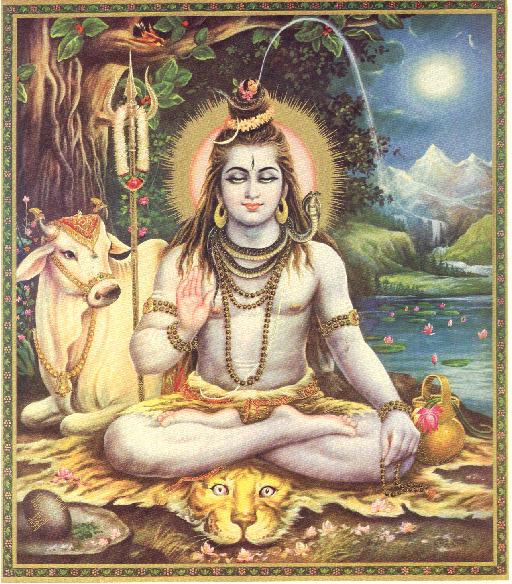
Today is Maha Shivaratri or Shivaratri, so we are posting one nice verse from the Srimad Bhagavatam in glorification of Lord Siva.
Śrīmad-Bhāgavatam: Canto 4: “The Creation of the Fourth Order”
By His Divine Grace A. C. Bhaktivedanta Swami Prabhupāda
Chapter Four, Text 14
yad dvy-akṣaraṁ nāma gireritaṁ nṛṇāṁ
sakṛt prasaṅgād agham āśu hanti tat
pavitra-kīrtiṁ tam alaṅghya-śāsanaṁ
bhavān aho dveṣṭi śivaṁ śivetaraḥ
yat—which; dvi-akṣaram—consisting of two letters; nāma—named; girā īritam—merely being pronounced by the tongue; nṛṇām—persons; sakṛt—once; prasaṅgāt—from the heart; agham—sinful activities; āśu—immediately; hanti—destroys; tat—that; pavitra-kīrtim—whose fame is pure; tam—him; alaṅghya-śāsanam—whose order is never neglected; bhavān—you; aho—oh; dveṣṭi—envy; śivam—Lord Śiva; śiva-itaraḥ—who are inauspicious.
TRANSLATION
Satī continued: My dear father, you are committing the greatest offense by envying Lord Śiva, whose very name, consisting of two syllables, śi and va, purifies one of all sinful activities. His order is never neglected. Lord Śiva is always pure, and no one but you envies him.
PURPORT
Since Lord Śiva is the greatest soul among the living entities within this material world, his name, Śiva, is very auspicious for persons who identify the body with the soul. If such persons take shelter of Lord Śiva, gradually they will understand that they are not the material body but are spirit soul. Śiva means maṅgala, or auspicious. Within the body the soul is auspicious. Ahaṁ brahmāsmi: “I am Brahman.” This realization is auspicious. As long as one does not realize his identity as the soul, whatever he does is inauspicious. Śiva means “auspicious,” and devotees of Lord Śiva gradually come to the platform of spiritual identification, but that is not all. Auspicious life begins from the point of spiritual identification. But there are still more duties—one has to understand one’s relationship with the Supreme Soul.
More
19 Feb 2012
by The Hare Krishna Movement
in Krishna Consciousness, Krsna is the Source of All Incarnations, Raja-Vidya
Tags: A.C. Bhaktivedanta Swami Prabhupada, Arjuna, ilusory energy, Krishna, Krishna consciousness, Krsna, Krsna's appearance, maya, Raja-Vidya, spiritual advancement

Kṛṣṇa’s birth, His appearance and disappearance, are likened unto the appearance and disappearance of the sun. In the morning it appears as if the sun is born from the eastern horizon, but actually it is not. The sun is neither rising nor setting; it is as it is in its position. All risings and settings are due to the rotation of the earth. Similarly, in Vedic literatures there are prescribed schedules for the appearance and disappearance of Śrī Kṛṣṇa. Kṛṣṇa’s rising is just like the sun. The sun’s rising and setting are going on at every moment; somewhere in the world people are witnessing sunrise and sunset. It is not that at one point Kṛṣṇa is born and at another point He is gone. He is always there somewhere, but He appears to come and go. Kṛṣṇa appears and disappears in many universes. We only have experience of this one universe, but from Vedic literatures we can understand that this universe is but a part of the infinite manifestations of the Supreme Lord.
Raja-vidya: The King of Knowledge
By His Divine Grace A.C. Bhaktivedanta Swami Prabhupada
Chapter 6
Knowledge of Kṛṣṇa’s Appearances and Activities
There are two forces of nature working in us. By one we decide that in this lifetime we will make spiritual advancement, but at the next moment the other force, māyā, or illusory energy, says, “What is all this trouble that you’re going to? Just enjoy this life and be easy with yourself.” This tendency to fall into forgetfulness is the difference between God and man. Arjuna is a companion and associate of Kṛṣṇa’s, and whenever Kṛṣṇa appears on any planet, Arjuna also takes birth and appears with Him. When Kṛṣṇa spoke Bhagavad-gītā to the sun god, Arjuna was also present with Him. But, being a finite living entity, Arjuna could not remember. Forgetfulness is the nature of the living entity. We cannot even remember what we were doing at this exact time yesterday or a week ago. If we cannot remember this, how is it possible to remember what happened in our previous lives? At this point we may ask how it is that Kṛṣṇa can remember and we cannot, and the answer is that Kṛṣṇa does not change His body.
More
18 Feb 2012
by The Hare Krishna Movement
in Back to Godhead, Hayagriva das, Krishna, Spiritual World
Tags: A.C. Bhaktivedanta Swami Prabhupada, Back to Godhead Magazine, Gokula, Goloka, Goloka Vrndavana, hayagriva das, Krsna lila, Lord Krsna's pastimes, spiritual sky, Spiritual world, the Divine Forms and Pastimes

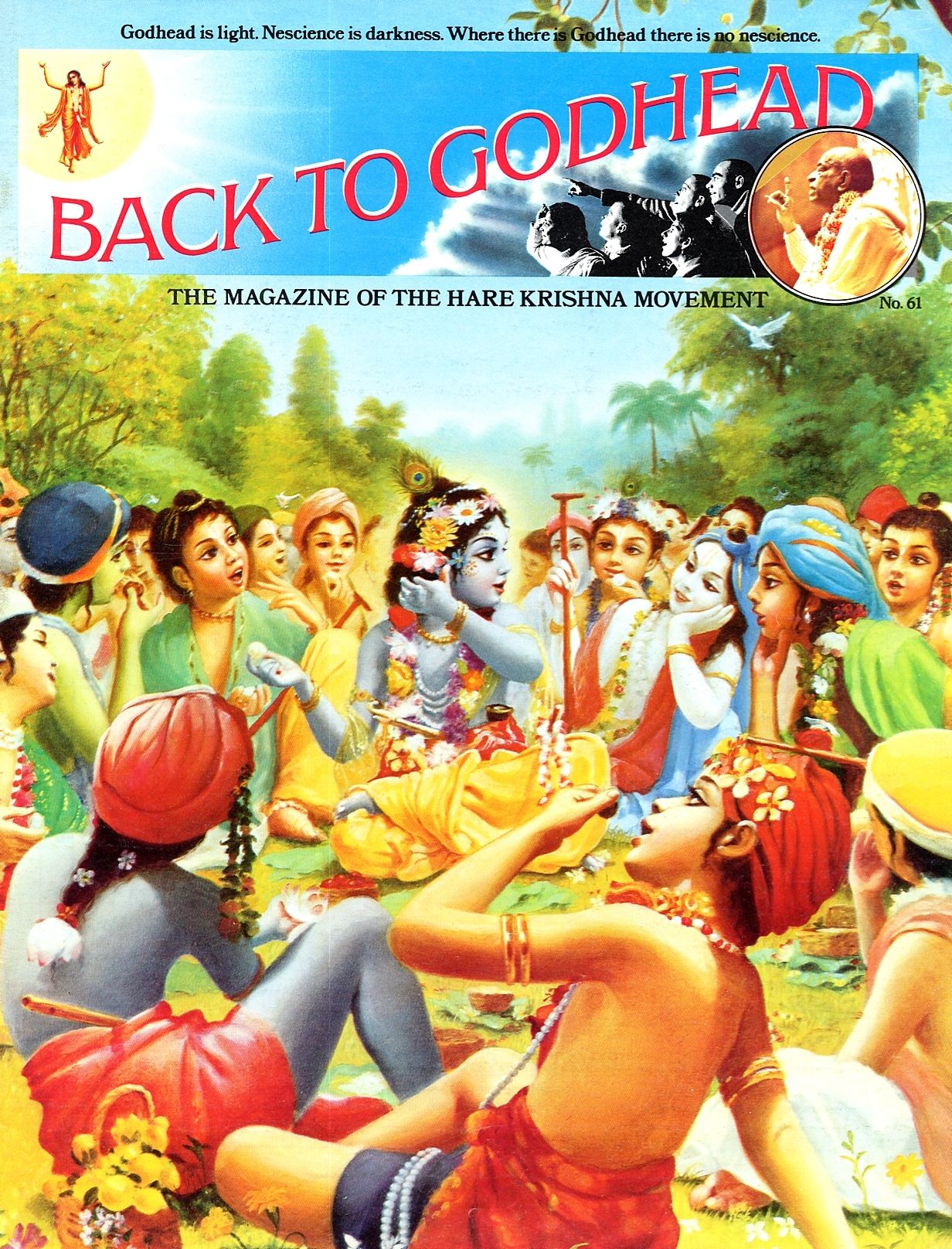
…The boys who are playing with Krsna and herding cows in Vrndavana are not ordinary living entities. They are highly developed sages who have acquired perfection by the accumulation of pious activities in past lives. For those who are under the spell of materialism, Krsna is an ordinary boy, but these cowherd boys in Vrndavana accept Him as their Master, and their Supreme Lovable Object. Consequently, all the individual boys and girls who sport in Goloka Vrndavana enjoy Krsna’s spiritual bliss. Similarly, the gopis are not ordinary cowherd girls, but are great sages who transform themselves in order to enjoy conjugal love with Krsna. Lord Caitanya spoke of them in this way: “Oh what penances did the gopis perform to eternally enjoy the beauty of the Lord Krsna? They drink His beauty with their eyes and they fill their eyes, their limbs and their hearts with celestial visions of His beauty. O, blessed are they, for they enjoy that sublime beauty which is the sweetest in the creation and which has no equal. The pure love of the gopis is like a glass that reflects this sweetness and these attributes. As the Lord sees these reflections, His sweetness increases and so does the love of the gopis. And both His sweetness and their love grow and grow as though competing with one another. And though both attain new brilliances, neither admits defeat in this wonderful competition…”
Krsna lila: The Divine Forms and Pastimes
By Sriman Hayagriva das Adhikari
From Back to Godhead Magazine 1970 Vol. 1, No. 32
Lord Krsna’s pastimes, His appearance and disappearance, are continuous and eternal throughout the universe. As far as these pastimes are concerned, there is no stoppage. It is hard for the common man to understand how Krsna’s lilas (pastimes) can be eternal. To our conception He was present on earth 5,000 years ago, and now He is gone. We compare Him to ourselves. We remain on this planet for 100 years at the most and then, like a bubble, we pop and disappear. Although this is true for ourselves, we should not compare our condition to that of the Absolute Godhead. His Body is eternal, blissful and full of knowledge, whereas ours is mortal and full of misery and ignorance. Consequently we cannot understand how Krsna’s lilas are eternal.
More
17 Feb 2012
by The Hare Krishna Movement
in Book Distribution, Books by Srila Prabhupada, Quotes by Srila Prabhupada
Tags: A.C. Bhaktivedanta Swami Prabhupada, bhagavad-gita, Book Distribution, Krsna Book, Letters by Srila Prabhupada, quotes by Srila Prabhupada, sankirtan, Srila Prabhupada's books, Srimad Bhagavatam

I am glad to hear that you are distributing nicely books and magazines. The more we sell books, the more we advance in Krishna Consciousness, and the more we help others to have solid information how they may take advantage of their human form of life and achieve the supreme perfection. So I want that you should now increase very greatly this selling of books and literatures. (S.P.L. to Kulasekhara 20/1/72)
One Krishna book sold means we go forward one step in our Krishna Consciousness. We should always remember this. (S.P.L. to Visnujana Maharaja 4th April 1971)
I am very glad to hear all the good news, especially that you want to sell books more and more. That is the best preaching work; each book sold means there is some practical effect of preaching, there is some tangible progress. So try to sell books as many as possible in your country, and in this way, so long you remain active but not for your personal sense-gratification, so long you remain active only satisfying Krishna’s senses, then this movement will be successful without any doubt. As soon as someone wants to satisfy his own senses, then he fails at everything. (S.P.L. to Kuruksetra 23/11/72)
More
16 Feb 2012
by The Hare Krishna Movement
in Teachings of Queen Kunti
Tags: A.C. Bhaktivedanta Swami Prabhupada, devotional service, hearts of advanced transcendentalists, Queen Kunti, Srimad Bhagavatam, sudras, vaisyas, women
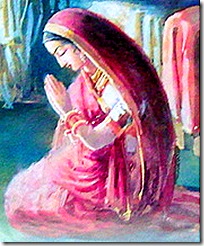
Even the greatest philosophical speculators cannot have access to the region of the Lord. It is said in the Upaniṣads that the Supreme Truth, the Absolute Personality of Godhead, is beyond the range of the thinking power of the greatest philosopher. He is unknowable by great learning or by the greatest brain. He is knowable only by one who has His mercy. Others may go on thinking about Him for years together, yet He is unknowable. This very fact is corroborated by the Queen, who is playing the part of an innocent woman. Women in general are unable to speculate like philosophers, but they are blessed by the Lord because they believe at once in the superiority and almightiness of the Lord, and thus they offer obeisances without reservation. The Lord is so kind that He does not show special favor only to one who is a great philosopher. He knows the sincerity of purpose. For this reason only, women generally assemble in great number in any sort of religious function. In every country and in every sect of religion it appears that the women are more interested than the men. This simplicity of acceptance of the Lord’s authority is more effective than showy insincere religious fervor.
Kuntīdevī prayed to the Lord very submissively, and this is the symptom of a Vaiṣṇava.
Teachings of Queen Kunti
By His Divine Grace A.C. Bhaktivedanta Swami Prabhupada
Chapter 3, The most Intelligent Woman
tathā paramahaṁsānāṁ
munīnām amalātmanām
bhakti-yoga-vidhānārthaṁ
kathaṁ paśyema hi striyaḥ
You Yourself descend to propagate the transcendental science of devotional service unto the hearts of the advanced transcendentalists and mental speculators, who are purified by being able to discriminate between matter and spirit. How, then, can we women know You perfectly? —Śrīmad-Bhāgavatam 1.8.20
More
14 Feb 2012
by The Hare Krishna Movement
in Devotional Service, Krishna Consciousness, KRSNA The Supreme Personality of Godhead
Tags: A.C. Bhaktivedanta Swami Prtabhupada, devotional service, entourage, feelings of separation, gopis, Krishna, Krsna The Supreme Personality of Godhead, Krsna's transcendental form Krsna's pastimes, Lord Caitanya, true love

Today being Valentines Day, and with everyone absorbed in a loving mood, we thought we would post something about True Love.
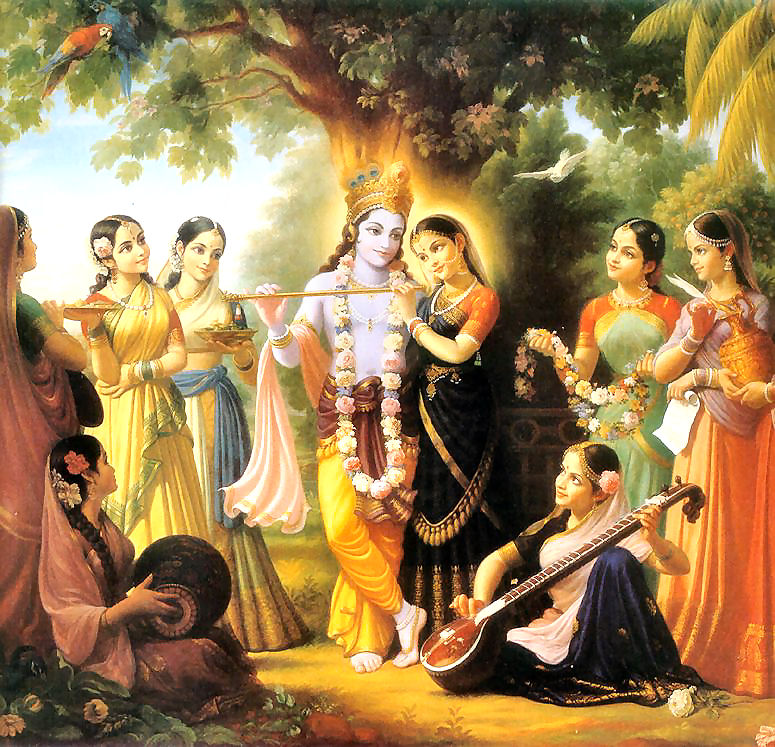
…Everyone and everything is attracted to Kṛṣṇa–that is the perfect description of Kṛṣṇa’s attraction. The example of the gopīs is very instructive to persons who are trying to be absorbed in Kṛṣṇa consciousness. One can very easily associate with Kṛṣṇa simply by remembering His transcendental pastimes. Everyone has a tendency to love someone. That Kṛṣṇa should be the object of love is the central point of Kṛṣṇa consciousness. By constantly chanting the Hare Kṛṣṇa mantra and remembering the transcendental pastimes of Kṛṣṇa, one can be fully in Kṛṣṇa consciousness and thus make his life sublime and fruitful.
KRSNA The Supreme Personality of Godhead
By His Divine Grace A.C. Bhaktivedanta Swami Prabhupada
Chapter 34
The Gopīs’ Feelings of Separation
The gopīs of Vṛndāvana were so attached to Kṛṣṇa that they were not satisfied simply with the rāsa dance at night. They wanted to associate with Him and enjoy His company during the daytime also. When Kṛṣṇa went to the forest with His cowherd boy friends and cows, the gopīs did not physically take part, but their hearts went with Him. And because their hearts went, they were able to enjoy His company through strong feelings of separation. To acquire this strong feeling of separation is the teaching of Lord Caitanya and His direct disciplic succession of Gosvāmīs. When we are not in physical contact with Kṛṣṇa, we can associate with Him like the gopīs, through feelings of separation. Kṛṣṇa’s transcendental form, qualities, pastimes, and entourage are all identical with Him. There are nine different kinds of devotional service. Devotional service to Kṛṣṇa in feelings of separation elevates the devotee to the highest perfectional level, to the level of the gopīs.
More
13 Feb 2012
by The Hare Krishna Movement
in Srimad Bhagavatam
Tags: A.C. Bhaktivedanta Swami Prabhupada, bhagavatam, Krishna, Personality of Godhead, SB 1.2.17, SB 1.2.18, SB 1.2.4, Srimad Bhagavatam
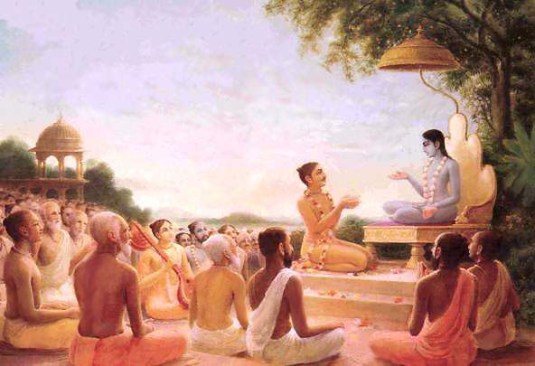
Verses Recited Before Śrīmad-Bhāgavatam Class
nārāyaṇaṁ namaskṛtya
naraṁ caiva narottamam
devīṁ sarasvatīṁ vyāsaṁ
tato jayam udīrayet
Before reciting this Śrīmad-Bhāgavatam, which is the very means of conquest, one should offer respectful obeisances unto the Personality of Godhead, Nārāyaṇa, unto Nara-nārāyaṇa Ṛṣi, the supermost human being, unto mother Sarasvatī, the goddess of learning, and unto Śrīla Vyāsadeva, the author. [SB 1.2.4]
śṛṇvatāṁ sva-kathāḥ kṛṣṇaḥ
puṇya-śravaṇa-kīrtanaḥ
hṛdy antaḥ stho hy abhadrāṇi
vidhunoti suhṛt satām
Śrī Kṛṣṇa, the Personality of Godhead, who is the Paramātmā [Supersoul] in everyone’s heart and the benefactor of the truthful devotee, cleanses desire for material enjoyment from the heart of the devotee who has developed the urge to hear His messages, which are in themselves virtuous when properly heard and chanted. [SB 1.2.17]
naṣṭa-prāyeṣv abhadreṣu
nityaṁ bhāgavata-sevayā
bhagavaty uttama-śloke
bhaktir bhavati naiṣṭhikī
By regular attendance in classes on the Bhāgavatam and by rendering of service to the pure devotee, all that is troublesome to the heart is almost completely destroyed, and loving service unto the Personality of Godhead, who is praised with transcendental songs, is established as an irrevocable fact. [SB 1.2.18]
Pasted from; http://causelessmercy.com/?P=TMG#1
13 Feb 2012
by The Hare Krishna Movement
in Vegetarian Cooking, Vegetarian Recipies, Vegetarianism
Tags: chapati, chapati recipe, The Hare Krsna Cookbook, vegetarian cooking
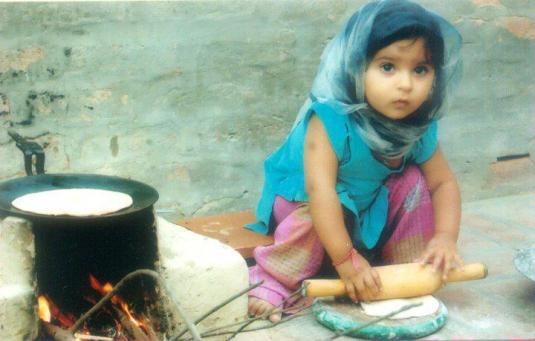
From The Hare KRSNA Cookbook 1972
Basic Chapati
1 cup Whole Weat Flour
1/4 cup Melted Butter
Warm water
Mix the flour and water together, adding water gradually until dough is soft but not wet, and can be kneaded. Knead the dough until it’s fairly soft (8 to 10 minutes). Cover and let dough rest for one hour. Sprinkle flour on rolling area and makes 1-1/2 inch balls out of dough. Flatten balls and roll out to about 4-5″ diameter. Place the chapati on a heated skillet (dry, free from oil) and cook until bubbles appear. Turn chapati quickly and let cook until bubbles appear again. Using tongs, remove chapati from pan, and hold over an open flame or burner to make it puff up. Heat it first on the side that was first cooked. You can lay directly on the burner for a brief moment, but don’t let it stick. When chapati puffs up, turn quickly and repeat on other side till it puffs. Remove, butter both sides, and cover with a clean cloth to keep in heat while remaining chapatis are cooked.
Pasted from; http://www.harekrsna.com/practice/prasadam/recipes/breads.htm
12 Feb 2012
by The Hare Krishna Movement
in Diksha, Guru & Disciple, Locanananda das, Siksa
Tags: GBC, guru and disciple, initation, interview with Locananda das, Iskcon, July 9th Letter, Locanananda das, officiating acaryas, rittik, ritvik, Srila Prabhupada

And the most definitive direction on this subject is found in the purport of the Srimad Bhagavatam: “One should take initiation from a bona fide spiritual master coming in the disciplic succession, who is authorized by his predecessor spiritual master. This is called diksha-vidhana.” (SB 4.8.54)
Initiation Protocols
Interview with Sriman Locanananda Prabhu
Interviewer: The issue of initiations in ISKCON has divided devotees for several decades and appears to have evolved into a schism. What is your personal perspective on this issue?
Locanananda dasa: When I was President of the Amsterdam temple in 1977, I received a copy of the Summary Report of the GBC meetings held in Vrndavana that year from the 27th through the 29th of May. In that report, two of the three questions Srila Prabhupada answered on May 28th were included, but the answer to the question about future initiations was not. A few weeks later, I received a copy of the July 9th letter explaining the new initiation protocols. It didn’t seem as if much had changed. Initiations would resume despite Srila Prabhupada’s ongoing illness. The letter also addressed the selection of “rittik” representatives of the acarya and referred to the May 28th meeting with Srila Prabhupada, but there was no detailed explanation as to how the two were connected. We were really left in the dark for years as to what instructions Srila Prabhupada had actually given the GBC as a mandate for future initiations.
Interviewer: Would you say it was a cover-up and hijacking of the movement?
More
12 Feb 2012
by The Hare Krishna Movement
in Srila Prabhupada
Tags: A.C. Bhaktivedanta Swami Prabhupada, captain of the ship, dedication, Founder Acarya of the International Society for Krishna Consciousness, Iskcon, SB 1.1.22, Srila Prabhupada
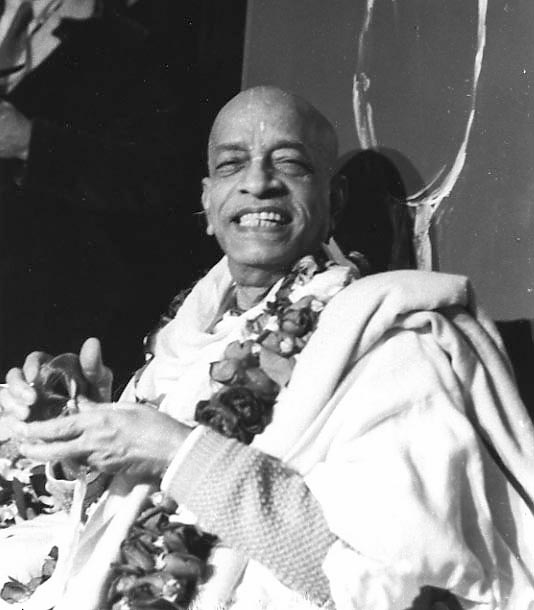
Dedication to
His Divine Grace A. C. Bhaktivedanta Swami Prabhupāda
Founder-Ācārya of the International Society for Krishna Consciousness
tvaṁ naḥ sandarśito dhātrā
dustaraṁ nistitīrṣatām
kaliṁ sattva-haraṁ puṁsāṁ
karṇa-dhāra ivārṇavam
We think that we have met Your Goodness by the will of providence, just so that we may accept you as captain of the ship for those who desire to cross the difficult ocean of Kali, which deteriorates all the good qualities of a human being.” (Śrīmad-Bhāgavatam 1.1.22)
On the order of his spiritual master, His Divine Grace A. C. Bhaktivedanta Swami Prabhupāda began translating and writing Vedic literature in the English language to bring the message of Lord Kṛṣṇa to the Western countries. After decades of struggle in India, he came to the West and started the International Society for Krishna Consciousness. Later on he created the Bhaktivedanta Book Trust, to publish his writings and recordings of his lectures, conversations, etc. The VedaBase has been created so that this great treasurehouse of knowledge may be preserved and propagated and so that all may take advantage of the wisdom and association of the pure devotee of Lord Krishna.
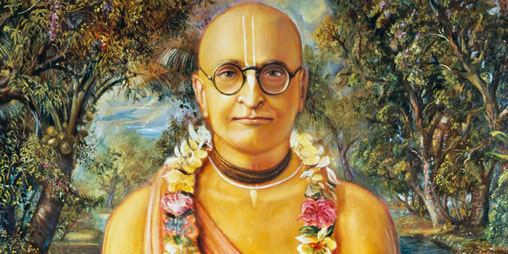
His Divine Grace A. C. Bhaktivedanta Swami Prabhupāda appeared in this world in 1896 in Calcutta, India. He first met his spiritual master, Śrīla Bhaktisiddhānta Sarasvatī Gosvāmī, in Calcutta in 1922. Bhaktisiddhānta Sarasvatī, a prominent religious scholar and the founder of sixty-four Gauḍīya Maṭhas (Vedic institutes), liked this educated young man and convinced him to dedicate his life to teaching Vedic knowledge. Śrīla Prabhupāda became his student, and eleven years later (1933) at Allahabad he became his formally initiated disciple.
At their first meeting, in 1922, Śrīla Bhaktisiddhānta Sarasvatī Ṭhākura requested Śrīla Prabhupāda to broadcast Vedic knowledge through the English language. In the years that followed, Śrīla Prabhupāda wrote a commentary on the Bhagavad-gītā, assisted the Gauḍīya Maṭha in its work and, in 1944, started Back to Godhead, an English fortnightly magazine. Maintaining the publication was a struggle. Single-handedly, Śrīla Prabhupāda edited it, typed the manuscripts, checked the galley proofs, and even distributed the individual copies. Once begun, the magazine never stopped; it is now being continued by his disciples in the West and is published in over thirty languages.
More
11 Feb 2012
by The Hare Krishna Movement
in Bhaktisiddhanta Sarasvati Thakura, Lectures
Tags: disappearance day of Srila Bhaktisiddhanta Sarasvati, Guru Maharaja, Lecture by His Divine Grace, Srila Bhaktisiddhanta, Srila Prabhupada

Today marks the disappearance day of Srila Bhaktisiddhanta Sarasvati Gosvami Maharaja, the Spiritual Master of His Divine Grace A.C. Bhaktivedanta Swami Prabhupada. We honor this occasion by posting a lecture given by His Divine Grace on the disappearance day of Srila Bhaktisiddhanta in 1968.
His Divine Grace Śrīla Bhaktisiddhānta Sarasvatī Gosvāmī Prabhupāda’s
Disappearance Day, Lecture Los Angeles, December 9, 1968
(Prabhupāda leads kīrtana)
Prabhupāda: Hare Kṛṣṇa. Come on. I was thinking of “Where is Jayānanda?” now immediately he has come. (someone brings some kind of offering and Śrīla Prabhupāda says to give it to his Guru Mahārāja) Take care it may not fall down.
(pause) All right.
So today is the disappearance day of my Guru Mahārāja. As I told you that sādhavo jīva vā mara vā. There was a nice story the other day I told you that a sage is giving different kinds of blessings to different types of persons. So to a king’s son, a prince, he blessed, rāja-putra ciraṁ jīva: “You are a king’s son, a prince. You live forever.” And muni-putra, the son of a saintly person, he blessed him, mā jīva mā jīva: “You don’t live.” Rāja-putra ciraṁ muni-putra mā jīva. And sādhu, devotees, he blessed him, jīva vā mara vā: “Either you live or you die, as you like.” And there was a butcher, he blessed him, mā jīva mā mara: “You don’t die, don’t live.” So these words are very significant. That I have already explained, still I am explaining. A prince, he’s enjoying sense, that’s all. He has got enough facility for sense enjoyment. So his next life is hellish. Because if you indulge in sex life, then Kṛṣṇa will give you facility to have sex life three times in an hour, just like the pigeons, the monkeys, the sparrows, they are very sexually strong. You have seen it. So the facility is given. So princely order, they are after sense enjoyment. So he’s blessed that “Better you live forever, because after your death, you do not know what is going to happen to you. You are going to get a hellish life. Better you live for some time. Go on with your enjoyment.” And muni-putra mā jīva. Brahmacārī, working under the guidance under strict disciplinary guidance, of a spiritual master, he is blessed, mā jīva, “You better die. Because you are so trained to enter into the kingdom of God, so why should you take so much trouble? Better you die and go back to Godhead.” Ma jīva. And a devotee he blessed, jīva va maro va: “My dear devotee, either you live or die, the same thing.” And the butcher, he blessed him, ma jīva ma mara: “You don’t live, don’t die.” What he’s to do? His living condition is so abominable. From the morning, he has to slaughter so many animals, see the bloodstain, the ghastly scene. That is his livelihood. So what a horrible life this is. So “Don’t live. And don’t die also.” Because after death, oh, he is going to be in so much hellish condition, nobody can describe. So both lives, living condition and death, after death, his condition is very horrible.
More
08 Feb 2012
by The Hare Krishna Movement
in Disciplic succession, Raja-Vidya
Tags: A.C. Bhaktivedanta Swami Prabhupada, bhagavad-gita, Brahma, disciplic succession, Indra, Parampara, Raja-Vidya, Srila Prabhupada, the king of knowledge
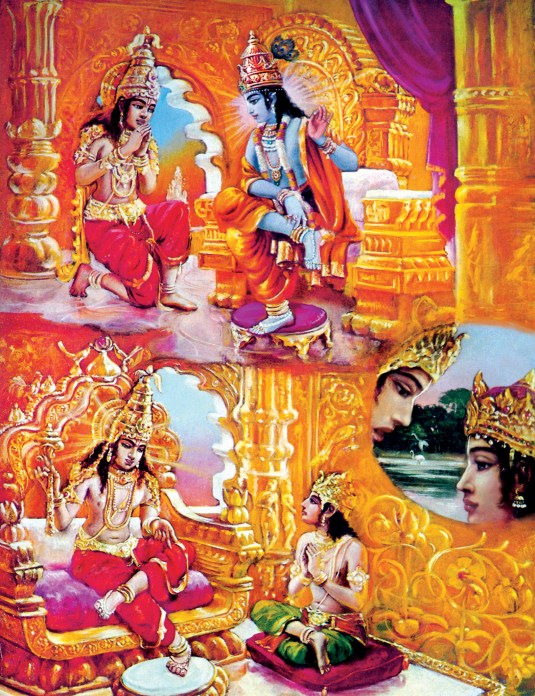
click on image to enlarge
At one time, Indra, the king of heaven, committed an offense at the feet of his spiritual master, and his spiritual master cursed him to take the birth of a hog. Thus the throne of the heavenly kingdom became empty as Indra went to earth to become a hog. Seeing the situation, Brahmā came to earth and addressed the hog: “My dear sir, you have become a hog on this planet earth. I have come to deliver you. Come with me at once.” But the hog replied:. “Oh I cannot go with you. I have so many responsibilities—my children, wife and this nice hog society.” Even though Brahmā promised to take him back to heaven, Indra, in the form of a hog, refused. This is called forgetfulness. Similarly, Lord Śrī Kṛṣṇa comes and says to us, “What are you doing in this material world? Sarva-dharmān parityajya mām ekaṁ śaraṇaṁ vraja [Bg. 18.66]. Come to Me, and I’ll give you all protection.” But we say, “I don’t believe You Sir. I have more important business here.” This is the position of the conditioned soul—forgetfulness. This forgetfulness is quickly dissipated by following in the path of disciplic succession.
Raja-vidya: The King of Knowledge
By His Divine Grace A.C. Bhaktivedanta Swami Prabhupada
Chapter 5
Parampara: Knowledge Through Disciplic Succession
śrī bhagavān uvāca
imaṁ vivasvate yogaṁ
proktavān aham avyayam
vivasvān manave prāha
manur ikṣvākave ’bravīt
“The Blessed Lord said: I instructed this imperishable science of yoga to the sun-god, Vivasvān, and Vivasvān instructed it to Manu, the father of mankind, and Manu in turn instructed it to Ikṣvāku.” (Bg. 4.1)
Many ages ago Kṛṣṇa imparted the divine knowledge of Bhagavad-gītā to Vivasvān, the god of the sun. To the best of our knowledge, the sun is a very hot place, and we do not consider it possible for anyone to live there. It is not even possible to approach the sun very closely with these bodies. However, from the Vedic literatures we can understand that the sun is a planet just like this one but that everything there is composed of fire. Just as this planet is predominately composed of earth, there are other planets which are predominately composed of fire, water and air.
The living entities on these various planets acquire bodies composed of elements in accordance with the predominating element on the planet; therefore those beings who live on the sun have bodies which are composed of fire. Of all beings on the sun, the principal personality is a god by the name of Vivasvān. He is known as the sun-god (sūrya-nārāyaṇa). On all planets there are principal personalities, just as in the United States the chief person is the President. From the history called the Mahābhārata we understand that formerly there was only one king on this planet by the name of Mahārāja Bharata. He ruled some 5,000 years ago, and the planet was named after him. Subsequently the earth has become divided into so many different countries. In this way there is usually one and sometimes many controllers of the various planets in the universe.
More
07 Feb 2012
by The Hare Krishna Movement
in Hansadutta das, Srila Prabhupada
Tags: hansadutta das, Iskcon, Krishna, philosophy, prabhupada, science of self reasization, Srila Prabhupada, Varnashrama Dharma

Prabhupada, Man of God
By Sriman Hansadutta Prabhu
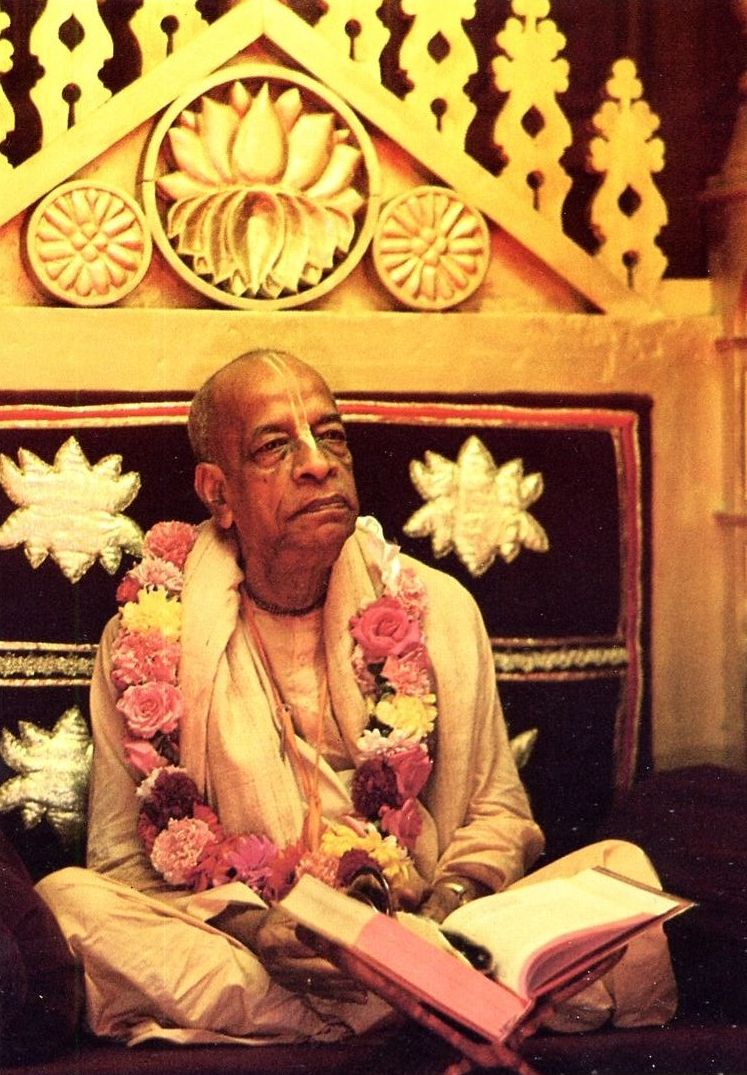
His Divine Grace A.C. Bhaktivedanta Swami Prabhupada, Founder-Acharya of the International Society for Krishna Consciousness (ISKCON) is respectfully called “Srila Prabhupada”, or “spiritual master at whose feet all others bow down”. Who was he really? What did he accomplish?
Five thousand years ago, the Supreme Personality of Godhead, Lord Sri Krishna, descended to re-establish the principles of religion. At that time, Vedic culture was dying all around the world, being ruled by demonic kings. After Krishna left this world, a rapid decline in the principles of Varnashrama Dharma ensued.
Before the appearance of Srila Prabhupada, Vedic culture existed only in very small pockets in India. We must truly understand what Srila Prabhupada actually achieved in the span of about 10 years. He took THE highest spiritual culture, THE highest philosophy and THE highest science of self-realization, and successfully brought it to the West, which had no spiritual culture, no philosophy and no science of the soul. He started a worldwide revolution in religion by humbly teaching tens of thousands of fallen, sinful, lusty and degraded persons the essence of Vedic culture: pure love of God.
More
Previous Older Entries Next Newer Entries