15 Aug 2014
by The Hare Krishna Movement
in A.C. Bhaktivedanta Swami Prabhupada, Festivals, Janmastami, Krishna, Krsna Consciousness, Krsna God, KRSNA The Supreme Personality of Godhead
Tags: A.C. Bhaktivedanta Swami Prabhupada, birth of Lord Krishna, Janmastami, janmastami festival, Krishna, Krsna, Krsna Book, Sri Krishna Janmastami, Srimad Bhagavatam

click on image to enlarge
With the advent of Lord Krsna’s birthday celebration (Janmastami) rapidly approaching, it seemed fitting that we do a post on the birth of Lord Krsna. So the following is the entire third chapter from the Krsna Book entitled “The Birth of Lord Kṛṣṇa”.
…As stated in the Bhagavad-gītā, the Lord says that His appearance, birth, and activities, are all transcendental, and one who understands them factually becomes immediately eligible to be transferred to the spiritual world. The Lord’s appearance or birth is not like that of an ordinary man who is forced to accept a material body according to his past deeds. The Lord’s appearance is explained in the Second Chapter: He appears out of His own sweet pleasure. When the time was mature for the appearance of the Lord, the constellations became very auspicious. The astrological influence of the star known as Rohiṇī was also predominant because this star is considered to be very auspicious. Rohiṇī is under the direct supervision of Brahmā. According to the astrological conclusion, besides the proper situation of the stars, there are auspicious and inauspicious moments due to the different situations of the different planetary systems. At the time of Kṛṣṇa’s birth, the planetary systems were automatically adjusted so that everything became auspicious. ( from Kṛṣṇa, the Supreme Personality of Godhead Chapter 3)
Full Chapter More
13 Aug 2014
by The Hare Krishna Movement
in A.C. Bhaktivedanta Swami Prabhupada, Krsna Consciousness, Nectar of Devotion, Radha Krishna, Rupa Goswami, Srimati Radharani
Tags: A. C. Bhaktivedanta Swmai Prabhupada, Nectar of Devotion, Radha, Radharani, Srimati Radharani

click on image to enlarge
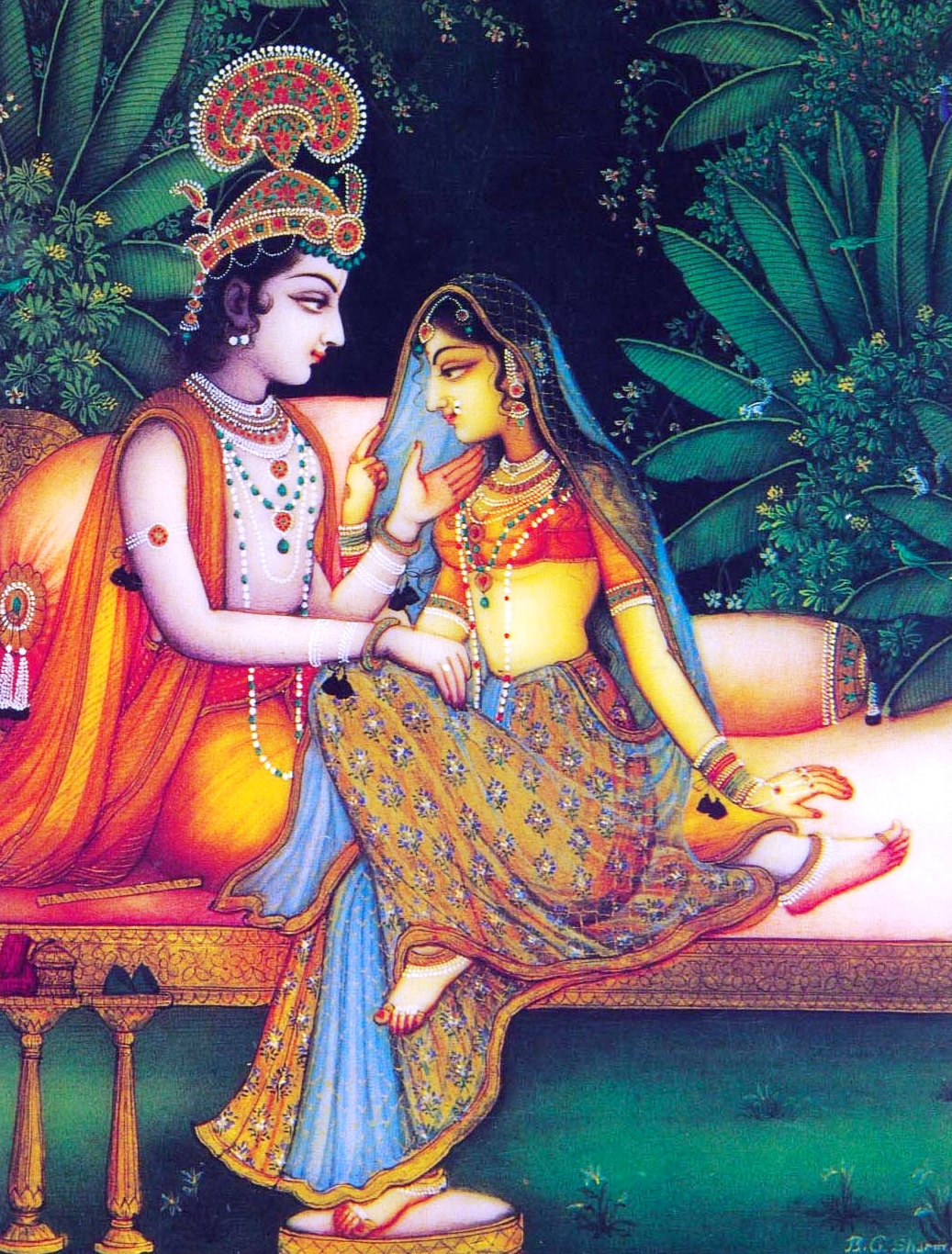
…The beauty of Śrīmatī Rādhārāṇī is described as follows: “Her eyes defeat the attractive features of the eyes of the cakorī bird. When one sees the face of Rādhārāṇī, he immediately hates the beauty of the moon. Her bodily complexion defeats the beauty of gold. Thus, let us all look upon the transcendental beauty of Śrīmatī Rādhārāṇī.” Kṛṣṇa’s attraction for Rādhārāṇī is described by Kṛṣṇa Himself thus: “When I create some joking phrases in order to enjoy the beauty of Rādhārāṇī, Rādhārāṇī hears these joking words with great attention; but by Her bodily features and counterwords She neglects Me. And I even possess unlimited pleasure by Her neglect of Me, for She becomes so beautiful that She increases My pleasure one hundred times.” A similar statement can be found in Gīta-govinda, wherein it is said that when the enemy of Kaṁsa, Śrī Kṛṣṇa, embraces Śrīmatī Rādhārāṇī, He immediately becomes entangled in a loving condition and gives up the company of all other gopīs. (from Nectar of Devotion Chapter 44)
More
12 Aug 2014
by The Hare Krishna Movement
in A.C. Bhaktivedanta Swami Prabhupada, Krishna Consciousness, Nectar of Instruction, Rupa Goswami, Upadesamrta
Tags: A.C. Bhaktivedanta Swami Prabhupada, fruitive workers, jnanis, knowledge, liberated by virtue, lord hari, nectar of instruction Srila Rupa Goswami, NoI 10, Srila Prabhupada, Supreme Personality of Godhead, Upadesamrta

Continuing with our series on the Nectar of Inststuction (Upadeśāmṛta), we are posting Text 10, the very important instructions given by Śrīla Rūpa Gosvāmī on advanced knowledge of the higher values of life.
…The gopīs are exalted above all the advanced devotees because they are always totally dependent upon Śrī Kṛṣṇa, the transcendental cowherd boy. Among the gopīs, Śrīmatī Rādhārāṇī is the most dear to Kṛṣṇa. Her kuṇḍa [lake] is as profoundly dear to Lord Kṛṣṇa as this most beloved of the gopīs. Who, then, will not reside at Rādhā-kuṇḍa and, in a spiritual body surcharged with ecstatic devotional feelings [aprākṛtabhāva], render loving service to the divine couple Śrī Śrī Rādhā-Govinda, who perform Their aṣṭakālīya-līlā, Their eternal eightfold daily pastimes. Indeed, those who execute devotional service on the banks of Rādhā-kuṇḍa are the most fortunate people in the universe. (The Nectar of Instruction Text 10)
More
10 Aug 2014
by The Hare Krishna Movement
in A.C. Bhaktivedanta Swami Prabhupada, B. G. Sharma Art, Balarama, Festivals
Tags: A.C. Bhaktivedanta Swami Prabhupada, appearance day of lord balarama, bala, Balarama, brother of Krsna, full moon day, Krishna's elder brother, Lord Balarama, original spiritual master, Purnima, Srila Prabhupada, vaishnavas

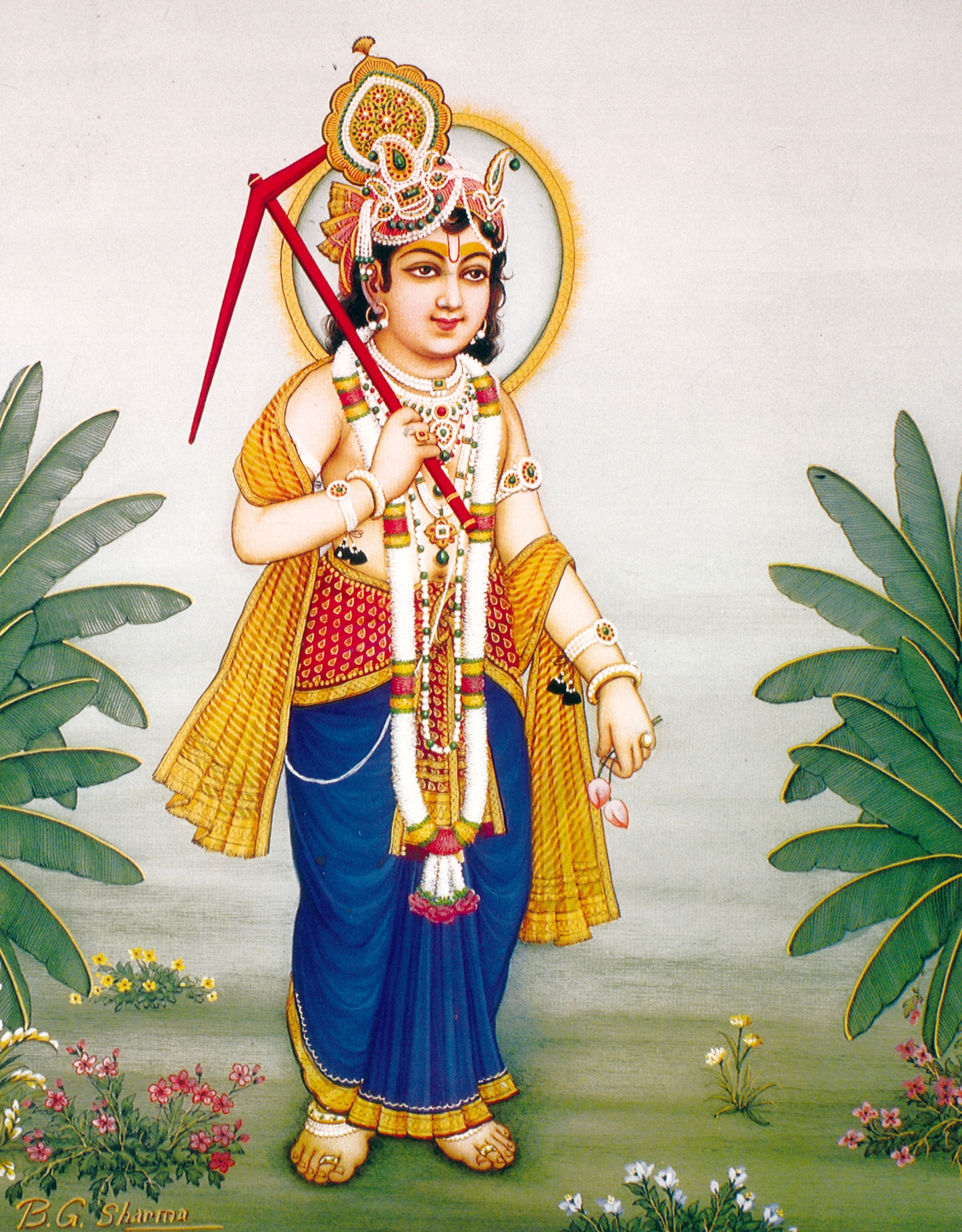
Lord Balarama’s Appearance Day
Lord Balarama is Krishna’s elder brother and His appearance day takes place on the full moon day (purnima), two weeks before Krishna Janmashtami. Krishna and Balarama were the darlings of Vrindavan/ Vraja. Together They would spend the day enjoying the company of the cowherd boys in the forests of Vraja. Their wonderful pastimes are related in the tenth canto of Srimad-Bhagavatam, which Srila Prabhupada also translated as The Krishna Book. Lord Balarama is also considered the original spiritual master and His worship is therefore most important for Vaishnavas.
Lord Balarāma has two weapons, a plow and a club, from which He takes service when they are required.
(from Kṛṣṇa Book Chapter 65 Lord Balarāma Visits Vṛndāvana)
…In the Upaniṣads it is stated, nāyam ātmā bala-hīnena labhyaḥ. The purport is that one cannot attain the supreme platform of self-realization without being sufficiently favored by Balarāma. Bala does not mean physical strength. No one can attain spiritual perfection by physical strength. One must have the spiritual strength which is infused by Balarāma, or Saṅkarṣaṇa. Ananta, or Śeṣa, is the source of the power which sustains all the planets in their different positions. Materially this sustaining power is known as the law of gravitation, but actually it is a display of the potency of Saṅkarṣaṇa. Balarāma, or Saṅkarṣaṇa, is the source of spiritual power, or the original spiritual master. Therefore Lord Nityānanda Prabhu, who is also the incarnation of Balarāma, is the original spiritual master. And the spiritual master is the representative of Balarāma, the form of the Supreme Personality of Godhead who supplies spiritual strength. In the Caitanya-caritāmṛta it is confirmed that the spiritual master is the manifestation of the mercy of Kṛṣṇa. (from Kṛṣṇa Book Chapter 2: Prayers by the Demigods for Lord Kṛṣṇa in the Womb)
More
09 Aug 2014
by The Hare Krishna Movement
in Back to Godhead, Soul, Spiritual Life, The Hare Krishna Movement, Vishnujana Swami
Tags: Back to Godhead Magazine, Bhagavad-gita 2.59, BTG, His Holiness Visnujana Svami, illusion, illusory energy, mercy of the Lord, neophytes, regulative principles, soul, Spiritual Life, the Hare Krsna movement, vairagya, Visnujana Swami

Some Day the Tiny Soul Will Want to Get Out of Illusion
Instructions to the devotees of the Hare Krsna movement
given in New York City, March 31, 1974
by His Holiness Visnujana Svami
Excerpted from Back to Godhead Magazine 1974 Vol. 1, No. 65
…As soon as one gets the association of the bhakti-vedanta, the pure devotee or spiritual master, and hears from his lips the nectarean waves flowing just like the wonderful River Ganges, these waves enter his ears and his heart and purify him. Thus he is freed from the seeds of contaminated material desires. When he hears sufficiently, his intelligence becomes satisfied, and he agrees to act on the instructions of his bona fide spiritual master. The more he acts on these instructions, the more he becomes freed from past bad habits and the conditional responses of this material world. Thus his conditional association is completely vanquished. This, of course, is where he achieves a spiritual taste (ruci) and spiritual strength (vairagya).
full lecture More
07 Aug 2014
by The Hare Krishna Movement
in A.C. Bhaktivedanta Swami Prabhupada, Letters by Srila Prabhupada, Mukunda das Goswami, Spiritual Master, Spiritual World
Tags: A.C. Bhaktivedanta Swami Prabhupada, Krishna, Krishna Loka, letters by prabhupada, liberated person, Lord Caitanya, Mukunda dasa, resident of Krishna Loka, spiritual master, Srila Prabhupada
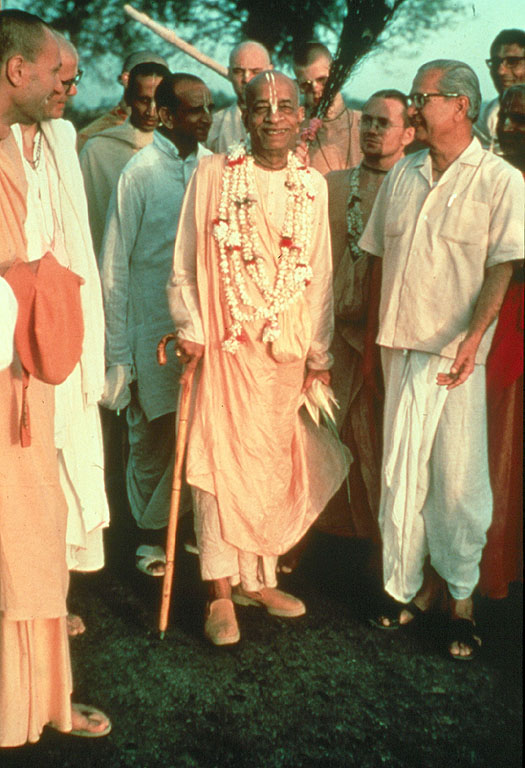
…Unless one is a resident of Krishna Loka, one cannot be a Spiritual Master. That is the first proposition. A layman cannot be a Spiritual Master, and if he becomes so then he will simply create disturbance. And who is a liberated person? One who knows Krishna. It is stated in BG, fourth chapter, anyone who knows Krishna in truth is immediately liberated, and after quitting the present body, he immediately goes to Krishna. That means he becomes a resident of Krishna Loka. As soon as one is liberated he is immediately a resident of Krishna Loka, and anyone who knows the truth of Krishna can become Spiritual Master. That is the version of Lord Caitanya. So to summarize the whole thing, it is to be understood that a bona fide Spiritual Master is a resident of Krishna Loka. (Letter to Mukunda June 10, 1969)
Full letter More
07 Aug 2014
by The Hare Krishna Movement
in Letters by Srila Prabhupada, Madhudvisa das (ACBSP)
Tags: A.C. Bhaktivedanta Swami Prabhupada, Australia Sankirtan, feild for dancing, letters by prabhupada, Madhudvisa dasa, Madhudvisa Swami, Michael Morrissey, sankirtan, Srila Prabhupada
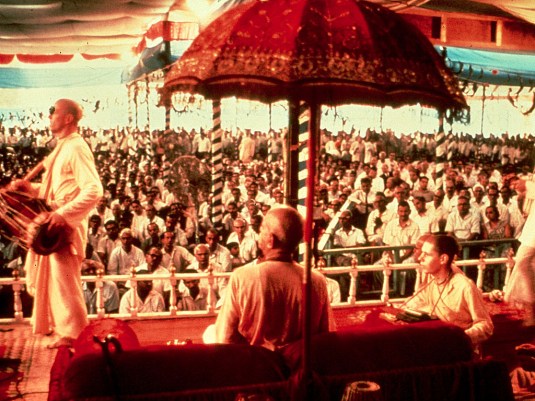
…I have no objection if you feel like going to Australia for heading up the Sankirtana party there and managing things in general….You can go to Australia, there you have got enough field for your dancing. (Letter to Madhudvisa dasa April 26, 1972)
More
06 Aug 2014
by The Hare Krishna Movement
in Iskcon Bangalore, Madhu Pandit das, Temples, The Hare Krishna Movement
Tags: A.C. Bhaktivedanta Swami Prabhupada, Chanchalapathi dasa, Indias tallest temple for Krishna, ISKCON Bangalore, largest religious structure in India, Madhu Pandit dasa, sacred edificice, Sri Krishna, Vrindavan Chandrodaya Mandir, Vrindavan Mathura district

Vrindavan to have India’s tallest temple for Krishna
“Just like we have got a tendency to construct a skyscraper building. As in your country, you do. So you should not be attached to the skyscraper building, but you can utilize the tendency by constructing a big temple like skyscraper for Krishna. In this way, you have to purify your material activities.”(Srila Prabhupada in a class in front of the samadhi of Srila Rupa Gosvami in Vrindavan, Oct 29th, 1972)
“This is Krishna conscious vision: ‘Oh, there are so many skyscrapers. Why not construct a nice skyscraper temple of Krishna?’ This is Krishna consciousness.” (Srila Prabhupada lecture in Bombay, Feb 25th, 1974)
VRINDAVAN/MATHURA: A 210-metre-high temple is soon going to change the skyline of Vrindavan in Mathura district. The project, whose foundation stone will be laid on March 16, has been conceived by Madhu Pandit Dasa, president of ISKCON, Bangalore, and will consist of a grand temple of Sri Krishna at its centre and many other interesting elements around it. Poised to be the tallest and largest religious structure in India, the monumental temple, named the Vrindavan Chandrodaya Mandir, with a footprint of about four and a half acres and a built-up area of 540,000 square feet, will integrate elements of modern architecture with traditional Indian temple architecture.
for more images of temple go to; Vrindavan Chandrodaya Mandir
More
05 Aug 2014
by The Hare Krishna Movement
in A.C. Bhaktivedanta Swami Prabhupada, Bhagavad-gita, Soul
Tags: A.C. Bhaktivedanta Swami Prabhupada, Arjuna, Bg2.12, Bg2.30, bhagavad-gita, boyhood to youth to old age, dehino smin yatha dehe, eternal soul, ever existing soul, for the soul there is never birth or death, Krsna, krsna consciousness, reincarnation, science of the soul science of self realization, soul, soul passes into another body, soul slokas, Srila Prabhupada, unborn

This morning I was thinking about the soul and its eternal journey. So I went to Srila Prabhupada’s Bhagavad-gita As It Is and found some of the important slokas that pertained to the subject of the soul.
As the embodied soul continually passes, in this body, from boyhood to youth to old age, the soul similarly passes into another body at death. The self-realized soul is not bewildered by such a change. (Bg. 2.13)
For the soul there is never birth nor death. Nor, having once been, does he ever cease to be. He is unborn, eternal, ever-existing, undying and primeval. He is not slain when the body is slain. (Bg. 2.20)
As a person puts on new garments, giving up old ones, similarly, the soul accepts new material bodies, giving up the old and useless ones. (Bg. 2.22)
The soul can never be cut into pieces by any weapon, nor can he be burned by fire, nor moistened by water, nor withered by the wind. (Bg. 2.23)
More
03 Aug 2014
by The Hare Krishna Movement
in A.C. Bhaktivedanta Swami Prabhupada, Krishna Consciousness Movement, Lectures, Nectar of Devotion, Nectar of Devotion, Photos by Gurudas
Tags: A. C. Bhaktivedanta Swami Pabhupada, active service, bhakti is explained, bhakti means service, Bhakti-rasamrta-sindhu, devotional service, Gurudas, Krsna consciousness movement, Nectar of Devotion, photos by Gurudas, Pradyumana das, scientific and authorized movement, Srila Prabhupada
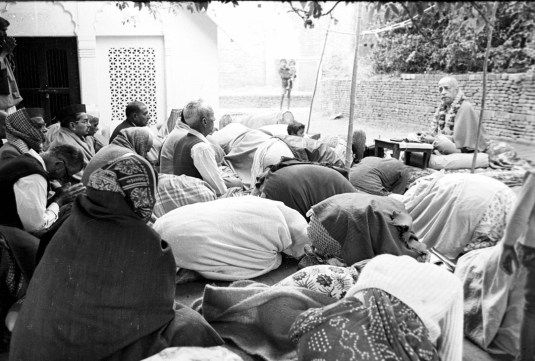
click on image to enlarge
..utilize everything for the purpose of Kṛṣṇa. That is Kṛṣṇa consciousness movement. Most scientific and authorized movement. Trying to place people in his original, constitutional position and cooperate for the service of Kṛṣṇa. That is Kṛṣṇa consciousness movement.
…So bhakti-rasāmṛta-sindhu is to taste the mellow of serving Kṛṣṇa. That is the science of serving Kṛṣṇa. Therefore we have named this book, “Nectar of Devotion.” It is summary study of bhakti-rasa, the mellow, the transcendental mellow which one can taste. Everyone is tasting. Otherwise he cannot work. So yat karoṣi yaj juhoṣi. Kṛṣṇa says, “Whatever engagement you may have, kuruṣva tad mad-arpaṇam, do it for Kṛṣṇa.” Don’t take the result yourself. Give it to Kṛṣṇa. Then you’ll taste the rel…, relish the mellow, transcendental mellow, bhakti-rasa. And then you’ll be happy. (The Nectar of Devotion Lectures Vṛndāvana, October 17, 1972)
Full Lecture More
29 Jul 2014
by The Hare Krishna Movement
in A.C. Bhaktivedanta Swami Prabhupada, Caitanya Mahaprabhu, Chanting Hare Krishna, The Path of Perfection, Yoga
Tags: Adi 17.21, bhakti yoga, chanting, chanting Hare Krishna, chanting the holy names of the Lord, harer nama, harer namaiva kevalam, liberation, quarrel and hypocris, self realization, The Path of Perfection, yoga, yoga systems

…the bhakti-yoga system is recommended for everyone. Without training or education, one can automatically participate in bhakti-yoga. Even a small child can clap at kīrtana. Therefore Lord Caitanya Mahāprabhu has proclaimed bhakti-yoga the only system practical for this age.
harer nāma harer nāma
harer nāmaiva kevalam
kalau nāsty eva nāsty eva
nāsty eva gatir anyathā
[Adi 17.21]
“In this age of quarrel and hypocrisy the only means of deliverance is chanting the holy name of the Lord. There is no other way. There is no other way. There is no other way.”
Chanting is very simple, and one will feel the results immediately. Pratyakṣāvagamaṁ dharmyam. If we attempt to practice other yoga systems, we will remain in darkness; we will not know whether or not we are making progress. In bhakti-yoga, one can understand, “Yes, now I am making progress.” This is the only yoga system by which one can quickly attain self-realization and liberation in this life. One doesn’t have to wait for another lifetime. (The Path of Perfection, Chapter Seven)
Full Chapter More
27 Jul 2014
by The Hare Krishna Movement
in A.C. Bhaktivedanta Swami Prabhupada, B. G. Sharma Art, Cow Protection
Tags: 68-06-14, A.C. Bhaktivedanta Swami Prabhupada, cow protection, cowherd friends, Krishna and Balarama, Letter to Hayagriva, Nanda Maharaja, New Vrindaban, protection of the cows and bulls, vaisya community

click on image to enlarge
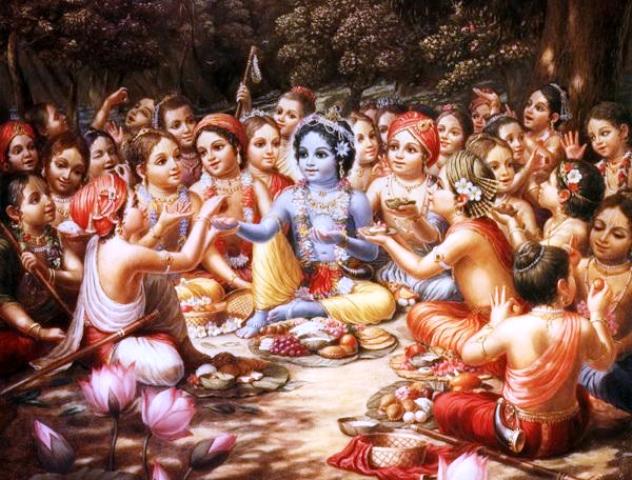
…The community in which Krishna preferred to belong was Vaisya community, because Nanda Maharaja happened to be a Vaisya king, or landholder, and his main business was cow protection. It is understood that he had 900,000 cows and Krishna and Balarama used to take charge of them, along with His many cowherd boy friends, and every day, in the morning He used to go out with His friends and cows into the pasturing grounds.
We have to maintain the animals throughout their life. We must not make any program for selling them to the slaughterhouses. That is the way of cow protection. Krishna by His practical example taught us to give all protection to the cows and that should be the main business of New Vrindaban. Vrindaban is also known as Gokula. Go means cows, and kula means congregation. Therefore the special feature of New Vrindaban will be cow protection, and by doing so, we shall not be loser. In India of course, a cow is protected and the cowherdsmen they derive sufficient profit by such protection. (Letter to Hayagriva June 14, 1968)
Full letter More
26 Jul 2014
by The Hare Krishna Movement
in A.C. Bhaktivedanta Swami Prabhupada, Festivals, Krishna Consciousness, Krishna Consciousness Movement, Krsna Consciousness
Tags: A.C. Bhaktivedanta Swami Prabhupada, Hare Krishna, human being, jagannatha svami, krsna consciousness, Kuruksetra, philosophy of Krsna Consciousness, prabhupada, Ratha Yatra Festival, Ratha yatra lecture, Ratha-yatra, San Francisco Ratha yatra, solar eclipse, The Hare Krishna Movement

…So if we want to have eternal life, full of knowledge and blissfulness, then we must take to Kṛṣṇa consciousness. Our, this Kṛṣṇa consciousness movement is the greatest welfare activities in the human society. We are giving information to every man, without any discrimination of cast, creed, or color, that every human being especially, not only human being, all living entities, including the animals, beasts, birds, trees, aquatics—everyone—they can achieve to the highest perfection of life by this Kṛṣṇa consciousness. But especially the extra intelligence of the human being can be utilized to realize Kṛṣṇa. If we don’t do that, we are missing a great opportunity. So our request to everyone is to understand this philosophy of Kṛṣṇa consciousness. (Ratha-yātrā Lecture, June 27, 1971, San Francisco)
Full Lecture More
23 Jul 2014
by The Hare Krishna Movement
in A.C. Bhaktivedanta Swami Prabhupada, Lotus Feet, Narottama Dasa Thakura, Radha Krishna, Spiritual World, Sri Caitanya-Caritamrta
Tags: A. C. Bhaktivedanta Swami Pabhupada, acarya advaitacandra, CC Adi 13.124, Lord Nityananda, lotus feet, Narottama Dasa Thakura, Nityananda Prabhu, raghunathadasa, rupa, spiritual bliss, sri caitanya nityananda, Sri Caitanya-caritamrta, Sri Radha and Krsna, svarupa, the lotus feet of Sri Caitanya Mahaprabhu
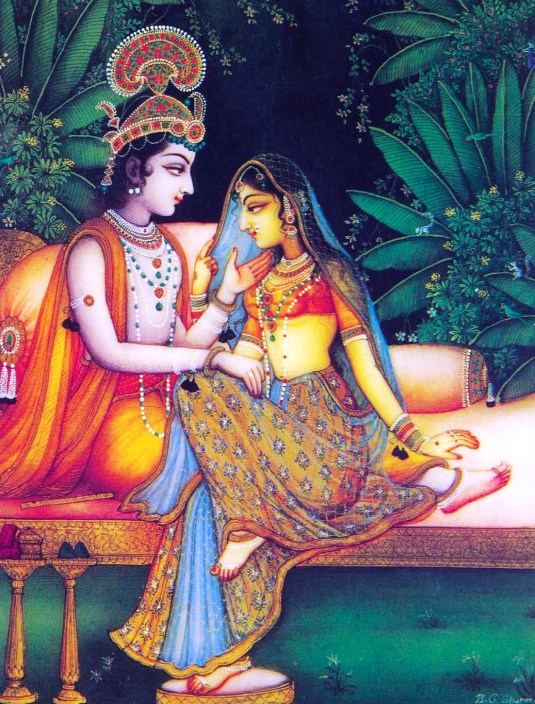
click on image to enlarge
…Narottama dāsa Ṭhākura says: “My real riches are Nityānanda Prabhu and the lotus feet of Śrī Rādhā and Kṛṣṇa.” He further prays, “O Lord, kindly give me this opulence. I do not want anything but Your lotus feet as my property.” (from purport Adi-lila 13.124)
Full text and purport More
22 Jul 2014
by The Hare Krishna Movement
in A.C. Bhaktivedanta Swami Prabhupada, Srimad Bhagavatam
Tags: A.C. Bhaktivedanta Swami Prabhupada, Bhagavata-dharma, Brahmaloka, conditioned souls, fruitive activities, heavenly planets, incarnation, kingdom of God, Krsna, Lord Brahma, material ezistence, material world, meditate upon the virat-rupa, Patalaloka, phantasmagoria, Spiritual world, sri suka uvaca, Sri Sukadeva Gosvami, Srimad Bhagavatam, The Lord in the Heart, virat-rupa
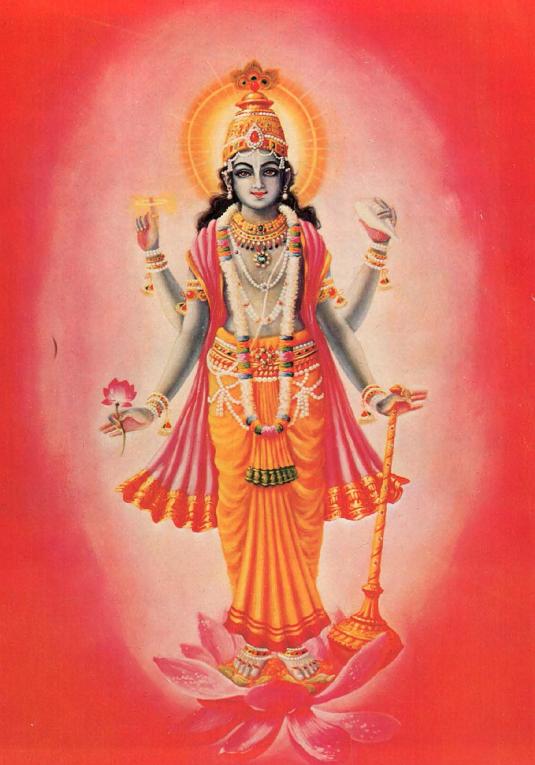
Śrīmad-Bhāgavatam
By His Divine Grace A. C. Bhaktivedanta Swami Prabhupāda
Canto Two, Chapter 2
The Lord in the Heart
Full Chapter More
20 Jul 2014
by The Hare Krishna Movement
in Akhilananda das, Festivals, Ratha-yatra
Tags: Akhilananda dasa, Lady Subadhra, Lord Balarama, Lord Caitanya, Lord Jaganath, Lord Nityananda, New Vrindavan, photos by Vyasasan das, Ratha Yatra 2014, ratha yatra at new vrindavan 2014, Ratha Yatra Festival, Sri Sri Radha Vrindavan Chandra, Srila Prabhupada

click on image to enlarge
Yesterday, the Ratha Yatra Festival was celebrated at New Vrindavan, West Virginia. Although there were scattered rain showers, and the umbrellas came out, still it was a very auspicious day, and nice event enjoyed by all. Following are some of the pictures I took along the festival rout.
More
19 Jul 2014
by The Hare Krishna Movement
in A.C. Bhaktivedanta Swami Prabhupada, Morning Walks, Science
Tags: A.C. Bhaktiveanta Swami Prabhupada, Bahulasva, Baradraj, bhagavata, Citsukhananda, dogmas, fools, Harikesa, Jayadvaita, Krsna-dasa, Moon Rocks from Arizona, morning walks with Srila Prabhupada, Nalini-kantha, Narayana, other planets, over-intelligent, paramahamsa, prabhupada, Rahu, rascaldom, rascals, scientists, Socrates, Sudama, Tamala Krsna, Yadubara, Yadunandana
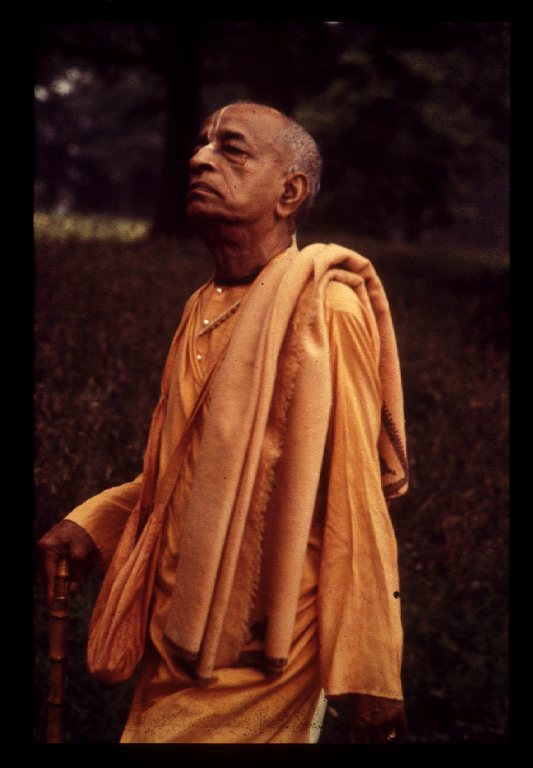
“Moon Rocks from Arizona”
Morning walk discussion by His Divine Grace A. C. Bhaktivedanta Swami Prabhupada and disciples
Recorded July 21, 1975
To hear lecture
Prabhupada: Oh. [break] Krsna dasa, some scientists say that there is no life in the other planets, and some scientists said there may be. So who is correct?
Paramahamsa: Well, didn’t the Yamadutas… You stated in your lecture yesterday that the Yamadutas said that what is truth is what is in the Vedas. So I assume from the Vedic knowledge that there is life on other planets. Logically speaking also.
Prabhupada: Yes. How can you say there is no life?
More
19 Jul 2014
by The Hare Krishna Movement
in A.C. Bhaktivedanta Swami Prabhupada, Krishna Consciousness, Krishna Nectar, Krsna Consciousness, KRSNA The Supreme Personality of Godhead, Vaisnava Vocabulary
Tags: A.C. Bhaktivedanta Swami Prabhupada, chanting Krsna, cowheard boys, hearing and chanting about Krsna, Krsna Book, krsna consciousness, krsna nectar, Krsna the suporeme personality of godhead, nityanavanavayamana, transcendental subject matter

I am so much enjoying my reading of the Krsna Book every morning. Although I have read and re-read it so many times before, it is more relishable with each new reading.
It is said that it is the nature of a devotee to constantly apply his mind, energy, words, ears, etc., in hearing and chanting about Kṛṣṇa. This is called Kṛṣṇa consciousness, and for one who is rapt in hearing and chanting Kṛṣṇa, the subject matter never becomes hackneyed or old. That is the significance of transcendental subject matter in contrast to material subject matter. Material subject matter becomes stale, and one cannot hear a certain subject for a long time; he wants change. But as far as transcendental subject matter is concerned, it is called nityanavanavāyamāna. This means that one can go on chanting and hearing about the Lord and never feel tired but will remain fresh and eager to hear more and more.
It is the duty of the spiritual master to disclose all confidential subject matter to the inquisitive and sincere disciple.
And thus in the Krsna Book, Srila Prabhupada reveals the activities of the Supreme Person Krsna as is evident from the following excerpt:
More
17 Jul 2014
by The Hare Krishna Movement
in A.C. Bhaktivedanta Swami Prabhupada, Demons, Krishna Nectar, KRSNA The Supreme Personality of Godhead
Tags: A.C. Bhaktivedanta Swami Prabhupada, Aghasura, aghasura demon, demon, inhabitants of Vrndavana, Krsna, Krsna and Balarama, Krsna Book, Krsna The Supreme Personality of Godhead, mahima, mahima-siddhi, mystic powers, Vrndavan, yoga system, yogic siddhi
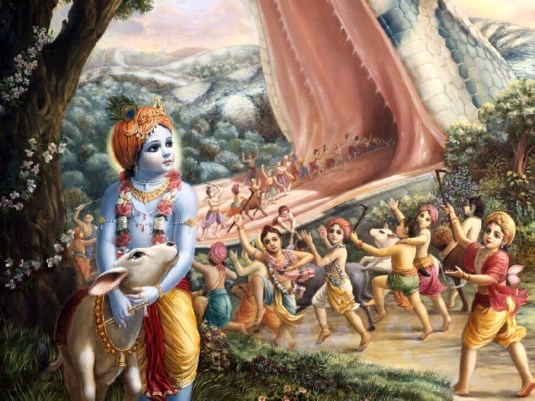
click on image to enlarge
This is one of my favorite stories from the Krsna Book. I always enjoyed how fearless the cowherd boys were. They were free of any fear. This is the benefit of Krsna Consciousness; “Any material arrangement for protecting oneself from death is always unsure, but if one is in Kṛṣṇa consciousness, then immortality is confidently assured.”
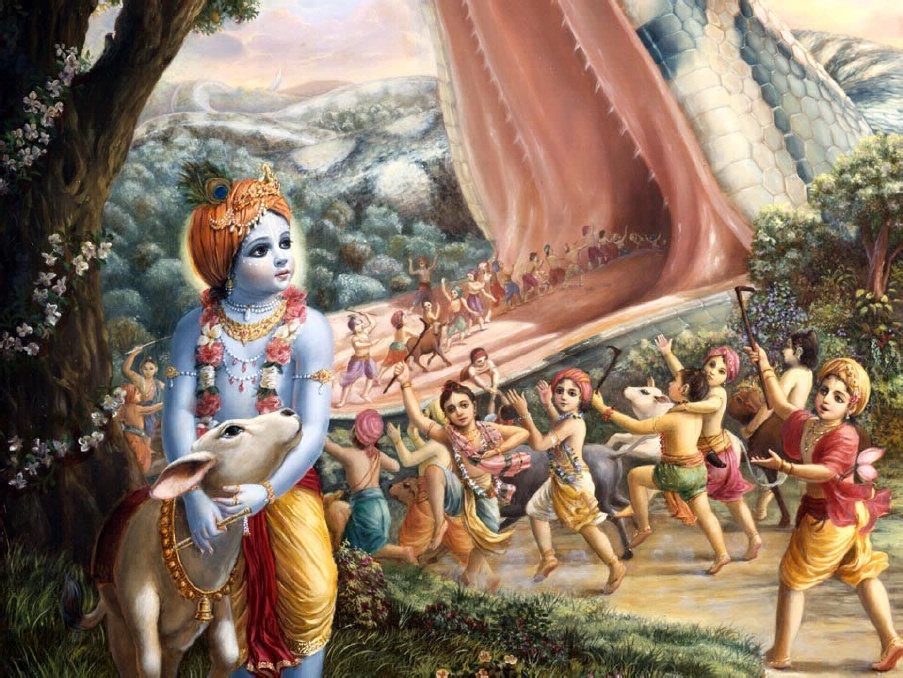
…Aghāsura, thus deciding to kill all the inhabitants of Vṛndāvana, expanded himself by the yogic siddhi called mahimā. The demons are generally expert in achieving almost all kinds of mystic powers. In the yoga system, by the perfection called mahimā-siddhi, one can expand himself as he desires. The demon Aghāsura expanded himself up to eight miles and assumed the shape of a very fat serpent. Having attained this wonderful body, he stretched his mouth open just like a mountain cave. Desiring to swallow all the boys at once, including Kṛṣṇa and Balarāma, he sat on the path.
The demon in the shape of a big fat serpent expanded his lips from land to sky; his lower lip was touching the ground, and his upper lip was touching the clouds. His jaws appeared like a big mountain cave, without limitation, and his teeth appeared just like mountain summits. His tongue appeared to be a broad traffic way, and he was breathing just like a hurricane. His eyes were blazing like fire. At first the boys thought that the demon was a statue, but after examining it they saw that it was a big serpent lying down on the road and widening his mouth. The boys began to talk among themselves: “Dear friends, this figure appears to be a great animal, and he is sitting in such a posture just to swallow us all. Just see—is it not a big snake that has widened his mouth to eat all of us?”
More
Previous Older Entries Next Newer Entries










 The Hare Krishna Movement