Perhaps it was Krsna who directed me to the last chapter of Śrīla Prabhupāda-līlāmṛta, by Satsvarūpa dāsa Goswāmī. The famous book chronicling The life of our Founder-Acarya His Divine Grace A. C. Bhaktivedanta Swami Prabhupada. In this last chapter entitled, “The Final Lesson”, last sentence of this voluminious book, Satsvarūpa dāsa Goswāmī concludes with this statement:
“Our hope is that by hearing about Śrīla Prabhupāda the reader will become himself a Prabhupādānuga, a follower of Śrīla Prabhupāda. We can wish no better fortune upon anyone.”
Update: this came as a comment…
This is probably the best thing Satsvarupa Maharaja ever wrote. When a devotee decides to join the Hare Krishna movement as a full-time member, they are announcing to the world their acceptance of Srila Prabhupada as the empowered representative of the Supreme Personality of Godhead. By mature realization they will come to recognize Srila Prabhupada as their eternal spiritual master. These lifetime servants of the spiritual master are called Prabhupadanugas.
Those who mould their lives in such a way that they can always think of the lotus feet of the spiritual master will live with him eternally. Because of Srila Prabhupada’s transcendental position, there is no separation in time or space between us. He is present in our lives and is guiding us back to Godhead through his written and spoken word. By his unlimited blessings we continue to move forward in Krishna consciousness and surely we will one day reach the ultimate goal of love of Godhead. The more we advance toward that goal, the more we will understand the greatness of Srila Prabhupada’s compassion upon us and his concern for the conditioned souls of this world who are all part and parcel of the Supreme Lord, Sri Krishna.(Locanananda das)
Sometimes the ISKCON devotees refer to Prabhupadanugas as some splinter group, not belonging to the mainstream devotees. But in fact we can plainly see from some of the writing of the senior members of our society that becoming a follower of Śrīla Prabhupāda is exactly what is needed. For instance in Bhakti Curu Swami’s, Disappearance Day offering to Srila Prabhupada, given June 16, 2010, he states:
…everyday, in all the temples of ISKCON, Srila Prabhupada is worshipped by everyone. Then why do we hesitate to tell a new comer who is searching for a guru that Srila Prabhupada, the best guru the world has ever seen, is still here, and one can surrender unto him and go back to Godhead very easily? When we have such a great good fortune, why do we not take full advantage of it? It is only when we do so that the glorious days of ISKCON will come back again and we will witness Sri Caitanya Mahaprabhu’s sankirtan movement starting to spread in leaps and bounds all over the world.
If we really love ISKCON and if we sincerely want the Krsna Consciousness movement to spread all over the world in every town and village, then let us broadcast all over the world that Srila Prabhupada is still with us and that anyone who wants to receive his mercy can approach him and establish his eternal relationship with him.
Without a doubt, this is my favorite book ever. I never get tired of reading from the Krsna Book. It seems to get sweeter every time.
Krsna was very pleased with the atmosphere of the forest, where flowers bloomed and bees and drones hummed very jubilantly. While the birds, trees and branches were all looking very happy, Krsna, tending the cows and accompanied by Sri Balarama and the cowherd boys, began to vibrate His transcendental flute. After hearing the vibration, the gopis in Vrndavana remembered Him and began to talk amongst themselves about how nicely Krsna was playing His flute. When the gopis were describing the sweet vibration of Krsna’s flute’; they also remembered their pastimes with Him; thus their minds became disturbed, and they were unable to fully describe the beautiful vibrations. While discussing the transcendental vibration, they also remembered how Krsna dressed, decorated with a peacock feather on His head, just like a dancing actor, and with blue flowers pushed over His ear. His garment glowed yellow-gold, and He was garlanded with a vaijayanti necklace. Dressed in such an attractive way, Krsna filled up the holes of His flute with the nectar emanating from His lips. So they remembered Him, entering Vrndavana forest, which is always glorified by the footprints of Krsna and His friends.
Here is another word for your vaisnava vocabulary, acintya-bhedabheda-tattva. I was always facinated by this word because its meaning is inconceivable; simultaneous oneness and difference. Srila Prabhupada uses the example of the sun and the sunshine. The sunshine is not different from the sun as it is the engery of the sun, but when the sunshine is shinning in your room you cannot say the sun is in you room. Hence, one and different simultaneously. So similarly, God and His creation are one and different simultaneously One and Different.
Another example Srila Prabhupada uses is a drop of water from the ocean, has the same qualities as the ocean, in quality but not in quanitity. As living entities or as parts of God’s energy, we’re also equal in quality with God, but there’s a vast difference in quantity.
Achintya-bhedabheda-tattva refers to the inconceivable and simultaneous oneness and difference of the Supreme Person and His energies. This is one of the key points of theistic philosophy taught by Chaitanya Mahaprabhu. As parts of God’s energy, we’re also equal in quality with God, but there’s a vast difference in quantity. We’re each infinitesimal sparks of spiritual energy, and the Supreme Person, Krishna, is the infinite, supreme source of all energies.
Achintya-bhedabheda-tattva describes the relationship between the Supreme Lord and His energies, including individual souls, as both one with and different from Him simultaneously. This principle is beyond human comprehension, hence the “inconceivable” aspect.
From a lecture at a Christian Monastery – Melbourne April 06, 1972
My wife shared this with me, it was a post on Facebook, put up by Govinda dasi. Although I have never personally met Hayagriva Prabhu, I have enjoyed reading his books and articles in Back to Godhead Magizine.
…Srila Prabhupada named him Hayagriva, and used to jokingly say that Hayagriva is like the horse incarnation, and is sent by Krishna to make my books very beautiful and eloquent in English language.
Hari Sauri: There was an emotional reunion this afternoon between Srila Prabhupada and Hayagriva Prabhu. Although he was one of Srila Prabhupada’s first disciples, he has been away from devotional service for some years. He has come now to finish the philosophy book project and to be with Prabhupada for some time. He walked slowly into Prabhupada’s room, his face flushed and his deep voice trembling. “It’s your old Hayagriva, Prabhupada,” he choked out, and fell sobbing to the floor in full length dandavats. Prabhupada sat behind his desk, silent, but clearly moved by the sight of his sometimes – wayward son.
When Hayagriva got up Prabhupada gave him a garland, and remarked to Radhaballabha Dasa and me how Hayagriva had been sent by Krishna to help him spread Krishna consciousness all over the world. In reply, Hayagriva said that he had never forgotten Prabhupada, not even for a day. Prabhupada was deeply affected by this and said that he also had never forgotten Hayagriva. “I was thinking, has Hayagriva gone away? I was thinking like that.” His voice broke and he was unable to speak for a few seconds. Although he tried to check his tears, still some trickled from the corners of his eyes. Then he tipped his head from side to side. “All right,” he said, and we all left.
Prabhupada has so much affection for his disciples – no one can estimate how much. It was very apparent that he never forgets any devotional service that has been rendered to him.
Reference: A Transcendental Diary Volume 2 – Hari Sauri Dasa
“One may artificially repress the desires of the senses, although the taste for sensual enjoyment remains; but by ceasing such enjoyments, experiencing a higher taste, one is fixed in consciousness.” (Bhagavad-gita 2.59)
Visnujana Swami: “When one experiences ruci, which, means a taste for Spiritual life, he can rise above the attraction of the illusory energy by the mercy of the Lord. Then he is able to feel vairagya. Vairagya is the strength that protects us, even when we are neophytes in Krishna consciousness, from breaking the Krishna conscious regulative principles and being attracted to the flickering sensual enjoyments of the mundane world. Ruci, and vairagya-the taste for spiritual life and the strength to maintain it-are rarely achieved.
If you had a huge diamond and were carrying it around with you on the street, people might flock to see such a diamond. Ruci and vairagya, however, are much more valuable diamonds. But although you are all walking through the streets with these valuable gifts, unfortunately no one is interested, in following you to take advantage of them. Ruci and vairagya are such wonderful gems, however, that if you give them away to others, these gems will still stay with you.
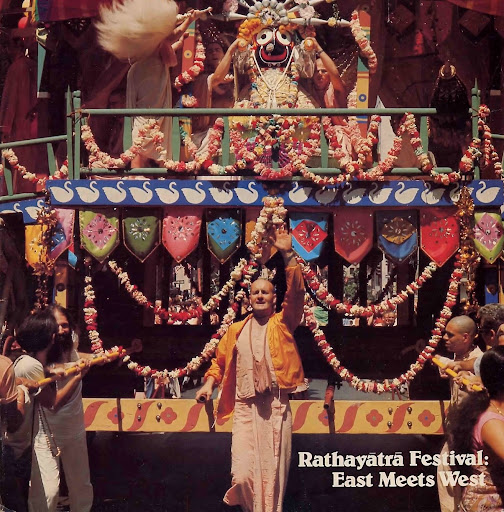
We are planning to go to the New York City Ratha-yatra this year. It will be held on June 14. It has been 49 years since I last attended the Rathayatra in New York City. But that day is still fresh in my memory, for two main reasons. First is that Srila Prabhupada was there Riding on Lady Subadhra’s cart, and the second is I took my first initiation the next day, and was given the name Vyasasan das.
It was also memorable because my dear friend and God brother Jayananda das brahmacari, was there. The following is an interview with Jayananda published in the Back to Godhead Magazine Vol. 12, 6, 1977
. Interview with Jayananda Prabhu
(Back to Godhead magazine, June 1977)
BTG: Jayananda, how did you first get involved in Krishna consciousness?
Jayananda: I heard Srila Prabhupada speaking in San Francisco, and somehow I knew he didn’t want to cheat me. So I just wanted to work for him.
BTG: And now for ten years you’ve worked on the Ratha-yatra carts.
Jayananda: Yes.
BTG: What were the first Ratha-yatras like?
Jayananda: The first year, 1967, we just rented a flatbed truck and started out in the Haight-Ashbury district of San Francisco. We decorated the truck with flowers and put the Deities on the back, and the girls passed out fruit. A good crowd walked along with us at the beginning, and when we turned off Haight Street a smaller group of maybe fifty people came with us and we went all the way to the beach.
The second year (1968) we made our own cart, with saffron silk canopies, small ones. And we had the parade through Golden Gate Park to the beach. By that time the San Francisco temple had grown a little—we had maybe 30 devotees—and about 100 people came with us through the park. The chanting was very nice that year.
Then in 1969 we built a much bigger cart, with a tall silk canopy, like the ones they build in Jagannath Puri in India. But in 1970 we worked for two months straight and built the three big carts, basically the same ones we use now. Also, we had all kinds of publicity—TV, billboards, posters. And Srila Prabhupada came to that Ratha-yatra. So a lot of people came, maybe 12,000 people. It was big—a tremendous success. We had a few mishaps, though. One cart broke down in the middle of the parade. And it was a bitter cold day. But even though it was so cold at the beach, thousands of people stayed there with us and ate a lot of Krsna prasad (spiritual food offered to Krishna). We brought 20 50-gallon barrels of prasad, and they ate it all.
I was thinking how Srila Prabhupada always referred to the the process of Krishna Consciousness as Joyful. He mentioned this joyful process in his letters, we share some of them with you.
Tridandi Goswami A.C. Bhaktivedanta Swami Founder-Acharya: International Society for Krishna Consciousness CENTER: 1975 So. La Cienega Blvd. Los Angeles, California 90034
DATE: July 15, 1969
My Dear Jadurany,
Please accept my blessings. I am in due receipt of your recent letter, and I have noted the contents. Regarding Festivals in Boston, you may hold as many as possible. If you can hold such festivals daily, that is also nice. Our movement is for ananda, simply bliss, and the method of pushing this movement is chanting, dancing, feasting and philosophizing. So in our almanac there are many festivals in every month. I am enclosing some festivals which were already held in Los Angeles, and if you perform them, I will give you a long list of others. But don’t embarrass yourself at present with greater plans than you can handle. The more you get devotees the more you will be able to perform nice festivals.
I am glad that Boston is improving in so many ways. So far as painting is concerned, you can begin now. I have already advised you this in a note enclosed with Tape #14 of Krishna. So read the Krishna tape transcriptions and draw pictures as many as possible. Each picture should be very much attractive, colorful and nice so that people will appreciate these paintings also. Our standard size will be like TLC, and you can make the pictures accordingly. According to my idea the pictures should be proportionate to 81/2 x 11. The style of the book will be like TLC so far as paper, print and binding are concerned.
Please convey my blessings to Satsvarupa and the others. I hope this will meet you all in good health.
This morning I was reminded of something that I heard Srila Prabhupada say in a lecture. He was describing that Krishna Consciousness is very simple, you just need to do four things. Always think of Krishna, become His devotee, offer obeisances, and worship Him.
Engage your mind always in thinking of Me, offer obeisances and worship Me. Being completely absorbed in Me, surely you will come to Me. (Bhagavad-gita 9.34)
This verse is also repeated in the 16th Chapter:
man-manā bhava mad-bhakto mad-yājī māṁ namaskuru mām evaiṣyasi satyaṁ te pratijāne priyo ’si me
Always think of Me and become My devotee. Worship Me and offer your homage unto Me. Thus you will come to Me without fail. I promise you this because you are My very dear friend.
In this verse it is clearly indicated that Kṛṣṇa consciousness is the only means of being delivered from the clutches of this contaminated material world…Pure devotional service is the highest achievement of human society. (from purport)
This morning there was this nagging voice that kept saying “read Adi-lila chapter 4, of the Sri Caitanya-caritamrta” I haven’t read from the Caitanya-caritamrta for a while because I was re-reading the Bhagavad-gita and Krsna Book and because it is summer, I am busy with work… But I responded to the nagging voice…and pulled Vol. 1 from the shelf. As I read I became more and more enlivened and the words jumped out at me…. Śrīmatī Rādhārāṇī, who is the attraction for the all-attractive. What is attracting the All Attractive? Srimati Radharani!
And the other thing that jumped out at me was the word hlādinī. Here is another word for your vaishnava vocabulary. So today is a two part post from the Sri Caitanya-caritamrta, describing the hladini energy, and the attractiveness of Srimati Radharani.
Lord Kṛṣṇa enchants the world, but Śrī Rādhā enchants even Him. Therefore She is the supreme goddess of all. (Adi 4.95)
Śrī Rādhā is the full power, and Lord Kṛṣṇa is the possessor of full power. The two are not different, as evidenced by the revealed scriptures. (Adi 4.96)
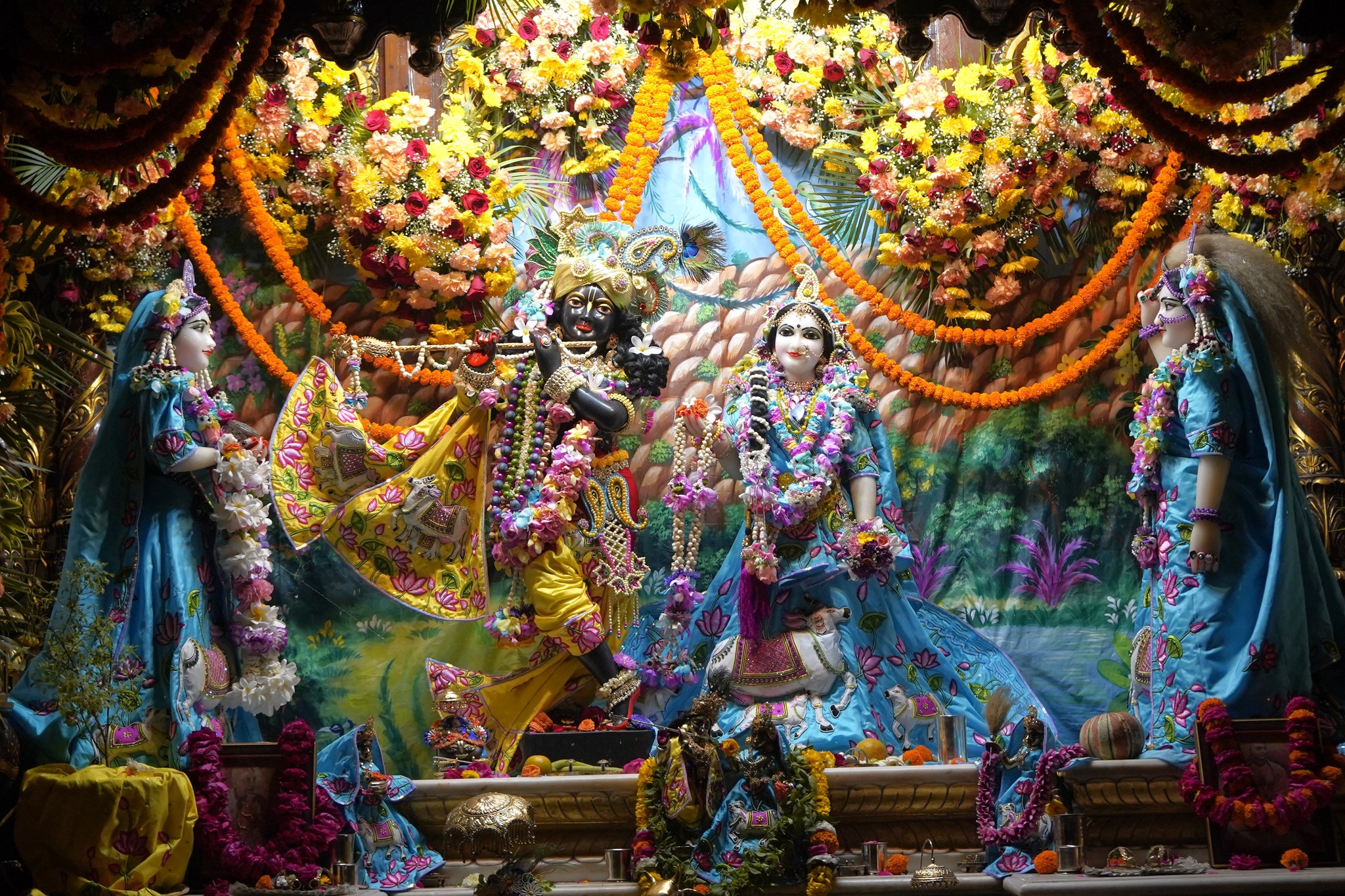
Śrīmatī Rādhārāṇī is as fully spiritual as Kṛṣṇa. No one should consider Her to be material. She is definitely not like the conditioned souls, who have material bodies, gross and subtle, covered by material senses. She is all-spiritual, and both Her body and mind are of the same spiritual embodiment. Because Her body is spiritual, Her senses are also spiritual. Thus Her body, mind and senses fully shine in love of Kṛṣṇa. She is the personified hlādinī-śakti (the pleasure-giving energy of the Lord’s internal potency), and therefore She is the only source of enjoyment for Śrī Kṛṣṇa.
Śrī Kṛṣṇa cannot enjoy anything that is internally different from Him. Therefore Rādhā and Śrī Kṛṣṇa are identical. The sandhinī portion of Śrī Kṛṣṇa’s internal potency has manifested the all-attractive form of Śrī Kṛṣṇa, and the same internal potency, in the hlādinī feature, has presented Śrīmatī Rādhārāṇī, who is the attraction for the all-attractive. No one can match Śrīmatī Rādhārāṇī in the transcendental pastimes of Śrī Kṛṣṇa. (from purport Adi 4.71)
…All the desires of Lord Kṛṣṇa rest in Śrīmatī Rādhārāṇī. (from purport)
This is a nice description of Lord Kṛṣṇa’s transcendental counchshell, and of how He was received by the citizens of Dvārakā. Beautiful!
Sūta Gosvāmī said: Upon reaching the border of His most prosperous metropolis, known as the country of the Ānartas [Dvārakā], the Lord sounded His auspicious conchshell, heralding His arrival and apparently pacifying the dejection of the inhabitants.
The white and fat-boweled conchshell, being gripped by the hand of Lord Kṛṣṇa and sounded by Him, appeared to be reddened by the touch of His transcendental lips. It seemed that a white swan was playing in the stems of red lotus flowers.
The citizens of Dvārakā, having heard that sound which threatens fear personified in the material world, began to run towards Him fast, just to have a long desired audience with the Lord, who is the protector of all devotees.
…The sound heralded by Lord Kṛṣṇa was something like the heralding of the sunrise in the morning. This sound of the Lord is identical with the Lord. We are always fearful due to our ignorance of the next problem. The whole material existence is full of problems, and thus the fear problem is always prominent. This is due to our association with the illusory energy of the Lord, known as māyā or external energy, yet all fear is vanished as soon as there is the sound of the Lord, represented by His holy name, as it was sounded by Lord Śrī Caitanya Mahāprabhu in the following sixteen words:
Hare Kṛṣṇa, Hare Kṛṣṇa, Kṛṣṇa Kṛṣṇa, Hare Hare Hare Rāma, Hare Rāma, Rāma Rāma, Hare Hare
We can take advantage of these sounds and be free from all threatening problems of material existence.
…The best and ultimate authority is Kṛṣṇa, for He is our eternal well-wisher, and He always speaks for our benefit. Since we have to accept some authority, why not accept His? Simply by hearing of His glories from Bhagavad-gītā and Śrīmad-Bhāgavatam and by chanting His names: Hare Kṛṣṇa, Hare Krsna, Krsna Krsna, Hare Hare, Hare Rama, Hare Rama, Rama Rama, Hare Hare, we can swiftly perfect our lives.
Kṛṣṇa Consciousness, the Matchless Gift By His Divine Grace A. C. Bhaktivedanta Swami Prabhupāda Chapter One
Spiritual Knowledge Through Kṛṣṇa
The aim of this Kṛṣṇa consciousness movement is to bring all living entities back to their original consciousness. All living entities within the material world are, to varying degrees, afflicted with a type of madness. This Kṛṣṇa consciousness movement aims at curing man of his material disease and reestablishing his original consciousness. In a Bengali poem a great Vaiṣṇava poet has written, “When a man is haunted by ghosts, he can only speak nonsense. Similarly, anyone who is under the influence of material nature should be considered haunted, and whatever he speaks should be considered nonsense.” One may be considered a great philosopher or great scientist, but if he is haunted by the ghost of māyā, illusion, whatever he theorizes and whatever he speaks is more or less nonsensical. Today we are given the example of a psychiatrist who, when requested to examine a murderer, proclaimed that since all the patients with whom he had come in contact were more or less crazy, the court could excuse the murderer on those grounds if it so desired. The point is that in the material world it is very difficult to find a sane living entity. The prevailing atmosphere of insanity in this world is all caused by the infection of material consciousness.
This morning while I was chanting my japa (chanting silently the Hare Krishna mantra) I was thinking of how Google defined mantra meditation. So many people today have heard the words yoga and meditation, but what do they think it means? Some think yoga is just a good form of exercise, and meditation is just a way of shutting out the noise, and thinking of nothing. So I did a Google search:
Mantra meditation involves repeating a sacred sound, word, or phrase to focus the mind and promote relaxation. This technique helps to quiet the mind and allow for deeper states of meditation. The repeated mantra acts as a point of focus, helping to direct the mind and reduce mental chatter.
Mantra meditation is a technique that involves using mantras to relax the mind and help it focus.
Not bad definitions really, but for me, actually Yoga means “Union with God”, and Meditation means “Meditation on God”. So the ultimate goal of Yoga is bhakti-yoga, and the highest form of Mantra-meditation is to focus on God (Krishna).
The following are just a few of the many quotes from Srila Prabhupada which encourage us to approach Krishna through the mercy of Srimati Radharani, Krishna’s eternal consort. For those of us who feel that there is no hope of making spiritual progress in this lifetime, Srimati Radharani, Who is compassion personified, kindly comes to our rescue if we can humbly invoke Her divine blessings.
“I offer my respects to Radharani whose bodily complexion is like molten gold and who is the Queen of Vrndavana. You are the daughter of King Vrsabhanu, and You are very dear to Lord Krishna.” (Sri Radha Pranama)
“I emphatically say to you, O brothers, you will obtain your good fortune from the Supreme Lord Krishna only when Srimati Radharani becomes pleased with you.”(Prayer to the Lotus Feet of Krishna, September 13, 1965)
“Actually, because Krishna is the Supreme Personality of Godhead, it is very difficult to approach Him. But the devotees, taking advantage of His compassionate nature, which is represented by Radharani, always pray to Radharani for Krishna’s compassion.” (Nectar of Devotion, Chapter 22)
“There is no comparison to Radharani’s beauty and the luster of Her transcendental body. The so-called beauty of the moon has fallen on the ground in the presence of Radharani’s beauty.” (From Vrindavana by Srila Narottama das Thakura)
“The beauty of Srimati Radharani’s eyes forcibly devours the beauty of newly grown blue lotus flowers, and the beauty of Her face surpasses that of an entire forest of fully blossomed lotuses. Her bodily luster seems to place even gold into a painful situation. Thus the wonderful, unprecedented beauty of Srimati Radharani is awakening in Vrindavana.” (Caitanya-caritamrita Antya 1.169)
Śrīmad-Bhāgavatam 7.5.22-34 Lecture By His Divine Grace A.C. Bhaktivedanta Swami Prabhupada Los Angeles, May 27, 1972
So today, appearance day of Lord Nṛsiṁhadeva. Lord Nṛsiṁhadeva appeared on this Nṛsiṁha Cāturdaśī on account of His devotee, Prahlāda. As it is stated in the Bhagavad-gītā, yadā yadā hi dharmasya glānir bhavati bhārata, abhyutthānam adharmasya [Bg. 4.7]. Paritrāṇāya sādhūnāṁ vināśāya ca duṣkṛtāṁ, sambhavāmi yuge yuge [Bg. 4.8]. The Lord appears with two purposes. Paritrāṇāya sādhūnām: just to give protection and rescue the devotees, and to kill the demons, vināśāya ca duṣkṛtām. So Prahlāda Mahārāja, five-years-old boy, his only fault was that he was Kṛṣṇa conscious. He was devotee of Kṛṣṇa. That was his only fault. And the father was so unkind to a child, even five years old. He could not excuse, “Oh, let this boy do whatever, chanting Hare Kṛṣṇa.” No. The demons are so much against God consciousness that even at his home he would not allow his own child to become God conscious. This is demoniac civili… So you’ll find many critics, many enemies, because you are making progress in Kṛṣṇa consciousness. So the demons are always against this Kṛṣṇa consciousness movement. That is the whole history. Just like Lord Jesus Christ, he was crucified. What was his fault? He was preaching God consciousness, that’s all. This society is so cruel. So Prahlāda Mahārāja was tortured in so many ways. The torturing methods, I think you will find as you will see in today’s picture, how Prahlāda Mahārāja was tortured.
So one day, Hiraṇyakaśipu… After all, he was his son. Affection was there. So one day, Hiraṇyakaśipu asked the boy,
So he asked his son, “My dear son, what you have learned? The best thing, what you have learned from your teachers, so you kindly let me know.” So Prahlāda Mahārāja informed that “I have learned like this.” What is that?
A strange thing happened to me while we were in India. We were at Radha Kund (Srimati Radharani’s bathing ghat), and after sprinkling 3 drops of water on my head, I offered my obeisances, and I prayed, please take away the lust, anger, greed and envy from my heart. This surprised me because I never prayed for that before. But it got me thinking…if you take away Lust, what is left, is Love. Take away Anger, and you are left with Happiness, take away Greed, and you have Charity or Generosity, and if you take awayEnvy, you are left with Kindness to others.
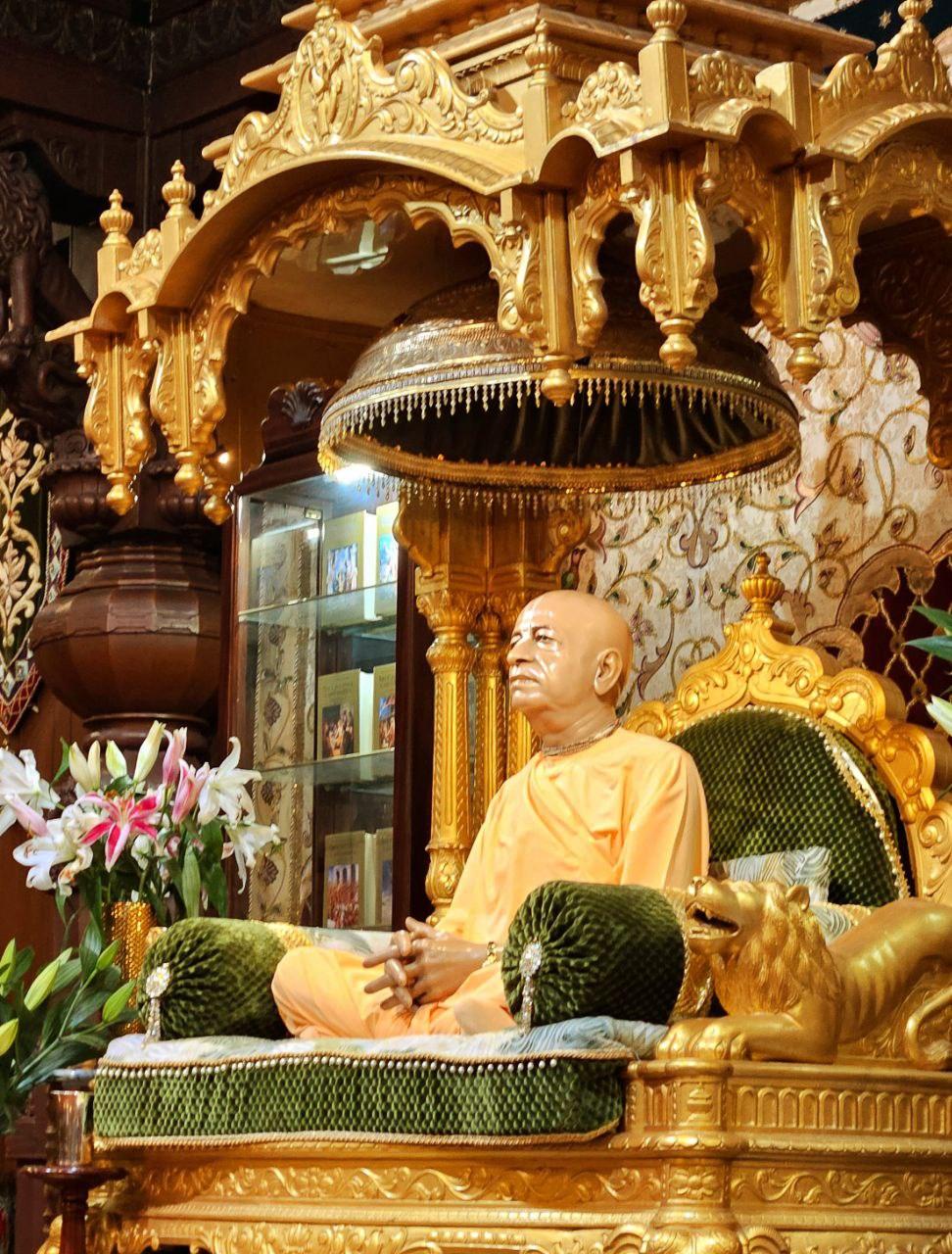
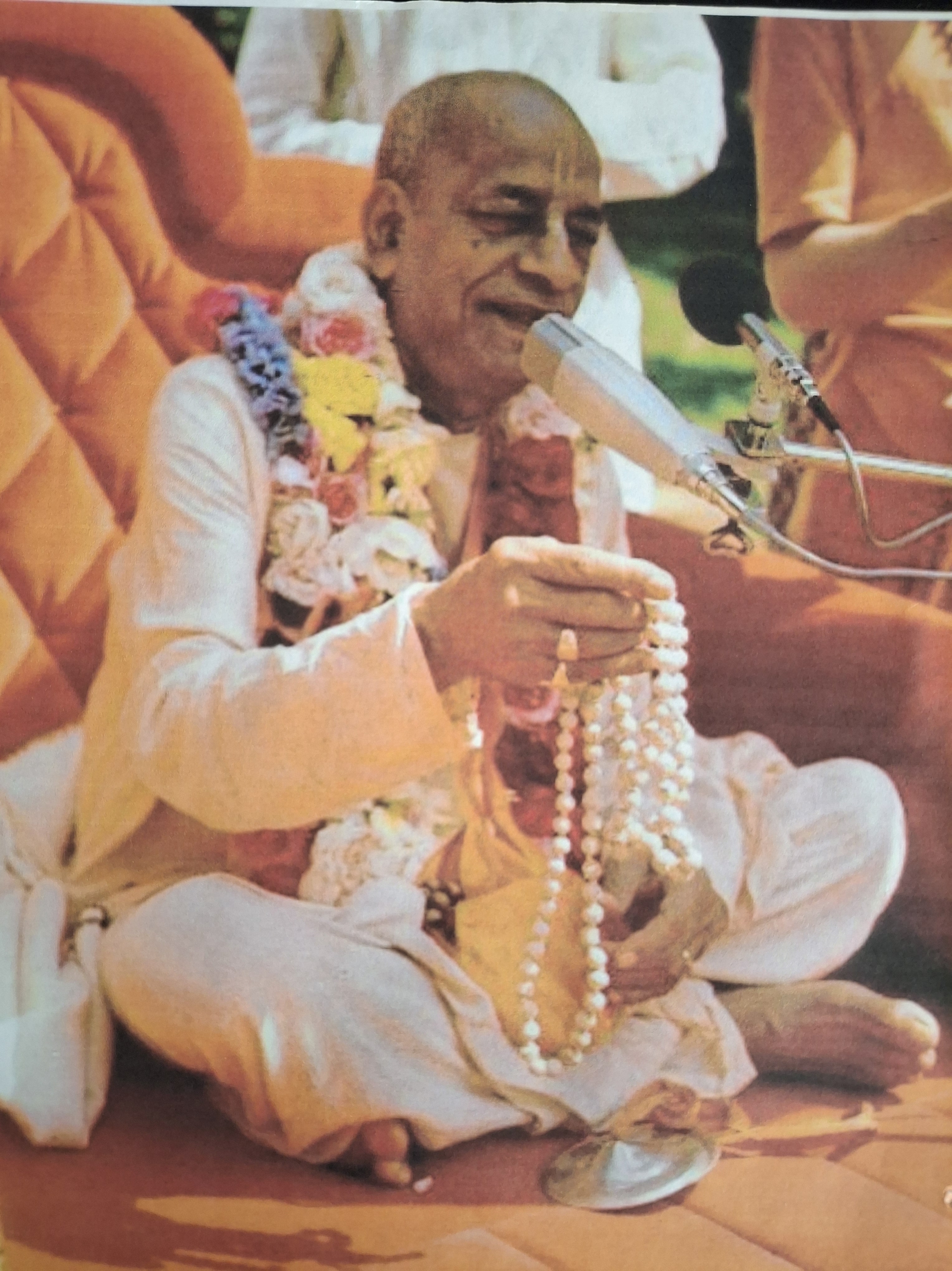
I’m sure everyone has a favorite picture of Srila Prabhupada, I particularly like this one in the morning when I am chanting Japa. It reminds me of the promise I made to chant every day.
When a mantra or hymn is chanted softly and slowly, that is called japa. The same mantra, when chanted loudly, is called kīrtana. For example, the mahā-mantra (Hare Kṛṣṇa, Hare Kṛṣṇa, Kṛṣṇa Kṛṣṇa, Hare Hare/ Hare Rāma, Hare Rāma, Rāma Rāma, Hare Hare) when uttered very softly only for one’s own hearing is called japa. The same mantra, when chanted loudly for being heard by all others, is called kīrtana. The mahā-mantra can be used for japa and kīrtana also. When japa is practiced it is for the personal benefit of the chanter, but when kīrtana is performed it is for the benefit of all others who may hear.
In the Padma Purāṇa there is a statement: “For any person who is chanting the holy name either softly or loudly, the paths to liberation and even heavenly happiness are at once open.” (Nectar of Devotion Chapter 9)
Of all the sacrifices, the chanting of Hare Kṛṣṇa, Hare Kṛṣṇa, Kṛṣṇa Kṛṣṇa, Hare Hare/ Hare Rāma, Hare Rāma, Rāma Rāma, Hare Hare is the purest representation of Kṛṣṇa. (from purport; Bhagavad-gita 10.25)
“One has to qualify himself to see and understand God, and that process of qualification is called Kṛṣṇa consciousness. By engaging ourselves in God’s service, we become qualified to see God. Otherwise it is not possible.“
“One cannot understand the form, name, quality, or paraphernalia of God with one’s material senses.” (Cc Madya 17.136)
Just as God is eternal, we are also eternal, and when we establish our eternal relationship with the supreme, complete eternal, we realize our eternality.
God is the supreme living entity among all living entities, the supreme eternal among all eternals. By Kṛṣṇa consciousness, by purification of the senses, this knowledge will be realized, and we will come to see God.
The following post is Chapter 3 from the book “The Path to Perfection”which gives some instruction on Seeing God (Krsna) and on the yoga system.
So we are finishing our series on the five types of relationships (rasa’s) with the Lord. Today we are exploring Devotional Service in Conjugal Love (Madhurya-rasa) as explained in chapter 44 of “The Nectar of Devotion”.
Because of the sensitive nature of this topic, we have posted the entire chapter from the the original 1970 edition of “The Nectar of Devotion”, by His Divine Grace A C Bhaktivedanta Swami Prabhupada.
A pure devotee’s attraction to Krsna in conjugal love is called devotional service in conjugal love. Although such conjugal feelings are not at all material, there is some similarity between this spiritual love and material activities. Therefore, persons who are interested only in material activities are unable to understand this spiritual conjugal love, and these devotional reciprocations appear very mysterious to them. Rupa Gosvāmī therefore describes conjugal love very briefly.
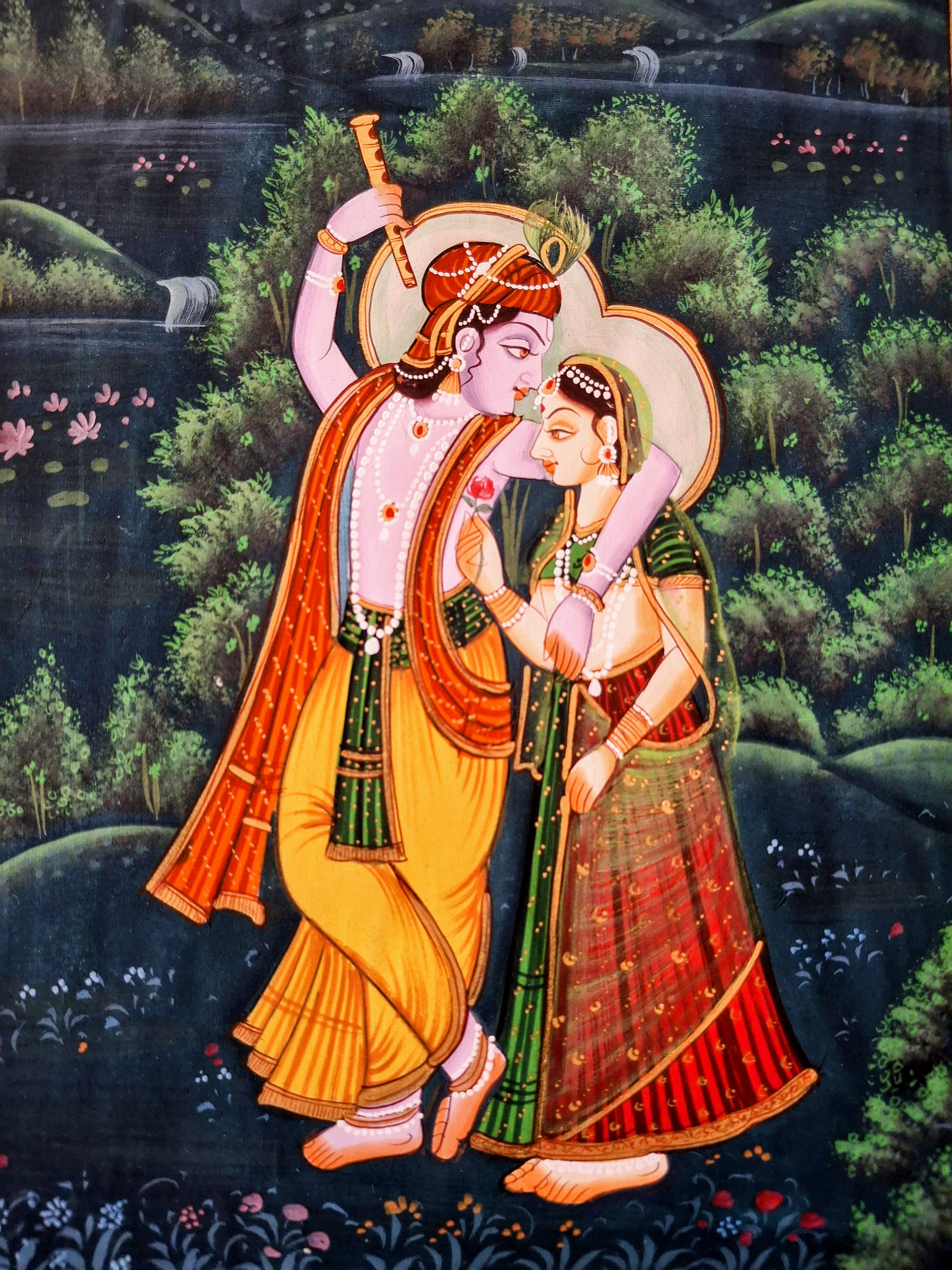
The impetuses of conjugal love are Krsna and His very dear consorts, such as Rādhārāṇī and Her immediate associates. Lord Krsnahas no rival: no one is equal to Him, and no one is greater than Him. His beauty is also without any rival, and because He excels all others in the pastimes of conjugal love, He is the original object of all conjugal love.
So we are continuing our series on the five types of relationships (rasa’s) with the Lord. Today we are exploring the Paternal Devotional stage of Love of God (Vatsalya-rasa) as explained in chapter 43 of “The Nectar of Devotion”.
When ecstatic love develops into the relationship of parenthood and becomes steadily established, the relationship is called vatsalya-rasa. The exhibition of this vatsalya-rasa standard of devotional service can be found in the dealings of Krishna with His devotees who represent themselves as superior personalities like father, mother, teacher, etc.
Learned scholars have described the impetuses of parental love for Krishna, existing in the elderly personalities who are in relation with Him, as follows: “The Supreme Personality of Godhead, whose bodily complexion is just like a bluish, new-grown lotus flower, whose body is very delicate and whose lotus eyes are surrounded by scattered hair as black as bees, was walking on the streets of Vrindavan when Mother Yasoda, the beloved wife of Nanda Mahārāj, saw Him. Immediately the milk began to flow from her breasts, soaking her body.” Some specific provocations for parental love of Krishna are listed as His blackish bodily hue, which is very attractive and pleasing to see, His all-auspicious bodily features, His mildness, His sweet words, His simplicity, His shyness, His humility, His constant readiness to offer respect to the elderly, and His charity. All of these qualities are considered ecstatic provocations for parental love.