Here is another word for your vaisnava vocabulary, acintya-bhedabheda-tattva. I was always facinated by this word because its meaning is inconceivable; simultaneous oneness and difference. Srila Prabhupada uses the example of the sun and the sunshine. The sunshine is not different from the sun as it is the engery of the sun, but when the sunshine is shinning in your room you cannot say the sun is in you room. Hence, one and different simultaneously. So similarly, God and His creation are one and different simultaneously One and Different.
Another example Srila Prabhupada uses is a drop of water from the ocean, has the same qualities as the ocean, in quality but not in quanitity. As living entities or as parts of God’s energy, we’re also equal in quality with God, but there’s a vast difference in quantity.
Achintya-bhedabheda-tattva refers to the inconceivable and simultaneous oneness and difference of the Supreme Person and His energies. This is one of the key points of theistic philosophy taught by Chaitanya Mahaprabhu. As parts of God’s energy, we’re also equal in quality with God, but there’s a vast difference in quantity. We’re each infinitesimal sparks of spiritual energy, and the Supreme Person, Krishna, is the infinite, supreme source of all energies.
Achintya-bhedabheda-tattva describes the relationship between the Supreme Lord and His energies, including individual souls, as both one with and different from Him simultaneously. This principle is beyond human comprehension, hence the “inconceivable” aspect.
From a lecture at a Christian Monastery – Melbourne April 06, 1972
Sometimes I ask myself, “are you making any spiritual advancement? Are you becoming free from lust anger and greed? And are you developing the qualities of a devotee?”. So, from time to time I like to look up the “qualities of a devotee”, and do a reality check.
Srila Prabhupada exhibits all the super excellent qualities of a devotee. He is the Acarya (one who teaches by example) and is exemplary in showing us how to develop the qualities of a devotee, in order to benefit all living beings and to serve Krsna.
The qualities of a devotee, twenty-six in number, are listed below:
1.) Kind to everyone, 2.) Does not quarrel with anyone, 3.) Fixed in the Absolute Truth, 4.) Equal to everyone, 5.) Faultless, 6.) Charitable, 7.) Mild, 8.) Clean, 9.) Simple, without material possession, 10.) Benevolent, 11.) Peaceful, 12.) Completely attached to Krsna, 13.) Has no material hankering, 14.) Meek, 15.) Steady, 16.) Self-controlled, 17.) Does not eat more than required, 18.) Sane, 19.) Respectful, 20.) Humble, 21.) Grave, 22.) Compassionate, 23.) Friendly, 24.) Poetic, 25.) Silent, 26.) Expert
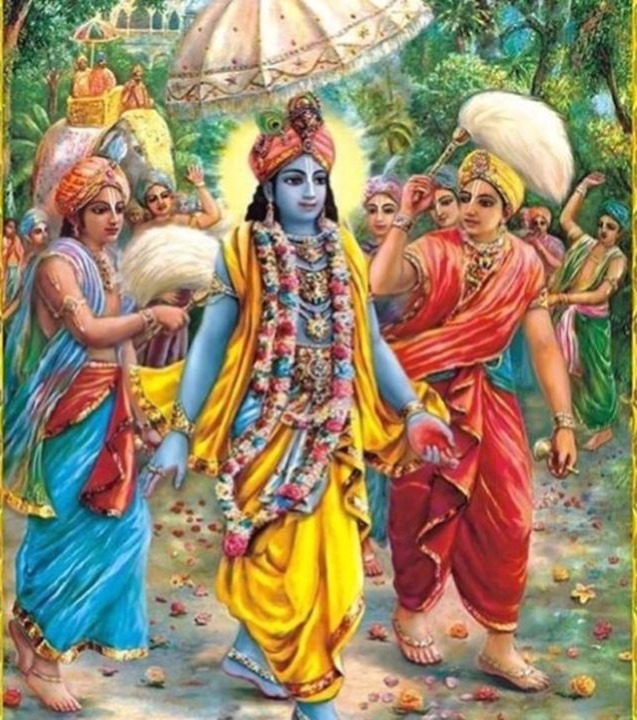
This is a nice description of Lord Kṛṣṇa’s transcendental counchshell, and of how He was received by the citizens of Dvārakā. Beautiful!
Sūta Gosvāmī said: Upon reaching the border of His most prosperous metropolis, known as the country of the Ānartas [Dvārakā], the Lord sounded His auspicious conchshell, heralding His arrival and apparently pacifying the dejection of the inhabitants.
The white and fat-boweled conchshell, being gripped by the hand of Lord Kṛṣṇa and sounded by Him, appeared to be reddened by the touch of His transcendental lips. It seemed that a white swan was playing in the stems of red lotus flowers.
The citizens of Dvārakā, having heard that sound which threatens fear personified in the material world, began to run towards Him fast, just to have a long desired audience with the Lord, who is the protector of all devotees.
…The sound heralded by Lord Kṛṣṇa was something like the heralding of the sunrise in the morning. This sound of the Lord is identical with the Lord. We are always fearful due to our ignorance of the next problem. The whole material existence is full of problems, and thus the fear problem is always prominent. This is due to our association with the illusory energy of the Lord, known as māyā or external energy, yet all fear is vanished as soon as there is the sound of the Lord, represented by His holy name, as it was sounded by Lord Śrī Caitanya Mahāprabhu in the following sixteen words:
Hare Kṛṣṇa, Hare Kṛṣṇa, Kṛṣṇa Kṛṣṇa, Hare Hare Hare Rāma, Hare Rāma, Rāma Rāma, Hare Hare
We can take advantage of these sounds and be free from all threatening problems of material existence.
…The best and ultimate authority is Kṛṣṇa, for He is our eternal well-wisher, and He always speaks for our benefit. Since we have to accept some authority, why not accept His? Simply by hearing of His glories from Bhagavad-gītā and Śrīmad-Bhāgavatam and by chanting His names: Hare Kṛṣṇa, Hare Krsna, Krsna Krsna, Hare Hare, Hare Rama, Hare Rama, Rama Rama, Hare Hare, we can swiftly perfect our lives.
Kṛṣṇa Consciousness, the Matchless Gift By His Divine Grace A. C. Bhaktivedanta Swami Prabhupāda Chapter One
Spiritual Knowledge Through Kṛṣṇa
The aim of this Kṛṣṇa consciousness movement is to bring all living entities back to their original consciousness. All living entities within the material world are, to varying degrees, afflicted with a type of madness. This Kṛṣṇa consciousness movement aims at curing man of his material disease and reestablishing his original consciousness. In a Bengali poem a great Vaiṣṇava poet has written, “When a man is haunted by ghosts, he can only speak nonsense. Similarly, anyone who is under the influence of material nature should be considered haunted, and whatever he speaks should be considered nonsense.” One may be considered a great philosopher or great scientist, but if he is haunted by the ghost of māyā, illusion, whatever he theorizes and whatever he speaks is more or less nonsensical. Today we are given the example of a psychiatrist who, when requested to examine a murderer, proclaimed that since all the patients with whom he had come in contact were more or less crazy, the court could excuse the murderer on those grounds if it so desired. The point is that in the material world it is very difficult to find a sane living entity. The prevailing atmosphere of insanity in this world is all caused by the infection of material consciousness.
The following are just a few of the many quotes from Srila Prabhupada which encourage us to approach Krishna through the mercy of Srimati Radharani, Krishna’s eternal consort. For those of us who feel that there is no hope of making spiritual progress in this lifetime, Srimati Radharani, Who is compassion personified, kindly comes to our rescue if we can humbly invoke Her divine blessings.
“I offer my respects to Radharani whose bodily complexion is like molten gold and who is the Queen of Vrndavana. You are the daughter of King Vrsabhanu, and You are very dear to Lord Krishna.” (Sri Radha Pranama)
“I emphatically say to you, O brothers, you will obtain your good fortune from the Supreme Lord Krishna only when Srimati Radharani becomes pleased with you.”(Prayer to the Lotus Feet of Krishna, September 13, 1965)
“Actually, because Krishna is the Supreme Personality of Godhead, it is very difficult to approach Him. But the devotees, taking advantage of His compassionate nature, which is represented by Radharani, always pray to Radharani for Krishna’s compassion.” (Nectar of Devotion, Chapter 22)
“There is no comparison to Radharani’s beauty and the luster of Her transcendental body. The so-called beauty of the moon has fallen on the ground in the presence of Radharani’s beauty.” (From Vrindavana by Srila Narottama das Thakura)
“The beauty of Srimati Radharani’s eyes forcibly devours the beauty of newly grown blue lotus flowers, and the beauty of Her face surpasses that of an entire forest of fully blossomed lotuses. Her bodily luster seems to place even gold into a painful situation. Thus the wonderful, unprecedented beauty of Srimati Radharani is awakening in Vrindavana.” (Caitanya-caritamrita Antya 1.169)
A strange thing happened to me while we were in India. We were at Radha Kund (Srimati Radharani’s bathing ghat), and after sprinkling 3 drops of water on my head, I offered my obeisances, and I prayed, please take away the lust, anger, greed and envy from my heart. This surprised me because I never prayed for that before. But it got me thinking…if you take away Lust, what is left, is Love. Take away Anger, and you are left with Happiness, take away Greed, and you have Charity or Generosity, and if you take awayEnvy, you are left with Kindness to others.
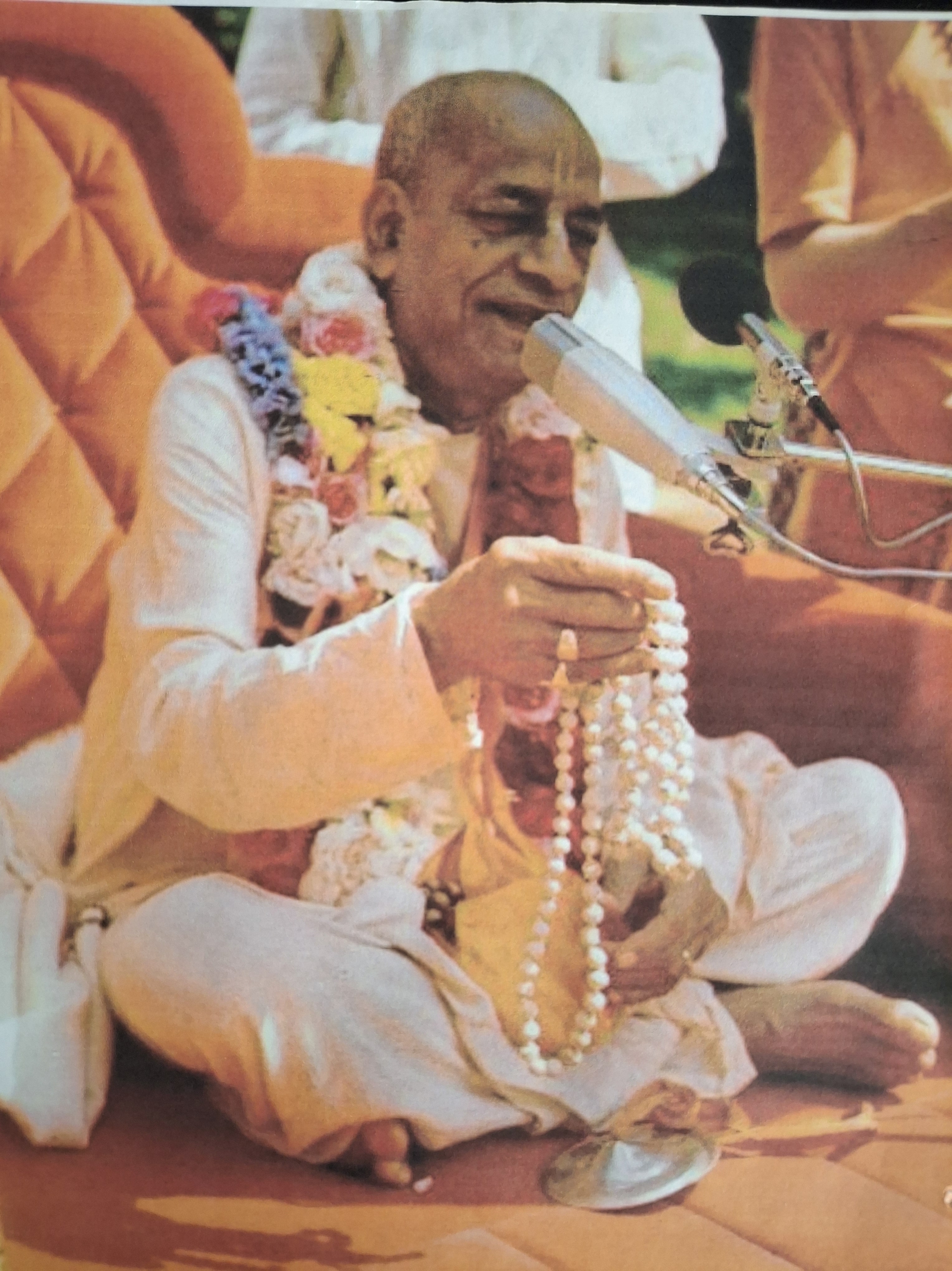
I’m sure everyone has a favorite picture of Srila Prabhupada, I particularly like this one in the morning when I am chanting Japa. It reminds me of the promise I made to chant every day.
When a mantra or hymn is chanted softly and slowly, that is called japa. The same mantra, when chanted loudly, is called kīrtana. For example, the mahā-mantra (Hare Kṛṣṇa, Hare Kṛṣṇa, Kṛṣṇa Kṛṣṇa, Hare Hare/ Hare Rāma, Hare Rāma, Rāma Rāma, Hare Hare) when uttered very softly only for one’s own hearing is called japa. The same mantra, when chanted loudly for being heard by all others, is called kīrtana. The mahā-mantra can be used for japa and kīrtana also. When japa is practiced it is for the personal benefit of the chanter, but when kīrtana is performed it is for the benefit of all others who may hear.
In the Padma Purāṇa there is a statement: “For any person who is chanting the holy name either softly or loudly, the paths to liberation and even heavenly happiness are at once open.” (Nectar of Devotion Chapter 9)
Of all the sacrifices, the chanting of Hare Kṛṣṇa, Hare Kṛṣṇa, Kṛṣṇa Kṛṣṇa, Hare Hare/ Hare Rāma, Hare Rāma, Rāma Rāma, Hare Hare is the purest representation of Kṛṣṇa. (from purport; Bhagavad-gita 10.25)
“One has to qualify himself to see and understand God, and that process of qualification is called Kṛṣṇa consciousness. By engaging ourselves in God’s service, we become qualified to see God. Otherwise it is not possible.“
“One cannot understand the form, name, quality, or paraphernalia of God with one’s material senses.” (Cc Madya 17.136)
Just as God is eternal, we are also eternal, and when we establish our eternal relationship with the supreme, complete eternal, we realize our eternality.
God is the supreme living entity among all living entities, the supreme eternal among all eternals. By Kṛṣṇa consciousness, by purification of the senses, this knowledge will be realized, and we will come to see God.
The following post is Chapter 3 from the book “The Path to Perfection”which gives some instruction on Seeing God (Krsna) and on the yoga system.
So we are finishing our series on the five types of relationships (rasa’s) with the Lord. Today we are exploring Devotional Service in Conjugal Love (Madhurya-rasa) as explained in chapter 44 of “The Nectar of Devotion”.
Because of the sensitive nature of this topic, we have posted the entire chapter from the the original 1970 edition of “The Nectar of Devotion”, by His Divine Grace A C Bhaktivedanta Swami Prabhupada.
A pure devotee’s attraction to Krsna in conjugal love is called devotional service in conjugal love. Although such conjugal feelings are not at all material, there is some similarity between this spiritual love and material activities. Therefore, persons who are interested only in material activities are unable to understand this spiritual conjugal love, and these devotional reciprocations appear very mysterious to them. Rupa Gosvāmī therefore describes conjugal love very briefly.
The impetuses of conjugal love are Krsna and His very dear consorts, such as Rādhārāṇī and Her immediate associates. Lord Krsnahas no rival: no one is equal to Him, and no one is greater than Him. His beauty is also without any rival, and because He excels all others in the pastimes of conjugal love, He is the original object of all conjugal love.
So we are continuing our series on the five types of relationships (rasa’s) with the Lord. Today we are exploring the Paternal Devotional stage of Love of God (Vatsalya-rasa) as explained in chapter 43 of “The Nectar of Devotion”.
When ecstatic love develops into the relationship of parenthood and becomes steadily established, the relationship is called vatsalya-rasa. The exhibition of this vatsalya-rasa standard of devotional service can be found in the dealings of Krishna with His devotees who represent themselves as superior personalities like father, mother, teacher, etc.
Learned scholars have described the impetuses of parental love for Krishna, existing in the elderly personalities who are in relation with Him, as follows: “The Supreme Personality of Godhead, whose bodily complexion is just like a bluish, new-grown lotus flower, whose body is very delicate and whose lotus eyes are surrounded by scattered hair as black as bees, was walking on the streets of Vrindavan when Mother Yasoda, the beloved wife of Nanda Mahārāj, saw Him. Immediately the milk began to flow from her breasts, soaking her body.” Some specific provocations for parental love of Krishna are listed as His blackish bodily hue, which is very attractive and pleasing to see, His all-auspicious bodily features, His mildness, His sweet words, His simplicity, His shyness, His humility, His constant readiness to offer respect to the elderly, and His charity. All of these qualities are considered ecstatic provocations for parental love.
So today we are exploring the Servitude stage of Love of God (Dasya-rasa) as explained in chapter 36 of “The Nectar of Devotion”.
Each soul, according to its constitutional nature, possesses a unique loving relationship with Krishna in one of five principal categories. When devotees return to the spiritual world, they engage in direct loving devotional service to Krishna in their particular rasa.
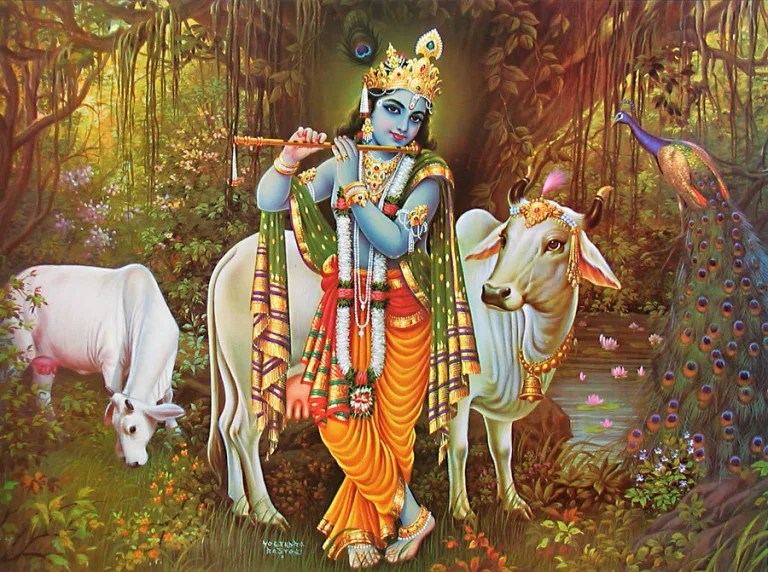
Devotees engaged in servitude are attached to Krishna in the affection of reverence. Some of the inhabitants of Gokula (Vrindavan) as exhibited on earth) are attached to Krishna on this platform of affection in reverence. The inhabitants of Vrindavan used to say, “Kṛṣṇa is always manifest before us with a complexion like a blackish cloud. He holds His wonderful flute in His lotus hands. He is dressed in yellow silks and bedecked with a peacock feather on His head. When Krishna walks near Govardhan Hill with these personal features, all the inhabitants of the heavenly planets, as well as the inhabitants of this earth, feel transcendental bliss and consider themselves the eternal servants of the Lord.”
Today we are exploring the Neutral stage of Love of God, (santa-rasa), as explained in chapter 35 of “The Nectar of Devotion”.
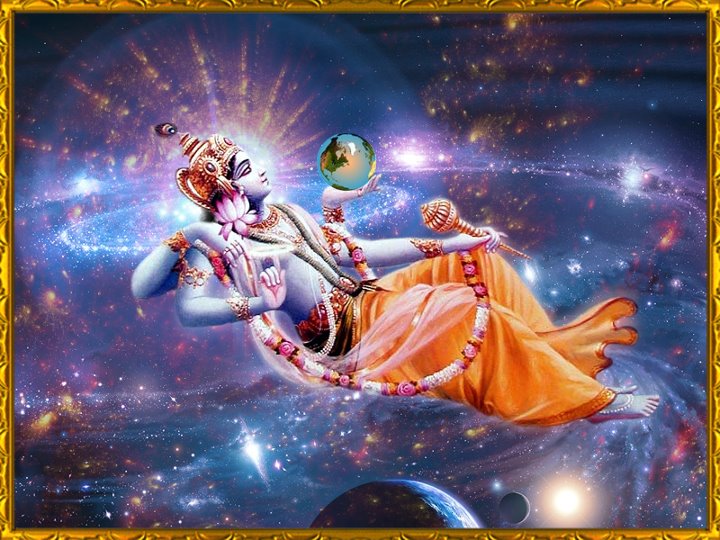
“When the yogi sees the eternal form of Visnu and appreciates the Lord’s beauty in awe and veneration, he is situated in the neutral stage of love of God.”
…Some great sages have attained this neutral position by practicing austerity, penance and meditation to control the senses. Such sages are generally called mystic yogīs, and in most cases they are inclined to appreciate the spiritual pleasure of the impersonal feature of the absolute truth. They are practically unaware of the transcendental pleasure derived from personal contact with the Supreme Godhead.
When some great saintly persons who had undergone penances and austerities saw the four-handed transcendental form of Visnu, they began to remark as follows: “This four-handed form of the Lord, manifested in a bluish color, is the reservoir of all pleasure and the center of our living force. Actually, when we see this eternal form of Visnu, we, along with many other paramahaṁsas, become immediately captivated by the beauty of the Lord.” This appreciation of Lord Visnu by saintly persons is an instance of situation in santa-rasa, or the neutral stage of devotional service. In the beginning, those who are aspiring for salvation try to get out of the material entanglement by performing painful austerities and penances, and ultimately they come to the impersonal status of spiritual realization. At this brahma-bhuta [SB 4.30.20] stage of liberation from the material entanglement, the symptoms, as explained in the Bhagavad-gita, are that one becomes joyous beyond any hankering or lamentation and gains a universal vision. When the devotee is situated in the santa-rasa, or neutral stage of devotional service, he appreciates the Visnu form of the Lord.
Today as most of the Western World celebrates Easter Sunday, we thought we word honor the life of Lord Jesus Christ with some select writings by our spiritual master A.C. Bhaktivedanta Swami Prabhupada.
The Śrīmad-Bhāgavatam states that any bona fide preacher of God consciousness must have the qualities of titikṣā (tolerance) and karuṇā (compassion). In the character of Lord Jesus Christ we find both these qualities. He was so tolerant that even while he was being crucified, he didn’t condemn anyone. And he was so compassionate that he prayed to God to forgive the very persons who were trying to kill him. (Of course, they could not actually kill him. But they were thinking that he could be killed, so they were committing a great offense.) As Christ was being crucified he prayed, “Father, forgive them. They know not what they are doing.”
…Of course, the message that Christ preached was just according to his particular time, place, and country, and just suited for a particular group of people. But certainly he is the representative of God. Therefore we adore Lord Jesus Christ and offer our obeisances to him.
Once, in Melbourne, a group of Christian ministers came to visit me. They asked, “What is your idea of Jesus Christ?” I told them, “He is our guru. He is preaching God consciousness, so he is our spiritual master.” The ministers very much appreciated that.
Actually, anyone who is preaching God’s glories must be accepted as a guru. Jesus Christ is one such great personality. We should not think of him as an ordinary human being. The scriptures say that anyone who considers the spiritual master to be an ordinary man has a hellish mentality. If Jesus Christ were an ordinary man, then he could not have delivered God consciousness. (Science of Self Realization, Chapter 4, “Understanding Krsna and Christ)
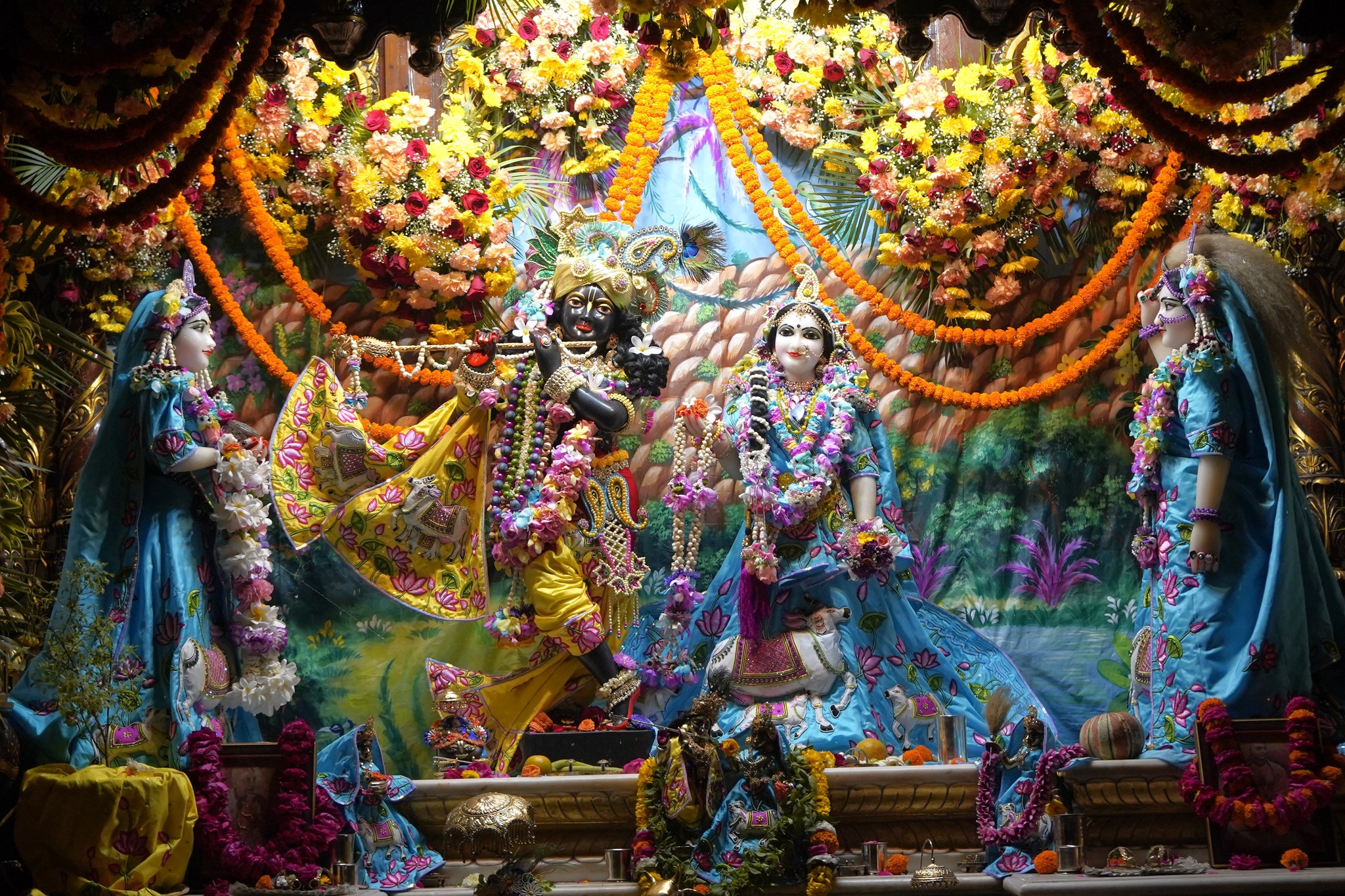
We are currently in Vrindavan, India, at the Krsna Balaram Mandir, with the most beautiful Radha Shyam. All the deities looked so gorgeous this morning, in their black outfits.
Have been doing the parikaram of the twelve forests of Vrindavan, and it has been amazing, and feel exceptional fortune, at being here, and experiencing so much devotional nectar.
I wish to share some from the Preface to the”Nectar of Devotion” By A. C. Bhaktivedanta Swami:
The basic principle of the living condition is that we have a general propensity to love someone. No one can live without loving someone else. This propensity is present in every living being. Even an animal like a tiger has this loving propensity at least in a dormant stage, and it is certainly present in the human beings. The missing point, however, is where to repose our love so that everyone can become happy. At the present moment the human society teaches one to love his country or family or his personal self, but there is no information where to repose the loving propensity so that everyone can become happy. That missing point is Krsna, and The Nectar of Devotion teaches us how to stimulate our original love for Krsna and how to be situated in that position where we can enjoy our blissful life.
Those who are followers of His Divine Grace A.C. Bhaktivedanta Swami Prabhupada, and read from his books with faith and conviction, are receiving Transcendental Knowledgethrough the disciplic succession.Evaṁ paramparā-prāptam imaṁ rājarṣayo viduḥ. (Bhagavad-gīta, 4.2)
…”Your time is so valuable that you cannot get back your life, one day of your life or one moment of your life, by paying millions of dollars. (Srila Prabhupada lectureSB 1.2.19 New Vrindaban)
I have been thinking lately about about my life. I am 70 years old, or to break it down; 25,550 days, 613,200 hours, 36,792,000 minutes, 2,207,520.000 seconds. How much of my life have I wasted? When I wasn’t thinking about Krsna, when I was not engaged in devotional service. How many hours did I spend sleeping, or engaged in fruitive labor, intoxication or sense gratification? Really, I have wasted so much valuable time, and can never get that back.
“If such valuable time you simply waste, then just estimate it what is your loss, practically, from monetary point. One moment of your life cannot be returned by millions of dollars.
Therefore our Rūpa Gosvāmī also teaches, avyartha-kālatvam (CC Madhya 23.18). A Kṛṣṇa conscious person should see, “Whether my time has become wasted? Whether I am utilizing my time, the short duration of my life, properly?” All Kṛṣṇa conscious persons should be vigilant to see that the time is not wasted. Śrī Caitanya Mahāprabhu therefore advises, kīrtanīyaḥ sadā hariḥ.
tṛṇād api sunīcenataror api sahiṣṇunāamāninā mānadenakīrtanīyaḥ sadā hariḥ (CC Adi 17.31)
We have therefore introduced chanting Hare Kṛṣṇa twenty-four hours. I am glad to see all the devotees, they are carrying the beads, that this is nice practice. It must be. Chant Hare Kṛṣṇa, Hare Kṛṣṇa, for twenty-four hours: while working, even in sleeping. If you practice, in sleep also you will chant Hare Kṛṣṇa. That is possible. It is not impossible, it is fact.” (lecture SB 1.2.19 New Vrindaban)
..”So we should be very much careful in discharging the duty. The devotee should be so much careful that he’ll always see, “Whether this moment is spoiled or utilized?”Avyartha-kālatvam (CC Madhya 23.18). Avyartha-kālatvam, that “My time may not be wasted.” He should be so careful, “Whether my time is being wasted?” And time wasted, the time we engage for our bodily necessities, that is wasted. Generally, conditioned souls, they are simply wasting their time. Only the period which we are engaged in Kṛṣṇa consciousness, that is utilized. So we should be very much careful whether time is being wasted or being utilized.”… (Morning walk San Francisco, 1968)
This morning I just happened to open this small book entitled “Life comes from Life”, which has been sitting quietly on our bookshelf for many, many years. For some reason today, I opened it and began to read. It is based on morning walk conversations with Srila Prabhupada and his disciples on the origins of life, and is very interesting. We are posting the first chapter as well as a free pdf download of entire book, that you can read or save to your computer.
This is such a beautiful song, it is a meditation in itself.
Krishna is very pleased when we call on Him by His Names, which are associated with His devotees, qualities and pastimes. This song by Bhaktivinoda Thakura is composed of the Nanes of Krsna in different aspects. (from the Songs of the Vaisnava Acaryas)
Śrī Nāma-kīrtana Chanting of the Holy Names by Srila Bhaktivinoda Thakura
yaśomatī-nandana–Lord Kṛṣṇa is the beloved son of mother Yaśodā; vraja-vara-nāgara–most beloved of the inhabitants of Vraja; gokularañjana–the attractor of the people of Gokula; kāna–(an intimate nickname); gopī-parāṇa-dhana–the wealth of the lives of the gopīs; madana-manohara–who can attract even the mind of Cupid; kāliyadamana-vidhāna–the chastiser of the Kāliya serpent.
Lord Kṛṣṇa is the beloved son of mother Yaśodā; the transcendental lover in the land of Vraja; the delight of Gokula; Kāna [a nickname of Kṛṣṇa]; the wealth of the lives of the gopīs. He steals the mind of even Cupid and punishes the Kāliya serpent.
amala harinām amiya-vilāsā vipina-purandara, navīna nāgara-bora, baṁśī-badana suvāsā
amala harinām–these pure holy names; amiya vilāsā–are full of sweet, nectarean pastimes; vipina-purandara–He is the monarch of the garden groves; navīna nāgara-bora–He is the best of youthful lovers; vaḿśīvadana–He is seen with His flute placed to His lips; suvāsā–He is an excellent dresser.
These pure, holy names of Lord Hari are full of sweet, nectarean pastimes. Kṛṣṇa is the Lord of the twelve forests of Vraja, He is ever-youthful and is the best of lovers. He is always playing on a flute, and He is an excellent dresser.
braja-jana-pālana–the protector of the inhabitants of Vraja; asura-kula-nāśana–the destroyer of demonic dynasties; nanda-godhana-rākhaoyālā– the keeper of Nanda Mahārāja’s valuable cows; govinda–the giver of pleasure to the cows; mādhava–the husband of the goddess of fortune; navanīta-taskara–the butter thief; sundara nanda-gopālā–the beautiful cowherd son of Nanda Mahārāja.
Kṛṣṇa is the protector of the inhabitants of Vraja; the destroyer of various demoniac dynasties; the keeper and tender of Nanda Mahārāja’s cows; the giver of pleasure to the cows, land, and spiritual senses; the husband of the goddess of fortune; the butter thief; and the beautiful cowherd boy of Nanda Mahārāja.
yāmuna-taṭa-cara–He wanders along the banks of the river Yamunā; gopī-vasana-hara–He steals the garments of the gopīs; rāsa-rasika–He delights in the mellows of the rāsa dance; kṛpāmoya–He is very merciful; śrī-rādhā-vallabha–the most beloved of Srīmatī Rādhāraṇī vṛndāvananaṭabara–the great dancer of Vṛndāvana; bhakativinod-āśraya–the shelter of Bhaktivinoda
Kṛṣṇa wanders along the banks of the River Yamunā. He stole the garments of the young damsels of Vraja who were bathing there. He delights in the mellows of the rāsa dance; He is very merciful; the lover and beloved of Śrīmatī Rādhārāṇī; the great dancer of Vṛndāvana; and the shelter and only refuge of Ṭhākura Bhaktivinoda.
I remember years ago when I was just a young new devotee, and we were asked to go out and distribute books, we were asked so many questions by people we met. One question I will never forget; “What does the mantra mean?” How to explain this to someone who has never heard of Krishna? So I replied; “O Lord please engage me in Your loving devotional service”. Even as a new devotee I knew there was more I could have said, but I left it at that.
But that basic question always stayed with me.
Hare Krishna, Hare Krishna, Krishna Krishna, Hare Hare, Hare Rama, Hare Rama, Rama Rama, Hare Hare
Another definition I discovered is;
Hare– Srimati Radharini (the divine energy of the Lord)
Krishna– The All Attractive Supreme Personality of Godhead
Rama– Name of Lord Krishna who is the reservoir of pleasure. (as in Radha-Ramana, the giver of pleasure to Srimati Radharani) The name Rama also means Lord Ramacandra, and Lord Balarama.
But for me, I like this verse I discovered in my reading;
“O Srimati Radharani, O All Attractive Reservoir of Pleasure, Lord Sri Krishna, please engage me in your loving devotional service”













 The Hare Krishna Movement