05 Aug 2012
by The Hare Krishna Movement
in Krishna, Opulence of the Absolute, Sri Caitanya-Caritamrta, Srimati Radharani
Tags: A.C. Bhaktivedanta Swami Prabhupada, Aprakrta-madana, cupid, Krishna, Krsna, Mad. 8.139, Madana, Madana-mohana, Manmatha-madana, Nectar of Devotion, sac-cid-ananda-vigraha, Sri Caitanya-caritamrta
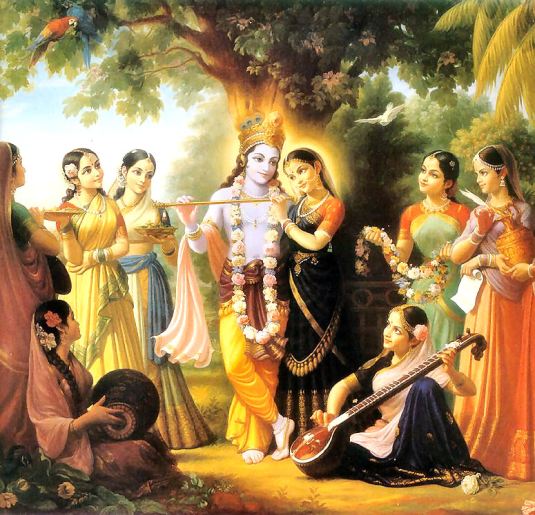
click on image to enlarge
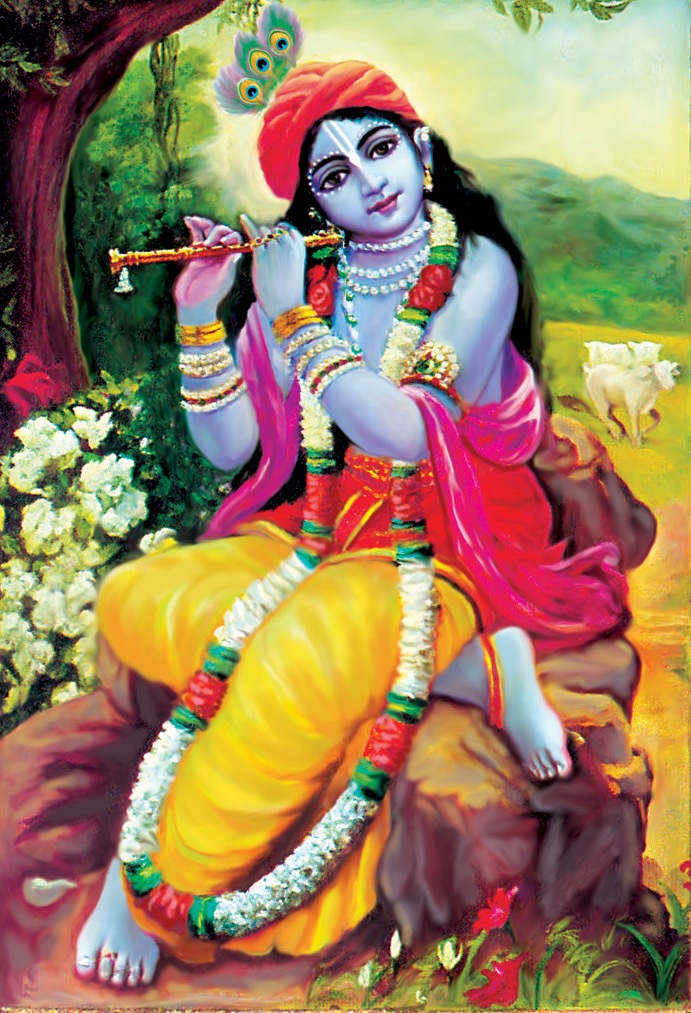
“The very name Kṛṣṇa means that He attracts even Cupid. He is therefore attractive to everyone-male and female, moving and inert living entities. Indeed, Kṛṣṇa is known as the all-attractive one.
“Śrīla Rūpa Gosvāmī has stated that devotional service attracts even Kṛṣṇa. Kṛṣṇa attracts everyone, but devotional service attracts Kṛṣṇa. The symbol of devotional service in the highest degree is Rādhārāṇī. Kṛṣṇa is called Madana-mohana, which means that He is so attractive that He can defeat the attraction of thousands of Cupids. But Rādhārāṇī is still more attractive, for She can even attract Kṛṣṇa. Therefore devotees call Her Madana-mohana-mohinī, the attractor of the attractor of Cupid. To perform devotional service means to follow in the footsteps of Rādhārāṇī…” (Nectar of Devotion Lecture, Nov. 11, 1972, Vrindavan)
…The name Madana refers to Cupid, but Kṛṣṇa is the spiritual Madana. His body is not material like the body of Cupid in this material universe. Kṛṣṇa’s body is all-spiritual-sac-cid-ānanda-vigraha. Therefore He is called Aprākṛta-madana. He is also known as Manmatha-madana, which means that He is attractive even to Cupid.
More
30 Jul 2012
by The Hare Krishna Movement
in A.C. Bhaktivedanta Swami Prabhupada, Back to Godhead, Caitanya Mahaprabhu
Tags: A.C. Bhaktivedanta Swami Prabhupada, Avatara, Back to Godhead Magazine, golden avatara, Krsna, Krsna-prema-pradaya te, namo maha-vadanyaya, Rupa Gosvami, Sri Caitanya Mahaprabhu

… When Rupa Gosvami, the principal disciple of Lord Caitanya, first saw Caitanya Mahaprabhu, he offered a nice prayer to Lord Caitanya. This prayer says, namo maha-vadanyaya krsna-prema-pradaya te/ krsnaya krsna-caitanya-namne gaura-tvise namah. “My dear Lord, You are the most munificent of all the incarnations.” Why? Krsna-prema-pradaya te: “You are directly giving love of God. You have no other purpose. Your process is so nice that one can immediately learn to love God. Therefore You are the most munificent of all incarnations. And it is not possible for any personality other than Krsna Himself to deliver this benediction; therefore I say that You are Krsna.” Krsnaya krsna-caitanya-namne: “You are Krsna, but You have assumed the name Krsna Caitanya. I surrender unto You.”
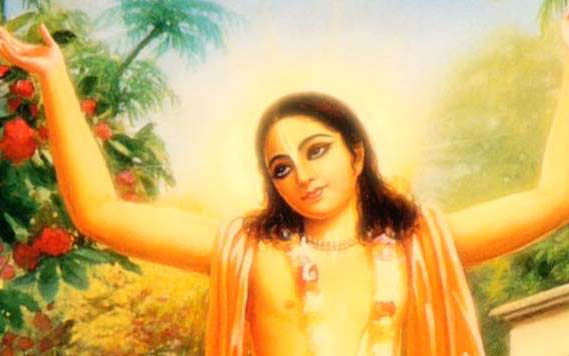
Lord Caitanya: The Golden Avatara
By His Divine Grace A.C. Bhaktivedanta Swami Prabhupada
Excerpted from Back to Godhead Magazine Vol. 1, Number 39
Sri Caitanya Mahaprabhu, the golden avatara, appeared in India nearly 500 years ago. It is the custom in India that when a child is born, an astrologer is called for. When Lord Krsna, the Supreme Personality of Godhead, appeared 5,000 years ago, Gargamuni was called by His father, and he said, “This child formerly incarnated in five complexions, such as red and golden, and now He has appeared in blackish color.” Krsna’s color is described in the scriptures as blackish, just like a cloud. Lord Caitanya is understood to be Krsna appearing in golden complexion.
More
18 Jul 2012
by The Hare Krishna Movement
in Caitanya Mahaprabhu, Lectures, Sri Caitanya-Caritamrta
Tags: A.C. Bhaktivedanta Swami Prabhupada, Caitanya Caritamrta, Krsna, krsnera svarupa ananta, Lord Caitanya, Mad. 20.146-151, photo by Gurudas, prabhupada, Prabhupada lectures, transcendental forms of Krsna, Vedas, Vedic knowledge points to Krishna

“Vedic Knowledge Points To Krsna”
Lecture on Caitanya-caritamrta Madhya 20.146-151
New York, December 3, 1966
By His Divine Grace A.C. Bhaktivedanta Swami Prabhupada
Prabhupada:
mukhya-gauna-vrtti, kimva anvaya-vyatireke
vedera pratijna kevala kahaye krsnake
So Lord Caitanya says, “You study Vedas in any way, directly, indirectly. In whatever way you like you study Vedas, but the ultimate objective is Krsna.”
Now, Caitanya, Lord Caitanya, is describing about the various forms of Krsna. This is very important subject. How Krsna is all-pervading, He is describing.
krsnera svarupa-ananta, vaibhava-apara
cic-chakti, maya-sakti, jiva-sakti ara
Krsnera svarupa ananta. The transcendental forms of Krsna, innumerable, vaibhava, and His opulence, that is also innumerable. Nobody can estimate. How many forms are there of Krsna or how much opulent He is, nobody can estimate; nobody can measure. This is inconceivable. The first proposition. Cic-chakti maya-sakti jiva-sakti ara. And His potencies are also unlimited, out of which, three potencies are generally accepted: cit-sakti, spiritual potency; material potency; and marginal potency. These three potencies I have described many times. Cit-sakti, the spiritual potency, is a manifestation of the spiritual world, and material potency is a manifestation of this material world, and the marginal potency, we are, we living entities. We are marginal potency. Why it is marginal? Because although we belong to the spiritual potency, but we have got tendency to come into contact of this material potency. Therefore it is called marginal, “this way or that way.” That a slight independence which is there in every living entity, he can use that, and he may select either to live in the spiritual potency or in the material potency. Therefore the living entities are called marginal potency. So parasya saktir vividhaiva sruyate [Cc. Madhya 13.65, purport]. Although the energies of the Supreme Lord are innumerable — nobody can count or measure — but they are divided into three.
More
23 Jun 2012
by The Hare Krishna Movement
in Krishna Consciousness, Teachings of Queen Kunti
Tags: A.C. Bhaktivedanta Swami Prabhupada, back to Godhead, calamities, clamity, dangers, Krishna, Krishna consciousness, Krsna, kuntidevi, Let There Be Calamities, Queen Kunti, repetition of birth and death, Teachings of Queen Kunti, vipadah

…In this very interesting verse, it is described that vipadaḥ—calamities or dangers—are very good if such dangers and calamities remind us of Kṛṣṇa.
Here Kuntīdevī speaks of apunar bhava-darśanam. The prefix a means “not,” and punar bhava means “repetition of birth and death.” The real danger is the repetition of birth and death. That must be stopped.
As long as we are in this material world, there must be calamities because this is the place of calamity. But even with calamities our business should be to develop our Kṛṣṇa consciousness, so that after giving up this body we may go back home, back to Kṛṣṇa.
Teachings of Queen Kuntī
By His Divine Grace A. C. Bhaktivedanta Swami Prabhupāda
Chapter Eight
Let There Be Calamities
vipadaḥ santu tāḥ śaśvat
tatra tatra jagad-guro
bhavato darśanaṁ yat syād
apunar bhava-darśanam
I wish that all those calamities would happen again and again so that we could see You again and again, for seeing You means that we will no longer see repeated births and deaths. (Śrīmad-Bhāgavatam 1.8.25)
Generally, the distressed, the needy, the intelligent, and the inquisitive who have performed some pious activities worship or begin to worship the Lord. Others, who are thriving on misdeeds only, regardless of status, cannot approach the Supreme due to being misled by the illusory energy. Therefore, for a pious person, if there is some calamity there is no other alternative than to take shelter of the lotus feet of the Lord. Constantly remembering the lotus feet of the Lord means preparing for liberation from birth and death. Therefore, even though there are so-called calamities, they are welcome because they give us an opportunity to remember the Lord, which means liberation.
One who has taken shelter of the lotus feet of the Lord, which are accepted as the most suitable boat for crossing the ocean of nescience, can achieve liberation as easily as one leaps over the holes made by the hooves of a calf. Such persons are meant to reside in the abode of the Lord, and they have nothing to do with a place where there is danger in every step.
More
11 Jun 2012
by The Hare Krishna Movement
in Chanting Hare Krishna, Diksha, Guru & Disciple, Hare Krishna Maha Mantra
Tags: chanting Hare Krishna, guru disciple, initiation ceromony, Krsna, krsna consciousness, lecture on initiation, Madhudvisa, Revatinandana, spiritual master, Srila Prabhupada, Srimati dasi, ten offences to be advoided while chanting the maha-mantra, ten offenses, Vilasa-vigraha, yoga process
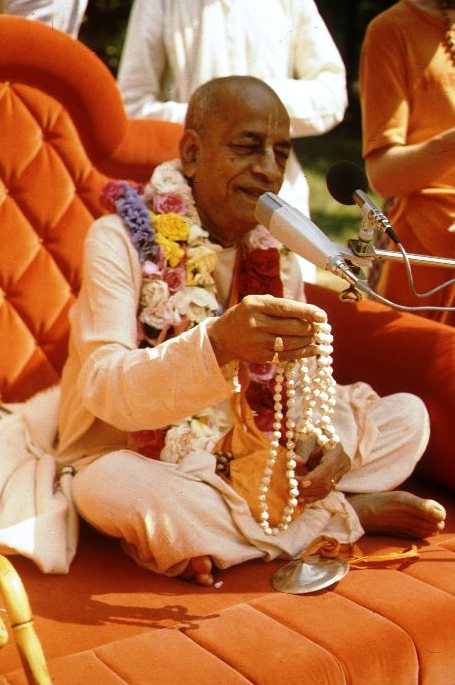
…Madhudviṣa: Śrīla Prabhupāda? Should I read the ten offenses?
Prabhupāda: Yes.
Madhudviṣa: We have them here.
Prabhupāda: Just see. Go on reading. Yes, you read.
Madhudviṣa: “The ten offenses to avoid while chanting the mahā-mantra. Number one: Blaspheming the Lord’s devotee.”
Prabhupāda: Now just try to understand. Any devotee of Lord should not be blasphemed. It doesn’t matter in any country. Just like Lord Jesus Christ, he is a great devotee. And even Muhammad, he’s also a devotee. It is not that because we are devotee and they are not devotee. Don’t think like that. Anyone who is preaching the glories of God, he is a devotee. He should not be blasphemed. You should be careful. Then?
Madhudviṣa: “Number two: Considering the Lord and other demigods on the same level or assuming there are many Gods.”…
Lecture on Initiation and the Ten Offences to be Advoided While Chanting the Maha-mantra
By His Divine Grace A. C. Bhaktivedanta Swami Prabhupāda
Seattle, October 20, 1968
More
06 Jun 2012
by The Hare Krishna Movement
in Uncategorized
Tags: 1972 Macmillan edition, A.C. Bhaktivedanta Swami Prabhupada, Arjuna, as it is, bhagavad-gita, Contents of the Gita Sumarized, Krishna, Krishna consciousness, Krsna, Madhusudana, material compassion, real self, Sanjaya, self realization
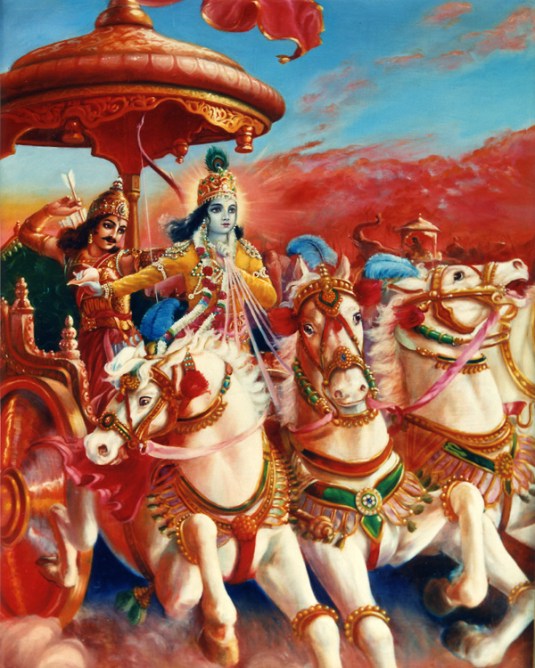
As this is a very long chapter we are posting it in two parts. Today we are posting text 1-35, and tomorrow we will conclude the chapter entitled “Contents of the Gita Summarized”
Bhagavad-gita As It Is 1972 Macmillan Edition
By His Divine Grace A.C. Bhaktivedanta Swami Prabhupada
Chapter Two, Text and Purports 1-35
Contents of the Gita Summarized
TEXT 1
sañjaya uvāca
taṁ tathā kṛpayāviṣṭam
aśru-pūrṇākulekṣaṇam
viṣīdantam idaṁ vākyam
uvāca madhusūdanaḥ
sañjayaḥ uvāca—Sañjaya said; tam—unto Arjuna; tathā—thus; kṛpayā—by compassion; āviṣṭam—overwhelmed; aśru-pūrṇa—full of tears; ākula—depressed; īkṣaṇam—eyes; viṣīdantam—lamenting; idam—this; vākyam—words; uvāca—said; madhusūdanaḥ—the killer of Madhu.
TRANSLATION
Sañjaya said: Seeing Arjuna full of compassion and very sorrowful, his eyes brimming with tears, Madhusūdana, Kṛṣṇa, spoke the following words.
PURPORT
Material compassion, lamentation and tears are all signs of ignorance of the real self. Compassion for the eternal soul is self-realization. The word “Madhusūdana” is significant in this verse. Lord Kṛṣṇa killed the demon Madhu, and now Arjuna wanted Kṛṣṇa to kill the demon of misunderstanding that had overtaken him in the discharge of his duty. No one knows where compassion should be applied. Compassion for the dress of a drowning man is senseless. A man fallen in the ocean of nescience cannot be saved simply by rescuing his outward dress-the gross material body. One who does not know this and laments for the outward dress is called a śūdra, or one who laments unnecessarily. Arjuna was a kṣatriya, and this conduct was not expected from him. Lord Kṛṣṇa, however, can dissipate the lamentation of the ignorant man, and for this purpose the Bhagavad-gītā was sung by Him. This chapter instructs us in self-realization by an analytical study of the material body and the spirit soul, as explained by the supreme authority, Lord Śrī Kṛṣṇa. This realization is made possible by working with the fruitive being situated in the fixed conception of the real self.
More
09 May 2012
by The Hare Krishna Movement
in Narada-bhakti-sutra
Tags: A.C. Bhaktivedanta Swami Prabhupada, devotional service, Krsna, Narada, Narada-bhakti-sutra, regulative devotional service, religious rituals, renunciation, service to Krishna, social custom, transcendental loving service, Vedic injunction
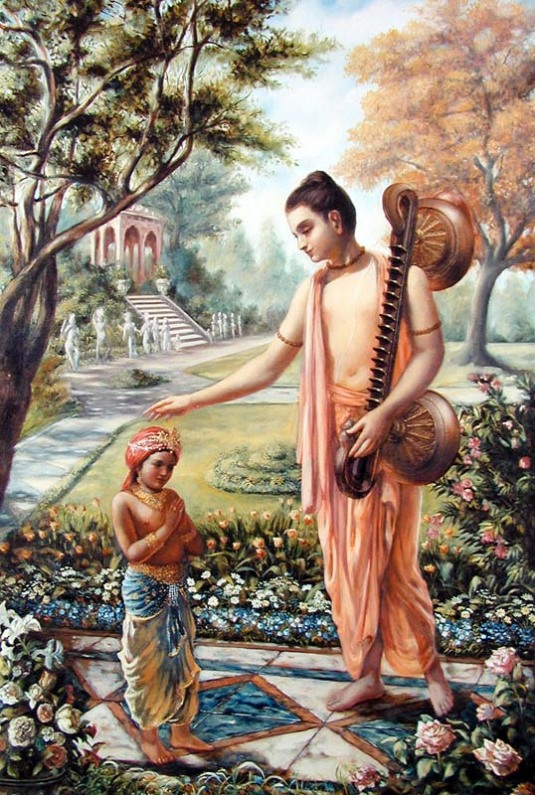
Narada-bhakti-sutra
By His Divine Grace A. C. Bhaktivedanta Swami Prabhupāda
TEXT 8
nirodhas tu loka-veda-vyāpāra-nyāsaḥ
nirodhaḥ—renunciation; tu—moreover; loka—of social custom; veda—and of the revealed scripture; vyāpāra—of the engagements; nyāsa—renunciation.
TRANSLATION
Such renunciation in devotional service means to give up all kinds of social customs and religious rituals governed by Vedic injunction.
PURPORT
In a verse in the Lalita-mādhava (5.2), Śrīla Rūpa Gosvāmī describes renunciation in devotional service:
ṛddhā siddhi-vraja-vijayitā satya-dharmā samādhir
brahmānando gurur api camatkārayaty eva tāvat
yāvat premṇāṁ madhu-ripu-vaśīkāra-siddhauṣadhīnāṁ
gandho ’py antaḥ-karaṇa-saraṇī-pānthatāṁ na prayāti
“Activities such as mystic trance, becoming one with the Supreme, and the religious principles of brahminism, such as speaking the truth and tolerance, have their own respective attractions, but when one becomes captivated by love of Kṛṣṇa, the Supreme Personality of Godhead, all attraction for mystic power, monistic pleasure, and mundane religious principles becomes insignificant.”
In other words, by discharging pure devotional service one attains the highest stage of love of Godhead and is freed from all other obligations, such as those mentioned in the karma-kāṇḍa, jñāna-kāṇḍa, and yoga-kāṇḍa sections of the Vedas. One who engages in pure devotional service has no desire to improve himself—except in the service of the Lord. In such devotional service there cannot be any worship of the impersonal or localized features of the Supreme Lord. The devotee simply performs activities that satisfy the Supreme Personality of Godhead and thus attains pure love for the Lord.
More
01 May 2012
by The Hare Krishna Movement
in Spiritual World, Srimad Bhagavatam
Tags: A.C. Bhaktivedanta Swami Prabhupada, bhagavate, Brahma, Devaki, Krishna, Krsna, om namo bhagavate vasudevaya, Personality of Godhead, primeval Lord, SB 1.1.1, Sri Krsna, Srimad Bhagavatam, Vasudeva, Vyasadeva

Śrīmad-Bhāgavatam:
by His Divine Grace A. C. Bhaktivedanta Swami Prabhupāda
Canto 1: “Creation”, Chapter 1, Text 1
Questions by the Sages
oṁ namo bhagavate vāsudevāya
janmādy asya yato ’nvayād itarataś cārtheṣv abhijñaḥ svarāṭ
tene brahma hṛdā ya ādi-kavaye muhyanti yat sūrayaḥ
tejo-vāri-mṛdāṁ yathā vinimayo yatra tri-sargo ’mṛṣā
dhāmnā svena sadā nirasta-kuhakaṁ satyaṁ paraṁ dhīmahi
om—O my Lord; namaḥ—offering my obeisances; bhagavate—unto the Personality of Godhead; vāsudevāya—unto Vāsudeva (the son of Vasudeva), or Lord Śrī Kṛṣṇa, the primeval Lord; janma-ādi—creation, sustenance and destruction; asya—of the manifested universes; yataḥ—from whom; anvayāt—directly; itarataḥ—indirectly; ca—and; artheṣu—purposes; abhijñaḥ—fully cognizant; sva-rāṭ—fully independent; tene—imparted; brahma—the Vedic knowledge; hṛdā—consciousness of the heart; yaḥ—one who; ādi-kavaye—unto the original created being; muhyanti—are illusioned; yat—about whom; sūrayaḥ—great sages and demigods; tejaḥ—fire; vāri—water; mṛdām—earth; yathā—as much as; vinimayaḥ—action and reaction; yatra—whereupon; tri-sargaḥ—three modes of creation, creative faculties; amṛṣā—almost factual; dhāmnā—along with all transcendental paraphernalia; svena—self-sufficiently; sadā—always; nirasta—negation by absence; kuhakam—illusion; satyam—truth; param—absolute; dhīmahi—I do meditate upon.
TRANSLATION
O my Lord, Śrī Kṛṣṇa, son of Vasudeva, O all-pervading Personality of Godhead, I offer my respectful obeisances unto You. I meditate upon Lord Śrī Kṛṣṇa because He is the Absolute Truth and the primeval cause of all causes of the creation, sustenance and destruction of the manifested universes. He is directly and indirectly conscious of all manifestations, and He is independent because there is no other cause beyond Him. It is He only who first imparted the Vedic knowledge unto the heart of Brahmājī, the original living being. By Him even the great sages and demigods are placed into illusion, as one is bewildered by the illusory representations of water seen in fire, or land seen on water. Only because of Him do the material universes, temporarily manifested by the reactions of the three modes of nature, appear factual, although they are unreal. I therefore meditate upon Him, Lord Śrī Kṛṣṇa, who is eternally existent in the transcendental abode, which is forever free from the illusory representations of the material world. I meditate upon Him, for He is the Absolute Truth.
PURPORT
Obeisances unto the Personality of Godhead, Vāsudeva, directly indicate Lord Śrī Kṛṣṇa, who is the divine son of Vasudeva and Devakī. This fact will be more explicitly explained in the text of this work. Śrī Vyāsadeva asserts herein that Śrī Kṛṣṇa is the original Personality of Godhead, and all others are His direct or indirect plenary portions or portions of the portion. Śrīla Jīva Gosvāmī has even more explicitly explained the subject matter in his Kṛṣṇa-sandarbha. And Brahmā, the original living being, has explained the subject of Śrī Kṛṣṇa substantially in his treatise named Brahma-saṁhitā. In the Sāma-veda Upaniṣad, it is also stated that Lord Śrī Kṛṣṇa is the divine son of Devakī. Therefore, in this prayer, the first proposition holds that Lord Śrī Kṛṣṇa is the primeval Lord, and if any transcendental nomenclature is to be understood as belonging to the Absolute Personality of Godhead, it must be the name indicated by the word Kṛṣṇa, which means the all-attractive. In Bhagavad-gītā, in many places, the Lord asserts Himself to be the original Personality of Godhead, and this is confirmed by Arjuna, and also by great sages like Nārada, Vyāsa, and many others. In the Padma Purāṇa, it is also stated that out of the innumerable names of the Lord, the name of Kṛṣṇa is the principal one. Vāsudeva indicates the plenary portion of the Personality of Godhead, and all the different forms of the Lord, being identical with Vāsudeva, are indicated in this text. The name Vāsudeva particularly indicates the divine son of Vasudeva and Devakī. Śrī Kṛṣṇa is always meditated upon by the paramahaṁsas, who are the perfected ones among those in the renounced order of life.
More
02 Apr 2012
by The Hare Krishna Movement
in Krishna Consciousness, Teachings of Queen Kunti
Tags: asamaurdhva, Devaki, Hrsikesa, King Kamsa, Krsna, kuntidevi, Lord Brahma, Lord Krsna, Lord Siva, Nanda Maharaja, Queen Kunti, Vasudeva
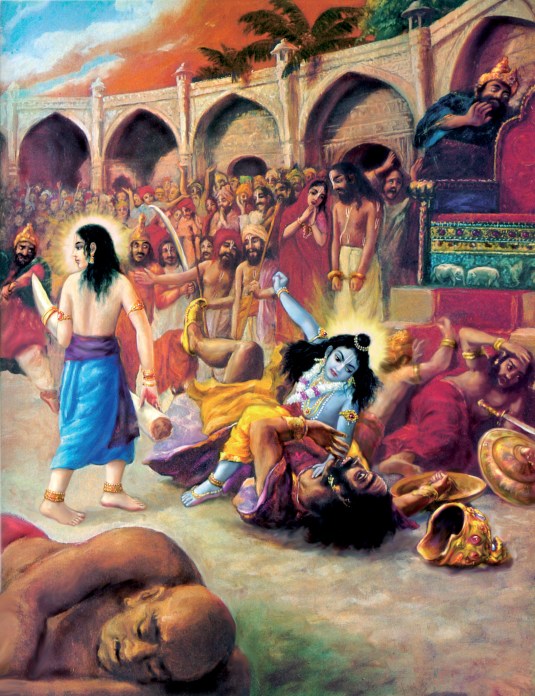
…Of course, the world is full of dangers. But Kuntīdevī says, “Because Devakī is Your devotee, You saved her from the distresses imposed upon her by her envious brother.”
…For sense gratification we have fallen into this material condition and are suffering in different varieties of life. Because this is the material world, even Kṛṣṇa’s mother was put into suffering. Devakī was so advanced that she became the mother of Kṛṣṇa, but still she was put into difficulties by her own brother, Kaṁsa. That is the nature of this material world. The living entities in this world are so jealous that if one’s personal interest is hampered, one will immediately be ready to give trouble to others, even to one’s nearest relatives.
“A person who acts in the service of Kṛṣṇa with his body, mind, intelligence, and words is a liberated person, even within the material world.”
Teachings of Queen Kunti
By His Divine Grace A.C. Bhaktivedanta Swami Prabhupada
Chapter 6
The Master of the Senses
yathā hṛṣīkeśa khalena devakī
kaṁsena ruddhāticiraṁ śucārpitā
vimocitāhaṁ ca sahātmajā vibho
tvayaiva nāthena muhur vipad-gaṇāt
O Hṛṣīkeśa, master of the senses and Lord of lords, You have released Your mother, Devakī, who was long imprisoned and distressed by the envious King Kaṁsa, and me and my children from a series of constant dangers.
—Śrīmad-Bhāgavatam 1.8.23
Devakī, the mother of Kṛṣṇa and sister of King Kaṁsa, was put into prison along with her husband, Vasudeva, because the envious King was afraid of being killed by Devakī’s eighth son (Kṛṣṇa). The King killed all the sons of Devakī who were born before Kṛṣṇa, but Kṛṣṇa escaped the danger of child-slaughter because He was transferred to the house of Nanda Mahārāja, Lord Kṛṣṇa’s foster father. Kuntīdevī, along with her children, was also saved from a series of dangers. But Kuntīdevī was shown far more favor because Lord Kṛṣṇa did not save the other children of Devakī, whereas He saved the children of Kuntīdevī. This was done because Devakī’s husband, Vasudeva, was living, whereas Kuntīdevī was a widow and there was none to help her except Kṛṣṇa. The conclusion is that Kṛṣṇa bestows more favor upon a devotee who is in greater dangers. Sometimes He puts His pure devotees in such dangers because in that condition of helplessness the devotee becomes more attached to the Lord. The more the attachment is there for the Lord, the more success is there for the devotee.
More
24 Feb 2012
by The Hare Krishna Movement
in Devotee's, Diksha, Guru & Disciple, Siksa, Vyasasan das
Tags: A.C. Bhaktivedanta Swami Prabhupada, disciple, guru, Gurus and Godbrothers, Iskcon, Krsna, spiritual master, Srila Prabhupada, The Hare Krishna Movement, Vyasasan das
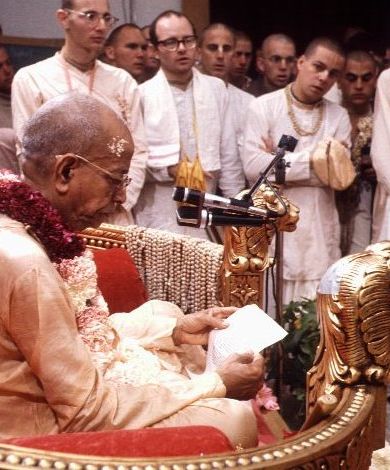
Gurus and Godbrothers
By Vyasasan das
Dear Srila Prabhupada,
Please accept my most humble obeisances, and kindly forgive my offences. In my last letter to you, which I titled “Return to the Hare Krishna Movement”, I was addressing some of the changes I witnessed to your movement since my return in 2006. I expressed some of my disappointments and concerns, and yet I still have faith in this mission of yours.
It was interesting to see which of my older God brothers was still practicing their Krsna Consciousness within the framework of ISKCON, who had remained and who had left. I read one very sad statistic the other day on the Internet, and am sorry to report that 95% of your initiated disciples are no longer practicing their KRSNA Consciousness within the structure of ISKCON. I was very alarmed by this, because it indicates to me there is a fatal flaw in the way the society is being managed.
This is not to say that they are not still practicing their Krsna Consciousness, for “once a devotee always a devotee”, or as is stated in the Srimad Bhagavatam 1.5.19, a person who has once relished the taste of the lotus feet of the Lord can do nothing but remember that ecstasy again and again, but sadly most are not practicing their faith within the structure of ISKCON.
More
19 Feb 2012
by The Hare Krishna Movement
in Krishna Consciousness, Krsna is the Source of All Incarnations, Raja-Vidya
Tags: A.C. Bhaktivedanta Swami Prabhupada, Arjuna, ilusory energy, Krishna, Krishna consciousness, Krsna, Krsna's appearance, maya, Raja-Vidya, spiritual advancement

Kṛṣṇa’s birth, His appearance and disappearance, are likened unto the appearance and disappearance of the sun. In the morning it appears as if the sun is born from the eastern horizon, but actually it is not. The sun is neither rising nor setting; it is as it is in its position. All risings and settings are due to the rotation of the earth. Similarly, in Vedic literatures there are prescribed schedules for the appearance and disappearance of Śrī Kṛṣṇa. Kṛṣṇa’s rising is just like the sun. The sun’s rising and setting are going on at every moment; somewhere in the world people are witnessing sunrise and sunset. It is not that at one point Kṛṣṇa is born and at another point He is gone. He is always there somewhere, but He appears to come and go. Kṛṣṇa appears and disappears in many universes. We only have experience of this one universe, but from Vedic literatures we can understand that this universe is but a part of the infinite manifestations of the Supreme Lord.
Raja-vidya: The King of Knowledge
By His Divine Grace A.C. Bhaktivedanta Swami Prabhupada
Chapter 6
Knowledge of Kṛṣṇa’s Appearances and Activities
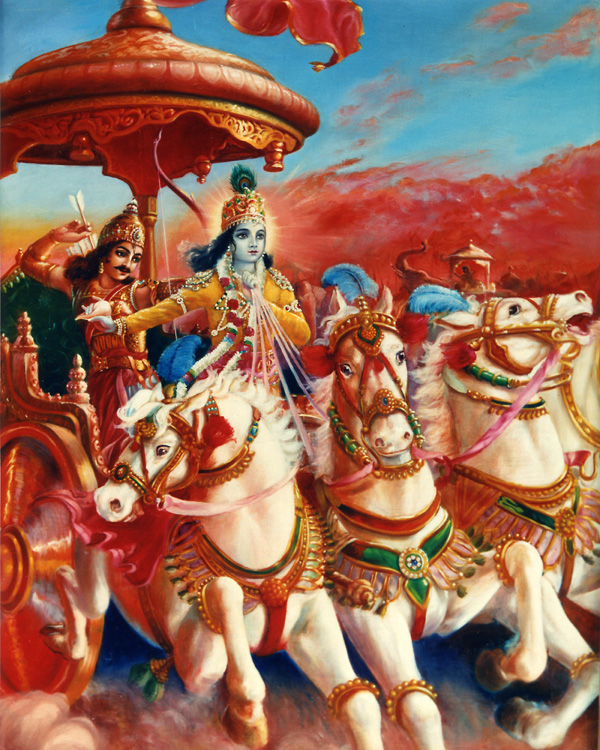
There are two forces of nature working in us. By one we decide that in this lifetime we will make spiritual advancement, but at the next moment the other force, māyā, or illusory energy, says, “What is all this trouble that you’re going to? Just enjoy this life and be easy with yourself.” This tendency to fall into forgetfulness is the difference between God and man. Arjuna is a companion and associate of Kṛṣṇa’s, and whenever Kṛṣṇa appears on any planet, Arjuna also takes birth and appears with Him. When Kṛṣṇa spoke Bhagavad-gītā to the sun god, Arjuna was also present with Him. But, being a finite living entity, Arjuna could not remember. Forgetfulness is the nature of the living entity. We cannot even remember what we were doing at this exact time yesterday or a week ago. If we cannot remember this, how is it possible to remember what happened in our previous lives? At this point we may ask how it is that Kṛṣṇa can remember and we cannot, and the answer is that Kṛṣṇa does not change His body.
More
02 Feb 2012
by The Hare Krishna Movement
in Krishna, Teachings of Queen Kunti
Tags: A.C. Bhaktivedanta Swami Prabhupada, asuras, Krsna, Nrsimha, Putana, Rama, residents of Vrndavana, Srila Prabhupada, Srimad Bhagavatam, Teachings of Queen Kunti, Varaha

…Krishna is accepted as the Supreme Personality of Godhead by such authoritative personalities as Vyāsa, Devala, Asita, Nārada, Madhva, Śaṅkara, Rāmānuja, Śrī Caitanya Mahāprabhu, Jīva Gosvāmī, Viśvanātha Cakravartī, Bhaktisiddhānta Sarasvatī, and all other authorities of the line. He Himself has declared as much in many places of the authentic literatures. And yet there is a class of men with demoniac mentality who are always reluctant to accept the Lord as the Supreme Absolute Truth. This is partially due to their poor fund of knowledge and partially due to their stubborn obstinacy, which results from various misdeeds in the past and present. Such persons could not recognize Lord Śrī Kṛṣṇa even when He was present before them.
Teachings of Queen Kunti
By His Divine Grace A.C. Bhaktivedanta Swami Prabhupada
Chapter 2, Beyond the Senses
māyā-javanikācchannam
ajñādhokṣajam avyayam
na lakṣyase mūḍha-dṛśā
nato nāṭya-dharo yathā
Being beyond the range of limited sense perception, You are the eternally irreproachable factor covered by the curtain of deluding energy. You are invisible to the foolish observer, exactly as an actor dressed as a player is not recognized. —Śrīmad-Bhāgavatam 1.8.19
In the Bhagavad-gītā Lord Śrī Kṛṣṇa affirms that less intelligent persons mistake Him to be an ordinary man like us, and thus they deride Him. The same is confirmed herein by Queen Kuntī.
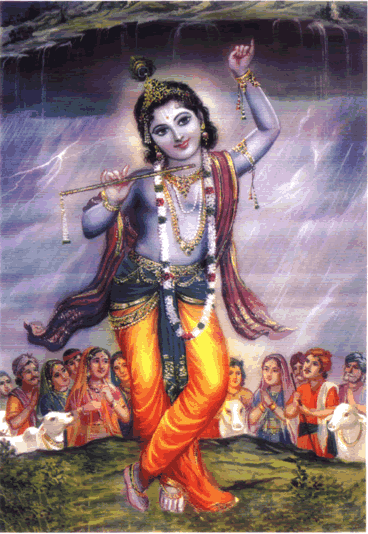
The less intelligent persons are those who rebel against the authority of the Lord. Such persons are known as asuras. The asuras cannot recognize the Lord’s authority. When the Lord Himself appears among us, as Rāma, Nṛsiṁha, Varāha, or in His original form as Kṛṣṇa, He performs many wonderful acts which are humanly impossible. As we shall find in the Tenth Canto of this great literature, Lord Śrī Kṛṣṇa exhibited His humanly impossible activities even from the days of His lying on the lap of His mother. He killed the Pūtanā witch, although she smeared her breast with poison just to kill the Lord. The Lord sucked her breast like a natural baby, and He sucked out her very life also. Similarly, He lifted the Govardhana Hill, just as a boy picks up a frog’s umbrella, and stood several days continuously just to give protection to the residents of Vṛndāvana.
More
22 Jan 2012
by The Hare Krishna Movement
in Books by Srila Prabhupada, Krishna Consciousness, The Path of Perfection
Tags: A.C. Bhaktivedanta Swami Prabhupada, bhakti yoga, Durga, Krishna Consciousness Society, Krsna, lotus feet, O son of Maharaja Nanda, Radha and Krsna, Srila Prabhupada, The Path of Perfection, yoga

Thanks to Sudarshan das for submitting this picture
…We have formed this International Society for Krishna Consciousness in order to teach people what they have forgotten. In this material world, we have forgotten the service of Rādhā-Kṛṣṇa; therefore we have become servants of māyā, the senses. Therefore, in this Society we are saying, “You are serving your senses. Now just turn your service to Rādhā and Kṛṣṇa, and you will be happy. You have to render service—either to māyā [illusion], the senses, or to Śrī Śrī Rādhā-Kṛṣṇa.”
In this world, everyone is serving the senses, but people are not satisfied. No one can be satisfied, because the senses are always demanding more gratification, and this means that we are constantly having to serve the senses. In any case, our position as servant remains the same. It is a question of whether we want to be happy in our service. It is the verdict of Bhagavad-gītā and the other Vedic scriptures that we will never be happy trying to serve our senses, for they are only sources of misery. Therefore Lord Caitanya Mahāprabhu prays to be situated in Kṛṣṇa’s service. He also prays,
ayi nanda-tanuja kiṅkaraṁ
patitaṁ māṁ viṣame bhavāmbudhau
kṛpayā tava pāda-paṅkaja-
sthita-dhūlī-sadṛśaṁ vicintaya
“O son of Mahārāja Nanda [Kṛṣṇa], I am Your eternal servitor, yet somehow or other I have fallen into the ocean of birth and death. Please pick me up from this ocean of death and place me as one of the atoms at Your lotus feet.” (Śikṣāṣṭaka 5) This is another way of asking Kṛṣṇa to engage us in His service…
The Path of Perfection
By His Divine Grace A.C. Bhaktivedanta Swami Prabhupada
Chapter 8
Failure and Success in Yoga
full chapter More
12 Jan 2012
by The Hare Krishna Movement
in Krishna, Teachings of Queen Kunti
Tags: A.C. Bhaktivedanta Swami Prabhupada, Krsna, kunty uvaca, Srimad Bhagavatam, Srimati Kuntidevi, Teachings of Queen Kunti, The Original Person
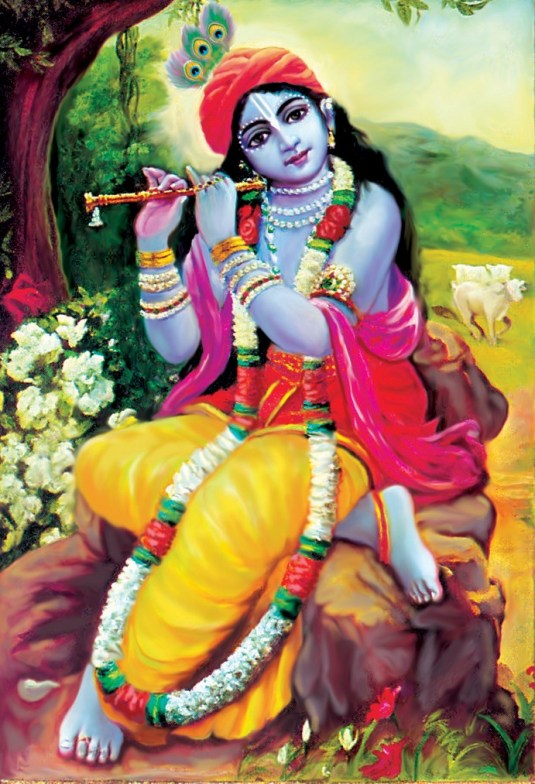
Teachings of Queen Kunti
By His Divine Grace A.C. Bhaktivedanta Swami Prabhupada
Chapter 1, The Original Person
kunty uvāca
namasye puruṣaṁ tvādyam
īśvaraṁ prakṛteḥ param
alakṣyaṁ sarva-bhūtānām
antar bahir avasthitam
Śrīmatī Kuntī said: O Kṛṣṇa, I offer my obeisances unto You because You are the original personality and are unaffected by the qualities of the material world. You are existing both within and without everything, yet You are invisible to all. —Śrīmad-Bhāgavatam 1.8.18
Śrīmatī Kuntīdevī was quite aware that Kṛṣṇa is the original Personality of Godhead, although He was playing the part of her nephew. Such an enlightened lady could not commit a mistake by offering obeisances unto her nephew. Therefore, she addressed Him as the original puruṣa beyond the material cosmos. Although all living entities are also transcendental, they are neither original nor infallible. The living entities are apt to fall down under the clutches of material nature, but the Lord is never like that. In the Vedas, therefore, He is described as the chief among all living entities (nityo nityānāṁ cetanaś cetanānām). Then again He is addressed as īśvara, or the controller. The living entities or the demigods like Candra and Sūrya are also to some extent īśvara, but none of them is the supreme īśvara, or the ultimate controller. Kṛṣṇa is the parameśvara, or the Supersoul. He is both within and without. Although He was present before Śrīmatī Kuntī as her nephew, He was also within her and everyone else. In the Bhagavad-gītā (15.15) the Lord says, “I am situated in everyone’s heart, and only due to Me one remembers, forgets, and is cognizant, etc. Through all the Vedas I am to be known because I am the compiler of the Vedas, and I am the teacher of the Vedānta.” Queen Kuntī affirms that the Lord, although both within and without all living beings, is still invisible. The Lord is, so to speak, a puzzle for the common man. Queen Kuntī experienced personally that Lord Kṛṣṇa was present before her, yet He entered within the womb of Uttarā to save her embryo from the attack of Aśvatthāmā’s brahmāstra. Kuntī herself was puzzled about whether Śrī Kṛṣṇa is all-pervasive or localized. In fact, He is both, but He reserves the right of not being exposed to persons who are not surrendered souls. This checking curtain is called the māyā energy of the Supreme Lord, and it controls the limited vision of the rebellious soul. It is explained as follows.
11 Jan 2012
by The Hare Krishna Movement
in Books by Srila Prabhupada, Krishna, Raja-Vidya
Tags: A.C. Bhaktivedanta Swami Prabhupada, Banyan tree, jivas, Krsna, material energy, Narada Muni and cobbler, prakrti, Raja-Vidya, spiritual energy, the king of knowledge

Banyan Tree by Herb Kawainui Kane
Click to enlarge
It is not very difficult to see God everywhere in the creation, for He is everywhere present…those who are conversant with the science of Kṛṣṇa can see Him in every atom of the creation.
…You can see that there is this banyan tree, and you can see that so many fruits are falling daily, and in each fruit there are so many seeds, and in every seed there is a banyan tree like this one. If, within a small seed there can be a big tree like this, is it difficult to accept that the Lord is in every atom of creation…
So this is called faith. It is not a question of blindly believing. There is reason behind the belief. If Kṛṣṇa can put a large tree within so many little seeds, is it so astounding that He is keeping all the planetary systems floating in space through His energy?
Raja-Vidya: The King of Knowledge
By His Divine Grace A.C. Bhaktivedanta Swami Prabhupada
Chapter 3
Knowledge of Kṛṣṇa’s Energies
It may be noted at this point that the Ninth Chapter of Bhagavad-gītā is especially meant for those who have already accepted Śrī Kṛṣṇa as the Supreme Personality of Godhead. In other words, it is meant for His devotees. If one does not accept Śrī Kṛṣṇa as the Supreme, this Ninth Chapter will appear as something different from what it actually is. As stated in the beginning, the subject matter of the Ninth Chapter is the most confidential material in the entire Bhagavad-gītā. If one doesn’t accept Kṛṣṇa as the Supreme, he will think the chapter to be a mere exaggeration. This is especially the case with the verses dealing with Kṛṣṇa’s relationship with His creation.
More
25 Dec 2011
by The Hare Krishna Movement
in Lord Jesus Christ, Science of Self Realization, Srila Prabhupada Conversations, Vegetarianism
Tags: Christ, Christos, Emmanuel Jungclaussen, Father Emmanuel, Jesus, Krishna, Krsna, Krsta, Lord Jesus Christ, Srila Prabhupada, the anointed one, The Science of Self Realization, Understanding Krsna and Christ

Conversation with Father Emmanuel
The Science of Self Realization
By His Divine Grace A.C. Bhaktivedanta Swami Prabhupada
Chapter 4 “Understanding Krsna and Christ”
Conversation with Father Emmanuel
In 1974, near ISKCON’s center in Frankfurt am Main, West Germany, Srila Prabhupada and several of his disciples took a morning walk with father Emmanuel Jungclaussen, a Benedictine monk from Niederalteich Monastery.
Noticing that Srila Prabhupada was carrying meditation beads similar to the rosary, Father Emmanuel explained that he also chanted a constant prayer: “Lord Jesus Christ, be merciful unto us.” The following conversation ensued.
Srila Prabhupada: What is the meaning of the word Christ?
Father Emmanuel: Christ comes from the Greek word Christos, meaning “the anointed one.”
Srila Prabhupada: Christos is the Greek version of the word Krsna.
Father Emmanuel: This is very interesting.
Srila Prabhupada: When an Indian person calls on Krsna, he often says, “Krsta.” Krsta is a Sanskrit word meaning “attraction.” So when we address God as “Christ,” “Krsta,” or “Krsna,” we indicate the same all-attractive Supreme Personality of Godhead. When Jesus said, “Our Father, who art in heaven, sanctified be Thy name,” that name of God was “Krsta” or “Krsna.” Do you agree?
Father Emmanuel: I think Jesus, as the son of God, has revealed to us the actual name of God: Christ. We can call God “Father,” but if we want to address Him by His actual name, we have to say “Christ.”
Srila Prabhupada: Yes. “Christ” is another way of saying Krsta, and “Krsta” is another way of pronouncing Krsna, the name of God. Jesus said that one should glorify the name of God, but yesterday I heard one theologian say that God has no name-that we can call Him only “Father.” A son may call his father “Father,” but the father also has a specific name. Similarly, “God” is the general name of the Supreme Personality of Godhead, whose specific name is Krsna. Therefore whether you call God “Christ,” “Krsta,” or “Krsna,” ultimately you are addressing the same Supreme Personality of Godhead.
More
13 Dec 2011
by The Hare Krishna Movement
in Book Distribution, Diksha, Quotes by Srila Prabhupada, Sankirtan, Siksa
Tags: Book Distribution, books by Srila Prabhupada, Chanting the holy name, guru, Harinama diksa, kirtan, Krsna, sankirtan, spiritual master, spoken kirtans

SRILA PRABHUPADA’S BOOK DISRIBUTION: INITIATING THE WORLD WITH THE HOLY NAME.
This series of Quotes was taken from http://www.prabhupada.org.uk/diksa.htm The author is unknown. Some editing was done by me -V
Srila Prabhupada’s transcendental books are his loud chanting of the holy name. Such loud chanting is giving the people of the world Harinama diksa.
Regarding Sankirtana and book distribution, book distribution is also chanting. Anyone who reads the books that is also chanting and hearing. Why distinguish between chanting and book distribution? These books I have recorded and chanted, and they are transcribed. It is spoken kirtanas. So book distribution is also chanting. These are not ordinary books. It is recorded chanting. Anyone who reads, he is hearing. Book distribution must not be neglected. (S.P.L. to Rupanuga dasa, 19th October, 1974)
When a devotee is perfectly qualified in chanting the transcendental vibration of the holy name, he is quite fit to become a spiritual master and to deliver all the people of the world. The chanting of the holy name is so powerful that it gradually establishes its supremacy above everything in the world. The devotee who chants it becomes transcendentally situated in ecstasy and sometimes laughs, cries and dances in his ecstasy. Sometimes the unintelligent put hindrances in the path of chanting this maha-mantra, but one who is situated on the platform of love of Godhead chants the holy name loudly for all concerned. As a result everyone becomes initiated in the chanting of the holy names–Hare Krsna, Hare Krsna, Krsna Krsna, Hare Hare/ Hare Rama, Hare Rama, Rama Rama, Hare Hare. (T.L.C. Chapter 18)
More
21 Nov 2011
by The Hare Krishna Movement
in A.C. Bhaktivedanta Swami Prabhupada, Back to Godhead, Ganges
Tags: His Divine Grace A.C. Bhaktivedanta Swami Prabhupada, Krishna, Krsna, kuntidevi, Lord Madhu, Queen Kunti, River Ganges

The Flow of Attraction to Krsna
Back to Godhead Magazine
Volume 01, Number 60, 1973
tvayi me ‘nanya-visaya matir madhu-pate ‘sakrt
ratim udvahatad addha gangevaugham udanvati
“O Lord of Madhu, as the Ganges forever flows to the sea without hindrance, let my attraction be constantly drawn unto You without being diverted to anyone else.” (Srimad-Bhagavatam, 1.8.42 -Prayer by Queen Kunti)
By His Divine Grace A.C. Bhaktivedanta Swami Prabhupada
In the previous verses of Srimad-Bhagavatam Queen Kunti prayed that the Lord kindly cut off her attraction for her kinsmen, the Pandava and Vrsni families. However, giving up one’s attraction for material things is not sufficient. The Mayavadi philosophers say, brahma satyam jagan-mithya: “This world is false, and Brahman [spirit] is truth.” We admit this, but qualify it. As living entities, we want enjoyment. Enjoyment means variety. It is not possible to enjoy anything without variety. Why has God created so many colors and so many forms? In order to create enjoyment out of variety. Indeed, variety is the mother of enjoyment. Mayavadi philosophers wish to negate this variety, and therefore they are called impersonalists.
The human form of life is meant for reestablishing our relationship with God. This material world means forgetfulness of our relationship with God. There is no Krsna consciousness in this material world, for as soon as there is Krsna consciousness, as soon as there is action on the basis of Krsna, there is nothing material. Everything is spiritual.
More
19 Oct 2011
by The Hare Krishna Movement
in Songs of the Vaisnava Acaryas, Sri Damodarastakam, Visnujana Swami
Tags: Damodara, idam to mukhambojam atyanta-nilair, Krsna, lotus face, mukhambhojam, Sri Damodarastakam, Visnujana Swami, Yasoda

O Lord, the cheeks of Your blackish lotus face, which is encircled by locks of curling hair, have become reddened like bimba fruit due to Mother Yasoda’s kisses
idaḿ te mukhāmbhojam atyanta-nīlair
vṛtaḿ kuntalaiḥ snigdha-raktaiś ca gopyā
muhuś cumbitaḿ bimba-raktādharaḿ me
manasy āvirāstām alaḿ lakṣa-lābhaiḥ
idam–this; te–Your; mukha-ambhojam–lotus-like face; avyakta-nīlaiḥ–by very dark blue; vṛtam–surrounded; kuntalaiḥ–by curling locks of hair; snigdha–soft and glossy; raktaiḥ–by reddish-tinted; ca–also; gopyā–by the gopī (Srī Yaśodā); muhuḥ–again and again; cumbitam–kissed; bimbarakta-adharam–with lips red as the bimba fruit; me–my; manasi–in the heart; āvirāstām–may it be manifest; alam–useless (there is no need for me); lakṣa-lābhaiḥ–by millions of attainments of other boons.
5) O Lord, the cheeks of Your blackish lotus face, which is encircled by locks of curling hair, have become reddened like bimba fruit due to Mother Yasoda’s kisses. What more can I describe than this? Millions of opulences are of no use to me, but may this vision constantly remain in my mind.
Purport
The poet demonstrates in this verse that longing for the association of the Lord in the heart is the best means to achieve Him. The longing to see the beautiful lotus face of the Lord, which is supremely enchanting, is stated first (idam te mukhambhojam). The indescribably sweet face of Sri Krishna resembles a lotus flower in full bloom. Simply by seeing His face, which is the treasure house of supreme bliss, all anxiety and distress disappear.
More
18 Oct 2011
by The Hare Krishna Movement
in Krishna, Lectures, Songs of the Vaisnava Acaryas
Tags: braja-jana-vallabha, God, His Divine Grace A.C. Bhaktivedanta Swami Prabhupada, Jaya Radha Madhava, Krsna, kunja-vihari, lover of Srimati Radharani, Radha-Madhava, The Supreme Personality of Godhead, Vrndavana forest

Radha Madhava
(New York, July 20, 1971)
By His Divine Grace A.C. Bhaktivedanta Swami Prabhupada
[Sings Jaya Radha-Madhava.] (song lyrics follow this post)
Srila Prabhupada:
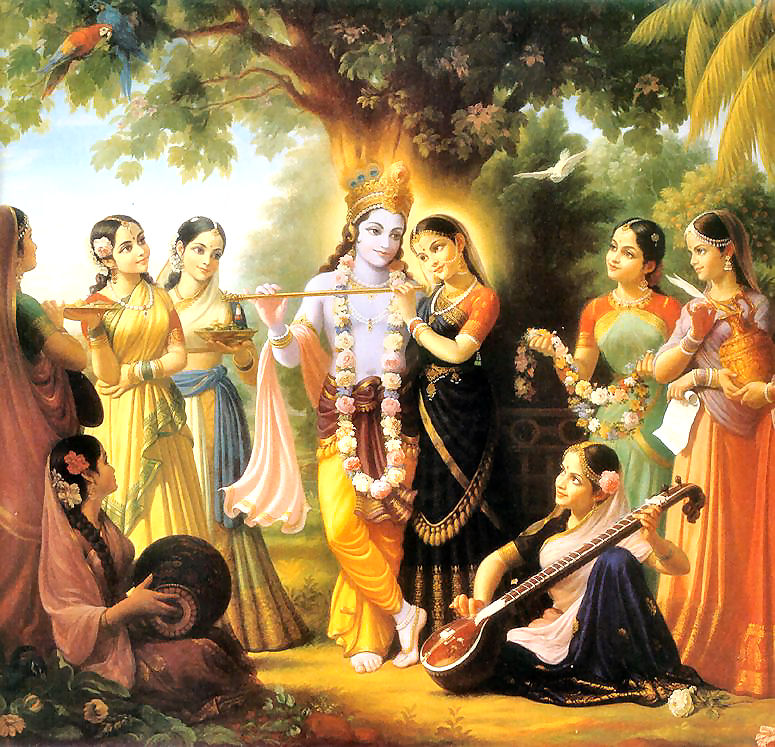
So this is the original nature of Krsna. He is Radha-Madhava. He is the lover of Srimati Radharani. And kunja-vihari, always enjoying the company of the gopis within the bushes of Vrdavana forest. Radha-madhava kunja-vihari. So He’s not only lover of Radharani, but braja-jana-vallabha. The whole residents of Vrndavana, they love Krsna. They do not know anything else. They do not know whether Krsna is God, or not; neither they are very much harassed, that “I shall love Krsna if He is God.” “He may be God or He may be whatever He is. It doesn’t matter, but we love God, Krsna.” That’s all. That is called unnalloyed love. “If Krsna is God, then I shall love Him” — this is conditional love. This is not pure love. Krsna may be God or whatever He may be, but by His wonderful acts, the Vrajavasi, they are thinking, “Oh Krsna, He is very wonderful child, maybe some demigod. Maybe some demigod.” Because people are generally under impression that the demigods are all-powerful.
More
Previous Older Entries Next Newer Entries











 The Hare Krishna Movement