01 May 2012
by The Hare Krishna Movement
in Spiritual World, Srimad Bhagavatam
Tags: A.C. Bhaktivedanta Swami Prabhupada, bhagavate, Brahma, Devaki, Krishna, Krsna, om namo bhagavate vasudevaya, Personality of Godhead, primeval Lord, SB 1.1.1, Sri Krsna, Srimad Bhagavatam, Vasudeva, Vyasadeva

Śrīmad-Bhāgavatam:
by His Divine Grace A. C. Bhaktivedanta Swami Prabhupāda
Canto 1: “Creation”, Chapter 1, Text 1
Questions by the Sages
oṁ namo bhagavate vāsudevāya
janmādy asya yato ’nvayād itarataś cārtheṣv abhijñaḥ svarāṭ
tene brahma hṛdā ya ādi-kavaye muhyanti yat sūrayaḥ
tejo-vāri-mṛdāṁ yathā vinimayo yatra tri-sargo ’mṛṣā
dhāmnā svena sadā nirasta-kuhakaṁ satyaṁ paraṁ dhīmahi
om—O my Lord; namaḥ—offering my obeisances; bhagavate—unto the Personality of Godhead; vāsudevāya—unto Vāsudeva (the son of Vasudeva), or Lord Śrī Kṛṣṇa, the primeval Lord; janma-ādi—creation, sustenance and destruction; asya—of the manifested universes; yataḥ—from whom; anvayāt—directly; itarataḥ—indirectly; ca—and; artheṣu—purposes; abhijñaḥ—fully cognizant; sva-rāṭ—fully independent; tene—imparted; brahma—the Vedic knowledge; hṛdā—consciousness of the heart; yaḥ—one who; ādi-kavaye—unto the original created being; muhyanti—are illusioned; yat—about whom; sūrayaḥ—great sages and demigods; tejaḥ—fire; vāri—water; mṛdām—earth; yathā—as much as; vinimayaḥ—action and reaction; yatra—whereupon; tri-sargaḥ—three modes of creation, creative faculties; amṛṣā—almost factual; dhāmnā—along with all transcendental paraphernalia; svena—self-sufficiently; sadā—always; nirasta—negation by absence; kuhakam—illusion; satyam—truth; param—absolute; dhīmahi—I do meditate upon.
TRANSLATION
O my Lord, Śrī Kṛṣṇa, son of Vasudeva, O all-pervading Personality of Godhead, I offer my respectful obeisances unto You. I meditate upon Lord Śrī Kṛṣṇa because He is the Absolute Truth and the primeval cause of all causes of the creation, sustenance and destruction of the manifested universes. He is directly and indirectly conscious of all manifestations, and He is independent because there is no other cause beyond Him. It is He only who first imparted the Vedic knowledge unto the heart of Brahmājī, the original living being. By Him even the great sages and demigods are placed into illusion, as one is bewildered by the illusory representations of water seen in fire, or land seen on water. Only because of Him do the material universes, temporarily manifested by the reactions of the three modes of nature, appear factual, although they are unreal. I therefore meditate upon Him, Lord Śrī Kṛṣṇa, who is eternally existent in the transcendental abode, which is forever free from the illusory representations of the material world. I meditate upon Him, for He is the Absolute Truth.
PURPORT
Obeisances unto the Personality of Godhead, Vāsudeva, directly indicate Lord Śrī Kṛṣṇa, who is the divine son of Vasudeva and Devakī. This fact will be more explicitly explained in the text of this work. Śrī Vyāsadeva asserts herein that Śrī Kṛṣṇa is the original Personality of Godhead, and all others are His direct or indirect plenary portions or portions of the portion. Śrīla Jīva Gosvāmī has even more explicitly explained the subject matter in his Kṛṣṇa-sandarbha. And Brahmā, the original living being, has explained the subject of Śrī Kṛṣṇa substantially in his treatise named Brahma-saṁhitā. In the Sāma-veda Upaniṣad, it is also stated that Lord Śrī Kṛṣṇa is the divine son of Devakī. Therefore, in this prayer, the first proposition holds that Lord Śrī Kṛṣṇa is the primeval Lord, and if any transcendental nomenclature is to be understood as belonging to the Absolute Personality of Godhead, it must be the name indicated by the word Kṛṣṇa, which means the all-attractive. In Bhagavad-gītā, in many places, the Lord asserts Himself to be the original Personality of Godhead, and this is confirmed by Arjuna, and also by great sages like Nārada, Vyāsa, and many others. In the Padma Purāṇa, it is also stated that out of the innumerable names of the Lord, the name of Kṛṣṇa is the principal one. Vāsudeva indicates the plenary portion of the Personality of Godhead, and all the different forms of the Lord, being identical with Vāsudeva, are indicated in this text. The name Vāsudeva particularly indicates the divine son of Vasudeva and Devakī. Śrī Kṛṣṇa is always meditated upon by the paramahaṁsas, who are the perfected ones among those in the renounced order of life.
More
02 Apr 2012
by The Hare Krishna Movement
in Krishna Consciousness, Teachings of Queen Kunti
Tags: asamaurdhva, Devaki, Hrsikesa, King Kamsa, Krsna, kuntidevi, Lord Brahma, Lord Krsna, Lord Siva, Nanda Maharaja, Queen Kunti, Vasudeva
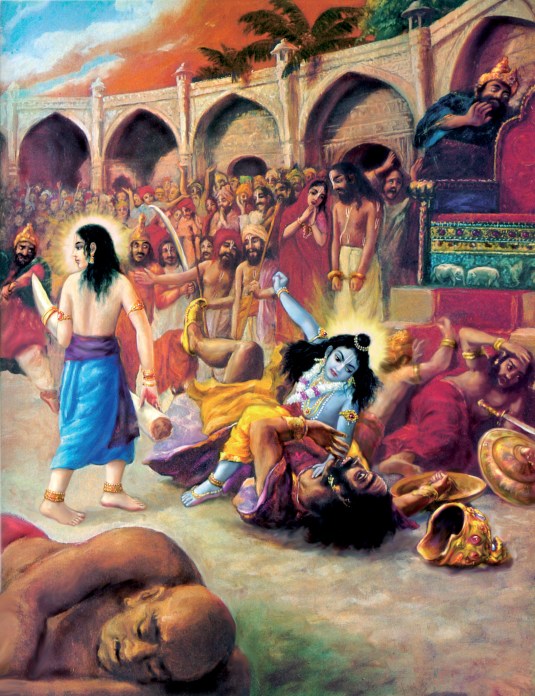
…Of course, the world is full of dangers. But Kuntīdevī says, “Because Devakī is Your devotee, You saved her from the distresses imposed upon her by her envious brother.”
…For sense gratification we have fallen into this material condition and are suffering in different varieties of life. Because this is the material world, even Kṛṣṇa’s mother was put into suffering. Devakī was so advanced that she became the mother of Kṛṣṇa, but still she was put into difficulties by her own brother, Kaṁsa. That is the nature of this material world. The living entities in this world are so jealous that if one’s personal interest is hampered, one will immediately be ready to give trouble to others, even to one’s nearest relatives.
“A person who acts in the service of Kṛṣṇa with his body, mind, intelligence, and words is a liberated person, even within the material world.”
Teachings of Queen Kunti
By His Divine Grace A.C. Bhaktivedanta Swami Prabhupada
Chapter 6
The Master of the Senses
yathā hṛṣīkeśa khalena devakī
kaṁsena ruddhāticiraṁ śucārpitā
vimocitāhaṁ ca sahātmajā vibho
tvayaiva nāthena muhur vipad-gaṇāt
O Hṛṣīkeśa, master of the senses and Lord of lords, You have released Your mother, Devakī, who was long imprisoned and distressed by the envious King Kaṁsa, and me and my children from a series of constant dangers.
—Śrīmad-Bhāgavatam 1.8.23
Devakī, the mother of Kṛṣṇa and sister of King Kaṁsa, was put into prison along with her husband, Vasudeva, because the envious King was afraid of being killed by Devakī’s eighth son (Kṛṣṇa). The King killed all the sons of Devakī who were born before Kṛṣṇa, but Kṛṣṇa escaped the danger of child-slaughter because He was transferred to the house of Nanda Mahārāja, Lord Kṛṣṇa’s foster father. Kuntīdevī, along with her children, was also saved from a series of dangers. But Kuntīdevī was shown far more favor because Lord Kṛṣṇa did not save the other children of Devakī, whereas He saved the children of Kuntīdevī. This was done because Devakī’s husband, Vasudeva, was living, whereas Kuntīdevī was a widow and there was none to help her except Kṛṣṇa. The conclusion is that Kṛṣṇa bestows more favor upon a devotee who is in greater dangers. Sometimes He puts His pure devotees in such dangers because in that condition of helplessness the devotee becomes more attached to the Lord. The more the attachment is there for the Lord, the more success is there for the devotee.
More
24 Feb 2012
by The Hare Krishna Movement
in Devotee's, Diksha, Guru & Disciple, Siksa, Vyasasan das
Tags: A.C. Bhaktivedanta Swami Prabhupada, disciple, guru, Gurus and Godbrothers, Iskcon, Krsna, spiritual master, Srila Prabhupada, The Hare Krishna Movement, Vyasasan das
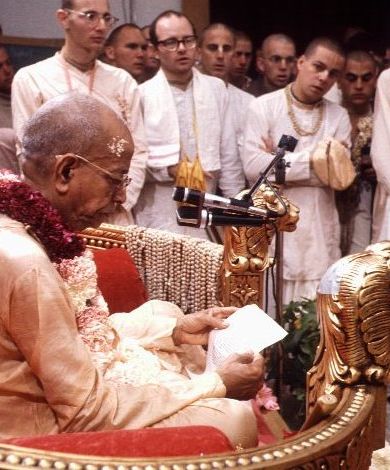
Gurus and Godbrothers
By Vyasasan das
Dear Srila Prabhupada,
Please accept my most humble obeisances, and kindly forgive my offences. In my last letter to you, which I titled “Return to the Hare Krishna Movement”, I was addressing some of the changes I witnessed to your movement since my return in 2006. I expressed some of my disappointments and concerns, and yet I still have faith in this mission of yours.
It was interesting to see which of my older God brothers was still practicing their Krsna Consciousness within the framework of ISKCON, who had remained and who had left. I read one very sad statistic the other day on the Internet, and am sorry to report that 95% of your initiated disciples are no longer practicing their KRSNA Consciousness within the structure of ISKCON. I was very alarmed by this, because it indicates to me there is a fatal flaw in the way the society is being managed.
This is not to say that they are not still practicing their Krsna Consciousness, for “once a devotee always a devotee”, or as is stated in the Srimad Bhagavatam 1.5.19, a person who has once relished the taste of the lotus feet of the Lord can do nothing but remember that ecstasy again and again, but sadly most are not practicing their faith within the structure of ISKCON.
More
19 Feb 2012
by The Hare Krishna Movement
in Krishna Consciousness, Krsna is the Source of All Incarnations, Raja-Vidya
Tags: A.C. Bhaktivedanta Swami Prabhupada, Arjuna, ilusory energy, Krishna, Krishna consciousness, Krsna, Krsna's appearance, maya, Raja-Vidya, spiritual advancement

Kṛṣṇa’s birth, His appearance and disappearance, are likened unto the appearance and disappearance of the sun. In the morning it appears as if the sun is born from the eastern horizon, but actually it is not. The sun is neither rising nor setting; it is as it is in its position. All risings and settings are due to the rotation of the earth. Similarly, in Vedic literatures there are prescribed schedules for the appearance and disappearance of Śrī Kṛṣṇa. Kṛṣṇa’s rising is just like the sun. The sun’s rising and setting are going on at every moment; somewhere in the world people are witnessing sunrise and sunset. It is not that at one point Kṛṣṇa is born and at another point He is gone. He is always there somewhere, but He appears to come and go. Kṛṣṇa appears and disappears in many universes. We only have experience of this one universe, but from Vedic literatures we can understand that this universe is but a part of the infinite manifestations of the Supreme Lord.
Raja-vidya: The King of Knowledge
By His Divine Grace A.C. Bhaktivedanta Swami Prabhupada
Chapter 6
Knowledge of Kṛṣṇa’s Appearances and Activities
There are two forces of nature working in us. By one we decide that in this lifetime we will make spiritual advancement, but at the next moment the other force, māyā, or illusory energy, says, “What is all this trouble that you’re going to? Just enjoy this life and be easy with yourself.” This tendency to fall into forgetfulness is the difference between God and man. Arjuna is a companion and associate of Kṛṣṇa’s, and whenever Kṛṣṇa appears on any planet, Arjuna also takes birth and appears with Him. When Kṛṣṇa spoke Bhagavad-gītā to the sun god, Arjuna was also present with Him. But, being a finite living entity, Arjuna could not remember. Forgetfulness is the nature of the living entity. We cannot even remember what we were doing at this exact time yesterday or a week ago. If we cannot remember this, how is it possible to remember what happened in our previous lives? At this point we may ask how it is that Kṛṣṇa can remember and we cannot, and the answer is that Kṛṣṇa does not change His body.
More
02 Feb 2012
by The Hare Krishna Movement
in Krishna, Teachings of Queen Kunti
Tags: A.C. Bhaktivedanta Swami Prabhupada, asuras, Krsna, Nrsimha, Putana, Rama, residents of Vrndavana, Srila Prabhupada, Srimad Bhagavatam, Teachings of Queen Kunti, Varaha

…Krishna is accepted as the Supreme Personality of Godhead by such authoritative personalities as Vyāsa, Devala, Asita, Nārada, Madhva, Śaṅkara, Rāmānuja, Śrī Caitanya Mahāprabhu, Jīva Gosvāmī, Viśvanātha Cakravartī, Bhaktisiddhānta Sarasvatī, and all other authorities of the line. He Himself has declared as much in many places of the authentic literatures. And yet there is a class of men with demoniac mentality who are always reluctant to accept the Lord as the Supreme Absolute Truth. This is partially due to their poor fund of knowledge and partially due to their stubborn obstinacy, which results from various misdeeds in the past and present. Such persons could not recognize Lord Śrī Kṛṣṇa even when He was present before them.
Teachings of Queen Kunti
By His Divine Grace A.C. Bhaktivedanta Swami Prabhupada
Chapter 2, Beyond the Senses
māyā-javanikācchannam
ajñādhokṣajam avyayam
na lakṣyase mūḍha-dṛśā
nato nāṭya-dharo yathā
Being beyond the range of limited sense perception, You are the eternally irreproachable factor covered by the curtain of deluding energy. You are invisible to the foolish observer, exactly as an actor dressed as a player is not recognized. —Śrīmad-Bhāgavatam 1.8.19
In the Bhagavad-gītā Lord Śrī Kṛṣṇa affirms that less intelligent persons mistake Him to be an ordinary man like us, and thus they deride Him. The same is confirmed herein by Queen Kuntī.
The less intelligent persons are those who rebel against the authority of the Lord. Such persons are known as asuras. The asuras cannot recognize the Lord’s authority. When the Lord Himself appears among us, as Rāma, Nṛsiṁha, Varāha, or in His original form as Kṛṣṇa, He performs many wonderful acts which are humanly impossible. As we shall find in the Tenth Canto of this great literature, Lord Śrī Kṛṣṇa exhibited His humanly impossible activities even from the days of His lying on the lap of His mother. He killed the Pūtanā witch, although she smeared her breast with poison just to kill the Lord. The Lord sucked her breast like a natural baby, and He sucked out her very life also. Similarly, He lifted the Govardhana Hill, just as a boy picks up a frog’s umbrella, and stood several days continuously just to give protection to the residents of Vṛndāvana.
More
22 Jan 2012
by The Hare Krishna Movement
in Books by Srila Prabhupada, Krishna Consciousness, The Path of Perfection
Tags: A.C. Bhaktivedanta Swami Prabhupada, bhakti yoga, Durga, Krishna Consciousness Society, Krsna, lotus feet, O son of Maharaja Nanda, Radha and Krsna, Srila Prabhupada, The Path of Perfection, yoga

Thanks to Sudarshan das for submitting this picture
…We have formed this International Society for Krishna Consciousness in order to teach people what they have forgotten. In this material world, we have forgotten the service of Rādhā-Kṛṣṇa; therefore we have become servants of māyā, the senses. Therefore, in this Society we are saying, “You are serving your senses. Now just turn your service to Rādhā and Kṛṣṇa, and you will be happy. You have to render service—either to māyā [illusion], the senses, or to Śrī Śrī Rādhā-Kṛṣṇa.”
In this world, everyone is serving the senses, but people are not satisfied. No one can be satisfied, because the senses are always demanding more gratification, and this means that we are constantly having to serve the senses. In any case, our position as servant remains the same. It is a question of whether we want to be happy in our service. It is the verdict of Bhagavad-gītā and the other Vedic scriptures that we will never be happy trying to serve our senses, for they are only sources of misery. Therefore Lord Caitanya Mahāprabhu prays to be situated in Kṛṣṇa’s service. He also prays,
ayi nanda-tanuja kiṅkaraṁ
patitaṁ māṁ viṣame bhavāmbudhau
kṛpayā tava pāda-paṅkaja-
sthita-dhūlī-sadṛśaṁ vicintaya
“O son of Mahārāja Nanda [Kṛṣṇa], I am Your eternal servitor, yet somehow or other I have fallen into the ocean of birth and death. Please pick me up from this ocean of death and place me as one of the atoms at Your lotus feet.” (Śikṣāṣṭaka 5) This is another way of asking Kṛṣṇa to engage us in His service…
The Path of Perfection
By His Divine Grace A.C. Bhaktivedanta Swami Prabhupada
Chapter 8
Failure and Success in Yoga
full chapter More
12 Jan 2012
by The Hare Krishna Movement
in Krishna, Teachings of Queen Kunti
Tags: A.C. Bhaktivedanta Swami Prabhupada, Krsna, kunty uvaca, Srimad Bhagavatam, Srimati Kuntidevi, Teachings of Queen Kunti, The Original Person
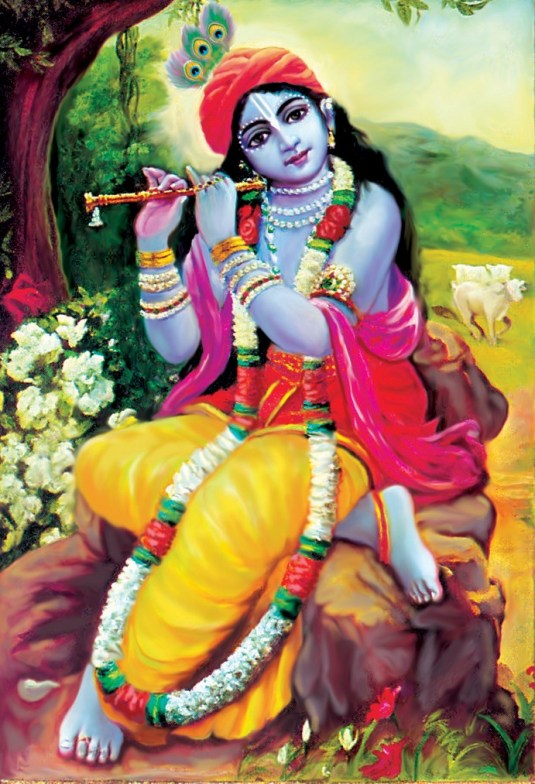
Teachings of Queen Kunti
By His Divine Grace A.C. Bhaktivedanta Swami Prabhupada
Chapter 1, The Original Person
kunty uvāca
namasye puruṣaṁ tvādyam
īśvaraṁ prakṛteḥ param
alakṣyaṁ sarva-bhūtānām
antar bahir avasthitam
Śrīmatī Kuntī said: O Kṛṣṇa, I offer my obeisances unto You because You are the original personality and are unaffected by the qualities of the material world. You are existing both within and without everything, yet You are invisible to all. —Śrīmad-Bhāgavatam 1.8.18
Śrīmatī Kuntīdevī was quite aware that Kṛṣṇa is the original Personality of Godhead, although He was playing the part of her nephew. Such an enlightened lady could not commit a mistake by offering obeisances unto her nephew. Therefore, she addressed Him as the original puruṣa beyond the material cosmos. Although all living entities are also transcendental, they are neither original nor infallible. The living entities are apt to fall down under the clutches of material nature, but the Lord is never like that. In the Vedas, therefore, He is described as the chief among all living entities (nityo nityānāṁ cetanaś cetanānām). Then again He is addressed as īśvara, or the controller. The living entities or the demigods like Candra and Sūrya are also to some extent īśvara, but none of them is the supreme īśvara, or the ultimate controller. Kṛṣṇa is the parameśvara, or the Supersoul. He is both within and without. Although He was present before Śrīmatī Kuntī as her nephew, He was also within her and everyone else. In the Bhagavad-gītā (15.15) the Lord says, “I am situated in everyone’s heart, and only due to Me one remembers, forgets, and is cognizant, etc. Through all the Vedas I am to be known because I am the compiler of the Vedas, and I am the teacher of the Vedānta.” Queen Kuntī affirms that the Lord, although both within and without all living beings, is still invisible. The Lord is, so to speak, a puzzle for the common man. Queen Kuntī experienced personally that Lord Kṛṣṇa was present before her, yet He entered within the womb of Uttarā to save her embryo from the attack of Aśvatthāmā’s brahmāstra. Kuntī herself was puzzled about whether Śrī Kṛṣṇa is all-pervasive or localized. In fact, He is both, but He reserves the right of not being exposed to persons who are not surrendered souls. This checking curtain is called the māyā energy of the Supreme Lord, and it controls the limited vision of the rebellious soul. It is explained as follows.
11 Jan 2012
by The Hare Krishna Movement
in Books by Srila Prabhupada, Krishna, Raja-Vidya
Tags: A.C. Bhaktivedanta Swami Prabhupada, Banyan tree, jivas, Krsna, material energy, Narada Muni and cobbler, prakrti, Raja-Vidya, spiritual energy, the king of knowledge

Banyan Tree by Herb Kawainui Kane
Click to enlarge
It is not very difficult to see God everywhere in the creation, for He is everywhere present…those who are conversant with the science of Kṛṣṇa can see Him in every atom of the creation.
…You can see that there is this banyan tree, and you can see that so many fruits are falling daily, and in each fruit there are so many seeds, and in every seed there is a banyan tree like this one. If, within a small seed there can be a big tree like this, is it difficult to accept that the Lord is in every atom of creation…
So this is called faith. It is not a question of blindly believing. There is reason behind the belief. If Kṛṣṇa can put a large tree within so many little seeds, is it so astounding that He is keeping all the planetary systems floating in space through His energy?
Raja-Vidya: The King of Knowledge
By His Divine Grace A.C. Bhaktivedanta Swami Prabhupada
Chapter 3
Knowledge of Kṛṣṇa’s Energies
It may be noted at this point that the Ninth Chapter of Bhagavad-gītā is especially meant for those who have already accepted Śrī Kṛṣṇa as the Supreme Personality of Godhead. In other words, it is meant for His devotees. If one does not accept Śrī Kṛṣṇa as the Supreme, this Ninth Chapter will appear as something different from what it actually is. As stated in the beginning, the subject matter of the Ninth Chapter is the most confidential material in the entire Bhagavad-gītā. If one doesn’t accept Kṛṣṇa as the Supreme, he will think the chapter to be a mere exaggeration. This is especially the case with the verses dealing with Kṛṣṇa’s relationship with His creation.
More
25 Dec 2011
by The Hare Krishna Movement
in Lord Jesus Christ, Science of Self Realization, Srila Prabhupada Conversations, Vegetarianism
Tags: Christ, Christos, Emmanuel Jungclaussen, Father Emmanuel, Jesus, Krishna, Krsna, Krsta, Lord Jesus Christ, Srila Prabhupada, the anointed one, The Science of Self Realization, Understanding Krsna and Christ

Conversation with Father Emmanuel
The Science of Self Realization
By His Divine Grace A.C. Bhaktivedanta Swami Prabhupada
Chapter 4 “Understanding Krsna and Christ”
Conversation with Father Emmanuel
In 1974, near ISKCON’s center in Frankfurt am Main, West Germany, Srila Prabhupada and several of his disciples took a morning walk with father Emmanuel Jungclaussen, a Benedictine monk from Niederalteich Monastery.
Noticing that Srila Prabhupada was carrying meditation beads similar to the rosary, Father Emmanuel explained that he also chanted a constant prayer: “Lord Jesus Christ, be merciful unto us.” The following conversation ensued.
Srila Prabhupada: What is the meaning of the word Christ?
Father Emmanuel: Christ comes from the Greek word Christos, meaning “the anointed one.”
Srila Prabhupada: Christos is the Greek version of the word Krsna.
Father Emmanuel: This is very interesting.
Srila Prabhupada: When an Indian person calls on Krsna, he often says, “Krsta.” Krsta is a Sanskrit word meaning “attraction.” So when we address God as “Christ,” “Krsta,” or “Krsna,” we indicate the same all-attractive Supreme Personality of Godhead. When Jesus said, “Our Father, who art in heaven, sanctified be Thy name,” that name of God was “Krsta” or “Krsna.” Do you agree?
Father Emmanuel: I think Jesus, as the son of God, has revealed to us the actual name of God: Christ. We can call God “Father,” but if we want to address Him by His actual name, we have to say “Christ.”
Srila Prabhupada: Yes. “Christ” is another way of saying Krsta, and “Krsta” is another way of pronouncing Krsna, the name of God. Jesus said that one should glorify the name of God, but yesterday I heard one theologian say that God has no name-that we can call Him only “Father.” A son may call his father “Father,” but the father also has a specific name. Similarly, “God” is the general name of the Supreme Personality of Godhead, whose specific name is Krsna. Therefore whether you call God “Christ,” “Krsta,” or “Krsna,” ultimately you are addressing the same Supreme Personality of Godhead.
More
13 Dec 2011
by The Hare Krishna Movement
in Book Distribution, Diksha, Quotes by Srila Prabhupada, Sankirtan, Siksa
Tags: Book Distribution, books by Srila Prabhupada, Chanting the holy name, guru, Harinama diksa, kirtan, Krsna, sankirtan, spiritual master, spoken kirtans

SRILA PRABHUPADA’S BOOK DISRIBUTION: INITIATING THE WORLD WITH THE HOLY NAME.
This series of Quotes was taken from http://www.prabhupada.org.uk/diksa.htm The author is unknown. Some editing was done by me -V
Srila Prabhupada’s transcendental books are his loud chanting of the holy name. Such loud chanting is giving the people of the world Harinama diksa.
Regarding Sankirtana and book distribution, book distribution is also chanting. Anyone who reads the books that is also chanting and hearing. Why distinguish between chanting and book distribution? These books I have recorded and chanted, and they are transcribed. It is spoken kirtanas. So book distribution is also chanting. These are not ordinary books. It is recorded chanting. Anyone who reads, he is hearing. Book distribution must not be neglected. (S.P.L. to Rupanuga dasa, 19th October, 1974)
When a devotee is perfectly qualified in chanting the transcendental vibration of the holy name, he is quite fit to become a spiritual master and to deliver all the people of the world. The chanting of the holy name is so powerful that it gradually establishes its supremacy above everything in the world. The devotee who chants it becomes transcendentally situated in ecstasy and sometimes laughs, cries and dances in his ecstasy. Sometimes the unintelligent put hindrances in the path of chanting this maha-mantra, but one who is situated on the platform of love of Godhead chants the holy name loudly for all concerned. As a result everyone becomes initiated in the chanting of the holy names–Hare Krsna, Hare Krsna, Krsna Krsna, Hare Hare/ Hare Rama, Hare Rama, Rama Rama, Hare Hare. (T.L.C. Chapter 18)
More
21 Nov 2011
by The Hare Krishna Movement
in A.C. Bhaktivedanta Swami Prabhupada, Back to Godhead, Ganges
Tags: His Divine Grace A.C. Bhaktivedanta Swami Prabhupada, Krishna, Krsna, kuntidevi, Lord Madhu, Queen Kunti, River Ganges

The Flow of Attraction to Krsna
Back to Godhead Magazine
Volume 01, Number 60, 1973
tvayi me ‘nanya-visaya matir madhu-pate ‘sakrt
ratim udvahatad addha gangevaugham udanvati
“O Lord of Madhu, as the Ganges forever flows to the sea without hindrance, let my attraction be constantly drawn unto You without being diverted to anyone else.” (Srimad-Bhagavatam, 1.8.42 -Prayer by Queen Kunti)
By His Divine Grace A.C. Bhaktivedanta Swami Prabhupada
In the previous verses of Srimad-Bhagavatam Queen Kunti prayed that the Lord kindly cut off her attraction for her kinsmen, the Pandava and Vrsni families. However, giving up one’s attraction for material things is not sufficient. The Mayavadi philosophers say, brahma satyam jagan-mithya: “This world is false, and Brahman [spirit] is truth.” We admit this, but qualify it. As living entities, we want enjoyment. Enjoyment means variety. It is not possible to enjoy anything without variety. Why has God created so many colors and so many forms? In order to create enjoyment out of variety. Indeed, variety is the mother of enjoyment. Mayavadi philosophers wish to negate this variety, and therefore they are called impersonalists.
The human form of life is meant for reestablishing our relationship with God. This material world means forgetfulness of our relationship with God. There is no Krsna consciousness in this material world, for as soon as there is Krsna consciousness, as soon as there is action on the basis of Krsna, there is nothing material. Everything is spiritual.
More
19 Oct 2011
by The Hare Krishna Movement
in Songs of the Vaisnava Acaryas, Sri Damodarastakam, Visnujana Swami
Tags: Damodara, idam to mukhambojam atyanta-nilair, Krsna, lotus face, mukhambhojam, Sri Damodarastakam, Visnujana Swami, Yasoda

O Lord, the cheeks of Your blackish lotus face, which is encircled by locks of curling hair, have become reddened like bimba fruit due to Mother Yasoda’s kisses
idaḿ te mukhāmbhojam atyanta-nīlair
vṛtaḿ kuntalaiḥ snigdha-raktaiś ca gopyā
muhuś cumbitaḿ bimba-raktādharaḿ me
manasy āvirāstām alaḿ lakṣa-lābhaiḥ
idam–this; te–Your; mukha-ambhojam–lotus-like face; avyakta-nīlaiḥ–by very dark blue; vṛtam–surrounded; kuntalaiḥ–by curling locks of hair; snigdha–soft and glossy; raktaiḥ–by reddish-tinted; ca–also; gopyā–by the gopī (Srī Yaśodā); muhuḥ–again and again; cumbitam–kissed; bimbarakta-adharam–with lips red as the bimba fruit; me–my; manasi–in the heart; āvirāstām–may it be manifest; alam–useless (there is no need for me); lakṣa-lābhaiḥ–by millions of attainments of other boons.
5) O Lord, the cheeks of Your blackish lotus face, which is encircled by locks of curling hair, have become reddened like bimba fruit due to Mother Yasoda’s kisses. What more can I describe than this? Millions of opulences are of no use to me, but may this vision constantly remain in my mind.
Purport
The poet demonstrates in this verse that longing for the association of the Lord in the heart is the best means to achieve Him. The longing to see the beautiful lotus face of the Lord, which is supremely enchanting, is stated first (idam te mukhambhojam). The indescribably sweet face of Sri Krishna resembles a lotus flower in full bloom. Simply by seeing His face, which is the treasure house of supreme bliss, all anxiety and distress disappear.
More
18 Oct 2011
by The Hare Krishna Movement
in Krishna, Lectures, Songs of the Vaisnava Acaryas
Tags: braja-jana-vallabha, God, His Divine Grace A.C. Bhaktivedanta Swami Prabhupada, Jaya Radha Madhava, Krsna, kunja-vihari, lover of Srimati Radharani, Radha-Madhava, The Supreme Personality of Godhead, Vrndavana forest

Radha Madhava
(New York, July 20, 1971)
By His Divine Grace A.C. Bhaktivedanta Swami Prabhupada
[Sings Jaya Radha-Madhava.] (song lyrics follow this post)
Srila Prabhupada:
So this is the original nature of Krsna. He is Radha-Madhava. He is the lover of Srimati Radharani. And kunja-vihari, always enjoying the company of the gopis within the bushes of Vrdavana forest. Radha-madhava kunja-vihari. So He’s not only lover of Radharani, but braja-jana-vallabha. The whole residents of Vrndavana, they love Krsna. They do not know anything else. They do not know whether Krsna is God, or not; neither they are very much harassed, that “I shall love Krsna if He is God.” “He may be God or He may be whatever He is. It doesn’t matter, but we love God, Krsna.” That’s all. That is called unnalloyed love. “If Krsna is God, then I shall love Him” — this is conditional love. This is not pure love. Krsna may be God or whatever He may be, but by His wonderful acts, the Vrajavasi, they are thinking, “Oh Krsna, He is very wonderful child, maybe some demigod. Maybe some demigod.” Because people are generally under impression that the demigods are all-powerful.
More
30 Aug 2011
by The Hare Krishna Movement
in Bhagavad-gita, Book Changes
Tags: Bhagavad-gita As It Is, His Divine Grace A.C. Bhaktivedanta Swami Prabhupada, Krsna, Krsna consciousness movement, Macmillan 1972 Edition

If personally I have any credit in this matter, it is only that I have tried to present Bhagavad-gītā as it is, without adulteration. Before my presentation of Bhagavad-gītā As It Is, almost all the English editions of Bhagavad-gītā were introduced to fulfill someone’s personal ambition. But our attempt, in presenting Bhagavad-gītā As It Is, is to present the mission of the Supreme Personality of Godhead, Kṛṣṇa.
Bhagavad-gita As It Is – Macmillan 1972 Edition
By His Divine Grace A. C. Bhaktivedanta Swami Prabhupada
Preface
Originally I wrote Bhagavad-gītā As It Is in the form in which it is presented now. When this book was first published, the original manuscript was, unfortunately, cut short to less than 400 pages, without illustrations and without explanations for most of the original verses of the Śrīmad Bhagavad-gītā. In all of my other books-Śrīmad Bhāgavatam, Śrī Īśopaniṣad, etc.-the system is that I give the original verse, its English transliteration, word-for-word Sanskrit-English equivalents, translations and purports. This makes the book very authentic and scholarly and makes the meaning self-evident. I was not very happy, therefore, when I had to minimize my original manuscript. But later on, when the demand for Bhagavad-gītā As It Is considerably increased, I was requested by many scholars and devotees to present the book in its original form, and Messrs. Macmillan and Co. agreed to publish the complete edition. Thus the present attempt is to offer the original manuscript of this great book of knowledge with full paramparā explanation in order to establish the Kṛṣṇa consciousness movement more soundly and progressively.
More
25 Aug 2011
by The Hare Krishna Movement
in Krishna, Spiritual World, Srimad Bhagavatam
Tags: bhakti-vedantas, His Divine Grace A.C. Bhaktivedanta Swami Prabhupada, Kali, Krsna, Sri Narada, Srimad Bhagavatam, transcendental pastimes, Vyasadeva

Srimad Bhagavatam
By His Divine Grace A.C. Bhaktivedanta Swami Prabhupada
Canto 1, Chapter 5, Text 26
The Lord descends on this material world out of His causeless mercy and displays His various transcendental pastimes as a human being so that human beings attracted towards Him become able to go back to Godhead.
O Vyāsadeva, in that association and by the mercy of those great Vedāntists, I could hear them describe the attractive activities of Lord Kṛṣṇa And thus listening attentively, my taste for hearing of the Personality of Godhead increased at every step.
Lord Śrī Kṛṣṇa, the Absolute Personality of Godhead, is attractive not only in His personal features, but also in His transcendental activities. It is so because the Absolute is absolute by His name, fame, form, pastimes, entourage, paraphernalia, etc. The Lord descends on this material world out of His causeless mercy and displays His various transcendental pastimes as a human being so that human beings attracted towards Him become able to go back to Godhead. Men are naturally apt to hear histories and narrations of various personalities performing mundane activities, without knowing that by such association one simply wastes valuable time and also becomes addicted to the three qualities of mundane nature. Instead of wasting time, one can get spiritual success by turning his attention to the transcendental pastimes of the Lord. By hearing the narration of the pastimes of the Lord, one contacts directly the Personality of Godhead, and, as explained before, by hearing about the Personality of Godhead, from within, all accumulated sins of the mundane creature are cleared. Thus being cleared of all sins, the hearer gradually becomes liberated from mundane association and becomes attracted to the features of the Lord. Nārada Muni has just explained this by his personal experience. The whole idea is that simply by hearing about the Lord’s pastimes one can become one of the associates of the Lord. Nārada Muni has eternal life, unlimited knowledge and unfathomed bliss, and he can travel all over the material and spiritual worlds without restriction. One can attain to the highest perfection of life simply by attentive hearing of the transcendental pastimes of the Lord from the right sources, as Śrī Nārada heard them from the pure devotees (bhakti-vedāntas) in his previous life. This process of hearing in the association of the devotees is especially recommended in this age of quarrel (Kali).
03 Aug 2011
by The Hare Krishna Movement
in A.C. Bhaktivedanta Swami Prabhupada, Devotee's, Guru & Disciple, Letters by Srila Prabhupada, Tamal Krishna Goswami
Tags: krpa siddha, Krsna, nitya siddha, sadhana siddha, spiritual master, Srila Prabhupada, Tamala Krishna

Letter to: Tamala Krsna
Los Angeles
21 June, 1970
Paris
My Dear Tamala,
Please accept my blessings. I beg to acknowledge receipt of your letter dated 18th June, 1970, sent by Special Delivery Air Mail.
Krsna philosophy is understood as it is stated in the Vedas:
Yasya deve para bhakti yatha deve tatha gurau
tasya ete kathitha hi artha prakasante mahatmanah
“One who has got unflinching faith in the Supreme Lord and similar faith in his Spiritual Master to him only the imports of Vedic knowledge become revealed.”
A Spiritual Master is always liberated. In any condition of His life He should not be mistaken as ordinary human being. This position of a Spiritual Master is achieved by three processes. One is called sadhana siddha. That means one who is liberated by executing the regulative principle of devotional service. Another is krpa siddha, one who is liberated by the mercy of Krsna or His devotee. And another is nitya siddha who is never forgetful of Krsna throughout his whole life. These are the three features of the perfection of life.
So far Narada Muni is concerned, in His previous life He was a maidservant’s son, but by the mercy of the devotees He later on became siddha and next life He appeared as Narada with complete freedom to move anywhere by the grace of the Lord. So even though He was in his previous life a maidservant’s son there was no impediment in the achievement of His perfect spiritual life. Similarly any living entity who is conditioned can achieve the perfectional stage of life by the above mentioned processes and the vivid example is Narada Muni.
So I do not know why you have asked about my previous life. Whether I was subjected to the laws of material nature? So, even though accepting that I was subjected to the laws of material nature, does it hamper in my becoming Spiritual Master? What is your opinion? From the life of Narada Muni it is distinct that although He was a conditioned soul in His previous life, there was no impediment of His becoming the Spiritual Master. This law is applicable not only to the Spiritual Master, but to every living entity.
There are thousands of examples explained in our books that the conditioned soul is never affected with the material body. It is said in the Vedas asamga ayam purusa which means the living entity is always unaffected with matter. Another example is given that the reflection of the moon on water appears to be moving, but actually the moon is not moving, it is fixed up. So any living entity is like that. His reflection on the material body appears to be changing, but the spirit soul is fixed up, therefore this movement is called illusion.
Liberation means liberation from this changing condition.
So far I am concerned, I cannot say what I was in my previous life, but one great astrologer calculated that I was previously a physician and my life was sinless. Besides that, to corroborate the statement of Bhagavad-gita “sucinam srimatam gehe yogabhrasta samyayate” [Bg. 6.41] which means an unfinished yogi takes birth in rich family or born of a suci or pious father. By the grace of Krsna I got these two opportunities in the present life to be born of a pious father and brought up in one of the richest, aristocratic families of Calcutta (Kasinath Mullick). The Radha Krsna Deity in this family called me to meet Him, and therefore last time when I was in Calcutta, I stayed in that temple along with my American disciples. Although I had immense opportunities to indulge in the four principles of sinful life because I was connected with a very aristocratic family, Krsna always saved me, and throughout my whole life I do not know what is illicit sex, intoxication, meat-eating or gambling. So far my present life is concerned, I do not remember any part of my life when I was forgetful of Krsna.
More
07 Jul 2011
by The Hare Krishna Movement
in Back to Godhead, Ganesha, Satyaraja das
Tags: elephant head, Ganapati, Ganesa, Ganesh, Govinda, Hare Krishna, Hindu pantheon, Krsna, lotus feet, Pillaiyar, Saryaraja das, Vinayaka
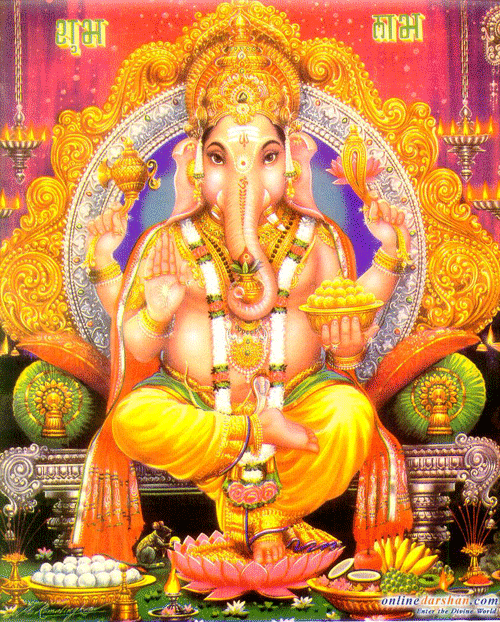
Ganesha (Sanskrit: गणेश; IAST: Gaṇeśa) also spelled Ganesa or Ganesh, also known as Ganapati (Sanskrit: गणपति;IAST: gaṇapati), Vinayaka (Sanskrit: विनायक; IAST: Vināyaka), and Pillaiyar (Tamil: பிள்ளையார்), is one of the deities best-known and most widely worshipped in the Hindu pantheon. His image is found throughout India and Nepal. Hindu sects worship him regardless of affiliations. Devotion to Ganesha is widely diffused and extends to Jains, Buddhists, and beyond India.
Ganesha is Vighneshvara or Vighnaraja, the Lord of Obstacles, both of a material and spiritual order. He is popularly worshipped as a remover of obstacles, though traditionally he also places obstacles in the path of those who need to be checked. [pasted from; Wikipedia.org]
Ganesa: Remover of Obstacles
By Satyaraja Dasa
from; Back to Godhead Magazine
The joyous elephant-faced deity known as Ganesa is revered by one billion Hindus worldwide, and though his worship has little place in the modern-day Hare Krsna movement, his personality and pastimes are part of ISKCON’s heritage.
Ganesa is often seen as the creator and remover of obstacles, as the guardian at entrances, and as a spiritually potent figure who can avert all evil influences. In popular Hindu lore he is thus the god to be worshiped first, before all religious ceremonies, public and private. Things tend to start off with Ganesa, and this is reflected even in common idiomatic phrases. For example, in Maharashtra when a dedication or inauguration is to be performed, a Marathi speaker may refer to the occasion as Sri ganesa karane (“doing the Sri Ganesa”). Another such expression is ganapatice kele (“to conceive a child”). Similar phrases are found in other Indian languages.
More
30 Jun 2011
by The Hare Krishna Movement
in Krishna, Krishna Consciousness
Tags: Balarama, gopis, His Divine Grace A.C. Bhaktivedanta Swami Prabhupada, Krishna, Krsna, Krsna Book, Lord Caitanya, Siksastaka, The Supreme Personality of Godhead

Krishna Nectar
From; KRSNA, The Supreme Personality of Godhead – 1970 Edition
By; His Divine Grace A. C. Bhaktivedanta Swami Prabhupada
Chapter23
Delivering the Wives of the Brahmanas Who Performed Sacrifices
The brāhmaṇas’ wives saw Kṛṣṇa putting on a garment glittering like gold. He wore a nice garland of forest flowers and a peacock feather on His head. He was also painted with the minerals found in Vṛndāvana, and He looked exactly like a dancing actor on a theatrical stage. They saw Him keeping one hand on the shoulder of His friend, and in His other hand, He was holding a lotus flower. His ears were decorated with lilies, He wore marks of tilaka, and He was smiling charmingly. With their very eyes, the wives of the brāhmaṇas saw the Supreme Personality of Godhead, of whom they had heard so much, who was so dear to them, and in whom their minds were always absorbed. Now they saw Him eye to eye and face to face, and Kṛṣṇa entered within their hearts through their eyes.
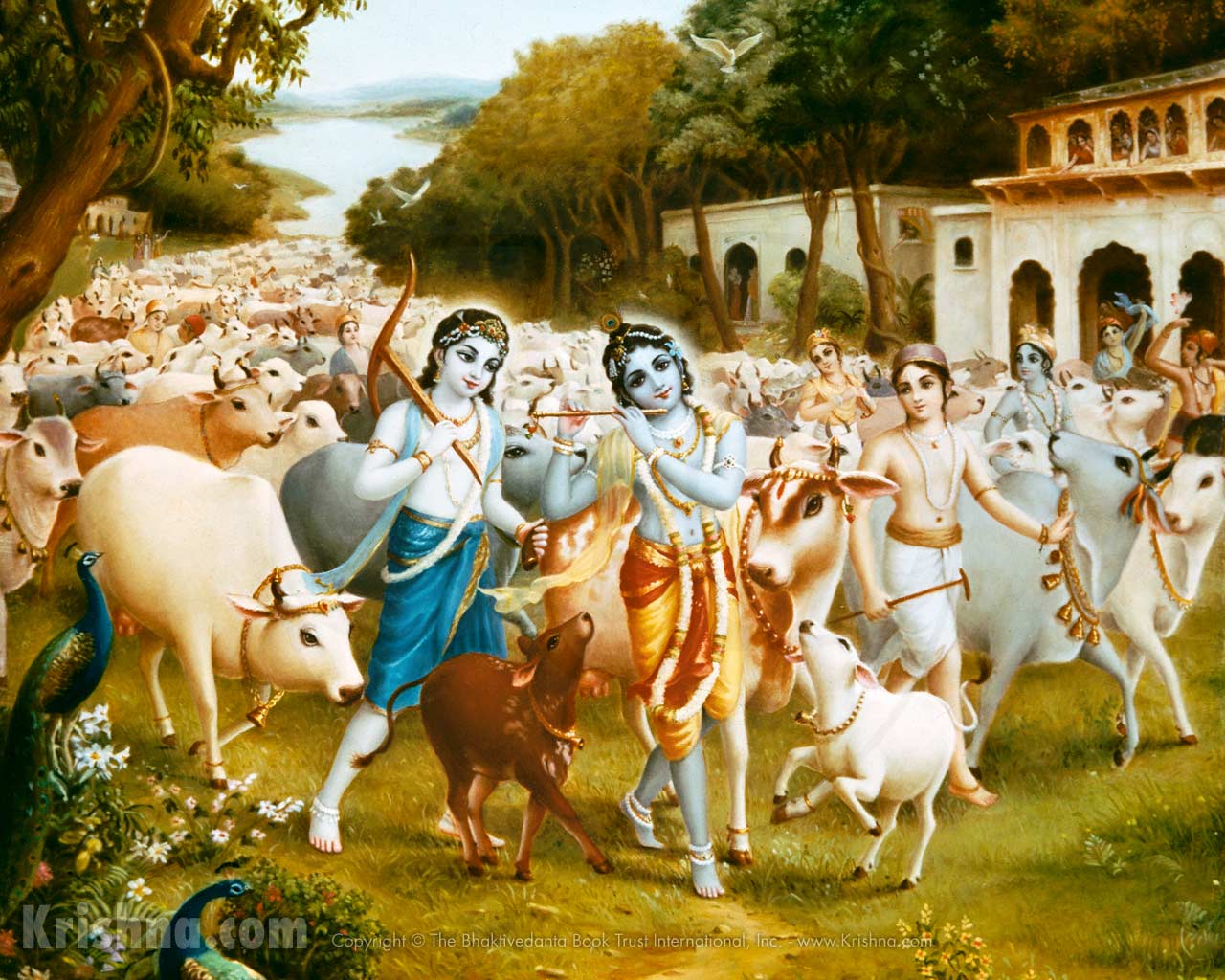
…”For a long time the wives had been anxious to see Kṛṣṇa. However, when they were preparing to leave home to go see Him, their husbands, fathers, sons and relatives asked them not to go. But the wives did not comply. When a devotee is called by the attraction of Kṛṣṇa, he does not care for bodily ties. The women entered the forest of Vṛndāvana on the bank of the Yamunā, which was verdant with vegetation and newly grown vines and flowers. Within that forest, they saw Kṛṣṇa and Balarāma engaged in tending the cows, along with Their very affectionate boy friends.
More
24 Jun 2011
by The Hare Krishna Movement
in Devotional Service, Nectar of Devotion
Tags: A.C. Bhaktivedanta Swami, Bhakti-rasamrta-sindhu, characteristics of pure devotional service, Krsna, Nectar of Devotion, Srila Rupa Goswami, Srimad Bhagavatam
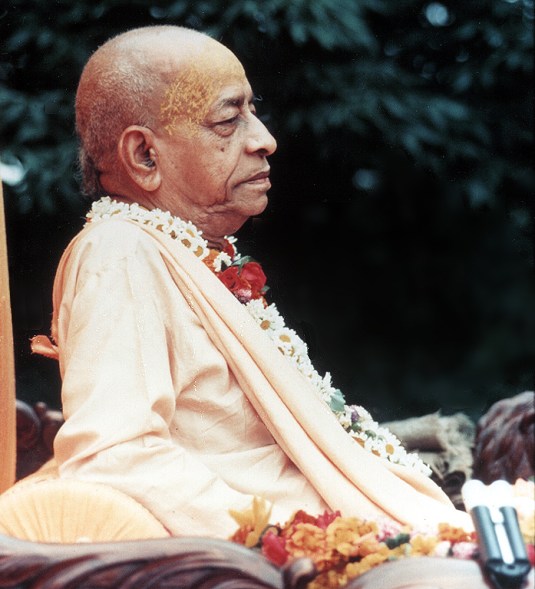
Nectar of Devotion
By: His Divine Grace A. C. Bhaktivedanta Swami Prabhupada
Chapter One
Characteristics of Pure Devotional Service
In Śrīmad-Bhāgavatam, Third Canto, Twenty-ninth Chapter, verses 12 and 13, Śrīla Kapiladeva, while instructing His mother, has given the following characteristics of pure devotional service: “My dear mother, those who are My pure devotees, and who have no desire for material benefit or philosophical speculation, have their minds so much engaged in My service that they are never interested in asking Me for anything—except to be engaged in that service. They do not even beg to live in My abode with Me.”
There are five kinds of liberation, namely to become one with the Lord, to live with the Supreme Lord on the same planet, to have the same features as the Lord, to enjoy the same opulences as the Lord and to live as a companion of the Lord. A devotee, what to speak of rejecting material sense gratification, does not even want any of the five kinds of liberation. He is satisfied simply by discharging loving service to the Lord. That is the characteristic of pure devotion.
In the above statement by Kapiladeva from Śrīmad-Bhāgavatam, the actual position of a pure devotee is described, and the primary characteristics of devotional service are also defined. Further characteristics of devotional service are described by Rūpa Gosvāmī with evidences from different scriptures. He states that there are six characteristics of pure devotional service, which are as follows:
(1) Pure devotional service brings immediate relief from all kinds of material distress.
(2) Pure devotional service is the beginning of all auspiciousness.
(3) Pure devotional service automatically puts one in transcendental pleasure.
(4) Pure devotional service is rarely achieved.
(5) Those in pure devotional service deride even the conception of liberation.
(6) Pure devotional service is the only means to attract Kṛṣṇa.
Kṛṣṇa is all-attractive, but pure devotional service attracts even Him. This means that pure devotional service is even transcendentally stronger than Kṛṣṇa Himself, because it is Kṛṣṇa’s internal potency.
More
18 Jun 2011
by The Hare Krishna Movement
in Back to Godhead, Chanting Hare Krishna
Tags: devotees, Hare Krishna, impersonalists, Krsna, Kurappiah Chockalingam, Om, omkara, pranava, spiritual vibration, Srimati Radharani

Om or Hare Krishna?
By Kurappiah Chockalingam
Though the sacred sound om is often associated with impersonalists, only the devotees understand its full import.
The Gosvamis of Vrndavana have analyzed om (a-u-m) as follows: The letter a refers to Krsna, the master of all planets and all living entities. The letter u indicates Srimati Radharani, the pleasure potency of Krsna, and m indicates the living entities. Thus omkara represents Krsna; His name, fame, pastimes, potencies, and devotees; and everything else pertaining to Him.
THROUGHOUT THE VEDAS there is much mention of the syllabel om. This spiritual vibration, which is sometimes called omkara or pranava, comprises three Sanskrit sounds – a, u, and ma (the a in ma is silent). When these three sounds are combined, the result is the single-syllabled vibration om.
An unusual attribute of om is that it has no direct translation from Sanskrit into English. And though every Vedantist will accept om to be a representation of God, exactly how om is viewed differs according to various schools to thought. These schools can be classified into two main categories, the Mayavadi, or impersonalist, and the Vaisnava, or devotee.
The impersonalist, as the name suggests, is happy to treat om as an impersonal, formless, representation of the Absolute Truth. Therefore, the Mayavadi will very openly chant om, being careful to avoid names such as Krsna and Rama, which according to them, are limited. A Mayavadi might explain his theory of pranava om like this: “Since this whole universe has been created by Him (God), whatever there is in the universe is Him alone.
As such, He has no name. But if He has to have a name, then all names are His, for He alone is appearing in all forms. The first sound in most languages is a; the last sound to leave as our mouth closes is m; u is the center of the two. Together, they represent all the basic sounds from which words are produced. And threfore, these three sounds, making up the syllable om, represent the entire universe of names and forms.”
More
Previous Older Entries Next Newer Entries












 The Hare Krishna Movement