24 Sep 2012
by The Hare Krishna Movement
in A.C. Bhaktivedanta Swami Prabhupada, Letters by Srila Prabhupada, Yosomatinandana das
Tags: A.C. Bhaktivedanta Swami Prabhupada, Back to Godhead Magazine, Krishna, Krishna philosophy, Letters by Srila Prabhupada, Supreme Personality of Godhead, Yasomatinandana

click to enlarge
Back to Godhead Magazine
Letters, Volume-01 Number-55, 1973
My dear Yasomatinandana,
Please accept my blessings. I am in due receipt of your letter, and I am so much pleased to read it. Your letter is so nice that I am advising that it be published in Back to Godhead. In the meantime you can immediately begin translating all our books into the Gujarati language. All these translations will be published in series in our Gujarati BTG, and if you are serious about it, you can be the Editor. So immediately begin translating and regularly produce books in Gujarati, and it will be a great service for you. The more you render service, the more you will be enlightened by the Supreme Personality of Godhead. Thank you once more for understanding our philosophy very nicely.
Hoping this will meet you in good health,
Your ever well-wisher, A.C. Bhaktivedanta Swami
Full letter by Yasomatinandana dasa More
21 Sep 2012
by The Hare Krishna Movement
in A.C. Bhaktivedanta Swami Prabhupada, Krishna Consciousness, KRSNA The Supreme Personality of Godhead, Srimati Radharani
Tags: A.C. Bhaktivedanta Swami Prabhupada, bumblebee, Goloka Vrndavana, gopis, inhabitants of Vrndavana, Krishna, Krsna, Nanda Maharaja, Radha, Radhastami, Srimati Radharani, srimati radharani appearance day, Uddhava, Yasoda
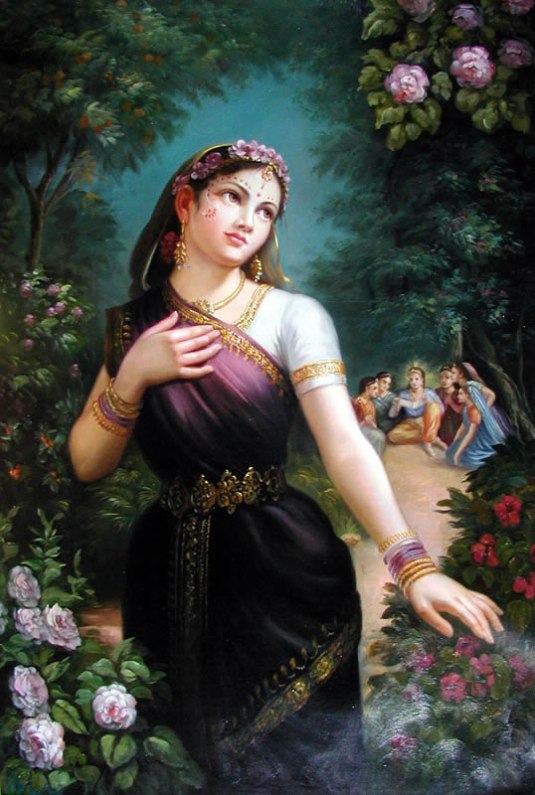
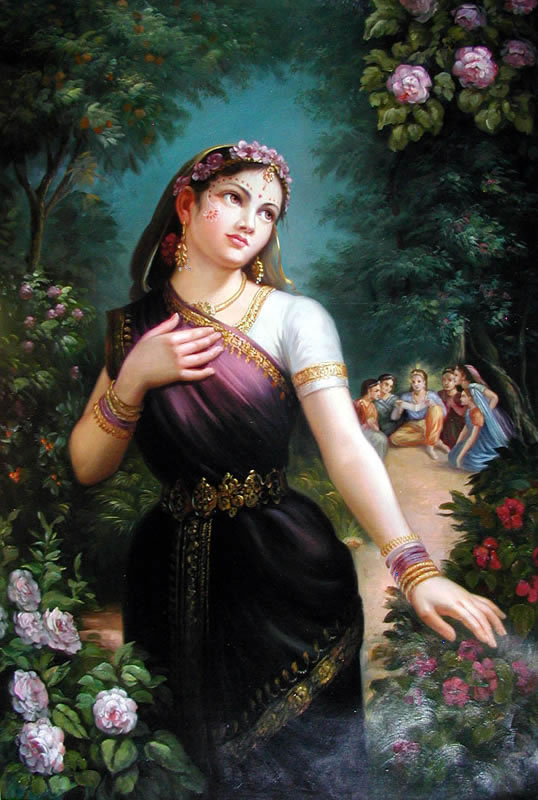
On this eve of Srimati Radharani’s appearance day (Radhastami) celebration I am reminded of one of my favorite KRSNA Book stories; Delivery of the Message of Kṛṣṇa to the Gopīs. We share the entire chapter with you here.
…One of the gopīs, namely Śrīmatī Rādhārāṇī, was so much absorbed in thoughts of Kṛṣṇa by dint of Her personal touch with Him that She actually began to talk with a bumblebee which was flying there and trying to touch Her lotus feet. While another gopī was talking with Kṛṣṇa’s messenger Uddhava, Śrīmatī Rādhārāṇī took that bumblebee to be a messenger from Kṛṣṇa and began to talk with it as follows. “Bumblebee, you are accustomed to drinking honey from the flowers, and therefore you have preferred to be a messenger of Kṛṣṇa, who is of the same nature as you. I have seen on your moustaches the red powder of kuṅkuma, which was smeared on the flower garland of Kṛṣṇa while He was pressing the breast of some other girl who is My competitor. You are feeling very proud by touching that flower, and your moustaches have become reddish. You have come here carrying a message for Me. You are anxious to touch My feet. But My dear bumblebee, let me warn you–don’t touch Me! I don’t want any messages from your unreliable master. You are the unreliable servant of an unreliable master.” It may be that Śrīmatī Rādhārāṇī purposely addressed that bumblebee sarcastically in order to criticize the messenger Uddhava. Indirectly, Śrīmatī Rādhārāṇī saw Uddhava as not only resembling Kṛṣṇa’s bodily features but as being equal to Kṛṣṇa. In this way She indicated that Uddhava was as unreliable as Kṛṣṇa Himself. Śrīmatī Rādhārāṇī wanted to give specific reasons why She was dissatisfied with Kṛṣṇa and His messengers.
She addressed the bumblebee, “Your master Kṛṣṇa is exactly of your quality. You sit down on a flower, and after taking a little honey you immediately fly away and sit in another flower and taste. You’re just like your master Kṛṣṇa. He gave us the chance of tasting the touch of His lips and then left altogether. I know also that the goddess of fortune, Lakṣmī, who is always in the midst of the lotus flower, is constantly engaged in Kṛṣṇa’s service. But I do not know why she has become so captivated by Kṛṣṇa. She is attached to Him, although she knows His actual character. As far as we are concerned, we are more intelligent than that goddess of fortune. We are not going to be cheated anymore by Kṛṣṇa or His messengers…”
Kṛṣṇa, The Supreme Personality of Godhead
By His Divine Grace A.C. Bhaktivedanta Swami Prabhupada
Chapter 46
Delivery of the Message of Kṛṣṇa to the Gopīs More
18 Sep 2012
by The Hare Krishna Movement
in Health, Practicing Krishna Consciousness at Home, Prasadam, Vegetarian Cooking, Vegetarian Recipies, Vegetarianism
Tags: hare krishna cookbook, hare krishna cooking, health consciousness, Krishna, prabhupada, practicing krishna consciousness at home, Srila Prabhupada, standard devotee diet, vegetarian cooking, vegetarian recipies, vegetarianism

Once when Srila Prabhupada saw what was being served to the devotees, lavishly prepared multi-course lunches, he told the managers that it was too opulent. He said we should eat simply during the week with rice, dhal, chapatis and a little subji and once a week on the Sunday love feasts we could be more lavish. Today with more of us becoming Health Conscious, it is good to remember the very simple devotee diet that was recommended to us so long ago.
Standard Devotee Diet
Srila Prabhupada recommended a standard diet for the devotees, and instructed that all of the temples should follow it every day. That menu follows:
BREAKFAST:
Simple farina cereal with nuts and raisins
Milk (steaming hot), or yogurt in the summertime
Chick peas (raw, soaked overnight)
Ginger root (raw)
Oranges, apples and/or bananas
LUNCH:
Rice
Chapatis
Dal made with freshly ground ginger root and freshly ground spices
Subji made with ghee, freshly ground ginger root and freshly ground spices
BEFORE TAKING REST:
Milk (steaming hot)
Bananas
For a free download of the Hare Krishna Cookbook on pdf More
16 Sep 2012
by The Hare Krishna Movement
in Free Downloads, Free eBooks, Sri Isopanisad
Tags: A.C. Bhaktivedanta Swami Prabhupada, God realization, impersonal Brahman, invocation, ISKCON Books, KBI, Krishna, Krishna Path, Paramatma, prabhupada purports, Sri Isopanisad, supreme absolute truth, Supreme Personality of Godhead, the complete whole, The Hare Krishna Movement

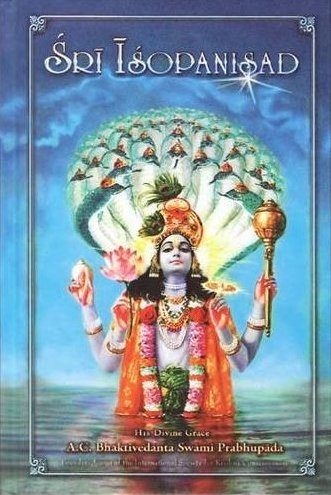
This begins a new series on the Sri Isopanisad (The knowledge that brings one nearer to the Supreme Personality of Godhead, Krishna). It begins with the Invocation and is followed by eighteen mantras and purports by Srila Prabhupada. To purchase the book you can visit The Hare Krishna Movement or to download free pdf you can click on link at bottom of post or visit Krishna Path for free downloads and epub’s.
Śrī Īśopaniṣad
By His Divine Grace A.C. Bhaktivedanta Swami Prabhupada
Original text found in first edition published by ISKCON BOOKS in 1969
INVOCATION
oṁ pūrṇam adaḥ pūrṇam idaṁ
pūrṇāt pūrṇam udacyate
pūrṇasya pūrṇam ādāya
pūrṇam evāvaśiṣyate
oṁ—the Complete Whole; pūrṇam—perfectly complete; adaḥ—that; pūrṇam—perfectly complete; idam—this phenomenal world; pūrṇāt—from the all-perfect; pūrṇam—complete unit; udacyate—is produced; pūrṇasya—of the Complete Whole; pūrṇam—completely, all; ādāya—having been taken away; pūrṇam—the complete balance; eva—even; avaśiṣyate—is remaining.
TRANSLATION
The Personality of Godhead is perfect and complete, and because He is completely perfect, all emanations from Him, such as this phenomenal world, are perfectly equipped as complete wholes. Whatever is produced of the Complete Whole is also complete in itself. Because He is the Complete Whole, even though so many complete units emanate from Him, He remains the complete balance.
PURPORT
The Complete Whole, or the Supreme Absolute Truth, is the complete Personality of Godhead. Realization of impersonal Brahman or of Paramātmā, the Supersoul, is incomplete realization of the Absolute Complete. The Supreme Personality of Godhead is sac-cid-ānanda-vigraha [Bs. 5.1]. Realization of impersonal Brahman is realization of His sat feature, or His aspect of eternity, and Paramātmā realization is realization of His sat and cit features, His aspects of eternity and knowledge. But realization of the Personality of Godhead is realization of all the transcendental features-sat, cit and ānanda, bliss. When one realizes the Supreme Person, he realizes these aspects of the Absolute Truth in their completeness. Vigraha means “form.” Thus the Complete Whole is not formless. If He were formless, or if He were less than His creation in any other way, He could not be complete. The Complete Whole must contain everything both within and beyond our experience; otherwise He cannot be complete.
More
15 Sep 2012
by The Hare Krishna Movement
in A.C. Bhaktivedanta Swami Prabhupada, Back to Godhead, Krsna Consciousness, Spiritual Life
Tags: A.C. Bhaktivedanta Swami Prabhupada, Back to Godhead Magazine, gopis, Krishna, Krsna, material world, materialistic enjoyment, Spiritual Life, tri-bhanga form
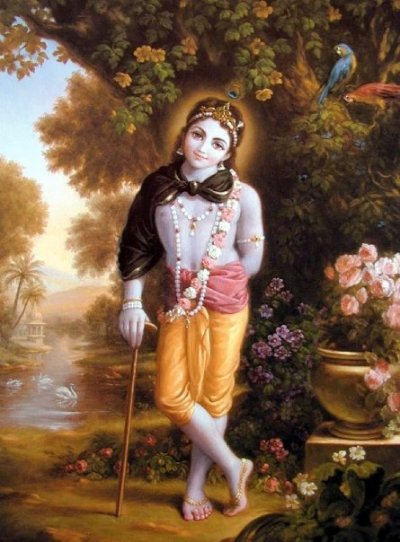
…The gopis are another example of great eagerness to see Krsna. The gopis came to Krsna, being captivated by His beautiful features.
The first thing Krsna is looking for is how eager you are to see Him. Krsna will respond. If you are actually eager to see Krsna …your efforts will be successful. But you must desire Krsna only. In this connection, Rupa Gosvami has written a verse:
smeram bhangi-traya-paricitam saci-vistirna-drstim
vamsi-nyastadhara-kisalayam ujjvalam candrakena
govindakhyam hari-tanum itah kesi-tirthopakanthe
ma preksisthas tava yadi sakhe bandhu-sange ‘sti rangah
The idea is that one gopi is advising another gopi, “My dear friend, there is one boy His name is Govinda. He is standing on the bank of the Yamuna near the Kesi-ghata, and He is playing on His flute. He is so beautiful, especially during this full-moon night. If you have any intention to enjoy in this material world with your children, husband, or other family members, then please do not go there.” Bhangi-traya: Krsna always stands in a three-curved way with His flute. That is Krsna’s tri-bhanga form, bending in three places. So the one gopi says to the other, “If you think that you’ll enjoy your life more in this material world, then do not go to see Krsna. Do not go there.” The idea is that if you once see Krsna, then you’ll forget all this nonsensical materialistic enjoyment. That is seeing Krsna.
More
13 Sep 2012
by The Hare Krishna Movement
in Krsna Consciousness, Lectures
Tags: A.C. Bhaktivedanta Swami Prabhupada, anyabilasita-sunyam, Bhagavad-gita lecture, Brahma-samhita, Krishna, krsna-prema, Lecture by Srila Prabhupada, love of God, namo maha-vadanyaya, no material desire, pure devotee
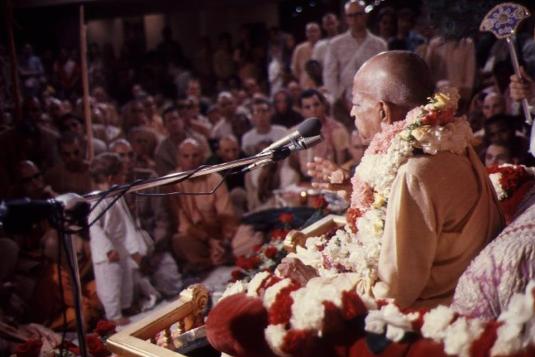
Click on image to enlarge
Pure devotee means he has no other desire, no material desire. Anyābhilāṣitā-śūnyam, zero.
…And if it is mixed up, anyābhi…, with material desire or spiritual emancipation or fruitive activities, then it is not pure devotee.
So if you can approach such pure devotee… As it is stated in the Brahma-saṁhitā, adurlabham ātma-bhaktau. This is ātma-bhaktau, a pure devotee. He can deliver you Kṛṣṇa. “Take Kṛṣṇa. Here is Kṛṣṇa.” Kṛṣṇa-prema… That is…
The symbolic representation is Śrī Caitanya Mahāprabhu. He’s described by Rūpa Gosvāmī:
namo mahā-vadānyāya kṛṣṇa-prema-pradāya te kṛṣṇāya kṛṣṇa-caitanya-nāmne gaura-tviṣe namaḥ [Madhya 19.53]
When Rūpa Gosvāmī… He was minister in the government of Nawab Hussain Shah. At that time, very exalted personality. He could understand Caitanya Mahāprabhu’s mission. Therefore when he first met Him at Allahabad, Prayāga, he offered his respect with these words: namo mahā-vadānyāya, the most munificent incarnation. Why? Kṛṣṇa-prema-pradāya te. “You are distributing kṛṣṇa-prema. It is very difficult to understand Kṛṣṇa, but You are so kind that You are immediately delivering love of Kṛṣṇa.”
You can know one person. But to develop love for him, that is another transaction. So people cannot understand even Kṛṣṇa, and what is the saying of Kṛṣṇa’s love? But Caitanya Mahāprabhu is so kind that He’s immediately giving kṛṣṇa-prema, love of Kṛṣṇa. Therefore He is described as the most munificent incarnation. Kṛṣṇa Himself could not deliver Himself. He wanted. “First of all you surrender.” Sarva-dharmān parityajya mām ekaṁ śaraṇaṁ vraja [Bg. 18.66] But Caitanya Mahāprabhu is so kind. Simply through this chanting and dancing, He is distributing love of Kṛṣṇa.
You can see practically. These boys from European and American countries, means all over the world, why they are chanting and dancing in this way? Do you think they have become mad? And one says, “Yes, they have become mad.” Why? For love of Kṛṣṇa. Now they have began they have become lover of Kṛṣṇa. So kṛṣṇa-prema is like that. That is through the mercy of Śrī Caitanya Mahāprabhu.
Therefore Śrī Caitanya Mahāprabhu is the symbolic representation of devotee. Bhaktāvatāraṁ bhaktākhyaṁ namāmi bhakta-śaktikam. Namāmi bhakta-śaktikam. He can give the strength to the devotee so that he can develop his dormant love of Kṛṣṇa. Therefore in the Brahma-saṁhitā it is stated that adurlabham ātma-bhaktau. If one is pure devotee, for him, Kṛṣṇa is available very easy. He says in the Bhagavad-gītā. Bhaktyā mām abhijānāti yāvān yaś cāsmi tattvataḥ [Bg. 18.55] “One can understand Me in truth…” Yāvān yaś cāsmi tattvataḥ. “Which is very, very difficult.”
manuṣyāṇāṁ sahasreṣu kaścid yatati siddhaye yatatām api siddhānāṁ kaścin māṁ vetti tattvataḥ [Bg. 7.3]
To understand Kṛṣṇa as He is, it is difficult. But if you take to this process of devotional service…
śravaṇaṁ kīrtanaṁ viṣṇoḥ smaraṇaṁ pāda-sevanam arcanaṁ vandanaṁ dāsyaṁ sakhyam ātma-nivedanam [SB 7.5.23]
Either of these process. All the process or either of these. You become successful to develop your dormant Kṛṣṇa consciousness, and then your life becomes successful. Thank you very much. (end)
Full lecture More
27 Aug 2012
by The Hare Krishna Movement
in A.C. Bhaktivedanta Swami Prabhupada, Krsna Consciousness: The Topmost Yoga System, Yoga
Tags: A.C. Bhaktivedanta Swami Prabhupada, bhagavad-gita, bhakti yoga, goal of yoga, Krishna, krsna consciousness, The Topmost Yoga System, yoga

…Kṛṣṇa consciousness is the great necessity of human society. Learn it and appreciate it, comprehend it and assimilate it—and teach it. It is very simple. If you offenselessly chant Hare Kṛṣṇa, everything will be revealed from within because Kṛṣṇa is sitting within you. If you are strong and have faith and conviction in Kṛṣṇa, as well as in the spiritual master, the transparent via medium to Kṛṣṇa, then Kṛṣṇa is there. The Vedas say that if you have implicit faith in God and implicit faith in your bona fide guru, who teaches you Kṛṣṇa consciousness, then the result will be that all the Vedic scriptures will be revealed authoritatively.(Srila Prabhupada)
More
25 Aug 2012
by The Hare Krishna Movement
in KRSNA The Supreme Personality of Godhead
Tags: A.C. Bhaktivedanta Swami Prabhupada, books by Srila Prabhupada, hearing and chanting, Krishna, Krsna, Lord Brahma, Lord Krsna, Purusottama, Purusottama month, The Supreme Personality of Godhead
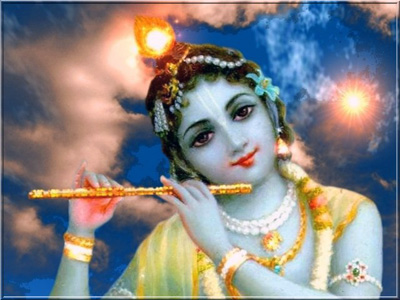
During the Purusottama Month, it is important to Hear and Chant more. With this in mind we are posting the 14th Chapter of Krsna, The Supreme Personality of Godhead, with Lord Brahma praising the Glories of Krishna (Purusottama) The Supreme Personality.
“My dear Lord, there are many instances in the history of human society where a person, after failing to achieve the transcendental platform, engaged himself in devotional service with his body, mind and words and thus attained the highest perfectional state of entering into Your abode. The processes of understanding You by speculation or mystic meditation are all useless without devotional service. One should therefore engage himself in Your devotional service even in his worldly activities, and one should always keep himself near You by the process of hearing and chanting Your transcendental glories. Simply by being attached to hearing and chanting Your glories, one can attain the highest perfectional stage and enter into Your kingdom. If a person, therefore, always keeps in touch with You by hearing and chanting Your glories and offers the results of his work for Your satisfaction only, he very easily and happily attains entrance into Your supreme abode. You are realizable by persons who have cleansed their hearts of all contamination. This cleansing of the heart is made possible by chanting and hearing the glories of Your Lordship.”
“In the Upaniṣads it is stated that the Supreme Brahman is as effulgent as the sun and is the origin of everything, and anyone who can understand that original person becomes liberated from the material conditional life. Anyone who can simply be attached to You by devotional service can know Your actual position, Your birth, appearance, disappearance and activities. As confirmed in the Bhagavad-gītā, simply by understanding Your constitutional position, appearance and disappearance, one can be immediately elevated to the spiritual kingdom after quitting this present body. Therefore to cross over the ocean of material nescience, an intelligent person takes shelter of Your lotus feet and is easily transferred to the spiritual world.”
More
21 Aug 2012
by The Hare Krishna Movement
in Guru & Disciple, Srila Prabhupada Conversations, Sriman George Harrison
Tags: conversations with Srila Prabhupada, Krishna, Sila Prabhupada conversations, Son of Hari, Sriman George Harrison
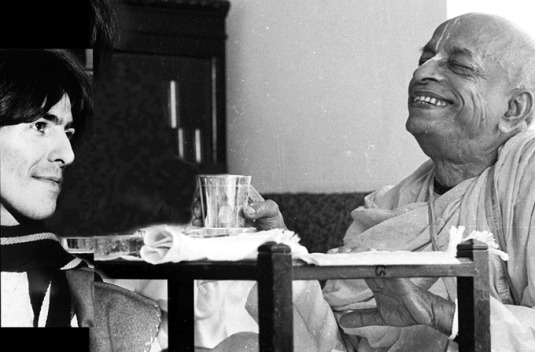
click on image to slightly enlarge
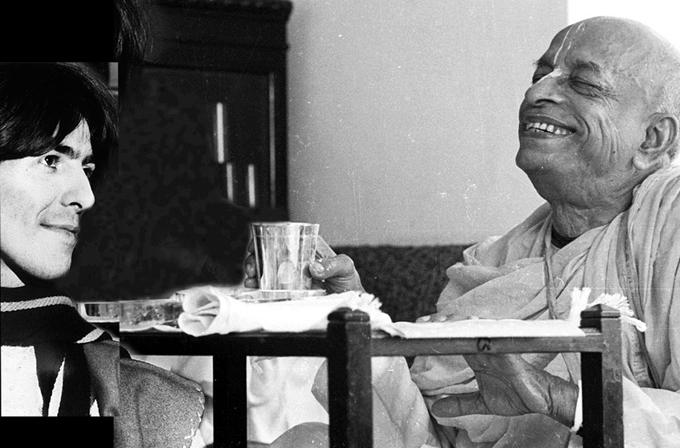
George Harrison: “Son of Hari”
Aug 20, 2012 — CANADA (SUN)
I recently saw this link to the “Son of Hari” website on Facebok and this morning I saw it posted on the Sampradaya Sun With appreciation we are re-posting it here.
The “Son of Hari” website is home to a collection of audio files, some recently released in original form by the Bhaktivedanta Archives, of recorded conversations between Srila Prabhupada and George Harrison.
Srila Prabhupada’s conversations with George on three dates are available: August 22, 1973, August 27, 1973, and July 26, 1976. Each conversation is broken down into multiple parts due to the length of the conversations. Text transcripts are also provided for the conversations.
click on link to visit site and hear conversations or read text; Son of Hari
More
17 Aug 2012
by The Hare Krishna Movement
in Uncategorized
Tags: A.C. Bhaktivedanta Swami Prabhupada, Arjuna, as it is, bhagavad-gita, Bhagavan, Iksvaku, imam vivasvate yogam, Krishna, Macmillan Edition, Manu, Original 1972 Macmillan, science of yoga, the blessed Lord said, The Supreme Personality of Godhead, transcendental knowledge, Vivasvan, yoga

Bhagavad-gītā As It Is
By His Divine Grace A. C. Bhaktivedanta Swami Prabhupāda
Chapter 4
Transcendental Knowledge
More
16 Aug 2012
by The Hare Krishna Movement
in Krsna Consciousness the Matchless Gift, The Hare Krishna Movement, The Matchless Gift
Tags: A.C. Bhaktivedanta Swami Prabhupada, books of Srila Prabhupada, eternal well-wisher, glories of Bhagavad-gita, great philosopher, great scientist, Hare Krishna, illusion, Krishna, Krishna consciousness movement, Krsna Consciousness The Matchless Gift, material world, maya, original consciousness, The Hare Krishna Movement, trancendental knowledge, Vaisnava poet, wisdom
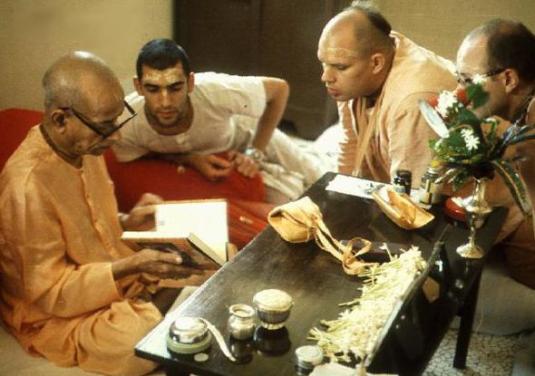
…The best and ultimate authority is Kṛṣṇa, for He is our eternal well-wisher, and He always speaks for our benefit. Since we have to accept some authority, why not accept His? Simply by hearing of His glories from Bhagavad-gītā and Śrīmad-Bhāgavatam and by chanting His names: Hare Kṛṣṇa, Hare Krsna, Krsna Krsna, Hare Hare, Hare Rama, Hare Rama, Rama Rama, Hare Hare, we can swiftly perfect our lives.
Kṛṣṇa Consciousness, the Matchless Gift
By His Divine Grace A. C. Bhaktivedanta Swami Prabhupāda
Chapter One
Spiritual Knowledge Through Kṛṣṇa
The aim of this Kṛṣṇa consciousness movement is to bring all living entities back to their original consciousness. All living entities within the material world are, to varying degrees, afflicted with a type of madness. This Kṛṣṇa consciousness movement aims at curing man of his material disease and reestablishing his original consciousness. In a Bengali poem a great Vaiṣṇava poet has written, “When a man is haunted by ghosts, he can only speak nonsense. Similarly, anyone who is under the influence of material nature should be considered haunted, and whatever he speaks should be considered nonsense.” One may be considered a great philosopher or great scientist, but if he is haunted by the ghost of māyā, illusion, whatever he theorizes and whatever he speaks is more or less nonsensical. Today we are given the example of a psychiatrist who, when requested to examine a murderer, proclaimed that since all the patients with whom he had come in contact were more or less crazy, the court could excuse the murderer on those grounds if it so desired. The point is that in the material world it is very difficult to find a sane living entity. The prevailing atmosphere of insanity in this world is all caused by the infection of material consciousness.
The purpose of this Hare Kṛṣṇa movement is to bring man back to his original consciousness, which is Kṛṣṇa consciousness, clear consciousness. When water falls from the clouds, it is uncontaminated like distilled water, but as soon as it touches the ground it becomes muddy and discolored. Similarly, we are originally pure spirit soul, part and parcel of Kṛṣṇa, and therefore our original constitutional position is as pure as God’s. In Bhagavad-gītā Sri Kṛṣṇa says:
More
09 Aug 2012
by The Hare Krishna Movement
in Festivals, Janmastami, Krishna, Lectures
Tags: A.C. Bhaktivedanta Swami Prabhupada, Hare Krishna, International Society for Krishna Consciousness, Janmastami, Krishna, Krsna Kesava pahi mam, Lord Sri Krishna, Lord Sri Krsna's Appearance Day Lecture, Rama Raghava raksa mam, Srila Prabhupada lecture

Kṛṣṇa! Kṛṣṇa! Kṛṣṇa! Kṛṣṇa! Kṛṣṇa! Kṛṣṇa! Kṛṣṇa! he
Kṛṣṇa! Kṛṣṇa! Kṛṣṇa! Kṛṣṇa! Kṛṣṇa! Kṛṣṇa! Kṛṣṇa! he
Kṛṣṇa! Kṛṣṇa! Kṛṣṇa! Kṛṣṇa! Kṛṣṇa! Kṛṣṇa! rakṣa mām
Kṛṣṇa! Kṛṣṇa! Kṛṣṇa! Kṛṣṇa! Kṛṣṇa! Kṛṣṇa! pāhi mām
Rāma! Rāghava! Rāma! Rāghava! Rāma! Rāghava! rakṣa mām
Kṛṣṇa! Keśava! Kṛṣṇa! Keśava! Kṛṣṇa! Keśava! pāhi mām
Caitanya-caritāmṛta (Madhya 7.96)
Today, here in the Western half of the World, we are celebrating Janmastami: the appearance day of Lord Sri Krishna. So let us take advantage of this auspicious day and hear, chant, and remember the pastimes of the Lord. Hare Krishna!
Janmāṣṭamī
Lord Śrī Kṛṣṇa’s Appearance Day Lecture
By His Divine Grace A.C. Bhaktivedanta Swami Prabhupada
Montreal, August 16, 1968
More
08 Aug 2012
by The Hare Krishna Movement
in Festivals, Janmastami, KRSNA The Supreme Personality of Godhead
Tags: A.C. Bhaktivedanta Swami Prabhupada, appearance day of Lord Krishna, appearance of Krishna, demigods, Janmastami, Krishna, Krsna, Krsna The Supreme Personality of Godhead, Prayers by the Demigods, Vedas
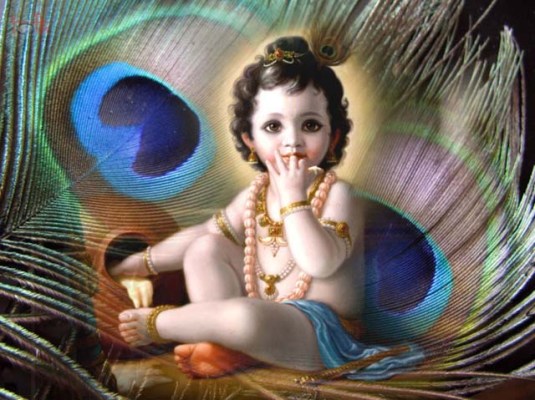
…The appearance of Kṛṣṇa is the answer to all imaginative iconography of the Supreme Personality of Godhead. Everyone imagines the form of the Supreme Personality of Godhead according to his mode of material nature. In the Brahmā-saṁhitā it is said that the Lord is the oldest person. Therefore a section of religionists imagine that God must be very old, and therefore they depict a form of the Lord like a very old man. But in the same Brahmā-saṁhitā, that is contradicted; although He is the oldest of all living entities, He has His eternal form as a fresh youth.
…”O dear Lord,” the demigods continued, “You are unborn; therefore we do not find any reason for Your appearance other than for Your pleasurable pastimes.” Although the reason for the appearance of the Lord is stated in the Bhagavad-gītā (He descends just to give protection to the devotee and vanquish the nondevotee), actually He descends for His pleasure-meeting with the devotees, not really to vanquish the nondevotees. The nondevotees can be vanquished simply by material nature. “The action and reaction of the external enregy of material nature (creation, maintenance and annihilation) are being carried on automatically. But simply by taking shelter of Your holy name–because Your holy name and Your personality are nondifferent–the devotees are sufficiently protected.” The protection of the devotees and the annihilation of the nondevotees are actually not the business of the Supreme Personality of Godhead when He descends. They are just for His transcendental pleasure. There cannot be any other reason for His appearance.
Excerpts from; KRSNA, The Supreme Personality of Godhead
By His Divine Grace A.C. Bhaktivedanta Swami Prabhupada
Volume 1, Chapter 2
More
05 Aug 2012
by The Hare Krishna Movement
in Festivals, Janmastami, Krishna
Tags: baby Krishna, Birth of Lord Krsna, Hare Krishna centers, Iskcon, Krishna, Krishna Janmastami, Krishna's appearance, Krishna's birth, Mother Yasoda, Rohini, Sri Krishna Janmastami

click on image to enlarge
Sri Krishna Janmastami is quickly approaching, and will be celebrated on August 9th, this year. For those of you who want to follow, it is recommended that you fast until Midnight. We would also encourage you to visit the nearest Hare Krishna Center and partake in the festivities.
Kṛṣṇa, the Supreme Personality of Godhead
By His Divine Grace A. C. Bhaktivedanta Swami Prabhupāda
Chapter Three
The Birth of Lord Kṛṣṇa
As stated in the Bhagavad-gītā, the Lord says that His appearance, birth, and activities, are all transcendental, and one who understands them factually becomes immediately eligible to be transferred to the spiritual world. The Lord’s appearance or birth is not like that of an ordinary man who is forced to accept a material body according to his past deeds. The Lord’s appearance is explained in the Second Chapter: He appears out of His own sweet pleasure. When the time was mature for the appearance of the Lord, the constellations became very auspicious. The astrological influence of the star known as Rohiṇī was also predominant because this star is considered to be very auspicious. Rohiṇī is under the direct supervision of Brahmā. According to the astrological conclusion, besides the proper situation of the stars, there are auspicious and inauspicious moments due to the different situations of the different planetary systems. At the time of Kṛṣṇa’s birth, the planetary systems were automatically adjusted so that everything became auspicious.
More
05 Aug 2012
by The Hare Krishna Movement
in Krishna, Opulence of the Absolute, Sri Caitanya-Caritamrta, Srimati Radharani
Tags: A.C. Bhaktivedanta Swami Prabhupada, Aprakrta-madana, cupid, Krishna, Krsna, Mad. 8.139, Madana, Madana-mohana, Manmatha-madana, Nectar of Devotion, sac-cid-ananda-vigraha, Sri Caitanya-caritamrta
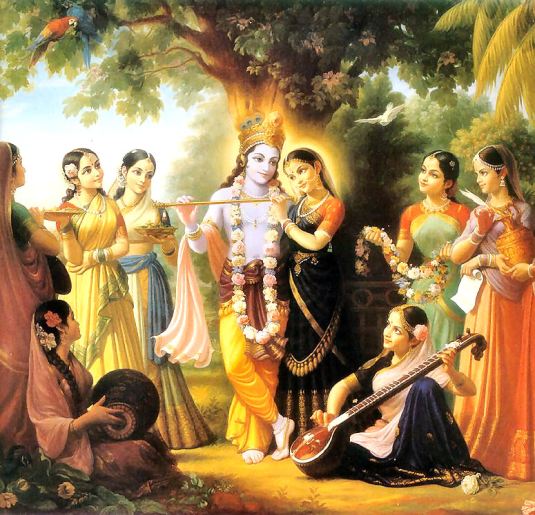
click on image to enlarge
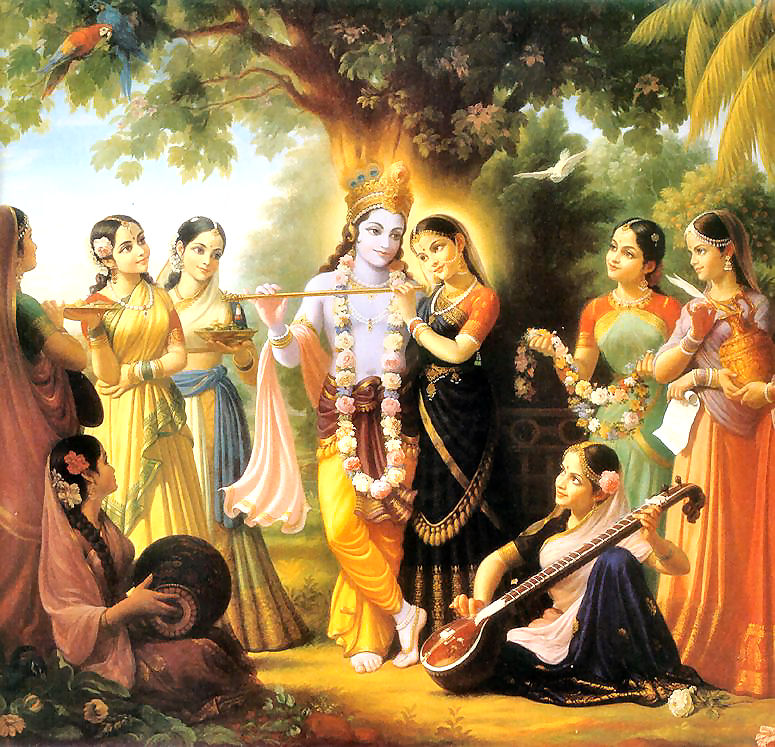
“The very name Kṛṣṇa means that He attracts even Cupid. He is therefore attractive to everyone-male and female, moving and inert living entities. Indeed, Kṛṣṇa is known as the all-attractive one.
“Śrīla Rūpa Gosvāmī has stated that devotional service attracts even Kṛṣṇa. Kṛṣṇa attracts everyone, but devotional service attracts Kṛṣṇa. The symbol of devotional service in the highest degree is Rādhārāṇī. Kṛṣṇa is called Madana-mohana, which means that He is so attractive that He can defeat the attraction of thousands of Cupids. But Rādhārāṇī is still more attractive, for She can even attract Kṛṣṇa. Therefore devotees call Her Madana-mohana-mohinī, the attractor of the attractor of Cupid. To perform devotional service means to follow in the footsteps of Rādhārāṇī…” (Nectar of Devotion Lecture, Nov. 11, 1972, Vrindavan)
…The name Madana refers to Cupid, but Kṛṣṇa is the spiritual Madana. His body is not material like the body of Cupid in this material universe. Kṛṣṇa’s body is all-spiritual-sac-cid-ānanda-vigraha. Therefore He is called Aprākṛta-madana. He is also known as Manmatha-madana, which means that He is attractive even to Cupid.
More
03 Aug 2012
by The Hare Krishna Movement
in Bhagavad-gita, Death and Dying, Practicing Krishna Consciousness at Home
Tags: A.C. Bhaktivedanta Swami Prabhupada, ananda, anta-kale ca mam eva, Arjuna, asat, Attaining the Supreme, Bg 8.5, chanting Hare Krishna, cit, death, He attains My nature, Krishna, Krishna's form, Krishna's names, material activities, nirananda, quits his body, remembering Me alone, sac-cid-ananda-vigraha, sat
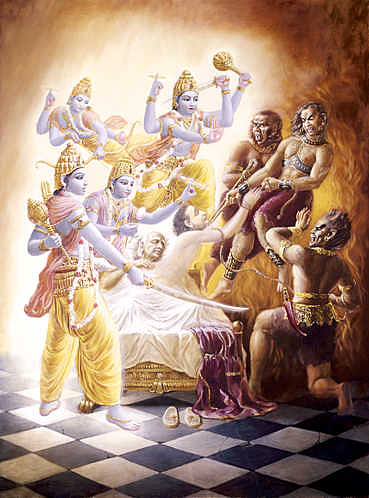
Next, one may raise the question of how one goes about approaching that abode of the Supreme Lord. Information of this is given in the Eighth Chapter of the Bhagavad-gita. It is said there:
And whoever, at the time of death, quits his body, remembering Me alone, at once attains My nature. Of this there is no doubt.
Whatever state of being one remembers when he quits his body, that state he will attain without fail.
Therefore, Arjuna, you should always think of Me in the form of Kṛṣṇa and at the same time carry out your prescribed duty of fighting. With your activities dedicated to Me and your mind and intelligence fixed on Me, you will attain Me without doubt.
…This instruction to Arjuna is very important for all men engaged in material activities. The Lord does not say that one should give up his prescribed duties or engagements. One can continue them and at the same time think of Kṛṣṇa by chanting Hare Kṛṣṇa. This will free one from material contamination and engage the mind and intelligence in Kṛṣṇa. By chanting Kṛṣṇa’s names, one will be transferred to the supreme planet, Kṛṣṇaloka, without a doubt.
More
31 Jul 2012
by The Hare Krishna Movement
in Festivals, Ratha-yatra
Tags: Balarama, bhajans, chanting Hare Krishna, dances, dramas, Festival on India, free sumptous feast, Krishna, Prasadam, Queens Ratha Yatra, Ratha Yatra parade, Sri Krishna Balarama
Sri Krishna Balarama 
Sri Krishna Balarama Ratha Yatra on Sunday, August 5, 2012!
The devotees of Queens invite all to come and celebrate our annual Ratha Yatra parade. It will begin at 1:00 pm sharp from the corner of Liberty Avenue and 123rd Street, and will continue all the way to our Mandir at 111-14 101 Avenue at 3:00 pm, followed by a Festival of India until 8:00 pm. Free sumptuous prasadam will be served all day long and we will have a full afternoon packed with dramas, dances, bhajans, devotional talks
and fun for the entire family.
Sri Krishna Balarama Mandir
111-14 101 Avenue
South Richmond Hill, New York 11419
website: http://www.krishnabalaramanyc.org
For more info, please contact:
Sunandana Das: 917-604-1085 ; sunandanadas@hotmail.com
Govinda: 347-480-5357
15 Jul 2012
by The Hare Krishna Movement
in Lectures, Srimad Bhagavatam
Tags: A.C. Bhaktivedanta Swami Prabhupada, bhagavata, Book Bhagavata, Devotee Bhagavata, Krishna, Lord Siva, maya, Parvati, prabhupada, Pradyumna, SB 1.2.18, Siva Purana
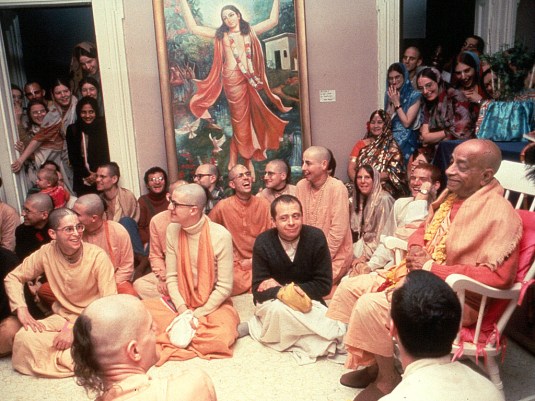
click on image to enlarge
…So Krsna and maya are side by side. As soon as you forget Krsna, or as soon as you want to utilize Krsna for your sense gratification, it is immediately maya, darkness. And as soon as you want to serve Krsna, immediately it is light. So if we keep ourself on this side, light side, always serving Krsna, then there is no possibility of our being in contact with maya.
“The Choice; Krishna Or Maya”
Srimad-Bhagavatam 1.2.18
August 21, 1972, Los Angeles
Pradyumna: (leads chanting, etc.)
nasta-prayesv abhadresu
nityam bhagavata-sevaya
bhagavaty uttama-sloke
bhaktir bhavati naisthiki
[SB 1.2.18]
Translation: “By regularly hearing the Bhagavatam and rendering service unto the pure devotee, all that is troublesome to the heart is practically destroyed, and loving service unto the glorious Lord, who is praised with transcendental songs, is established as an irrevocable fact.”
Prabhupada: So here it is said bhagavata-sevaya, not bhagavan-sevaya. Bhagavan is Krsna, the Supreme Personality of Godhead, and bhagavata means in relation with Bhagavan, who has got relationship with Bhagavan. So here it is recommended bhagavata-sevaya, not bhagavan-sevaya. The idea is that you cannot approach Bhagavan, God, directly. That is not possible. First of all, you have to serve bhagavata, the devotee bhagavata.
There are two kinds of bhagavata: book bhagavata and devotee bhagavata. So in the Siva Purana, there was a question by Parvati to Lord Siva. Lord Siva and Parvati, husband and wife. Parvati means the material nature. Srsti-sthiti-pralaya-sadhana-saktir eka chayeva yasya bhuvanani bibharti durga [Bs. 5.44]. Durga-devi. Durga-devi is in charge of this material world. It is called durga, durga, just like fort. And the superintendent of this fort is Durga. You cannot go out of this fort; you are imprisoned. So such Durga-devi, who is so powerful energy — she can create, annihilate, maintain, srsti-sthiti-pralaya-sadhana — she is always sitting by the side of her husband, Lord Siva, and questioning about spiritual enquiries. Just see. Such powerful deity is also ignorant about spiritual life. So the husband, Lord Siva, is Vaisnava, and she’s always asking, and sitting down underneath a bael tree. She can create so many universes, but for her, no building; only underneath a tree.
More
04 Jul 2012
by The Hare Krishna Movement
in Uncategorized
Tags: A.C. Bhaktivedanta Swami Prabhupada, Arjuna, as it is, bhagavad-gita, buddhi-yoga, chant the holy name of the Lord, constitution of the soul, Hare Krishna, karma, karma yoga, Krishna, krsna consciousness, material grief, philosophy of the soul, spiritual advancement, Sri Krsna, The Supreme Personality of Godhead
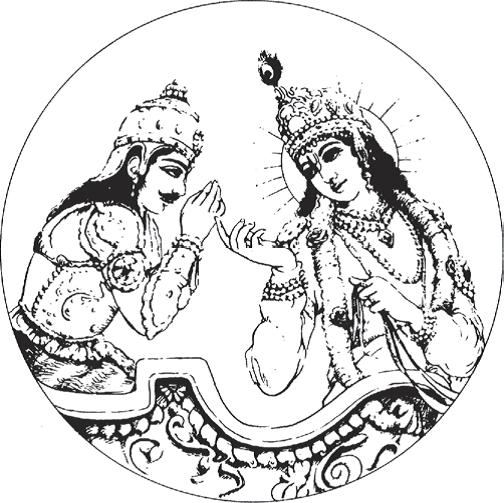
Bhagavad-gita As It Is – Macmillan 1972 Edition
By His Divine Grace A.C. Bhaktivedanta Swami Prabhupada
Chapter 3
TEXT 1
arjuna uvāca
jyāyasī cet karmaṇas te
matā buddhir janārdana
tat kiṁ karmaṇi ghore māṁ
niyojayasi keśava
arjunaḥ—Arjuna; uvāca—said; jyāyasī—speaking very highly; cet—although; karmaṇaḥ—than fruitive action; te—your; matā—opinion; buddhiḥ—intelligence; janārdana—O Kṛṣṇa; tat—therefore; kim—why; karmaṇi—in action; ghore—ghastly; mām—me; niyojayasi—engaging me; keśava—O Kṛṣṇa.
TRANSLATION
Arjuna said: O Janārdana, O Keśava, why do You urge me to engage in this ghastly warfare, if You think that intelligence is better than fruitive work?
PURPORT
The Supreme Personality of Godhead Śrī Kṛṣṇa has very elaborately described the constitution of the soul in the previous chapter, with a view to deliver His intimate friend Arjuna from the ocean of material grief. And the path of realization has been recommended: buddhi-yoga, or Kṛṣṇa consciousness. Sometimes Kṛṣṇa consciousness is misunderstood to be inertia, and one with such a misunderstanding often withdraws to a secluded place to become fully Kṛṣṇa conscious by chanting the holy name of Lord Kṛṣṇa. But without being trained in the philosophy of Kṛṣṇa consciousness, it is not advisable to chant the holy name of Kṛṣṇa in a secluded place where one may acquire only cheap adoration from the innocent public. Arjuna also thought of Kṛṣṇa consciousness or buddhi-yoga, or intelligence in spiritual advancement of knowledge, as something like retirement from active life and the practice of penance and austerity at a secluded place. In other words, he wanted to skillfully avoid the fighting by using Kṛṣṇa consciousness as an excuse. But as a sincere student, he placed the matter before his master and questioned Kṛṣṇa as to his best course of action. In answer, Lord Kṛṣṇa elaborately explained karma-yoga, or work in Kṛṣṇa consciousness, in this Third Chapter.
More
23 Jun 2012
by The Hare Krishna Movement
in Krishna Consciousness, Teachings of Queen Kunti
Tags: A.C. Bhaktivedanta Swami Prabhupada, back to Godhead, calamities, clamity, dangers, Krishna, Krishna consciousness, Krsna, kuntidevi, Let There Be Calamities, Queen Kunti, repetition of birth and death, Teachings of Queen Kunti, vipadah

…In this very interesting verse, it is described that vipadaḥ—calamities or dangers—are very good if such dangers and calamities remind us of Kṛṣṇa.
Here Kuntīdevī speaks of apunar bhava-darśanam. The prefix a means “not,” and punar bhava means “repetition of birth and death.” The real danger is the repetition of birth and death. That must be stopped.
As long as we are in this material world, there must be calamities because this is the place of calamity. But even with calamities our business should be to develop our Kṛṣṇa consciousness, so that after giving up this body we may go back home, back to Kṛṣṇa.
Teachings of Queen Kuntī
By His Divine Grace A. C. Bhaktivedanta Swami Prabhupāda
Chapter Eight
Let There Be Calamities
vipadaḥ santu tāḥ śaśvat
tatra tatra jagad-guro
bhavato darśanaṁ yat syād
apunar bhava-darśanam
I wish that all those calamities would happen again and again so that we could see You again and again, for seeing You means that we will no longer see repeated births and deaths. (Śrīmad-Bhāgavatam 1.8.25)
Generally, the distressed, the needy, the intelligent, and the inquisitive who have performed some pious activities worship or begin to worship the Lord. Others, who are thriving on misdeeds only, regardless of status, cannot approach the Supreme due to being misled by the illusory energy. Therefore, for a pious person, if there is some calamity there is no other alternative than to take shelter of the lotus feet of the Lord. Constantly remembering the lotus feet of the Lord means preparing for liberation from birth and death. Therefore, even though there are so-called calamities, they are welcome because they give us an opportunity to remember the Lord, which means liberation.
One who has taken shelter of the lotus feet of the Lord, which are accepted as the most suitable boat for crossing the ocean of nescience, can achieve liberation as easily as one leaps over the holes made by the hooves of a calf. Such persons are meant to reside in the abode of the Lord, and they have nothing to do with a place where there is danger in every step.
More
Previous Older Entries Next Newer Entries












 The Hare Krishna Movement