04 May 2014
by The Hare Krishna Movement
in A.C. Bhaktivedanta Swami Prabhupada, Bhagavad-gita, Demigod, Durga, Srimad Bhagavatam
Tags: A. C. Bhaktivedanta Swami Prabhuada, Bg 9.10, Durga, goddess Parvati, Krishna, Krsna, Lord Siva, material nature, Siva, the goddess durga
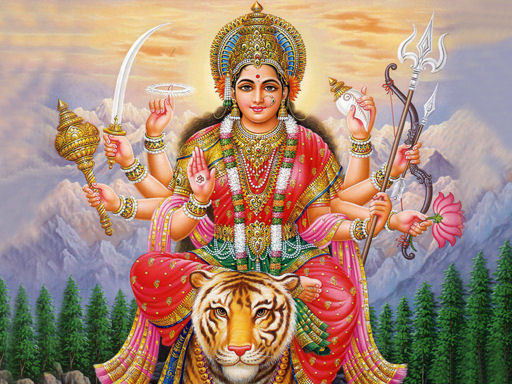
This morning, the above picture of the Goddess Durga crossed my desk, so I thought I would do a short post on Her. After some research in Srila Prabhupada’s books it is described: “Following the orders of Śrī Kṛṣṇa, the goddess Durgā creates, maintains and annihilates…Because the goddess Durgā satisfies Kṛṣṇa, we should therefore offer respects to goddess Durgā.” As devotees there is no need to worship the demigods, but because the demigods are also servants of Lord Krishna, we offer them our respect.
…Durgā—the goddess Pārvatī, the wife of Lord Śiva—is extremely powerful. She can create, maintain and annihilate any number of universes by her sweet will, but she acts under the direction of the Supreme Personality of Godhead, Kṛṣṇa, not independently. Kṛṣṇa is impartial, but because this is the material world of duality, such relative terms as happiness and distress, curses and favors, are created by the will of the Supreme. Those who are not nārāyaṇa-para, pure devotees, must be disturbed by this duality of the material world, whereas devotees who are simply attached to the service of the Lord are not at all disturbed by it. For example, Haridāsa Ṭhākura was beaten with cane in twenty-two bazaars, but he was never disturbed; instead, he smilingly tolerated the beating. Despite the disturbing dualities of the material world, devotees are not disturbed at all. Because they fix their minds on the lotus feet of the Lord and concentrate on the holy name of the Lord, they do not feel the so-called pains and pleasures caused by the dualities of this material world. (from purport SB 6.17.29)
This material nature is working under My direction, O son of Kuntī, and it is producing all moving and unmoving beings. By its rule this manifestation is created and annihilated again and again. (Bg 9.10)
More
30 Apr 2014
by The Hare Krishna Movement
in A.C. Bhaktivedanta Swami Prabhupada, Bhagavad-gita
Tags: A.C. Bhaktivedanta Swami Prabhupada, Arjuna, as it is, Bhagavad Gita, bhagavad-gita, Bhaktivedanta purports, Krishna, Sri Bhagavan uvaca, the Supreme Personality of Godhead said

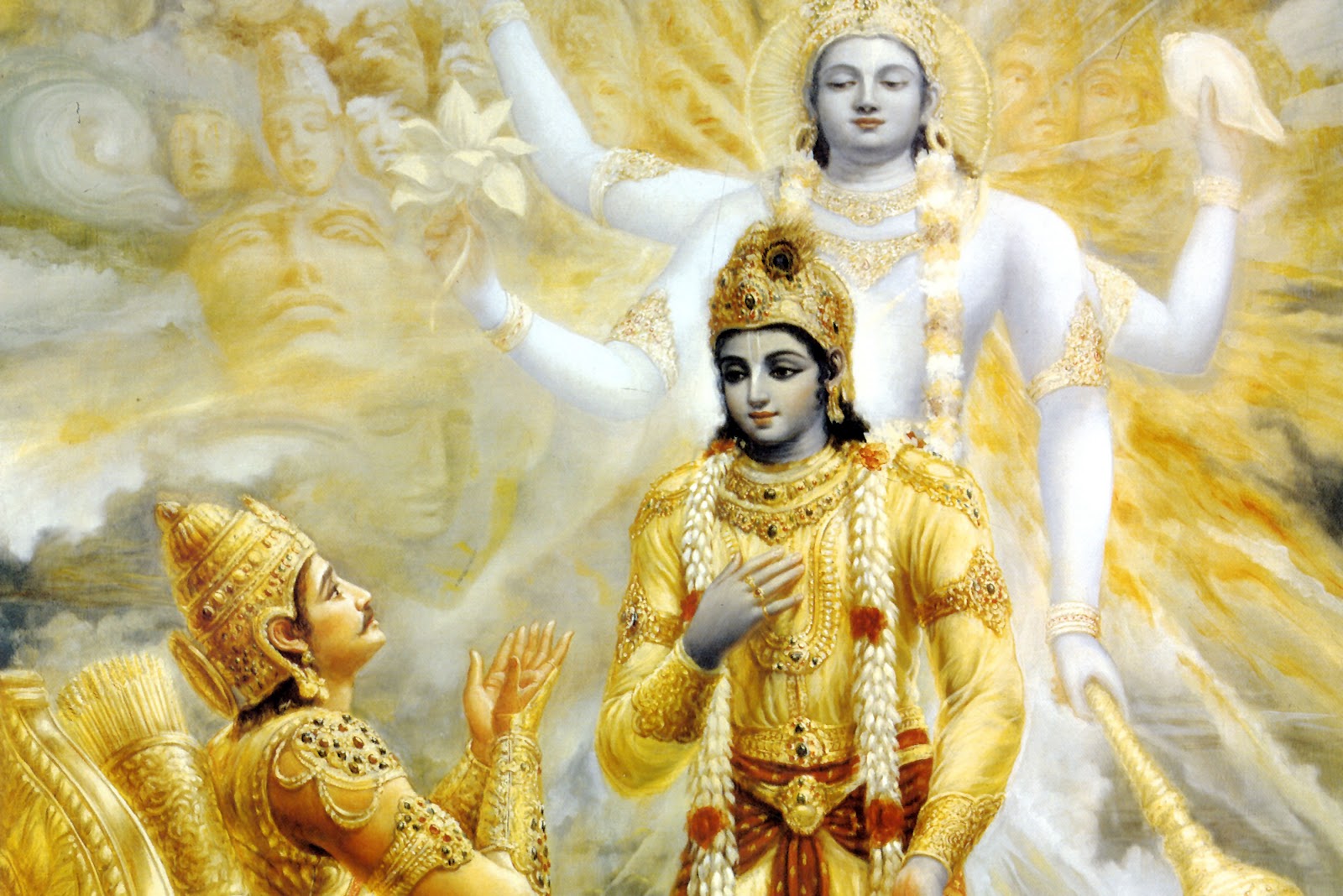
After the introduction chapter [Observing the Armies on the Battlefield of Kurukṣetra] to the Bhagavad-gita As It Is, Krishna begins His instructions to Arjuna:
The Supreme Person [Bhagavān] said: My dear Arjuna, how have these impurities come upon you? They are not at all befitting a man who knows the progressive values of life. They do not lead to higher planets, but to infamy.
O son of Pṛthā, do not yield to this degrading impotence. It does not become you. Give up such petty weakness of heart and arise, O chastiser of the enemy.
Full text and purport More
18 Mar 2014
by The Hare Krishna Movement
in A.C. Bhaktivedanta Swami Prabhupada, Bhagavad-gita, Krishna, Krishna Consciousness
Tags: A.C. Bhaktivedanta Swami Prabhupada, avajanati mam mudha, bhagavad-gita, fools, fools deride my transcendental nature, human being, human form, Krishna, Krsna, mudha, supreme dominion, the supreme personality, transcendental nature

This morning I was reading from the Srimad-Bhagavatam and the purport directed my attention to the verse from the Bhagavad-gita; “Fools deride Me when I descend in the human form. They do not know My transcendental nature and My supreme dominion over all that be.. So I went to the Bhagavad-gita and read again this very important verse and purport, and we share it with you today…
…it is clear that the Supreme Personality of Godhead, although appearing like a human being, is not a common man. The Personality of Godhead, who conducts the creation, maintenance and annihilation of the complete cosmic manifestation, cannot be a human being. Yet there are many foolish men who consider Kṛ,sṇa to be merely a powerful man and nothing more. Actually, He is the original Supreme Personality, as is confirmed in the Brahma-saṁhitā (iśvaraḥ paramaḥ kṛsṇaḥ); He is the Supreme Lord. (from purport Bg.9.11)
full text and purport More
12 Feb 2014
by The Hare Krishna Movement
in A.C. Bhaktivedanta Swami Prabhupada, Krsna Consciousness, The Hare Krishna Movement
Tags: A.C. Bhaktivedanta Swami Prabhupada, Absolute Truth, age of kali, blissful consciousness, bona fide spiritual science, chant the holy names of the Lord, eternal spirit souls, Founder Acarya, genuine spiritual master, Hare Hare, Hare Krishna, Hare Rama, International Society for Krishna Consciousness, Krishna, Krishna Krishna, love of God, sense gratification, Vedic knowledge
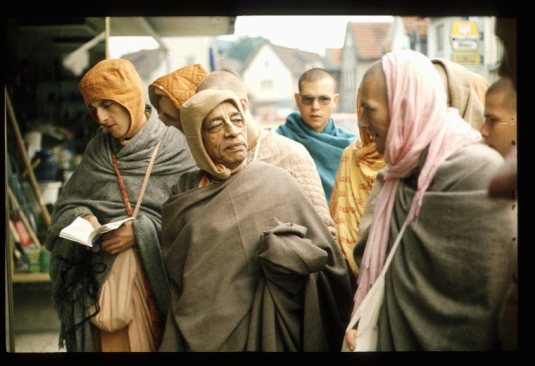
A Short Statement of the Philosophy of Krishna Consciousness
By His Divine Grace A.C. Bhaktivedanta Swami Prabhupada
Founder-Acarya of the International Society for Krishna Consciousness
More
17 Dec 2013
by The Hare Krishna Movement
in A.C. Bhaktivedanta Swami Prabhupada, Nectar of Instruction, Rupa Goswami
Tags: A.C. Bhaktivedanta Swami Prabhupada, absolute beauty, absoulte truth, bliss, Krishna, krsna-nama, Nectar of Instruction, qualities name and form, Rupa Sosvami, Text 7, the holy name of krsna, Upadesamrta

Continuing with our series on the Nectar of Iststuction (Upadeśāmṛta), we are posting Text 7, the very important instructions given by Śrīla Rūpa Gosvāmī on chanting the holy names of the Lord.
The holy name, character, pastimes and activities of Kṛṣṇa are all transcendentally sweet like sugar candy. Although the tongue of one afflicted by the jaundice of avidyā [ignorance] cannot taste anything sweet, it is wonderful that simply by carefully chanting these sweet names every day, a natural relish awakens within his tongue, and his disease is gradually destroyed at the root.
full text and purport More
12 Dec 2013
by The Hare Krishna Movement
in A.C. Bhaktivedanta Swami Prabhupada, Bhagavad-gita, Bhagavad-gita As It Is 1972 Edition, Gita Jayanti
Tags: A.C. Bhaktivedanta Swami Prabhupada, Advent of Bhagavad-gita, Arjuna, as it is, bhagavad-gita, ekadasi, gita jayanti, Krishna, Krsna, Original 1972 Edition, prabhupada gita, Srimad Bhagavad-gita

So today is The Advent of Srimad Bhagavad-gita; Gita Jayanti. It is celebrated on the Ekadasi, 11th day of the waxing moon of Margashirsha month (November-December). I just so happens, that today is also Christmas Day. So merry Christmas to all.
In honor of this day, Gita Jayntia, we present the Complete 1972 Edition of the Bhagavad-gita As It Is, by His Divine Grace A.C. Bhaktivedanta Swami in the PDF format for you to read or save to your computer. Also we include a link to our other page Prabhupadagita Where you can read the entire book online a chapter at a time with the original illustrations.
click on links below:
More
24 Nov 2013
by The Hare Krishna Movement
in A.C. Bhaktivedanta Swami Prabhupada, Chanting Hare Krishna
Tags: always chant, chanting Hare Krishna, chanting of the holy name of Lord Visnu, Hare Hare, Hare Krishna, Hare Rama, Krishna, Lord Visnu

The following are a few select excerpts on the importance of chanting Hare Krishna. Even if there is still some offence, our chanting should not be abandoned, but rather continued day and night.
Simply our prayer should be, My dear Krishna, please remind me to always chant Your Holy Name, please do not put me into forgetfulness. You are sitting within me as Supersoul, so you can put me into forgetfulness or into remembering You. So please do not put me into forgetfulness. Please always remind me to chant, even You send me into the hell, it doesn’t matter, just so long as I can always chant Hare Krishna. (letter to Devananda, Nov. 23, 1968)
The chanting of the holy name of Lord Viṣṇu is the best process of atonement for a thief of gold or other valuables, for a drunkard, for one who betrays a friend or relative, for one who kills a brāhmaṇa, or for one who indulges in sex with the wife of his guru or another superior. It is also the best method of atonement for one who murders women, the king or his father, for one who slaughters cows, and for all other sinful men. Simply by chanting the holy name of Lord Viṣṇu, such sinful persons may attract the attention of the Supreme Lord, who therefore considers, “Because this man has chanted My holy name, My duty is to give him protection.” (Srimad Bhagavatam 6.2.9-10)
“I do not find the strength to carry on alone the sankirtana of the holy name of Hari. Please bless me by giving me just one drop of faith with which to obtain the great treasure of the holy name of Krsna.
Krsna is yours. You have the power to give Him to me. I am simply your servant running behind you shouting, “Krsna! Krsna!” (Ohe! Vaisnava Thakrua-Srila Bhaktivinoda Thakur)
More
10 Nov 2013
by The Hare Krishna Movement
in A.C. Bhaktivedanta Swami Prabhupada, Cow Protection, Festivals, Gopastami, KRSNA The Supreme Personality of Godhead
Tags: A.C. Bhaktivedanta Swami Prabhupada, Balarama, childhood age known as kaumara, cowherd boy, gopa, gopastami, gosthastami, Krishna, Krsna, Krsna Book, pauganda, The killing of Dhenukasura, vaisnava calender, Vrndavan

Please click on image to enlarge
Today on the Vaisnava Calender marks the day known as Gopastami or Gosthastami. On this day lord Sri Krishna became a qualified cowherd and took the cows out to Govardhana to graze. Previously He was the keeper of the calves. It was on this day that He became a gopa, or cowherd boy.
In this way, Śrī Kṛṣṇa, along with His elder brother Balarāma, passed the childhood age known as kaumāra and stepped into the age of paugaṇḍa, from the sixth year up to the tenth. At that time, all the cowherd men conferred and agreed to give those boys who had passed their fifth year charge of the cows in the pasturing ground. Given charge of the cows, Kṛṣṇa and Balarāma traversed Vṛndāvana, purifying the land with Their footprints.
…When Kṛṣṇa, Balarāma and Their friends entered the village of Vṛndāvana, They played Their flutes, and the boys praised Their uncommon activities in the forest. Their faces were decorated with tilaka and smeared with the dust raised by the cows, and Kṛṣṇa’s head was decorated with a peacock feather. Both He and Balarāma played Their flutes, and the young gopīs were joyous to see Kṛṣṇa returning home. All the gopīs in Vṛndāvana remained very morose on account of Kṛṣṇa’s absence. All day they were thinking of Kṛṣṇa in the forest or of Him herding cows in the pasture. When they saw Kṛṣṇa returning, all their anxieties were immediately relieved, and they began to look at His face the way drones hover over the honey of the lotus flower. When Kṛṣṇa entered the village, the young gopīs smiled and laughed. Kṛṣṇa, while playing the flute, enjoyed the beautiful smiling faces of the gopīs. (from Kṛṣṇa, the Supreme Personality of Godhead, Chapter 15)
To honor this day we are posting some further childhood pastimes of Sri Krishna from the Kṛṣṇa Book entitled “The Killing of Dhenukāsura”
Full Chapter More
28 Oct 2013
by The Hare Krishna Movement
in A.C. Bhaktivedanta Swami Prabhupada, Bhagavad-gita, Krishna Consciousness, Krsna Consciousness
Tags: 1972 Edition, A.C. Bhaktivedanta Swami Prabhupada, Arjuna, Bhagavad-gita As It Is, bhava, devotee, essintial part of knowledge, friend of krsna, Krishna, krsna consciousness, man manah, official meditator, the most confidential part of knowledge
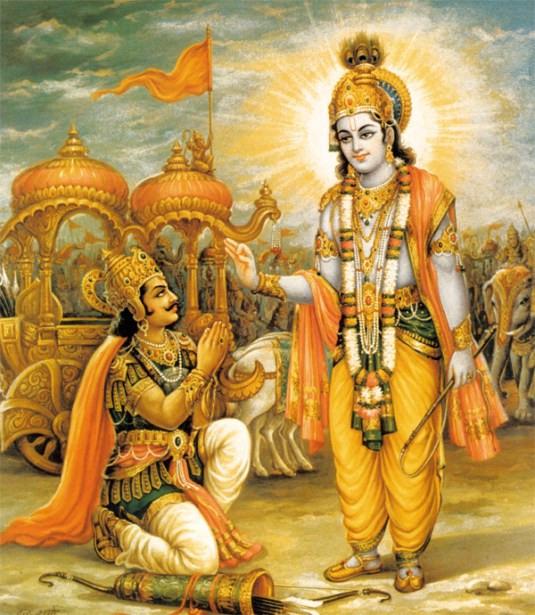
Because you are My very dear friend, I am speaking to you the most confidential part of knowledge. Hear this from Me, for it is for your benefit.
Always think of Me and become My devotee. Worship Me and offer your homage unto Me. Thus you will come to Me without fail. I promise you this because you are My very dear friend.
…”Just always think of Me.”…This is the most important instruction in all Vedic literature. What Kṛṣṇa is saying in this connection is the most essential part of knowledge, and it should be carried out not only by Arjuna but by all living entities.
…The most confidential part of knowledge is that one should become a pure devotee of Kṛṣṇa and always think of Him and act for Him. One should not become an official meditator. Life should be so molded that one will always have the chance to think of Kṛṣṇa. One should always act in such a way that all his daily activities are in connection with Kṛṣṇa. He should arrange his life in such a way that throughout the twenty-four hours he cannot but think of Kṛṣṇa. And the Lord’s promise is that anyone who is in such pure Kṛṣṇa consciousness will certainly return to the abode of Kṛṣṇa, where he will be engaged in the association of Kṛṣṇa face to face. This most confidential part of knowledge is spoken to Arjuna because he is the dear friend of Kṛṣṇa. Everyone who follows the path of Arjuna can become a dear friend to Kṛṣṇa and obtain the same perfection as Arjuna.
More
26 Oct 2013
by The Hare Krishna Movement
in A.C. Bhaktivedanta Swami Prabhupada, Damodara, KRSNA The Supreme Personality of Godhead
Tags: A.C. Bhaktivedanta Swami Prabhupada, Bhaktivedanta purport, Dhara, Drona, gopis, Krishna, krishna pastimes, Krsna, Krsna Book, Lord Balarama, Lord Damodara, Lord Krishna, month of Kartika, Mother Yasoda, Nanda Maharaja, residents of Vrndavana, SB 10.8, transcendental pleasure, Vision of the Universal Form
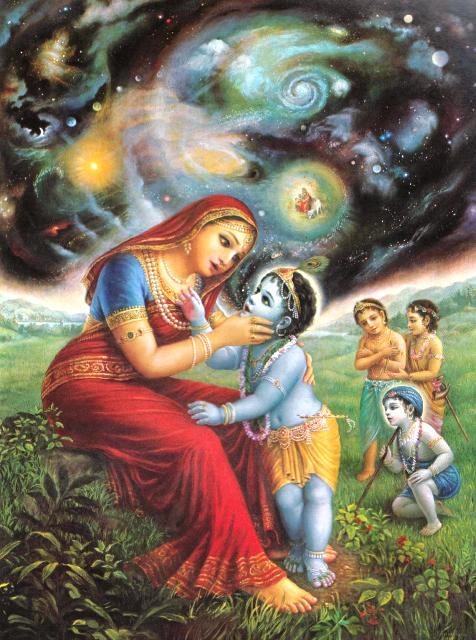
…continuing with our attempt to post Krsna’s childhood pastimes, throughout the duration of the “Month of Damodara”
…Another day, when Kṛṣṇa and Balarāma were playing with Their friends, all the boys joined Balarāma and told mother Yaśodā that Kṛṣṇa had eaten clay. On hearing this, mother Yaśodā caught hold of Kṛṣṇa’s hand and said, “My dear Kṛṣṇa, why have You eaten earth in a solitary place? Just see, all Your friends including Balarāma are complaining about You.” Being afraid of His mother, Kṛṣṇa replied, “My dear mother, all these boys, including My elder brother Balarāma, are speaking lies against Me. I have never eaten clay. My elder brother Balarāma, while playing with Me today, became angry, and therefore He has joined with the other boys to complain against Me. They have all combined together to complain so you will be angry and chastise Me. If you think they are truthful, then you can look within My mouth to see whether I have taken clay or not.” His mother replied, “All right, if You have actually not taken any clay, then just open Your mouth. I shall see.”
More
24 Oct 2013
by The Hare Krishna Movement
in A.C. Bhaktivedanta Swami Prabhupada, Damodara, KRSNA The Supreme Personality of Godhead, Srimad Bhagavatam
Tags: A.C. Bhaktivedanta Swami Ppabhupada, Balarama, butter, cows, Dear Yasoda, Krishna, Krsna Book, Krsna's childhood pastimes, milk, naughty childish activities of Krsna and Balarama in Vrndavan, naughty Krsna, Rohini, steal butter, Yasoda, yogurt

…All the gopī friends of Yaśodā and Rohiṇī enjoyed the naughty childish activities of Kṛṣṇa and Balarāma in Vṛndāvana. In order to enjoy further transcendental bliss, they all assembled and went to mother Yaśodā to lodge complaints against the restless boys. When Kṛṣṇa was sitting before mother Yaśodā, all the elderly gopīs began to lodge complaints against Him so that Kṛṣṇa could hear. They said, “Dear Yaśodā, why don’t you restrict your naughty Kṛṣṇa? He comes to our houses along with Balarāma every morning and evening, and before the milking of the cows They let loose the calves, and the calves drink all the milk of the cows. So when we go to milk the cows, we find no milk, and we have to return with empty pots. If we warn Kṛṣṇa and Balarāma about doing this, They simply smile charmingly. (Krsna Book Chapter 8)
…continuing with our attempt to post Krsna’s childhood pastimes, throughout the duration of the “Month of Damodara”
More
23 Oct 2013
by The Hare Krishna Movement
in A.C. Bhaktivedanta Swami Prabhupada, Damodara, Krishna Consciousness, KRSNA The Supreme Personality of Godhead, Srimad Bhagavatam
Tags: A.C. Bhaktivedanta Swami Prabhupada, Balarama, clay and saffron, Damodara, gopis, Krishna, Krsna, Krsna The Supreme Personality of Godhead, Lord Damodara, naughty babies, Rohini, sandalwood pulp, Yasoda

Within the house of Nanda Mahārāja, the cowherd ladies would enjoy seeing the pastimes of the babies Rāma and Kṛṣṇa. The babies would catch the ends of the calves’ tails, and the calves would drag Them here and there. When the ladies saw these pastimes, they certainly stopped their household activities and laughed and enjoyed the incidents. (SB 10.8.24)
These childhood pastimes of Krsna are so sublime and pleasing to the consciousness. We will continue to post Krsna’s childhood pastimes throughout the duration of the “Month of Damodara”.
…both Balarāma and Kṛṣṇa began to crawl on Their hands and knees. When They were crawling like that, They pleased Their mothers. The bells tied to Their waist and ankles sounded fascinating, and They would move around very pleasingly. Sometimes, just like ordinary children, They would be frightened by others and would immediately hurry to Their mothers for protection. Sometimes They would fall into the clay and mud of Vṛndāvana and would approach Their mothers smeared with clay and saffron. They were actually smeared with saffron and sandalwood pulp by Their mothers, but due to crawling over muddy clay, They would simultaneously smear Their bodies with clay. As soon as They would come crawling to Their mothers, Yaśodā and Rohiṇī would take Them on their laps and, covering the lower portion of their saris, allow Them to suck their breasts. When the babies were sucking their breasts, the mothers would see small teeth coming in. Thus their joy would be intensified to see their children grow. Sometimes the naughty babies would crawl up to the cowshed, catch the tail of a calf and stand up. The calves, being disturbed, would immediately begin running here and there, and the children would be dragged over clay and cow dung. To see this fun, Yaśodā and Rohiṇī would call all their neighboring friends, the gopīs. Upon seeing these childhood pastimes of Lord Kṛṣṇa, the gopīs would be merged in transcendental bliss. In their enjoyment they would laugh very loudly. (excerpted from Krsna Book Chapter 8)
Also from the Srimad Bhagavatam More
15 Oct 2013
by The Hare Krishna Movement
in A.C. Bhaktivedanta Swami Prabhupada, Bhagavad-gita As It Is 1972 Edition, Book Changes, Books by Srila Prabhupada
Tags: Arjuna, as it is, bhagavad-gita, Bhagavad-gita As It Is, book changes, complete 1972 edition, Krishna, original Bhagavad-gita, Prabhupada books, prabhupadagita, Srila Prabhupada's books

click on image to visit site
More
10 Oct 2013
by The Hare Krishna Movement
in A.C. Bhaktivedanta Swami Prabhupada
Tags: A.C. Bhaktivedanta Swami Prabhupada, Arjuna, as it is, Bhagavad-gita As It Is, Brahma, Candra, demigods, faith, goodness, ignorance, Indra, Krishna, krsna consciousness, passion, sattva, Siva, Spiritual Life, Srila Prabhupada, sun-god, The Divisions of Faith, Visnu

click on image to enlarge
Bhagavad-gītā As It Is 1972 Edition
by His Divine Grace A. C. Bhaktivedanta Swami Prabhupāda
Chapter Seventeen
The Divisions of Faith
More
08 Oct 2013
by The Hare Krishna Movement
in A.C. Bhaktivedanta Swami Prabhupada, Back to Godhead, Bhagavad-gita
Tags: A.C. Bhaktivedanta Swami Prabhupada, Arjuna, as it is, bhagavad-gita, Bhaktivedanta purports, Krishna, Lord Krsna, mental agonies, Puranas, Srila Prabhupada, Srimad Bhagavatam, Upanisads, Vedanta-sutras, Vedic literatures, Vedic wisdom

1973 Back to Godhead cover
This morning I was reading from the Srimad Bhagavatam Canto 1, Chapter 15, Text 27, wherein Srila Prabhupada was describing the glories and importance of the the Bhagavad-gita As It Is. The following is some excerpts from this amazing purport, followed by full text and purport. I found this one purport to be a very nice synopsis of the entire Bhagavad-gita As It Is.
…The Lord left behind Him the instructions of the Bhagavad-gītā not for the benefit of Arjuna alone, but also for all time and in all lands. The Bhagavad-gītā, being spoken by the Supreme Personality of Godhead, is the essence of all Vedic wisdom. It is nicely presented by the Lord Himself for all who have very little time to go through the vast Vedic literatures like the Upaniṣads, Purāṇas and Vedānta-sūtras.
…the Bhagavad-gītā can be consulted in all critical times, not only for solace from all kinds of mental agonies, but also for the way out of great entanglements which may embarrass one in some critical hour.
…The merciful Lord left behind Him the great teachings of the Bhagavad-gītā so that one can take the instructions of the Lord even when He is not visible to material eyesight.
…There is no difference between the sound representation of the Lord and the Lord Himself. One can derive the same benefit from the Bhagavad-gītā as Arjuna did in the personal presence of the Lord.
…The Bhagavad-gītā begins with the problems of life by discriminating the soul from the elements of matter and proves by all reason and argument that the soul is indestructible in all circumstances and that the outer covering of matter, the body and the mind, change for another term of material existence which is full of miseries. The Bhagavad-gītā is therefore meant for terminating all different types of miseries, and Arjuna took shelter of this great knowledge, which had been imparted to him during the Kurukṣetra battle. (from Purport to SB 1.15.27)
Full verse and purport More
06 Oct 2013
by The Hare Krishna Movement
in A.C. Bhaktivedanta Swami Prabhupada, Bhagavad-gita, Dasya (Friendship), Srimad Bhagavatam
Tags: A.C. Bhaktivedanta Swami Prabhupada, Arjuna, awe and reverence, conjugal love, dasya, friendship, God is great, Krishna, neutral stage, parental affection, sakhya, santa-rasa, servitude, srngara, vatsalya

There are five basic relationships a devotee might have with the Lord; namely in the neutral stage (sānta-rasa), which is the stage of awe and reverence. Knowing that God is Great. Then there are four transcendental mellows (rasas); servitude (dāsya), friendship (sakhya), parental affection (vātsalya) and conjugal love (śṛṅgāra).
Kṛṣṇa and Arjuna are related in friendship.
Arjuna was in a relationship with the Lord as friend. Of course there is a gulf of difference between this friendship and the friendship found in the material world. This is transcendental friendship which cannot be had by everyone. Of course everyone has a particular relationship with the Lord, and that relationship is evoked by the perfection of devotional service. But in the present status of our life, we have not only forgotten the Supreme Lord, but we have forgotten our eternal relationship with the Lord. Every living being, out of many, many billions and trillions of living beings, has a particular relationship with the Lord eternally. That is called svarūpa. By the process of devotional service, one can revive that svarūpa, and that stage is called svarūpa-siddhi-perfection of one’s constitutional position. So Arjuna was a devotee, and he was in touch with the Supreme Lord in friendship. (from Introduction to Bhagavad-gita As It Is)
The following verse is one of my most favorite from the Bhagavad-gita As It Is.
I have in the past addressed You as “O Kṛṣṇa,” “O Yādava,” “O my friend,” without knowing Your glories. Please forgive whatever I may have done in madness or in love. I have dishonored You many times while relaxing or while lying on the same bed or eating together, sometimes alone and sometimes in front of many friends. Please excuse me for all my offenses.
I find this verse to be a beautiful expression of what is Bhakti Yoga. It is a personal loving exchange with the Lord. There are two ways to approach the Lord. One can approach the Lord with awe and reverence (sānta-rasa), or with a more personal approach; love and affection.
Kṛṣṇa’s devotees relate to Kṛṣṇa in various relationships.. Kṛṣṇa and Arjuna are related in friendship. As the father tolerates, or the husband or master tolerates, so Kṛṣṇa tolerates. Very Beautiful!
Bhagavad-gita As It Is Texts 40-45 More
01 Oct 2013
by The Hare Krishna Movement
in A.C. Bhaktivedanta Swami Prabhupada, Devotional Service, Teachings of Lord Kapila
Tags: A.C. Bhaktivedanta Swami Prabhupada, bhakti, Bharatavarsa, devotional service, hearing and chanting, India, Kapila, Krishna, Krsna, nine processes of devotional service, parampara system, sravanam kirtanam visnoh, Teachings of Lord Kapila, the son of devahuti, the supreme Lord

…We can understand the pastimes of the Lord by following one or some of the authorized devotional processes.
śravaṇaṁ kīrtanaṁ viṣṇoḥ
smaraṇaṁ pāda-sevanam
arcanaṁ vandanaṁ dāsyaṁ
sakhyam ātma-nivedanam
[SB 7.5.23]
“Hearing, chanting and remembering the holy name, form, pastimes, qualities and entourage of the Lord, offering service according to the time, place and performer, worshiping the Deity, offering prayers, always considering oneself the eternal servant of Kṛṣṇa, making friends with Him and dedicating everything unto Him—these are the nine processes of devotional service.” (Bhāg. 7.5.23)
…hearing and chanting, are the beginning of bhakti, devotional service. Therefore it is said: tāni me śraddadhānasya kīrtanyāny anukīrtaya. The word anukīrtaya means to follow the paramparā system… The Supreme Lord is more anxious to give us education and enlightenment than we are to receive them. He gives us His literature, His devotees and the paramparā system, but it is up to us to take advantage of these. The Kṛṣṇa consciousness movement is intended to give society the proper understanding of the Absolute Truth. We are not presenting a manufactured, bogus philosophy. Why should we unnecessarily waste our time concocting some philosophy? There is so much to be learned that has already been given by the supreme authority. All we have to do is take this Vedic literature, try to learn it and distribute it. That is Caitanya Mahāprabhu’s mission.
Teachings of Lord Kapila, the Son of Devahūti
By His Divine Grace A. C. Bhaktivedanta Swami Prabhupāda
Chapter Three, Text 3
Full chapter More
30 Sep 2013
by The Hare Krishna Movement
in A.C. Bhaktivedanta Swami Prabhupada, Krishna Consciousness, Krsna Consciousness, KRSNA The Supreme Personality of Godhead
Tags: A.C. Bhaktivedanta Swami Prabhupada, Dwarka, Jarasandha, Kamsa, king jarasandha, kingdom of Mathura, Krishna, Krsna, Krsna erects the Dvaraka fort, Krsna The Supreme Personality of Godhead, military strength capital of the Yadu kings, Sri Krishna, Vedic civilization

click on image to enlarge
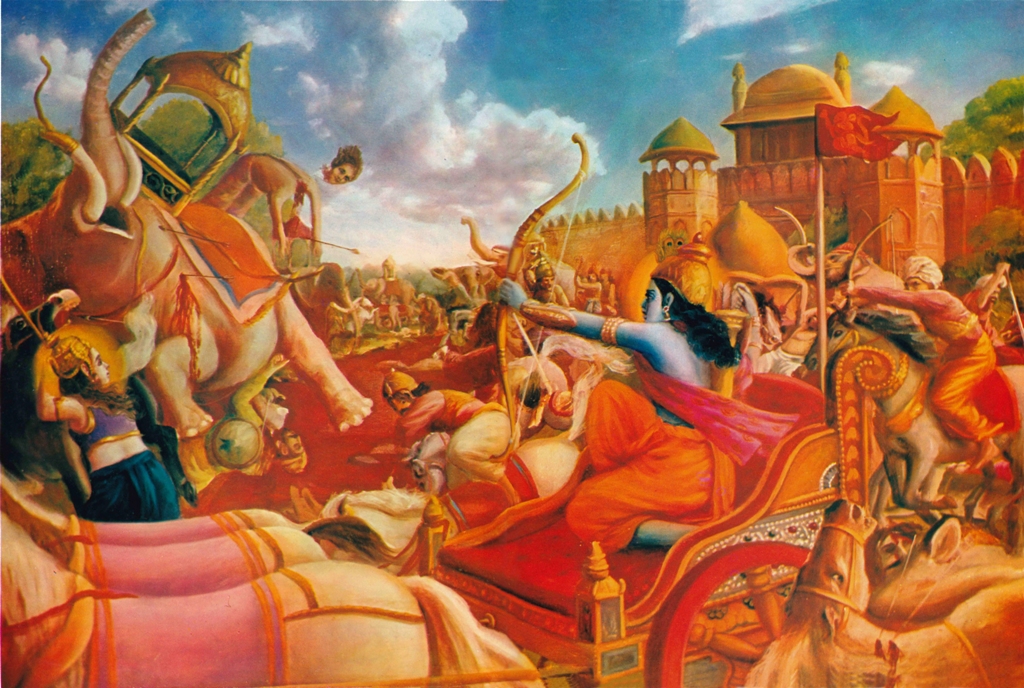
I often lament that as a child growing up my hero’s were fictional characters, like Flash Gordan and Superman, without any Krsna Consciousness. And I often think how fortunate are the children who grew up instead with stories from the Krsna Book, or the Mahabharata. With great battle scenes, real drama, and romance. Not just fictional stories but eternal pastimes of the Lord and His devotees. Here is one such example:
…In order to fight with Kṛṣṇa, Jarāsandha surrounded Him from all sides with great military strength, and the sun appeared covered by the cloudy air and dust. Similarly, Kṛṣṇa, the supreme sun, was covered by the military strength of Jarāsandha. Kṛṣṇa’s and Balarāma’s chariots were marked with pictures of Garuḍa and palm trees. The women of Mathurā were all standing on the tops of the houses and palaces and gates to see the wonderful fight, but when Kṛṣṇa’s chariot was surrounded by Jarāsandha’s military force, they became so frightened that some of them fainted. Kṛṣṇa saw Himself overwhelmed by the military strength of Jarāsandha. His small number of soldiers was being harassed by them, so He immediately took up His bow, named Śārṅga.
He began to take His arrows from their case, and one after another He set them on the bowstring and shot them toward the enemy. They were so accurate that the elephants, horses and infantry soldiers of Jarāsandha were quickly killed. The incessant arrows thrown by Kṛṣṇa appeared as a whirlwind of blazing fire killing all the military strength of Jarāsandha.
Wow!
Kṛṣṇa, the Supreme Personality of Godhead 1970 Edition
By His Divine Grace A. C. Bhaktivedanta Swami Prabhupāda
Chapter Fifty
Full Chapter More
29 Sep 2013
by The Hare Krishna Movement
in A.C. Bhaktivedanta Swami Prabhupada, Divine and Demoniac Natures
Tags: 1972 Edition, A.C. Bhaktivedanta Swami Prabhupada, Arjuna, as it is, austerity, Bhagavad-gita As It Is, charity, cultivation of spiritual knowledge, Demoniac, Divine, Fearlessness, Krishna, performance of sacrifice, purification of one’s existence, self-control, Sri Bhagavan uvaca, study of the Vedas, the blessed Lord said, the divine and demoniac natures

Bhagavad-gītā As It Is 1972 Edition
By His Divine Grace A. C. Bhaktivedanta Swami Prabhupāda
Chapter Sixteen
More
25 Sep 2013
by The Hare Krishna Movement
in A.C. Bhaktivedanta Swami Prabhupada, Bhagavad-gita, Krsna Consciousness, Spiritual Life, Yoga
Tags: A.C. Bhaktivedanta Swami Prabhupada, Arjuna, as it is, Bg. 6.29, Bg. 6.30, bhagavad-gita, bhakti yoga, Krishna, Krishna consciousness, krsna conscious yogi, love of God, self realization, true yogi, yoga, yogi
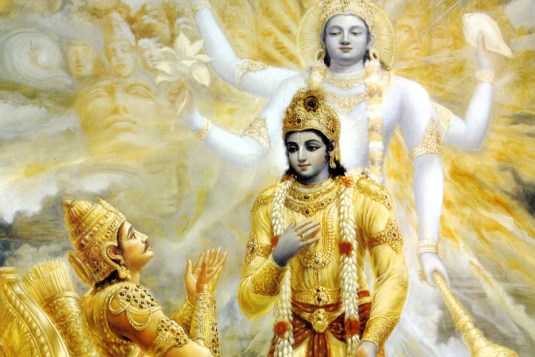
Please click on image to enlarge
A true yogī observes Me in all beings, and also sees every being in Me. Indeed, the self-realized man sees Me everywhere. (Bg. 6.29)
For one who sees Me everywhere and sees everything in Me, I am never lost, nor is he ever lost to Me. (Bg. 6.30)
…A person in Kṛṣṇa consciousness certainly sees Lord Kṛṣṇa everywhere, and he sees everything in Kṛṣṇa…Nothing can exist without Kṛṣṇa, and Kṛṣṇa is the Lord of everything—this is the basic principle of Kṛṣṇa consciousness.
…Kṛṣṇa consciousness is the development of love of Kṛṣṇa—a position transcendental even to material liberation. (from purport to Bg.6.30)
Bhagavad-gita As It Is 1972 Edition
By His Divine Grace A.;C. Bhaktivedanta Swami Prabhupada
Chapter 6, Text 29-30
Full Text and Purports More
Previous Older Entries Next Newer Entries










 The Hare Krishna Movement