08 Mar 2013
by The Hare Krishna Movement
in A.C. Bhaktivedanta Swami Prabhupada, Bhagavad-gita, Om
Tags: A.C. Bhaktivedanta Swami Prabhupada, bhakti yoga, chanting Hare Krishna, mama om visnu-padaya, meditation, Om, om ajnana-timirandhasya, om namo bhagavate vasudevaya, om tat sat, omkara, syllable om, The Syllable Om, yoga

The Syllable Om
Many years ago as a young aspiring yogi, and with my very first attempts at meditation, I began my practice with the sacred syllable Om. Many years later and although I may have advanced somewhat spiritually, and practice bhakti-yoga, devotional service and the chanting of the Maha-mantra Hare Krishna, Hare Krishna, Krishna Krishna, Hare Hare, still all my morning prayers still begin with the syllable Om. Such as “om namo bhagavate vasudevaya” before my reading of the Srimad Bhagavatam. And my morning offering of respectful obeisances to my spiritual master Srila Prabhupada with the prayer “om ajñāna-timirāndhasya jñānāñjana-śalākayā, cakṣur unmīlitaṁ yena tasmai śrī-gurave namaḥ” and “nama oṁ viṣṇu-pādāya kṛṣṇa-preṣṭhāya bhū-tale,śrīmate bhaktivedānta-svāmin iti nāmine”. Today we are looking at a few slokas from the Bhagavad-gita where the syllable Om is used.
More
06 Mar 2013
by The Hare Krishna Movement
in A.C. Bhaktivedanta Swami Prabhupada, Spiritual Life, Spiritual Master, Srimad Bhagavatam, Sukadeva Goswami
Tags: A.C. Bhaktivedanta Swami Prabhupada, at the time of death, dying man, great master, guru, Maharaja Pariksit, spiritual master, Srimad Bhagavatam, Sukadeva Gosvami, thesis of Srimad Bhagavatam

You are the spiritual master of great saints and devotees. I am therefore begging you to show the way of perfection for all persons, and especially for one who is about to die.
Please let me know what a man should hear, chant, remember and worship, and also what he should not do. Please explain all this to me.
Unless one is perfectly anxious to inquire about the way of perfection, there is no necessity of approaching a spiritual master. A spiritual master is not a kind of decoration for a householder. Generally a fashionable materialist engages a so-called spiritual master without any profit. The pseudo- spiritual master flatters the so-called disciple, and thereby both the master and his ward go to hell without a doubt. Mahārāja Parīkṣit is the right type of disciple because he puts forward questions vital to the interest of all men, particularly for the dying men. The question put forward by Mahārāja Parīkṣit is the basic principle of the complete thesis of Śrīmad-Bhāgavatam. Now let us see how intelligently the great master replies. (from purport to SB 1.19.37)
Srimad Bhagavatam
By His Divine Grace A.C. Bhaktivedanta Swami
Canto 1, Chapter 19, Text 29-40
More
04 Mar 2013
by The Hare Krishna Movement
in A.C. Bhaktivedanta Swami Prabhupada, Lectures, Nectar of Devotion
Tags: A.C. Bhaktivedanta Swami Prabhupada, Acyutananda das, ceto-darpana-marjanam, chanting Hare Krishna, cleansing the heart, Europeans and Americans, Nectar of Devotion, prabhupada, sankirtan, sri krishna sankirtan, Sri-krsna-sankirtan, Srila Prabhupada

click on image to enlarge
…Kṛṣṇa consciousness is a fact in everyone’s heart. It is already there. Otherwise how these Europeans and Americans, they’re taking to Kṛṣṇa consciousness very seriously? So it is to be understood that Kṛṣṇa consciousness was there already. By the process of hearing… As Caitanya Mahāprabhu has recommended: ceto-darpaṇa-mārjanaṁ paraṁ vijayate śrī-kṛṣṇa-saṅkīrtanam [Cc. Antya 20.12]. Śrī-kṛṣṇa-saṅkīrtanam is so auspicious that the chanting of this mantra awakens the dormant Kṛṣṇa consciousness. Ceto-darpaṇa-mārjanam. The more you hear Hare Kṛṣṇa mantra, the more your heart becomes cleansed. These are the statements given by Caitanya Mahāprabhu. There cannot be any defect. My statement may be defective, but Caitanya Mahāprabhu’s statement cannot be defective, because He is in the transcendental platform. He is transcendence Himself. Kṛṣṇa-caitanya-nāmne. Kṛṣṇāya kṛṣṇa-caitanya-nāmine. He’s Kṛṣṇa Himself, but He has appeared in the form of Kṛṣṇa Caitanya. Therefore, whatever He says, that is fact. Ceto-darpaṇa-mārjanam. The more we hear the vibration, the transcendental vibration, Hare Kṛṣṇa, Hare Kṛṣṇa, Kṛṣṇa Kṛṣṇa, Hare Hare/ Hare Rāma, Hare Rāma, Rāma Rāma, Hare Hare, without any offense… Even with, mixed with offense… There are three stages of chanting this vibration: offensive chanting, and almost offenseless chanting, and offenseless chanting. Offensive chanting may give you material pains and pleasures, and almost offenseless will give you liberation, will place you in the transcendental platform. And when it is offenseless, then immediately you’ll invoke love of God, Kṛṣṇa-prema. So even in offensive stage, if you go on chanting and try to be, try to become safe from offensive condition… Daśa-vidhā-nāma, ten kinds of offenses, if we avoid, that is the process of auspicity. But even we are not in the platform of offenseless chanting, still, we must go on chanting. It will gradually make our heart cleansed and we’ll be offenseless. Ceto-darpaṇa-mārjanaṁ bhava-mahā-dāvāgni-nirvāpaṇam [Cc. Antya 20.12]. So the Kṛṣṇa consciousness, awakening of Kṛṣṇa consciousness, is required. That is called ceto-darpaṇa-mārjanam.
So here, Rūpa Gosvāmī says auspicity means that which spreads for everyone, in all parts of the world. That is auspicity. Not partial. In politics or sociology or humanitarian activities, there is partiality for a certain section of human being, or certain section of living beings. But this chanting of Hare Kṛṣṇa mantra, awakening Kṛṣṇa consc…, dormant Kṛṣṇa consciousness, is meant for all living entities. Even birds, beasts, insects, they can also awaken. This is the recommendation of Haridāsa Ṭhākura, that if we chant loudly, the trees will hear, the birds will hear, the insect will hear, and they will be liberated. That is the statement of Nāmācārya Haridāsa Ṭhākura. Therefore chanting of Hare Kṛṣṇa mantra and awakening of dormant Kṛṣṇa consciousness is the auspicious activities, welfare activities, for every living entity all over the world.
Full Lecture More
03 Mar 2013
by The Hare Krishna Movement
in A.C. Bhaktivedanta Swami Prabhupada, Lokadrsti devi, Spiritual Master, Srila Prabhupada, Srila Prabhupada Pranati
Tags: A.C. Bhaktivedanta Swami Prabhupada, His Divine Grace, Lokadrsti devi dasi, nama om visnu padaya, namas to sarasvate, Prabhupada's Vyasasana, Pranati, Srila Prabhupada, Srila Prabhupada Pranati, Vyasasana

click on image to enlarge
Śrīla Prabhupāda Praṇati
nama oṁ viṣṇu-pādāya kṛṣṇa-preṣṭhāya bhū-tale
śrīmate bhaktivedānta-svāmin iti nāmine
namah–obeisances; om–address;visnu-padaya–unto him who is at the feet of Lord Visnu;krsna-presthaya–who is very dear to Lord Krsna;bhu-tale–on the earth;srimate–all beautiful;bhaktivedanta-svamin–A.C. Bhaktivedanta Swami;iti–thus;namine–who is named
I offer my respectful obeisances unto His Divine Grace A. C. Bhaktivedanta Swami Prabhupāda, who is very dear to Lord Kṛṣṇa, having taken shelter at His lotus feet.
namas te sārasvate deve gaura-vāṇī-pracāriṇe
nirviśeṣa-śūnyavādi-pāścātya-deśa-tāriṇe
namah–obeisances;te–unto you;sarasvate deve-servant of Bhaktisiddhanta Sarasvati Gosvami;gaura-vani–the message of Lord Caitanya;pracarine–who are preaching;nirvisesa–impersonalism;sunyavadi–voidism;pascatya–Western;desa–countries;
tarine–who are delivering
Our respectful obeisances are unto you, O spiritual master, servant of Sarasvatī Gosvāmī. You are kindly preaching the message of Lord Caitanyadeva and delivering the Western countries, which are filled with impersonalism and voidism.
Vyasasana decorations by Lokadrsti devi dasi
02 Mar 2013
by The Hare Krishna Movement
in A.C. Bhaktivedanta Swami Prabhupada, Vaisnava Vocabulary, Vani
Tags: A.C. Bhaktivedanta Swami Prabhupada, definition of vani, His Divine Grace Srila Bhaktisiddhanta Sarasvati Thakura Prabhupada, message, teaching, the power of speach, transcendental words, vaisnava vocabulary, vani, vanipedia, vanisource, vibration, voice, words

By chance I happened upon the Vanipedia About Page this morning while researching a post for Srila Bhaktisiddhanta’s appearance day, and found this most fascinating definition of the word Vani. We can see from studying Srila Prabhupada’s books just how vast the Sanskrit language is just from the example of this one word; vāṇī. In one letter written to Tribhuvanatha in June of 1972, Srila Prabhupada writes:
“I am very much stressing nowadays that my students shall increase their reading of my books and try to understand them from different angles of vision. Each sloka can be seen from many, many angles of vision, so become practiced in seeing things like this.”
So here is a word for your Vaisnava Vocabulary with its many meanings.
“Although according to material vision His Divine Grace Śrīla Bhaktisiddhānta Sarasvatī Ṭhākura Prabhupāda passed away from this material world on the last day of December, 1936, I still consider His Divine Grace to be always present with me by his vāṇī, his words. There are two ways of association-by vāṇī and by vapuḥ. Vāṇī means words, and vapuḥ means physical presence. Physical presence is sometimes appreciable and sometimes not, but vāṇī continues to exist eternally. Therefore we must take advantage of the vāṇī, not the physical presence. The Bhagavad-gītā, for example, is the vāṇī of Lord Kṛṣṇa. Although Kṛṣṇa was personally present five thousand years ago and is no longer physically present from the materialistic point of view, the Bhagavad-gītā continues.”
Definitions of Vani
Śrīla Prabhupāda has translated vāṇī in the following ways;
vāṇī—a voice
vāṇī—injunction
vāṇī—message
vāṇī—talking
vāṇī—teachings
vāṇī—the organ of speech
vāṇī—transcendental words
vāṇī—vibration
vāṇī—words
vāṇī—words, the power of speech
and here we see the meaning when connected to other words; More
01 Mar 2013
by The Hare Krishna Movement
in A.C. Bhaktivedanta Swami Prabhupada, Bhagavad-gita, Guru & Disciple, Krishna Consciousness
Tags: A.C. Bhaktivedanta Swami Prabhupada, Arjuna, Bg 10.12-14, brahman, guru, Krishna, param brahma param dhama, pavitram paramam bhavan, spiritual master, Srila Prabhupada, Supreme Brahman, Supreme Personality of Godhead

click on image to enlarge
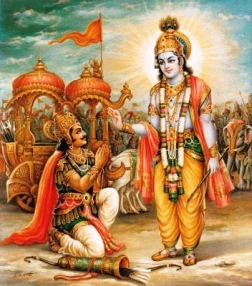
…The Bhagavad-gītā should be taken up in a spirit of devotion. One should not think that he is equal to Kṛṣṇa, nor should he think that Kṛṣṇa is an ordinary personality or even a very great personality. Lord Śrī Kṛṣṇa is the Supreme Personality of Godhead, at least theoretically, according to the statements of Bhagavad-gītā or the statements of Arjuna, the person who is trying to understand the Bhagavad-gītā. We should therefore at least theoretically accept Śrī Kṛṣṇa as the Supreme Personality of Godhead, and with that submissive spirit we can understand the Bhagavad-gītā. Unless one reads the Bhagavad-gītā in a submissive spirit, it is very difficult to understand Bhagavad-gītā because it is a great mystery.
Although I have read and re-read the introduction to the Bhagavad-gita many times now, every time it seems fresh, and new realizations are evident. For instance this morning I was reading how one should accept the Bhagavad-gita in a ‘submissive spirit’. This instruction just jumped out at me because recently I was having a discussion with one devotee friend who was describing from Srila Prabhupada’s letters that Krishna Consciousness cannot be achieved…
Krishna Consciousness is a transcendental science which can be revealed to a sincere devotee who is prepared to render service to the Lord. Krishna Consciousness is not achieved by dry arguments or by academic qualifications. (Letter to Subala – Delhi 29 September, 1967)
…but rather is received, through the mercy of the spiritual master and Krishna.
More
27 Feb 2013
by The Hare Krishna Movement
in Premanjana das, Quotes by Srila Prabhupada
Tags: A.C. Bhaktivedanta Swami Prabhupada, All Devotees Should Write, bhagavad-gita, devotees should write, krishna consciousness articles, Pranjal Joshi, preachers of krishna consciousness, Premanjana das, Srila Prabhupada writting, Srimad Bhagavatam, Teachings of Lord Caitanya
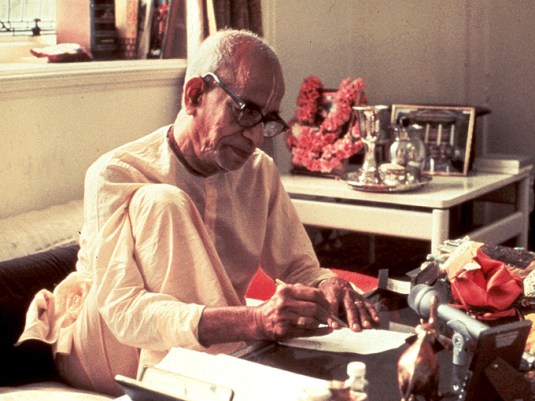
This is a very nice compilation of quotes on the importance of writting based on the works of Srila Prabhupada.
“All students should be encouraged to write some article after reading Srimad-Bhagavatam, Bhagavad-gita and Teachings of Lord Caitanya. They should realize the information, and they must present their assimilation in their own words. Otherwise, how they can become preachers?”
(Letter to Brahmananda — Los Angeles, July 1, 1969)
More
24 Feb 2013
by The Hare Krishna Movement
in A.C. Bhaktivedanta Swami Prabhupada, Beyond Birth & Death, Bhagavad-gita, Bhismadeva, Srimad Bhagavatam
Tags: A.C. Bhaktivedanta Swami Prabhupada, beyond samsara, bhagavad-gita, Bhismadeva, bhutva-bhutva, Lord Sri Krsna, mystic yogis, mystics, parliyate, pure devotee, repetition of different bodies, samsara, samsara means material existence, samsara means this material entanglement, Srimad Bhagavatam, yogic situation, yogis

Beyond Saṁsāra
As I was reading from the Srimad Bhagavatam this morning about the passing of Bhīṣmadeva it was being described how “The perfect yogīs or mystics can leave the material body at their own sweet will at a suitable time and go to a suitable planet desired by them.” And how it is possiable to go beyond Saṁsāra, and go back to Godhead without any doubt.
…In the momentous hour of leaving his material body, Bhīṣmadeva set the glorious example concerning the important function of the human form of life. The subject matter which attracts the dying man becomes the beginning of his next life. Therefore, if one is absorbed in thoughts of the Supreme Lord Śrī Kṛṣṇa, he is sure to go back to Godhead without any doubt.
And what is Samsara?
Saṁsāra means material existence. That is called saṁsāra. Bhūtvā bhūtvā pralīyate (BG 8.19). You take your birth once in some form of body. You live for some time. Then you have to give up this body. Then you have to accept another body. Then again live for some time. Then give up that body. Again accept another body. In this way, it is going on. That is called saṁsāra, rotating within this material world. (Lecture on Gurvastakam at Upsala University by His Divine Grace -Stockholm, September 9, 1973)
The saṁsāra means repetition of different bodies. That is called saṁsāra. (Lecture on SB 1.2.4 -Rome, May 28, 1974)
Saṁsāra means this material entanglement. This is called saṁsāra.
(Lecture on CC Madhya-lila 25.40-50 – San Francisco, January 24, 1967)
More
23 Feb 2013
by The Hare Krishna Movement
in A.C. Bhaktivedanta Swami Prabhupada, Nityananda, Sri Caitanya-Caritamrta
Tags: A.C. Bhaktivedanta Swami Prabhupada, Absolute Truth, appearance of lord nityananda, Gadadesa, Lord Nityananda, Sri Krsna Caitanya, sun and moon

“I offer my respectful obeisances unto Śrī Kṛṣṇa Caitanya and Lord Nityānanda, who are like the sun and moon. They have arisen simultaneously on the horizon of Gauḍa to dissipate the darkness of ignorance and thus wonderfully bestow benediction upon all.”
Śrī Kṛṣṇa and Balarāma, the Personalities of Godhead, who formerly appeared in Vṛndāvana and were millions of times more effulgent than the sun and moon, have arisen over the eastern horizon of Gauḍadeśa [West Bengal], being compassionate for the fallen state of the world.
The appearance of Śrī Kṛṣṇa Caitanya and Prabhu Nityānanda has surcharged the world with happiness.
As the sun and moon drive away darkness by their appearance and reveal the nature of everything, these two brothers dissipate the darkness of ignorance covering the living beings’ and enlighten them with knowledge of the Absolute Truth.
By the grace of Lord Caitanya and Lord Nityānanda, this darkness of ignorance is removed, and the truth is brought to light.
The Absolute Truth is Śrī Kṛṣṇa, and loving devotion to Śrī Kṛṣṇa exhibited in pure love is achieved through congregational chanting of the holy name, which is the essence of all bliss.
Hare Krishna, Hare Krishna
Krishna Krishna, Hare Hare
Hare Rama, Hare Rama
Rama Rama, Hare Hare
These two, the sun and moon, are very kind to the people of the world. Thus for the good fortune of all, They have appeared on the horizon of Bengal.

click on image to enlarge
Verses excerpted from:
Sri Caitanya-caritamrta 1975 Edition
by His Divine Grace A.C. Bhaktivedanta Swami Prabhupada
Adi-lila 1.84-89, 95-96, & 102
22 Feb 2013
by The Hare Krishna Movement
in A.C. Bhaktivedanta Swami Prabhupada, Narottama das Thakur, Nitai Pada Kamala, Nityananda, Songs of the Vaisnava Acaryas
Tags: A.C. Bhaktivedanta Swami Prabhupada, appearance of Nityananda Prabhu, lotus feet are like cooling moons, lotus feet of lord nityananda, Narottama Dasa Thakura, Nita Pada Kamala, nitai-pada, Nityananda, Nityananda Prabhu, nitāi-pada-kamala, Radha-Krsna, Sri Nityananda, Sri Nityananda Nistha

Nita Pada Kamala
Sri Nityananda Nistha (offical name)
by Narottama Dasa Thakura
nitāi-pada-kamala, koṭi-candra-suśītala
je chāyāy jagata jurāy
heno nitāi bine bhāi, rādhā-kṛṣṇa pāite nāi
dṛḍha kori’ dharo nitāir pāy
The lotus feet of Lord Nityananda are a shelter where one will get the soothing moonlight not only of one, but of millions of moons. If the world wants to have real peace, it should take shelter of Lord Nityananda. Unless one takes shelter under the shade of the lotus feet of Lord Nityananda, it will be very difficult for him to approach Radha-Krsna. If one actually wants to enter into the dancing party of Radha-Krsna, he must firmly catch hold of the lotus feet of Lord Nityananda.
se sambandha nāhi jā’r, bṛthā janma gelo tā’r
sei paśu boro durācār
nitāi nā bolilo mukhe, majilo saḿsāra-sukhe
vidyā-kule ki koribe tār
Anyone who has not established his relationship with Nityananda Prabhu is understood to have spoiled his valuable human birth. Such a human being is actually an uncontrollable animal. Because he never uttered the holy name of Nityananda, he has become merged into so-called material happiness. What can his useless education and family tradition do to help him?
More
22 Feb 2013
by The Hare Krishna Movement
in A.C. Bhaktivedanta Swami Prabhupada, Varaha
Tags: A.C. Bhaktivedanta Swami Prabhupada, Bhaktivedanta purports, Brahma, incarnations, Lord Sri Krsna, Lord Varaha's appearance day, Manu, Mrthu, Narasimha, Rama, Rudra, Srila Prabhupada lectures, transcendental incarnations, Varaha, Vyasa

In honor of Lord Varaha’s Apperance Day we are posting some words by Srila Prabhupada from the Bhaktivedanta Purports to the Srimad Bhagavatam and some words from one of his lectures on the Srimad Bhagavatam explaining the Lords various incarnations.
Lord Varaha’s Appearance Day
Kṛṣṇa Is the Source of All Incarnations
As the supreme controller of both the material and spiritual worlds, the Lord has different incarnations of unlimited categories. Incarnations like Brahmā, Rudra, Manu, Pṛthu and Vyāsa are His material qualitative incarnations, but His incarnations like Rāma, Narasiṁha, Varāha and Vāmana are His transcendental incarnations. Lord Śrī Kṛṣṇa is the fountainhead of all incarnations, and He is therefore the cause of all causes. (SB 1.1.17 Purport)
More
19 Feb 2013
by The Hare Krishna Movement
in A.C. Bhaktivedanta Swami Prabhupada, Prayers & Verses, Songs of the Vaisnava Acaryas, Sri Sri Guru-astaka, Sri Sri Guru-astaka, Vishvanatha Chakravarti
Tags: A.C. Bhaktivedanta Swami Prabhupada, blazing fire of material existence, gurus and disciples, material existence, prayer to the spiritual master, samsara, samsara-davanalalidha-loka, spiritual master, Srila Prabhupada, Srila Visvanatha Cakravarti Thakura

click on image to enlarge
Śrī Śrī Gurv-aṣṭaka
Eight Prayers to the Spiritual Master
by Śrīla Viśvanātha Cakravartī Ṭhākura
Śrīla Viśvanātha Cakravartī Ṭhākura, who appeared in the latter half of the 17th Century, is a great spiritual master in the Kṛṣṇa conscious chain of gurus and disciples. He says that one should loudly chant the following eight prayers, with care and attention, during brahma-muhurta, the auspicious time an hour and a half before sunrise when devotional practices are especially potent. Anyone who thus chants these eight beautiful prayers glorifying the spiritual master will certainly get a chance to render direct service to Krishna, the lord of Vrndavana, after the demise of his body.
…This song is offering obeisances particularly to the spiritual master, and the symptoms of the spiritual master are described in this prayer. The spiritual master has two kind of symptoms in his activities. One kind is called constant, and other kind is called temporary. So the first verse says that the constant symptom of the spiritual master is that he can deliver his disciples from the blazing fire of this material existence. That is the eternal qualification of spiritual master. (From purport by His Divine Grace A.C. Bhaktivedanta Swami Prabhupada)
For full song with Roman transliteration, English equivalents, translation and purport by His Divine Grace A.C. Bhaktivedanta Swami Prabhupada More
19 Feb 2013
by The Hare Krishna Movement
in A.C. Bhaktivedanta Swami Prabhupada, Bhagavad-gita, Krishna Consciousness, The Hare Krishna Movement
Tags: 1972 Edition, A.C. Bhaktivedanta Swami Prabhupada, as it is, bhagavad-gita, chanting Hare Krishna, Krishna consciousness, krishna consciousness is natural and transcendental, krishna conssciousness is historically authorized, krsna consciousness, preface

click on image to enlarge
…Our Kṛṣṇa consciousness movement is genuine, historically authorized, natural and transcendental due to its being based on Bhagavad-gītā As It Is. It is gradually becoming the most popular movement in the entire world, especially amongst the younger generation. It is becoming more and more interesting to the older generation also. Older gentlemen are becoming interested, so much so that the fathers and grandfathers of my disciples are encouraging us by becoming life members of our great society, the International Society for Krishna Consciousness.
…The Kṛṣṇa consciousness movement is essential in human society, for it offers the highest perfection of life. How this is so is explained fully in the Bhagavad-gītā. This knowledge constitutes a great science, and each and every living being has to hear it for his own interest. (from Preface to the Bhagavad-gita As It Is)
More
18 Feb 2013
by The Hare Krishna Movement
in A.C. Bhaktivedanta Swami Prabhupada, Guru & Disciple, Krsna-katha, Srimad Bhagawatam
Tags: A.C. Bhaktivedanta Swami Prabhupada, bepetition of birth and death, bhagavad-gita, disciple, Krsna, Krsna-katha, liberated spiritual master, nivrtta-tarsaih, SB 10.1.4, Srila Prabhupada, Srimad Bhagavatam, Supreme Personality of Godhead
click on image to enlarge
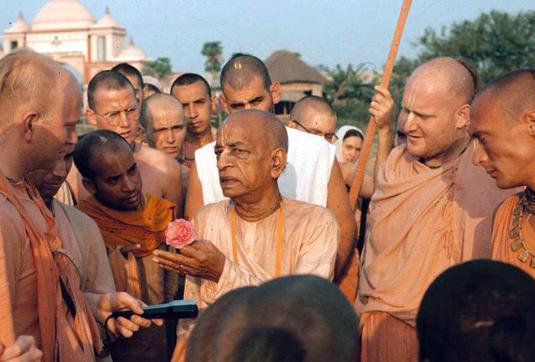
…When discourses on kṛṣṇa-kathā take place between a liberated spiritual master and his disciple, others also sometimes take advantage of hearing these topics and also benefit. These topics are the medicine to stop the repetition of birth and death. The cycle of repeated birth and death, by which one takes on different bodies again and again, is called bhava or bhava-roga. If anyone, willingly or unwillingly, hears kṛṣṇa-kathā, his bhava-roga, the disease of birth and death, will certainly stop. Therefore kṛṣṇa-kathā is called bhavauṣadha, the remedy to stop the repetition of birth and death.
In India it is the practice among the general populace to hear about Kṛṣṇa, either from Bhagavad-gītā or from Śrīmad-Bhāgavatam, in order to gain relief from the disease of repeated birth and death. Although India is now fallen, when there is a message that someone will speak about Bhagavad-gītā or Śrīmad-Bhāgavatam, thousands of people still gather to hear. The following verse indicates, however, that such recitation of Bhagavad-gītā and Śrīmad-Bhāgavatam must be done by persons completely freed from material desires (nivṛtta-tarṣaiḥ).
If we hear the glories of the Supreme Personality of Godhead from liberated persons, this hearing will certainly free us from the bondage of material activities, but hearing Śrīmad-Bhāgavatam spoken by a professional reciter cannot actually help us achieve liberation. Kṛṣṇa-kathā is very simple. In Bhagavad-gītā it is said that Kṛṣṇa is the Supreme Personality of Godhead. As He Himself explains, mattaḥ parataraṁ nānyat kiñcid asti dhanañjaya: “O Arjuna, there is no truth superior to Me.” Simply by understanding this fact—that Kṛṣṇa is the Supreme Personality of Godhead—one can become a liberated person. (Purport SB 10.1.4)
Full Verse and Purport More
16 Feb 2013
by The Hare Krishna Movement
in A.C. Bhaktivedanta Swami Prabhupada, Radha Madhava, Science of Self Realization, Spiritual Life, Vrindavan
Tags: A.C. Bhaktivedanta Swami Prabhupada, cowherd boys, devotees, father, gopis, Kṛṣṇa’s associate as a friend, Krsna, Krsnaloks, or mother, reciprocation of love, self realization, servant, summit of self-realization, The Perfection of Self Realization
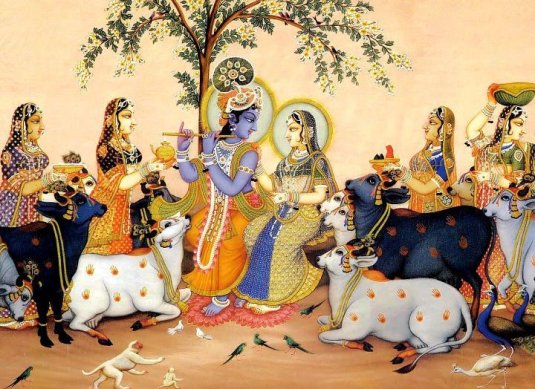
…Kṛṣṇa’s only business is satisfying the devotees, and their only business is satisfying Kṛṣṇa. This is the reciprocation of love… The Supreme Personality of Godhead, wanders on the banks of the Yamunā to please the gopīs, the cowherd boys, the birds, the bees, and the cows and calves. These are not ordinary birds, bees, cows, calves, or men; they have all reached the summit of self-realization and thus, after many, many lives, have attained a position whereby they can play with Kṛṣṇa. This Kṛṣṇa consciousness movement can enable everyone to go to Kṛṣṇaloka and become Kṛṣṇa’s associate as a friend, servant, father, or mother. Kṛṣṇa is agreeable to take any of these positions in relation to His devotee.
More
15 Feb 2013
by The Hare Krishna Movement
in A.C. Bhaktivedanta Swami Prabhupada, Book Changes, Mahesh Raja das
Tags: A.C. Bhaktivedanta Swami Prabhupada, book changes, conditioned souls, God, great scholar, Krishna, Krsna, Liberated souls, prakrta shajiyas, sahajiyas, srila prabhupada conversations, Srila Prabhupada lectures, Srila Prabhupada's writting, transcendental literature

click on image to slightly enlarge
Under the Direction of God (Krishna)
His Divine Grace Srila Prabhupada speaks as Krsna speaks
“It is not possible for a common man to write books on bhakti, for his writings will not be effective. He may be a very great scholar and expert in presenting literature in flowery language, but this is not at all helpful in understanding transcendental literature. Even if transcendental literature is written in faulty language, it is acceptable if it is written by a devotee, whereas so-called transcendental literature written by a mundane scholar, even if it is a very highly polished literary presentation, cannot be accepted. The secret in a devotee’s writing is that when he writes about the pastimes of the lord, the lord helps him; he does not write himself.
We Don’t Allow Any Literature Not Given by Liberated Soul
compiled by Sriman Mahesh Prabhu
The difference between Srila Prabhupada’s books and other so-called gurus’ (conditioned souls) writing is Srila Prabhupada’s instruction was coming directly from Krsna. This is the transcendental platform.
Srila Prabhupada encouraged his disciples, however, to write their realizations. Other conditioned souls may present their nonsense commentaries on Bhagavad-Gita etc., but they will never be quoted for references. Srila Prabhupada is on the trancendental platform and Krishna speaks through him, consequently only he will be quoted for reference.
More
14 Feb 2013
by The Hare Krishna Movement
in A.C. Bhaktivedanta Swami Prabhupada, Lectures, Radha Madhava, Radha-Madhava, Songs of the Vaisnava Acaryas
Tags: A.C. Bhaktivedanta Swami Prabhupada, braja-jana-ranjana, giri-vara-dhari, gopi-jana-vallabha, Jaya Radha Madhava, kunja-bihari, Lectures by Srila Prabhupada, purport to Jaya Radha Madhava, yamuna-tira-vana-cari, yasoda-nandana
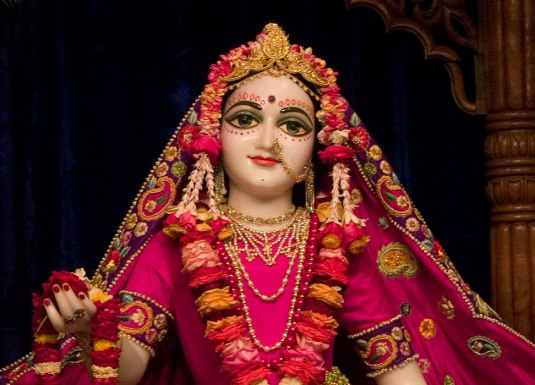
click on image to enlarge
Jaya Rādhā-Mādhava
by Srila Bhaktivinoda Thakura
jaya rādhā-mādhava kuñja-bihārī
gopī-jana-vallabha giri-vara-dhārī
jaya–all glories to: rādhā-mādhava–Rādhā and the Lord of sweetness; kuñja-bihārī–He who enjoys loving pastimes in the groves of Vṛndāvana; gopī-jana-vallabha–the lover of the cowherd maidens of Vraja; giri-vara-dhārī–the holder of the great hill named Govardhana;
Krsna is the lover of Radha. He displays many amorous pastimes in the groves of Vrndavana, He is the lover of the cowherd maidens of Vraja, and the holder of the great hill named Govardhana.
yaśodā-nandana braja-jana-rañjana
yāmuna-tīra-vana-cārī
yaśodā-nandana–the beloved son of mother Yaśodā; vraja-jana-rañjana–the delighter of the inhabitants of Vraja; yāmuna-tīra-vana-cārī–who wanders in the forests along the banks of the river Yamunā
He is the beloved son of mother Yasoda, the delighter of the inhabitants of Vraja, and He wanders in the forests along the banks of the River Yamuna!
Purport to Jaya Rādhā-Mādhava
New York, July 20, 1971
Prabhupāda: So you know this song Jaya Rādhā-Mādhava?
Devotees: Jaya!
Prabhupāda: So you can follow me?
Devotees: Jaya! Haribol! (Śrīla Prabhupāda leads singing of Jaya Rādhā-Mādhava)
More
10 Feb 2013
by The Hare Krishna Movement
in A.C. Bhaktivedanta Swami Prabhupada, Free Downloads, Free eBooks, Srimad Bhagawatam
Tags: A.C. Bhaktivedanta Swami Prabhupada, Dehli Bhagawatam, free download, original bhagavatam, Prabhupada books, scaned copy, Srila Prabhupada, Srimad Bhagwatam, Tridani Goswami A.C. Bhaktivedanta Swami
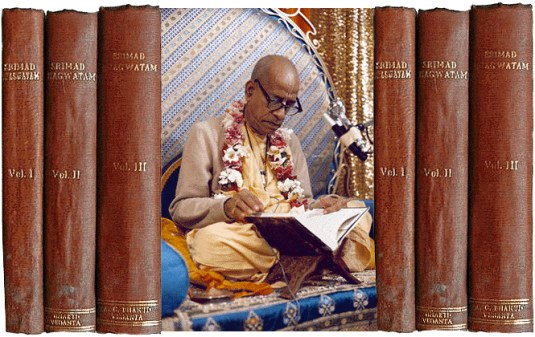
Srimad Bhagwatam
By His Divine Grace A.C Bhaktivedanta Swami Prabhupada
For a free download of these Original Srimad Bhagwatam’s please click on following links
Srimad Bhagwatam Vol. 1
Srimad Bhagwatam Vol. 2
Srimad Bhagwatam Vol.3
Thanks to our friends at Krishna Path .org for making these scanned copies available for a free PDF download
10 Feb 2013
by The Hare Krishna Movement
in A.C. Bhaktivedanta Swami Prabhupada, Caitanya Mahaprabhu, Chanting Hare Krishna, Krsna Consciousness, Sankirtan, Sri Caitanya-Caritamrta
Tags: A.C. Bhaktivedanta Swami Prabhupada, actions which will be benificial for all living entities, adi-lila 9.27-52, devotional service, Krsna consciousness movement, sankirtan movement, Sri Caitanya Mahaprabhu, Sri Caitanya-caritamrta, tree of devotional service, welfare activities for the benifit of others
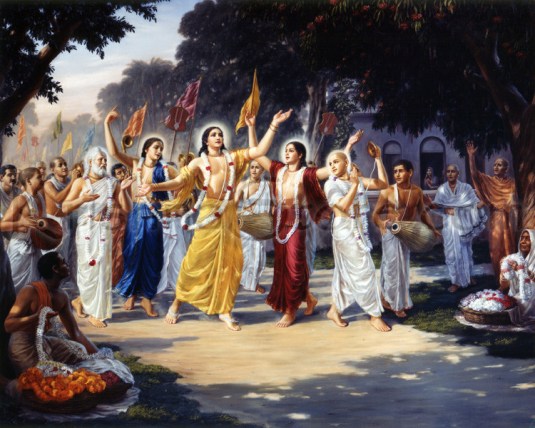
click on image to enlarge
Lord Caitanya’s Sankirtana Movement
“It is the duty of every living being to perform welfare activities for the benefit of others with his life, wealth, intelligence and words.”
“By his work, thoughts and words, an intelligent man must perform actions which will be beneficial for all living entities in this life and in the next.”
The Kṛṣṇa consciousness movement introduced by Lord Caitanya is extremely important because one who takes to it becomes eternal, being freed from birth, death and old age. People do not recognize that the real distresses in life are the four principles of birth, death, old age and disease. They are so foolish that they resign themselves to these four miseries, not knowing the transcendental remedy of the Hare Kṛṣṇa mahā-mantra. Simply by chanting the Hare Kṛṣṇa mahā-mantra, one can become free from all misery, but because they are enchanted by the illusory energy, people do not take this movement seriously. Therefore those who are actually servants of Śrī Caitanya Mahāprabhu must seriously distribute this movement all over the world to render the greatest benefit to human society.
There is a very nice section in the Śrī Caitanya-caritāmṛta wherein the author uses the figurative example of the gardener, to explain the mission of Lord Caitanya Mahāprabhu. With pleasure we are posting the entire section below… More
07 Feb 2013
by The Hare Krishna Movement
in A.C. Bhaktivedanta Swami Prabhupada, Teachings of Lord Chaitanya, The Lords Omnipotency, Vaisnava Vocabulary
Tags: A.C. Bhaktivedanta Swami Prabhupada, Brahma stealing the cows and calves, Dwaraka, Krishna, Narada Muni, omnipotency, prabhava, rasa dance, svayam-rupa, Teachings of Lord Chaitanya, the Lord's Omnipotency, transcendental form, vaibhava, vaibhava-prakasa
click on image to slightly enlarge
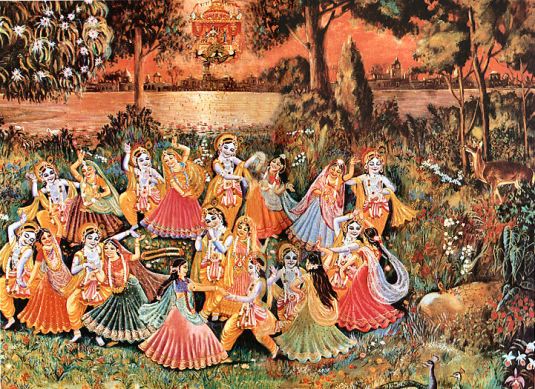
Here is a new word for your Vaisnava Vocabulary; vaibhava-prakāśa. As I was reading the Krsna Book the other day this word vaibhava-prakāśa just jumped out from the pages, and I was reminded again of the Lord’s omnipotency.
“The Lord’s omnipotency is displayed by His simultaneous presence in every place. He is present always in His eternal abode Goloka Vṛndāvana, and still He is present in everyone’s heart and even within every invisible atom.” (SB 1.9.10 purport)
“The personal form of Kṛṣṇa can be divided into two: svayam-rūpa and svayam-prakāśa. As far as His svayam-rūpa (or pastime form) is concerned, it is in that form that He remains always in Vṛndāvana with the inhabitants of Vṛndāvana. This personal form (svayam-rūpa) can be further divided into the prābhava and vaibhava forms. For instance, Kṛṣṇa expanded Himself in multiple forms during the rāsa dance in order to dance with each and every gopī who took part in forms in order to accommodate His 16,108 wives.
… As far as Kṛṣṇa is concerned, when He manifested Himself in different forms, each and every one of them was a separate individual. When Nārada Muni visited Kṛṣṇa at different palaces at Dvārakā, he was astonished at this,…He wondered how the Lord was present with His queens in each and every one of His 16,108 palaces. With each queen, Kṛṣṇa Himself was in a different form, and He was acting in different ways. In one form He was engaged in playing with His children, and in yet another form He was performing some household work. These different activities are conducted by the Lord when He is in His “emotional” forms, which are known as vaibhava-prakāśa expansions. Similarly, there are other unlimited expansions of the forms of Kṛṣṇa, but even when they are divided or expanded without limit, they are still one and the same. There is no difference between one form and another. That is the absolute nature of the Supreme Personality of Godhead.” ( Teachings of Lord Chaitanya)
More
Previous Older Entries Next Newer Entries