07 Jun 2012
by The Hare Krishna Movement
in A.C. Bhaktivedanta Swami Prabhupada, Devotee's, Krishna Consciousness, Lectures
Tags: A.C. Bhaktivedanta Swami Prabhupada, benefactor of the truthful devotee, bhagavad-gita, chanting Hare Krishna, Hear About Krishna, heard and chanted, Krishna, lecture by Prabhupada, material enjoyment, Paramata, Sri Krishna, supersoul, The Supreme Personality of Godhead

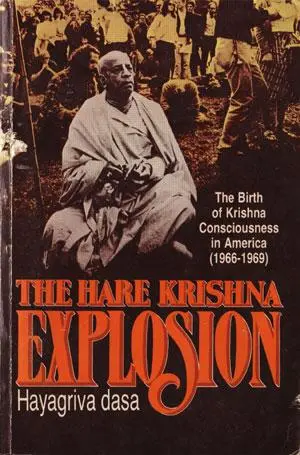
…I have not bribed these American and European boys to become Krishna conscious. I have no money. When I went to America, I had only seven dollars. One hour’s expenditure in New York. There is no question of bribing them. But they heard about Krishna. I was reading Bhagavad-gita on the street, in the park, and chanting. They heard, and they came to me. They became attracted. Why?
Just Give Them Chance to Hear About Krishna
Srimad-Bhagavatam Lecture 1.2.17 Vrndavana, October 28, 1972
By His Divine Grace A.C. Bhaktivedanta Swami Prabhupada
srnvatam sva-kathah krsnah
punya-sravana-kirtanah
hrdy antah-stho hy abhadrani
vidhunoti suhrt satam
Translation: “Sri Krishna, the Personality of Godhead, who is the Paramatma, Supersoul, in everyone’s heart and the benefactor of the truthful devotee, cleanses desire for material enjoyment from the heart of the devotee who relishes His messages, which are in themselves virtuous when properly heard and chanted.”
There is a English proverb that “God helps him who tries to help himself”. That is a English proverb. So to become Krsna conscious is not very difficult thing. People have no taste. They do not understand the importance of this Krsna consciousness movement. But this is the only way by which one can become perfect and happy.
It is confirmed in the Bhagavad-gita that just to become happy and peaceful one has to learn three things.
bhoktaram yajna-tapasam
sarva-loka-mahesvaram
suhrdam sarva-bhutanam
jnatva mam santim rcchati
If you want… Because the problem is that we want to be happy and peaceful. Everyone says, “I want peace. There is no peace in my mind.” That is a general understanding. Nobody can say that “I am completely happy and peaceful.” No, that is not possible. The material world is made in such a way that you cannot feel happy. That is not possible. First of all, we have come to this material world to enjoy sense gratification, but that is not our proper business. Our proper business is to satisfy the senses of Krsna, not our senses. So because we have deviated from our original position, therefore it is always a perplexity of our life. But due to illusion we cannot understand it.
More
07 Jun 2012
by The Hare Krishna Movement
in A.C. Bhaktivedanta Swami Prabhupada, Back to Godhead, Lectures
Tags: A.C. Bhaktivedanta Swami Prabhupada, Conway Hall London, eternal servitors of Krishna, Gurudas, Krishna, lecture by Prabhupada, meditation, relationship with God, sankirtana movement, self realization, Srila Prabhupada, Supreme Lord, true identity

…As soon as one understands his identity, his relationship with God, then immediately he becomes happy. We are so full of miseries because we have identified ourselves with the material world. Therefore we are unhappy. Anxieties and fearfulness are due to our misidentifying with the material world.
A Lecture Given At Conway Hall, London,
By His Divine Grace A.C. Bhaktivedanta Swami Prabhupada
We Are All Eternal Servitors of Krsna
Today’s subject matter is our relationship with God. That is self-realization. The sankirtana movement is the easiest process for self-realization because it cleanses the heart. Our misunderstanding of our identity is due to the dust covering the mirror of the mind. In a mirror which is covered with dust one cannot see himself. But if it is very clear, then one can see himself. So meditation is a process for cleansing the heart. Meditation means to try to understand one’s relationship with the Supreme.
More
30 May 2012
by The Hare Krishna Movement
in A.C. Bhaktivedanta Swami Prabhupada, Back to Godhead, Lectures
Tags: A.C. Bhaktivedanta Swami Prabhupada, Back to Godhead Magazine, Bible, gospel according to Saint John, Hare Krishna, In The Begining Was the Word, mantra, Prabhupada Lecture, sound, sound is the origin of all creation, the Word, vibration of transcendental sound, Word was with God
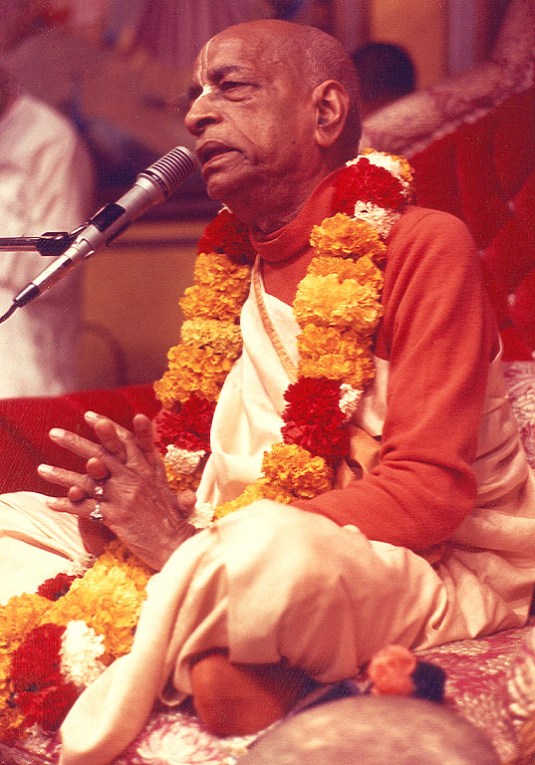
…”In the beginning was the Word.” This indicates that before creation, transcendental sound existed. That word or transcendental sound is not like material sound, for if we associate with the transcendental sound Hare Krsna, we become purified and thus become transcendental. To give a crude example, if we put an iron rod into a fire, it will gradually become warmer and warmer until it becomes red hot. When it is red hot, it will no longer be iron; it will be fire. How has it become fire? By association with the fire. Therefore if you simply keep yourself in touch with God through the transcendental sound, gradually you will become godly, and as soon as you become godly, you will become the same in quality as God full in riches, full in power, full in knowledge and everything else. Therefore the Vedic instruction is, “Don’t keep yourself in darkness. Come to the light.”
In the Beginning Was the Word
By His Divine Grace A.C. Bhaktivedanta Swami Prabhupada
From Back to Godhead Magazine 1975 Vol. 10, No. 1
Ladies and gentlemen, I thank you very much for kindly participating in this sankirtana movement, which is a movement for the vibration of transcendental sound. Sound is the origin of all creation. That is admitted in the Bible also. We are reading a passage from the Bible:
[A disciple reads] The Gospel According to Saint John. Chapter 1. “In the beginning was the Word, and the Word was with God, and the Word was God. The same was in the beginning with God. All things were made by him; and without him was not anything made that was made. In him was life; and the life was the light of men. And the light shineth in darkness; and the darkness comprehended it not.”
More
20 May 2012
by The Hare Krishna Movement
in A.C. Bhaktivedanta Swami Prabhupada, Chanting Hare Krishna, Journey of Self-Discovery, Meditation, Yoga
Tags: A.C. Bhaktivedanta Swami Prabhupada, chanting Hare Krishna, journey of self-discovery, meditation, meditation through transcendental sound, Srila Prabhupada, yoga

Journey of Self-Discovery
By His Divine Grace A.C. Bhaktivedanta Swami Prabhupada
Chapter 5, Yoga & Meditation
Meditation Through Transcendental Sound
Lecturing at Boston’s Northeastern University in the summer of 1969, Śrīla Prabhupāda introduces a meditation system renowned for its extraordinary power and the fact that it can be easily practiced almost anywhere and at any time. “If you take up this simple process,” he says, “chanting Hare Kṛṣṇa, Hare Kṛṣṇa, Kṛṣṇa Kṛṣṇa, Hare Hare/ Hare Rāma, Hare Rāma, Rāma Rāma Hare Hare, you are immediately elevated to the transcendental platform.” He adds, “No other meditation is possible while you are walking on the street.”
My dear boys and girls, I thank you very much for attending this meeting. We are spreading this Kṛṣṇa consciousness movement because there is a great need of this consciousness throughout the world. And the process is very easy—that is the advantage.
First of all, we must try to understand what the transcendental platform is. As far as our present condition is concerned, we are on various platforms. So we have to first of all stand on the transcendental platform; then there can be a question of transcendental meditation.
In the Third Chapter of Bhagavad-gītā, you’ll find an explanation of the various statuses of conditioned life. The first is the bodily conception of life (indriyāṇi parāṇy āhuḥ). Everyone in this material world is under this bodily concept of life. Someone is thinking, “I am Indian.” You are thinking, “I am American.” Somebody’s thinking, “I am Russian.” Somebody’s thinking he is something else. So everyone is thinking, “I am the body.”
More
23 Apr 2012
by The Hare Krishna Movement
in A.C. Bhaktivedanta Swami Prabhupada, Bhagavad-gita, Bhakti Yoga, Krishna Consciousness, Yoga
Tags: astanga-yoga, bhakti yoga, Govinda, jnana-yoga, karma yoga, Krishna, Srila Prabhupada, Syamasundara, Vasudeva, yoga, yogi

If one is fortunate enough to come to the point of bhakti-yoga, it is to be understood that he has surpassed all the other yogas. Therefore, to become Kṛṣṇa conscious is the highest stage of yoga, just as, when we speak of Himalayan, we refer to the world’s highest mountains, of which the highest peak, Mount Everest, is considered to be the culmination.
The culmination of all kinds of yoga practices lies in bhakti-yoga. All other yogas are but means to come to the point of bhakti in bhakti-yoga. Yoga actually means bhakti-yoga; all other yogas are progressions toward the destination of bhakti-yoga. From the beginning of karma-yoga to the end of bhakti-yoga is a long way to self-realization. Karma-yoga, without fruitive results, is the beginning of this path. When karma-yoga increases in knowledge and renunciation, the stage is called jñāna-yoga. When jñāna-yoga increases in meditation on the Supersoul by different physical processes, and the mind is on Him, it is called aṣṭāṅga-yoga. And, when one surpasses the aṣṭāṅga-yoga and comes to the point of the Supreme Personality of Godhead Kṛṣṇa, it is called bhakti-yoga, the culmination. Factually, bhakti-yoga is the ultimate goal, but to analyze bhakti-yoga minutely one has to understand these other yogas. The yogī who is progressive is therefore on the true path of eternal good fortune.
It is by great fortune that one comes to Kṛṣṇa consciousness on the path of bhakti-yoga to become well situated according to the Vedic direction. The ideal yogī concentrates his attention on Kṛṣṇa, who is called Śyāmasundara, who is as beautifully colored as a cloud, whose lotus-like face is as effulgent as the sun, whose dress is brilliant with jewels and whose body is flower garlanded. Illuminating all sides is His gorgeous luster, which is called the brahmajyoti. He incarnates in different forms such as Rāma, Nṛsiṁha, Varāha and Kṛṣṇa, the Supreme Personality of Godhead, and He descends like a human being, as the son of Mother Yaśodā, and He is known as Kṛṣṇa, Govinda and Vāsudeva. He is the perfect child, husband, friend and master, and He is full with all opulences and transcendental qualities. If one remains fully conscious of these features of the Lord, he is called the highest yogī.
More
09 Apr 2012
by The Hare Krishna Movement
in A.C. Bhaktivedanta Swami Prabhupada, Back to Godhead, The Hare Krishna Movement, Varnasrama Dharma
Tags: back to Godhead, bhagavad-gita, Hindu, Krsna Balarama Mandir, Lord Caitanya, Ramananda Raya, Srila Prabhupada, The Hare Krishna Movement, varnasrama dharma, varnasrama-dharma
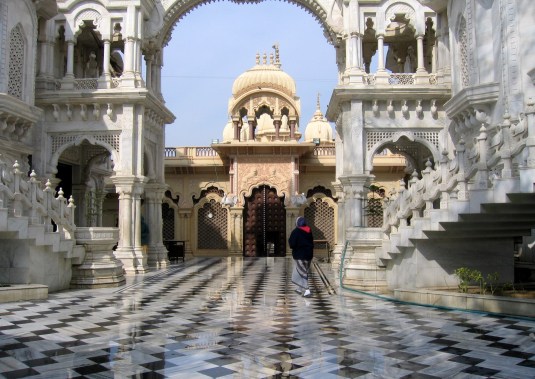
…When Lord Caitanya talked with the great devotee Ramananda Raya, the Lord asked him, “What is the basic principle of human life?” Ramananda Raya answered that human civilization begins when varnasrama-dharma is accepted. Before coming to the standard of varnasrama-dharma there is no question of human civilization. Therefore, the Krsna consciousness movement is trying to establish this right system of human civilization, which is known as Krsna consciousness, or daiva-varnasrama—divine culture.
Divine Culture
By His Divine Grace A.C. Bhaktivedanta Swami Prabhupada
Excerpted from ‘Back To Godhead 1974, Vol 1, No. 68
There is a misconception that the Krsna consciousness movement represents the Hindu religion. In act, however, Krsna consciousness is in no way a faith or religion that seeks to defeat other faiths or religions. Rather, it is an essential cultural movement for the entire human society and does not consider any particular sectarian faith. This cultural movement is especially meant to educate people in how they can love God.
Sometimes Indians both inside and outside of India think that we are preaching the Hindu religion, but actually we are not. One will not find the word “Hindu” in Bhagavad-gita. Indeed, there is no such word as “Hindu” in the entire Vedic literature. This word has been introduced by the Muslims from provinces next to India, such as Afghanistan, Baluchisthan and Persia. There is a river called “Sindhu” bordering the northwestern provinces of India, and since the Muslims there could not pronounce “Sindhu” properly, instead they called the river “Hindu,” and the inhabitants of this tract of land they called “Hindus.” In India, according to the Vedic language, the Europeans are called mlecchas or yavanas. Similarly, “Hindu” is a name given by the Muslims.
More
24 Mar 2012
by The Hare Krishna Movement
in A.C. Bhaktivedanta Swami Prabhupada, Back to Godhead, Remembering Srila Prabhupada, Srila Prabhupada
Tags: back to Godhead, bhagavad-gita, devotional service, Krsna conscious person, krsna consciousness, part and parcel, spritual sky, Srila Prabhupada, suffering of conditioned soul

…Someone asked, “What is the Krsna conscious person’s attitude towards others?” Srila Prabhupada replied, “He sees everyone as part and parcel of Krsna. The Krsna conscious person thinks, ‘They are suffering from not knowing Krsna, so let me bring them to Krsna.’ This is the highest service. Everyone is suffering, so to act in Krsna consciousness is the highest service. After all, they are suffering on account of detachment from Krsna.”
“Krsna consciousness never becomes old, it is fresh eternally. Do you know of any book five thousand years old that reads as fresh as Bhagavad-gita? Live in spiritual understanding and you’ll never become faded.”
The Great Soul Who Walked Among Us
Excerpted from Back To Godhead Magazine Vol. 13 No. 1-2
“Consider this example: when the sun is in the sky, there is no question of darkness. Similarly, when the Hare Krsna mantra is vibrating on your tongue and you are hearing attentively, then your consciousness becomes Krsna consciousness, or clear consciousness, and there is no question of maya, or hazy consciousness. Just as when light and darkness come together the darkness cannot stand before the light, maya cannot remain in the presence of Krsna.
More
13 Mar 2012
by The Hare Krishna Movement
in A.C. Bhaktivedanta Swami Prabhupada, Back to Godhead, Sankirtan, Sri Siksastakam, Yoga
Tags: A.C. Bhaktivedanta Swami Prabhupada, Back to Godhead Magazine, bhagavad-gita, Hari Kirtana, Kali-yuga, Lord Caitanya Mahaprabhu, perfection of yoga, religion, sankirtan movement, The Yoga for the Modern Age
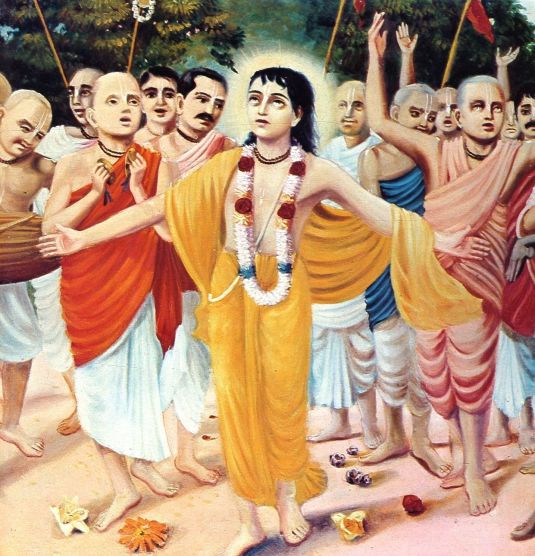
..When Rupa Gosvami first met Lord Caitanya Mahaprabhu at Prayag, Lord Caitanya was chanting and dancing in the street “Hare Krsna, Hare Krsna.” At that time also he offered one prayer. Namo maha-vadanyaya krsna-prema-pradaya te. “O You are the most munificent of all incarnations because You are distributing love of Godhead.” Krsna-prema-pradaya te krsnaya krsna-caitanya-namne gaura-tvise namah. “You are Krsna Himself because if You were not Krsna You could not distribute Krsna-prema or love of God, for love of Krsna is not so easily acquired. But You are distributing this love freely to everyone.”
Hari Kirtana: The Yoga for the Modern Age
By His Divine Grace A.C. Bhaktivedanta Swami Prabhupada
Excerpted from ‘Back To Godhead’ Magazine
1970, Vol., 1 No. 34
Ceto-darpana-marjanam bhava-mahadavagni-nirvapanam sreyah kairava candrika vitaranam vidyavadhu jivanam anandambudhi-vardhanam pratipadam purnamrtasvadanam sarvatma-snapanam param vijayate sri-krsna-sankirtanam. All glories to the sankirtana movement. Param vijayate sri-krsna-sankirtanam. Lord Caitanya Mahaprabhu, when He was only a sixteen-year-old boy, introduced this sankirtana movement 500 years ago in Navadvipa, India. It was not that He manufactured some religious system, just as nowadays so many religious systems are being manufactured.
Actually religion cannot be manufactured. Dharmam tu saksad-bhagavat-pranitam. Religion means the codes of God, the laws of God, that’s all. Certainly we cannot live without obeying the state laws, and similarly, we cannot live without obeying the laws of God. And in the Bhagavad-gita the Lord says, “yada yada hi dharmasya glanir bhavati bharata abhyutthanam adharmasya,” and there is a predominance of irreligious activities, “tadatmanam srjamy aham,” at that time I (Krsna) appear. And in the material world we can see the same principle demonstrated, for whenever there is disobedience of state laws, there is the advent of some particular state officer or police man to “set things right.”
More
29 Feb 2012
by The Hare Krishna Movement
in A.C. Bhaktivedanta Swami Prabhupada, Bhagavad-gita, Divine and Demoniac Natures
Tags: A.C. Bhaktivedanta Swami Prabhupada. As It Is, anger, Bg. 16. 10-12, bhagavad-gita, Demoniac, Divine, greed, human civilization, lust, Original 1972 Edition, sense gratificiation, The Divine and Demoneac Natures
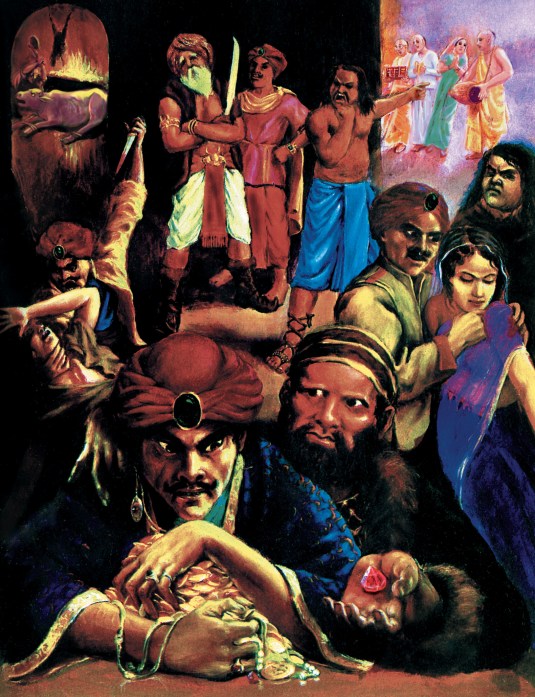
They believe that to gratify the senses unto the end of life is the prime necessity of human civilization. Thus there is no end to their anxiety. Being bound by hundreds and thousands of desires, by lust and anger, they secure money by illegal means for sense gratification.
Bhagavad-gītā As It Is
By His Divine Grace A. C. Bhaktivedanta Swami Prabhupāda
Chapter 16, Text 10-12
The Divine and Demoniac Natures
TEXT 10
kāmam āśritya duṣpūraṁ
dambha-māna-madānvitāḥ
mohād gṛhītvāsad-grāhān
pravartante ’śuci-vratāḥ
kāmam—lust; āśritya—taking shelter of; duṣpūram—insatiable; dambha—pride; māna—false prestige; mada-anvitāḥ—absorbed in conceit; mohāt—by illusion; gṛhītvā—taking; asat—nonpermanent; grāhān—things; pravartante—flourish; aśuci—unclean; vratāḥ—avowed.
The demoniac, taking shelter of insatiable lust, pride and false prestige, and being thus illusioned, are always sworn to unclean work, attracted by the impermanent.
Purport
The demoniac mentality is described here. The demons’ lust is never satiated. They will go on increasing and increasing their insatiable desires for material enjoyment. Although they are always full of anxieties on account of accepting nonpermanent things, they still continue to engage in such activities out of illusion. They have no knowledge and cannot tell that they are heading the wrong way. Accepting nonpermanent things, such demoniac people create their own God, create their own hymns and chant accordingly. The result is that they become more and more attracted to two things—sex enjoyment and accumulation of material wealth. The word aśuci-vratāḥ, unclean vow, is very significant in this connection. Such demoniac people are only attracted by wine, women, gambling and meat eating; those are their aśuci, unclean habits. Induced by pride and false prestige, they create some principles of religion which are not approved by the Vedic injunctions. Although such demoniac people are most abominable in the world, still, by artificial means, the world creates a false honor for them. Although they are gliding toward hell, they consider themselves very much advanced.
More
30 Jan 2012
by The Hare Krishna Movement
in A.C. Bhaktivedanta Swami Prabhupada, Advaita Acarya, Sri Caitanya-Caritamrta
Tags: A.C. Bhaktivedanta Swami Prabhupada, Adi. 12-13, Advaita Acarya, devotional service, Lord Advaita Acarya, Lords devotee, Maha-Visnu, maya, Sri Caitanya-caritamrta

Thinking of the lotus feet of Śrī Kṛṣṇa, He constantly offered tulasī buds in water from the Ganges.
While most of the world celebrated the Appearance day of Advaita Acarya yesterday…according to the BBT Art Calendar the variant date for our area is today. (go figure?) So we are posting some verses from the Sri Caitanya-caritamrta in honor of His appearance.
Sri Caitanya-caritamrta – 1975 Edition
By His Divine Grace A.C. Bhaktivedanta Swami Prabhupada
Adi-lila Chapter 1, Text 12-13
mahā-viṣṇur jagat-kartā
māyayā yaḥ sṛjaty adaḥ
tasyāvatāra evāyam
advaitācārya īśvaraḥ
mahā-viṣṇuḥ—Mahā-Viṣṇu, the resting place of the efficient cause; jagat-kartā—the creator of the cosmic world; māyayā—by the illusory energy; yaḥ—who; sṛjati—creates; adaḥ—that universe; tasya—His; avatāraḥ—incarnation; eva—certainly; ayam—this; advaita-ācāryaḥ—of the name Advaita Ācārya; īśvaraḥ—the Supreme Lord, the resting place of the material cause.
Lord Advaita Ācārya is the incarnation of Mahā-Viṣṇu, whose main function is to create the cosmic world through the actions of Māyā.
advaitaṁ hariṇādvaitād
ācāryaṁ bhakti-śaṁsanāt
bhaktāvatāram īśaṁ tam
advaitācāryam āśraye
advaitam—known as Advaita; hariṇā—with Lord Hari; advaitāt—from being nondifferent; ācāryam—known as Ācārya; bhakti-śaṁsanāt—from the propagation of devotional service to Śrī Kṛṣṇa; bhakta-avatāram—the incarnation as a devotee; īśam—to the Supreme Lord; tam—to Him; advaita-ācāryam—to Advaita Ācārya; āśraye—I surrender.
Because He is nondifferent from Hari, the Supreme Lord, He is called Advaita, and because He propagates the cult of devotion, He is called Ācārya. He is the Lord and the incarnation of the Lord’s devotee. Therefore I take shelter of Him.
Pasted from; Prabhupada Books
21 Jan 2012
by The Hare Krishna Movement
in A.C. Bhaktivedanta Swami Prabhupada, Teachings of Lord Kapila
Tags: A.C. Bhaktivedanta Swami Prabhupada, happiness and distress, Son of Devahuti, Teachings of Lord Kapila, The Symptoms of a Sadhu, winter, winter and summer seasons

click to enlarge image
“O son of Kuntī, the nonpermanent appearance of happiness and distress and their disappearance in due course are like the appearance and disappearance of winter and summer seasons. They arise from sense perception, O scion of Bharata, and one must learn to tolerate them without being disturbed.”
In summer we suffer, and in winter we suffer. In the summer, fire brings suffering, and in the winter the same fire is pleasing. Similarly, in the winter, water is suffering, but in the summer it is pleasing. The water and the fire are the same, but sometimes they are pleasing, sometimes they are not….The more we are in the bodily conception, the more we suffer.
Teachings of Lord Kapila, the Son of Devahuti
By His Divine Grace A.C. Bhaktivedanta Swami Prabhupada
Chapter 11, Text 23
mad-āśrayāḥ kathā mṛṣṭāḥ
śṛṇvanti kathayanti ca
tapanti vividhās tāpā
naitān mad-gata-cetasaḥ
Engaged constantly in chanting and hearing about Me, the Supreme Personality of Godhead, the sādhus do not suffer from material miseries because they are always filled with thoughts of My pastimes and activities.
More
21 Jan 2012
by The Hare Krishna Movement
in A.C. Bhaktivedanta Swami Prabhupada, Back to Godhead, Poetry of Srila Prabhupada
Tags: A.C. Bhaktivedanta Swami Prabhupada, Founder Acharya, International Society for Krishna Consciousness, Poetry of Srila Prabhupada, Prabhupada's arrival in USA, spiritual master, Srila Prabhupada

Poem by Srila Prabhupada on His First Arrival in the USA
The spiritual master and founder of the International Society for Krishna Consciousness, His Divine Grace A.C. Bhaktivedanta Swami Prabhupada, is now engaging thousands of men and women in America and throughout the world in the science of bhakti-yoga, transcendental loving service to God. Prabhupada had no personal motive in first beginning ISKCON; he so vigorously preaches the philosophy of God consciousness simply because he has been ordered to do so by his own spiritual master, Srila Bhaktisiddhanta Sarasvati Gosvami Maharaja.
His Divine Grace A.C. Bhaktivedanta Swami Prabhupada first arrived in the United States in 1965 with seven dollars, a letter of introduction to an Indian family in Pennsylvania, and a suitcase with some volumes of Srimad-Bhagavatam. In the following poem, written in Bengali on the day of his arrival in the USA, Srila Prabhupada addresses the Supreme Lord Krsna, asking Him His purpose in sending His servant to America. The translation from Bengali was done by Srila Prabhupada himself.
As Follows; More
13 Jan 2012
by The Hare Krishna Movement
in A.C. Bhaktivedanta Swami Prabhupada, Devotee's, Lectures, Srimad Bhagavatam
Tags: Ajamila, devotees, Lectures by Srila Prabhupada, Narayana, SB 6.1.28-29, sinful persons, Srila Prabhupada, Srimad Bhagavatam, Visnudutas, Yamaduta, Yamaraja

“At the time of his death the sinful Ajamila saw three awkward persons with deformed bodily features, fierce, twisted faces, and hair standing erect on their bodies. With ropes in their hands, they had come to take him away to the abode of Yamaraja. When he saw them he was extremely bewildered, and because of attachment to his child, Narayana, who was playing a short distance away, Ajamila began to cal him loudly by his name. Thus with tears in his eyes he somehow or other chanted the holy name of Narayana. the order carriers of Visnu, the Visnudutas, immediately arrived when when they heard the holy name of their master from the mouth of the dying Ajamila. The order carriers of Yamaraja were snatching the soul from the core of the heart of Ajamila, the husband of the prostitute, but with resounding voices the messengers of Lord Visnu, the Visnudutas, forbade them to do so” (from Srimad Bhagavatam 6.1.27-29)
Srimad Bhagavatam Lectures
By His Divine Grace A.C. Bhaktivedanta Swami Prabhupada
SB 6.1.28-29 May 28, 1975 Honolulu
Pradyumna: Translation: “Ajāmila then saw three awkward persons with deformed bodily features, fierce, twisted faces, and hair standing erect on their bodies. With ropes in their hands they had come to take him away to the abode of Yamarāja. When he saw them he was extremely bewildered, and because of attachment to his child, who was playing a short distance away, Ajāmila began to call him loudly by his name. Thus, with tears in his eyes, he somehow or other chanted the holy name of Nārāyaṇa.” [SB 6.1.28-29]
Prabhupāda: Sa pāśa-hastāṁs trīn dṛṣṭvā puruṣān ati-dāruṇān. So, at the time of death there are so many disturbance. We have got experience, but you have forgot because bhūtvā bhūtvā pralīyate [Bg. 8.19]. But these things are observed by the sinful person. The Yamadūta, they come to take to the sinful, sinful person, not devotees. Just like the whole population of the city, they are not all subjected to the prison laws. Some criminals. Similarly, this Yamadūta goes to such sinful persons. They are not all. But it is the question of Ajāmila… He was so sinful that automatically the Yamadūtas came, and they wanted to take him.
full lecture More
05 Jan 2012
by The Hare Krishna Movement
in A.C. Bhaktivedanta Swami Prabhupada, Bhagavad-gita, Krishna Consciousness, Yoga
Tags: bhagavad-gita, bhajete, His Divine Grace A.C. Bhaktivedanta Swami Prabhupada, Krishna, Krishna consciousness, prabhupada, yoga, yogi, yoginam api sarvesam

It is by great fortune that one comes to Kṛṣṇa consciousness on the path of bhakti-yoga to become well situated according to the Vedic direction. The ideal yogī concentrates his attention on Kṛṣṇa, who is called Śyāmasundara, who is as beautifully colored as a cloud, whose lotus-like face is as effulgent as the sun, whose dress is brilliant with jewels and whose body is flower garlanded. Illuminating all sides is His gorgeous luster, which is called the brahmajyoti. He incarnates in different forms such as Rāma, Nṛsiṁha, Varāha and Kṛṣṇa, the Supreme Personality of Godhead, and He descends like a human being, as the son of Mother Yaśodā, and He is known as Kṛṣṇa, Govinda and Vāsudeva. He is the perfect child, husband, friend and master, and He is full with all opulences and transcendental qualities. If one remains fully conscious of these features of the Lord, he is called the highest yogī.
Bhagavad-gita As It Is – Macmillan 1972 Edition
By His Divine Grace A.C. Bhaktivedanta Swami Prabhupada
Chapter 6, Text 47
yoginām api sarveṣāṁ
mad-gatenāntar-ātmanā
śraddhāvān bhajate yo māṁ
sa me yuktatamo mataḥ
yoginām—of all yogīs; api—also; sarveṣām—all types of; mat-gatena—abiding in Me; antaḥ-ātmanā—always thinking of Me within; śraddhāvān—in full faith; bhajate—renders transcendental loving service; yaḥ—one who; mām—Me (the Supreme Lord); saḥ—he; me—Mine; yuktatamaḥ—the greatest yogī; mataḥ—is considered.
Translation
And of all yogīs, he who always abides in Me with great faith, worshiping Me in transcendental loving service, is most intimately united with Me in yoga and is the highest of all.
More
26 Dec 2011
by The Hare Krishna Movement
in A.C. Bhaktivedanta Swami Prabhupada, Nectar of Instruction, The Nectar of Instruction
Tags: A.C. Bhaktivedanta Swami Prabhupada, capitalism, human life, Lords energy, materialistic communism, Nectar of Instruction, Rupa Goswami, sense gratification, spiritual development

…Kṛṣṇa conscious devotees know very well that this material world is designed by the complete arrangement of the Lord to fulfill all the necessities of life for all living beings, without their having to encroach upon the life or rights of one another. This complete arrangement affords the proper quota of wealth for everyone according to his real needs, and thus everyone may live peacefully according to the principle of plain living and high thinking. Unfortunately, materialists who have neither faith in the plan of God nor any aspiration for higher spiritual development misuse their God-given intelligence only to augment their material possessions. They devise many systems—such as capitalism and materialistic communism—to advance their material position. They are not interested in the laws of God or in a higher goal. Always anxious to fulfill their unlimited desires for sense gratification, they are conspicuous by their ability to exploit their fellow living beings…
The Nectar of Instruction
By His Divine Grace A.C. Bhaktivedanta Swami Prabhupada
Text 2
atyāhāraḥ prayāsaś ca
prajalpo niyamāgrahaḥ
jana-saṅgaś ca laulyaṁ ca
ṣaḍbhir bhaktir vinaśyati
ati-āhāraḥ—overeating or too much collecting; prayāsaḥ—overendeavouring; ca—and; prajalpaḥ—idle talk; niyama—rules and regulations; āgrahaḥ—too much attachment to (or agrahaḥ—too much neglect of); jana-saṅgaḥ—association with worldly-minded persons; ca—and; laulyam—ardent longing or greed; ca—and; ṣaḍbhiḥ—by these six; bhaktiḥ—devotional service; vinaśyati—is destroyed.
One’s devotional service is spoiled when he becomes too entangled in the following six activities: (1) eating more than necessary or collecting more funds than required; (2) overendeavoring for mundane things that are very difficult to obtain; (3) talking unnecessarily about mundane subject matters; (4) Practicing the scriptural rules and regulations only for the sake of following them and not for the sake of spiritual advancement, or rejecting the rules and regulations of the scriptures and working independently or whimsically; (5) associating with worldly-minded persons who are not interested in Kṛṣṇa consciousness; and (6) being greedy for mundane achievements.
More
21 Nov 2011
by The Hare Krishna Movement
in A.C. Bhaktivedanta Swami Prabhupada, Back to Godhead, Ganges
Tags: His Divine Grace A.C. Bhaktivedanta Swami Prabhupada, Krishna, Krsna, kuntidevi, Lord Madhu, Queen Kunti, River Ganges

The Flow of Attraction to Krsna
Back to Godhead Magazine
Volume 01, Number 60, 1973
tvayi me ‘nanya-visaya matir madhu-pate ‘sakrt
ratim udvahatad addha gangevaugham udanvati
“O Lord of Madhu, as the Ganges forever flows to the sea without hindrance, let my attraction be constantly drawn unto You without being diverted to anyone else.” (Srimad-Bhagavatam, 1.8.42 -Prayer by Queen Kunti)
By His Divine Grace A.C. Bhaktivedanta Swami Prabhupada
In the previous verses of Srimad-Bhagavatam Queen Kunti prayed that the Lord kindly cut off her attraction for her kinsmen, the Pandava and Vrsni families. However, giving up one’s attraction for material things is not sufficient. The Mayavadi philosophers say, brahma satyam jagan-mithya: “This world is false, and Brahman [spirit] is truth.” We admit this, but qualify it. As living entities, we want enjoyment. Enjoyment means variety. It is not possible to enjoy anything without variety. Why has God created so many colors and so many forms? In order to create enjoyment out of variety. Indeed, variety is the mother of enjoyment. Mayavadi philosophers wish to negate this variety, and therefore they are called impersonalists.
The human form of life is meant for reestablishing our relationship with God. This material world means forgetfulness of our relationship with God. There is no Krsna consciousness in this material world, for as soon as there is Krsna consciousness, as soon as there is action on the basis of Krsna, there is nothing material. Everything is spiritual.
More
08 Nov 2011
by The Hare Krishna Movement
in A.C. Bhaktivedanta Swami Prabhupada, Back to Godhead, Krishna Consciousness
Tags: A.C. Bhaktivedanta Swami Prabhupada, Back to Godhead Magazine, bhagavad-gita, Freedom in Krsna, krsna consciousness, yoga, yogi

Freedom in Krsna
By His Divine Grace A.C. Bhaktivedanta Swami Prabhupada
Re-printed from Back to Godhead Magazine 1973, Vol. 1, No. 48
vande rupa-sanatanau raghuyugau sri-jiva-gopalakau.
We are following in the footsteps of Lord Caitanya Mahaprabhu in order to understand Krsna consciousness. Krsna, the Supreme Personality of Godhead, is said in Sri Isopanisad to be very far away from us yet at the same time to be very near. Isvara, the supreme controller, is situated in everyone’s heart, not only in the hearts of human beings, but also within the beasts, birds, aquatics, and even within the atoms themselves. We simply have not realized Him. Actually anyone, however, can find Krsna within his heart.
The process of finding Krsna is called yoga. There are many types of yoga. In the Western countries people are generally familiar with the process of hatha-yoga. This is an approved method and is described in the Sixth Chapter of Bhagavad-gita. At the present moment, however, people are short-lived, they are not very fortunate, and they are always disturbed by many external affairs, and therefore it is not possible to properly execute this hatha-yoga. Even five thousand years ago when Krsna advised His friend Arjuna to accept the hatha-yoga process, Arjuna said, “Krsna, this practice is impossible.” He further said that to control the mind is as difficult as to control the wind. The mind flickers from one engagement to another and changes so swiftly that it is very difficult to control it in this age. Therefore Arjuna said that for him this process of hatha-yoga was not possible.
More
19 Oct 2011
by The Hare Krishna Movement
in A.C. Bhaktivedanta Swami Prabhupada, Nectar of Instruction, Radha-kunda, Srimati Radharani
Tags: A.C. Bhaktivedanta Swami Prabhupada, damsels of Vrajabhumi, divine kunda, His Divine Grace A.C. Bhaktivedanta Swami Prabhupada, Nectar of Instruction, Radha-kunda, Sri Radha kunda, Srila Rupa Goswami, Srimati Radharani

Rādhā-kuṇḍa
It is stated that a devotee will at once develope pure love of Kṛṣṇa in the wake of the gopīs if he once takes a bath in Rādhā-kuṇḍa.
The Nectar of Instruction
By His Divine Grace A.C. Bhaktivedanta Swami Prabhupada
Text 11
kṛṣṇasyoccaiḥ praṇaya-vasatiḥ preyasībhyo ’pi rādhā
kuṇḍaṁ cāsyā munibhir abhitas tādṛg eva vyadhāyi
yat preṣṭhair apy alam asulabhaṁ kiṁ punar bhakti-bhājāṁ
tat premedaṁ sakṛd api saraḥ snātur āviṣkaroti
kṛṣṇasya—of Lord Śrī Kṛṣṇa; uccaiḥ—very highly; praṇaya-vasatiḥ—object of love; preyasībhyaḥ—out of the many lovable gopīs; api—certainly; rādhā—Śrīmatī Rādhārāṇī; kuṇḍam—lake; ca—also; asyāḥ—of Her; munibhiḥ—by great sages; abhitaḥ—in all respects; tādṛk eva—similarly; vyadhāyi—is described; yat—which; preṣṭhaiḥ—by the most advanced devotees; api—even; alam—enough; asulabham—difficult to obtain; kim—what; punaḥ—again; bhakti-bhājām—for persons engaged in devotional service; tat—that; prema—love of Godhead; idam—this; sakṛt—once; api—even; saraḥ—lake; snātuḥ—of one who has bathed; āviṣkaroti—arouses.
Of the many objects of favored delight and of all the lovable damsels of Vrajabhūmi, Śrīmatī Rādhārāṇī is certainly the most treasured object of Kṛṣṇa’s love. And, in every respect, Her divine kuṇḍa is described by great sages as similarly dear to Him. Undoubtedly Rādhā-kuṇḍa is very rarely attained even by the great devotees; therefore it is even more difficult for ordinary devotees to attain. If one simply bathes once within those holy waters, one’s pure love of Kṛṣṇa is fully aroused.
Why is Rādhā-kuṇḍa so exalted? The lake is so exalted because it belongs to Śrīmatī Rādhārāṇī, who is the most beloved object of Śrī Kṛṣṇa. Among all the gopīs, She is the most beloved. Similarly, Her lake, Śrī Rādhā-kuṇḍa, is also described by great sages as the lake that is as dear to Kṛṣṇa as Rādhā Herself. Indeed, Kṛṣṇa’s love for Rādhā-kuṇḍa and Śrīmatī Rādhārāṇī is the same in all respects. Rādhā-kuṇḍa is very rarely attained, even by great personalities fully engaged in devotional service, not to speak of ordinary devotees who are only engaged in the practice of vaidhī bhakti.
It is stated that a devotee will at once develope pure love of Kṛṣṇa in the wake of the gopīs if he once takes a bath in Rādhā-kuṇḍa. Śrīla Rūpa Gosvāmī recommends that even if one cannot live permanently on the banks of Rādhā-kuṇḍa, he should at least take a bath in the lake as many times as possible. This is a most important item in the execution of devotional service. Śrīla Bhaktivinoda Ṭhākura writes in this connection that Śrī Rādhā-kuṇḍa is the most select place for those interested in advancing their devotional service in the wake of the lady friends (sakhīs) and confidential serving maids (mañjarīs) of Śrīmatī Rādhārāṇī. Living entities who are eager to return home to the transcendental kingdom of God, Goloka Vṛndāvana, by means of attaining their spiritual bodies (siddha-deha) should live at Rādhā-kuṇḍa, take shelter of the confidential serving maids of Śrī Rādhā and under their direction engage constantly in Her service.
This is the most exalted method for those engaged in devotional service under the protection of Śrī Caitanya Mahāprabhu. In this connection Śrīla Bhaktisiddhānta Sarasvatī Ṭhākura writes that even great sages and great devotees like Nārada and Sanaka do not get an opportunity to come to Rādhā-kuṇḍa to take their baths. What, then, to speak of ordinary devotees? If, by great fortune, one gets an opportunity to come to Rādhā-kuṇḍa and bathe even once, he can develop his transcendental love for Kṛṣṇa, exactly as the gopīs did. It is also recommended that one should live on the banks of Rādhā-kuṇḍa and should be absorbed in the loving service of the Lord. One should bathe there regularly and give up all material conceptions, taking shelter of Śrī Rādhā and Her assistant gopīs. If one is thus constantly engaged during his lifetime, after giving up the body he will return back to Godhead to serve Śrī Rādhā in the same way as he contemplated during his life on the banks of Rādhā-kuṇḍa. The conclusion is that to live on the banks of the Rādhā-kuṇḍa and to bathe there daily constitute the highest perfection of devotional service. It is a difficult position to attain, even for great sages and devotees like Nārada. Thus there is no limit to the glory of Śrī Rādhā-kuṇḍa. By serving Rādhā-kuṇḍa, one can get an opportunity to become an assistant of Śrīmatī Rādhārāṇī under the eternal guidance of the gopīs.
09 Oct 2011
by The Hare Krishna Movement
in A.C. Bhaktivedanta Swami Prabhupada, Back to Godhead, Lectures, Technology
Tags: chanting Hare Krishna, Krsna consciousness movement, Lecture by His Divine Grace A.C. Bhaktivedanta Swami Prabhupada, Massachusetts Institute of Technology, MIT, spiritual master, technology

Massachusetts Institute of Technology
The Krsna consciousness movement teaches a science missing from the classrooms of even the world’s best universities.
This movement is for solving the problems of life, and it can be easily done. Anyone can accept it. It doesn’t matter whether one is Indian or American or Hindu or Muslim or Christian. It doesn’t matter. Simply chant this vibration: Hare Krsna, Hare Krsna, Krsna Krsna, Hare Hare/ Hare Rama, Hare Rama, Rama Rama, Hare Hare.
Lecture
By His Divine Grace
A. C. Bhaktivedanta Swami Prabhupada
Founder-Acarya of the International Society for Krishna Consciousness
Massachusetts Institute of Technology, Boston—May 5, 1968
om ajnana-timirandhasya
jnananjana-salakaya
caksur unmilitam yena
tasmai sri-gurave namah
“I offer my respectful obeisances unto my spiritual master, who with the torchlight of knowledge has opened my eyes, which were blinded by the darkness of ignorance.”
This Prayer Is Offering respectful obeisances to the spiritual master. Why? Because the spiritual master is the person who opens our eyes, complicated in ignorance, with the torch of transcendental knowledge. Timirandhasya. Every one of us is born ignorant, and we require specific education and training for seeing things as they are.
Today I am very glad to meet you. You are all students of technology. This Krsna consciousness movement is another technology. In the modern state of civilization there are different depart-ments of knowledge. There is a department for teaching medical science, there is a department for teaching engineering—so many other departments of knowledge. Unfortunately, there is no department for distributing knowledge of the science of the soul. But that is the most important thing, because the soul is the mainstay, the background of all our movements.
In the Bhagavad-gita [3.42] there is a nice verse:
indriyani parany ahur
indriyebhyah param manah
manasas tu para buddhir
yo buddheh paratas tu sah
The idea is that in the present consciousness I am thinking that I am the body, although actually I am not the body. This is ignorance. “Body” means the senses. When I am talking, I am using my tongue for vibration. So these bodily activities are sensual activities.
If you go deep into the matter, you’ll find that the senses can act only when the mind is sound. A crazy man, or a madman, cannot use his senses properly. Therefore the technology of the mind is a higher science. First of all there is the technology of the senses, and then a higher technology of the mind, which is known as psychology and studies thinking, feeling, willing. Psychologists are trying to understand how these are working.
More
25 Sep 2011
by The Hare Krishna Movement
in A.C. Bhaktivedanta Swami Prabhupada, Devotional Service, Krishna Consciousness, Yoga
Tags: bhakti yoga, devotional service, His Divine Grace A.C. Bhaktivedanta Swami Prabhupada, krsna consciousness, Krsna's name, master of yoga, Srila Prabhupada, The Topmost Yoga System, yoga, Yoga and the Master of Yoga, yogesvara
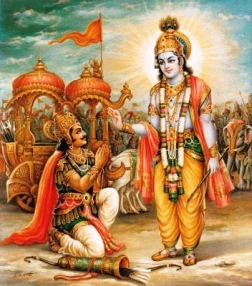
Yogesvara, the ultimate object of yoga
Krsna Consciousness The Topmost Yoga System
By His Divine Grace A. C. Bhaktivedanta Swami Prabhupada
Chapter 2
Yoga and the Master of Yoga
Yoga means the connecting link between the soul and the Supersoul, or the Supreme and the minute living creatures. Lord Śrī Kṛṣṇa is that Supreme, the Personality of Godhead. Being, therefore, the ultimate object of yoga, Kṛṣṇa’s name is yogeśvara, the master of yoga.
At the conclusion of the Bhagavad-gītā, it is said: “Where there is Kṛṣṇa, and where there is Arjuna, the greatest of bowmen, there, undoubtedly, is victory.”
The Bhagavad-gītā is a narrative spoken by Sañjaya, the secretary of Mahārāja Dhṛtarāṣṭra. This is just like airwaves from the radio: the play is going on in the auditorium, but you can hear from your room. So, just as we now have such a mechanical arrangement, at that time there were also certain arrangements, although there was no machine. Anyway, the secretary of Dhṛtarāṣṭra could see what was going on in the battlefield, and he was in the palace, telling this to Mahārāja Dhṛtarāṣṭra, who was blind. Now, the conclusion made by Sañjaya was that Kṛṣṇa is the Supreme Personality of Godhead.
When the yoga performance is described, it is said that Kṛṣṇa’s name is yogeśvara. No one can be a better yogī than the master of yoga, and Kṛṣṇa is the master. There are many different types of yoga. Yoga means the system, and yogi means the person who practices that system. The object of yoga, the ultimate goal, is to understand Kṛṣṇa. Therefore, Kṛṣṇa consciousness means to practice the topmost type of yoga.
This topmost yoga system was described by Kṛṣṇa in the Gītā to His most intimate friend, Arjuna. In the beginning, the Lord said that this system can be practiced only by a person who has developed attachment for it. This Kṛṣṇa conscious yoga system cannot be practiced by an ordinary man who has no attachment for Kṛṣṇa, for it is a different system, and the topmost—bhakti-yoga.
More
Previous Older Entries Next Newer Entries









 The Hare Krishna Movement