20 Aug 2012
by The Hare Krishna Movement
in Kali Yuga, Srimad Bhagavatam, Time
Tags: A.C. Bhaktivedanta Swami Prabhupada, age of kali, bhagavad-gita, dvapara-yuga, enlightenment, great sacrifice, Kali-yuga, meditation, Naimisaranya, satya-yuga, self realization, Sri Krishna, Srimad Bhagavatam, Treta-yuga, worship of the Lord, yoga

By human calculation, a thousand ages taken together is the duration of Brahmā’s one day. And such also is the duration of his night.
…This age of Kali is not at all suitable for self-realization as was Satya-yuga, the golden age, or Tretā- or Dvāpara-yugas, the silver and copper ages. For self-realization, the people in Satya-yuga, living a lifetime of a hundred thousand years, were able to perform prolonged meditation. And in Tretā-yuga, when the duration of life was ten thousand years, self-realization was attained by performance of great sacrifice. And in the Dvāpara-yuga, when the duration of life was one thousand years, self-realization was attained by worship of the Lord. But in the Kali-yuga, the maximum duration of life being one hundred years only and that combined with various difficulties, the recommended process of self-realization is that of hearing and chanting of the holy name, fame, and pastimes of the Lord.
The sages of Naimiṣāraṇya began this process in a place meant specifically for the devotees of the Lord. They prepared themselves to hear the pastimes of the Lord over a period of one thousand years. By the example of these sages one should learn that regular hearing and recitation of the Bhāgavatam is the only way for self-realization. Other attempts are simply a waste of time, for they do not give any tangible results. Lord Śrī Caitanya Mahāprabhu preached this system of Bhāgavata-dharma, and He recommended that all those who were born in India should take the responsibility of broadcasting the messages of Lord Śrī Kṛṣṇa, primarily the message of Bhagavad-gītā. And when one is well established in the teachings of Bhagavad-gītā, he can take up the study of Śrīmad-Bhāgavatam for further enlightenment in self-realization.
Further information on the Age of Kali More
18 Aug 2012
by The Hare Krishna Movement
in Krsna Consciousness, Srimad Bhagavatam
Tags: A.C. Bhaktivedanta Swami Prabhupada, adventures and pastimes of the Lord, age of quarrel, Kali-yuga, Krishna and Balarama, Krishna's transcendental pastimes, Mahabarata, multi-incarnations, mundane news, Puranas, Ramayana, Srimad Bhagavatam, Supreme Godhead, transcendental news, virtuous glories of the Lord
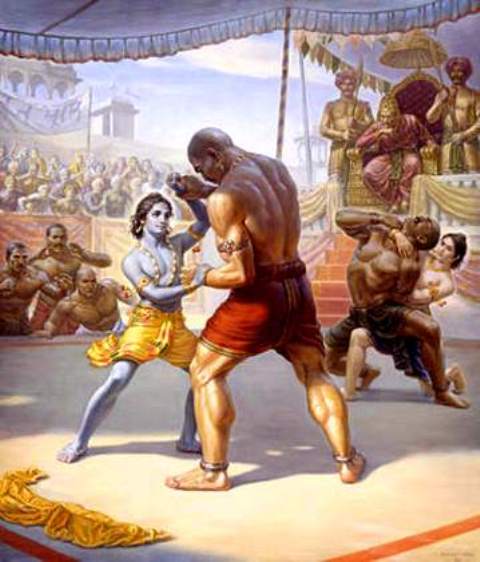
Who is there, desiring deliverance from the vices of the age of quarrel, who is not willing to hear the virtuous glories of the Lord?
His transcendental acts are magnificent and gracious, and great learned sages like Nārada sing of them. Please, therefore, speak to us, who are eager to hear about the adventures He performs in His various incarnations.
O wise Sūta, please narrate to us the transcendental pastimes of the Supreme Godhead’s multi-incarnations. Such auspicious adventures and pastimes of the Lord, the supreme controller, are performed by His internal powers.
We never tire of hearing the transcendental pastimes of the Personality of Godhead, who is glorified by hymns and prayers. Those who have developed a taste for transcendental relationships with Him relish hearing of His pastimes at every moment.
..There is a great difference between mundane stories, fiction, or history and the transcendental pastimes of the Lord. The histories of the whole universe contain references to the pastimes of the incarnations of the Lord. The Rāmāyaṇa, the Mahābhārata, and the Purāṇas are histories of bygone ages recorded in connection with the pastimes of the incarnations of the Lord and therefore remain fresh even after repeated readings. For example, anyone may read Bhagavad-gītā or the Śrīmad-Bhāgavatam repeatedly throughout his whole life and yet find in them new light of information. Mundane news is static whereas transcendental news is dynamic, inasmuch as the spirit is dynamic and matter is static. Those who have developed a taste for understanding the transcendental subject matter are never tired of hearing such narrations. (From Purport to SB 1.1.19)
Srimad Bhagavatam
By His Divine Grace A.C. Bhaktivedanta Swami Prabhupada
Canto 1, Chapter 1, Text 16-19
Full Text and Purport More
29 Jul 2012
by The Hare Krishna Movement
in People, Srimad Bhagavatam
Tags: A.C. Bhaktivedanta Swami Prabhupada, artists, Brahma, Candra, demigods, engineres, Indra, inventors, kings, leaders, learned scholars, politicians, powerful deities, scientists, Siva, Srimad Bhagavatam

…There are many powerful kings, leaders, learned scholars, scientists, artists, engineers, inventors, excavators, archaeologists, industrialists, politicians, economists, business magnates, and many more powerful deities or demigods like Brahmā, Śiva, Indra, Candra, Sūrya, Varuṇa and Marut, who are all protecting the interest of the universal affairs of maintenance, in different positions, and all of them are different powerful parts and parcels of the Supreme Lord.
The Supreme Lord Śrī Kṛṣṇa is the father of all living entities, who are placed in different high and low positions according to their desires or aspirations. Some of them, as particularly mentioned above, are specifically endowed with powers by the will of the Lord. A sane person must know for certain that a living being, however powerful he may be, is neither absolute nor independent. All living beings must accept the origin of their specific power as mentioned in this verse. And if they act accordingly, then simply by discharging their respective occupational duties they can achieve the highest perfection of life, namely eternal life, complete knowledge and inexhaustible blessings.
As long as the powerful men of the world do not accept the origin of their respective powers, namely the Personality of Godhead, the actions of māyā (illusion) will continue to act. The actions of māyā are such that a powerful person, misled by the illusory, material energy, wrongly accepts himself as all in all and does not develop God consciousness. As such, the false sense of egoism (namely myself and mine) has become overly prominent in the world, and there is a hard struggle for existence in human society. The intelligent class of men, therefore, must admit the Lord as the ultimate source of all energies and thus pay tribute to the Lord for His good blessings. Simply by accepting the Lord as the supreme proprietor of everything, since He is actually so, one can achieve the highest perfection of life.
More
28 Jul 2012
by The Hare Krishna Movement
in Shiva, Srimad Bhagavatam
Tags: A.C. Bhaktivedanta Swami Prabhupada, autumn season, blossoming petals of the lotus flower, darkness in the heart, effulgence, Krishna's lotus feet, Lord Siva, lotus feet, pada, padma, SB 4.25.52, Shiva, Srimad Bhagavatam, yasya deve para bhaktir
click on image to slightly enlarge
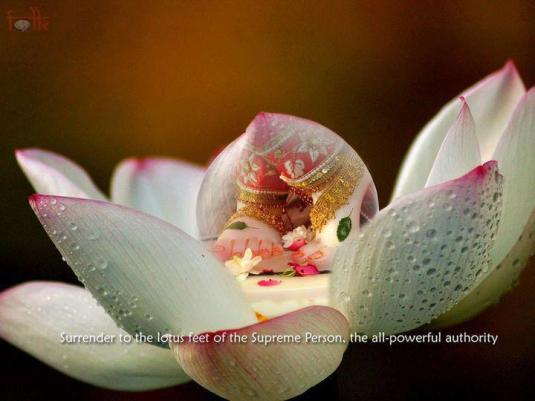
My dear Lord, Your two lotus feet are so beautiful that they appear like two blossoming petals of the lotus flower which grows during the autumn season. Indeed, the nails of Your lotus feet emanate such a great effulgence that they immediately dissipate all the darkness in the heart of a conditioned soul. My dear Lord, kindly show me that form of Yours which always dissipates all kinds of darkness in the heart of a devotee. My dear Lord, You are the supreme spiritual master of everyone; therefore all conditioned souls covered with the darkness of ignorance can be enlightened by You as the spiritual master.
Srimad Bhagavatam
By His Divine Grace A.C. Bhaktivedanta Swami Prabhupada
Canto Four, Chapter 25, Verse 52
Chanting the Song Sung by Lord Siva
More
16 Jul 2012
by The Hare Krishna Movement
in A.C. Bhaktivedanta Swami Prabhupada, Meditation, Srimad Bhagavatam, Visnu, Yoga
Tags: A.C. Bhaktivedanta Swami Prabhupada, Absolute Truth, impersonal conception of the Absolute Truth, Lord Visnu, material energy, pantheism, Personality of Godhead, Srimad Bhagavatam, Visnu
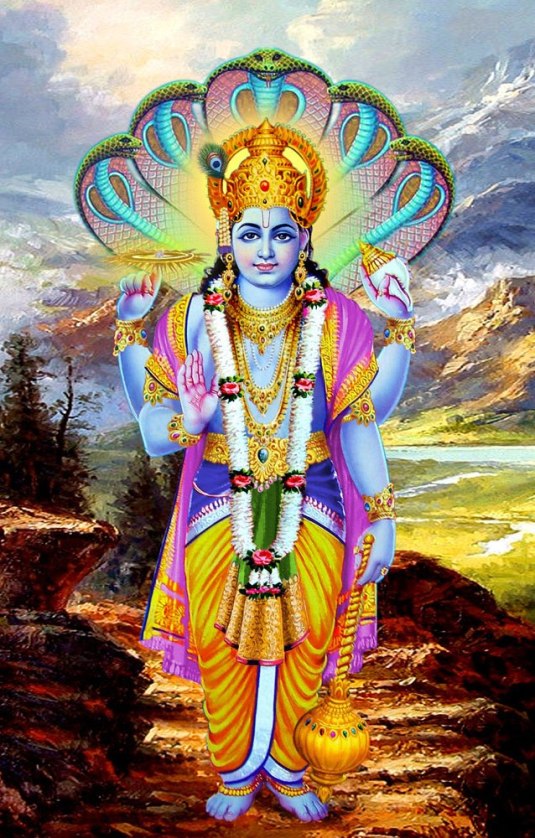
In our previous post Fix your mind upon the Supreme Personality of Godhead it was recommended that we should fix one’s mind in the service of the Personality of Godhead. Now the next step is to meditate upon the form of the Lord. To move from the impersonal to the more personal aspects of the Absolute Truth.
Thereafter, you should meditate upon the limbs of Viṣṇu, one after another, without being deviated from the conception of the complete body. Thus the mind becomes free from all sense objects. There should be no other thing to be thought upon. Because the Supreme Personality of Godhead, Viṣṇu, is the Ultimate Truth, the mind becomes completely reconciled in Him only.
…Therefore, thinking of Viṣṇu or meditating upon the transcendental form of Viṣṇu, specifically upon Lord Kṛṣṇa, is the last word on the subject of meditation.
…it is definitely assured that the Supreme Lord is not impersonal. He is a person, but His body is different from those of conditioned persons like us. Otherwise, meditation beginning from the praṇava (oṁkāra) up to the limbs of the personal body of Viṣṇu would not have been recommended by Śukadeva Gosvāmī for the attainment of complete spiritual perfection. The Viṣṇu forms of worship in great temples of India are not, therefore, arrangements of idol worship, as they are wrongly interpreted to be by a class of men with a poor fund of knowledge; rather, they are different spiritual centers of meditation on the transcendental limbs of the body of Viṣṇu. The worshipable Deity in the temple of Viṣṇu is identical with Lord Viṣṇu by the inconceivable potency of the Lord.
More
16 Jul 2012
by The Hare Krishna Movement
in A.C. Bhaktivedanta Swami Prabhupada, Meditation, Srimad Bhagavatam, Yoga
Tags: A.C. Bhaktivedanta Swami Prabhupada, God realization, meditation, Om, omkara, Personality of Godhead, pranava, SB 2.1.18, self realization, Srimad Bhagavatam, yoga

In our previous post Om, Oṁkāra, or the Praṇava, is the Seed of Transcendental Realization Oṁkāra, or the praṇava, which is the seed of transcendental realization, and it is composed of the three transcendental letters a-u-m, was discussed. By its chanting by the mind, in conjunction with the breathing process, was a means of changing the habit of the mind, to bring the mind under control. But in this next verse, Śukadeva Gosvāmī recommends the next step in God Realization, namely to fix one’s mind in the service of the Personality of Godhead.
Gradually, as the mind becomes progressively spiritualized, withdraw it from sense activities, and by intelligence the senses will be controlled. The mind too absorbed in material activities can be engaged in the service of the Personality of Godhead and become fixed in full transcendental consciousness.
More
09 Jul 2012
by The Hare Krishna Movement
in Chanting Hare Krishna, Hare Krishna Maha Mantra, Krishna Consciousness, Srimad Bhagavatam
Tags: A.C. Bhaktivedanta Swami Prabhupada, chanting Hare Krishna, devotional service, offenseless chanting and hearing, parikshit, Prabhupada books, Sri Sukadeva Goswami, Srimad Bhagavatam, The Hare Krishna Movement, transcendental chanting of the holy name
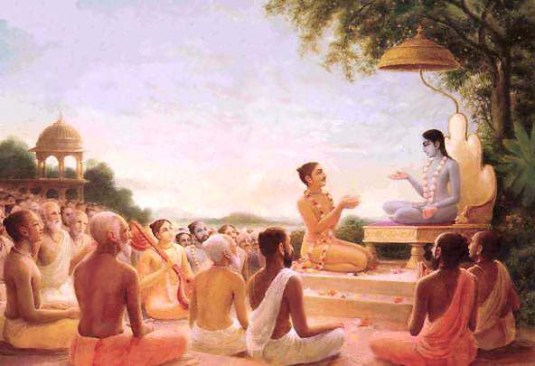
click on image to visit online store
…In this verse, Śrī Śukadeva Gosvāmī recommends the transcendental chanting of the holy name of the Lord. By offenseless chanting and hearing of the holy name of the Lord, one becomes acquainted with the transcendental form of the Lord, and then with the attributes of the Lord, and then with the transcendental nature of His pastimes, etc. Here it is mentioned that one should constantly chant the holy name of the Lord after hearing it from authorities. This means that hearing from the authorities is the first essential.
Anyone who hears Śrīmad-Bhāgavatam attentively from its bona fide reciter is sure to become a sincere devotee of the Lord, who is able to award liberation. There was none so attentive as Mahārāja Parīkṣit in the matter of hearing Śrīmad-Bhāgavatam, and there was none so qualified as Śukadeva Gosvāmī to recite the text of Śrīmad-Bhāgavatam. Therefore, anyone who follows in the footsteps of either the ideal reciter or the ideal hearer, Śukadeva Gosvāmī and Mahārāja Parīkṣit respectively, will undoubtedly attain salvation like them.
O King, constant chanting of the holy name of the Lord after the ways of the great authorities is the doubtless and fearless way of success for all, including those who are free from all material desires, those who are desirous of all material enjoyment, and also those who are self-satisfied by dint of transcendental knowledge.
Srimad Bhagavatam
By His Divine Grace A.C. Bhaktivedanta Swami Prabhupada
Second Canto, Chapter One, Text 10-11
The First Step in God Realization
More
25 Jun 2012
by The Hare Krishna Movement
in Bhagavad-gita, Salvation, Srimad Bhagavatam
Tags: A.C. Bhaktivedanta Swami Prabhupada, Arjuna, Battlefield of Kuruksetra, bhagavad-gita, Bhisma, liberation from material bondage, merciful glance, salvation, SB 1.9.35, Srimad Bhagavatam, The Passing Away of Bhismadeva in the Presence of Lord Krsna

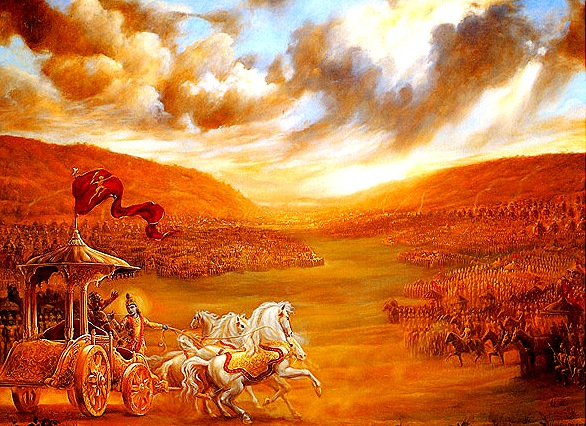
…The Lord diminished the duration of life of the opposite party by His merciful glance. It is said that all the fighters who assembled on the Battlefield of Kurukṣetra attained salvation by personally seeing the Lord at the time of death. Therefore, His diminishing the duration of life of Arjuna’s enemy does not mean that He was partial to the cause of Arjuna. Factually He was merciful to the opposite party because they would not have attained salvation by dying at home in the ordinary course of life. Here was a chance to see the Lord at the time of death and thus attain salvation from material life. Therefore, the Lord is all good, and whatever He does is for everyone’s good.
Srimad Bhagavatam
By His Divine Grace A.C. Bhaktivedanta Swami Prabhupada
Canto 1, Chapter 9, Text 35
The Passing Away of Bhismadeva in the Presence of Lord Krsna
sapadi sakhi-vaco niśamya madhye
nija-parayor balayo rathaṁ niveśya
sthitavati para-sainikāyur akṣṇā
hṛtavati pārtha-sakhe ratir mamāstu
sapadi—on the battlefield; sakhi-vacaḥ—command of the friend; niśamya—after hearing; madhye—in the midst; nija—His own; parayoḥ—and the opposite party; balayoḥ—strength; ratham—chariot; niveśya—having entered; sthitavati—while staying there; para-sainika—of the soldiers on the opposite side; āyuḥ—duration of life; akṣṇā—by looking over; hṛtavati—act of diminishing; pārtha—of Arjuna, son of Pṛthā (Kuntī); sakhe—unto the friend; ratiḥ—intimate relation; mama—my; astu—let there be.
In obedience to the command of His friend, Lord Śrī Kṛṣṇa entered the arena of the Battlefield of Kurukṣetra between the soldiers of Arjuna and Duryodhana, and while there He shortened the life spans of the opposite party by His merciful glance. This was done simply by His looking at the enemy. Let my mind be fixed upon that Kṛṣṇa.
Purport
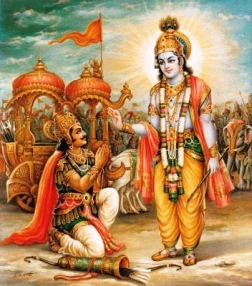
In the Bhagavad-gītā (1.21-25) Arjuna ordered the infallible Lord Śrī Kṛṣṇa to place his chariot between the phalanxes of the soldiers. He asked Him to stay there until he had finished observing the enemies he had to face in the battle. When the Lord was so asked, He at once did so, just like an order carrier. And the Lord pointed out all the important men on the opposite side, saying, “Here is Bhīṣma, here is Droṇa,” and so on. The Lord, being the supreme living being, is never the order supplier or order carrier of anyone, whoever he may be. But out of His causeless mercy and affection for His pure devotees, sometimes He carries out the order of the devotee like an awaiting servant. By executing the order of a devotee, the Lord becomes pleased, as a father is pleased to carry out the order of his small child. This is possible only out of pure transcendental love between the Lord and His devotees, and Bhīṣmadeva was quite aware of this fact. He therefore addressed the Lord as the friend of Arjuna.
More
17 Jun 2012
by The Hare Krishna Movement
in A.C. Bhaktivedanta Swami Prabhupada, Srimad Bhagavatam
Tags: A.C. Bhaktivedanta Swami Prabhupada, birds of the same feather, crows, goodness, passion, SB 1.5.10-11, Srimad Bhagavatam, swans, swans and crows

…Crows and swans are not birds of the same feather because of their different mental attitudes. The fruitive workers or passionate men are compared to the crows, whereas the all-perfect saintly persons are compared to the swans. The swans do not take pleasure in the places where crows are assembled for conferences and meetings. They are instead seen in the atmosphere of natural scenic beauty where there are transparent reservoirs of water nicely decorated with stems of lotus flowers in variegated colors of natural beauty. That is the difference between the two classes of birds.
Those words which do not describe the glories of the Lord, who alone can sanctify the atmosphere of the whole universe, are considered by saintly persons to be like unto a place of pilgrimage for crows. Since the all-perfect persons are inhabitants of the transcendental abode, they do not derive any pleasure there.
On the other hand, that literature which is full of descriptions of the transcendental glories of the name, fame, forms, pastimes, etc., of the unlimited Supreme Lord is a different creation, full of transcendental words directed toward bringing about a revolution in the impious lives of this world’s misdirected civilization. Such transcendental literatures, even though imperfectly composed, are heard, sung and accepted by purified men who are thoroughly honest.
… literatures which describe the glories of the Lord are enjoyed by the paramahaṁsas who have grasped the essence of human activities.
Srimad Bhagavatam
By His Divine Grace A.C. Bhaktivedanta Swami Prabhupada
Canto 1, Chapter 5, Texts 10-11
More
09 Jun 2012
by The Hare Krishna Movement
in Krishna, Srimad Bhagavatam
Tags: A.C, austerity, Bhaktivedanta Swami Prabhupada, goal of life, knowledge, Krishna, Personality of Godgead, revealed scriptures, sacrifices, SB 1.2.28-29, Sri Krsna, Srila Prabhupada, Srimad Bhagavatam, ultimate goal of life, Vasudeva, vasudeva-para veda, yoga
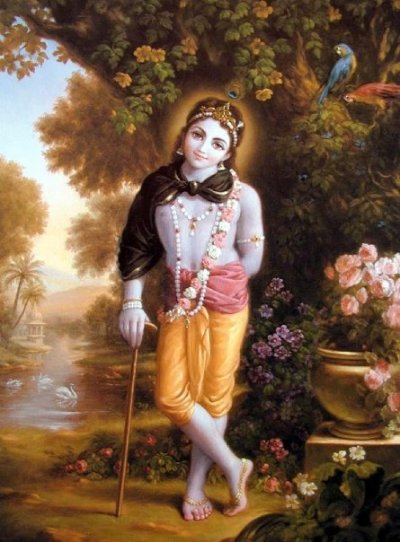
That Śrī Kṛṣṇa, the Personality of Godhead, is the only object of worship is confirmed in these two ślokas.
Srimad-Bhagavatam
By His Divine Grace A.C. Bhaktivedanta Swami Prabhupada
Canto 1, Chapter Two, Text 28-29
TEXTS 28-29
vāsudeva-parā vedā
vāsudeva-parā makhāḥ
vāsudeva-parā yogā
vāsudeva-parāḥ kriyāḥ
vāsudeva-paraṁ jñānaṁ
vāsudeva-paraṁ tapaḥ
vāsudeva-paro dharmo
vāsudeva-parā gatiḥ
vāsudeva—the Personality of Godhead; parāḥ—the ultimate goal; vedāḥ—revealed scriptures; vāsudeva—the Personality of Godhead; parāḥ—for worshiping; makhāḥ—sacrifices; vāsudeva—the Personality of Godhead; parāḥ—the means of attaining; yogāḥ—mystic paraphernalia; vāsudeva—the Personality of Godhead; parāḥ—under His control; kriyāḥ—fruitive activities; vāsudeva—the Personality of Godhead; param—the supreme; jñānam—knowledge; vāsudeva—the Personality of Godhead; param—best; tapaḥ—austerity; vāsudeva—the Personality of Godhead; paraḥ—superior quality; dharmaḥ—religion; vāsudeva—the Personality of Godhead; parāḥ—ultimate; gatiḥ—goal of life.
In the revealed scriptures, the ultimate object of knowledge is Śrī Kṛṣṇa, the Personality of Godhead. The purpose of performing sacrifice is to please Him. Yoga is for realizing Him. All fruitive activities are ultimately rewarded by Him only. He is supreme knowledge, and all severe austerities are performed to know Him. Religion [dharma] is rendering loving service unto Him. He is the supreme goal of life.
Purport
That Śrī Kṛṣṇa, the Personality of Godhead, is the only object of worship is confirmed in these two ślokas. In the Vedic literature there is the same objective: establishing one’s relationship and ultimately reviving our lost loving service unto Him. That is the sum and substance of the Vedas. In the Bhagavad-gītā the same theory is confirmed by the Lord in His own words: the ultimate purpose of the Vedas is to know Him only. All the revealed scriptures are prepared by the Lord through His incarnation in the body of Śrīla Vyāsadeva just to remind the fallen souls, conditioned by material nature, of Śrī Kṛṣṇa, the Personality of Godhead. No demigod can award freedom from material bondage. That is the verdict of all the Vedic literatures. Impersonalists who have no information of the Personality of Godhead minimize the omnipotency of the Supreme Lord and put Him on equal footing with all other living beings, and for this act such impersonalists get freedom from material bondage only with great difficulty. They can surrender unto Him only after many, many births in the culture of transcendental knowledge.
More
25 May 2012
by The Hare Krishna Movement
in Krishna Consciousness, Lectures, Practicing Krishna Consciousness at Home
Tags: A.C. Bhaktivedanta Swami Prabhupada, Bg 7.8, bhagavad-gita, everywhere is Krishna, I am the light of Sun and Moon, I am the taste of water, Krishna consciousness, raso ham apsu kunteya, remembering Krishna, simple meditation, Srila Prabhupada, Srimad Bhagavatam

…Thus when a devotee drinks water or any other liquid, he immediately remembers Kṛṣṇa. For a devotee there is no difficulty in awakening Kṛṣṇa consciousness twenty-four hours a day. If you simply drink water, and practice the simple meditation of remembering that Krishna says in the Bhagavad-gita 7.8 “raso ‘ham apsu kaunteya prabhāsmi śaśi-sūryayoḥ”, “I am the taste of water, the light of the sun and the moon”. It is easy to remember Krishna (God)
Is there any land within this universe where there is no sunshine, moonshine? Everywhere. So where is the difficulty to become Kṛṣṇa conscious? You are practicing meditation. Why not this simple meditation?
“How I can think of Kṛṣṇa constantly? Kṛṣṇa says that you think of Kṛṣṇa while drinking water, you think of Kṛṣṇa when you see the sunshine, think of Kṛṣṇa when you see the moonshine, day and night. So at daytime there is sunshine, at night there is moonshine. So day and night you can think of Kṛṣṇa. So, so many ways…
Because our only business is to remember Kṛṣṇa. That we can do any stage of life. It does not require that you have to become a brāhmaṇa, an Indian, and so on, so on, great learned scholar in Vedic scripture. No. You may be in the far away country, in Europe, America, or you may not be in brāhmaṇa family. It doesn’t matter. But you can remember Kṛṣṇa. We are teaching this art through Kṛṣṇa consciousness, that you may remain in whichever position Kṛṣṇa has put you. It doesn’t matter. But try to understand Kṛṣṇa. “How can I understand?” Well, you are drinking water. You can understand Kṛṣṇa. Where is the difficulty? Raso ‘ham apsu kaunteya [Bg. 7.8]. Kṛṣṇa says that “I am the taste of water.” Then where there is a person who does not drink water? Is there any land where people do not drink water? Is there any land?
So many ways we can remember Kṛṣṇa always.
A devotee who has purified his existence through devotional service sees only Kṛṣṇa in every step of life. (Paraphrased from Lecture by His Divine Grace A.C. Bhaktivedanta Swami Prabhupada given in Vrndavan India August 17, 1974)
Full Bhagavad-gita verse 7.8 and Lecture follow More
24 May 2012
by The Hare Krishna Movement
in Srimad Bhagavatam, Sukadeva Goswami
Tags: A.C. Bhaktivedanta Swami Prabhupada, householder, material contamination, material distinctions, spiritual vision, Srila Prabhupada, Srila Sukadeva Gosvami, Srila Vyasadeva, Srimad Bhagavatam, Sukadeva Goswami, Vyasadeva

When Vyasadeva was following his son, Srila Sukadeva Gosvami, they came upon some damsels bathing in a pond, Sukadeva was also naked, yet the maidens did not cover themselves when he passed by. However, they did cover themselves when the fully-clad Vyasadeva approached. Astonished at the apparently inconsistent behavior of the young girls, Vyasadeva asked them to explain. “Your son is purified of all material contamination,” they said, “so when he looks at us he makes no distinction between male and female. But as a householder, you do make such distinctions. Therefore, while we feel no shame before your son, we must cover ourselves before you.
More
13 May 2012
by The Hare Krishna Movement
in Srimad Bhagavatam
Tags: Mothers Day, Seven Mothers, Srila Prabhupada, Srimad Bhagavatam, sva-matrbhih, the cow, the earth, the nurse, the real mother, the wife of a brahmana, the wife of the king, the wife of the spiritual master

Here in the West Mothers Day is being celebrated; a day to honor our Mothers.
…According to scriptures also, there are seven mothers: (1) the real mother, (2) the wife of the spiritual master, (3) the wife of a brāhmaṇa, (4) the wife of the king, (5) the cow, (6) the nurse, and (7) the earth. All of them are mothers.
Srimad Bhagavatam
By His Divine Grace A.C. Bhaktivedanta Swaim Prabhupada
from Canto 1, Chapter 11, Text 28-
Seven Mothers
praviṣṭas tu gṛhaṁ pitroḥ
pariṣvaktaḥ sva-mātṛbhiḥ
vavande śirasā sapta
devakī-pramukhā mudā
praviṣṭaḥ—after entering; tu—but; gṛham—houses; pitroḥ—of the father; pariṣvaktaḥ—embraced; sva-mātṛbhiḥ—by His own mothers; vavande—offered obeisances; śirasā—His head; sapta—seven; devakī—Devakī; pramukhā—headed by; mudā—gladly.
After entering the house of His father, He was embraced by the mothers present, and the Lord offered His obeisances unto them by placing His head at their feet. The mothers were headed by Devakī [His real mother].
It appears that Vasudeva, the father of Lord Kṛṣṇa, had completely separate residential quarters where he lived with his eighteen wives, out of whom Śrīmatī Devakī is the real mother of Lord Kṛṣṇa. But in spite of this, all other stepmothers were equally affectionate to Him, as will be evident from the following verse. Lord Kṛṣṇa also did not distinguish His real mother from His stepmothers, and He equally offered His obeisances unto all the wives of Vasudeva present on the occasion. According to scriptures also, there are seven mothers: (1) the real mother, (2) the wife of the spiritual master, (3) the wife of a brāhmaṇa, (4) the wife of the king, (5) the cow, (6) the nurse, and (7) the earth. All of them are mothers. Even by this injunction of the śāstras, the stepmother, who is the wife of the father, is also as good as the mother because the father is also one of the spiritual masters. Lord Kṛṣṇa, the Lord of the universe, plays the part of an ideal son just to teach others how to treat their stepmothers.
More
08 May 2012
by The Hare Krishna Movement
in Devotional Service
Tags: A.C. Bhaktivedanta Swami Prabhupada, Akura, arcanam, Arjuna, atma-nivedanam, Bali Maharaja, dasyam, goddess of fortune, Hanuman, kirtanam, Laxmi, pada-sevanam, Pariksit Maharaja, Prahlada Maharaja, Prthu Maharaja, sakhyam, SB 7.5.23-24, sravanam, Srimad Bhagavatam, Sukadeva Goswami, vandanam, visnu smaranam

“Parīkṣit Mahārāja attained salvation simply by hearing, and Śukadeva Gosvāmī attained salvation simply by chanting. Prahlāda Mahārāja attained salvation by remembering the Lord. The goddess of fortune, Lakṣmīdevī, attained perfection by worshiping the Lord’s lotus feet. Pṛthu Mahārāja attained salvation by worshiping the Deity of the Lord. Akrūra attained salvation by offering prayers, Hanumān by rendering service, Arjuna by establishing friendship with the Lord, and Bali Mahārāja by offering everything to the service of the Lord.”
The Nine Processes of Devotional Service
They are described by Prahlada Maharaja in the 7th Canto of the Srimad Bhagavatam as follows:
To hear about Sri Visnu’s transcendental name, His form, His characteristics, His possessions and His pastimes and to hear and chant about His pastimes, to remember them, to serve the lotus feet of the Lord, to respectfully offer service to the Lord, to offer prayers to the Lord, to become His servant, to consider the Lord one’s best friend and to offer Him everything-these nine processes are recognized as pure devotional service.
1. HEARING (sravanam) Maharaja Pariksit(the last seven days of his life, he constantly heard the Srimad Bhagavatam).
2. CHANTING (kirtanam) Sukadeva Goswami(spoke the Bhagavatam to Maharaja Pariksit)
More
05 May 2012
by The Hare Krishna Movement
in Srimad Bhagavatam
Tags: A.C. Bhaktivedanta Swami, Absolute Truth, Bhaktivedanta purports, Krishna, Srila Prabhupada, Srimad Bhagavatam, The Supreme Personality of Godhead

…Forgetting Kṛṣṇa, we have created so many objects of questions and answers, but none of them are able to give us complete satisfaction. All things—but Kṛṣṇa—give temporary satisfaction only, so if we are to have complete satisfaction we must take to the questions and answers about Kṛṣṇa. We cannot live for a moment without being questioned or without giving answers. Because the Śrīmad-Bhāgavatam deals with questions and answers that are related to Kṛṣṇa, we can derive the highest satisfaction only by reading and hearing this transcendental literature.
Srimad Bhagavatam
By His Divine Grace A.C. Bhaktivedanta
Canto 1, Chapter 2, Text 5
munayaḥ sādhu pṛṣṭo ’haṁ
bhavadbhir loka-maṅgalam
yat kṛtaḥ kṛṣṇa-sampraśno
yenātmā suprasīdati
munayaḥ—O sages; sādhu—this is relevant; pṛṣṭaḥ—questioned; aham—myself; bhavadbhiḥ—by all of you; loka—the world; maṅgalam—welfare; yat—because; kṛtaḥ—made; kṛṣṇa—the Personality of Godhead; sampraśnaḥ—relevant question; yena—by which; ātmā—self; suprasīdati—completely pleased.
TRANSLATION
O sages, I have been justly questioned by you. Your questions are worthy because they relate to Lord Kṛṣṇa and so are of relevance to the world’s welfare. Only questions of this sort are capable of completely satisfying the self.
PURPORT
Since it has been stated hereinbefore that in the Bhāgavatam the Absolute Truth is to be known, the questions of the sages of Naimiṣāraṇya are proper and just, because they pertain to Kṛṣṇa, who is the Supreme Personality of Godhead, the Absolute Truth. In Bhagavad-gītā (15.15) the Personality of Godhead says that in all the Vedas there is nothing but the urge for searching after Him, Lord Kṛṣṇa. Thus the questions that pertain to Kṛṣṇa are the sum and substance of all the Vedic inquiries.
The whole world is full of questions and answers. The birds, beasts and men are all busy in the matter of perpetual questions and answers. In the morning the birds in the nest become busy with questions and answers, and in the evening also the same birds come back and again become busy with questions and answers. The human being, unless he is fast asleep at night, is busy with questions and answers. The businessmen in the market are busy with questions and answers, and so also the lawyers in the court and the students in the schools and colleges. The legislators in the parliament are also busy with questions and answers, and the politicians and the press representatives are all busy with questions and answers. Although they go on making such questions and answers for their whole lives, they are not at all satisfied. Satisfaction of the soul can only be obtained by questions and answers on the subject of Kṛṣṇa.
More
01 May 2012
by The Hare Krishna Movement
in Spiritual World, Srimad Bhagavatam
Tags: A.C. Bhaktivedanta Swami Prabhupada, bhagavate, Brahma, Devaki, Krishna, Krsna, om namo bhagavate vasudevaya, Personality of Godhead, primeval Lord, SB 1.1.1, Sri Krsna, Srimad Bhagavatam, Vasudeva, Vyasadeva

Śrīmad-Bhāgavatam:
by His Divine Grace A. C. Bhaktivedanta Swami Prabhupāda
Canto 1: “Creation”, Chapter 1, Text 1
Questions by the Sages
oṁ namo bhagavate vāsudevāya
janmādy asya yato ’nvayād itarataś cārtheṣv abhijñaḥ svarāṭ
tene brahma hṛdā ya ādi-kavaye muhyanti yat sūrayaḥ
tejo-vāri-mṛdāṁ yathā vinimayo yatra tri-sargo ’mṛṣā
dhāmnā svena sadā nirasta-kuhakaṁ satyaṁ paraṁ dhīmahi
om—O my Lord; namaḥ—offering my obeisances; bhagavate—unto the Personality of Godhead; vāsudevāya—unto Vāsudeva (the son of Vasudeva), or Lord Śrī Kṛṣṇa, the primeval Lord; janma-ādi—creation, sustenance and destruction; asya—of the manifested universes; yataḥ—from whom; anvayāt—directly; itarataḥ—indirectly; ca—and; artheṣu—purposes; abhijñaḥ—fully cognizant; sva-rāṭ—fully independent; tene—imparted; brahma—the Vedic knowledge; hṛdā—consciousness of the heart; yaḥ—one who; ādi-kavaye—unto the original created being; muhyanti—are illusioned; yat—about whom; sūrayaḥ—great sages and demigods; tejaḥ—fire; vāri—water; mṛdām—earth; yathā—as much as; vinimayaḥ—action and reaction; yatra—whereupon; tri-sargaḥ—three modes of creation, creative faculties; amṛṣā—almost factual; dhāmnā—along with all transcendental paraphernalia; svena—self-sufficiently; sadā—always; nirasta—negation by absence; kuhakam—illusion; satyam—truth; param—absolute; dhīmahi—I do meditate upon.
TRANSLATION
O my Lord, Śrī Kṛṣṇa, son of Vasudeva, O all-pervading Personality of Godhead, I offer my respectful obeisances unto You. I meditate upon Lord Śrī Kṛṣṇa because He is the Absolute Truth and the primeval cause of all causes of the creation, sustenance and destruction of the manifested universes. He is directly and indirectly conscious of all manifestations, and He is independent because there is no other cause beyond Him. It is He only who first imparted the Vedic knowledge unto the heart of Brahmājī, the original living being. By Him even the great sages and demigods are placed into illusion, as one is bewildered by the illusory representations of water seen in fire, or land seen on water. Only because of Him do the material universes, temporarily manifested by the reactions of the three modes of nature, appear factual, although they are unreal. I therefore meditate upon Him, Lord Śrī Kṛṣṇa, who is eternally existent in the transcendental abode, which is forever free from the illusory representations of the material world. I meditate upon Him, for He is the Absolute Truth.
PURPORT
Obeisances unto the Personality of Godhead, Vāsudeva, directly indicate Lord Śrī Kṛṣṇa, who is the divine son of Vasudeva and Devakī. This fact will be more explicitly explained in the text of this work. Śrī Vyāsadeva asserts herein that Śrī Kṛṣṇa is the original Personality of Godhead, and all others are His direct or indirect plenary portions or portions of the portion. Śrīla Jīva Gosvāmī has even more explicitly explained the subject matter in his Kṛṣṇa-sandarbha. And Brahmā, the original living being, has explained the subject of Śrī Kṛṣṇa substantially in his treatise named Brahma-saṁhitā. In the Sāma-veda Upaniṣad, it is also stated that Lord Śrī Kṛṣṇa is the divine son of Devakī. Therefore, in this prayer, the first proposition holds that Lord Śrī Kṛṣṇa is the primeval Lord, and if any transcendental nomenclature is to be understood as belonging to the Absolute Personality of Godhead, it must be the name indicated by the word Kṛṣṇa, which means the all-attractive. In Bhagavad-gītā, in many places, the Lord asserts Himself to be the original Personality of Godhead, and this is confirmed by Arjuna, and also by great sages like Nārada, Vyāsa, and many others. In the Padma Purāṇa, it is also stated that out of the innumerable names of the Lord, the name of Kṛṣṇa is the principal one. Vāsudeva indicates the plenary portion of the Personality of Godhead, and all the different forms of the Lord, being identical with Vāsudeva, are indicated in this text. The name Vāsudeva particularly indicates the divine son of Vasudeva and Devakī. Śrī Kṛṣṇa is always meditated upon by the paramahaṁsas, who are the perfected ones among those in the renounced order of life.
More
30 Apr 2012
by The Hare Krishna Movement
in Ganges, Holy Places of Pilgrimage, Srimad Bhagavatam
Tags: cleansed of all dirty things, Ganges, Ganges River, holy ganges river, krsna consciousness, Maharaja Prthu, SB . 4. 21. 31, spiritual progress, Srila Prabhupada, Srimad Bhagavatam

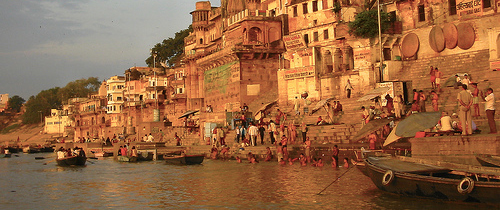
Ganges River at Varanasi India
Srimad-Bhagavatam
By His Divine Grace A.C. Bhaktivedanta Swami Prabhupada
Canto 4, Chapter 21, Text 31
Instructions by Maharaja Prthu
yat-pāda-sevābhirucis tapasvinām
aśeṣa-janmopacitaṁ malaṁ dhiyaḥ
sadyaḥ kṣiṇoty anvaham edhatī satī
yathā padāṅguṣṭha-viniḥsṛtā sarit
yat-pāda—whose lotus feet; sevā—service; abhiruciḥ—inclination; tapasvinām—persons undergoing severe penances; aśeṣa—innumerable; janma—birth; upacitam—acquire; malam—dirtiness; dhiyaḥ—mind; sadyaḥ—immediately; kṣiṇoti—destroys; anvaham—day after day; edhatī—increasing; satī—being; yathā—as; pada-aṅguṣṭha—the toes of His lotus feet; viniḥsṛtā—emanating from; sarit—water.
By the inclination to serve the lotus feet of the Supreme Personality of Godhead, suffering humanity can immediately cleanse the dirt which has accumulated in their minds during innumerable births. Like the Ganges water, which emanates from the toes of the lotus feet of the Lord, such a process immediately cleanses the mind, and thus spiritual or Kṛṣṇa consciousness gradually increases.
In India, one can actually see that a person who takes a bath in the Ganges waters daily is almost free from all kinds of diseases. A very respectable brāhmaṇa in Calcutta never took a doctor’s medicine. Even though he sometimes felt sick, he would not accept medicine from the physician but would simply drink Ganges water, and he was always cured within a very short time. The glories of Ganges water are known to Indians and to ourselves also.
More
29 Apr 2012
by The Hare Krishna Movement
in Rama
Tags: A.C. Bhaktivedanta Swami Prabhupada, goddess of fortune, Laksmiji, Lord Ramachandra, Ravana, Sita, sita rama, Sitaji, Sri Ramacandra, Srimad Bhagavatam

In honor of the Appearance Day of Sita Devi, Wife of Lord Ramachandra, we post a short excerpt from Srila Prabhupada’s Srimad Bhagavatam.
…Sītā is Lakṣmījī, or the goddess of fortune, but she is never to be enjoyed by any living being. She is meant for being worshiped by the living being along with her husband, Śrī Rāmacandra. A materialistic man like Rāvaṇa does not understand this great truth, but on the contrary he wants to snatch Sītādevī from the custody of Rāma and thus incurs great miseries. The materialists, who are after opulence and material prosperity, may take lessons from the Rāmāyaṇa that the policy of exploiting the nature of the Lord without acknowledging the supremacy of the Supreme Lord is the policy of Rāvaṇa. Rāvaṇa was very advanced materially, so much so that he turned his kingdom, Laṅkā, into pure gold, or full material wealth. But because he did not recognize the supremacy of Lord Rāmacandra and defied Him by stealing His wife, Sītā, Rāvaṇa was killed, and all his opulence and power were destroyed.
Srimad Bhagavatam
By His Divine Grace A.C. Bhaktivedanta Swami Prabhupada
Canto 2, Chapter 7, Text 23
Scheduled Incarnations with Specific Functions
asmat-prasāda-sumukhaḥ kalayā kaleśa
ikṣvāku-vaṁśa avatīrya guror nideśe
tiṣṭhan vanaṁ sa-dayitānuja āviveśa
yasmin virudhya daśa-kandhara ārtim ārcchat
asmat—unto us, beginning from Brahmā down to the insignificant ant; prasāda—causeless mercy; sumukhaḥ—so inclined; kalayā—with His plenary extensions; kaleśaḥ—the Lord of all potencies; ikṣvāku—Mahārāja Ikṣvāku, in the dynasty of the sun; vaṁśe—family; avatīrya—by descending in; guroḥ—of the father or spiritual master; nideśe—under the order of; tiṣṭhan—being situated in; vanam—in the forest; sa-dayitā-anujaḥ—along with His wife and younger brother; āviveśa—entered; yasmin—unto whom; virudhya—being rebellious; daśa-kandharaḥ—Rāvaṇa, who had ten heads; ārtim—great distress; ārcchat—achieved.
Due to His causeless mercy upon all living entities within the universe, the Supreme Personality of Godhead, along with His plenary extensions, appeared in the family of Mahārāja Ikṣvāku as the Lord of His internal potency, Sītā. Under the order of His father, Mahārāja Daśaratha, He entered the forest and lived there for considerable years with His wife and younger brother. Rāvaṇa, who was very materially powerful, with ten heads on his shoulders, committed a great offense against Him and was thus ultimately vanquished.
More
22 Apr 2012
by The Hare Krishna Movement
in Devotional Service, Krishna Consciousness, Vaisnava-aparadha
Tags: bhakti creeper, His Divine Grace A.C. Bhaktivedanta Swami Prabhupada, Krsna consciousness becomes polluted by material activities, laws of nature, Lord Krsna, mad elephant offense, offending a brahmana, offending a vaisnava, pure consciousness, Srimad Bhagavatam, vaiṣṇava-aparādha, Vaisnavas

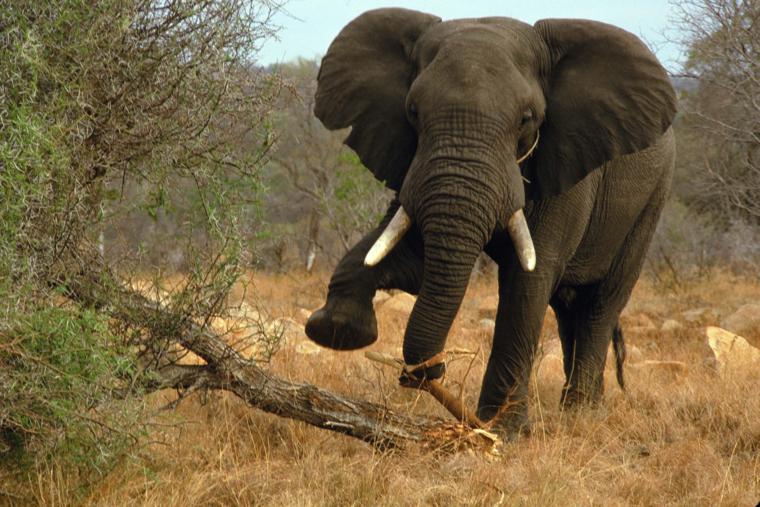
Sometimes we see that devotees, even though they are following the rules and regulations, appear not to be making very much spiritual advancement. Often we see that they appear to be going backwards rather than forward in their devotional lives. This is often the case of “the mad elephant offense” or vaisnava-aparadha, which can stop or destroy their devotional career, and should be carefully avoided. We have included a few select verses from Srila Prabhupada’s Srimad Bhagavatam which support this statement.
…To commit an offense against a devotee is very dangerous in devotional service. Lord Caitanya therefore said that an offense to a devotee is just like a mad elephant run loose; when a mad elephant enters a garden, it tramples all the plants. Similarly, an offense unto the feet of a pure devotee murders one’s position in devotional service…
…One’s pure intelligence, or pure Kṛṣṇa consciousness, becomes polluted by material activities. Pure consciousness can be revived by the process of sacrifice, charity, pious activities, etc., but when one pollutes his Kṛṣṇa consciousness by offending a brāhmaṇa or a Vaiṣṇava, it is very difficult to revive. Śrī Caitanya Mahāprabhu has described the vaiṣṇava-aparādha, or offense to a Vaiṣṇava, as “the mad elephant offense.” One should be very careful not to offend a Vaiṣṇava or a brāhmaṇa…
Srimad Bhagavatam 3.15.39
kṛtsna-prasāda-sumukhaṁ spṛhaṇīya-dhāma
snehāvaloka-kalayā hṛdi saṁspṛśantam
śyāme pṛthāv urasi śobhitayā śriyā svaś-
cūḍāmaṇiṁ subhagayantam ivātma-dhiṣṇyam
The Lord is the reservoir of all pleasure. His auspicious presence is meant for everyone’s benediction, and His affectionate smiling and glancing touch the core of the heart. The Lord’s beautiful bodily color is blackish, and His broad chest is the resting place of the goddess of fortune, who glorifies the entire spiritual world, the summit of all heavenly planets. Thus it appeared that the Lord was personally spreading the beauty and good fortune of the spiritual world.
Purport
When the Lord came, He was pleased with everyone; therefore it is stated here, kṛtsna-prasāda-sumukham. The Lord knew that even the offensive doormen were His pure devotees, although by chance they committed an offense at the feet of other devotees. To commit an offense against a devotee is very dangerous in devotional service. Lord Caitanya therefore said that an offense to a devotee is just like a mad elephant run loose; when a mad elephant enters a garden, it tramples all the plants. Similarly, an offense unto the feet of a pure devotee murders one’s position in devotional service. On the part of the Lord there was no offended mood because He does not accept any offense created by His sincere devotee. But a devotee should be very cautious of committing offenses at the feet of another devotee. The Lord, being equal to all, and being especially inclined to His devotee, looked as mercifully at the offenders as at the offended. This attitude of the Lord was due to His unlimited quantity of transcendental qualities. His cheerful attitude towards the devotees was so pleasing and heart-touching that His very smile was attractive for them. That attraction was glorious not only for all the higher planets of this material world, but beyond, for the spiritual world also. Generally a human being has no idea of what the constitutional position is in the higher material planets, which are far better constituted in regard to all paraphernalia, yet the Vaikuṇṭha planet is so pleasing and so celestial that it is compared to the middle jewel or locket in a necklace of jewels.
More
29 Mar 2012
by The Hare Krishna Movement
in Krsna is the Source of All Incarnations, Rama
Tags: A.C. Bhaktivedanta Swami Prabhupada, Hanuman, Rama, Ravana, Sita, Sri Rama, Srimad Bhagavatam, The Pewrsonality of Godhead

Srimad Bhagavatam
By His Divine Grace A.C. Bhaktivedanta Swami Prabhupada
Canto 1, Chapter 3, Text 22
Krsna Is the Source of All Incarnations
nara-devatvam āpannaḥ
sura-kārya-cikīrṣayā
samudra-nigrahādīni
cakre vīryāṇy ataḥ param
nara—human being; devatvam—divinity; āpannaḥ—having assumed the form of; sura—the demigods; kārya—activities; cikīrṣayā—for the purpose of performing; samudra—the Indian Ocean; nigraha-ādīni—controlling, etc.; cakre—did perform; vīryāṇi—superhuman prowess; ataḥ param—thereafter.
In the eighteenth incarnation, the Lord appeared as King Rāma. In order to perform some pleasing work for the demigods, He exhibited superhuman powers by controlling the Indian Ocean and then killing the atheist King Rāvaṇa, who was on the other side of the sea.
Purport
The Personality of Godhead Śrī Rāma assumed the form of a human being and appeared on the earth for the purpose of doing some pleasing work for the demigods or the administrative personalities to maintain the order of the universe. Sometimes great demons and atheists like Rāvaṇa and Hiraṇyakaśipu and many others become very famous due to advancing material civilization by the help of material science and other activities with a spirit of challenging the established order of the Lord. For example, the attempt to fly to other planets by material means is a challenge to the established order. The conditions of each and every planet are different, and different classes of human beings are accommodated there for particular purposes mentioned in the codes of the Lord. But, puffed up by tiny success in material advancement, sometimes the godless materialists challenge the existence of God. Rāvaṇa was one of them, and he wanted to deport ordinary men to the planet of Indra (heaven) by material means without consideration of the necessary qualifications. He wanted a staircase to be built up directly reaching the heavenly planet so that people might not be required to undergo the routine of pious work necessary to enter that planet. He also wanted to perform other acts against the established rule of the Lord. He even challenged the authority of Śrī Rāma, the Personality of Godhead, and kidnapped His wife, Sītā. Of course Lord Rāma came to chastise this atheist, answering the prayer and desire of the demigods. He therefore took up the challenge of Rāvaṇa, and the complete activity is the subject matter of the Rāmāyaṇa. Because Lord Rāmacandra was the Personality of Godhead, He exhibited superhuman activities which no human being, including the materially advanced Rāvaṇa, could perform. Lord Rāmacandra prepared a royal road on the Indian Ocean with stones that floated on the water. The modern scientists have done research in the area of weightlessness, but it is not possible to bring in weightlessness anywhere and everywhere. But because weightlessness is the creation of the Lord by which He can make the gigantic planets fly and float in the air, He made the stones even within this earth to be weightless and prepared a stone bridge on the sea without any supporting pillar. That is the display of the power of God.
Previous Older Entries Next Newer Entries