This morning I was thinking about the different relationships one can have with the Lord. In “The Nectar of Devotion”, Srila Prabhupada describes the five primary kinds of devotional service-namely, neutrality, servitude, fraternity, parenthood and conjugal love.Over the course of the next five posts, I want to explore these five primary relationships.
But for today, I want to start with this nice verse from the Bhagavad-gita, where these five types of relationships are mentioned in purport.
For one who remembers Me without deviation, I am easy to obtain, O son of Pṛthā, because of his constant engagement in devotional service. (Bg 8.14)
…Bhakti-yoga is very simple and pure and easy to perform. One can begin by simply chanting Hare Kṛṣṇa. Kṛṣṇa is very merciful to those who engage in His service, and He helps in various ways that devotee who is fully surrendered to Him so he can understand Him as He is. The Lord gives such a devotee sufficient intelligence so that ultimately the devotee can attain Him in His spiritual kingdom.
…Generally, the bhakti-yogīs are engaged in five different ways: 1) śānta-bhakta, engaged in devotional service in neutrality; 2) dāsya-bhakta, engaged in devotional service as servant; 3) sākhya-bhakta, engaged as friend; 4) vātsalya-bhakta, engaged as parent; and 5) mādhurya-bhakta, engaged as conjugal lover of the Supreme Lord. (from purport)
Ever since I was a small child, I have been attracted to the statue of Buddha. Don’t know why, but I had a statue of Buddha in my bedroom, and it was a Christian home. I didn’t really know about Krishna then or who the Buddha was…but I was so attracted to everything Eastern. As I learned latter in life Buddha was actually an incarnation of Krsna. “From the Bhāgavatam we understand that Lord Buddha is the incarnation of Kṛṣṇa who appeared when materialism was rampant and materialists were using the pretext of the authority of the Vedas.” (from purport Bg 4.7)
The Four Noble Truths & The Eightfold Path
The Four Noble Truths
The Buddha’s first sermon after his Enlightenment centered on the Four Noble Truths, which are the foundation of Buddhism. The truths are:
The truth of suffering (dukkha) The truth of the cause of suffering (samudaya) The truth of the end of suffering (nirhodha) The truth of the path that frees us from suffering (magga)
…”Everyone and everything is attracted to Kṛṣṇa–that is the perfect description of Kṛṣṇa’s attraction. The example of the gopīs is very instructive to persons who are trying to be absorbed in Kṛṣṇa consciousness. One can very easily associate with Kṛṣṇa simply by remembering His transcendental pastimes. Everyone has a tendency to love someone. That Kṛṣṇa should be the object of love is the central point of Kṛṣṇa consciousness. By constantly chanting the Hare Kṛṣṇa mantra and remembering the transcendental pastimes of Kṛṣṇa, one can be fully in Kṛṣṇa consciousness and thus make his life sublime and fruitful.”
Kṛṣṇa, The Supreme Personality of Godhead By His Divine Grace A. C. Bhaktivedanta Swami Prabhupada Vol. 1, Chapter 34
The Gopīs’ Feelings of Separation
The gopīs of Vṛndāvana were so attached to Kṛṣṇa that they were not satisfied simply with the rāsa dance at night. They wanted to associate with Him and enjoy His company during the daytime also. When Kṛṣṇa went to the forest with His cowherd boy friends and cows, the gopīs did not physically take part, but their hearts went with Him. And because their hearts went, they were able to enjoy His company through strong feelings of separation. To acquire this strong feeling of separation is the teaching of Lord Caitanya and His direct disciplic succession of Gosvāmīs. When we are not in physical contact with Kṛṣṇa, we can associate with Him like the gopīs, through feelings of separation. Kṛṣṇa’s transcendental form, qualities, pastimes, and entourage are all identical with Him. There are nine different kinds of devotional service. Devotional service to Kṛṣṇa in feelings of separation elevates the devotee to the highest perfectional level, to the level of the gopīs.
At various times people have called him a scholar, a philosopher, a cultural ambassador, a prolific author, a religious leader, a spiritual teacher, a social critic, and a holy man. In truth, he was all these things and more.
Over five hundred years ago, Lord Sri Krishna appeared as Sri Chaitanya Mahaprabhu in Navadvipa, a village in West Bengal. The purpose of His appearance was to inaugurate the Sankirtana Movement, the Yuga Dharma for this age of Kali. He declared that the chanting of His holy names would spread beyond the shores of India to every town and village in the world. He predicted that His commander-in-chief would appear to accomplish this mission.
Yes… Srila Prabhupada appeared to fulfill this prophecy.
Well the Golden Jubilee at Krishna Balarama Mandir is over, and its time for many of us to return to their respective homes. The above photo are the Prabhupada disciples, sannayasi’s, and other participants, taken on the last day of festival. Many thanks to the management and festival organizers, as well as all the Vrindavan residents who helped make this a memorable occasion.
The Sri Sri Krishna Balaram Mandir, situated in the Raman Reti area of Vrindavan, holds a special significance for the devotees of the International Society for Krishna Consciousness. This grand temple represents the fulfilled dream of Srila Prabhupada, Founder Acharya of ISKCON, who wished to construct a temple of unparalleled beauty for the worship of the transcendental brothers Krishna and Balaram in the same village where They played more than five thousand years ago. Srila Prabhupada directly oversaw all the aspects of design and construction and personally called the Lord to come and accept the worship of His devotees from around the world. He said, “Lord Balaram is the source of spiritual strength, and I have built this temple just to give strength to the devotees”.
Today, the Sri Sri Krishna Balaram Mandir is a booming spiritual center. Every day of the week pilgrims flood in the gate in great numbers from all over the world. In fact, the large green government signs posted over the highway turn off to Vrindavan only give directions to two temples: Banke Bihari and ISKCON.
Recently, while discussing Srila Prabhupada and his glories with a younger devotee, I was surprised to hear him say, “You’re so lucky. You got Srila Prabhupada, but what about us?” Startled by hearing such a despondent remark by a newcomer who should be brimming with hope and enthusiasm in Krsna consciousness, I proceeded to explain that Srila Prabhupada is, in fact, as present now as he has ever been. Throughout his books, letters and conversations, Srila Prabhupada emphasized this point again and again, so there should be no cause for misunderstanding.
In 1975, when asked by a reporter in Berkeley what would happen to the movement after his departure, Srila Prabhupada replied, “I will never die. I will live forever in my books.” In the Caitanya-caritamrta (Adi-lila 1.35, purport), Srila Prabhupada explains, “There is no difference between the spiritual master’s instructions and the spiritual master himself.” Further assuring us all, Prabhupada spoke the following words just prior to his departure in 1977: “If I depart, there is no cause for lamentation. I will always be with you through my books and my orders. I will always remain with you in that way.”
I have been reading the Krsna Book lately, and just yesterday we were reading chapter 14 “Prayers Offered by Lord Brahma to Lord Krsna”, and I was reminded this was the last chapter Srila Prabhupada was working on in the Srimad Bhagavatam series before his passing. So I had another look at the Tenth Canto, part 3, and thought it a good idea to share it with all our readers.
This is the final Śrīmad-Bhāgavatam volume translated by His Divine Grace A. C. Bhaktivedanta Swami Prabhupada, Founder-Acarya of the International Society for Krishna Consciousness, before his untimely departure. We share it with you as a free PDF download. You can click on the above link to view the complete volume or save it to your computer.
Foward
This is the final Śrīmad-Bhāgavatam volume translated by His Divine Grace A. C. Bhaktivedanta Swami Prabhupada, founder-acarya of the International Society for Krishna Consciousness. It is smaller than the earlier volumes because it ends where the renowned author stopped translating just before his departure from this mortal world on November 14, 1977, at the Krsna-Balarama Mandira in Vrndavana, India.
The first part of this volume was produced in the usual fashion. Srila Prabhupada would sit and read silently from the Sanskrit text and then speak the translation and commentary into his dictaphone. Later, due to illness, it became necessary for his disciples to assist him personally.
In these last days Srila Prabhupada was gravely ill. Unable to eat for weeks, his health had deteriorated, making even the slightest movement excruciatingly painful.
As he lay still, a devotee would softly read the Sanskrit to him. Another disciple, sitting on his bed, held the microphone to him, nearly touching his mouth. And then Srila Prabhupada would speak, voice sometimes barely audible.
These recordings, made in his quarters at the temple, constitute the balance of this book.
In these final moments, the physician attending His Divine Grace confided that an ordinary man in such critical condition would have been crying out from the intense pain. Srila Prabhupada’s disciples were awestruck as they watched their spiritual master work quietly, undisturbed.
In the last part of the book we find Srila Prabhupada’s usual clarity of thought, constant scriptural references, scrupulous attention to detail, and rigorous philosophical exposition fully intact, just as they were in the preceding twenty-nine volumes of the Śrīmad-Bhāgavatam.
Srila Prabhpada’s last days and this translation will stands an inspiring reminder that even the severest material circumstances cannot impede the activities of a pure devotee of the Supreme Personality of Godhead.
We are currently in Vrindavan, India, at the Krsna Balaram Mandir, with the most beautiful Radha Shyam. All the deities looked so gorgeous this morning, in their black outfits.
Have been doing the parikaram of the twelve forests of Vrindavan, and it has been amazing, and feel exceptional fortune, at being here, and experiencing so much devotional nectar.
I wish to share some from the Preface to the”Nectar of Devotion” By A. C. Bhaktivedanta Swami:
The basic principle of the living condition is that we have a general propensity to love someone. No one can live without loving someone else. This propensity is present in every living being. Even an animal like a tiger has this loving propensity at least in a dormant stage, and it is certainly present in the human beings. The missing point, however, is where to repose our love so that everyone can become happy. At the present moment the human society teaches one to love his country or family or his personal self, but there is no information where to repose the loving propensity so that everyone can become happy. That missing point is Krsna, and The Nectar of Devotion teaches us how to stimulate our original love for Krsna and how to be situated in that position where we can enjoy our blissful life.
“I liked Prabhupada’s humbleness. I always liked his humility and his simplicity. The servant of the servant of the servant is really what it is, you know. None of us are God—just His servants. He just made me feel so comfortable. I always felt very relaxed with him, and I felt more like a friend. I felt that he was a good friend. Even though he was at the time seventy-nine years old, working practically all through the night, day after day, with very little sleep, he still didn’t come through to me as though he was a very highly educated intellectual being, because he had a sort of childlike simplicity. Which is great, fantastic. Even though he was the greatest Sanskrit scholar and a saint, I appreciated the fact that he never made me feel uncomfortable. In fact, he always went out of his way to make me feel comfortable. I always thought of him as sort of a lovely friend, really, and now he’s still a lovely friend.
“That was the thing about Prabhupada, you see. He didn’t just talk about loving Krishna and getting out of this place, but he was the perfect example. He talked about always chanting, and he was always chanting. I think that that in itself was perhaps the most encouraging thing for me. It was enough to make me try harder, to be just a little bit better. He was a perfect example of everything he preached.
We are currently in Vrindavan, India, doing the twelve day Parikrama of the forests of Vrindavan. We have visited many Holy sites, and have had Darshana with so beautiful deities, and gotten water sprinkled on us, from many sacred Kunds (ponds, bathing sites). It has been a wonderful trip thus far, although the traffic, and dust, has been rather exhausting. Hare Krishna! -V
The 12 principal forests of Vraja
The 12 principal forests of Vraja, where Krishna and Radha are said to have performed their divine pastimes, are Madhuvana, Talavana, Kumudavana, Bhulavana, Kamyavana, Khadiravana, Vrindavana, Bhadravana, Bhandiravana, Baelvana, Lohavana, and Madhavana.
Seven forests on the west side of the Yamuna River:
Madhuvana, Talavana, Kumudavana, Bahulavana, Kamyavana, Khadiravana, and Vrindavana.
Five forests on the east side of the Yamuna River:
Bhadravana, Bhandiravana, Baelvana, Lohavana, and Mahavana.
Significance:
These forests are considered sacred and are revered places of pilgrimage for devotees.
Remembering Jayananda by Vyasasan das __________________
There are some things about becoming a devotee I will never forget, for instance; receiving my first book, relishing my first plate of prasadam, seeing the deities in the temple for the first time, meeting Srila Prabhupada, Visnujhana Swami and Jayananda das bramachari.
The first time I meet Jayananda, was in 1975 in San Diego. I had been traveling with the RDTSKP for the last few months, since I joined. I was very much enjoying being a devotee, and traveling and putting on festivals, distributing prasadam, books and the Holy Name. By this time I had meet a number of Sannyasis; including Tamal Krsna Goswami, Gurudas Swami, Tripuari Swami, Vishnujana Swami, etc. and was very impressed by their character, and position.
One morning after Bhagavatam class we were all sitting down on the floor taking our breakfast. I was looking over at all the assembled sannyasis; there must have been seven of them eating together. They all had on nice orange clothing, and were eating off beautiful silver plates, and I was thinking, “Ya, that’s what I want. I want to be a Hare Krishna Sannyasa. Devotees will offer me respectful obeisances when they see me, and I will always get the best accommodations and best prasadam”. So I was thinking like this… when in walks in this guy in a greasy hooded sweatshirt, ripped doti, hands and face covered with dirt and grease, (it turns out he just changed the oil in 6 sankirtan vans), and he walks over to the prasadam table and starts filling a plate.
So I ask the devotee sitting next to me, “Who is that guy, is he supposed to be here?” I thought it was some bum wearing a dhoti. But the devotee replied; “Oh, that’s Jayananda Prabhu, he’s a really advanced devotee”. Well I was looking at Jayananda who was eagerly feasting on the morning prasadam, and I was looking over at the sannyasis who were carefully moving the prasadam around the silver plates, and I just wasn’t that sure?
Today we visited Radha Kund, as well as many other places of pilgrimage in Vraja; the district of Vrindavan. We were greatly surprised at how everything around Krishna Balarama Mandir, has grown and changed. So much construction, so many more people, and worst, so many motorized vehicile’s. I took some pictures of Radha Kund today, which I will share at bottom of post.
Rādhā-kuṇḍa
It is stated that a devotee will at once develope pure love of Kṛṣṇa in the wake of the gopīs if he once takes a bath in Rādhā-kuṇḍa.
We spent the last week at the Sri Sri Radha Madhava Temple in Mayapur. It was an incredible week! Bathing Lord Caitanya Mahaprabhu on His Appearance Day, attending aroti at Srila Prabhupada’s Samadhi, Guru-puja at temple, etc. but the take away for me was the Radha Madhava altar. To see Radha and Krishna surrounded by the beautiful Ashtasakhi’s (the 8 principle gopis) was a sight to behold. And I wanted to know more about these beautiful personality’s.
The list of Ashtasakhi include: Lalita, Vishaka, Champaklata, Chitra, Tungavidhya, Induleka, Rangadevi, and Sudevi. All of these eight prominent gopis are regarded to be an expansion of Radha, the chief consort of Krishna.
Srimati Radharani is considered the topmost devotee of Lord Krishna, His eternal consort, and the root of pure, selfless devotion, embodying the supreme devotional Bliss of seeking Krishna’s pleasure.
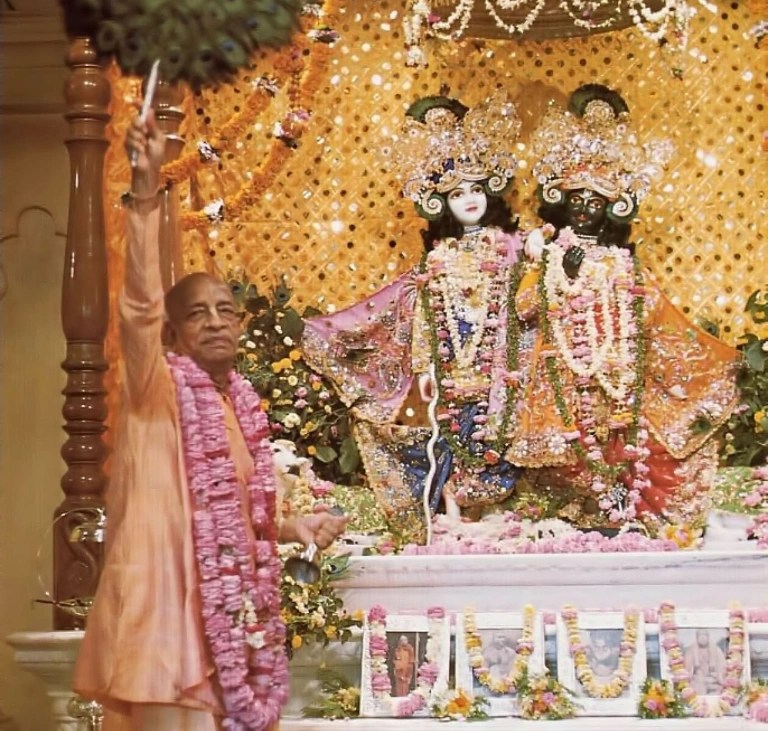
Probably because we leave for India today, and probably because we are going for the 50th Aniversity of the opening of the Sri Sri Krishna Balarama Temple in Vrindavan, but every morning I think about this Iconic picture of Srila Prabhupada offering the first Arotika to Krishna and Balarama.
We share with you some of thepastimes of the two transcendental brothers.
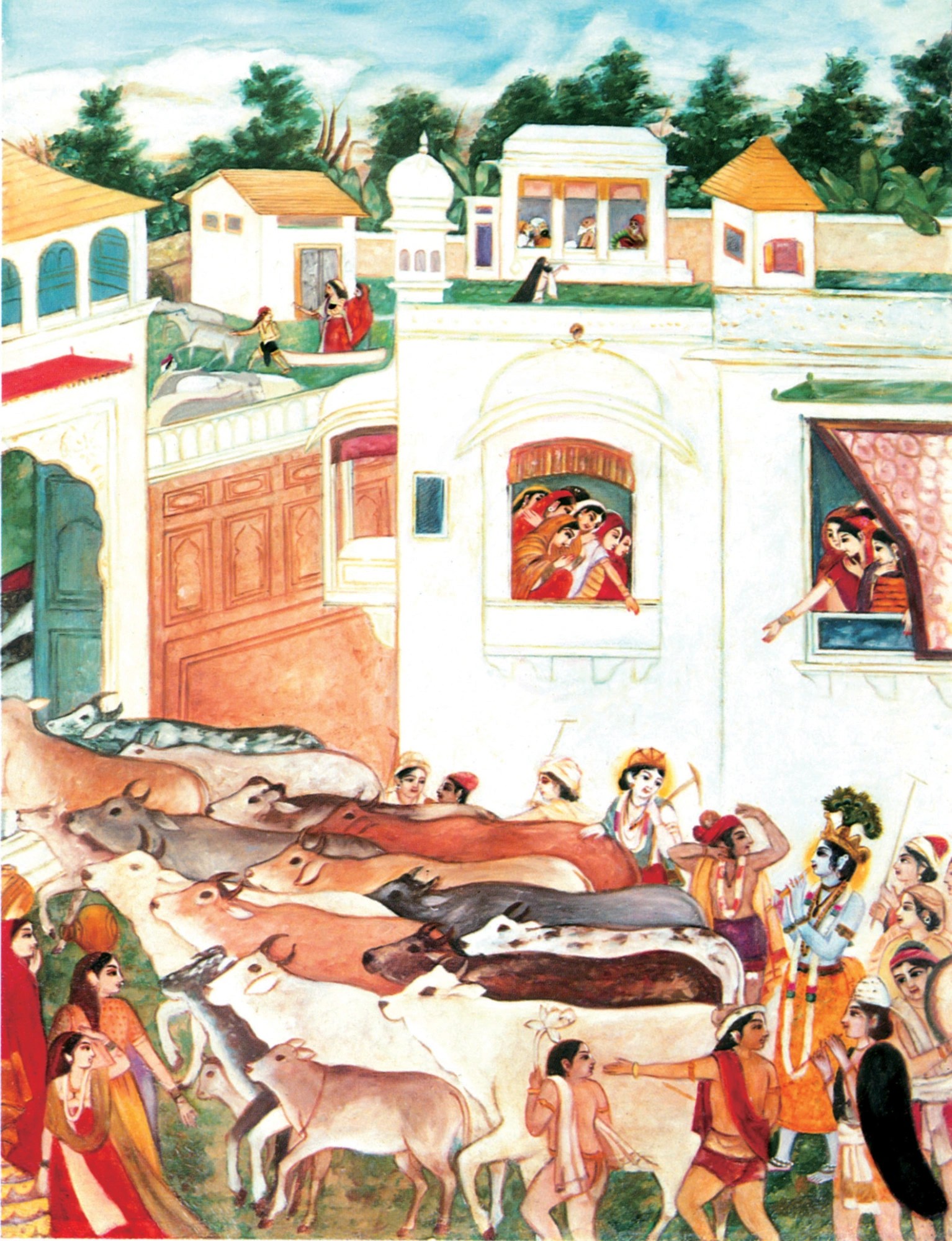
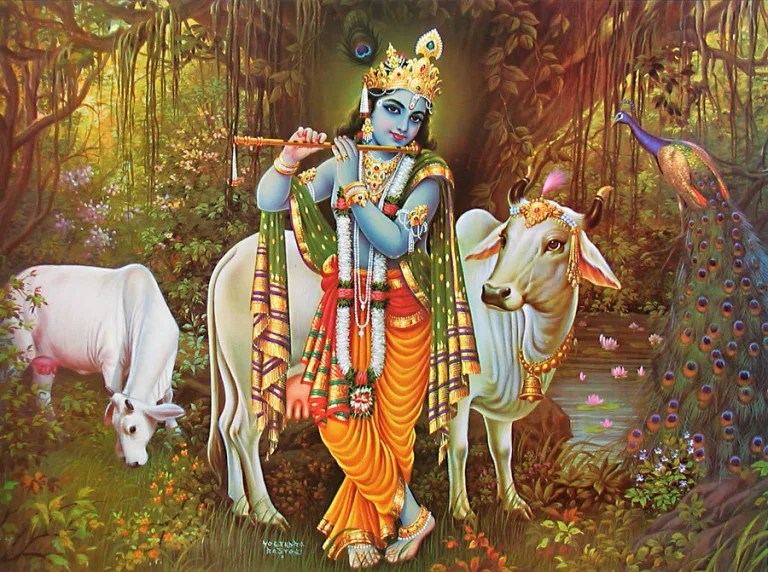
While Kṛṣṇa was engaged in tending the cows in the forest of Vṛndāvana or on Govardhana Hill, the gopīs in the village were always absorbed in thinking of Him and discussing His different pastimes. This is the perfect example of Kṛṣṇa consciousness: to somehow or other remain always engrossed in thoughts of Kṛṣṇa. The vivid example is always present in the behavior of the gopīs; therefore Lord Caitanya declared that no one can worship the Supreme Lord by any method which is better than the method of the gopīs. The gopīs were not born in very high brāhmaṇa or kṣatriya families; they were born in the families of vaiśyas, and not in big mercantile communities but in the families of cowherd men. They were not very well educated, although they heard all sorts of knowledge from the brāhmaṇas, the authorities of Vedic knowledge. The gopīs’ only purpose was to remain always absorbed in thoughts of Kṛṣṇa. (“The Gopīs Attracted by the Flute.”)
We are leaving for India next week. First stop Kolkota. We want to visit the birthplace of Srila Prabhupada, so I went to the webpage: Birthplace Temple and found this nice Biography which we share today with you.
A Short Biography of Srila Prabhupada
His Divine Grace A.C. Bhaktivedanta Swami Srila Prabhupada is the Founder-Acharya of International Society for Krishna Consciousness (ISKCON) which brought a spiritual dimension to the lives of thousands of his followers. He was a rare personality who appeared on the earth and dedicated his life to spreading God consciousness all over the world.
The scriptures recommend the chanting of the holy name of Lord Krishna (Harinama sankirtan) as the devotional practice best suited for the present age for spiritual perfection. Sri Chaitanya Mahaprabhu who appeared over 500 years ago in West Bengal, India was the greatest exponent of this method. He predicted that His message will be carried to every town and village of this world by a powerful spiritual ambassador. The life and activities of Srila Prabhupada prove beyond doubt that he was the empowered personality who appeared to fulfil this prediction.
When His Divine Grace A.C. Bhaktivedanta Swami Srila Prabhupada entered the port of New York City on September 17, 1965 few Americans took notice — but he was not merely another immigrant. He was on a mission to introduce the ancient teachings of Vedic India into mainstream America. Before Srila Prabhupada passed away on November 14, 1977 at the age of 81, his mission proved successful. He had founded the International Society for Krishna Consciousness (ISKCON) and saw it grow into a worldwide confederation of more than 100 temples, ashrams and cultural centers.
I was thinking about it this morning, how in the Material world everything is temporary and limited, whereas is the Spiritual world everything is eternal and unlimited. For instance:
…In the Caitanya-caritāmṛta it is said that when Kṛṣṇa comes before Rādhārāṇī, She becomes so much engladdened by seeing the beauty of Kṛṣṇa that She becomes more beautiful, and as soon as Rādhārāṇī becomes beautiful, Kṛṣṇa becomes engladdened and He becomes more beautiful. So unlimitedly there is competition of becoming more beautiful. That is the state. Competition. Because in the spiritual world everything is unlimited. So unlimitedly both of them becoming more beautiful and both of them enjoying unlimitedly. ((Lecture on SB 1.2.8 New Vrindaban, September 6, 1972)
Yesterday was the Appearance Day of Lord Nityananda, but this morning I was still thinking about some of His pastimes. One was the story of the deliverance of Jagai and Madhai. Nityananda Prabhu reminded Lord Caitanya of His mission to deliver the hopelessly fallen souls of the age, of whom Jagai and Madhai were typical examples. Ninety-nine percent of the population of the age resemble these brothers, despite high birth and apparent respectability. We also include the story of the Lord Caitanya “Inspiring the Jungle Animals”to chant the holy names of the Lord.
The Special Kindness of Lord Caitanya
Sri Caitanya Mahaprabhu, an incarnation of the Supreme Lord, appeared in India in the fifteenth century. His mission was to freely distribute pure love of God to everyone without considering who was qualified or unqualified. He predicted that the whole world would one day hear the chanting of the Lord’s holy names. The first of the following two narratives is excerpted from Srila Prabhupada’s introduction to Srimad-Bhagavatam. The second taken from his English translation of Sri Caitanya-caritamrta, an extensive account of Lord Caitanya’s life and teachings.
This is such a beautiful song, it is a meditation in itself.
Krishna is very pleased when we call on Him by His Names, which are associated with His devotees, qualities and pastimes. This song by Bhaktivinoda Thakura is composed of the Nanes of Krsna in different aspects. (from the Songs of the Vaisnava Acaryas)
Śrī Nāma-kīrtana Chanting of the Holy Names by Srila Bhaktivinoda Thakura
yaśomatī-nandana–Lord Kṛṣṇa is the beloved son of mother Yaśodā; vraja-vara-nāgara–most beloved of the inhabitants of Vraja; gokularañjana–the attractor of the people of Gokula; kāna–(an intimate nickname); gopī-parāṇa-dhana–the wealth of the lives of the gopīs; madana-manohara–who can attract even the mind of Cupid; kāliyadamana-vidhāna–the chastiser of the Kāliya serpent.
Lord Kṛṣṇa is the beloved son of mother Yaśodā; the transcendental lover in the land of Vraja; the delight of Gokula; Kāna [a nickname of Kṛṣṇa]; the wealth of the lives of the gopīs. He steals the mind of even Cupid and punishes the Kāliya serpent.
amala harinām amiya-vilāsā vipina-purandara, navīna nāgara-bora, baṁśī-badana suvāsā
amala harinām–these pure holy names; amiya vilāsā–are full of sweet, nectarean pastimes; vipina-purandara–He is the monarch of the garden groves; navīna nāgara-bora–He is the best of youthful lovers; vaḿśīvadana–He is seen with His flute placed to His lips; suvāsā–He is an excellent dresser.
These pure, holy names of Lord Hari are full of sweet, nectarean pastimes. Kṛṣṇa is the Lord of the twelve forests of Vraja, He is ever-youthful and is the best of lovers. He is always playing on a flute, and He is an excellent dresser.
braja-jana-pālana–the protector of the inhabitants of Vraja; asura-kula-nāśana–the destroyer of demonic dynasties; nanda-godhana-rākhaoyālā– the keeper of Nanda Mahārāja’s valuable cows; govinda–the giver of pleasure to the cows; mādhava–the husband of the goddess of fortune; navanīta-taskara–the butter thief; sundara nanda-gopālā–the beautiful cowherd son of Nanda Mahārāja.
Kṛṣṇa is the protector of the inhabitants of Vraja; the destroyer of various demoniac dynasties; the keeper and tender of Nanda Mahārāja’s cows; the giver of pleasure to the cows, land, and spiritual senses; the husband of the goddess of fortune; the butter thief; and the beautiful cowherd boy of Nanda Mahārāja.
yāmuna-taṭa-cara–He wanders along the banks of the river Yamunā; gopī-vasana-hara–He steals the garments of the gopīs; rāsa-rasika–He delights in the mellows of the rāsa dance; kṛpāmoya–He is very merciful; śrī-rādhā-vallabha–the most beloved of Srīmatī Rādhāraṇī vṛndāvananaṭabara–the great dancer of Vṛndāvana; bhakativinod-āśraya–the shelter of Bhaktivinoda
Kṛṣṇa wanders along the banks of the River Yamunā. He stole the garments of the young damsels of Vraja who were bathing there. He delights in the mellows of the rāsa dance; He is very merciful; the lover and beloved of Śrīmatī Rādhārāṇī; the great dancer of Vṛndāvana; and the shelter and only refuge of Ṭhākura Bhaktivinoda.
So today we recognize the Disappearance day of Madhvacarya, who is in our line of Disciplic Succession dating back to Krsna. His philosophy and writings have distinguished him as one of India’s greatest spiritual teachers. He is the Acarya of the Madhva Sampradaya. So this following post by Chanchalapathi Prabhu is very timely.
“Srila Prabhupada is the Deliverer of all ISKCON Devotees”
By Chanchalapathi Dasa -ISKCON Bangalore
Recently I had the opportunity of interacting with a few scholars of Madhva sampradaya in Bangalore and Udupi. One of them was an elderly Sanskrit scholar, a seventy year old retired university professor, a respected teacher and follower of Madhva philosophy in Bangalore.
The discussion with him led to the subject of the theological differences between ISKCON Bangalore and ISKCON Mumbai.
…The process of meditation recommended in the Śrīmad-Bhāgavatam is not to fix one’s attention on something impersonal or void.
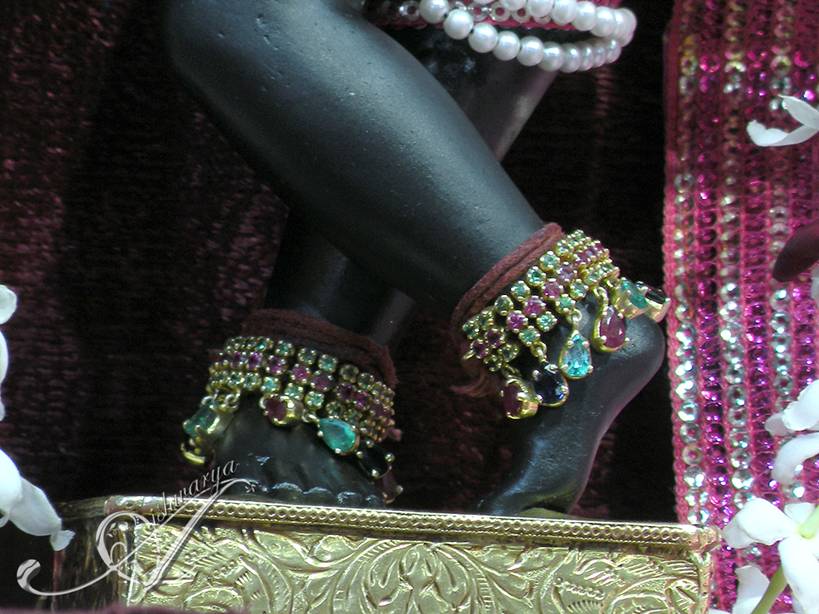
The process of meditation should begin from the lotus feet of the Lord and progress to His smiling face. The meditation should be concentrated upon the lotus feet, then the calves, then the thighs, and in this way higher and higher. The more the mind becomes fixed upon the different parts of the limbs, one after another, the more the intelligence becomes purified. (SB 2.2.13)
Śrīmad-Bhāgavatam By His Divine Grace A. C. Bhaktivedanta Swami Prabhupāda Canto Two, Chapter 2, Text 13-14












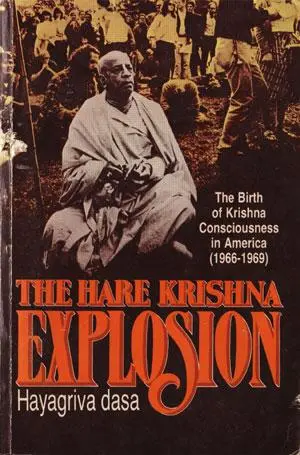

 The Hare Krishna Movement
