10 May 2013
by The Hare Krishna Movement
in A.C. Bhaktivedanta Swami Prabhupada, Srimad Bhagavatam, Teachings of Queen Kunti, Vegetarianism
Tags: A.C. Bhaktivedanta Swami Prabhupada, fruits, godless civilization, herbs and grains, human prosperity, industrial enterprise, natural gifts of nature, nature, organic food, SB 1.8.40, Theachings of Wueen Kunti, vegetables, vegetarian, vegetarianism
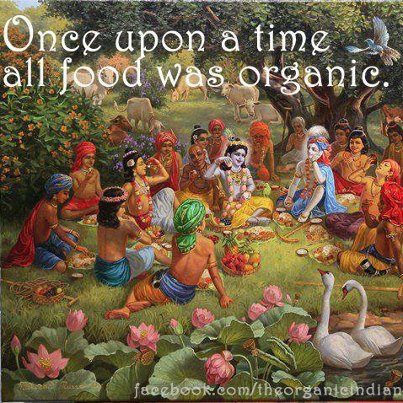
The following is a very nice verse from the Srimad Bhagavatam describing the Gifts of Nature, and how everything is coming from God. We have also included the chapter from the Teachings of Queen Kunti, Where Srila Prabhupada further explaines this wonderful text.
…Human prosperity flourishes by natural gifts and not by gigantic industrial enterprises.
Srimad Bhagavatam
By His Divine Grace A.C. Bhaktivedanta Swami Prabhupada
Canto One, Chapter 8, Text 40
ime jana-padāḥ svṛddhāḥ
supakvauṣadhi-vīrudhaḥ
vanādri-nady-udanvanto
hy edhante tava vīkṣitaiḥ
ime—all these; jana-padāḥ—cities and towns; svṛddhāḥ—flourished; supakva—nature; auṣadhi—herbs; vīrudhaḥ—vegetables; vana—forests; adri—hills; nadī—rivers; udanvantaḥ—seas; hi—certainly; edhante—increasing; tava—by You; vīkṣitaiḥ—seen.
All these cities and villages are flourishing in all respects because the herbs and grains are in abundance, the trees are full of fruits, the rivers are flowing, the hills are full of minerals and the oceans full of wealth. And this is all due to Your glancing over them.
Human prosperity flourishes by natural gifts and not by gigantic industrial enterprises. The gigantic industrial enterprises are products of a godless civilization, and they cause the destruction of the noble aims of human life. The more we go on increasing such troublesome industries to squeeze out the vital energy of the human being, the more there will be unrest and dissatisfaction of the people in general, although a few only can live lavishly by exploitation. The natural gifts such as grains and vegetables, fruits, rivers, the hills of jewels and minerals, and the seas full of pearls are supplied by the order of the Supreme, and as He desires, material nature produces them in abundance or restricts them at times. The natural law is that the human being may take advantage of these godly gifts by nature and satisfactorily flourish on them without being captivated by the exploitative motive of lording it over material nature. The more we attempt to exploit material nature according to our whims of enjoyment, the more we shall become entrapped by the reaction of such exploitative attempts. If we have sufficient grains, fruits, vegetables and herbs, then what is the necessity of running a slaughterhouse and killing poor animals? A man need not kill an animal if he has sufficient grains and vegetables to eat. The flow of river waters fertilizes the fields, and there is more than what we need. Minerals are produced in the hills, and the jewels in the ocean. If the human civilization has sufficient grains, minerals, jewels, water, milk, etc., then why should it hanker after terrible industrial enterprises at the cost of the labor of some unfortunate men? But all these natural gifts are dependent on the mercy of the Lord. What we need, therefore, is to be obedient to the laws of the Lord and achieve the perfection of human life by devotional service. The indications by Kuntīdevī are just to the point. She desires that God’s mercy be bestowed upon them so that natural prosperity be maintained by His grace.
Also From the Teachings of Queen Kunti, Chapter 23 More
22 Apr 2013
by The Hare Krishna Movement
in A.C. Bhaktivedanta Swami Prabhupada, Devotional Service, Dvaraka, Spiritual Life, Srimad Bhagavatam
Tags: A.C. Bhaktivedanta Swami Prabhupada, devotees, impersonal, just as it behooves, Krishna, reciprocates, SB 1.11.20-22, Supreme Personality of Godhead, yatha-vidhi
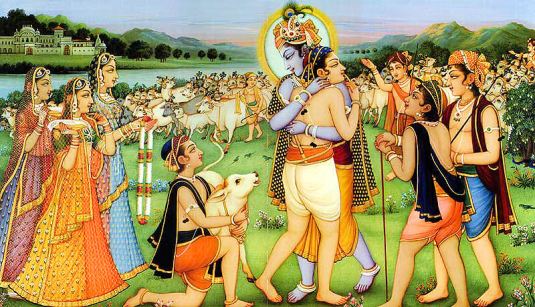
Everyone is Eligible for the Supreme Destination Part II
This is a continuation from yesterdays post because as I continued my reading from Chapter Eleven entitled “Lord Kṛṣṇa’s Entrance into Dvārakā”, it became apparent that:
The Supreme Lord Personality of Godhead is neither impersonal nor an inert object unable to reciprocate the feelings of His devotees. Here the word yathā-vidhi, or “just as it behooves” is significant. He reciprocates “just as it behooves” with His different types of admirers and devotees. Of course, the pure devotees are of one type only because they have no other object for service but the Lord, and therefore the Lord also reciprocates with such pure devotees just as it behooves, namely, He is always attentive to all the matters of His pure devotees. There are others who designate Him as impersonal, and so the Lord also does not take any personal interest. He satisfies everyone in terms of one’s development of spiritual consciousness, and a sample of such reciprocation is exhibited here with His different welcomers.
Yes, this is a beautiful chapter of the Srimad Bhagavatam, and Srila Prabhupada’s Purports are dripping with transcendental Knowledge.
More
14 Apr 2013
by The Hare Krishna Movement
in A.C. Bhaktivedanta Swami Prabhupada, Srimad Bhagavatam, Srimati Radharani
Tags: A.C. Bhaktivedanta Swami Prabhupada, devotee, feminine counterpart of God, feminine nature, pure devotee, Radha, Radharani, Srimad Bhagavatam, Srimati Radharani, Vedic literatures, Vrndavana
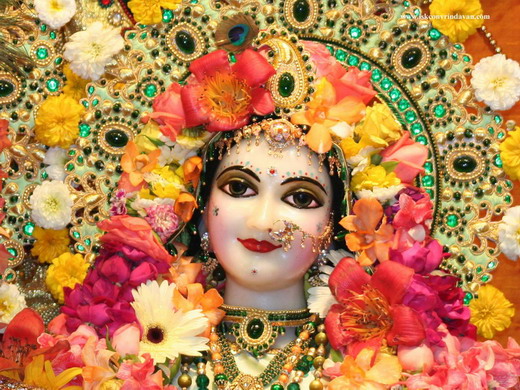
…In the Brahma-saṁhitā it is said that the Lord is never to be found by becoming a great scholar of the Vedic literatures, but He is very easily approachable through His pure devotee. In Vṛndāvana all the pure devotees pray for the mercy of Śrīmatī Rādhārāṇī, the pleasure potency of Lord Kṛṣṇa. Śrīmatī Rādhārāṇī is a tenderhearted feminine counterpart of the supreme whole, resembling the perfectional stage of the worldly feminine nature. Therefore, the mercy of Rādhārāṇī is available very readily to the sincere devotees, and once She recommends such a devotee to Lord Kṛṣṇa, the Lord at once accepts the devotee’s admittance into His association. The conclusion is, therefore, that one should be more serious about seeking the mercy of the devotee than that of the Lord directly, and by one’s doing so (by the good will of the devotee) the natural attraction for the service of the Lord will be revived. (Purport Srimad Bhagavatam 2.3.23)
Full text and purport More
13 Apr 2013
by The Hare Krishna Movement
in A.C. Bhaktivedanta Swami Prabhupada, Lectures, Srimad Bhagavatam
Tags: A.C. Bhaktivedanta Swami Prabhupada, bhagavata, Christian, Hindu, Jesus Christ, love God, Prahlada Maharaja, religion, SB 7.9.12, Srila Prabhupada lecture, Srimad Bhagavatam lecture

…Everyone will say that “My system of religion is better than yours.” That is quite natural. A Hindu will say, “Oh, I am better than the Christian.” Christian will say, “I am better than the Hindu.” But Bhagavata says that that is not the test of religion. Bhagavat says, sa vai pumsam paro dharmo yato bhaktir adhoksaje [SB 1.2.6]. That type of religion is the best by which one develops love of Godhead. That’s all. The test is how much you have developed love of Godhead. Bhava-grahi janardana. In Vedic literature it is said that God, Krsna, simply accepts your bhava or your situation, how much you have developed your attraction for God, or Krsna. That is taken into account. He does not take account that “Oh, you are very rich. You are very beautiful. You are very opulent,” or “You are very poor. You are not beautiful.” These considerations are not there. The only consideration is how much you love God. Then your life is successful. (Srimad Bhagavatam Lecture 7.9.12, Montreal)
Full Lecture More
12 Apr 2013
by The Hare Krishna Movement
in A.C. Bhaktivedanta Swami Prabhupada, Chanting Hare Krishna, Mantra Meditation, Srimad Bhagavatam, Vaisnava Vocabulary
Tags: A.C. Bhaktivedanta Swami Prabhupada, chanting Hare Krishna, Hare Krishna, Hare Krishna Mantra, holy name, kirtanad eva krsnasya, Krsna maha-mantra, Lord Caitanya Mahaprabhu, Srila Prabhupada

click on image to enlarge
..Simply by chanting the holy name of Kṛṣṇa: Hare Kṛṣṇa, Hare Kṛṣṇa, Kṛṣṇa Kṛṣṇa, Hare Hare/ Hare Rāma, Hare Rāma, Rāma Rāma, Hare Hare simply by chanting the holy name…,” kīrtanād eva kṛṣṇasya, “he becomes free from all these contaminations, by one thing, simply chanting Hare Kṛṣṇa.”
Kīrtanād eva kṛṣṇasya, mukta-saṅgaḥ paraṁ vrajet
…although Kali-yuga is an ocean of faults, there is still one good quality about this age: Simply by chanting the Hare Kṛṣṇa mahā-mantra, one can become free from material bondage and be promoted to the transcendental kingdom.
This is a very important sloka (verse), as can be confirmed by the number of times Srila Prabhupada has cited it. I was curious about this verse so I went to the incomparable web page Vani Quotes and did a search on the phrase kīrtanād eva kṛṣṇasya, mukta-saṅgaḥ paraṁ vrajet, and was surprised to find just how many times Srila Prabhupada used this verse in his preaching. I think this will be the next verse I try to memorize.
Full verse:
kaler doṣa-nidhe rājann
asti hy eko mahān guṇaḥ
kīrtanād eva kṛṣṇasya
mukta-saṅgaḥ paraṁ vrajet
kaleḥ—of the age of Kali; doṣa-nidheḥ—in the ocean of faults; rājan—O King; asti—there is; hi—certainly; ekaḥ—one; mahān—very great; guṇaḥ—good quality; kīrtanāt—by chanting; eva—certainly; kṛṣṇasya—of the holy name of Kṛṣṇa; mukta-saṅgaḥ—liberated from material bondage; param—to the transcendental spiritual kingdom; vrajet—one can go.
My dear King, although Kali-yuga is an ocean of faults, there is still one good quality about this age: Simply by chanting the Hare Kṛṣṇa mahā-mantra, one can become free from material bondage and be promoted to the transcendental kingdom. (SB 12.3.510
Cited Verses More
09 Apr 2013
by The Hare Krishna Movement
in A.C. Bhaktivedanta Swami Prabhupada, Dvaraka, Srimad Bhagavatam
Tags: A.C. Bhaktivedanta Swami Prabhupada, Dvaraka, Krsna's attraction, lamp offered to sun, Lord Krishna, maya, presence of the sun, self-sufficient, Sun

click on image to enlarge
In one of our previous posts entitled “Lord Kṛṣṇa’s Transcendental Conchshell” we were describing Lord Krsna’s entrance in Dvarka. This post is a continuation from that chapter, describing the citizens presentation and prayers to the Lord. Very nice!
The citizens arrived before the Lord with their respective presentations, offering them to the fully satisfied and self-sufficient one, who, by His own potency, incessantly supplies others. These presentations were like the offering of a lamp to the sun. Yet the citizens began to speak in ecstatic language to receive the Lord, just as wards welcome their guardian and father.
…Lord Kṛṣṇa’s attraction is so powerful that once being attracted by Him one cannot tolerate separation from Him. Why is this so? Because we are all eternally related with Him as the sun rays are eternally related with the sun disc. The sun rays are molecular parts of the solar radiation. Thus the sun rays and the sun cannot be separated. The separation by the cloud is temporary and artificial, and as soon as the cloud is cleared, the sun rays again display their natural effulgence in the presence of the sun. Similarly, the living entities, who are molecular parts of the whole spirit, are separated from the Lord by the artificial covering of māyā, illusory energy. This illusory energy, or the curtain of māyā, has to be removed, and when it is so done, the living entity can see the Lord face to face, and all his miseries are at once removed. Every one of us wants to remove the miseries of life, but we do not know how to do it. The solution is given here, and it rests on us to assimilate it or not. (Excerpted from purport SB 1.11.10)
…Lord Śrī Kṛṣṇa, being the primeval Lord, the Supreme Truth, is compared to the sun. Without Him all our knowledge is either false or partial. The opposite of the sun is the darkness, and similarly the opposite of Kṛṣṇa is māyā, or illusion. The devotees of the Lord can see everything in true perspective due to the light disseminated by Lord Kṛṣṇa. By the grace of the Lord the pure devotee cannot be in the darkness of ignorance. Therefore, it is necessary that we must always be in the sight of Lord Kṛṣṇa so that we can see both ourselves and the Lord with His different energies. As we cannot see anything in the absence of the sun, so also we cannot see anything including our own self, without the factual presence of the Lord. Without Him all our knowledge is covered by illusion. (Excerpted from purport SB 1.11.9)
Full Text and Purport More
08 Apr 2013
by The Hare Krishna Movement
in A.C. Bhaktivedanta Swami Prabhupada, Ajamila, Lectures, Srimad Bhagavatam
Tags: A.C. Bhaktivedanta Swami Prabhupada, Ajamila, ass, back to Godhead, happiness, Lecture by His Divine Grace, Lecture by Srila Prabhupada, material life, mudha, sa evam vartamano, SB 6.1.26-27
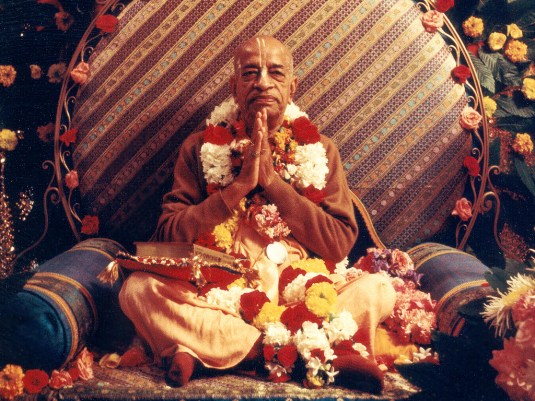
This is a very nice lecture by His Divine Grace from the sixth Canto of the Srimad Bhagavatam, recorded July 12th, 1975, in Philadelphia, PA.
…We are thinking, “I shall be happy in this way. I shall be happy in this…” Nothing. You shall never be happy—this is perfect instruction—unless you go back to home, back to Godhead. Just like a mad boy, he has forsaken his father. His father is rich man, everything is there, but he has become hippie. So similarly, we are also like that. Our father is Kṛṣṇa. We can live there very comfortably without any botheration, without endeavor for earning money, but we have decided that we shall live here in this material world. This is called ass. … Therefore mūḍha. We do not know what is our self-interest. And we are hoping against hope, “I shall be happy in this way. I shall be happy in this way.” Therefore this word is used, mūḍha. They do not know what is actually his happiness, and he is trying one chapter, another, one chapter, another, “Now I will be happy.” The ass. The ass. Sometimes the washerman sits on his back and takes a bunch of grass and puts in front of the ass, and the ass wants to take the grass. But as he moving forward, the grass is also moving forward. (laughter) And he thinks, “Just one step forward, I shall get the grass.” But because he is ass, he does not know that “The grass is situated in such a way that I may go on for millions of years; still, I will not get the happiness…” This is ass. He does not come to his senses that “For millions and trillions of years I may try to be happy in this material world. I will never be happy.”
More
03 Apr 2013
by The Hare Krishna Movement
in A.C. Bhaktivedanta Swami Prabhupada, Ajamila, Back to Godhead, Srimad Bhagavatam
Tags: A.C. Bhaktivedanta Swami Prabhupada, Back to Godhead Magazine, Hare Krishna, Narayana, servants of Yamaraja, Supreme Lord Visnu, Visnu, Visnudutas, yamadutas

click image to enlarge
…At the time of death, Ajamila helplessly and very loudly chanted the holy name of the Lord. That chanting alone has already freed him from the reactions of all sinful life. One who chants the holy name is immediately freed from the reactions of unlimited sins, even if he chants indirectly to indicate something else, jokingly, for musical entertainment, or even neglectfully. This is accepted by all the learned scholars of the scriptures. If one chants the holy name of Hari and then dies because of an accidental misfortune, one is immediately absolved from having to enter hellish life, even though he is sinful.
Full Story More
30 Mar 2013
by The Hare Krishna Movement
in A.C. Bhaktivedanta Swami Prabhupada, Spiritual Life, Spiritual Master, Spiritual World, Srimad Bhagavatam
Tags: Bs. 5.28, cintamani-dhama, cintamani=arakara-sadmasu, cows, goddesses of fortune, gopis, Govinda, kalpa-vrksa, Laksmis, Lord Govinda, SB 1.11.26, spiritual gems, Spiritual Life, spiritual master A.C. Bhaktivedanta Swami Prabhupada, Spiritual world, Srimad Bhagavatam, touchstone, transcendental abode, transcendental windows

Sometimes when I am sitting and reading from Srila Prabhupada’s Srimad Bhagavatam, a verse or sentence from the purport just jumps out from the page almost like it is in 3D, and I catch a glimpse of what the Spiritual World must be like. It is beyond even my imagination, but sometimes I catch a glimmer of light, through a transcendental window, by the grace of my spiritual master His Divine Grace A. C. Bhaktivedanta Swami Prabhupada.
…The transcendental abode of the Lord where the trees are all desire trees and the buildings are made of touchstone. The Lord Govinda is engaged there in herding the surabhi cows as His natural occupation.
“I worship Govinda, the primeval Lord, the first progenitor who is tending the cows, yielding all desire, in abodes built with spiritual gems, surrounded by millions of purpose trees, always served with great reverence and affection by hundreds of thousands of lakṣmīs or gopīs.” (Bs 5.29)
…And those who are artists, overtaken by the beautiful creation, should better see to the beautiful face of the Lord for complete satisfaction. The face of the Lord is the embodiment of beauty. What they call beautiful nature is but His smile, and what they call the sweet songs of the birds are but specimens of the whispering voice of the Lord.
More
12 Mar 2013
by The Hare Krishna Movement
in A.C. Bhaktivedanta Swami Prabhupada, Chanting Hare Krishna, Krishna Consciousness, Mantra Meditation, Sankirtan, Srimad Bhagavatam
Tags: A.C. Bhaktivedanta Swami Prabhupada, age of kali, chant Hare Krishna, full of faults, Hare Krishna Mantra, Kali-yuga, kirtanad eva krsnasya, Krsna, krsna consciousness, Lord Caitanya Mahaprabhu, sankirtana movement, Srila Prabhupada, The Hare Krishna Movement
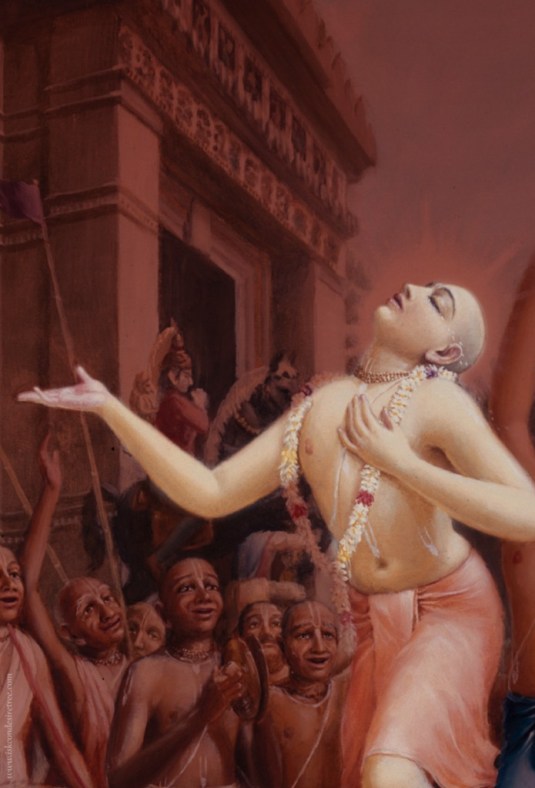
“In the sastra it is said this Kali-yuga is full of faults, so many faults. It is the ocean of faults. But there is a very nice thing, asti hy eko mahan gunah, a very great quality. What is that? Kirtanad eva krsnasya mukta-sangah param vrajet [SB 12.3.51]. If you simply chant Hare Krishna mantra, then you become perfect. Is it very difficult? Chant Hare Krishna and you become perfect. But we are so unfortunate, we are not even prepared to chant. This is our position. So you have to make little determination that ‘I shall chant henceforward Hare Krishna mantra.’ Then everything is all right.” (Srila Prabhupada from Lecture)
and this from Srimad Bhagavatam 8.5.23
When Kṛṣṇa appeared, He gave His orders, and when Kṛṣṇa Himself appeared as a devotee, as Śrī Caitanya Mahāprabhu, He showed us the path by which to cross the ocean of Kali-yuga. That is the path of The Hare Kṛṣṇa Movement. When Śrī Caitanya Mahāprabhu appeared, He ushered in the era for the saṅkīrtana movement. It is also said that for ten thousand years this era will continue. This means that simply by accepting the saṅkīrtana movement and chanting the Hare Kṛṣṇa mahā-mantra, the fallen souls of this Kali-yuga will be delivered. After the Battle of Kurukṣetra, at which Bhagavad-gītā was spoken, Kali-yuga continues for 432,000 years, of which only 5,000 years have passed. Thus there is still a balance of 427,000 years to come. Of these 427,000 years, the 10,000 years of the saṅkīrtana movement inaugurated by Śrī Caitanya Mahāprabhu 500 years ago provide the opportunity for the fallen souls of Kali-yuga to take to the Kṛṣṇa consciousness movement, chant the Hare Kṛṣṇa mahā-mantra and thus be delivered from the clutches of material existence and return home, back to Godhead.
Full Text and Purport More
06 Mar 2013
by The Hare Krishna Movement
in A.C. Bhaktivedanta Swami Prabhupada, Spiritual Life, Spiritual Master, Srimad Bhagavatam, Sukadeva Goswami
Tags: A.C. Bhaktivedanta Swami Prabhupada, at the time of death, dying man, great master, guru, Maharaja Pariksit, spiritual master, Srimad Bhagavatam, Sukadeva Gosvami, thesis of Srimad Bhagavatam

You are the spiritual master of great saints and devotees. I am therefore begging you to show the way of perfection for all persons, and especially for one who is about to die.
Please let me know what a man should hear, chant, remember and worship, and also what he should not do. Please explain all this to me.
Unless one is perfectly anxious to inquire about the way of perfection, there is no necessity of approaching a spiritual master. A spiritual master is not a kind of decoration for a householder. Generally a fashionable materialist engages a so-called spiritual master without any profit. The pseudo- spiritual master flatters the so-called disciple, and thereby both the master and his ward go to hell without a doubt. Mahārāja Parīkṣit is the right type of disciple because he puts forward questions vital to the interest of all men, particularly for the dying men. The question put forward by Mahārāja Parīkṣit is the basic principle of the complete thesis of Śrīmad-Bhāgavatam. Now let us see how intelligently the great master replies. (from purport to SB 1.19.37)
Srimad Bhagavatam
By His Divine Grace A.C. Bhaktivedanta Swami
Canto 1, Chapter 19, Text 29-40
More
24 Feb 2013
by The Hare Krishna Movement
in A.C. Bhaktivedanta Swami Prabhupada, Beyond Birth & Death, Bhagavad-gita, Bhismadeva, Srimad Bhagavatam
Tags: A.C. Bhaktivedanta Swami Prabhupada, beyond samsara, bhagavad-gita, Bhismadeva, bhutva-bhutva, Lord Sri Krsna, mystic yogis, mystics, parliyate, pure devotee, repetition of different bodies, samsara, samsara means material existence, samsara means this material entanglement, Srimad Bhagavatam, yogic situation, yogis

Beyond Saṁsāra
As I was reading from the Srimad Bhagavatam this morning about the passing of Bhīṣmadeva it was being described how “The perfect yogīs or mystics can leave the material body at their own sweet will at a suitable time and go to a suitable planet desired by them.” And how it is possiable to go beyond Saṁsāra, and go back to Godhead without any doubt.
…In the momentous hour of leaving his material body, Bhīṣmadeva set the glorious example concerning the important function of the human form of life. The subject matter which attracts the dying man becomes the beginning of his next life. Therefore, if one is absorbed in thoughts of the Supreme Lord Śrī Kṛṣṇa, he is sure to go back to Godhead without any doubt.
And what is Samsara?
Saṁsāra means material existence. That is called saṁsāra. Bhūtvā bhūtvā pralīyate (BG 8.19). You take your birth once in some form of body. You live for some time. Then you have to give up this body. Then you have to accept another body. Then again live for some time. Then give up that body. Again accept another body. In this way, it is going on. That is called saṁsāra, rotating within this material world. (Lecture on Gurvastakam at Upsala University by His Divine Grace -Stockholm, September 9, 1973)
The saṁsāra means repetition of different bodies. That is called saṁsāra. (Lecture on SB 1.2.4 -Rome, May 28, 1974)
Saṁsāra means this material entanglement. This is called saṁsāra.
(Lecture on CC Madhya-lila 25.40-50 – San Francisco, January 24, 1967)
More
13 Feb 2013
by The Hare Krishna Movement
in A.C. Bhaktivedanta Swami Prabhupada, Bhava, Srimad Bhagavatam, Vaisnava Vocabulary
Tags: A.C. Bhaktiverdanta Swami Prabhupada, affection, Bhagavad Gita, bhava, highest achievement of human society, love of God, preliminary stage of transcendental love of Godhead, prema, pure devotional service, pure love or prema, Srimad Bhagavatam

click on image to enlarge
Here is a new word for your Vaisnava Vocabulary: Bhāva. In the Glossary in the back of the Bhagavad-gita As It Is, 1972 Edition, the word Bhāva is defined as; the preliminary stage of transcendental love of Godhead. Bhāva is a big word and has various meanings
…The last stage of the devotional life is called bhāva, or transcendental love of Godhead.
“In the beginning one must have a preliminary desire for self-realization.…This taste leads one further forward to attachment for Kṛṣṇa consciousness, which is matured in bhāva, or the preliminary stage of transcendental love of God. Real love for God is called premā, the highest perfectional stage of life.” In the premā stage there is constant engagement in the transcendental loving service of the Lord. So, by the slow process of devotional service, under the guidance of the bona fide spiritual master, one can attain the highest stage, being freed from all material attachment, from the fearfulness of one’s individual spiritual personality, and from the frustrations resulting from void philosophy. Then one can ultimately attain to the abode of the Supreme Lord. (Bhagavad-gita 4.11)
So it seem that bhāva is not only the preliminary stage of transcendental love of Godhead but we find that this preliminary stage of transcendental love is also the path to the highest perfectional stage of life, pure love or premā. There are two ways to approach the Lord, one is with awe and reverence and the other is with affection; bhāva. One who approaches the Lord with affection, is sure to advance spiritually.
In the Srimad Bhagavatam we find many references to the word Bhāva and highlighted some of them here. More
28 Jan 2013
by The Hare Krishna Movement
in A.C. Bhaktivedanta Swami Prabhupada, Caitanya Mahaprabhu, Devotional Service, Srimad Bhagavatam
Tags: A.C. Bhaktivedanta Swami Prabhupada, causeless mercy, chanting, devotional service, hearing, Lord Sri Caitanya Mahaprabhu, mercy of sri caitanya, millennium, Prayers by Queen Kunti, praying, remembering, Srimad Bhagavad-gita, Srimad Bhagavatam, worshiping

…In the Śrīmad Bhagavad-gītā the Lord asserts that He appears in every millennium just to reestablish the way of religion. The way of religion is made by the Supreme Lord. No one can manufacture a new path of religion, as is the fashion for certain ambitious persons. The factual way of religion is to accept the Lord as the supreme authority and thus render service unto Him in spontaneous love.
The Lord, however, out of His causeless mercy, because He is more merciful to the suffering living beings than they can expect, appears before them and renovates the principles of devotional service comprised of hearing, chanting, remembering, serving, worshiping, praying, cooperating and surrendering unto Him. Adoption of all the above-mentioned items, or any one of them, can help a conditioned soul get out of the tangle of nescience and thus become liberated from all material sufferings created by the living being illusioned by the external energy. This particular type of mercy is bestowed upon the living being by the Lord in the form of Lord Śrī Caitanya Mahāprabhu. (from Purport to SB 1.8.35)
Full Text and puroprt More
17 Jan 2013
by The Hare Krishna Movement
in A.C. Bhaktivedanta Swami Prabhupada, Krishna, Srimad Bhagavatam
Tags: A.C. Bhaktivedanta Swami Prabhupada, Dwarka, flowers fell upon the road, garlands of flowers, Krishna, Krsna, lightning and rainbows, Lord Krsna's Entrance into Dvaraka, Lord' bodily hue, monsoon cloud, SB 1.11.27, white feathered fans, white umbrella, yellow garments

As the Lord passed along the public road of Dvārakā, His head was protected from the sunshine by a white umbrella. White feathered fans moved in semicircles, and showers of flowers fell upon the road. His yellow garments and garlands of flowers made it appear as if a dark cloud were surrounded simultaneously by sun, moon, lightning and rainbows.
…The sun, moon, rainbow and lightning do not appear in the sky simultaneously. But the situation created at the time of His passing on the roads of Dvārakā was beautiful and could not be compared to anything besides the description of natural phenomena.
full text and purport More
06 Jan 2013
by The Hare Krishna Movement
in A.C. Bhaktivedanta Swami Prabhupada, Quotes by Srila Prabhupada, Srila Prabhupada Conversations, Srila Prabhupada vani, Srimad Bhagavatam
Tags: A.C. Bhaktivedanta Swami Prabhupada, Bali Maharaja, devotee, Hara means taking away, Krishna, Krsna, Krsna's Mercy, Lord Krishna, Lord Visnu, special favor, special mercy of the Lord, Srila Prabhupada, Supreme Personality of Godhead, takes away, takes away valuable things, taking away material opulences, yasyāham anugṛhṇāmi hariṣye tad-dhanaṁ śanaiḥ, Yudhisthira Maharaja

click on image to enlarge
Yasyāham anugṛhṇāmi hariṣye tad-dhanaṁ śanaiḥ
“I Gradually Deprive Him of His Wealth”
In our previous post entitled Vṛndāvana Bhajana I was curious about the verse Srila Prabhupada used in the First Stanza; yasyāham anugṛhṇāmi hariṣye tad-dhanaṁ śanaiḥ “I gradually take away all the wealth of those upon whom I am merciful.”. So I did a search on the word “yasyāham anugṛhṇāmi” and was surprised to find that Srila Prabhupada had used that partictular verse 36 times in his books, lectures and conversations as documented by the very nice web site Vani Quotes. The verse originated from the Srimad Bhagavatam, 10.88.8 and is as follows:
śrī-bhagavān uvāca
yasyāham anugṛhṇāmi
hariṣye tad-dhanaṁ śanaiḥ
tato ‘dhanaṁ tyajanty asya
svajanā duḥkha-duḥkhitam
śrī-bhagavān uvāca—the Personality of Godhead said; yasya—whom; aham—I; anugṛhṇāmi—favor; hariṣye—I will take away; tat—his; dhanam—wealth; śanaiḥ—gradually; tataḥ—then; adhanam—poor; tyajanti—abandon; asya—his; sva-janāḥ—relatives and friends; duḥkha-duḥkhitam—who suffers one distress after another.
The Personality of Godhead said: If I especially favor someone, I gradually deprive him of his wealth. Then the relatives and friends of such a poverty-stricken man abandon him. In this way he suffers one distress after another.
So in this way, gradually, I became attached to these Gauḍīya Matha activities, and by the grace of Kṛṣṇa, my business also was not going very well. (laughter) (laughs) Yes. Kṛṣṇa says yasyāham anughṛṇāmi hariṣye tad-dhanaṁ śanaiḥ. If somebody wants to be actually devotee of Kṛṣṇa, at the same time, keeps his material attachment, then Kṛṣṇa’s business is He takes away everything material, so that cent percent he becomes, I mean to say, dependent on Kṛṣṇa. So that actually happened to my life.
All the references to this verse are listed (referenced) as follows: More
03 Jan 2013
by The Hare Krishna Movement
in A.C. Bhaktivedanta Swami Prabhupada, Gajendra, Gajendra's Prayers of Surrender, Gajendra's Prayers of Surrender, Srimad Bhagavatam
Tags: A.C. Bhaktivedanta Swami Prabhupada, elephant and the crocodile, Gajendra, indradyumna, king of the elephants, SB 8.3.1-29, Srimad Bhagavatam, Supreme Lord, The Supreme Personality of Godhead
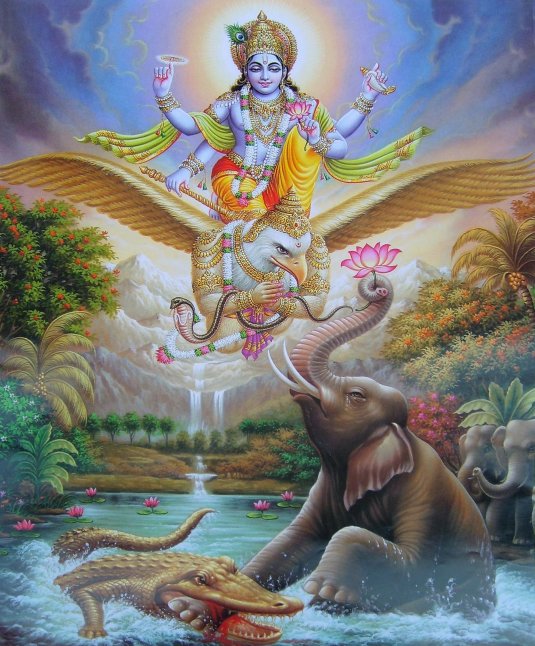
click on image to enlarge
The following are the prayers by Gajendra, the King of the elephants, offered to the Supreme Personality of Godhead, during his difficult struggle with the crocodile. It appears that the King of the elephants was formerly a human being known as Indradyumna and that he learned a prayer to the Supreme Lord. Fortunately he remembered that prayer and began to chant it. First he offered his respectful obeisances to the Supreme Personality of Godhead, and because of his awkward position in having been attacked by the crocodile, he expressed his inability to recite prayers nicely. Nonetheless, he tried to chant the mantra and expressed himself in the prayers that follow.
…It is imperative that all devotees in Kṛṣṇa consciousness practice chanting some mantra. Certainly one should chant the Hare Kṛṣṇa mantra, which is the mahā-mantra, or great mantra, and also one should practice chanting cintāmaṇi-prakara-sadmasu or the Nṛsiṁha strotra (ito nṛsiṁhaḥ parato nṛsiṁho yato yato yāmi tato nṛsiṁhaḥ). Every devotee should practice in order to chant some mantra perfectly so that even though he may be imperfect in spiritual consciousness in this life, in his next life he will not forget Kṛṣṇa consciousness, even if he becomes an animal. Of course, a devotee should try to perfect his Kṛṣṇa consciousness in this life, for simply by understanding Kṛṣṇa and His instructions, after giving up this body one can return home, back to Godhead. Even if there is some falldown, practice of Kṛṣṇa consciousness never goes in vain. For example, Ajāmila, in his boyhood, practiced chanting the name of Nārāyaṇa under the direction of his father, but later, in his youth, he fell down and became a drunkard, woman-hunter, rogue and thief. Nonetheless, because of chanting the name of Nārāyaṇa for the purpose of calling his son, whom he had named Nārāyaṇa, he became advanced, even though he was involved in sinful activities. Therefore, we should not forget the chanting of the Hare Kṛṣṇa mantra under any circumstances. It will help us in the greatest danger, as we find in the life of Gajendra. (From Purport to text 1)
Śrīmad-Bhāgavatam
By His Divine Grace A. C. Bhaktivedanta Swami Prabhupāda
Canto 8, Chapter Three, Text 1-29
Gajendra’s Prayers of Surrender More
13 Dec 2012
by The Hare Krishna Movement
in A.C. Bhaktivedanta Swami Prabhupada, Srimad Bhagavatam
Tags: A.C. Bhaktivedanta Swami Prabhupada, bhakti, feelings of devotional service, illusion and fearfulness, illusion fearfulness, lamentation, Lord Krishna, SB 1.7.7., Srimad Bhagavatam, Supreme Personality of Godhead, The Son Of Drona Punished, transcendental sound, Vedic literature, worldly miseries, yasyam

The ultimate result of devotional service is to develop genuine love for the Supreme Personality…And love is the only word that can be properly used to indicate the relation between Lord Kṛṣṇa and the living entities.
Loving devotional service to the Lord begins with hearing about the Lord. There is no difference between the Lord and the subject matter heard about Him. Therefore, hearing about Him means immediate contact with Him by the process of vibration of the transcendental sound…
…The conclusion is that simply by hearing the Vedic literature Śrīmad-Bhāgavatam, one can have direct connection with the Supreme Personality of Godhead Śrī Kṛṣṇa, and thereby one can attain the highest perfection of life by transcending worldly miseries, illusion and fearfulness. These are practical tests for one who has actually given a submissive hearing to the readings of the Śrīmad-Bhāgavatam.
Full text and purport More
08 Dec 2012
by The Hare Krishna Movement
in A.C. Bhaktivedanta Swami Prabhupada, Guru & Disciple, Narada Muni, Srimad Bhagavatam
Tags: A.C. Bhaktivedanta Swami Prabhupada, bliss and knowledge, eternal life, perfect stage of life, sad-dharma-prccha, sat cit ananda, spiritual body, spiritual master, Sri Narada Muni, Sri Vyasadeva, Srila Vyasadeva, Suta Goswvami

…Śrī Nārada Muni in his previous life was just an ordinary maidservant’s son, so how he became so perfectly transformed into the spiritual body of eternal life, bliss and knowledge is certainly important. Śrī Vyāsadeva desired him to disclose the facts for everyone’s satisfaction.
Vyāsadeva himself was the disciple of Nāradajī, and therefore it was natural to be anxious to hear what Nārada did after initiation from the spiritual masters. He wanted to follow in Nārada’s footsteps in order to attain to the same perfect stage of life. This desire to inquire from the spiritual master is an essential factor to the progressive path. This process is technically known as sad-dharma-pṛcchā.
The life of a sincere devotee of the Lord is thus explained in a nutshell by Nārada Muni by his personal example. Such a devotee, after his initiation by the Lord or His bona fide representative, takes very seriously chanting of the glories of the Lord and traveling all over the world so that others may also hear the glories of the Lord. Such devotees have no desire for material gain. They are conducted by one single desire: to go back to Godhead. This awaits them in due course on quitting the material body. Because they have the highest aim of life, going back to Godhead, they are never envious of anyone, nor are they proud of being eligible to go back to Godhead. Their only business is to chant and remember the holy name, fame and pastimes of the Lord and, according to personal capacity, to distribute the message for others’ welfare without motive of material gain. (from Purports to 6th chapter)
The following is the Translations from the entire 6th Chapter the First Canto of Srimad Bhagavatam describing Srila Narada Muni’s transformation from a simple and gentle maidservants son to his platform of spiritual perfection and realization.
More
18 Nov 2012
by The Hare Krishna Movement
in A.C. Bhaktivedanta Swami Prabhupada, Book Changes, Srimad Bhagavatam
Tags: A.C. Bhaktivedanta Swami Prabhupada, book changes, departure from mortal world, final verse, Nov. 14 1977, SB 10.13.64, Srila Prabhupada, Srimad Bhagavatam, Tenth Canto, translated by His Divine Grace
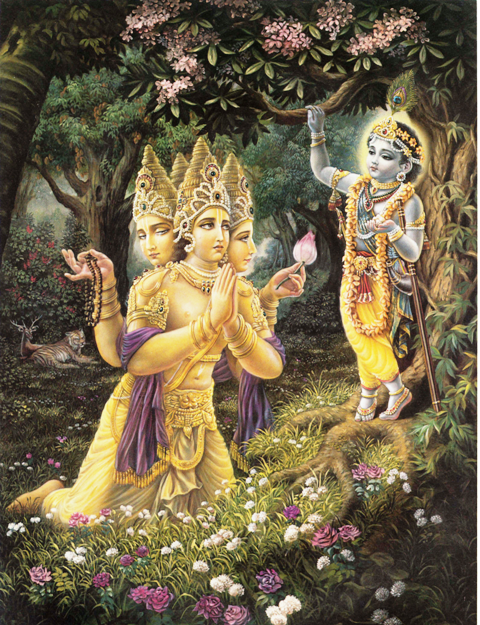
This is the final Srimad Bhagavatam verse translated by His Divine Grace A.C. Bhaktivedanta Swami Prabhupada, the Founder-Acarya of the International Society for Krishna Consciousness. This is where Srila Prabhupada ended his translating, before his departure from this mortal world on November 14, 1977, at the Krsna-Balarama Mandira in Vrndavana, India.
Śrīmad-Bhāgavatam
By His Divine Grace A.C. Bhaktivedanta Swami Prabhupada
Canto 10, Chapter 13, Text 64
śanair athotthāya vimṛjya locane
mukundam udvīkṣya vinamra-kandharaḥ
kṛtāñjaliḥ praśrayavān samāhitaḥ
sa-vepathur gadgadayailatelayā
śanaiḥ—gradually; atha—then; utthāya—rising; vimṛjya—wiping; locane—his two eyes; mukundam—at Mukunda, Lord Śrī Kṛṣṇa; udvīkṣya—looking up; vinamra-kandharaḥ—his neck bent; kṛta-añjaliḥ—with folded hands; praśraya-vān—very humble; samāhitaḥ—his mind concentrated; sa-vepathuḥ—his body trembling; gadgadayā—faltering; ailata—Brahmā began to offer praise; īlayā—with words.
Then, rising very gradually and wiping his two eyes, Lord Brahmā looked up at Mukunda. Lord Brahmā, his head bent low, his mind concentrated and his body trembling, very humbly began, with faltering words, to offer praises to Lord Kṛṣṇa.
Brahmā, being very joyful, began to shed tears, and he washed the lotus feet of Kṛṣṇa with his tears. Repeatedly he fell and rose as he recalled the wonderful activities of the Lord. After repeating obeisances for a long time, Brahmā stood up and smeared his hands over his eyes. Śrīla Viśvanātha Cakravartī Ṭhākura comments that the word locane indicates that with his two hands he wiped the two eyes on each of his four faces. Seeing the Lord before him, Brahmā began to offer prayers with great humility, respect and attention.
Thus end the Bhaktivedanta purports of the Tenth Canto, Thirteenth Chapter, of the Śrīmad-Bhāgavatam, entitled “The Stealing of the Boys and Calves by Brahmā.”
Previous Older Entries Next Newer Entries










 The Hare Krishna Movement