I remember some years ago (1979), Bob Dylan released this song entitled “Gotta Serve Somebody”. I’m sure many of you remember it.
[Chorus] But you’re going to have to serve somebody, yes indeed You’re going to have to serve somebody Well, it may be the devil or it may be the Lord But you’re going to have to serve somebody
I chose to serve the Lord, Krishna. Service ts our eternal nature, our dharma. And like Bob says “You’re going to have to serve somebody”
The following are some quotes from the Srimad Bhagavatam, ant the Bhagavad-gita, on our eternal relationship (sanātana-dharma) with the Lord.
At the last stage of one’s life, one should be bold enough not to be afraid of death. But one must cut off all attachment to the material body and everything pertaining to it and all desires thereof. (SB 2.1.15)
The foolishness of gross materialism is that people think of making a permanent settlement in this world, although it is a settled fact that one has to give up everything here that has been created by valuable human energy. Great statesmen, scientists, philosophers, etc., who are foolish, without any information of the spirit soul, think that this life of a few years only is all in all and that there is nothing more after death. This poor fund of knowledge, even in the so-called learned circles of the world, is killing the vitality of human energy, and the awful result is being keenly felt. And yet the foolish materialistic men do not care about what is going to happen in the next life. The preliminary instruction in the Bhagavad-gītā is that one should know that the identity of the individual living entity is not lost even after the end of this present body, which is nothing but an outward dress only. As one changes an old garment, so the individual living being also changes his body, and this change of body is called death. Death is therefore a process of changing the body at the end of the duration of the present life. An intelligent person must be prepared for this and must try to have the best type of body in the next life. The best type of body is a spiritual body, which is obtained by those who go back to the kingdom of God or enter the realm of Brahman. (from purport)
So we are finishing our series on the five types of relationships (rasa’s) with the Lord. Today we are exploring Devotional Service in Conjugal Love (Madhurya-rasa) as explained in chapter 44 of “The Nectar of Devotion”.
Because of the sensitive nature of this topic, we have posted the entire chapter from the the original 1970 edition of “The Nectar of Devotion”, by His Divine Grace A C Bhaktivedanta Swami Prabhupada.
A pure devotee’s attraction to Krsna in conjugal love is called devotional service in conjugal love. Although such conjugal feelings are not at all material, there is some similarity between this spiritual love and material activities. Therefore, persons who are interested only in material activities are unable to understand this spiritual conjugal love, and these devotional reciprocations appear very mysterious to them. Rupa Gosvāmī therefore describes conjugal love very briefly.
The impetuses of conjugal love are Krsna and His very dear consorts, such as Rādhārāṇī and Her immediate associates. Lord Krsnahas no rival: no one is equal to Him, and no one is greater than Him. His beauty is also without any rival, and because He excels all others in the pastimes of conjugal love, He is the original object of all conjugal love.
This is a nice compalation of quotes by Srila Prabhupada on the class of devotee known as ‘ahajiya’.
“A class of so-called devotees known as prākṛta-sahajiyās sometimes display devotional symptoms to exhibit their good fortune. They are pretending, however, because these devotional features are only external. The prākṛta-sahajiyās exhibit these symptoms to advertise their so-called advancement in love of Kṛṣṇa, but instead of praising the prākṛta-sahajiyās for their symptoms of transcendental ecstasy, pure devotees do not like to associate with them. It is not advisable to equate the prākṛta-sahajiyās with pure devotees. When one is actually advanced in ecstatic love of Kṛṣṇa, he does not try to advertise himself. Instead, he endeavors more and more to render service to the Lord.” (Caitanya-caritāmṛta Antya 20.28, Purport)
(Muni Maharaja, Bhakti Prajnana Kesava Maharaja, A.C. Bhaktivedanta Swami)
Today marks Srila Prabhupada’s acceptance of Sannyasa. Thanks to Prabhupada Connect for so nicely putting together this list list of quotes by Srila Prabhupada on Sannyasa, which we have re-posted here.
Srila Prabhupada’s Sannyasa Initiation
Srila Prabhupada accepted the order of sannyasa from Sri Srimad Bhaktiprajnana Kesava Maharaja on September 17, 1959 at the Kesavaji Math in Mathura. Included below are some relevant quotes from Srila Prabhupada’s lectures and letters.
“When I was householder, several times there was indication given by my Guru Maharaja that I should give up family life and become a sannyasi and preach this Krishna consciousness movement. In several way there was hints from my spiritual master, but still, I was not willing. I was thinking, ‘If I go away, then my family, my sons, my daughters, they will suffer.’ But actually, I have left my family connection in 1950. Actually ’54, but introductory in ’50. For the last twenty years. But they are living; I am living. They are not dying in my absence, and I am not suffering without being in my family. On the other hand, by Krishna’s grace, I have got better family members. I have got nice children in a foreign country. They are taking so much care of me, I could not expect such care from my own children.
So this is God’s grace. We should depend on Krishna. If Krishna is kind, wherever we go, everyone will be pleased, everyone will be kind. And if Krishna is unpleased, even in your family life you’ll not be comfortable. Therefore, according to the Vedic system, at a certain age, it is indicated that one should retire from family life.” (Srila Prabhupada Lecture, Tittenhurst, London, September 12, 1969)
“The Krishna consciousness movement is not that we are asking everyone to become a sannyasi like me, and give up everything. No. That is not our program. You act as a brahmaṇa, as a ksatriya or a vaisya or a sudra. It doesn’t matter. But you try to satisfy Krishna. That is the program.” (Srila Prabhupada Lecture, Bombay, December 30, 1972)
Today we celebrate the birth of Lord Krsna, or Krishna Janmastami, with a full day fast and a feast after his appearance at Midnight tonight. We honor this auspicious day with a post from the Krsna Book.
The joyous vibrations at Krsna’s birth ceremony could be heard in all the pasturing grounds and houses.
The other day I was talking with one guest, explaining that we are actually sac-cid-ānanda; (eternal, full of knowledge, and bliss), eternal spirit souls, but are, at the present moment, in a temporary position, just like a fish out of water. This is a very good analogy that Srila Prabhupada has used often in his preaching. I did a search this morning on Prabhupada Books.com and found a few references that I am posting here, as well as one very nice Bhagavad-gita Lecture wherein Srila Prabhupada is describing the nature of the soul.
Everyone in the material world is engaged in all kinds of political, philanthropic and humanitarian activities to make material life happy and prosperous, but this is not possible. One should understand that in the material world, however one may try to make adjustments, he cannot be happy. To cite an example I have given many times, if you take a fish out of water, you can give it a very comfortable velvet bedstead, but still the fish cannot be happy; it will die. Because the fish is an animal of the water, it cannot be happy without water. Similarly, we are all spirit soul; unless we are in spiritual life or in the spiritual world, we cannot be happy. That is our position. (Srila Prabhupada; Krsna Consciousness The Topmost Yoga System)
Śrīla Prabhupāda: The Vedic injunction is that people are searching after knowledge, and that when one understands the Absolute Truth, he understands everything. Yasmin vijñāte sarvam evaṁ vijñātaṁ bhavati. People are trying to approach an objective, but they do not know that the final objective is Kṛṣṇa. They are simply trying to make adjustments with so many materialistic revolutions. They have no knowledge that they are spiritual beings and that unless they go back to the spiritual world and associate with the Supreme Spirit, God, there is no question of happiness. We are like fish out of water. Just as a fish cannot be happy unless he is in the water, we cannot be happy apart from the spiritual world. We are part and parcel of the Supreme Spirit, Kṛṣṇa, but we have left His association and fallen from the spiritual world because of our desire to enjoy this material world. So unless we reawaken the understanding of our spiritual position and go back home to the spiritual world, we can never be happy. We can go on theorizing for many lifetimes, but we will only see one revolution after another. The old order changes, yielding its place to the new. Or in other words, history repeats itself. (Srila Prabhupada; The Journey for Self Discovery)
A fish that is taken out of the water cannot be happy by any arrangement on land. He must be supplied with water. In the same way, the minute sac-cid-ānanda living entity cannot be really happy through any amount of planning conceived by his illusioned brain in this material universe. He must therefore be given a different type of happiness which is spiritual in essence. Our ambition should be aimed at enjoying spiritual bliss and not this temporary happiness. Some philosophers claim that spiritual bliss is attained by negating material happiness and material existence. Theoretical negation of material activities as propounded by Śrīpāda Śaṅkarācārya may be effective for an insignificant section of mankind, but the best and surest way for everyone to attain spiritual bliss was propounded by Lord Śrī Caitanya Mahāprabhu by means of devotional activities. These devotional activities can change the very face of material nature. (Srila Prabhupada; Elevation to Krsna Consciousness)
Purport to Jaya Radha Madhava
By Srila A.C. Bhaktivedanta Swami Prabhupada
(New York, July 20, 1971)
[Sings Jaya Radha-Madhava.]
Srila Prabhupada: So this is the original nature of Krsna, original nature of Krsna. He is Radha-Madhava. He is the lover of Srimati Radharani. And kunja-vihari, always enjoying the company of the gopis within the bushes of Vrdavana forest. Radha-madhava kunja-vihari. So He’s not only lover of Radharani, but braja-jana-vallabha. The whole residents of Vrndavana, they love Krsna. They do not know anything else. They do not know whether Krsna is God, or not; neither they are very much harassed, that “I shall love Krsna if He is God.” “He may be God or He may be whatever He is. It doesn’t matter, but we love God, Krsna.” That’s all. That is called unnalloyed love. “If Krsna is God, then I shall love Him” — this is conditional love. This is not pure love. Krsna may be God or whatever He may be, but by His wonderful acts, the Vrajavasi, they are thinking, “Oh Krsna, He is very wonderful child, maybe some demigod. Maybe some demigod.” Because people are generally under impression that the demigods are all-powerful.
To those who are constantly devoted and worship Me with love, I give the understanding by which they can come to Me.
This is one of those verses that years ago I added to my repertoire of memorized slokas, and remains today one of my favorite verses. I have come to realize, that it is not by any great knowledge or scholarship, on my part, that I will make spiritual advancement, but rather, it is by faith and devotion, that I might be able to advance spiritually.
…A person may have a bona fide spiritual master and may be attached to a spiritual organization, but still, if he is not intelligent enough to make progress, then Kṛṣṇa from within gives him instructions so that he may ultimately come to Him without difficulty. The qualification is that a person always engage himself in Kṛṣṇa consciousness and with love and devotion render all kinds of services. He should perform some sort of work for Kṛṣṇa, and that work should be with love. If a devotee is intelligent enough, he will make progress on the path of self-realization. If one is sincere and devoted to the activities of devotional service, the Lord gives him a chance to make progress and ultimately attain to Him. (from purport to Bg. 10.10)
O learned one, in this iron age of Kali men have but short lives. They are quarrelsome, lazy, misguided, unlucky and, above all, always disturbed. (SB 1.1.10)
This morning as I was reading from the Srimad Bhagavam, and Srila Prabhupada was describing the symptoms of this age.
…In Kali-yuga, the duration of life is shortened not so much because of insufficient food but because of irregular habits. By keeping regular habits and eating simple food, any man can maintain his health. Overeating, over-sense gratification, overdependence on another’s mercy, and artificial standards of living sap the very vitality of human energy. Therefore the duration of life is shortened.
The people of this age are also very lazy, not only materially but in the matter of self-realization.
In this age, men are victims not only of different political creeds and parties, but also of many different types of sense-gratificatory diversions, such as cinemas, sports, gambling, clubs, mundane libraries, bad association, smoking, drinking, cheating, pilfering, bickerings, and so on. Their minds are always disturbed and full of anxieties due to so many different engagements… In the Kali-yuga the whole atmosphere is surcharged with faithlessness. Men are no longer interested in spiritual values. Material sense gratification is now the standard of civilization.
Although it is indeed a difficult age to live in, still there is a solution. In this First Chapter of Srimad Bhagavatam;
…The sages of Naimiṣāraṇya are anxious to disentangle all fallen souls, and here they are seeking the remedy from Śrīla Sūta Gosvāmī.
This morning I was reading from the Srimad Bhagavatam, Canto 3, Chapter 2, and I just stopped and re-read the following three verses and purports a second time, as they were so visually attractive. Srila Prabhupada in his purport, was painting a beautiful picture of the spiritual world.
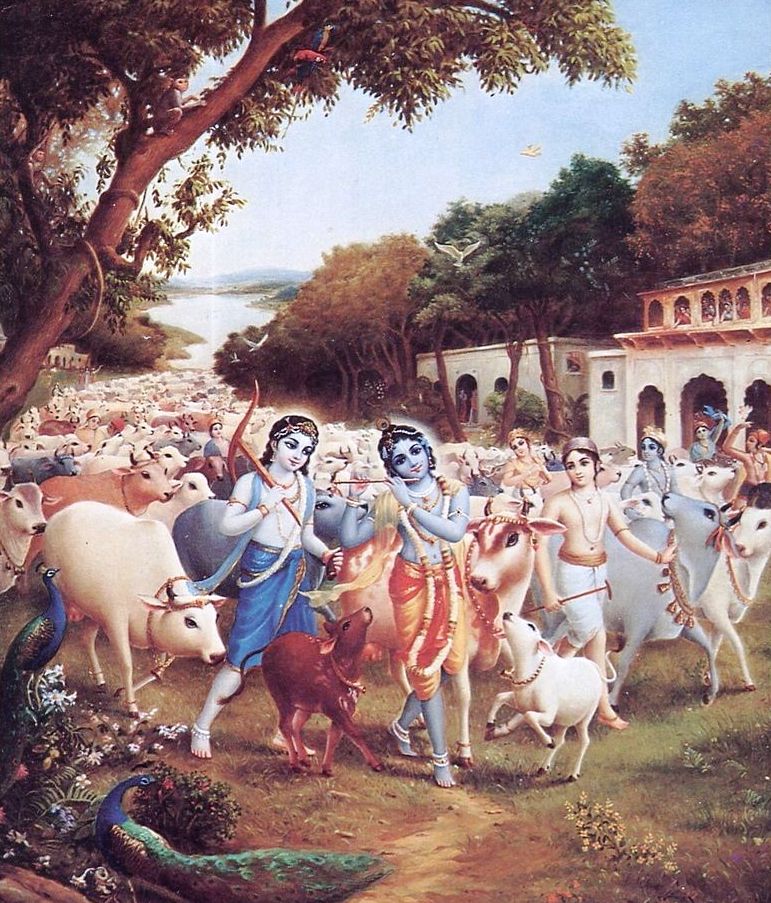
In His childhood, the Almighty Lord was surrounded by cowherd boys and calves, and thus He traveled on the shore of the Yamunā River, through gardens densely covered with trees and filled with vibrations of chirping birds. (SB 3.2.27)
…The forests on the shore of the Yamunā are all beautiful gardens full of trees of mango, jackfruit, apples, guava, oranges, grapes, berries, palmfruit and so many other plants and fragrant flowers. And because the forest was on the bank of the Yamunā, naturally there were ducks, cranes and peacocks on the branches of the trees. All these trees and birds and beasts were pious living entities born in the transcendental abode of Vṛndāvana just to give pleasure to the Lord and His eternal associates, the cowherd boys. (from purport)
Yesterday I was cleaning out the abandoned barn at Bahulavan, which is now being put back together again, and I found an old issue of Back to Godhead Magazine mixed in with so much debris. I pulled it out, cleaned it off, and added it to my collection of Back to Godhead Magazines. I had always heard of this famous sailing ship, and finally got a chance to see it.
Sailing Back to Godhead
Article excerpted from Back to Godhead Magazine Vol. 16, No. 6, 1981
A teakwood ketch and a devotee’s determination help bring Lord Krsna’s message to the Hawaiian Islands.
“…Krsna consciousness is the only established religion I know of that openly respects all other bonafide religions. My wife and I chant Hare Krsna and read Srila Prabhupada’s books daily. It’s added a dimension to my life that I feel is essential.”
A lecture by His Divine Grace A.C. Bhaktivedanta Swami Prabhupada
Founder-Acarya of the International Society for Krishna Consciousness
Excerpted from Back to Godhead Magazine Vol. 18, No. 10, 1983
Ladies and gentlemen, thank you very much for kindly participating in this Krsna consciousness movement, which is spreading bhagavata-dharma. Bhagavata-dharma means “the activities performed in relationship with the Supreme Lord.” The Lord is Bhagavan, the Supreme Personality of Godhead, and the devotee is bhagavata, one who acts in relationship with Bhagavan.
Some Day the Tiny Soul Will Want to Get Out of Illusion
Instructions to the devotees of the Hare Krsna movement
given in New York City, March 31, 1974
by His Holiness Visnujana Svami
Excerpted from Back to Godhead Magazine 1974 Vol. 1, No. 65
…As soon as one gets the association of the bhakti-vedanta, the pure devotee or spiritual master, and hears from his lips the nectarean waves flowing just like the wonderful River Ganges, these waves enter his ears and his heart and purify him. Thus he is freed from the seeds of contaminated material desires. When he hears sufficiently, his intelligence becomes satisfied, and he agrees to act on the instructions of his bona fide spiritual master. The more he acts on these instructions, the more he becomes freed from past bad habits and the conditional responses of this material world. Thus his conditional association is completely vanquished. This, of course, is where he achieves a spiritual taste (ruci) and spiritual strength (vairagya).
I have always loved this picture since the first time I opened the Bhagavad-gita some 42 years ago. It is a beautiful image of life in the Spiritual Sky, and also, it is a nice graphic description of the 5 types of relationships one can have with the Supreme Lord. The following is a short description, from the Introduction to the Bhagavad-gita As It Is, about the eternal nature, and the 5 types of relationships on can have with the Lord.
…In this material world we find that everything is temporary. It comes into being, stays for some time, produces some by-products, dwindles and then vanishes. That is the law of the material world, whether we use as an example this body, or a piece of fruit or anything. But beyond this temporary world there is another world of which we have information. This world consists of another nature which is sanātana, eternal. Jīva is also described as sanātana, eternal, and the Lord is also described as sanātana in the Eleventh Chapter. We have an intimate relationship with the Lord, and because we are all qualitatively one—the sanātana-dhāma, or sky, the sanātana Supreme Personality and the sanātana living entities—the whole purpose of Bhagavad-gītā is to revive our sanātana occupation, or sanātana-dharma, which is the eternal occupation of the living entity. We are temporarily engaged in different activities, but all of these activities can be purified when we give up all these temporary activities and take up the activities which are prescribed by the Supreme Lord. That is called our pure life.
…That destination is called the sanātana sky, the eternal spiritual sky. (from Introduction to Bhagavad-gita As It Is)
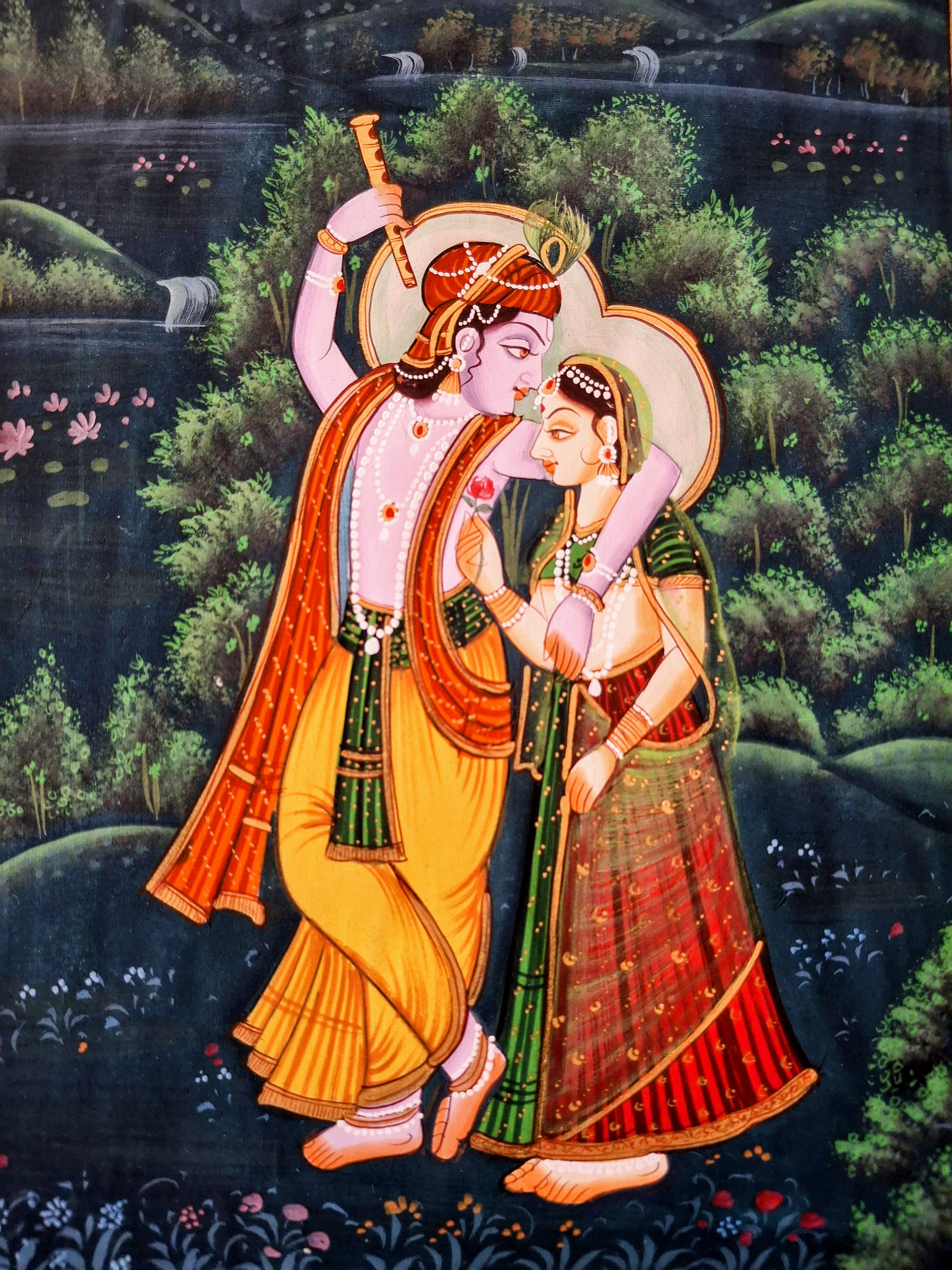
[This is a verse spoken by Śrīmatī Rādhārāṇī.] “My dear friend, now I have met My very old and dear friend Kṛṣṇa on this field of Kurukṣetra. I am the same Rādhārāṇī, and now We are meeting together. It is very pleasant, but still I would like to go to the bank of the Yamunā beneath the trees of the forest there. I wish to hear the vibration of His sweet flute playing the fifth note within that forest of Vṛndāvana.”
I guess we all have our favorite verse or sloka from Srila Prabhupada’s books, and a favorite picture as well. This is probably my favorite verse from the Srimad Bhagavatam. It speaks to me, and I find that I quote this verse often when I am speaking with others about the joyous nature of Krishna consciousness.
I will be away from the computer for the next few weeks as we are taking a ‘spring break’, but I wanted our last post to be about Remembering Krishna.
My dear Vyāsa, even though a devotee of Lord Kṛṣṇa sometimes falls down somehow or other, he certainly does not undergo material existence like others [fruitive workers, etc.] because a person who has once relished the taste of the lotus feet of the Lord can do nothing but remember that ecstasy again and again. (Srimad Bhagavatam 1.5.19)
…Pure devotional service is so spiritually relishable that a devotee becomes automatically uninterested in material enjoyment. That is the sign of perfection in progressive devotional service. A pure devotee continuously remembers the lotus feet of Lord Śrī Kṛṣṇa and does not forget Him even for a moment, not even in exchange for all the opulence of the three worlds. (from purport)
I was talking with one devotee the other day about Puerto Vallarta Mexico. We both agreed that it was a very beautiful and magical place and the devotee informed me that Srila Prabhupada had once visited there, liked it very much and said it reminded him of the birth place of Bhaktivinoda Thakur. This prompted me to do a search on Srila Prabhupada’s visit to Mexico…
In yesterdays post we listed the 64 Arts and Sciences that Krsna and Balarama learned from their spiritual master, today we list the The Sixty-four Activities in Fine Arts and Crafts, learned by Srimati Radharani and the gopis, as found in the Brahma-samhita text 37.
I worship Govinda, the primeval Lord, residing in His own realm, Goloka, with Rādhā, resembling His own spiritual figure, the embodiment of the ecstatic potency possessed of the sixty-four artistic activities, in the company of Her confidantes [sakhīs], embodiments of the extensions of Her bodily form, permeated and vitalized by His ever-blissful spiritual rasa.
As devotees, or rather as practitioners of bhakti-yoga, we should be aspiring to act in such a way that all of our actions and words will be an inspiration to others. We are representatives of our spiritual master and Krishna. And as such should try to act according to the instructions given in the Bhagavad-gita.
The perfectional stage of spiritual life which one can experience even while being in the material world is described in the Twelfth Chapter of Bhagavad-gītā as follows:
“One who is not envious but who is a kind friend to all living entities, who does not think himself a proprietor, who is free from false ego and equal both in happiness and distress, who is always satisfied and engaged in devotional service with determination and whose mind and intelligence are in agreement with Me-he is very dear to Me. He for whom no one is put into difficulty and who is not disturbed by anxiety, who is steady in happiness and distress, is very dear to Me. A devotee who is not dependent on the ordinary course of activities, who is pure, expert, without cares, free from all pains, and who does not strive for some result, is very dear to Me. One who grasps neither pleasure or grief who neither laments nor desires, and who renounces both auspicious and inauspicious things, is very dear to Me. One who is equal to friends and enemies, who is equipoised in honor and dishonor, heat and cold, happiness and distress, fame and infamy, who is always free from contamination, always silent and satisfied with anything, who doesn’t care for any residence, who is fixed in knowledge and engaged in devotional service, is very dear to Me. He who follows this imperishable path of devotional service and who completely engages himself with faith, making Me the supreme goal, is very, very dear to Me.” (Bg. 12.13-20)
Two Ways to Approach the Lord; Affection & Veneration
“Lord Kṛṣṇa’s mercy is dependent only on affection. Being obliged only by affection, Lord Kṛṣṇa acts very independently. (Cc. Madya 10. 139)
I have been looking for this(above) verse for the longest time. I remember reading this verse and purport a couple of years ago, and could not remember which book of the Sri Caitanya-caritamrta it came from. But today by Krsna’s mercy, I found the verse and purport.
“…Lord Śrī Kṛṣṇa, the Supreme Personality of Godhead, is merciful, but His mercy does not depend on mundane rules and regulations. He is dependent only on affection and nothing else. Service to Lord Kṛṣṇa can be rendered in two ways. One can serve the Lord in affection or in veneration. When service is rendered in affection, it is the Lord’s special mercy. When service is rendered in veneration, it is doubtful whether Kṛṣṇa’s mercy is actually involved.” (from purport Cc. Madya 10. 139)














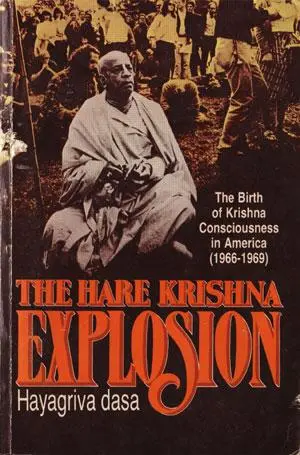

 The Hare Krishna Movement