25 Feb 2015
by The Hare Krishna Movement
in A.C. Bhaktivedanta Swami Prabhupada, Hearing and Memorizing, Krsna Consciousness, Quotes by Srila Prabhupada, Spiritual Master, Sri Vrindavan das, Srila Prabhupada's Books
Tags: A.C. Bhaktiveanta Swami Prabhupada, Bhaktivedanta Book Trust, knowledge, Krishna consciousness, quotes by Srila Prabhupada, Spiritual Life, Sri Vrindavan das, the spiritula master

The following is a nice collection of Srila Prabhupada Quotes on the importance of reading and hearing, compiled by Sri Vrindavan das.
Touch Krishna Immediately by Sound Vibration
by Sri Vrindavan das
Lecture 13 January, 1969
Srila Prabhupada: “So although a physical body is not present, the vibration should be accepted as the presence of the Spiritual Master, vibration. What we have heard from the Spiritual Master, that is living.”
Paramahamsa: My question is, a pure devotee, when he comments on Bhagavad-gita, someone who never sees him physically, but he just comes in contact with the commentary, explanation, is this the same thing?
Srila Prabhupada: “Yes, you can associate with Krishna by reading Bhagavad-gita. And these saintly persons, they have given their explanations, comments. So where is the difficulty?”
More
27 Jan 2015
by The Hare Krishna Movement
in A.C. Bhaktivedanta Swami Prabhupada, Krsna Consciousness, Michael Buck, New Vrindavan, Simple Living
Tags: ancient technique of cob, building with a mixture of sand, clay, fresh milk and cream, Michael Buck, Middle Earth, reclaimed materials, SB 4.22.24, straw, water and earth

There has been an ongoing discussion here at New Vrindaban about the possibility of establishing a Vedic or Eco Village, where people would be able to live simply, and practice Krishna Consciousness. Establishing cottage industries based on agriculture, dairy, arts and crafts, etc., and living a more earth based lifestyle
A few day ago my wife shared a link with me on Facebook describing an earth friendly, hand built house, built by Michael Buck, for practically nothing! As I have myself been a builder for almost 40 years now, as as we have been discussing the idea of an Eco Village here at New Vrindaban, I was of course interested. This is a nice example of a house that could easily be built with materials that are local to our area, using the ancient technique of cob – building with a mixture of sand, clay, straw, water and earth.
The following is the text and images as it appears on the English web site Daily Mail.
More
19 Jan 2015
by The Hare Krishna Movement
in A.C. Bhaktivedanta Swami Prabhupada, Bhagavad-gita, Krsna Consciousness, Photos
Tags: A.C. Bhaktivedanta Swami Prabhupada, absoulte stage, Bhagavad-gita lecture, devotees, God, Govinda dasi, krsna consciousness, photograph of spiritual master, prabhupada, Sept. 16 1966, Spiritual Life, spiritual master, spiritually advanced, transcendental life

click on image to enlarge
…Yes. Those who are spiritually advanced, their photograph and ordinary photograph is different. Just like here is statue of Kṛṣṇa. He’s not different from Kṛṣṇa. The original person Kṛṣṇa and this statue of Kṛṣṇa is the same. Similarly, a spiritually perfect person and his photograph is the same. Because it is in the absolute stage. In the absolute stage there is no difference. In the material stage there is difference. Is that clear?… (Srila Prabhupada Bhagavad-gita Lecture Sept. 16, 1966)
Full Lecture More
10 Jan 2015
by The Hare Krishna Movement
in A.C. Bhaktivedanta Swami Prabhupada, Difficulties, Krsna Consciousness, Letters by Srila Prabhupada
Tags: A.C. Bhaktivedanta Swami Prabhupada, chant Hare Krishna, compression, depression, difficulities, difficult, guru disciple, krsna consciousness, letters by prabhupada, rectification, repression, the material world

Sometimes when people take to Krsna Consciousness, they think that automatically, all their problems and difficulties will be solved, but unfortunately this is not the immediate case, as the letters from Srila Prabhupada to his disciples so vividly indicate. I was listening to one lecture where Srila Prabhupada was saying “…in this material world there will always be difficulties. This material world was designed in such a way that there will always be difficulties.” I went through some of the letters and highlighted where Srila Prabhupada used the word difficulties. It was interesting to read how he explained about these difficulties.
“Please accept my blessings. I beg to acknowledge receipt of your letter dated December 27, 1973. I can understand that you are sometimes experiencing difficulties but that you are very sincerely trying to become Krsna Conscious and that you have a number of persons there who are interested in your presentation of Krsna Consciousness. Actually this material world is full of suffering conditions and the only way to become free from these sufferings which are due to past sinful activities is to chant Hare Krsna. In this age no other method of rectification is possible. Along with the chanting of Hare Krsna we have to rigidly observe the prohibition of four sinful activities. If only these things we can do our lives can become perfect. I think you have my books so please study them carefully.” (Letter to: Bhumata — Los Angeles 2 January, 1974)
And in this one famous letter he wrote to Gurudas Prabhu, Srila Prabhupada descrbes his own difficulties in starting this Hare Krishna Movement.
My dear Gurudasa,
Please accept my blessings. I am in due receipt of your letter dated August 23, 1972, and I have noted the contents carefully. Do not be depressed. All along my godbrothers gave me only depression, repression, compression—but I continued strong in my duty. So never mind there is some discouragement, continue with your work in full enthusiastic Krishna Consciousness attitude of service…
Hoping this meets you in good health.
Your ever well-wisher,
A.C. Bhaktivedanta Swami
The following are the letters that Srila Prabhupada wrote to his disciples wherein he uses the word difficulties. More
10 Dec 2014
by The Hare Krishna Movement
in A.C. Bhaktivedanta Swami Prabhupada, Brahma-samhita, Goloka Vrndaban, Krsna Consciousness, Krsna God, Spiritual World
Tags: gopis, His Lordship, His lotus feet, His moonlike face is the drinking vessel for eyes which hanker after all that is beautiful, Krsna, Laksmis, Lord Govinda, spiritual gems, The Lord’s chest is the abode of the goddess of fortune, touchstone, transcendental abode of the Lord, Vedic literatures
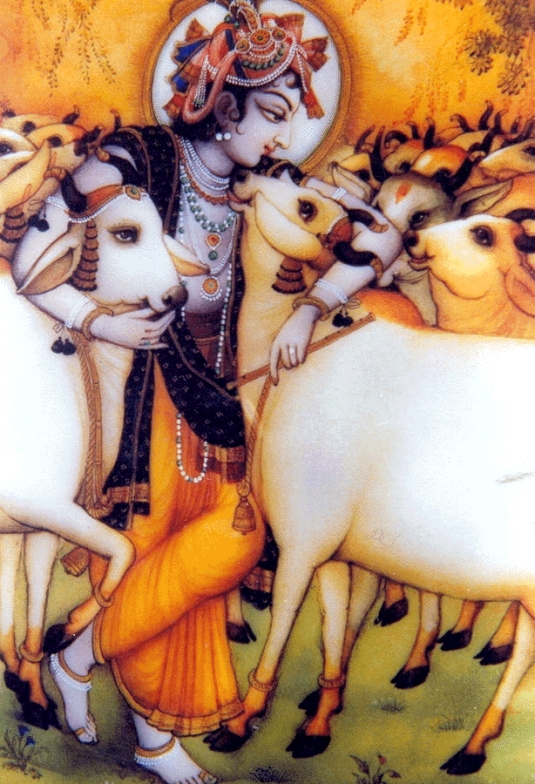
Sometimes when I am sitting and reading from Srila Prabhupada’s Srimad Bhagavatam, a verse or sentence from the purport just jumps out from the page almost like it is in 3D, and I catch a glimpse of what the Spiritual World must be like. It is beyond even my imagination, but sometimes I catch a glimmer of light, through a transcendental window, by the grace of my spiritual master His Divine Grace A. C. Bhaktivedanta Swami Prabhupada.
…The transcendental abode of the Lord where the trees are all desire trees and the buildings are made of touchstone. The Lord Govinda is engaged there in herding the surabhi cows as His natural occupation.
“I worship Govinda, the primeval Lord, the first progenitor who is tending the cows, yielding all desire, in abodes built with spiritual gems, surrounded by millions of purpose trees, always served with great reverence and affection by hundreds of thousands of lakṣmīs or gopīs.” (Bs 5.29)
…The Lord Govinda is engaged there in herding the surabhi cows as His natural occupation. And those who are artists, overtaken by the beautiful creation, should better see to the beautiful face of the Lord for complete satisfaction. The face of the Lord is the embodiment of beauty. What they call beautiful nature is but His smile, and what they call the sweet songs of the birds are but specimens of the whispering voice of the Lord.
More
09 Dec 2014
by The Hare Krishna Movement
in A.C. Bhaktivedanta Swami Prabhupada, B. G. Sharma Art, Krishna Consciousness, Krsna, Krsna Consciousness, Srimad Bhagavatam
Tags: A.C. Bhaktivedanta Swami Prabhupada, Arjuna, arjuna's arrows, awakened to love of God, Battlefield of Kurukṣetra, Goloka Vrndavana, Krsna, lotuslike face of Krsna, love of God, material contaminations, pleasing to the eyes of the seer, SB3.2.20, spiritual sky, Srimad Bhagavatam, the beauty of the Lord, transcendental sky, Vaikuntha planets

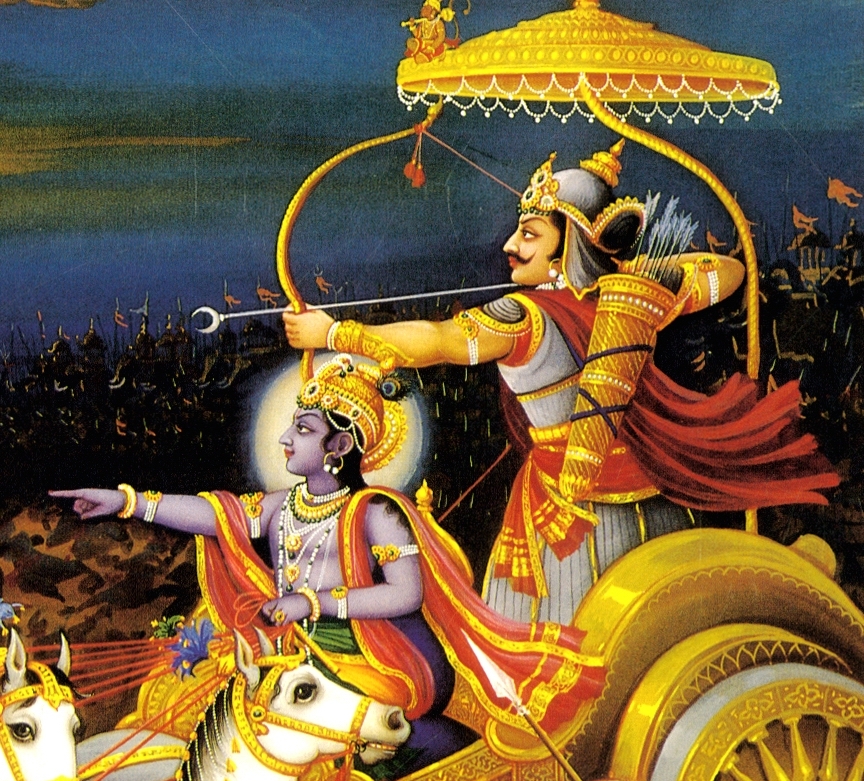
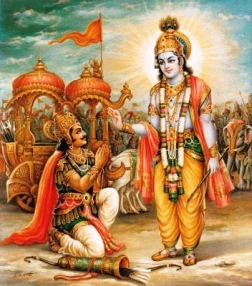
Certainly others who were fighters on the Battlefield of Kurukṣetra were purified by the onslaught of Arjuna’s arrows, and while seeing the lotuslike face of Kṛṣṇa, so pleasing to the eyes, they achieved the abode of the Lord. (SB 3.2.20)
This morning as I was reading from the Srimad-Bhagavatam, the words “pleasing to the eyes of the seer” jumped out at me. And I was reminded again how just by appreciating the beauty of the Lord, one can attain success in life, as the following purport explains.
“…All the warriors who fought against Arjuna but who were able to see the lotuslike face of the Lord on the battlefront achieved the abode of the Lord, exactly as the devotees of the Lord do. The words “pleasing to the eyes of the seer” are very significant. When the warriors from the other side of the battlefield saw Lord Kṛṣṇa at the front, they appreciated His beauty, and their dormant instinct of love of God was awakened.
This love of God is awakened by the association of pure devotees of the Lord… Those who saw the beautiful face of the Lord on the Battlefield of Kurukṣetra were purified first by Arjuna when he made his onslaught with arrows… All the activities of a pure devotee are executed on behalf of the Lord because a pure devotee of the Lord has nothing to do for his personal interest. Arjuna’s killing was as good as killing by the Lord Himself. As soon as Arjuna shot an arrow at an enemy, that enemy became purified of all material contaminations and became eligible to be transferred to the spiritual sky… those who awakened to love of God were transferred to the planets of the transcendental sky.
Those whose love of God is awakened to the fullest extent go back to the Goloka Vṛndāvana planet in the spiritual sky, whereas persons who have just awakened to love of Godhead by accident or association are transferred to the Vaikuṇṭha planets. Essentially there is no material difference between Goloka and Vaikuṇṭha, but in the Vaikuṇṭhas the Lord is served in unlimited opulence, whereas in Goloka the Lord is served in natural affection.” (from purport to SB 3.2.20)
Full Text and Purport More
22 Nov 2014
by The Hare Krishna Movement
in A.C. Bhaktivedanta Swami Prabhupada, Krishna Consciousness, Krishna Nectar, Krsna, Krsna Consciousness, Srimad Bhagavatam
Tags: . rainy season, A.C. Bhaktiveanta Swami Prabhupada, beauty, Crsna consciousness, dark cloud, densely cloudy, eyes like lotus petals, ghana-syamam, Shyamasundara, Srimad Bhagavatam. Krsna, sundarya, the lords beauty

The Lord’s beauty resembles a dark cloud during the rainy season. As the rainfall glistens, His bodily features also glisten. Indeed, He is the sum total of all beauty. The Lord has four arms and an exquisitely beautiful face with eyes like lotus petals, a beautiful highly raised nose, a mind-attracting smile, a beautiful forehead and equally beautiful and fully decorated ears. (Srimad Bhagavatam 4.24.45-46)
The Lord’s beauty is compared to rainfall because when the rain falls in the rainy season, it becomes more and more pleasing to the people. After the scorching heat of the summer season, the people enjoy the rainy season very much. Indeed, they even come out of their doors in the villages and enjoy the rainfall directly. Thus the Lord’s bodily features are compared to the clouds of the rainy season. The devotees enjoy the Lord’s beauty because it is a collection of all kinds of beauties. Therefore the word sarva-saundarya-saṅgraham is used. No one can say that the body of the Lord is wanting in beautiful parts. It is completely pūrṇam. Everything is complete: God’s creation, God’s beauty and God’s bodily features. All these are so complete that all one’s desires can become fully satisfied when one sees the beauty of the Lord. The word sarva-saundarya indicates that there are different types of beauties in the material and spiritual worlds and that the Lord contains all of them. Both materialists and spiritualists can enjoy the beauty of the Lord. Because the Supreme Lord attracts everyone, including demons and devotees, materialists and spiritualists, He is called Kṛṣṇa. (from purport)
Full text and purport More
14 Oct 2014
by The Hare Krishna Movement
in A.C. Bhaktivedanta Swami Prabhupada, Damodara, Kartika, Krishna Consciousness, Krsna Consciousness, KRSNA The Supreme Personality of Godhead
Tags: A.C. Bhaktivedanta Swami Prabhupada, damodarastka prayers, Kartika, Krsna, Krsna The Supreme Personality of Godhead, month of Damodara, Mother Yasoda Binds Lord Krsna, spiritual subject matter, spiritually enlivening, transcendental subject matter

click on image to enlarge
The beauty of Transcendental subject matter is that it never gets old, but rather, becomes more relishable with every reading. For instance, every year we celebrate the month of Damodara or Kartika, with the reading of “Mother Yasoda Binds Lord Krsna”, and singing the Damodarastka prayers, and every year, it becomes more enjoyable and spiritually enlivening. That is the nature of Spiritual Subject Matter.
Kṛṣṇa, the Supreme Personality of Godhead
By His Divine Grace A. C. Bhaktivedanta Swami Prabhupāda
Chapter Nine
Mother Yaśodā Binds Lord Kṛṣṇa
Once upon a time, seeing that her maidservant was engaged in different household duties, mother Yaśodā personally took charge of churning butter. And while she churned butter, she sang the childhood pastimes of Kṛṣṇa and enjoyed thinking of her son.
More
10 Oct 2014
by The Hare Krishna Movement
in A.C. Bhaktivedanta Swami Prabhupada, Kartika, Krishna, Krishna Consciousness, Krsna, Krsna Consciousness, Yoga
Tags: A.C. Bhaktivedanta Swami Prabhupada, devotional service, fraternal mellow, God, Kartika, linking up with the Lord, month of Damadora, Nectar of Devotion, relationship with the Supreme Personality of Godhead, symptoms of ecstasy, yoga

click on image to enlarge
When Kṛṣṇa and His devotees meet, the meeting is technically called yoga, or linking up with the Lord. (Nectar of Devotion Chapter 39)
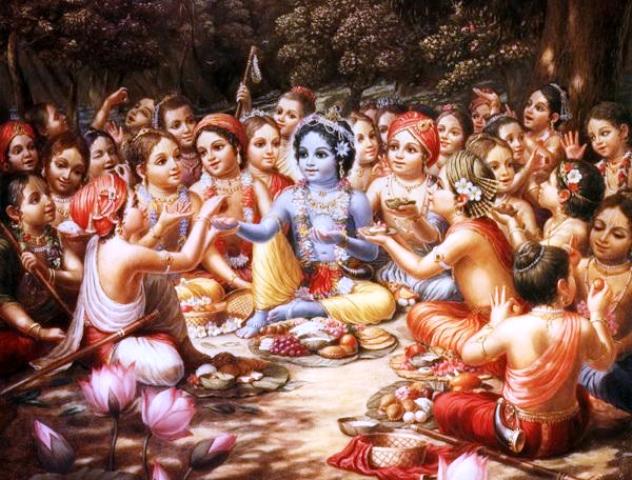
Durning the month of Damadora (Kartika) I like to focus my attention on the childhood pastimes of Krsna in Vrndavan. So with this in mind we decided to post a chapter from the Nectar of Devotion which focus’s on the Lords relationships with His devotees in the fraternal mellow or better known as friendship.
When a devotee is permanently situated in devotional service, and by different symptoms of ecstasy he has developed and matured a fraternal mellow or flavor in relationship with the Personality of Godhead, his feeling is called fraternal love of Godhead.
The impetus for such fraternal love of God is God Himself. When one is liberated and discovers his eternal relationship with the Supreme Lord, the Lord Himself becomes the impetus for increasing fraternal love. The eternal associates of the Lord in Vṛndāvana have described this as follows: “The Lord, Hari, whose bodily hue is like the indranīla jewel, whose smiling is as beautiful as the kunda flower, whose silk dress is as yellow as golden autumn foliage, whose chest is beautified with garlands of flowers and who is always playing upon His flute—this enemy of the Agha demon is always attracting our hearts by wandering about Vṛndāvana.” (Nectar of Devotion Chapter 41)
More
02 Oct 2014
by The Hare Krishna Movement
in A.C. Bhaktivedanta Swami Prabhupada, Krishna Consciousness, Krsna Consciousness, KRSNA The Supreme Personality of Godhead
Tags: A.C. Bhaktvedanta Swami Prabhupada, aghasura demon, associates of the Lord, cowherd boyfriends, cows and calves, Krsna Book, Krsna The Supreme Personality of Godhead, Lord Krsna, pious activities, residents of Vrndavan

click on image to enlarge
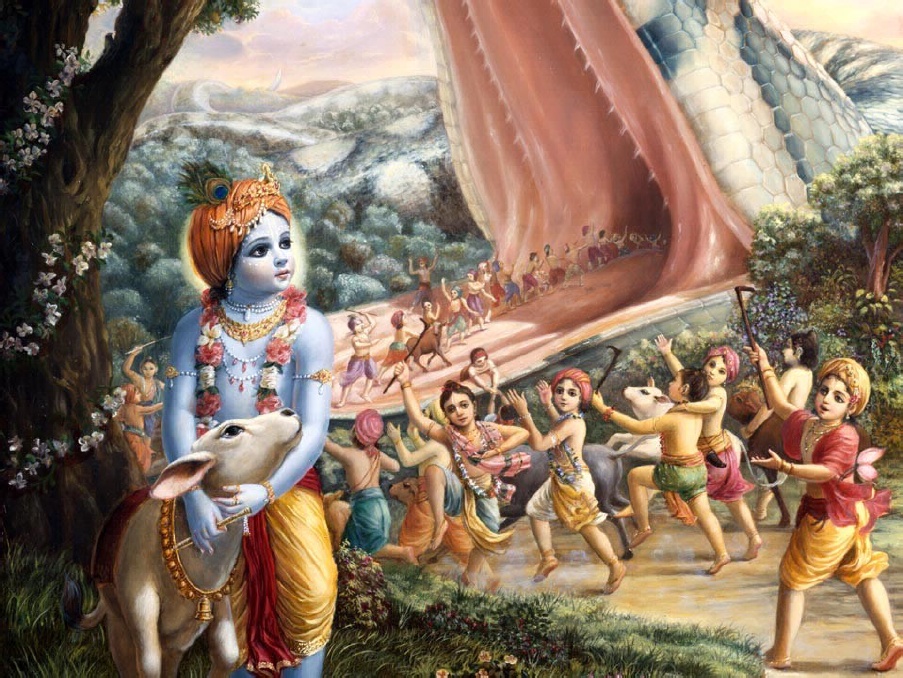
This story of the Killing of the Aghasura Demon, has always been one of my all time favorite stories in the Krsna Book. It is a good example of faith and trust.
….Only after accumulating heaps of pious activities were those boys promoted to personally associate with the Supreme Personality of Godhead. Who can estimate the transcendental fortune of the residents of Vṛndāvana? They were personally seeing the Supreme Personality of Godhead face to face, He whom many yogīs cannot find even after undergoing severe austerities, although He is sitting within their hearts.
… “Dear friends, this figure appears to be a great animal, and he is sitting in such a posture just to swallow us all. Just see—is it not a big snake that has widened his mouth to eat all of us?”
Then they further consulted among themselves:
“If we all at one time entered into the mouth of this great serpent, how could it possibly swallow all of us? And even if it were to swallow all of us at once, it could not swallow Kṛṣṇa. Kṛṣṇa will immediately kill him” (excerpted from chapter 12 “The Killing of the Aghāsura Demon”)
Full Chapter follows More
15 Aug 2014
by The Hare Krishna Movement
in A.C. Bhaktivedanta Swami Prabhupada, Festivals, Janmastami, Krishna, Krsna Consciousness, Krsna God, KRSNA The Supreme Personality of Godhead
Tags: A.C. Bhaktivedanta Swami Prabhupada, birth of Lord Krishna, Janmastami, janmastami festival, Krishna, Krsna, Krsna Book, Sri Krishna Janmastami, Srimad Bhagavatam

click on image to enlarge
With the advent of Lord Krsna’s birthday celebration (Janmastami) rapidly approaching, it seemed fitting that we do a post on the birth of Lord Krsna. So the following is the entire third chapter from the Krsna Book entitled “The Birth of Lord Kṛṣṇa”.
…As stated in the Bhagavad-gītā, the Lord says that His appearance, birth, and activities, are all transcendental, and one who understands them factually becomes immediately eligible to be transferred to the spiritual world. The Lord’s appearance or birth is not like that of an ordinary man who is forced to accept a material body according to his past deeds. The Lord’s appearance is explained in the Second Chapter: He appears out of His own sweet pleasure. When the time was mature for the appearance of the Lord, the constellations became very auspicious. The astrological influence of the star known as Rohiṇī was also predominant because this star is considered to be very auspicious. Rohiṇī is under the direct supervision of Brahmā. According to the astrological conclusion, besides the proper situation of the stars, there are auspicious and inauspicious moments due to the different situations of the different planetary systems. At the time of Kṛṣṇa’s birth, the planetary systems were automatically adjusted so that everything became auspicious. ( from Kṛṣṇa, the Supreme Personality of Godhead Chapter 3)
Full Chapter More
13 Aug 2014
by The Hare Krishna Movement
in A.C. Bhaktivedanta Swami Prabhupada, Krsna Consciousness, Nectar of Devotion, Radha Krishna, Rupa Goswami, Srimati Radharani
Tags: A. C. Bhaktivedanta Swmai Prabhupada, Nectar of Devotion, Radha, Radharani, Srimati Radharani

click on image to enlarge
…The beauty of Śrīmatī Rādhārāṇī is described as follows: “Her eyes defeat the attractive features of the eyes of the cakorī bird. When one sees the face of Rādhārāṇī, he immediately hates the beauty of the moon. Her bodily complexion defeats the beauty of gold. Thus, let us all look upon the transcendental beauty of Śrīmatī Rādhārāṇī.” Kṛṣṇa’s attraction for Rādhārāṇī is described by Kṛṣṇa Himself thus: “When I create some joking phrases in order to enjoy the beauty of Rādhārāṇī, Rādhārāṇī hears these joking words with great attention; but by Her bodily features and counterwords She neglects Me. And I even possess unlimited pleasure by Her neglect of Me, for She becomes so beautiful that She increases My pleasure one hundred times.” A similar statement can be found in Gīta-govinda, wherein it is said that when the enemy of Kaṁsa, Śrī Kṛṣṇa, embraces Śrīmatī Rādhārāṇī, He immediately becomes entangled in a loving condition and gives up the company of all other gopīs. (from Nectar of Devotion Chapter 44)
More
26 Jul 2014
by The Hare Krishna Movement
in A.C. Bhaktivedanta Swami Prabhupada, Festivals, Krishna Consciousness, Krishna Consciousness Movement, Krsna Consciousness
Tags: A.C. Bhaktivedanta Swami Prabhupada, Hare Krishna, human being, jagannatha svami, krsna consciousness, Kuruksetra, philosophy of Krsna Consciousness, prabhupada, Ratha Yatra Festival, Ratha yatra lecture, Ratha-yatra, San Francisco Ratha yatra, solar eclipse, The Hare Krishna Movement

…So if we want to have eternal life, full of knowledge and blissfulness, then we must take to Kṛṣṇa consciousness. Our, this Kṛṣṇa consciousness movement is the greatest welfare activities in the human society. We are giving information to every man, without any discrimination of cast, creed, or color, that every human being especially, not only human being, all living entities, including the animals, beasts, birds, trees, aquatics—everyone—they can achieve to the highest perfection of life by this Kṛṣṇa consciousness. But especially the extra intelligence of the human being can be utilized to realize Kṛṣṇa. If we don’t do that, we are missing a great opportunity. So our request to everyone is to understand this philosophy of Kṛṣṇa consciousness. (Ratha-yātrā Lecture, June 27, 1971, San Francisco)
Full Lecture More
19 Jul 2014
by The Hare Krishna Movement
in A.C. Bhaktivedanta Swami Prabhupada, Krishna Consciousness, Krishna Nectar, Krsna Consciousness, KRSNA The Supreme Personality of Godhead, Vaisnava Vocabulary
Tags: A.C. Bhaktivedanta Swami Prabhupada, chanting Krsna, cowheard boys, hearing and chanting about Krsna, Krsna Book, krsna consciousness, krsna nectar, Krsna the suporeme personality of godhead, nityanavanavayamana, transcendental subject matter

I am so much enjoying my reading of the Krsna Book every morning. Although I have read and re-read it so many times before, it is more relishable with each new reading.
It is said that it is the nature of a devotee to constantly apply his mind, energy, words, ears, etc., in hearing and chanting about Kṛṣṇa. This is called Kṛṣṇa consciousness, and for one who is rapt in hearing and chanting Kṛṣṇa, the subject matter never becomes hackneyed or old. That is the significance of transcendental subject matter in contrast to material subject matter. Material subject matter becomes stale, and one cannot hear a certain subject for a long time; he wants change. But as far as transcendental subject matter is concerned, it is called nityanavanavāyamāna. This means that one can go on chanting and hearing about the Lord and never feel tired but will remain fresh and eager to hear more and more.
It is the duty of the spiritual master to disclose all confidential subject matter to the inquisitive and sincere disciple.
And thus in the Krsna Book, Srila Prabhupada reveals the activities of the Supreme Person Krsna as is evident from the following excerpt:
More
01 Jul 2014
by The Hare Krishna Movement
in A.C. Bhaktivedanta Swami Prabhupada, Bhagavad-gita, Bhagavad-gita, Krsna Consciousness, Lectures
Tags: A.C. Bhaktivedanta Swami Prabhupada, as it is, Bg 9.34, bhagavad-gita, economically, God, God's party, Just always think of Me, just worship Me, krsna consciousness, lectures on Bhagavad gita, man-mana bava mad-bhakto, materialists, political field, politically, socially or religiously, spiritualism, spiritualists
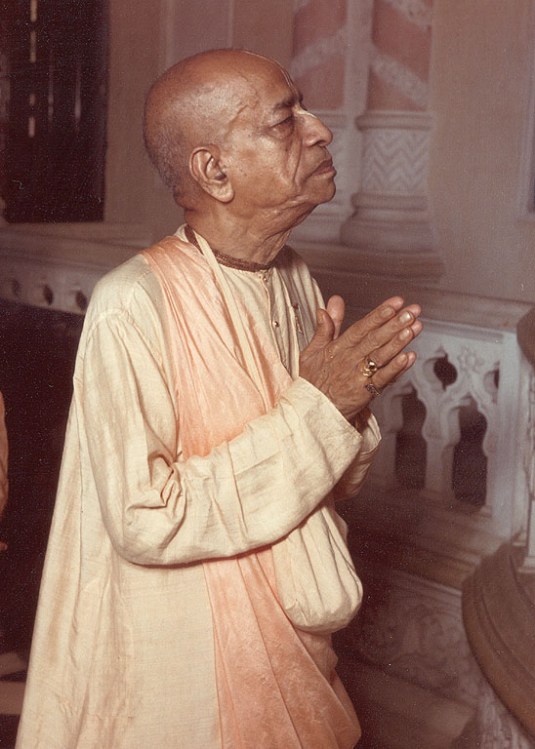
Engage your mind always in thinking of Me, offer obeisances and worship Me. Being completely absorbed in Me, surely you will come to Me. (Bg 9.34)
This is perhaps my favorite sloka from the Bhagavad-gita As It Is. “Always think of Me”, this for me is the essence of Krsna consciousness. Srila Prabhupada once said that “Krsna consciousness is so simple, you can miss it”. Thinking of Krsna, is Krsna consciousness. We have posted one of two lectures Srila Prabhupada gave on this very important verse.
Bhagavad-gītā Lecture 9.34
By His Divine Grace A. C. Bhaktivedanta Swami Prabhupada
New York, December 26, 1966
Prabhupāda:
man-manā bhava mad-bhakto
mad-yājī māṁ namaskuru
mām evaiṣyasi yuktvaivam
ātmānaṁ mat-parāyaṇaḥ
[Bg. 9.34]
This śloka, this verse we have already finished. The conclusion of the Ninth Chapter of Śrīmad Bhagavad-gītā, that, the Lord says that, man-manā bhava mad-bhaktaḥ. “Just always think of Me. Just become My devotee. And, if you want to worship, just worship Me.”
Full Lecture More
27 Jun 2014
by The Hare Krishna Movement
in A.C. Bhaktivedanta Swami Prabhupada, Krishna Nectar, Krsna Consciousness
Tags: A.C. Bhaktivedanta Swami Prabhupada, celebrated flute, cowherd boys, friends of krsna, Krishna, Krsna, remembrance of Lord Krsna, SB 3.2.27, Srimad Bhagavatam, Third Canto, transcendental flute, transcendental pleasure, Yamuna river
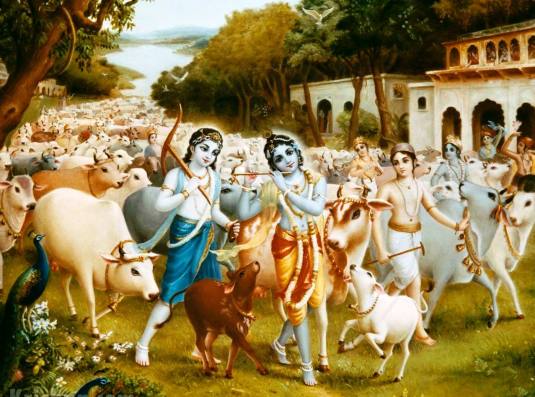
click on image to enlarge
This morning I was reading from the Srimad Bhagavatam Third Canto, Chapter Two. It was so enlivening, that I read out-loud, the entire chapter. The following is just three verses and purports from the chapter entitled ” Remembrance of Lord Kṛṣṇa”.
In His childhood, the Almighty Lord was surrounded by cowherd boys and calves, and thus He traveled on the shore of the Yamunā River, through gardens densely covered with trees and filled with vibrations of chirping birds. (SB 3.2.27)
…the Lord used to play His celebrated flute. The sound vibrated by His flute would give His friends such transcendental pleasure that they would forget all the talks of the brahmānanda which is so praised by the impersonalists. These cowherd boys, as will be explained by Śukadeva Gosvāmī, were living entities who had accumulated heaps of pious acts and thus were enjoying with the Lord in person and were hearing His transcendental flute. The Brahma-saṁhitā (5.30) confirms the Lord’s blowing His transcendental flute. (from purport to SB 3.2.29)
veṇuṁ kvaṇantam aravinda-dalāyatākṣaṁ
barhāvataṁsam asitāmbuda-sundarāṅgam
kandarpa-koṭi-kaminīya-viśeṣa-śobhaṁ
govindam ādi-puruṣaṁ tam ahaṁ bhajāmi
Brahmājī said, “I worship Govinda, the primeval Lord, who plays on His transcendental flute. His eyes are like lotus flowers, He is decorated with peacock plumes, and His bodily color resembles a fresh black cloud although His bodily features are more beautiful than millions of cupids.” These are the special features of the Lord.
More
17 Jun 2014
by The Hare Krishna Movement
in A.C. Bhaktivedanta Swami Prabhupada, Bhagavad-gita, Krsna, Krsna Consciousness, Meditation, Yoga, Yogi
Tags: A.C. Bhaktiveanta Swami Prabhupada, bhakti yoga, Govinda, Krsna, krsna consciousness, meditation, Nrismha, Rama, Syamasundara, Varaha, yoga, yogas, yogi, yoginam api sarvesam

“Of all yogis, he who abides in Me with great faith is the highest of all.”
It is by great fortune that one comes to Kṛṣṇa consciousness on the path of bhakti-yoga to become well situated according to the Vedic direction. The ideal yogī concentrates his attention on Kṛṣṇa, who is called Śyāmasundara, who is as beautifully colored as a cloud, whose lotus-like face is as effulgent as the sun, whose dress is brilliant with jewels and whose body is flower garlanded. Illuminating all sides is His gorgeous luster, which is called the brahmajyoti. He incarnates in different forms such as Rāma, Nṛsiṁha, Varāha and Kṛṣṇa, the Supreme Personality of Godhead, and He descends like a human being, as the son of Mother Yaśodā, and He is known as Kṛṣṇa, Govinda and Vāsudeva. He is the perfect child, husband, friend and master, and He is full with all opulences and transcendental qualities. If one remains fully conscious of these features of the Lord, he is called the highest yogī. (from purport to Bg. 6.47)
This is more or less a continuation of yesterdays post Freedom From All Miseries as it is the last verse in the Chapter 6, entitled; “Sankhya-yoga”. This is one of the very best verses and purports in the Bhagavad-gita for study if one is an aspiring yogi…
…The culmination of all kinds of yoga practices lies in bhakti-yoga. All other yogas are but means to come to the point of bhakti in bhakti-yoga. Yoga actually means bhakti-yoga; all other yogas are progressions toward the destination of bhakti-yoga. From the beginning of karma-yoga to the end of bhakti-yoga is a long way to self-realization. Karma-yoga, without fruitive results, is the beginning of this path. When karma-yoga increases in knowledge and renunciation, the stage is called jñāna-yoga. When jñāna-yoga increases in meditation on the Supersoul by different physical processes, and the mind is on Him, it is called aṣṭāṅga-yoga. And, when one surpasses the aṣṭāṅga-yoga and comes to the point of the Supreme Personality of Godhead Kṛṣṇa, it is called bhakti-yoga, the culmination. Factually, bhakti-yoga is the ultimate goal, but to analyze bhakti-yoga minutely one has to understand these other yogas. The yogī who is progressive is therefore on the true path of eternal good fortune. (from purport to Bg. 6.47)
More
10 May 2014
by The Hare Krishna Movement
in A.C. Bhaktivedanta Swami Prabhupada, Chanting Hare Krishna, Krishna Nectar, Krishna's flute, Krsna Consciousness, Sri Caitanya-Caritamrta
Tags: A.C. Bhaktivedanta Swami Prabhupada, chanting Hare Krishna, gopis, Krishna's Flute, Maha Mantra, Sri Caitanya-caritamrta, the Hare Krishna maha-mantra, vibration of Krsna's flute

“The vibration of His flute is just like a bird that creates a nest within the ears of the gopīs and always remains prominent there, not allowing any other sound to enter their ears. Indeed, the gopīs cannot hear anything else, nor are they able to concentrate on anything else, not even to give a suitable reply. Such are the effects of the vibration of Lord Kṛṣṇa’s flute.” (Madhya-lila 21.144)
…This vibration of Kṛṣṇa’s flute is represented by the Hare Kṛṣṇa mahā-mantra. A serious devotee of the Lord who chants and hears this transcendental vibration becomes so accustomed to it that he cannot divert his attention to any subject matter not related to Kṛṣṇa’s blissful characteristics and paraphernalia. (from purport)
Full Text and Purport More
23 Apr 2014
by The Hare Krishna Movement
in A.C. Bhaktivedanta Swami Prabhupada, Devotional Service, Krsna Consciousness, KRSNA The Supreme Personality of Godhead
Tags: A.C. Bhaktivedanta Swami Prabhupada, devotional service, exquisite garlands, florist of the name Sudama, Krsna, Krsna and Balarama, Krsna enters Mathura, Krsna The Supreme Personality of Godhead, My Dear Lord, service to Krsna, Sudama

…After dressing nicely, Kṛṣṇa and Balarāma went to a florist of the name Sudāmā. As soon as They reached the precinct of his house, the florist immediately came out and with great devotion fell down on his face to offer his respectful obeisances. He offered a nice seat to Kṛṣṇa and Balarāma and asked his assistant to bring out flowers and betel nuts smeared with pulp of candana. The florist’s welcome greatly satisfied the Lord.
The florist very humbly and submissively offered his prayers to the Lord, saying, ”My dear Lord, because You have come to my place, I think all my forefathers and all my worshipable superiors are pleased and delivered. My dear Lord, You are the supreme cause of all causes of this cosmic manifestation, but for the benefit of the residents of this earthly planet, You have appeared with Your plenary portion to give protection to Your devotees and annihilate the demons. You are equally disposed as the friend of all living entities; You are the Supersoul, and You do not discriminate between friend and enemy. Yet You are pleased to give Your devotees the special result of their devotional activities. My Lord, I am praying that You please tell me whatever You wish me to do, because I am Your eternal servant. If You will allow me to do something, it will be a great favor to me.“ The florist, Sudāmā, was greatly pleased within his heart by seeing Kṛṣṇa and Balarāma in his place, and thus, as his choicest desire, he made two exquisite garlands of various flowers and presented them to the Lord. Both Kṛṣṇa and Balarāma were very pleased with his sincere service, and Kṛṣṇa offered the florist His salutation and benediction, which He is always prepared to bestow upon the surrendered souls. When the florist was offered benediction, he begged from the Lord that he might remain His eternal servant in devotional service and by such service do good to all living creatures. By this, it is clear that a devotee of the Lord in Kṛṣṇa consciousness should not be simply satisfied by his own advancement in devotional service; he must be willing to work for the welfare of all others. This example was followed by the six Gosvāmīs of Vṛndāvana. It is therefore stated in their prayer, lokānāṁ hita-kāriṇau: Vaiṣṇavas, or devotees of the Lord, are not selfish. Whatever benefit they derive from the Supreme Personality of Godhead as benediction they want to distribute to all other persons. That is the greatest of all humanitarian activities. Being satisfied with the florist, Lord Kṛṣṇa not only gave him benediction for whatever he wanted, but over and above that, He offered him all material opulences, family prosperity, long duration of life, and whatever else his heart desired within the material world.
Full Chapter More
12 Feb 2014
by The Hare Krishna Movement
in A.C. Bhaktivedanta Swami Prabhupada, Krsna Consciousness, The Hare Krishna Movement
Tags: A.C. Bhaktivedanta Swami Prabhupada, Absolute Truth, age of kali, blissful consciousness, bona fide spiritual science, chant the holy names of the Lord, eternal spirit souls, Founder Acarya, genuine spiritual master, Hare Hare, Hare Krishna, Hare Rama, International Society for Krishna Consciousness, Krishna, Krishna Krishna, love of God, sense gratification, Vedic knowledge
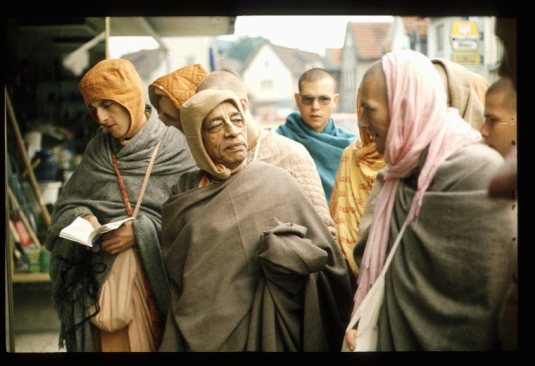
A Short Statement of the Philosophy of Krishna Consciousness
By His Divine Grace A.C. Bhaktivedanta Swami Prabhupada
Founder-Acarya of the International Society for Krishna Consciousness
More
Previous Older Entries Next Newer Entries











 The Hare Krishna Movement