I have been very much enjoying the daily post that Gargumuni Prabhu is posting on his Facebook page. Questions & Answers.
Is there Sex Life in Vaikuntha?
Prabhupada: For example: sex life, the most prominent feature of this material world. This sex life is explained in Srimad-Bhagavatam, 3rd Canto, in the explanation of Vaikuntha world, when it is said that in the Vaikuntha planets, the women or the fair sex is many many more times beautiful, well-constructed, their face and smiling more attractive, their breasts and hips are very high, and they clearly and freely mix with male devotees,, But their strong sense of devotion towards the Lord and being absorbed in Krishna Consciousness, all the features of womanly beauty cannot stimulate their sex passion. In the material world the same reflection of beauty and bodily features at once stimulate sex passion. Therefore, the enjoyment of opposite sex in the Vaikuntha world has no action of sex life whereas in the material world the perverted reflection of beauty has resultant action of sex life which is the cause of dragging material existence. So the description of the Vaikuntha life is nirguna, and the description of worldly life is sahaguna. Our devotional activities are executed by transferring epithet; our senses are there, they are acting pervertedly and putting us into difficulty. (Letter to: Janardana — Los Angeles 21 January, 1968)
Prabhupada: The women there are hundreds and thousands of times more beautiful than the women here in this material world, and the spiritual atmosphere is also many times better. Yet despite the pleasant atmosphere, the minds of the denizens do not become agitated because in the spiritual world, the Vaikuntha planets, the spiritualistic minds of the inhabitants are so much absorbed in the spiritual vibration of chanting the glories of the Lord that such enjoyment could not be surpassed by any other enjoyment, even sex, which is the culmination of all pleasure in the material world. In other words, in the Vaikuntha world, in spite of its better atmosphere and facilities, there is no impetus for sex life. As stated in Bhagavad-gita (2.59), param drstva nivartate: the inhabitants are so spiritually enlightened that in the presence of such spirituality, sex life is insignificant. ( SB 4.6.30)
It is said that it is the nature of a devotee to constantly apply his mind, energy, words, ears, etc., in hearing and chanting about Kṛṣṇa. This is called Kṛṣṇa consciousness, and for one who is rapt in hearing and chanting Kṛṣṇa, the subject matter never becomes hackneyed or old. That is the significance of transcendental subject matter in contrast to material subject matter. Material subject matter becomes stale, and one cannot hear a certain subject for a long time; he wants change. But as far as transcendental subject matter is concerned, it is called nityanavanavāyamāna. This means that one can go on chanting and hearing about the Lord and never feel tired but will remain fresh and eager to hear more and more.
…” Lord Kṛṣṇa brought His friends to the bank of the Yamunā and addressed them as follows: ’My dear friends, just see how this spot is very nice for taking lunch and playing on the soft sandy Yamunā bank. You can see how the lotus flowers in the water are beautifully blown and how they distribute their flavor all around. The chirping of the birds along with cooing of the peacocks, surrounded by the whispering of the leaves in the trees, combine and present sound-vibrations that echo one another. And this just enriches the beautiful scenery created by the trees here. Let us have our lunch in this spot because it is already late and we are feeling hungry. Let the calves remain near us, and let them drink water from the Yamunā. While we engage in our lunch-taking, the calves may engage in eating the soft grasses that are in this spot.’“
On hearing this proposal from Kṛṣṇa, all the boys became very glad and said, ”Certainly, let us all sit down here to take our lunch.“ They then let loose the calves to eat the soft grass. Sitting down on the ground and keeping Kṛṣṇa in the center, they began to open their different boxes brought from home. Lord Śrī Kṛṣṇa was seated in the center of the circle, and all the boys kept their faces toward Him. They ate and constantly enjoyed seeing the Lord face to face. Kṛṣṇa appeared to be the whorl of a lotus flower, and the boys surrounding Him appeared to be its different petals. The boys collected flowers, leaves of flowers and barks of trees and placed them under their different boxes, and thus they began to eat their lunch, keeping company with Kṛṣṇa. While taking lunch, each boy began to manifest different kinds of relations with Kṛṣṇa, and they enjoyed each other’s company with joking words. While thus enjoying lunch with His friends, Lord Kṛṣṇa’s flute was pushed within the belt of His cloth, and His bugle and cane were pushed in on the left-hand side of His cloth. He was holding a lump of foodstuff prepared with yogurt, butter, rice and pieces of fruit salad in His left palm, which could be seen through His petal-like finger joints. The Supreme Personality of Godhead, who accepts the results of all great sacrifices, was laughing and joking, enjoying lunch with His friends in Vṛndāvana. And thus the scene was being observed by the demigods from heaven. As for the boys, they were simply enjoying transcendental bliss in the company of the Supreme Personality of Godhead. (excerpted from: KRSNA Book Chapter 13 entitled “The Stealing of the Boys and Calves by Brahmā”)
Today we honor the Appearance Day of Srila Haridasa Thakura, an associate of Sri Caitanya Mahaprabhu, Haridāsa Ṭhākura daily chanted 300,000 names of the Lord. Certainly the chanting of 300,000 holy names of the Lord is wonderful. No ordinary person can chant so many names, nor should one artificially imitate Haridāsa Ṭhākura’s behavior. It is essential, however, that everyone fulfill a specific vow to chant the Hare Kṛṣṇa mantra.
Haridāsa Ṭhākura said that liberation and freedom from the reactions of sinful activities are only by-products of chanting the holy name of the Lord. If one chants the holy name of the Lord purely, he attains the platform of loving service to the Supreme Personality of Godhead. (SB 5.24.20)
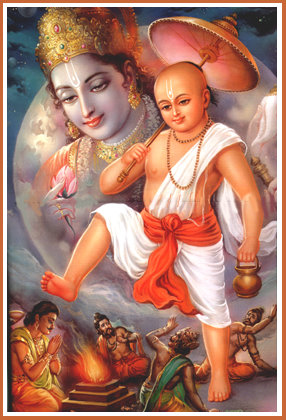
So today is the Appearance Day of Lord Vamanadeva, as well as the Appearance Day of Srila Jiva Goswami. The following is the entire 18th chapter, of the Srimad Bhagavatam, canto 8, texts 1-32, which describe the appearance of Lord Vamanadeva.
Lord Vāmanadeva, the Dwarf Incarnation
TEXT 1
Śukadeva Gosvāmī said: After Lord Brahmā had thus spoken, glorifying the Supreme Lord’s activities and prowess, the Supreme Personality of Godhead, who is never subject to death like an ordinary living being, appeared from the womb of Aditi. His four hands were decorated with a conchshell, club, lotus and disc, He was dressed in yellow garments, and His eyes appeared like the petals of a blooming lotus.
PURPORT
The word amṛta-bhūḥ is significant in this verse. The Lord sometimes appears like an ordinary child taking birth, but this does not mean that He is subject to birth, death or old age. One must be very intelligent to understand the appearance and activities of the Supreme Lord in His incarnations. This is confirmed in Bhagavad-gītā (4.9): janma karma ca me divyam evaṁ yo vetti tattvataḥ. One should try to understand that the Lord’s appearance and disappearance and His activities are all divyam, or transcendental. The Lord has nothing to do with material activities. One who understands the appearance, disappearance and activities of the Lord is immediately liberated. After giving up his body, he never again has to accept a material body, but is transferred to the spiritual world (tyaktvā dehaṁ punar janma naiti mām eti so ’rjuna [Bg. 4.9]).
Today I shall speak to you of the history of a boy devotee named Prahlāda Mahārāja. He was born in a family that was stubbornly atheistic. There are two kinds of men in this world: the demons and the demigods. What is the difference between them? The main difference is that the demigods, or godly persons, are devoted to the Supreme Lord, whereas the demons are atheistic. They do not believe in God because they are materialists. These two classes of men always exist in this world. At the present moment, due to the Age of Kali (Age of Quarrel), the number of demons has increased, but the classification has existed since the beginning of creation. The incident I am narrating to you occurred very, very long ago, a few million years after the time of creation.
Prahlāda Mahārāja was the son of the most atheistic person and the most materially powerful as well. Because the society was materialistic, this boy had no opportunity to glorify the Supreme Lord. The characteristic of a great soul is that he is very eager to broadcast glorification of the Supreme Lord. Lord Jesus Christ, for example, was very eager to broadcast the glorification of God, but demoniac people misunderstood him and crucified him.
A friend of mine recently sent me a couple of links to check out. The first is Purely Prabhupada.com ,which has the pre-1978 editions of His Divine Grace A.C. Bhaktivedanta Swami Prabhupāda’s books, there are videos, testimonials, and more. This site connects with its sister sitePurely Prabhupada.org which is a treasure-house of podcasts, articles, narrations, kirtans, and instructional series for practical application of spiritual life.
I have spent a number of hours now reviewing both sites and there seems to be a wealth of information and links here.
Today we honor the Appearance day of Lord Nṛsiṁhadeva, with a fast till sunset, followed by a nice vegetarian feast. We include the following texts from the Śrīmad-Bhāgavatam. So shortly after the Lord killed Hiraṇyakaśipu, and his armies, the Lord sat Himself on the throne of Hiraṇyakaśipu, and was offered prayers by all the assembled saintly persons and demigods.
…The Lord not only killed Hiraṇyakaśipu, the King of the demons, but also killed many of his followers. When there was no one else to fight, the Lord, roaring with anger, sat down on Hiraṇyakaśipu’s throne.
The entire universe was thus relieved of the rule of Hiraṇyakaśipu, and everyone was jubilant in transcendental bliss. Then all the demigods, headed by Lord Brahmā, approached the Lord. These included the great saintly persons, the Pitās, the Siddhas, the Vidyādharas, the Nāgas, the Manus, the prajāpatis, the Gandharvas, the Cāraṇas, the Yakṣas, the Kimpuruṣas, the Vaitālikas, the Kinnaras and also many other varieties of beings in human form. All of them stood not far from the Supreme Personality of Godhead and began offering their prayers unto the Lord, whose spiritual effulgence was brilliant as He sat on the throne. (from the chapter summary)
Śrīmad-Bhāgavatam By His Divine Grace A. C. Bhaktivedanta Swami Prabhupāda Canto 7, Chapter Eight, Text 35-56
As pouring water on the root of a tree energizes the trunk, branches, twigs and everything else, and as supplying food to the stomach enlivens the senses and limbs of the body, simply worshiping the Supreme Personality of Godhead through devotional service automatically satisfies the demigods, who are parts of that Supreme Personality. (SB 4.31.14)
If you simply pour water on the root of a tree, all the branches, twigs, leaves, and flowers will be nourished. Similarly, everyone can be satisfied simply by acyutejya. Acutya means Krsna, and ijya means worship… So this is the formula: make Krsna (God) the center and do everything for Him. There are no classes in our International Society for Krishna Consciousness. Now you are writing philosophy, but if I want you to wash dishes, you will do so immediately because you know that whatever you do, you are working for Krsna and for your spiritual master. In the material world different kinds of work have different values, but in Krsna consciousness everything is done on the absolute platform. Whether you wash dishes or write books or worship the Deity, the value is the same because you are serving Krsna. That is a classless society. Actually, the perfect classless society is Vrndavana. In Vrndavana, some are cowherd boys, some are cows, some are trees, some are fathers, some are mothers, but the center is Krsna, and everyone is satisfied simply by loving Him. When all people become Krsna conscious and they understand how to love Him, then there will be a classless society. Otherwise it is not possible.: if one is engaged in the devotional service of the Lord, the Supreme Personality of Godhead, everything is automatically accomplished.
Today I was visiting a web page that I like very much, and respect the time d effort that must have gone into its creation. The page is simply titled Srila Prabhupada There are Books, Audio files, Letters, a Reference Glossary, Sanskrit & Bengali Dictionary, Prabhupada Videos, Prabhupada Photos, and Music with Purports. Very impressive Archive!!!
Anyway, I urge all my readers to check it out!
The following was a nice page about Srila Prabhupada…
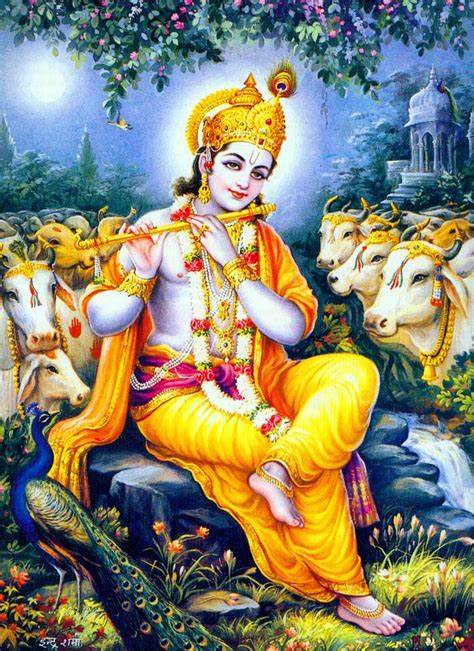
I worship Govinda, the primeval Lord, who is adept in playing on His flute, with blooming eyes like lotus petals with head decked with peacock’s feather, with the figure of beauty tinged with the hue of blue clouds, and His unique loveliness charming millions of Cupids.
The following is a nice description of Govinda: verse and purport from Srila Prabhupada’s Brahma-samhita, and a short excerpt from a lecture on the Srimad Bhagavatam.
I am always amazed at Srila Prabhupada’s humility.
Actually, it was my Guru Maharaj speaking through me. But I was not very expert at writing, as he was. Oh, he was a most erudite man, most refined and expert, a gentleman, a Vaikuntha man. Because I had never written before, there were so many grammatical discrepancies, yet I had to write.
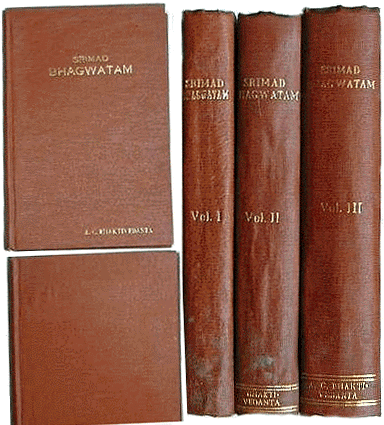
The subject matter was so important, so urgent. So I wrote those first three volumes of Srimad Bhagavatam, the First Canto. All of our philosophy, everything you need to know, is in those first three volumes. By Krishna’s grace, I managed to collect money to get them printed, and I took them with me on the boat to New York I didn’t go to America empty-handed. I went with the complete philosophy of Chaitanya Mahaprabhu, written in these rooms, inspired by the Goswamis. Thats what is pushing this Krishna consciousness movement.
If I have been successful, it’s because I have delivered my Guru Maharaj’s message intact, without change or deletion. That is parampara. The bona fide guru is like the postman delivering a message. He doesn’t open the mail and write his own opinion.
You may like the message or not, take it up or not—I have done my duty. I have delivered it. And it all began here. Therefore these Radha Damodar rooms are the hub of the wheel of the spiritual universe.”
This is an older article that appeared in Back to Godhead Magizine Vol. 11, No. 7, 1976, but is certainly still pertinent in todays culture. We have included the original pages in image form at bottom of post.
Curing the Crimes of a Lifetime
by Bibhavati-devi dasi
Adapted from Srimad-Bhagavatam, translation and commentary by His Divine Grace A.C. Bhaktivedanta Swami Prabhupada.
With recent disgrace of an American president still fresh in our minds, it is interesting to read of a similar case in ancient times. Five thousand years ago, a blind king named Dhrtarastra dishonored his high post and caused the death of millions. His story is of special importance, even today, because he found an antidote to the crimes of a lifetime, and in his old age became self-realized.
Today is Parsva Ekadasi (fast from grains and beans) and also a fast till noon for appearance of Lord Vamanadeva. His appearance is tomorrow but the fast is today.
With His appearance day in mind, as we are fasting today, we offer in Honor of Lord Vamanadeva, a select verse from the Srimad Bhagavatam, and a chapter summary. Hare Krishna!
Srimad-Bhagavatam By His Divine Grace A. C. Bhaktivedanta Swami Prabhupada Canto One, Chapter 19, Text 19
pañcadaśam—the fifteenth in the line; vāmanakam—the dwarf brāhmaṇa; kṛtvā—by assumption of; agāt—went; adhvaram—arena of sacrifice; baleḥ—of King Bali; pada-trayam—three steps only; yācamānaḥ—begging; pratyāditsuḥ—willing at heart to return; tri-piṣṭapam—the kingdom of the three planetary systems.
TRANSLATION
In the fifteenth incarnation, the Lord assumed the form of a dwarf-brāhmaṇa [Vāmana] and visited the arena of sacrifice arranged by Mahārāja Bali. Although at heart He was willing to regain the kingdom of the three planetary systems, He simply asked for a donation of three steps of land.
PURPORT
The Almighty God can bestow upon anyone the kingdom of the universe from a very small beginning, and similarly, He can take away the kingdom of the universe on the plea of begging a small piece of land.
The following is a chapter summary from Srimad Bhagavatam, eight canto, chapter 18, entitled “Lord Vāmanadeva, the Dwarf Incarnation”, describing the Lord’s appearance and activities.
Although I don’t know much about who created this page, It appears to have a good selection of pre 1978 Books, music, photos, videos and much more. Very nice site and easy to navigate. I would recommend taking a look. Hare Krishna!
Prahlāda Mahārāja, the Saintly Son of Hiraṇyakaśipu
Today we honor the appearance day of Lord Nṛsiṁhadeva, with a fast until sunset, followed by a nice vegetarian feast. We share with you the Seventh Canto of the Srimad Bhagavatam-Part One which describes the pastimes of Pralada Maharaja and his Demonic father Hiranyakasipu. I have included in this post, the entire scanned copy of Canto 7, Vol. 1. You can download by following the link below (it will take a few moments to open).
Śrīmad-Bhāgavatam Canto 7, Vol.1 “The Science of God” by His Divine Grace A. C. Bhaktivedanta Swami Prabhupāda
click the following link to veiw or save the entire scanned copy of SB-07-01-1976
“…So don’t think that “Because I have become a devotee, there will be no danger, no suffering.” Prahlāda Mahārāja suffered so much. The Pāṇḍavas suffered so much. Haridāsa Ṭhākura suffered so much. But we should not be disturbed by those suffering. We must have firm faith, firm conviction, that “Kṛṣṇa is there. He’ll give me protection.” Kaunteya pratijānīhi na me bhaktaḥ praṇaśyati [Bg. 9.31]. Don’t try to take benefit of other shelter than Kṛṣṇa. Always take to Kṛṣṇa.”
So this is Kṛṣṇa consciousness. We must take to Kṛṣṇa consciousness in…, at all circumstances, even it’s the most dangerous position. We must keep our faith in Kṛṣṇa’s lotus feet, and there will be no danger. (Srimad Bhagavatam lecture 1.8.24 April 17, 1973 Los Angeles)
Kṛṣṇa, is always protecting us. But still, there are so many dangers. This is the instruction, that because Kṛṣṇa is protecting you, you cannot expect that you’ll be out of danger. Danger you must meet, because…, then you’ll know that this material existence is full of dangers. Padaṁ padaṁ yad vipadām [SB 10.14.58]. This we always remember. We should not be so fool that “I am living very now comfortably.” No, sir. You are in danger. That is said by Kṛṣṇa. Duḥkhālayam aśāśvatam [Bg. 8.15]. Do not take this material existence as comfortable at any moment. Then you’ll not be able to make progress in spiritual life. As soon as you think that “I am very comfortable here,” then you are spiritually fall down. That is māyā. (Srimad Bhagavatam lecture 1.8.25 Oct. 4, 1974 Mayapur)
So today is New Years Day 2021. Hopefully we will all see a better year ahead. But I have given this notion of “Time” some serious thought of late, what with the pandemic, blazing forest fires, flooding, hurricanes, tornadoes, political unrest, etc. As my wife has reminded me many times this last year; ‘its Kali Yuga’ the age of decline, of quarrel and hypocrisy. So today I wanted to post some about Time and the duration of the material universe.
…The duration of the material universe is limited. It is manifested in cycles of kalpas. A kalpa is a day of Brahmā, and one day of Brahmā consists of a thousand cycles of four yugas or ages: Satya, Tretā, Dvāpara, and Kali. The cycle of Satya is characterized by virtue, wisdom and religion, there being practically no ignorance and vice, and the yuga lasts 1,728,000 years. In the Tretā-yuga vice is introduced, and this yuga lasts 1,296,000 years. In the Dvāpara-yuga there is an even greater decline in virtue and religion, vice increasing, and this yuga lasts 864,000 years. And finally in Kali-yuga (the yuga we have now been experiencing over the past 5,000 years) there is an abundance of strife, ignorance, irreligion and vice, true virtue being practically nonexistent, and this yuga lasts 432,000 years. (from purport Bg 8.17)
Even if I could grasp the extent of time in the material universe, that is just a fraction of the unlimited eternal time that continues after the termination of the yuga.
…Then the process is set rolling again. These four yugas, rotating a thousand times, comprise one day of Brahmā, the creator god, and the same number comprise one night. Brahmā lives one hundred of such “years” and then dies. These “hundred years” by earth calculations total to 311 trillion and 40 million earth years. By these calculations the life of Brahmā seems fantastic and interminable, but from the viewpoint of eternity it is as brief as a lightning flash. In the causal ocean there are innumerable Brahmās rising and disappearing like bubbles in the Atlantic. Brahmā and his creation are all part of the material universe, and therefore they are in constant flux. (from purport Bg 8.17)
The above calculations Srila Prabhupada uses and I quote;“seems fantastic and interminable, but from the viewpoint of eternity it is as brief as a lightning flash. In the causal ocean there are innumerable Brahmās rising and disappearing like bubbles in the Atlantic.”Wow!
One of the first slokas I ever memorized from the Bhagavad-gita was 9.26 patraṁ puṣpaṁ phalaṁ toyaṁ…“If one offers Me with love and devotion a leaf, a flower, fruit or water, I will accept it.” (Full text and purport follows). This was practically the beginning of my spiritual life. ‘Just try to love God by offering Him something, with devotion. A leaf, a flower, fruit or water.’
One does not need great wealth, education or opulence to satisfy the Supreme Personality of Godhead. If one is fully absorbed in love and ecstasy, he need offer only a flower and a little water. As stated in Bhagavad-gītā, patraṁ puṣpaṁ phalaṁ toyaṁ yo me bhaktyā prayacchati: “If one offers Me with love and devotion a leaf, a flower. fruit or water, I will accept it.” (Bg. 9.26)
The Supreme Lord can be pleased only by devotional service: therefore it is said here that the Lord is surely satisfied by devotion and nothing else. Quoting from the Gautamīya-tantra, the Hari-bhakti-vilāsa states:
“Śrī Kṛṣṇa, who is very affectionate toward His devotees, sells Himself to a devotee who offers merely a tulasī leaf and a palmful of water.” The Supreme Lord is causelessly merciful upon His devotee, so much so that even the poorest of men can offer Him a little water and a flower in devotion and thus please Him. This is due to His affectionate dealings with His devotees. (SB 5.3.6 purport)
Everyone is searching after peace of mind. This is obtainable only when one is completely freed from the desire for material sense gratification and is engaged in the devotional service of the Lord. As stated in Bhagavad-gītā: patraṁ puṣpaṁ phalaṁ toyaṁ yo me bhaktyā prayacchati (9.26). Worship of the Lord is not at all expensive. One can offer the Lord a leaf, a flower, a little fruit and some water. The Supreme Lord accepts these offerings when they are offered with love and devotion. In this way, one can become freed from material desires. As long as one maintains material desires, he cannot be happy. As soon as one engages in the devotional service of the Lord, his mind is purified of all material desires. Then one becomes fully satisfied. (SB 5.7.11, purport)
This morning I was just reflecting on how hot the weather has been, and how much all the plants are in need of water. Then, as I was reading the following verses from the Srimad Bhagavatam and I was thinking that we are all in need of Krsna, who is like the rain, and who’s beauty is compared to the dark clouds in the sky.
…After the scorching heat of the summer season, it is very pleasing to see dark clouds in the sky. The Lord wears a peacock feather in His hair, and His bodily complexion is just like a blackish cloud.
…The Lord’s beauty is compared to rainfall because when the rain falls in the rainy season, it becomes more and more pleasing to the people. After the scorching heat of the summer season, the people enjoy the rainy season very much. Indeed, they even come out of their doors in the villages and enjoy the rainfall directly. Thus the Lord’s bodily features are compared to the clouds of the rainy season.
…No one can say that the body of the Lord is wanting in beautiful parts. It is completely pūrṇam. Everything is complete: God’s creation, God’s beauty and God’s bodily features. All these are so complete that all one’s desires can become fully satisfied when one sees the beauty of the Lord. Both materialists and spiritualists can enjoy the beauty of the Lord. Because the Supreme Lord attracts everyone, including demons and devotees, materialists and spiritualists, He is called Kṛṣṇa. (from purport to SB 4.24.45-46)
The Supreme Lord (Viṣṇu) says: “Those who will offer Me the prayers composed by Lord Śiva, both in the morning and in the evening, will be given benedictions by Me. In this way they can both fulfill their desires and attain good intelligence.” (SB 4.30.10)
Chanting the Song Sung by Lord Śiva
Lord Śiva said to the Pracetās:
“Just execute your kingly duties with a pure heart and chant the prayer I have recited, fixing your mind on the lotus feet of the Lord. That will bring you all good fortune.” (p. 405)
The Rudra-gītā is Lord Śiva’s song to the Supreme Lord, Vāsudeva (Viṣṇu) and is known as the hymn of liberation. These prayers, which are contained in Śrīmad-Bhāgavatam 4.24.33-74, are presented by Lord Śiva to the sons (Pracetās) of King Prācīnabarhi for reaching the ultimate spiritual perfection.
The Supreme Lord (Viṣṇu) says: “Those who will offer Me the prayers composed by Lord Śiva, both in the morning and in the evening, will be given benedictions by Me. In this way they can both fulfill their desires and attain good intelligence.” (SB 4.30.10)