When I first began reading this verse from the Srimad Bhagavatam this morning, I thought it was just about hearing, but as I read and re read the purport, it was also about love.
“Simply by giving aural reception to this Vedic literature, the feeling for loving devotional service to Lord Kṛṣṇa, the Supreme Personality of Godhead, sprouts up at once to extinguish the fire of lamentation, illusion and fearfulness.” (Srimad Bhagavatam 1.7.7.)
There are various senses, of which the ear is the most effective. This sense works even when a man is deep asleep. One can protect himself from the hands of an enemy while awake, but while asleep one is protected by the ear only. The importance of hearing is mentioned here in connection with attaining the highest perfection of life, namely, getting free from three material pangs…
…And it is definitely suggested herein that simply by hearing the message of Śrīmad-Bhāgavatam one gets attachment for the Supreme Personality of Godhead Śrī Kṛṣṇa, and as soon as this is effected the symptoms of the material diseases disappear. Śrīla Vyāsadeva saw the all-perfect Personality of Godhead, and in this statement the all-perfect Personality of Godhead Śrī Kṛṣṇa is clearly confirmed.
The ultimate result of devotional service is to develop genuine love for the Supreme Personality. Love is a word which is often used in relation with man and woman. And love is the only word that can be properly used to indicate the relation between Lord Kṛṣṇa and the living entities.
Loving devotional service to the Lord begins with hearing about the Lord. (from purport)
So today marks the appearance day of Lord Ramacandra, otherwise known as Rama-Navami. We honor it with a full day fast, followed by an nice vegetarian feast. It is nice to remember the Lord by extra chanting of His holy names, and with readings throughout the day of the glorious pastimes of the Lord.
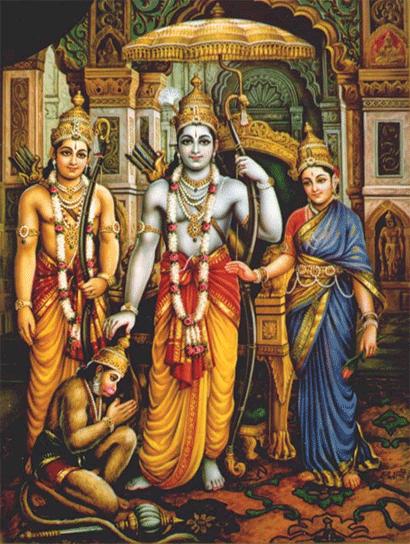
Ramachandra, or Lord Rama, is one of Krishna’s many avatars on earth. He appeared during a previous age, Treta-yuga, and ruled as emperor of the world. A chronicle of His activities is presented extensively in the epic Ramayana, and concisely in the ninth canto of the Srimad-Bhagavatam, a biography of Krishna’s many incarnations.
Ramachandra’s life is considered to be exemplary in every way. Followers of India’s Vedic culture see Him as the ideal king, the most powerful warrior, and the most faithful husband. It is said that He ruled His kingdom just as a loving father cares for his children. Lord Rama’s nobility, integrity, decency, and virtue are spoken of with reverence even today.
He appeared as the eldest son of Maharaja Dasarath, along with brothers Bharata, Lakshmana, and Shatrughna—also incarnations of the Supreme Person. He married Sita devi, daughter of King Janaka, after breaking the bow of Siva in the contest for Sita’s hand. On the day of Ramachandra’s coronation, however, due to royal intrigue, He was banished to the forest for fourteen years, and Lakshmana and Sita accompanied Him there.
Ravana, king of Lanka, kidnapped Sita when Rama was absent from Their forest home. Subsequently, Rama and Lakshmana organized an army of forest-dwelling simians, vanaras—including the great devotee Hanuman— to attack Lanka. He then killed Ravana, rescued Sita, and triumphantly returned to His capital city, Ayodhya.
“In the eighteenth incarnation, the Lord appeared as King Rāma. In order to perform some pleasing work for the demigods, He exhibited superhuman powers by controlling the Indian Ocean and then killing the atheist King Rāvaṇa, who was on the other side of the sea.” (Srimad Bhagavatam 1.3.22)
The following are the prayers by Gajendra, the King of the elephants, offered to the Supreme Personality of Godhead, during his difficult struggle with the crocodile. It appears that the King of the elephants was formerly a human being known as Indradyumna and that he learned a prayer to the Supreme Lord. Fortunately he remembered that prayer and began to chant it. First he offered his respectful obeisances to the Supreme Personality of Godhead, and because of his awkward position in having been attacked by the crocodile, he expressed his inability to recite prayers nicely. Nonetheless, he tried to chant the mantra and expressed himself in the prayers that follow.
…It is imperative that all devotees in Kṛṣṇa consciousness practice chanting some mantra. Certainly one should chant the Hare Kṛṣṇa mantra, which is the mahā-mantra, or great mantra, and also one should practice chanting cintāmaṇi-prakara-sadmasu or the Nṛsiṁha strotra (ito nṛsiṁhaḥ parato nṛsiṁho yato yato yāmi tato nṛsiṁhaḥ). Every devotee should practice in order to chant some mantra perfectly so that even though he may be imperfect in spiritual consciousness in this life, in his next life he will not forget Kṛṣṇa consciousness, even if he becomes an animal. Of course, a devotee should try to perfect his Kṛṣṇa consciousness in this life, for simply by understanding Kṛṣṇa and His instructions, after giving up this body one can return home, back to Godhead. Even if there is some falldown, practice of Kṛṣṇa consciousness never goes in vain. For example, Ajāmila, in his boyhood, practiced chanting the name of Nārāyaṇa under the direction of his father, but later, in his youth, he fell down and became a drunkard, woman-hunter, rogue and thief. Nonetheless, because of chanting the name of Nārāyaṇa for the purpose of calling his son, whom he had named Nārāyaṇa, he became advanced, even though he was involved in sinful activities. Therefore, we should not forget the chanting of the Hare Kṛṣṇa mantra under any circumstances. It will help us in the greatest danger, as we find in the life of Gajendra.(From Purport to text 1)
Śrīmad-Bhāgavatam By His Divine Grace A. C. Bhaktivedanta Swami Prabhupāda Canto 8, Chapter Three, Text 1-29
This morning as I was finishing the Tenth Chapter of the Second Canto, the following verse and purport jumped out at me from the pages. And I realized for the thousandth time, what great good fortune we have in that we can hear directly from the pure devotee of the Lord, about the eternal pastimes of the Lord, through the pages of the Srimad Bhagavatam.
Of the three types of Transcendentalist’s, namely the jñānī, the yogī and the bhakta, or the impersonalist, the meditator and the devotee. It is only the devotee who can factually know the Lord as He is and thus be trained in the bona fide service of the Lord and be allowed to enter into the direct association of the Lord in so many capacities. The highest glorious association with the Lord is made possible in the planet of Goloka Vṛndāvana, where Lord Kṛṣṇa enjoys Himself with the gopīs and His favorite animals, the surabhi cows.
… The impersonalist is satisfied simply by understanding the all-pervasive influence of the Lord. This is called Brahman realization. Greater than the impersonalist is the mystic who sees the Lord situated in his heart as Paramātmā, the partial representation of the Lord. But there are pure devotees who take part in the direct pleasure (ānanda) potency of the Lord by factual reciprocation of loving service. The Lord in His abode called the Vaikuṇṭha planets, which are eternal manifestations, always remains with His associates and enjoys transcendental loving services by His pure devotees in different transcendental humors.
So we are pleased to present the following Texts and Purports
Today we celebrate the appearance day of Sri Caitanya Mahaprabhu. We honor His appearance with a full day fast (until moon rise), followed by a special vegetarian feast. Also to honor the Lord’s appearance day, we have selected a few verses from the Sri Caitanya-caritmra.
Sri Caitanya-caritamrta 1975 Edition By His Divine Grace A. C. Bhaktivedanta Swami Madhya-lila,Chapter 19, Text 53 & 54
“O most munificent incarnation! You are Kṛṣṇa Himself appearing as Śrī Kṛṣṇa Caitanya Mahāprabhu. You have assumed the golden color of Śrīmatī Rādhārāṇī, and You are widely distributing pure love of Kṛṣṇa. We offer our respectful obeisances unto You.
“We offer our respectful obeisances unto that merciful Supreme Personality of Godhead who has converted all three worlds, which were maddened by ignorance, and saved them from their diseased condition by making them mad with the nectar from the treasure-house of love of God. Let us take full shelter of that Personality of Godhead, Śrī Kṛṣṇa Caitanya, whose activities are wonderful.”
Chanting the Maha Mantra, or the great “chant for deliverance”, is very easy, and can be preformed anywhere, anytime. Srila Prabhupada has said “from your lips to your ears”, it is that easy. It is the kind of yoga (union), or meditation, one can easily practice anywhere, anytime.
Chanting of the Hare Kṛṣṇa mantra is the easiest process of meditation. (from purport to Srimad Bhagavatam 4.8.53)
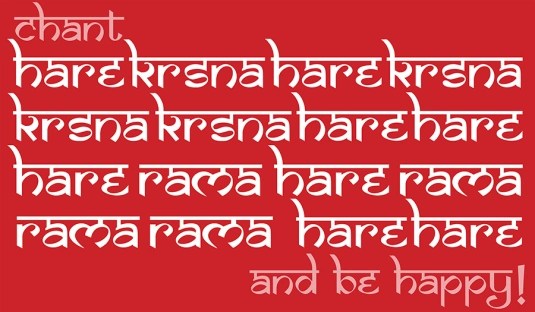
No other means of spiritual realization is as effective in this age of quarrel and hypocrisy as the chanting of the mahā-mantra: Hare Kṛṣṇa, Hare Kṛṣṇa, Kṛṣṇa Kṛṣṇa, Hare Hare / Hare Rāma, Hare Rāma, Rāma Rāma, Hare Hare. (BTG #30 1970)
Chanting the Hare Kṛṣṇa Mantra
(appeared as a separate pamphlet in 1967 and reproduced from the article “On Chanting the Hare Krishna Mantra” published in the 1970 Back to Godhead Magazine number 34)
“This simplest method of meditation is recommended for this age. By practical experience also, one can perceive that by chanting this mahā-mantra, or the Great Chanting for Deliverance, one can feel a transcendental ecstasy coming through from the spiritual stratum.”
“One has to qualify himself to see and understand God, and that process of qualification is called Kṛṣṇa consciousness. By engaging ourselves in God’s service, we become qualified to see God. Otherwise it is not possible.“
“One cannot understand the form, name, quality, or paraphernalia of God with one’s material senses.” (Cc Madya 17.136)
Just as God is eternal, we are also eternal, and when we establish our eternal relationship with the supreme, complete eternal, we realize our eternality.
God is the supreme living entity among all living entities, the supreme eternal among all eternals. By Kṛṣṇa consciousness, by purification of the senses, this knowledge will be realized, and we will come to see God.
The following post is Chapter 3 from the book “The Path to Perfection”which gives some instruction on Seeing God (Krsna) and on the yoga system.
Ever since I was a small child, I have been attracted to the statue of Buddha. Don’t know why, but I had a statue of Buddha in my bedroom, and it was a Christian home. I didn’t really know about Krishna then or who the Buddha was…but I was so attracted to everything Eastern. As I learned latter in life Buddha was actually an incarnation of Krsna. “From the Bhāgavatam we understand that Lord Buddha is the incarnation of Kṛṣṇa who appeared when materialism was rampant and materialists were using the pretext of the authority of the Vedas.” (from purport Bg 4.7)
The Four Noble Truths & The Eightfold Path
The Four Noble Truths
The Buddha’s first sermon after his Enlightenment centered on the Four Noble Truths, which are the foundation of Buddhism. The truths are:
The truth of suffering (dukkha) The truth of the cause of suffering (samudaya) The truth of the end of suffering (nirhodha) The truth of the path that frees us from suffering (magga)
I have been reading the Krsna Book lately, and just yesterday we were reading chapter 14 “Prayers Offered by Lord Brahma to Lord Krsna”, and I was reminded this was the last chapter Srila Prabhupada was working on in the Srimad Bhagavatam series before his passing. So I had another look at the Tenth Canto, part 3, and thought it a good idea to share it with all our readers.
This is the final Śrīmad-Bhāgavatam volume translated by His Divine Grace A. C. Bhaktivedanta Swami Prabhupada, Founder-Acarya of the International Society for Krishna Consciousness, before his untimely departure. We share it with you as a free PDF download. You can click on the above link to view the complete volume or save it to your computer.
Foward
This is the final Śrīmad-Bhāgavatam volume translated by His Divine Grace A. C. Bhaktivedanta Swami Prabhupada, founder-acarya of the International Society for Krishna Consciousness. It is smaller than the earlier volumes because it ends where the renowned author stopped translating just before his departure from this mortal world on November 14, 1977, at the Krsna-Balarama Mandira in Vrndavana, India.
The first part of this volume was produced in the usual fashion. Srila Prabhupada would sit and read silently from the Sanskrit text and then speak the translation and commentary into his dictaphone. Later, due to illness, it became necessary for his disciples to assist him personally.
In these last days Srila Prabhupada was gravely ill. Unable to eat for weeks, his health had deteriorated, making even the slightest movement excruciatingly painful.
As he lay still, a devotee would softly read the Sanskrit to him. Another disciple, sitting on his bed, held the microphone to him, nearly touching his mouth. And then Srila Prabhupada would speak, voice sometimes barely audible.
These recordings, made in his quarters at the temple, constitute the balance of this book.
In these final moments, the physician attending His Divine Grace confided that an ordinary man in such critical condition would have been crying out from the intense pain. Srila Prabhupada’s disciples were awestruck as they watched their spiritual master work quietly, undisturbed.
In the last part of the book we find Srila Prabhupada’s usual clarity of thought, constant scriptural references, scrupulous attention to detail, and rigorous philosophical exposition fully intact, just as they were in the preceding twenty-nine volumes of the Śrīmad-Bhāgavatam.
Srila Prabhpada’s last days and this translation will stands an inspiring reminder that even the severest material circumstances cannot impede the activities of a pure devotee of the Supreme Personality of Godhead.
…The process of meditation recommended in the Śrīmad-Bhāgavatam is not to fix one’s attention on something impersonal or void.
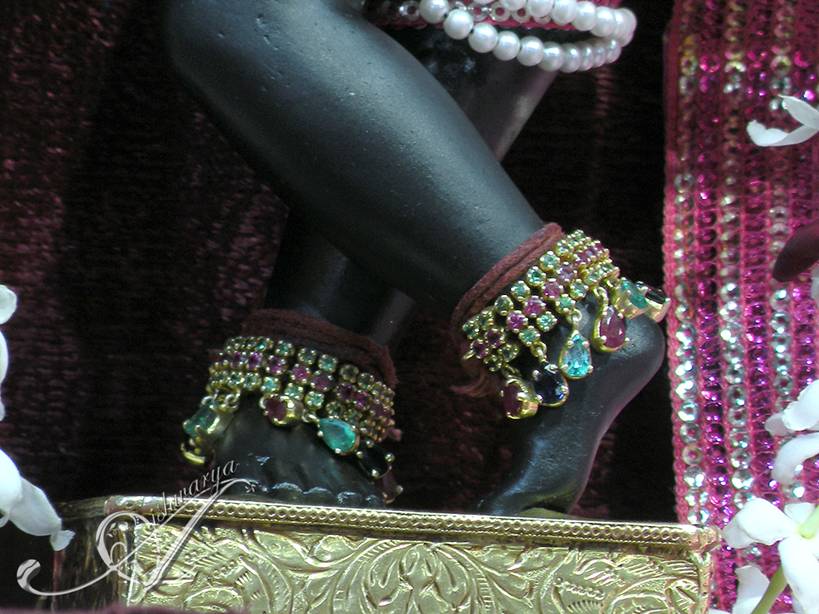
The process of meditation should begin from the lotus feet of the Lord and progress to His smiling face. The meditation should be concentrated upon the lotus feet, then the calves, then the thighs, and in this way higher and higher. The more the mind becomes fixed upon the different parts of the limbs, one after another, the more the intelligence becomes purified. (SB 2.2.13)
Śrīmad-Bhāgavatam By His Divine Grace A. C. Bhaktivedanta Swami Prabhupāda Canto Two, Chapter 2, Text 13-14
Some years back I was reading from one book and the author was explaining how within each of us, we have the Keys to the gates of the Kingdom of Heaven, and we also have the Keys to the gates of Hell. It is our choice at every moment which we choose to use. Evolution can work both ways.
The Evolutionary Process
…All living entities within this material world are undergoing the cycle of birth and death according to the laws of nature. This struggle of birth and death in different species may be called the evolutionary process, but in the Western world it has been wrongly explained. Darwin’s theory of evolution from animal to man is incomplete because the theory does not present the reverse condition, namely evolution from man to animal.
Human life, which is obtained in the course of the evolutionary process, is a chance for elevation (svargāpavarga) or for degradation (tiraścām punar asya ca). If one uses this human form of life properly, he can elevate himself to the higher planetary systems, where material happiness is many thousands of times better than on this planet, or one may cultivate knowledge by which to become free from the evolutionary process and be reinstated in one’s original spiritual life. This is called apavarga, or liberation. (from purport to SB 7.13.25)
Of late, there are some devotees I know, who are having difficulties in life; health issues, impoverishment, depression, etc. Sometimes I am asked for advice or support. I generally don’t like to give advice, as I consider myself fallen by nature. But thinking along these lines of ‘advice and support’ I did a search in Srila Prabhupada’s books to see how a devotee of the Lord deals with suffering. I have posted a couple of nice verses that deal with the Lords Mercy.
The mountains, although being struck by torrents of rain during the rainy season, are not shaken, just as those whose hearts are dedicated to the transcendental Personality of Godhead are never disturbed, even when harassed by great misfortune. (Light of the Bhagavata 12)
Because a person who is spiritually advanced accepts any adverse condition of life as the mercy of the Lord, he is completely eligible to enter into the spiritual kingdom. Even though a person takes to the devotional service of the Supreme Lord, he may sometimes become diseased, impoverished, or disappointed by life’s events. A true devotee of the Lord always considers these sufferings to be due to past sinful activities, and thus without becoming disturbed he patiently awaits the mercy of the Supreme Lord. Such devotees are compared to high mountains, which are never agitated in any way, even when struck by powerful torrents of rain in the rainy season. Rather, such devotees remain humble in spiritual enlightenment. Free from pride and envy, they easily gain the mercy of the Lord and go back home, back to Godhead.
This morning I was reading from the “Nectar of Devotion”, about devotional service. Srila Prabhupada was explaining the nine processes of performing devotional service and referenced the “Teachings of Lord Kapila”, which was a book I have not read for such a long time, so I thought I would share a chapter with you today. And also this very important verse from the Srimad Bhagavtam.
“Hearing, chanting and remembering the holy name, form, pastimes, qualities and entourage of the Lord, offering service according to the time, place and performer, worshiping the Deity, offering prayers, always considering oneself the eternal servant of Kṛṣṇa, making friends with Him and dedicating everything unto Him—these are the nine processes of devotional service.” (Bhāg. 7.5.23)
There are nine basic processes of devotional service—hearing and chanting about the Supreme Lord, remembering Him, serving His lotus feet, worshiping Him, offering prayers to the Lord, acting as His servant, becoming His friend, and surrendering everything to Him. The beginning is śravaṇaṁ kīrtanam, hearing and chanting. One must be very eager to hear and chant.
Teachings of Lord Kapila, the Son of Devahūti By His Divine Grace A. C. Bhaktivedanta Swami Prabhupāda Chapter Three, Text 3
Recently I have had this image of Visnu in my mind. I find that my mind often goes back to the days when we went out on book distribution every day and passed out books, magazines, and Spiritual Sky incense. I guess because I had distributed hundreds of BTG magazines, I have a clear memory of the magazine covers. I forgot most of what I learned in school, but I can still recall those early days of Sankirtan, and the joy I felt when someone took a book or magazine, or said Hare Krishna for the first time. Actually, being out there on the streets was a real education in human nature. And I fondly remember so many of the magazine covers.
ON THE COVER
Sri Visnu the maitainer of the universe and goal of the yogis’ meditation.
Today we celebrate Govardhana-puja, when Krishna exhibited His transcendental pastime of lifting Govardhana Hill to protect the inhabitants of Vrndavan. In honor of this auspicious day, we are posting the entire chapter from the KRSNA Book entitled “Devastating Rainfall in Vrndavana”. Enjoy!
…Lord Kṛṣṇa picked up Govardhana Hill with one hand, exactly as a child picks up a mushroom from the ground. Thus He exhibited His transcendental pastime of lifting Govardhana Hill. Lord Kṛṣṇa then began to address His devotees, “My dear brothers, My dear father, My dear inhabitants of Vṛndāvana, you can now safely enter under the umbrella of Govardhana Hill, which I have just lifted. Do not be afraid of the hill and think that it will fall from My hand. You have been too much afflicted from the heavy rain and strong wind; therefore I have lifted this hill, which will protect you exactly like a huge umbrella. I think this is a proper arrangement to relieve you from your immediate distress. Be happy along with your animals underneath this great umbrella.” Being assured by Lord Kṛṣṇa, all the inhabitants of Vṛndāvana entered beneath the great hill and appeared to be safe along with their property and animals. …The inhabitants of Vṛndāvana and their animals remained there for one week without being disturbed by hunger, thirst or any other discomforts. They were simply astonished to see how Kṛṣṇa was holding up the mountain with the little finger of His left hand.
… After this incident, the Supreme Personality of Godhead, surrounded by His dear friends and animals, returned to His home. As usual, the gopīs began to chant the glorious pastimes of Lord Kṛṣṇa with great feeling, for they were chanting from the heart. (Kṛṣṇa, the Supreme Personality of Godhead Chapter 25)
Today we celebrate the Appearance of Lord Krishna (Janmastami) with a full day fast, followed by a nice vegetarian feast. As we like to do on this day, we read from the KRSNA Book. So we are posting the complete chapter; “The Birth of Lord Kṛṣṇa”.
…As stated in the Bhagavad-gītā, the Lord says that His appearance, birth, and activities, are all transcendental, and one who understands them factually becomes immediately eligible to be transferred to the spiritual world. The Lord’s appearance or birth is not like that of an ordinary man who is forced to accept a material body according to his past deeds. The Lord’s appearance is explained in the Second Chapter: He appears out of His own sweet pleasure. When the time was mature for the appearance of the Lord, the constellations became very auspicious. The astrological influence of the star known as Rohiṇī was also predominant because this star is considered to be very auspicious. Rohiṇī is under the direct supervision of Brahmā. According to the astrological conclusion, besides the proper situation of the stars, there are auspicious and inauspicious moments due to the different situations of the different planetary systems. At the time of Kṛṣṇa’s birth, the planetary systems were automatically adjusted so that everything became auspicious. ( from Kṛṣṇa, the Supreme Personality of Godhead Chapter 3)
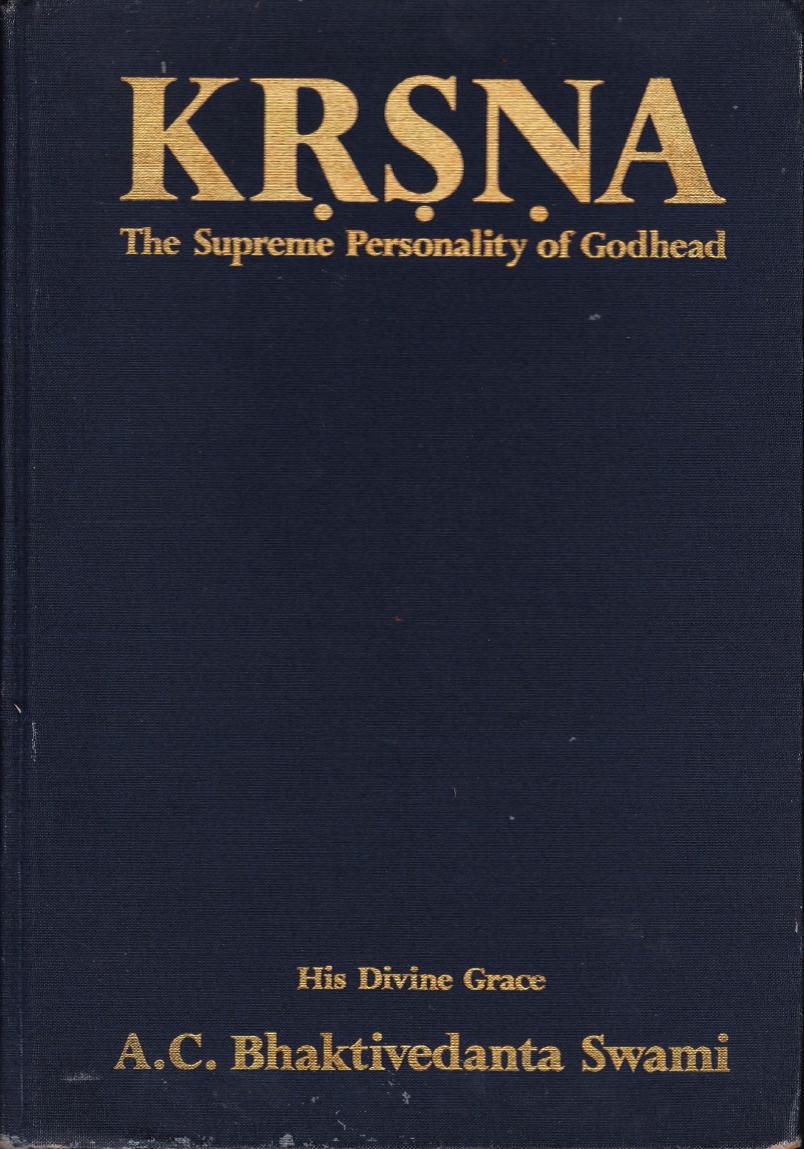
Today, being Krsna Janmastami, we are offering a free scanned copy of the original ISKCON Press 1970 Edition of KRSNA Book Vol. 1, which you can download. Just click on the following link to began downloading. This could take a while depending on the speed of your connection. This free scanned copy includes all the original art work as well.
I would like to share a very Special Photo of Srila Prabhupada in the San Francisco temple 1968 signing His name to a set of India published, first canto, Srimad Bhagavatam consisting of three volumes.
There is a backstory that bring back exciting memories to me. When Srila Prabhupada arrived in the USA, He carried with Him 200 sets of these books, which most were sold. The remaining books (assorted volumes) in India were shipped and arrived in the winter of 1966. In Srila Prabhupada’s Apt. it was me and Brahmananda that unpacked these volumes. They were shipped in thin steel painted black trunks. There were three or four of them and pretty banged-up during shipment. But the books were undamaged. There were only a small number of full sets left, most were 2nd and 3rd volumes of the set. The front-covers were packed separately. And it was my service to carefully put the front jackets on all the books right in front of Srila Prabhupada. I was so excited unpacking these volumes thinking as a young boy, what a great treasure I found. I had to carefully fold the jackets around each and every book while His Divine Grace watched. We stacked some books in His room and remainder one trunk that wasnt damaged we put all the other books. So this photo of Srila Prabhupada signing this set brought me back to those days that I was allowed to perform this humble service with great enthusiasm, and in my old age it brings my heart great happiness……your servant gargamuni das………
This morning when I opened my computer I saw this Headline;“Middle East braces for week that could determine the course of the Gaza war”. And I was reminded of all the conflict at present in the world. Then I opened the Srimad Bhagavatam and began reading the Preface by Srila Prabhupada and it seemed so timely.
Śrīmad-Bhāgavatam by His Divine Grace A. C. Bhaktivedanta Swami Prabhupāda
Preface
We must know the present need of human society. And what is that need? Human society is no longer bounded by geographical limits to particular countries or communities. Human society is broader than in the Middle Ages, and the world tendency is toward one state or one human society. The ideals of spiritual communism, according to Śrīmad-Bhāgavatam, are based more or less on the oneness of the entire human society, nay, of the entire energy of living beings. The need is felt by great thinkers to make this a successful ideology. Śrīmad-Bhāgavatam will fill this need in human society. It begins, therefore, with the aphorism of Vedānta philosophy janmādy asya yataḥ (Bhag. 1.1.1.) to establish the ideal of a common cause.
Human society, at the present moment, is not in the darkness of oblivion. It has made rapid progress in the field of material comforts, education and economic development throughout the entire world. But there is a pinprick somewhere in the social body at large, and therefore there are large-scale quarrels, even over less important issues. There is need of a clue as to how humanity can become one in peace, friendship and prosperity with a common cause. Śrīmad-Bhāgavatam will fill this need, for it is a cultural presentation for the respiritualization of the entire human society.
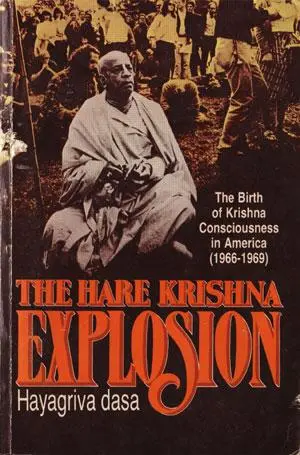
The following is an article I posted some years ago, but I feel it is still timely, and it still of the utmost importance to our society. We need to understand what were Srila Prabhupada’s intentions and desires for the continuation of his mission. Although our page is not intended as a political forum, it is a tool in the mission of our spiritual master, for the propagation of The Hare Krishna Movement or Krishna Consciousness.
Now that Śrīla Prabhupāda has named these representatives Temple Presidents may henceforward send recommendations for first and second initiation to whichever of these eleven representatives are nearest their Temple.After considering the recommendation, these representatives many accept the devotee as an initiated disciple of Śrīla Prabhupāda by giving a spiritual name, or in the case of a second initiation, by chanting on the Gāyatrī thread just as Śrīla Prabhupāda had done.
The name of a newly initiated disciple should be sent by the representative who has accepted him or her to Śrīla Prabhupāda, to be included in Divine Grace’s “Initiated Disciples” book. (from July 9th letter)
The Rtvik Representative Of The Acharya by Kṛṣṇacandra Dāsa – Vṛndāvan:
Shortly after His Divine Grace A. C. Bhaktivedanta Swami Śrīla Prabhupāda entered into his Samādhi līlā in 1977; 11 of his senior disciples and members of the GBC who held the official position of representatives of His Divine Grace in 1st and 2nd spiritual initiations [as per July 9th Document], without authority and without an order by His Divine Grace announced themselves to be pure devotees of the Lord and forcibly seized the titles, roles and functions of acharyas and Initiating Spiritual Masters of ISKCON.











 The Hare Krishna Movement
