Beyond Samsara

The Passing Away of Bhismadeva

Beyond Saṁsāra

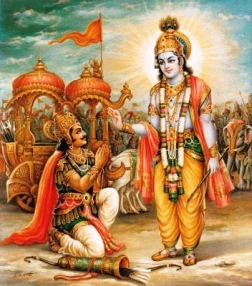
As I was reading from the Srimad Bhagavatam this morning about the passing of Bhīṣmadeva it was being described how “The perfect yogīs or mystics can leave the material body at their own sweet will at a suitable time and go to a suitable planet desired by them.” And how it is possiable to go beyond Saṁsāra, and go back to Godhead without any doubt?

…In the momentous hour of leaving his material body, Bhīṣmadeva set the glorious example concerning the important function of the human form of life. The subject matter which attracts the dying man becomes the beginning of his next life. Therefore, if one is absorbed in thoughts of the Supreme Lord Śrī Kṛṣṇa, he is sure to go back to Godhead without any doubt.

And what is Samsara?

Saṁsāra means material existence. That is called saṁsāra. Bhūtvā bhūtvā pralīyate (BG 8.19). You take your birth once in some form of body. You live for some time. Then you have to give up this body. Then you have to accept another body. Then again live for some time. Then give up that body. Again accept another body. In this way, it is going on. That is called saṁsāra, rotating within this material world. (Lecture on Gurvastakam at Upsala University by His Divine Grace -Stockholm, September 9, 1973)

The saṁsāra means repetition of different bodies. That is called saṁsāra. (Lecture on SB 1.2.4 -Rome, May 28, 1974)

Saṁsāra means this material entanglement. This is called saṁsāra.
(Lecture on CC Madhya-lila 25.40-50 – San Francisco, January 24, 1967)
More

Appearance of Lord Vamana

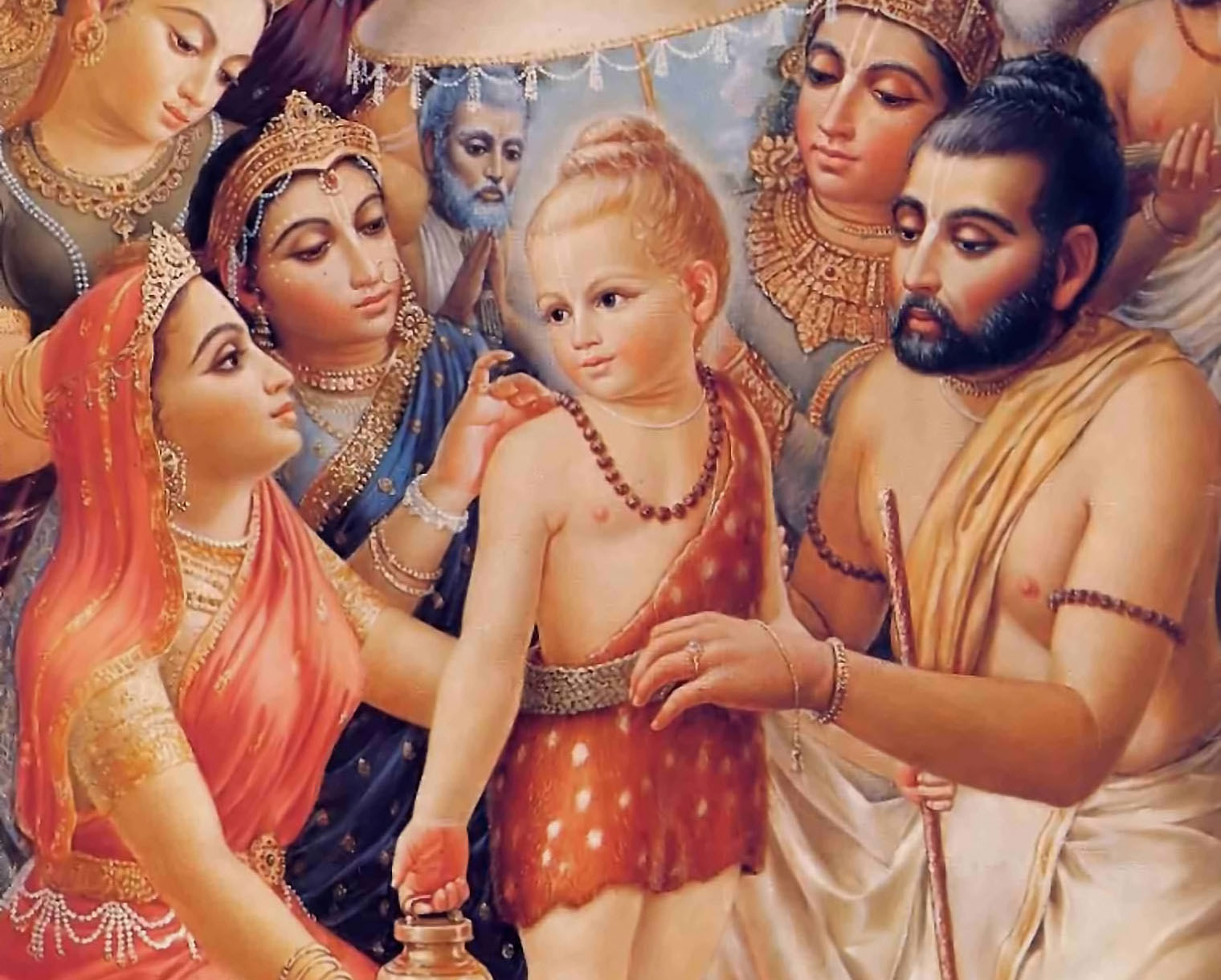
Today we celebrate the Appearance of Lord Vamanadeva, the fifteenth Incarnation, wherin Krsna assumed the form of a dwarf brahmana.

“In the fifteenth incarnation, the Lord assumed the form of a dwarf-brāhmaṇa [Vāmana]…” (SB 1.19.19)

The following is a chapter summary from Srimad Bhagavatam, eight canto, chapter 18, entitled “Lord Vāmanadeva, the Dwarf Incarnation”, describing the Lord’s appearance and activities, and a verse from the First Canto.

Srimad-Bhagavatam
By His Divine Grace A. C. Bhaktivedanta Swami Prabhupada
Canto One, Chapter 19, Text 19

pañcadaśaṁ vāmanakaṁ
kṛtvāgād adhvaraṁ baleḥ
pada-trayaṁ yācamānaḥ
pratyāditsus tri-piṣṭapam

pañcadaśam—the fifteenth in the line; vāmanakam—the dwarf brāhmaṇa; kṛtvā—by assumption of; agāt—went; adhvaram—arena of sacrifice; baleḥ—of King Bali; pada-trayam—three steps only; yācamānaḥ—begging; pratyāditsuḥ—willing at heart to return; tri-piṣṭapam—the kingdom of the three planetary systems.

TRANSLATION

In the fifteenth incarnation, the Lord assumed the form of a dwarf-brāhmaṇa [Vāmana] and visited the arena of sacrifice arranged by Mahārāja Bali. Although at heart He was willing to regain the kingdom of the three planetary systems, He simply asked for a donation of three steps of land.

PURPORT

The Almighty God can bestow upon anyone the kingdom of the universe from a very small beginning, and similarly, He can take away the kingdom of the universe on the plea of begging a small piece of land.

Śrīmad-Bhāgavatam
by His Divine Grace A. C. Bhaktivedanta Swami Prabhupāda
Canto 8, Chapter 18

Lord Vāmanadeva, the Dwarf Incarnation

This chapter describes how Lord Vāmanadeva appeared and how He went to the sacrificial arena of Mahārāja Bali, who received Him well and fulfilled His desire by offering Him benedictions.

More

Happiness & Suffering

Buddha and Happiness

Ever since I was a small child, I have been attracted to the statue of Buddha. Don’t know why, but I had a statue of Buddha in my bedroom, and it was a Christian home. I didn’t really know about Krishna then or who the Buddha was…but I was so attracted to everything Eastern. As I learned latter in life Buddha was actually an incarnation of Krsna. “From the Bhāgavatam we understand that Lord Buddha is the incarnation of Kṛṣṇa who appeared when materialism was rampant and materialists were using the pretext of the authority of the Vedas.” (from purport Bg 4.7)

The Four Noble Truths & The Eightfold Path

The Four Noble Truths

The Buddha’s first sermon after his Enlightenment centered on the Four Noble Truths, which are the foundation of Buddhism. The truths are:

The truth of suffering (dukkha)
The truth of the cause of suffering (samudaya)
The truth of the end of suffering (nirhodha)
The truth of the path that frees us from suffering (magga)

Let’s look at one truth at a time.

More

Protectors of the Cow

samurai_04

The following article I found very interesting. It was circulating on Face book before I saw it on the Sampradaya Sun this morning. It is very informative, and is worth reprinting here.

The Samurai: Protectors of the Cow
by Jahnava Nitai das
Mar 01, 2015 — ORISSA (SUN)

If I were to tell you, that once, no other country, save India, revered the cow as much as Japan, I could understand your disbelief. Today, we think of Japan as a meat-eating culture. However, this image is a product of the last 150 years of American influence. The traditional Japanese culture held the cow as the most sacred animal. What follows next is the true story of among the greatest protectors of the cow – the Samurai.

More

108 Imporant Slokas from the 1972 Bhagavad-gita As It Is

Click on image to go to Post

Click on image to go to Post

The Hare Krishna Cookbook

Songs of the Vaisnava Acaryas

Bhagavad-gita As It Is 1972 Edition “Online”

click on image

click on image to visit site

Srimad Bhagavatam Online

click on image

Raja-Vidya the King of Knowledge

click on image

click on image

Blog Stats

  • 4,865,329 hits

Enter your email address to subscribe to this blog and receive notifications of new posts by email.

Join 3,965 other subscribers

Important Slokas from the Brahma-samhita

click on image

click on image

Slokas from the Sri Isopanisad

click on image

click on image

Prayers By Queen Kunti (Slokas)

click on image

Gajendra’s Prayers of Surrender (Slokas)

click on image

A Short Statement of the Philosophy of Krishna Consciousness

click on image

click on image

July 9th Letter

click on image

click on image

The Hare Krishna Explosion

Reference Material/Study Guide

click on image

click on image

  • LINKS