…The process of meditation recommended in the Śrīmad-Bhāgavatam is not to fix one’s attention on something impersonal or void.
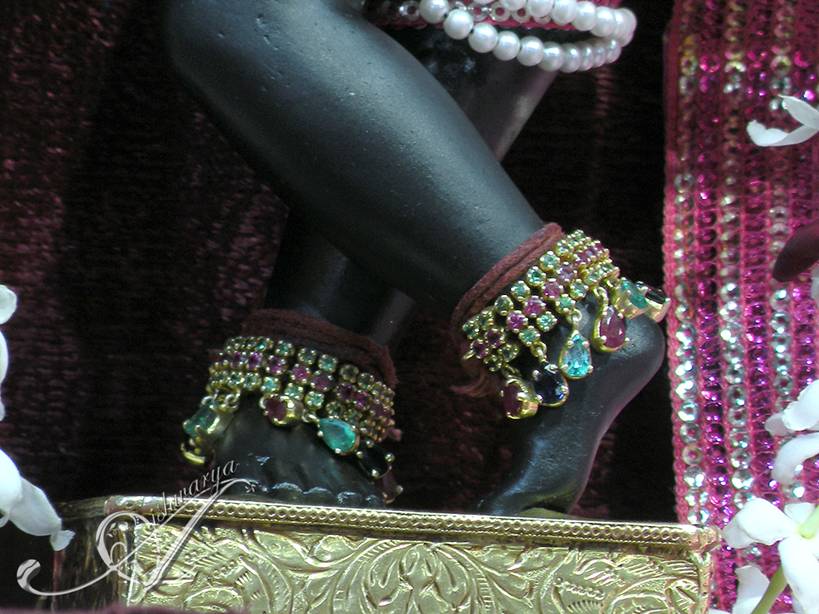
The process of meditation should begin from the lotus feet of the Lord and progress to His smiling face. The meditation should be concentrated upon the lotus feet, then the calves, then the thighs, and in this way higher and higher. The more the mind becomes fixed upon the different parts of the limbs, one after another, the more the intelligence becomes purified. (SB 2.2.13)
Śrīmad-Bhāgavatam By His Divine Grace A. C. Bhaktivedanta Swami Prabhupāda Canto Two, Chapter 2, Text 13-14
Some years back I was reading from one book and the author was explaining how within each of us, we have the Keys to the gates of the Kingdom of Heaven, and we also have the Keys to the gates of Hell. It is our choice at every moment which we choose to use. Evolution can work both ways.
The Evolutionary Process
…All living entities within this material world are undergoing the cycle of birth and death according to the laws of nature. This struggle of birth and death in different species may be called the evolutionary process, but in the Western world it has been wrongly explained. Darwin’s theory of evolution from animal to man is incomplete because the theory does not present the reverse condition, namely evolution from man to animal.
Human life, which is obtained in the course of the evolutionary process, is a chance for elevation (svargāpavarga) or for degradation (tiraścām punar asya ca). If one uses this human form of life properly, he can elevate himself to the higher planetary systems, where material happiness is many thousands of times better than on this planet, or one may cultivate knowledge by which to become free from the evolutionary process and be reinstated in one’s original spiritual life. This is called apavarga, or liberation. (from purport to SB 7.13.25)
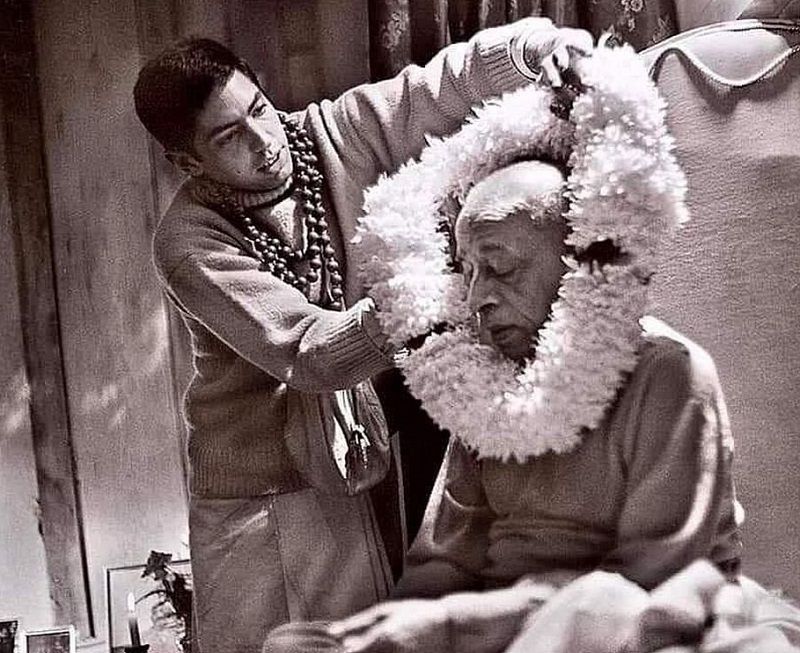
Sometimes I think if only I could take a picture with my mind, and recall it at any time, this would be one of the images I would like to hold on to. And of course one of Srila Prabhupada as well.
We share with you a song by Narottama Das Thakur entitled “Gaurangera Duti Pada”, with a purport by His Divine Grace A. C. Bhaktivedanta Swami.
Gaurangera Duti Pada by Narottama Dasa Thakura
” Anyone who has accepted the two lotus feet of Lord Caitanya can understand the true essence of devotional service. If one is captivated by the pleasing pastimes of Lord Caitanya, the dirty things in his heart will all become cleansed.“
…Gauranga refers to Lord Caitanya, who has a fair complexion. One who has a fair complexion is called gaura, and since Lord Caitanya was very fair, just like molten gold, He was also named Gaurasundara. Narottama dasa Thakura says, gaurangera duti pada, jar dhana-sampada, se jane bhakati-rasa-sar. Anyone who has accepted the two lotus feet of Lord Caitanya can understand the true essence of devotional service. Devotional service is very difficult. It cannot be understood by any ordinary man. As it is stated in the Bhagavad-gita, out of many thousands of persons who are trying to achieve the perfection of human life, only some actually become perfect and realize the self. And out of many thousands of such self-realized persons, only one can understand Krsna. Without understanding Krsna, how can one engage himself in the service of Krsna? Therefore, the devotional service of Krsna is not an ordinary thing. But fortunately, if one follows in the footsteps of Lord Caitanya (gaurangera duti pada) by following the path shown by Lord Caitanya-the process of simply chanting Hare Krsna-he can very easily understand what devotional service is. (from purport to the song “Gaurangera Duti Pada”)
Full song with Bengali Lyrics, English translation, and purport by His Divine Grace A. C. Bhaktivedanta Swami Prabhupada
I remember years ago when I was just a young new devotee, and we were asked to go out and distribute books, we were asked so many questions by people we met. One question I will never forget; “What does the mantra mean?” How to explain this to someone who has never heard of Krishna? So I replied; “O Lord please engage me in Your loving devotional service”. Even as a new devotee I knew there was more I could have said, but I left it at that.
But that basic question always stayed with me.
Hare Krishna, Hare Krishna, Krishna Krishna, Hare Hare, Hare Rama, Hare Rama, Rama Rama, Hare Hare
Another definition I discovered is;
Hare– Srimati Radharini (the divine energy of the Lord)
Krishna– The All Attractive Supreme Personality of Godhead
Rama– Name of Lord Krishna who is the reservoir of pleasure. (as in Radha-Ramana, the giver of pleasure to Srimati Radharani) The name Rama also means Lord Ramacandra, and Lord Balarama.
But for me, I like this verse I discovered in my reading;
“O Srimati Radharani, O All Attractive Reservoir of Pleasure, Lord Sri Krishna, please engage me in your loving devotional service”
Of late, there are some devotees I know, who are having difficulties in life; health issues, impoverishment, depression, etc. Sometimes I am asked for advice or support. I generally don’t like to give advice, as I consider myself fallen by nature. But thinking along these lines of ‘advice and support’ I did a search in Srila Prabhupada’s books to see how a devotee of the Lord deals with suffering. I have posted a couple of nice verses that deal with the Lords Mercy.
The mountains, although being struck by torrents of rain during the rainy season, are not shaken, just as those whose hearts are dedicated to the transcendental Personality of Godhead are never disturbed, even when harassed by great misfortune. (Light of the Bhagavata 12)
Because a person who is spiritually advanced accepts any adverse condition of life as the mercy of the Lord, he is completely eligible to enter into the spiritual kingdom. Even though a person takes to the devotional service of the Supreme Lord, he may sometimes become diseased, impoverished, or disappointed by life’s events. A true devotee of the Lord always considers these sufferings to be due to past sinful activities, and thus without becoming disturbed he patiently awaits the mercy of the Supreme Lord. Such devotees are compared to high mountains, which are never agitated in any way, even when struck by powerful torrents of rain in the rainy season. Rather, such devotees remain humble in spiritual enlightenment. Free from pride and envy, they easily gain the mercy of the Lord and go back home, back to Godhead.
Today I shall speak to you of the history of a boy devotee named Prahlāda Mahārāja. He was born in a family that was stubbornly atheistic. There are two kinds of men in this world: the demons and the demigods. What is the difference between them? The main difference is that the demigods, or godly persons, are devoted to the Supreme Lord, whereas the demons are atheistic. They do not believe in God because they are materialists. These two classes of men always exist in this world. At the present moment, due to the Age of Kali (Age of Quarrel), the number of demons has increased, but the classification has existed since the beginning of creation. The incident I am narrating to you occurred very, very long ago, a few million years after the time of creation.
Prahlāda Mahārāja was the son of the most atheistic person and the most materially powerful as well. Because the society was materialistic, this boy had no opportunity to glorify the Supreme Lord. The characteristic of a great soul is that he is very eager to broadcast glorification of the Supreme Lord. Lord Jesus Christ, for example, was very eager to broadcast the glorification of God, but demoniac people misunderstood him and crucified him.
One very important and enjoyable activity we can practice, is cooking and offering foodstuffs to Lord Krishna. The following are some instructions on cleanliness, ingredients, and prayers for offering. This is a nice way to practice Krishna Consciousness at home.
Prasadam How to Prepare and Offer Food
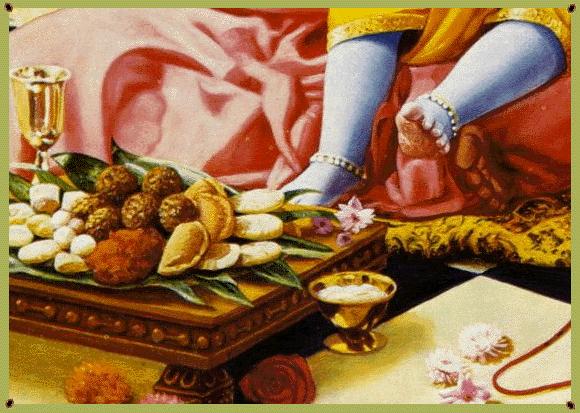
Food prepared for and offered to Krishna with love and devotion becomes completely spiritualized. Such food is called Krishna prasadam, which means “the mercy of Lord Krishna.”
Eating only food offered to Krishna is the perfection of vegetarianism. In the Bhagavad-gita Lord Krishna says that unless one eats only food that has been offered to Him in sacrifice, one will suffer the reactions of karma. He also states, “If one offers Me with love and devotion a leaf, a flower, a fruit, or water, I will accept it.”
We can offer Krishna foods prepared from milk products, vegetables, fruits, nuts, and grains. Meat, fish and eggs are not offerable. And a few vegetarian items are also forbidden— garlic and onions, for example, which are in the mode of darkness. (Hing, or asafoetida, is a tasty substitute for them in cooking.) Nor can you offer Krishna coffee or tea.
In preparing food, cleanliness is the most important principle. Nothing impure should be offered to God, so keep your kitchen very clean. Always wash your hands thoroughly before entering the kitchen. While preparing food, do not taste it, for you are cooking the meal not for yourself but for the plea¬sure of Krishna. Arrange positions of the food on dinnerware kept especially for this purpose; no one but the Lord should eat from these dishes. The easiest way to offer food is simply to pray, “My dear Lord Krishna, please accept this food,” and to chant each of the following prayers three times while ringing a bell.
This is probably one of my most favorite songs from the “Songs of the Vaisnava Acaryas” songbook. I try to sing it every day as part of my morning program. And I like to recite the English as well.
I offer my respectful obeisances unto the six Gosvāmīs, who were chanting very loudly everywhere in Vṛndāvana, shouting, “Queen of Vṛndāvana, Rādhārāṇī! O Lalita! O son of Nanda Mahārāja! Where are you all now? Are you just on the hill of Govardhana, or are you under the trees on the bank of the Yamunā? Where are you?” These were their moods in executing Kṛṣṇa consciousness.
Śrī Śrī Ṣaḍ-gosvāmy-aṣṭaka Eight Prayers to the Six Gosvamis by Śrīnivāsa Ācārya
This morning I was thinking about our eternal nature, as spirit souls. People talk about the soul, but what really is the soul. It is our eternal life. So we are really Eternal Spirit Souls, trapped in a Temporary Material body. Kinda like a fish out of water. Srila Prabhupada uses this example many times. So I decided to cite a few examples.
Śrīla Prabhupāda: The Vedic injunction is that people are searching after knowledge, and that when one understands the Absolute Truth, he understands everything. People are trying to approach an objective, but they do not know that the final objective is Krsna. They are simply trying to make adjustments with so many materialistic revolutions. They have no knowledge that they are spiritual beings and that unless they go back to the spiritual world and associate with the Supreme Spirit, God, there is no question of happiness. We are like fish out of water. Just as a fish cannot be happy unless he is in the water, we cannot be happy apart from the spiritual world. We are part and parcel of the Supreme Spirit, Krsna, but we have left His association and fallen from the spiritual world because of our desire to enjoy this material world. So unless we reawaken the understanding of our spiritual position and go back home to the spiritual world, we can never be happy. We can go on theorizing for many lifetimes, but we will only see one revolution after another. The old order changes, yielding its place to the new. Or in other words, history repeats itself. (from the “Journey of Self Discovery” chapter 7)
To cite an example I have given many times, if you take a fish out of water, you can give it a very comfortable velvet bedstead, but still the fish cannot be happy; it will die. Because the fish is an animal of the water, it cannot be happy without water. Similarly, we are all spirit soul; unless we are in spiritual life or in the spiritual world, we cannot be happy. That is our position. (“Krsna Consciousness: The Topmost Yoga”)
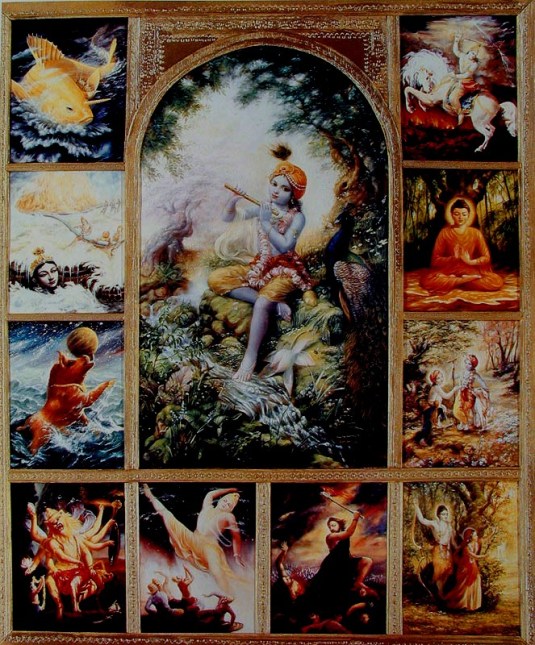
Lord Krsna appears in every millennium, in various incarnations, to annihilate the demons, protect the devotees and reestablish the principles of religion. From upper left-hand corner: Lord Matsya, the fish incarnation; Lord Kurma, the tortoise incarnation; Lord Varaha, the boar incarnation; Lord Nrsimhadeva, the man-lion incarnation; Lord Vamana, the dwarf-brahmana incarnation; Lord Parasurama, the warrior incarnation; Lord Ramacandra; Lord Krishna and Lord Balarama; Lord Buddha; and Lord Kalki, who destroys all demons at the end of the millennium.
In order to deliver the pious and to annihilate the miscreants, as well as to reestablish the principles of religion, I advent Myself millennium after millennium. (Bhagavada-gita As It Is 4.8)
I love reading these memories of the very early disciples of Srila Prabhupada. Prabhupada once said that Krishna sent some of you to assist me in this movement, and some of you were just lucky. I guess I was just lucky.
The following is the Foreward to “The Science of Self Realization” written by Mukunda das Goswami. I have read this countless times. Very Beautiful.
The Science of Self Realization Foreword By Mukunda Das
From the very start, I knew that His Divine Grace A. C. Bhaktivedanta Swami Prabhupāda was the most extraordinary person I had ever met. The first meeting occurred in the summer of 1966, in New York City. A friend had invited me to hear a lecture by “an old Indian svāmī” on lower Manhattan’s Bowery. Overwhelmed with curiosity about a svāmī lecturing on skid row, I went there and felt my way up a pitch-black staircase. A bell-like, rhythmic sound got louder and clearer as I climbed higher. Finally I reached the fourth floor and opened the door, and there he was.
About fifty feet away from where I stood, at the other end of a long, dark room, he sat on a small dais, his face and saffron robes radiant under a small light. He was elderly, perhaps sixty or so, I thought, and he sat cross-legged in an erect, stately posture. His head was shaven, and his powerful face and reddish horn-rimmed glasses gave him the look of a monk who had spent most of his life absorbed in study. His eyes were closed, and he softly chanted a simple Sanskrit prayer while playing a hand drum. The small audience joined in at intervals, in call-and-response fashion. A few played hand cymbals, which accounted for the bell-like sounds I’d heard. Fascinated, I sat down quietly at the back, tried to participate in the chanting, and waited.
This morning this verse kept going through my head:
Whatever inauspicious things I have done out of ignorance or unknowingly, please forgive that, and accept me as Your insignificant servant.
I had a hard time remembering where it came from. Then I remembered it was from the Sri Aparada-shodhana prayers. So I share them with you again. Hare Krishna!
Sri Aparadha-shodhana (Verses for Requesting Forgiveness for One’s Offences)
mantra-hinam kriya-hinam bhakti-hinam janardana yat pujitam maya deva paripurnam tad astu me
O my Lord, O Janardana, whatever little puja or worship that has been performed by me, although it is without devotion, without proper mantras, and without the proper performance, please let that become complete.
I am so saddened by the news coming out of California. Such a tragic loss for so many. Beautiful homes and forests, lives lost, lives disrupted. Our hearts go out to all who have been affected by the utter devastation.
This morning as I was singing the morning prayers:
“The spiritual master is receiving benediction from the ocean of mercy. Just as the cloud pours water on the forest fire to extinguish it, so the spiritual master extinguishes the blazing fire of material existence. I offer my respectful obeisances unto the lotus feet of my spiritual master.” (Śrī Gurvaṣṭakam, Verse 1)
I was again reminded of the California Fires and how this material world is often compared to a forest fire in Srila Prabhupada’s books. From the small paperback book entitled “Elevation to Krsna Consciousness” we read:
This material world is often compared to a forest fire which takes place automatically. No one wants a forest fire, but there is often lightning, or carelessness, or friction, or whatever, and the fire immediately takes place. Similarly, this material world is beset with a blazing fire of problems. Everyone wants to live here peacefully, but situations develop in such a way that this is not possible for anyone. We struggle very hard to adjust things in so many ways, but nature’s laws are so cruel and dangerous that in spite of our hopes and plans the blazing fire of the problems of material existence continues.
For some reason, this morning while I was chanting on my japa beads, I realized that I don’t know the names of the eight chief gopis of Radha and Krishna. Seemed like something I should know. So I did a little research this morning…and now I can relax a bit having discovered their names. Now I just have to learn how to pronounce them. -V
Lalita
Visakha
Champakalata
Citra
Tungavidya
Indulekha
Rangadevi
Sudevi
The Eight Gopis are the foremost, dearest and most beloved friends of Srimati Radharani. They are known in the world as Asta-sakhis (Eight main), Parama-preshta(Dearest) or Varishta(Top Most ) Gopis . Their names are Lalita, Visakha, Citra, Campakalata, Tungavidya, Induleckha, Rangadevi and Sudevi. The Astha-sakhis display the zenith of spiritual love for Radha and Krishna. No one can equal or exceed the love they bear for the Divine Couple. To increase the transcendental ecstasy of Radha and Krishna, the Parama-preshta Gopis show partiality; sometimes they favor Krishna, sometimes Radha. These Eight Gopis are the leaders of all the other gopis. In whatever time, place, or circumstance, these Gopis are placed, their most exalted and intense love for the transcendental Divine Couple is always very easy to see. These Varishtha Gopis are the leaders of millions of other gopis, and because they are very greedy to earn Radha’s love , try to please Her in every way possible.
Who is that smiling women in the middle? Why its Lady Subhadra!
Subhadra : Daughter of Vasudeva and sister of Lord Śrī Krsna. She was not only a very dear daughter of Vasudeva, but also a very dear sister to both Krsna and Baladeva. The two brothers and sister are represented in the famous Jagannatha temple of Puri, and the temple is still visited by thousands of pilgrims daily. This temple is in remembrance of the Lord’s visit at Kuruksetra during an occasion of solar eclipse and His subsequent meeting with the residents of Vrndavana. The meeting of Radha and Krsna during this occasion is a very pathetic story, and Lord Śrī Caitanya, in the ecstasy of Rādhārāṇī, always pined for Lord Śrī Krsna at Jagannatha Puri. While Arjuna was at Dvaraka, he wanted to have Subhadra as his queen, and he expressed his desire to Lord Krsna. Śrī Krsna knew that His elder brother, Lord Baladeva, was arranging her marriage elsewhere, and since He did not dare to go against the arrangement of Baladeva, He advised Arjuna to kidnap Subhadra. So when all of them were on a pleasure trip on the Raivata Hill, Arjuna managed to kidnap Subhadra according to the plan of Śrī Krsna. Śrī Baladeva was very angry at Arjuna, and He wanted to kill him, but Lord Krsna implored His brother to excuse Arjuna. Then Subhadra was duly married with Arjuna, and Abhimanyu was born of Subhadra. At the premature death of Abhumanyu, Subhadra was very mortified, but on the birth of Pariksit she was happy and solaced. (from purport to SB 1.13.3-4)
This morning I was looking through my bookshelf and I saw a book I didn’t recognize. But when I opened it, I saw my name was written on the first page. I must have purchased it on one of our trips. I had completely forgotten about it, and it was still brand new. I love a new book, so I was overjoyed to discover what was inside. Thousands of quotes from Srila Prabhupada’s many books on the Nectar of the Holy Name. So today I am posting just a few of them that jumped out at me, but I am also including the entire book as a free PDF at bottom of post.
Sri Caitanya Mahaprabhu asked, “What should all living entities constantly remember?” Ramananda Raya replied, “The chief object of remembrance is always the holy name of the Lord, His qualities and pastimes.” (Sri Caitanya−caritamrta Madhya−lila 8.252)
krte yad dhyayato visnum tretayam yajato makhaih dvapare paricaryayam kalau tad dhari−kirtanat [Sukadeva Gosvami to Maharaja Pariksit]:
“Whatever result was obtained in Satya−yuga by meditating on Visnu, in Treta−yuga by performing sacrifices and in Dvapara−yuga by serving the Lord’s lotus feet can also be obtained in Kali−yuga simply by chanting the Hare Krsna maha−mantra.” (Srimad−Bhagavatam 12.3.52)
The Holy Name Is the Universal and Supreme Religion for this Age
harer nama harer nama harer namaiva kevalam kalau nasty eva nasty eva nasty eva gatir anyatha (Sri Caitanya−caritamrta Adi 17.21)
“In this age of Kali there is no alternative, there is no alternative, there is no alternative for spiritual progress than the holy name, the holy name, the holy name of the Lord.”
krsna−varnam tvisakrsnam sangopangastra−parsadam yajnaih sankirtana−prayair yajanti hi su−medhasah
“The pious results derived from chanting the thousand holy names of Visnu three times can be attained by only one repetition of the holy name of Krsna.” ( Sri Caitanya−caritamrta Madhya−lila 9.33)
trnad api sunicena taror api sahisnuna amanina manadena kirtaniyah sada harih
“One should chant the holy name of the Lord in a humble state of mind, thinking oneself lower than the straw in the street. One should be more tolerant than a tree, devoid of all sense of false prestige and ready to offer all respects to others. In such a state of mind one can chant the holy name of the Lord constantly.”
Happy New Year everyone, hopefully This will be a good year.
Ya know, every year I make New Years’ resolutions, to be a better person, or to wake up early every day, stop eating so much white sugar and white flour, practice yoga, exercise, walk, chant my 16 rounds, etc. Typically my resolutions don’t even make it past the first week in January. But this year I am going to try something a little different. Keeping it simple. I am going to try to love God [Krishna] more.
I am reminded of the George Harrison song “My Sweet Lord”
My Sweet Lord
…I really want to see you Really want to be with you Really want to see you, Lord But it takes so long, my Lord
My sweet Lord My Lord My Lord
I really want to know you Really want to go with you Really want to show you, Lord But it won’t take long, my Lord (Hare Krishna)
full song below
But I am also reminded of the words of Srila Prabhupada in the KRSNA Book;
...Since Kṛṣṇa is all-attractive, one should know that all his desires should be focused on Kṛṣṇa… if we concentrate our loving propensities upon Kṛṣṇa only, then immediately universal love, unity and tranquillity will be automatically realized. When one waters the root of a tree, he automatically waters the branches, twigs, leaves and flowers; when one supplies food to the stomach through the mouth, he satisfies all the various parts of the body.
The art of focusing one’s attention on the Supreme and giving one’s love to Him is called Kṛṣṇa consciousness. (from Preface)
And from the Introduction of the KRSNA Book;
The supreme abode of the Personality of Godhead, Krsna, is also described in the Brahma-samhita as the abode of cintamani. That abode of Lord Krsna known as Goloka Vrindavan is full of palaces made of touchstone. There the trees are called desire trees, and the cows are called surabhi. The Lord is served there by hundreds and thousands of goddesses of fortune. His name is Govinda, the Primeval Lord, and He is the cause of all causes. There the Lord plays His flute, His eyes are like lotus petals, and the color of His body is like that of a beautiful cloud. On His head is a peacock feather. He is so attractive that He excels thousands of Cupids.
Krishna is so attractive, that it shouldn’t be hard to love Him more. Maybe this is a New Year Resolution I can actually keep.
Sri-Guru-Carana-Padma by Narottama dasa Thakura From Songs of the Vaisnava Acaryas
śrī-guru-caraṇa-padma, kevala-bhakati-sadma, bando muñi sāvadhāna mate jāhāra prasāde bhāi, e bhava toriyā jāi, kṛṣṇa-prāpti hoy jāhā ha’te
The lotus feet of our spiritual master are the only way by which we can attain pure devotional service. I bow to his lotus feet with great awe and reverence. By his grace one can cross the ocean of material suffering and obtain the mercy of Krsna.
guru-mukha-padma-vākya, cittete koriya aikya, ār nā koriho mane āśā śrī-guru-caraṇe rati, ei se uttama-gati, je prasāde pūre sarva āśā
My only wish is to have my consciousness purified by the words emanating from his lotus mouth. Attachment to his lotus feet is the perfection that fulfills all desires.
He opens my darkened eyes and fills my heart with transcendental knowledge. He is my Lord birth after birth. From him ecstatic prema emanates; by him ignorance is destroyed. The Vedic scriptures sing of his character.
śrī-guru karuṇā-sindhu, adhama janāra bandhu, lokanāth lokera jīvana hā hā prabhu koro doyā, deho more pada-chāyā, ebe jaśa ghuṣuk tribhuvana
Our spiritual master is the ocean of mercy, the friend of the poor, and the lord and master of the devotees. O master! Be merciful unto me. Give me the shade of your lotus feet. Your fame is spread all over the three worlds.
The Nectar of Devotion is specifically presented for persons who are now engaged in the Krsna consciousness movement. I beg to offer my sincere thanks to all my friends and disciples who are helping me to push forward the Krsna consciousness movement in the Western countries, and I beg to acknowledge, with thanks, the contribution made by my beloved disciple Śrīmad Jayānanda Brahmacari. My thanks are due as well to the directors of ISKCON Press, who have taken so much care in publishing this great literature. Hare Krsna.
A.C. Bhaktivedanta Swami
“Prabhupada: Hare Krsna. So we have published our Nectar of Devotion. So every one of you should read this Nectar of Devotion repeatedly. The whole substance of Vaisnava philosophy and activities, everything is there. So every one of you read this Nectar of Devotion once, twice, thrice.”
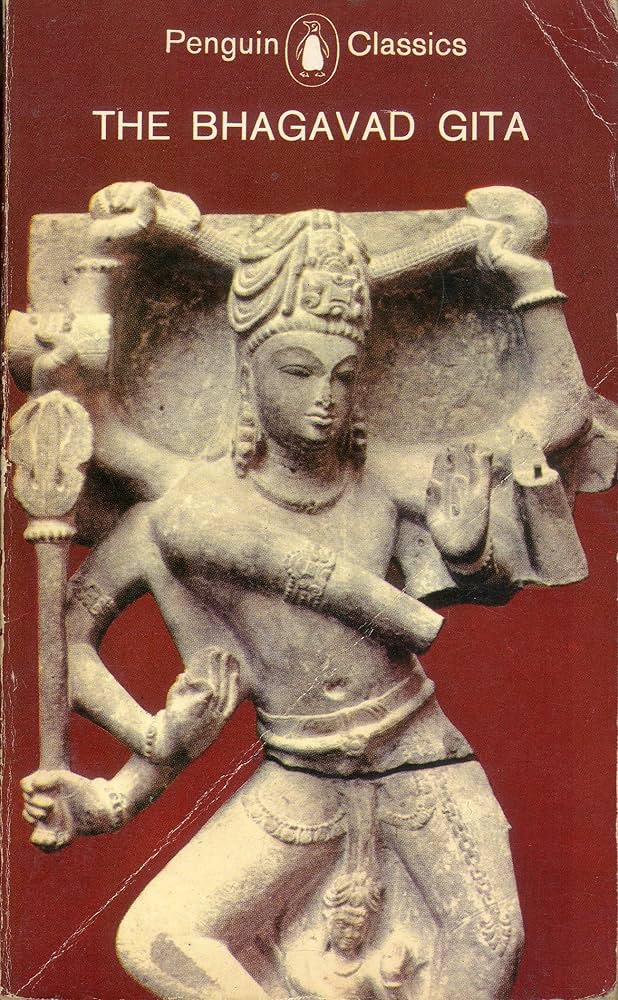
I remember back in my younger years, before I became a devotee, I decided to spend my summer off from college, hiking the Appalachian trail. I took with me some small books with me to read along the way. I was becoming interested in Eastern philosophy, and was asking myself questions like who is God, who am I, and what is my relationship with Him. I carried with me a small paperback book by Hermann Hesse entitled Siddhartha, a book by Henry David Thoreau; “Walden”, and the Penguin Classic; “The Bhagavad-gita.
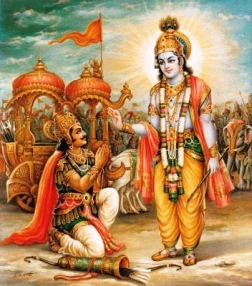
From the book “Siddhartha” I became interested in meditation and the journey to self discovery. From “Walden”, I became interested is self- sufficiency, or as I later describe it as simple living and high thinking, and from the Bhagavad-gita, I discovered who God is. Really. For some reason, as soon as I began reading, I immediately accepted that Krishna was God. This book was the song of God. This was God speaking to His friend Arjuna, instructing him. And I thought how wonderful to be a friend of God, to become Gods friend.
Even though I was raised as a Christian, went to church on Sunday, was taught by nuns and priests, I never got satisfactory answers to my question, Who is God? But this book the Bhagavad-gita, This was God Himself speaking to his friend. Now I knew, there is a God, and His name was Krishna.
About a year later I meet a Hare Krishna devotee at the Chicago O’Hare airport, and I got from him the Krsna Book, then later I went back there and found a deserted copy of the Bhagavad-gita As It Is, on a neglected bench seat, by His Divine Grace A. C. Bhaktivedanta Swami. It wasn’t just the translations that the penguin classic offered, but it was the complete edition, with original Sanskrit text, Roman transliterations, English equivalents, translation and elaborate purports.










 The Hare Krishna Movement
