…Decorated with splendid jewel lotus petals, the youthful and fragrant divine couple are splendid as a monsoon cloud and lightning as They stand on a jeweled golden pavement under a tall kalpa-druma tree by the Yamunā in Vṛndāvana Forest. O mind, please always remember Their charming, gentle smile.
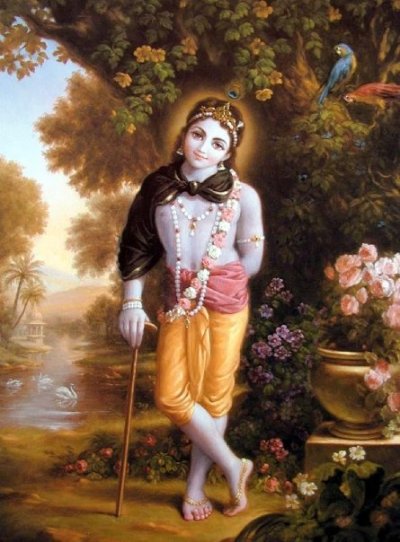
O mind, please remember Lord Hari’s splendid crown decorated with peacock feathers and guñjā, His wavy locks of hair, His forehead splendid with tilaka, His eyebrows, eyes, nose, splendid cheeks, ears, glittering jewel earrings, red lips, flute, face, arching neck marked with three lines, soft shoulders, broad arms decorated with armlets and other ornaments, hands, fingers marked with wavy lines, chest decorated with kaustubha jewel and garlands of pearls and forest flowers and the splendid mark of the goddess of fortune, the line of hairs on His splendid abdomen, His lotus navel, slender waist, tinkling bells, yellow garments, large knees, ankles decorated with tinkling ankle-bells, lotus feet, graceful toes, pink toenails, the redness that extends across the soles of His feet up to His heels, and on His right foot: the barleycorn-mark at the base of His big toe, the ūrdhva-rekhā by His fore-toe, the curved lotus in the middle of His foot, the flag on the surface of His foot, the elephant-goad and thunderbolt at the base of His little-toe, the four svastikas, the jambus, and the eight-pointed star in the middle.
A charming couple, two mountainous oceans of the nectar of the love they bear for each other, shines in Vṛndāvana Forest. The young girl, whose splendor rebukes the lightning flash, hides a gentle smile under Her blue sari. Please remember that smile.
O mind, please meditate on Rādhā’s fine, curly, braided hair, the jewel, golden leaf, tilaka, and curly hairs on Her forehead, Her eyebrows, mascara-anointed eyes, ears, the charming shark-shaped earings at Her cheeks, Her pearl-decorated nose, lips. splendid teeth, musk-dot-decorated chin, neck marked with three lines and decorated with many necklaces, gracefully sloping shoulders, armlet-decorated arms, elbows, lotus hands endowed with beautiful and auspicious lines and decorated with bracelets, jewel ūrmikās, rings, beautiful fingernails, breasts covered with a splendid red bodice, locket, flower-petal abdomen with a line of hairs, navel, slender waist marked with three lines, colorful undergarments, blue petticoat, thighs, knees, legs, ankles, anklets, ankle-bells, toe-ūrmikās, toe-rings, and toe-nails, the barleycorn and ari beneath Her left big-toe, the ūrdhva-rekhābeneath Her fore-toe, the small chariot nearby, the lotus, flag, flower, and vine in the middle, the elephant-goad beneath Her little-toe, beneath that a bracelet and parasol, on the heel a half-moon, on the heel of the other foot a fish, above that a flying mountain, on the sides a śakti and pada, under the big-toe a conchshell, under the little toe an altar, and beneath that an earring…
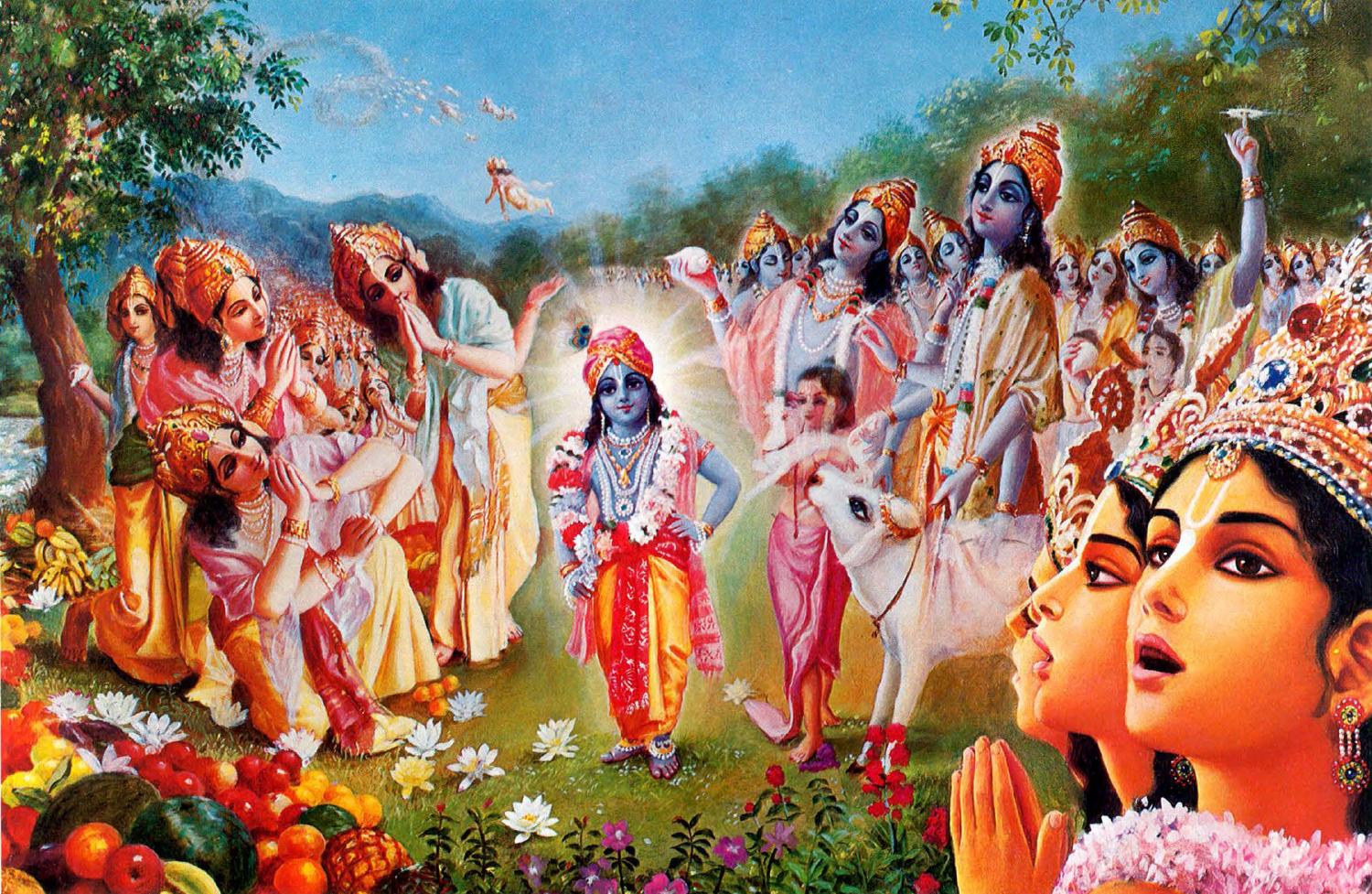
…Kṛṣṇa’s only business is satisfying the devotees, and their only business is satisfying Kṛṣṇa. This is the reciprocation of love… The Supreme Personality of Godhead, wanders on the banks of the Yamunā to please the gopīs, the cowherd boys, the birds, the bees, and the cows and calves. These are not ordinary birds, bees, cows, calves, or men; they have all reached the summit of self-realization and thus, after many, many lives, have attained a position whereby they can play with Kṛṣṇa. This Kṛṣṇa consciousness movement can enable everyone to go to Kṛṣṇaloka and become Kṛṣṇa’s associate as a friend, servant, father, or mother. Kṛṣṇa is agreeable to take any of these positions in relation to His devotee.
Under the Direction of God (Krishna) His Divine Grace Srila Prabhupada speaks as Krsna speaks
“It is not possible for a common man to write books on bhakti, for his writings will not be effective. He may be a very great scholar and expert in presenting literature in flowery language, but this is not at all helpful in understanding transcendental literature. Even if transcendental literature is written in faulty language, it is acceptable if it is written by a devotee, whereas so-called transcendental literature written by a mundane scholar, even if it is a very highly polished literary presentation, cannot be accepted. The secret in a devotee’s writing is that when he writes about the pastimes of the lord, the lord helps him; he does not write himself.
We Don’t Allow Any Literature Not Given by Liberated Soul
compiled by Sriman Mahesh Prabhu
The difference between Srila Prabhupada’s books and other so-called gurus’ (conditioned souls) writing is Srila Prabhupada’s instruction was coming directly from Krsna. This is the transcendental platform.
Srila Prabhupada encouraged his disciples, however, to write their realizations. Other conditioned souls may present their nonsense commentaries on Bhagavad-Gita etc., but they will never be quoted for references. Srila Prabhupada is on the trancendental platform and Krishna speaks through him, consequently only he will be quoted for reference.
…King Parīkṣit became more inquisitive to hear about Kṛṣṇa and His pastimes, and thus he inquired from Śukadeva Gosvāmī how his grandmother Subhadrā was kidnapped by his grandfather Arjuna at the instigation of Lord Kṛṣṇa. King Parīkṣit was very much eager to learn about his grandfather’s kidnapping and marriage of his grandmother.
Thus Śukadeva Gosvāmī began to narrate the story as follows: “Once upon a time, your grandfather Arjuna, the great hero, was visiting several holy places of pilgrimage, and while he was thus traveling all over he happened to come to Prabhāsakṣetra. In the Prabhāsakṣetra he heard the news that Lord Balarāma was negotiating the marriage of Subhadrā, the daughter of Arjuna’s maternal uncle, Vasudeva. Although her father, Vasudeva, and her brother, Kṛṣṇa, were not in agreement with Him, Balarāma was in favor of marrying Subhadrā to Duryodhana. Arjuna, however, desired to gain the hand of Subhadrā.”
As he thought of Subhadrā and her beauty, Arjuna became more and more captivated with the idea of marrying her, and with a plan in mind…
Here is a new word for your vaisnava vocabulary, nityanavanavāyamāna This word is explained in following paragraph. And for an example of the word nityanavanavāyamāna in transcendental subject matter we offer the following chapter from the KRSNA Book.
It is said that it is the nature of a devotee to constantly apply his mind, energy, words, ears, etc., in hearing and chanting about Kṛṣṇa. This is called Kṛṣṇa consciousness, and for one who is rapt in hearing and chanting Kṛṣṇa, the subject matter never becomes hackneyed or old. That is the significance of transcendental subject matter in contrast to material subject matter. Material subject matter becomes stale, and one cannot hear a certain subject for a long time; he wants change. But as far as transcendental subject matter is concerned, it is called nityanavanavāyamāna. This means that one can go on chanting and hearing about the Lord and never feel tired but will remain fresh and eager to hear more and more.
As the Lord passed along the public road of Dvārakā, His head was protected from the sunshine by a white umbrella. White feathered fans moved in semicircles, and showers of flowers fell upon the road. His yellow garments and garlands of flowers made it appear as if a dark cloud were surrounded simultaneously by sun, moon, lightning and rainbows.
…The sun, moon, rainbow and lightning do not appear in the sky simultaneously. But the situation created at the time of His passing on the roads of Dvārakā was beautiful and could not be compared to anything besides the description of natural phenomena.
…The gopīs were aware of the reason for Kṛṣṇa’s sudden disappearance. They could understand that when they were enjoying Kṛṣṇa, they thought themselves to be the most fortunate women within the universe, and since they were feeling proud, Kṛṣṇa disappeared immediately just to curb their pride. Kṛṣṇa does not like His devotees to be proud of their service to Him. He accepts everyone’s service, but He does not like one devotee to be prouder than others. If sometimes there are such feelings, Kṛṣṇa ends them by changing His attitude toward the devotee.
Kṛṣṇa, The Supreme Personality of Godhead (1970 Edition)
By His Divine Grace A.C. Bhaktivedanta Swami Prabhupada
Chapter 30
Yasyāham anugṛhṇāmi hariṣye tad-dhanaṁ śanaiḥ “I Gradually Deprive Him of His Wealth”
In our previous post entitled Vṛndāvana Bhajana I was curious about the verse Srila Prabhupada used in the First Stanza; yasyāham anugṛhṇāmi hariṣye tad-dhanaṁ śanaiḥ “I gradually take away all the wealth of those upon whom I am merciful.”. So I did a search on the word “yasyāham anugṛhṇāmi” and was surprised to find that Srila Prabhupada had used that partictular verse 36 times in his books, lectures and conversations as documented by the very nice web site Vani Quotes. The verse originated from the Srimad Bhagavatam, 10.88.8 and is as follows:
śrī-bhagavān uvāca
yasyāham anugṛhṇāmi
hariṣye tad-dhanaṁ śanaiḥ
tato ‘dhanaṁ tyajanty asya
svajanā duḥkha-duḥkhitam
śrī-bhagavān uvāca—the Personality of Godhead said; yasya—whom; aham—I; anugṛhṇāmi—favor; hariṣye—I will take away; tat—his; dhanam—wealth; śanaiḥ—gradually; tataḥ—then; adhanam—poor; tyajanti—abandon; asya—his; sva-janāḥ—relatives and friends; duḥkha-duḥkhitam—who suffers one distress after another.
The Personality of Godhead said: If I especially favor someone, I gradually deprive him of his wealth. Then the relatives and friends of such a poverty-stricken man abandon him. In this way he suffers one distress after another.
So in this way, gradually, I became attached to these Gauḍīya Matha activities, and by the grace of Kṛṣṇa, my business also was not going very well. (laughter) (laughs) Yes. Kṛṣṇa says yasyāham anughṛṇāmi hariṣye tad-dhanaṁ śanaiḥ. If somebody wants to be actually devotee of Kṛṣṇa, at the same time, keeps his material attachment, then Kṛṣṇa’s business is He takes away everything material, so that cent percent he becomes, I mean to say, dependent on Kṛṣṇa. So that actually happened to my life.
All the references to this verse are listed (referenced) as follows: More
…In this Seventh Chapter of Bhagavad-gītā, the nature of Kṛṣṇa consciousness is fully described. Kṛṣṇa is full in all opulences, and how He manifests such opulences is described herein. Also, four kinds of fortunate people who become attached to Kṛṣṇa, and four kinds of unfortunate people who never take to Kṛṣṇa are described in this chapter.
Bhagavad-gītā As It Is Complete 1972 Edition
By His Divine Grace A. C. Bhaktivedanta Swami Prabhupāda
Chapter 7
The following letter arrived in our mail box and because it is a very good question we have attempted to answer it here.
Dear Hare Krishna Movement
I understand that the Hare Krishna mantra should be received through a proper disciplic succession for it to be “active”
My question is, how can this be achieved? Is it sufficient to read about the mantra in books by His Divine Grace A.C. Bhaktivedanta Swami Prabhupada? Or is there a need to in person receive the mantra from a authentic disciple? If so, where can information be found on who such disciples are and how to contact them?
Thanks and best regards
Our Reply is as follows:
Dear _____
Thank you for your very important question. If you would take a moment and view the following YouTube… or listen to it while you read the purport given by Srila Prabhupada. By the end of it I assure you, that you will have received the Hare Krishna Mantra through the proper disciplic succession from the proper person who is a pure devotee of Krishna, the representative of Krishna. and is the direct link to the parampara (disciplic succession).
The Hare Krishna Maha Mantra
Purport to the Hare Krishna Maha Mantra
By His Divine Grace A.C. Bhaktivedanta Swami Prabhupada,
Founder and Acharya of the Krishna Consciousness Movement
New York, New York, USA 1966
As explained on the cover of the record album, this transcendental vibration– by chanting of Hare Krishna, Hare Krishna, Krishna Krishna, Hare/ Hare Rama, Hare Rama, Rama, Hare Hare – is the sublime method for reviving our Krishna consciousness. As living spiritual souls we are all originally Krsna conscious entities, but due to our association with matter since time immemorial, our consciousness is now polluted by material atmosphere. In this polluted concept of life, we are all trying to exploit the resources of material nature, but actually we are becoming more and more entangled in our complexities.
The following 25 verses (slokas) Prayers by Queen Kunti from the Srimad Bhagavatam were often quoted by Srila Prabhupada when giving lectures, and are so important that an entire book was published from the purports to these verses entitled “Teachings of Queen Kunti”. We encourage our readers to download the entire book by following the link at bottom of post for a free pdf file. You can also print these important slokas by clicking on the print icon following the post for easy reference to memorizing these famous slokas.
Srimad Bhagavatam
By His Divine Grace A.C. Bhaktivedanta Swami Prabhupada
Canto One, Chapter 8, Text 18-43
Those who are followers of His Divine Grace A.C. Bhaktivedanta Swami Prabhupada, and read from his books with faith and conviction, are receiving Transcendental KnowledgeEvaṁ paramparā-prāptam imaṁ rājarṣayo viduḥ. (Bhagavad-gīta, 4.2; see below for full verse and purport) through this disciplic succession:
…We have to accept Kṛṣṇa through the disciplic succession. There are four sampradāyas, disciplic successions. One comes from Lord Brahmā (the Brahma-sampradāya), and another comes from Lakṣmī, the goddess of fortune, (the Śrī-sampradāya). There are also the Kumāra-sampradāya and the Rudra-sampradāya. At the present moment, the Brahmā sampradāya is represented by the Madhva-sampradāya, and we belong to the Madhva-Gauḍīya-sampradāya. Our original sampradāya stems from Madhvācārya. In that sampradāya there was Mādhavendra Purī, and Mādhavendra Purī’s disciple was Śrī Īśvara Purī. Śrī Īśvara Purī’s disciple was Lord Caitanya Mahāprabhu. Thus we are coming in the disciplic succession from Śrī Caitanya Mahāprabhu, and therefore our sampradāya is called the Madhva-Gauḍīya-sampradāya. It is not that we have manufactured a sampradāya; rather, our sampradāya stems from Lord Brahmā.
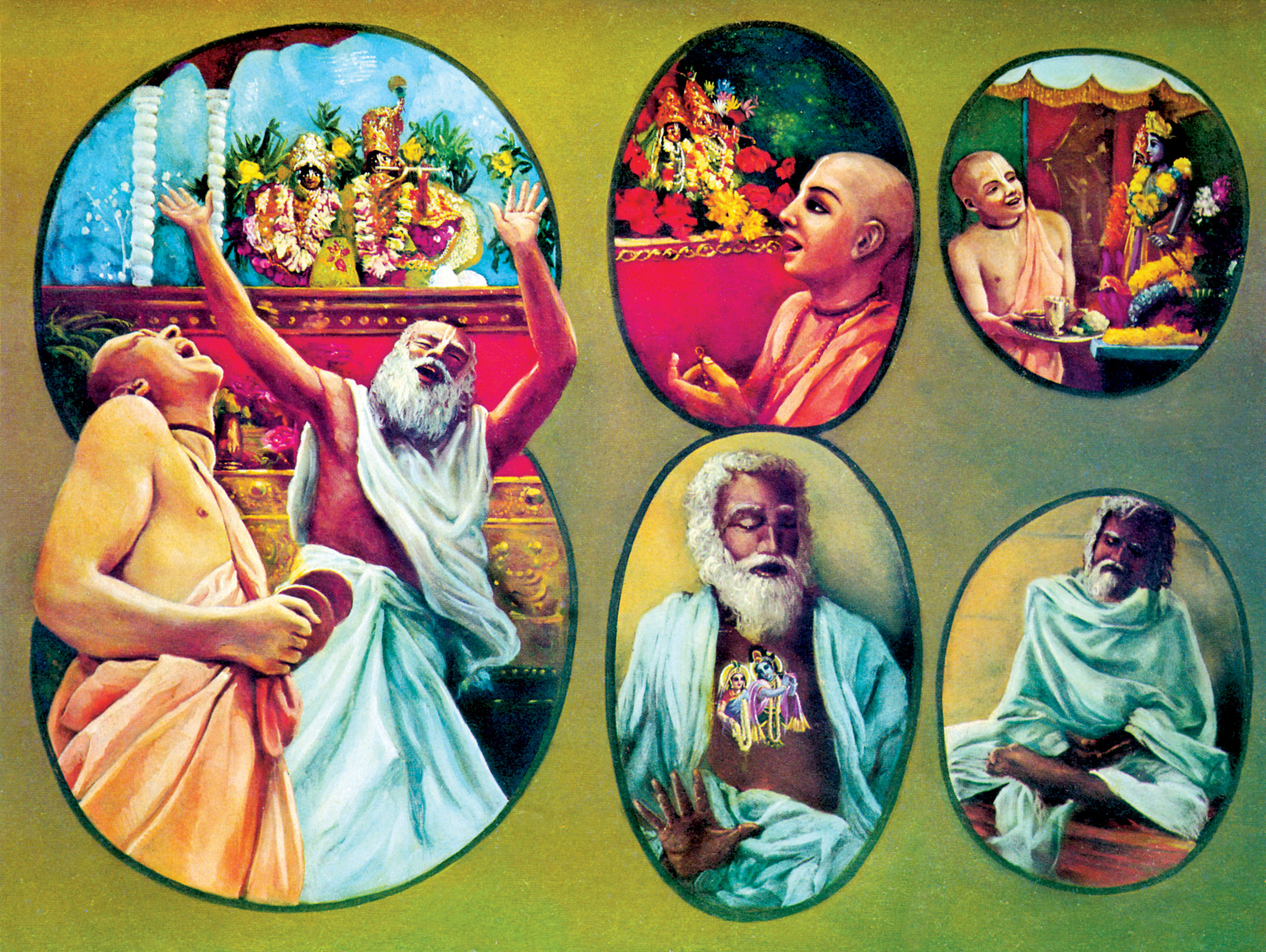
…If a devotee at all wants to cleanse his heart, he must chant and hear the glories of the Lord, Śrī Kṛṣṇa (śṛṇvatāṁ sva-kathāḥ kṛṣṇaḥ). This is a simple process. Kṛṣṇa Himself will help cleanse the heart because He is already seated there. Kṛṣṇa wants to continue living within the heart, and the Lord wants to give directions, but one has to keep his heart as clean as Lord Caitanya Mahāprabhu kept the Guṇḍicā temple. The devotee therefore has to cleanse his heart just as the Lord cleansed the Guṇḍicā temple. In this way one can be pacified and enriched in devotional service.
On this eve of Srimati Radharani’s appearance day (Radhastami) celebration I am reminded of one of my favorite KRSNA Book stories; Delivery of the Message of Kṛṣṇa to the Gopīs. We share the entire chapter with you here.
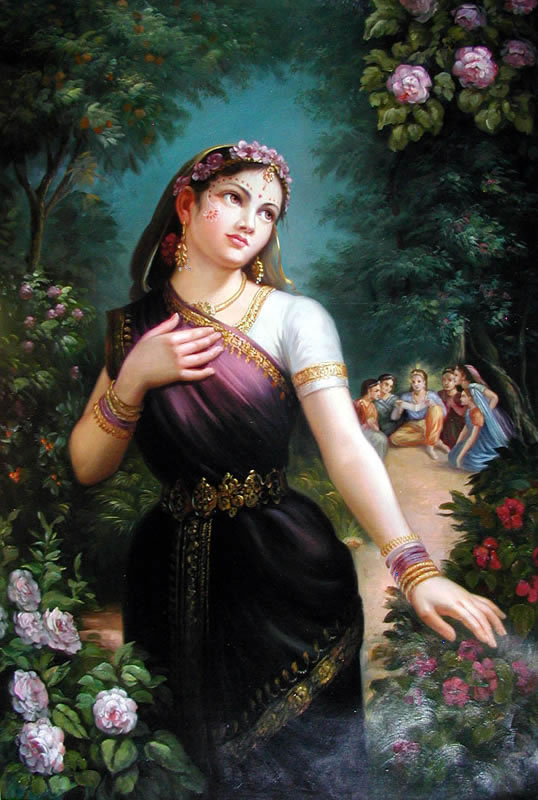
…One of the gopīs, namely Śrīmatī Rādhārāṇī, was so much absorbed in thoughts of Kṛṣṇa by dint of Her personal touch with Him that She actually began to talk with a bumblebee which was flying there and trying to touch Her lotus feet. While another gopī was talking with Kṛṣṇa’s messenger Uddhava, Śrīmatī Rādhārāṇī took that bumblebee to be a messenger from Kṛṣṇa and began to talk with it as follows. “Bumblebee, you are accustomed to drinking honey from the flowers, and therefore you have preferred to be a messenger of Kṛṣṇa, who is of the same nature as you. I have seen on your moustaches the red powder of kuṅkuma, which was smeared on the flower garland of Kṛṣṇa while He was pressing the breast of some other girl who is My competitor. You are feeling very proud by touching that flower, and your moustaches have become reddish. You have come here carrying a message for Me. You are anxious to touch My feet. But My dear bumblebee, let me warn you–don’t touch Me! I don’t want any messages from your unreliable master. You are the unreliable servant of an unreliable master.” It may be that Śrīmatī Rādhārāṇī purposely addressed that bumblebee sarcastically in order to criticize the messenger Uddhava. Indirectly, Śrīmatī Rādhārāṇī saw Uddhava as not only resembling Kṛṣṇa’s bodily features but as being equal to Kṛṣṇa. In this way She indicated that Uddhava was as unreliable as Kṛṣṇa Himself. Śrīmatī Rādhārāṇī wanted to give specific reasons why She was dissatisfied with Kṛṣṇa and His messengers.
She addressed the bumblebee, “Your master Kṛṣṇa is exactly of your quality. You sit down on a flower, and after taking a little honey you immediately fly away and sit in another flower and taste. You’re just like your master Kṛṣṇa. He gave us the chance of tasting the touch of His lips and then left altogether. I know also that the goddess of fortune, Lakṣmī, who is always in the midst of the lotus flower, is constantly engaged in Kṛṣṇa’s service. But I do not know why she has become so captivated by Kṛṣṇa. She is attached to Him, although she knows His actual character. As far as we are concerned, we are more intelligent than that goddess of fortune. We are not going to be cheated anymore by Kṛṣṇa or His messengers…”
Kṛṣṇa, The Supreme Personality of Godhead
By His Divine Grace A.C. Bhaktivedanta Swami Prabhupada
Chapter 46
Delivery of the Message of Kṛṣṇa to the Gopīs More
In honor of the Appearance day of Sītā Ṭhākurāṇī (the eternal wife of Sri Advaita Acharya), we are posting a brief pastime from Srila Prabhupada’s Śrī Caitanya-caritāmṛta: Ādi-līlā Chapter 13, Text 111-119, which gives the following account of Sita Thakurani’s visit to the house of Jagannatha Mishra after the birth of the Lord
One day shortly after Lord Caitanya Mahāprabhu was born, Advaita Ācārya’s wife, Sītādevī, who is worshipable by the whole world, took her husband’s permission and went to see that topmost child with all kinds of gifts and presentations
She brought different kinds of golden ornaments, including bangles for the hand, armlets, necklaces and anklets.
There were also tiger nails set in gold, waist decorations of silk and lace, ornaments for the hands and legs, nicely printed silken sārīs and a child’s garment, also made of silk. Many other riches, including gold and silver coins, were also presented to the child.
Riding in a palanquin covered with cloth and accompanied by maidservants, Sītā Ṭhākurāṇī came to the house of Jagannātha Miśra, bringing with her many auspicious articles such as fresh grass, paddy, gorocana, turmeric, kuṅkuma and sandalwood. All these presentations filled a large basket.
When Sītā Ṭhākurāṇī came to the house of Śacīdevī, bringing with her many kinds of eatables, dresses and other gifts, she was astonished to see the newly born child, for she appreciated that except for a difference in color, the child was directly Kṛṣṇa of Gokula Himself.
Seeing the transcendental bodily effulgence of the child, each of His nicely constructed limbs full of auspicious signs and resembling a form of gold, Sītā Ṭhākurāṇī was very much pleased, and because of her maternal affection, she felt as if her heart were melting.
She blessed the newly born child by placing fresh grass and paddy on His head and saying, “May You be blessed with a long duration of life.” But being afraid of ghosts and witches, she gave the child the name Nimāi.
On the day the mother and son bathed and left the maternity home, Sītā Ṭhākurāṇī gave them all kinds of ornaments and garments and then also honored Jagannātha Miśra. Then Sītā Ṭhākurāṇī, being honored by mother Śacīdevī and Jagannātha Miśra, was greatly happy within her mind, and thus she returned home.
In this way mother Śacīdevī and Jagannātha Miśra, having obtained a son who was the husband of the goddess of fortune, had all their desires fulfilled. Their house was always filled with riches and grains. As they saw the beloved body of Śrī Caitanya Mahāprabhu, day after day their pleasure increased.
…The gopis are another example of great eagerness to see Krsna. The gopis came to Krsna, being captivated by His beautiful features.
The first thing Krsna is looking for is how eager you are to see Him. Krsna will respond. If you are actually eager to see Krsna …your efforts will be successful. But you must desire Krsna only. In this connection, Rupa Gosvami has written a verse:
The idea is that one gopi is advising another gopi, “My dear friend, there is one boy His name is Govinda. He is standing on the bank of the Yamuna near the Kesi-ghata, and He is playing on His flute. He is so beautiful, especially during this full-moon night. If you have any intention to enjoy in this material world with your children, husband, or other family members, then please do not go there.” Bhangi-traya: Krsna always stands in a three-curved way with His flute. That is Krsna’s tri-bhanga form, bending in three places. So the one gopi says to the other, “If you think that you’ll enjoy your life more in this material world, then do not go to see Krsna. Do not go there.” The idea is that if you once see Krsna, then you’ll forget all this nonsensical materialistic enjoyment. That is seeing Krsna.
…This Fifth Chapter is a practical explanation of Kṛṣṇa consciousness, generally known as karma-yoga. The question of mental speculation as to how karma-yoga can give liberation is answered herewith. To work in Kṛṣṇa consciousness is to work with the complete knowledge of the Lord as the predominator. Such work is not different from transcendental knowledge. Direct Kṛṣṇa consciousness is bhakti-yoga, and jñāna-yoga is a path leading to bhakti-yoga. Kṛṣṇa consciousness means to work in full knowledge of one’s relationship with the Supreme Absolute, and the perfection of this consciousness is full knowledge of Kṛṣṇa, or the Supreme Personality of Godhead. A pure soul is the eternal servant of God as His fragmental part and parcel. He comes into contact with māyā (illusion) due to the desire to lord it over māyā, and that is the cause of his many sufferings. As long as he is in contact with matter, he has to execute work in terms of material necessities. Kṛṣṇa consciousness, however, brings one into spiritual life even while one is within the jurisdiction of matter, for it is an arousing of spiritual existence by practice in the material world. The more one is advanced, the more he is freed from the clutches of matter. The Lord is not partial toward anyone. Everything depends on one’s practical performance of duties in an effort to control the senses and conquer the influence of desire and anger. And, attaining Kṛṣṇa consciousness by controlling the above-mentioned passions, one remains factually in the transcendental stage, or brahman-nirvāṇa. The eightfold yoga mysticism is automatically practiced in Kṛṣṇa consciousness because the ultimate purpose is served. There is gradual process of elevation in the practice of yama, niyama, āsana, pratyāhāra, dhyāna, dhāraṇā, prāṇāyāma, and samādhi. But these only preface perfection by devotional service, which alone can award peace to the human being. It is the highest perfection of life.
During the Purusottama Month, it is always good to read and chant more. It is also important is to remember the wonderful pastimes of the Lord.
…After the demon was thrown into the trees, all the friends and associates of Dhenukāsura immediately assembled and attacked Balarāma and Kṛṣṇa with great force. They were determined to retaliate and avenge the death of their friend. But Kṛṣṇa and Balarāma began to catch each of the asses by the hind legs and, exactly in the same way, wheeled them around. Thus They killed all of them by throwing them into the palm trees. Because of the dead bodies of the asses, there was a panoramic scene. It appeared as if clouds of various colors were assembled in the trees. Hearing of this great incident, the demigods from the higher planets began to shower flowers on Kṛṣṇa and Balarāma and began to beat their drums and offer devotional prayers.
During the Purusottama Month, it is important to Hear and Chant more. With this in mind we are posting the 14th Chapter of Krsna, The Supreme Personality of Godhead, with Lord Brahma praising the Glories of Krishna (Purusottama) The Supreme Personality.
“My dear Lord, there are many instances in the history of human society where a person, after failing to achieve the transcendental platform, engaged himself in devotional service with his body, mind and words and thus attained the highest perfectional state of entering into Your abode. The processes of understanding You by speculation or mystic meditation are all useless without devotional service. One should therefore engage himself in Your devotional service even in his worldly activities, and one should always keep himself near You by the process of hearing and chanting Your transcendental glories. Simply by being attached to hearing and chanting Your glories, one can attain the highest perfectional stage and enter into Your kingdom. If a person, therefore, always keeps in touch with You by hearing and chanting Your glories and offers the results of his work for Your satisfaction only, he very easily and happily attains entrance into Your supreme abode. You are realizable by persons who have cleansed their hearts of all contamination. This cleansing of the heart is made possible by chanting and hearing the glories of Your Lordship.”
“In the Upaniṣads it is stated that the Supreme Brahman is as effulgent as the sun and is the origin of everything, and anyone who can understand that original person becomes liberated from the material conditional life. Anyone who can simply be attached to You by devotional service can know Your actual position, Your birth, appearance, disappearance and activities. As confirmed in the Bhagavad-gītā, simply by understanding Your constitutional position, appearance and disappearance, one can be immediately elevated to the spiritual kingdom after quitting this present body. Therefore to cross over the ocean of material nescience, an intelligent person takes shelter of Your lotus feet and is easily transferred to the spiritual world.”
…The appearance of Kṛṣṇa is the answer to all imaginative iconography of the Supreme Personality of Godhead. Everyone imagines the form of the Supreme Personality of Godhead according to his mode of material nature. In the Brahmā-saṁhitā it is said that the Lord is the oldest person. Therefore a section of religionists imagine that God must be very old, and therefore they depict a form of the Lord like a very old man. But in the same Brahmā-saṁhitā, that is contradicted; although He is the oldest of all living entities, He has His eternal form as a fresh youth.
…”O dear Lord,” the demigods continued, “You are unborn; therefore we do not find any reason for Your appearance other than for Your pleasurable pastimes.” Although the reason for the appearance of the Lord is stated in the Bhagavad-gītā (He descends just to give protection to the devotee and vanquish the nondevotee), actually He descends for His pleasure-meeting with the devotees, not really to vanquish the nondevotees. The nondevotees can be vanquished simply by material nature. “The action and reaction of the external enregy of material nature (creation, maintenance and annihilation) are being carried on automatically. But simply by taking shelter of Your holy name–because Your holy name and Your personality are nondifferent–the devotees are sufficiently protected.” The protection of the devotees and the annihilation of the nondevotees are actually not the business of the Supreme Personality of Godhead when He descends. They are just for His transcendental pleasure. There cannot be any other reason for His appearance.
Excerpts from; KRSNA, The Supreme Personality of Godhead
By His Divine Grace A.C. Bhaktivedanta Swami Prabhupada
Volume 1, Chapter 2










 The Hare Krishna Movement