25 Nov 2012
by The Hare Krishna Movement
in A.C. Bhaktivedanta Swami Prabhupada, Spiritual Life, Spiritual World
Tags: A.C. Bhaktivedanta Swami Prabhupada, abode, abode of the Supreme Lord, bhagavad-gita, Brahma-samhita, brahmajyoti, eternal sky, Goloka, goloka eva nivasty, Lord Sri Krsna, material conception, spiritual sky, Spiritual world, Supreme Lord, Vrndavana

…The Lord descends to this mortal world to show His pastimes in Vṛndāvana, which are full of happiness. When Lord Śrī Kṛṣṇa was in Vṛndāvana, His activities with His cowherd boy friends, with His damsel friends, with the inhabitants of Vṛndāvana and with the cows were all full of happiness. The total population of Vṛndāvana knew nothing but Kṛṣṇa. But Lord Kṛṣṇa even discouraged His father Nanda Mahārāja from worshiping the demigod Indra because He wanted to establish the fact that people need not worship any demigod. They need only worship the Supreme Lord because their ultimate goal is to return to His abode.
The abode of Lord Śrī Kṛṣṇa is described in the Bhagavad-gītā, Fifteenth Chapter, sixth verse: More
15 Nov 2012
by The Hare Krishna Movement
in Back to Godhead, Remembering Srila Prabhupada, Srila Prabhupada
Tags: Back to Godhead Magazine, bhagavad-gita, BTG 13.1-2, eternal, Krsna conscious person, krsna consciousness, Remembering Srila Prabhupada, Srila Prabhupada, The Great Soul Who Walked Among Us

…Someone asked, “What is the Krsna conscious person’s attitude towards others?” Srila Prabhupada replied, “He sees everyone as part and parcel of Krsna. The Krsna conscious person thinks, ‘They are suffering from not knowing Krsna, so let me bring them to Krsna.’ This is the highest service. Everyone is suffering, so to act in Krsna consciousness is the highest service. After all, they are suffering on account of detachment from Krsna.”
The Great Soul Who Walked Among Us
Excerpted from Back to Godhead Magazine
Vol. 13, 1-2, 1978
“Consider this example: when the sun is in the sky, there is no question of darkness. Similarly, when the Hare Krsna mantra is vibrating on your tongue and you are hearing attentively, then your consciousness becomes Krsna consciousness, or clear consciousness, and there is no question of maya, or hazy consciousness. Just as when light and darkness come together the darkness cannot stand before the light, maya cannot remain in the presence of Krsna.
More
31 Oct 2012
by The Hare Krishna Movement
in A.C. Bhaktivedanta Swami Prabhupada, Shiva
Tags: A.C. Bhaktivedanta Swami Prabhupada, Bg 9.25, bhagavad-gita, ghosts, ghosts and spirits, Halloween, halloween ghosts, nandi, SB 3.14.24, Shiva, Srimad Bhagavatam, witches
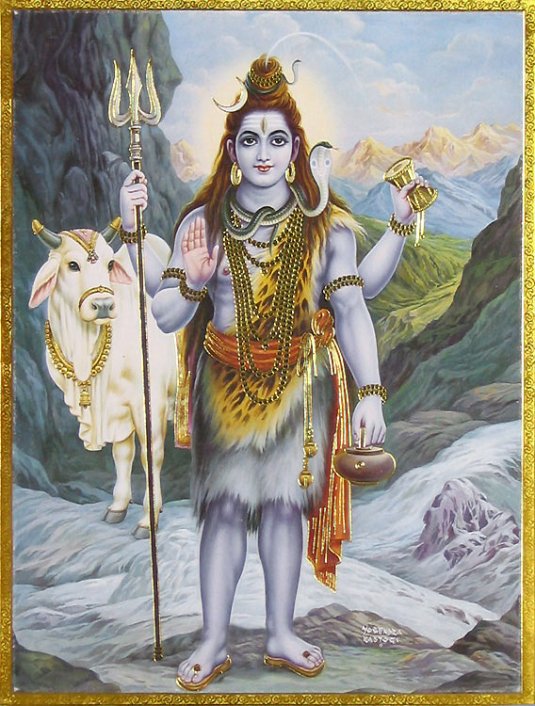
Shiva’s mount is the sacred bull Nandi, and is said to live on Mount Kailasa in the Himalayas.
Although Halloween is not a Vaisnave holiday, it is being celebrated here in the West today. So we wanted to do a post from the pages of Srila Prabhupada’s books where there is mention of Ghosts and Witches etc. Actually Ghosts are a very real entity as the following texts from the Bhagavad-gita and the Srimad Bhagavatam imply.
Lord Śiva, or Rudra, is the king of the ghosts. Ghostly characters worship Lord Śiva to be gradually guided toward a path of self-realization. Māyāvādī philosophers are mostly worshipers of Lord Śiva…Ghosts are bereft of a physical body because of their grievously sinful acts, such as suicide. The last resort of the ghostly characters in human society is to take shelter of suicide, either material or spiritual. Material suicide causes loss of the physical body, and spiritual suicide causes loss of the individual identity. Lord Śiva, being very kind to the ghosts, sees that although they are condemned, they get physical bodies. ( from purport to SB 3.14.24)
Those who worship the demigods will take birth among the demigods; those who worship ghosts and spirits will take birth among such beings; those who worship ancestors go to the ancestors; and those who worship Me will live with Me. (Bhagavad-gita 9.25)
Complete text and purports follow along with a definition of Halloween from Wikipedia More
15 Oct 2012
by The Hare Krishna Movement
in 108 Bhagavad-gita slokas, A.C. Bhaktivedanta Swami Prabhupada, Atmatattva das, Bhagavad-gita, Slokas
Tags: 108 bhagavad-gita slokas, 1972 MacMillian, A.C. Bhaktivedanta Swami Prabhupada, Atmatattva das, bhagavad-gita, bhakti sastri study guide, bhakti-sastri, Bhaktivedanta Academy, important slokas, original slokas., original translations, sloka

This is the list of 108 of the most important slokas from the Bhagavad-gita As It Is (1972 Macmillan Edition) by His Divine Grace A.C. Bhaktivedanta Swami Prabhupada. The index to these verses was taken from the Bhakti-sastri Study Guide compiled by Atmatattva dasa as used by the Bhaktivedanta Academy in Mayapur. [*Note for this collection of slokas, we are using the Original Translations rather than the later re-vised Translations. These were the Translations that Srila Prabhupada approved and which were memorized by heart, by all of the early disciples of His Divine Grace.]
These are important verses for memorizing. Srila Prabhupada has said, that when you quote a verse, your argument becomes authoritative.
More
11 Oct 2012
by The Hare Krishna Movement
in Bhagavad-gita, Ganges
Tags: A.C. Bhaktivedanta Swami Prabhupada, Arjuna, as it is, bhagavad-gita, essence of the Vedas, Ganges River, ganges water, great sages, Lord Krsna, nectarean milk of the bhagavad-gita, pure devotees

One cleanses himself daily by taking a bath in water, but one who takes his bath only once in the sacred Ganges water of the Bhagavad-gītā cleanses away all the dirt of material life. Because Bhagavad-gītā is spoken by the Supreme Personality of Godhead, one need not read any other Vedic literature. One need only attentively and regularly hear and read Bhagavad-gītā. In the present age, mankind is so absorbed with mundane activities that it is not possible to read all of the Vedic literatures. But this is not necessary. This one book, Bhagavad-gītā, will suffice because it is the essence of all Vedic literatures and because it is spoken by the Supreme Personality of Godhead. It is said that one who drinks the water of the Ganges certainly gets salvation, but what to speak of one who drinks the waters of Bhagavad-gītā? Gītā is the very nectar of the Mahābhārata spoken by Viṣṇu Himself, for Lord Kṛṣṇa is the original Viṣṇu. It is nectar emanating from the mouth of the Supreme Personality of Godhead, and the Ganges is said to be emanating from the lotus feet of the Lord. Of course there is no difference between the mouth and the feet of the Supreme Lord, but in our position we can appreciate that the Bhagavad-gītā is even more important than the Ganges.
More
22 Sep 2012
by The Hare Krishna Movement
in A.C. Bhaktivedanta Swami Prabhupada, Letters by Srila Prabhupada
Tags: A.C. Bhaktivedanta Swami Prabhupada, bhagavad-gita, God conscious, Lecture by Srila Prabhupada, Maharaja Yudhisthira, SB 1.9.49, Srimad Bhagavatam, Srimad Bhagavatam lecture

click on image to enlarge
…But this Kṛṣṇa consciousness movement is so nice that even caṇḍālas can be also raised to the platform of brāhmaṇa. Even if a caṇḍāla is trained up as a devotee, he can be better than a qualified brāhmaṇa. These are the shastric injunctions. The yavanas’ names are there also. Yavana-mleccha means generally they are meat-eaters, especially cow meat, cow flesh eaters. They are called yavana-mlecchas. So the higher caste, they cannot become meat-eaters. Meat-eating is there. That is for the lower class, not for the higher class. If anyone gives up meat-eating or the bad habits of lower class, illicit sex, meat-eating, intoxication, gambling, and if he’s trained how to become a qualified brāhmaṇa, then he can be accepted.
…So our this movement is not for the kṛpaṇas. It is meant for the brāhmaṇas. We want to become ourself brāhmaṇa, and we want to make others also brāhmaṇa. Because there is need of brāhmaṇa at the present moment. The whole human society is now running by the śūdras, all śūdras. Kalau śūdra-sambhavaḥ. In this Kali-yuga, everyone is a śūdra. Maybe born of a brāhmaṇa family, but because he has no culture… The first culture is garbhādhāna-saṁskāra. If garbhādhāna-saṁskāra is not observed even in a brāhmaṇa family, he becomes immediately śūdra. This is the statement of the śāstra. So nobody is observing garbhādhāna-saṁskāra. Therefore, according to śāstra, everyone is a śūdra. Now because everyone is śūdra, therefore he cannot be trained up as brāhmaṇa? No. He can be trained up. Caṇḍālo ‘pi dvija-śreṣṭho hari-bhakti-parāyaṇaḥ. If that śūdra or caṇḍāla can be turned into a devotee of Kṛṣṇa, hari-bhakti-parāyaṇaḥ, then under training he can become better than brāhmaṇa.
Lecture by His Divine Grace A.C. Bhaktivedanta Swami Prabhupada
Māyāpura, June 15, 1973 More
11 Sep 2012
by The Hare Krishna Movement
in A.C. Bhaktivedanta Swami Prabhupada, Devotional Service, Nectar of Instruction, The Nectar of Instruction, Upadesamrta
Tags: A.C. Bhaktivedanta Swami Prabhupada, bhagavad-gita, Bhakti-rasamrta-sindu, devotional service, imaginative ecstasy, Nectar of Instruction, sentimental speculation, Srila Prabhupada, Srila Rupa Goswami

Click on image to enlarge
…Devotional service means transcendental activities.
Devotional service is not a matter of sentimental speculation or imaginative ecstasy. Its substance is practical activity.
The execution of devotional service is not a matter of idle meditation but practical action in the foreground of spiritual life.
“In the course of traversing the universal creation of Brahmā, some fortunate soul may receive the seed of bhakti-latā, the creeper of devotional service. This is all by the grace of guru and Kṛṣṇa.” (Caitanya-caritāmṛta, Madhya 19.151)
If by fortune one takes advantage of this opportunity to engage in devotional service, the path of liberation immediately opens.
One should accept this opportunity to return home, back to Godhead, very enthusiastically.
The Nectar of Instruction
By His Divine Grace A.C. Bhaktivedanta Swami Prabhupada
Text 3
More
27 Aug 2012
by The Hare Krishna Movement
in A.C. Bhaktivedanta Swami Prabhupada, Krsna Consciousness: The Topmost Yoga System, Yoga
Tags: A.C. Bhaktivedanta Swami Prabhupada, bhagavad-gita, bhakti yoga, goal of yoga, Krishna, krsna consciousness, The Topmost Yoga System, yoga

…Kṛṣṇa consciousness is the great necessity of human society. Learn it and appreciate it, comprehend it and assimilate it—and teach it. It is very simple. If you offenselessly chant Hare Kṛṣṇa, everything will be revealed from within because Kṛṣṇa is sitting within you. If you are strong and have faith and conviction in Kṛṣṇa, as well as in the spiritual master, the transparent via medium to Kṛṣṇa, then Kṛṣṇa is there. The Vedas say that if you have implicit faith in God and implicit faith in your bona fide guru, who teaches you Kṛṣṇa consciousness, then the result will be that all the Vedic scriptures will be revealed authoritatively.(Srila Prabhupada)
More
20 Aug 2012
by The Hare Krishna Movement
in Kali Yuga, Srimad Bhagavatam, Time
Tags: A.C. Bhaktivedanta Swami Prabhupada, age of kali, bhagavad-gita, dvapara-yuga, enlightenment, great sacrifice, Kali-yuga, meditation, Naimisaranya, satya-yuga, self realization, Sri Krishna, Srimad Bhagavatam, Treta-yuga, worship of the Lord, yoga

By human calculation, a thousand ages taken together is the duration of Brahmā’s one day. And such also is the duration of his night.
…This age of Kali is not at all suitable for self-realization as was Satya-yuga, the golden age, or Tretā- or Dvāpara-yugas, the silver and copper ages. For self-realization, the people in Satya-yuga, living a lifetime of a hundred thousand years, were able to perform prolonged meditation. And in Tretā-yuga, when the duration of life was ten thousand years, self-realization was attained by performance of great sacrifice. And in the Dvāpara-yuga, when the duration of life was one thousand years, self-realization was attained by worship of the Lord. But in the Kali-yuga, the maximum duration of life being one hundred years only and that combined with various difficulties, the recommended process of self-realization is that of hearing and chanting of the holy name, fame, and pastimes of the Lord.
The sages of Naimiṣāraṇya began this process in a place meant specifically for the devotees of the Lord. They prepared themselves to hear the pastimes of the Lord over a period of one thousand years. By the example of these sages one should learn that regular hearing and recitation of the Bhāgavatam is the only way for self-realization. Other attempts are simply a waste of time, for they do not give any tangible results. Lord Śrī Caitanya Mahāprabhu preached this system of Bhāgavata-dharma, and He recommended that all those who were born in India should take the responsibility of broadcasting the messages of Lord Śrī Kṛṣṇa, primarily the message of Bhagavad-gītā. And when one is well established in the teachings of Bhagavad-gītā, he can take up the study of Śrīmad-Bhāgavatam for further enlightenment in self-realization.
Further information on the Age of Kali More
17 Aug 2012
by The Hare Krishna Movement
in Uncategorized
Tags: A.C. Bhaktivedanta Swami Prabhupada, Arjuna, as it is, bhagavad-gita, Bhagavan, Iksvaku, imam vivasvate yogam, Krishna, Macmillan Edition, Manu, Original 1972 Macmillan, science of yoga, the blessed Lord said, The Supreme Personality of Godhead, transcendental knowledge, Vivasvan, yoga

Bhagavad-gītā As It Is
By His Divine Grace A. C. Bhaktivedanta Swami Prabhupāda
Chapter 4
Transcendental Knowledge
More
15 Aug 2012
by The Hare Krishna Movement
in Bhagavad-gita, Krishna, Krishna Consciousness
Tags: A.C. Bhaktivedanta Swami Prabhupada, Absolute Truth, Arjuna, Asita, Bg 10.12-14, bhagavad-gita, Devala, eternal divine person, great sages, Narada, param brahma, param dhama, primal God, supreme abode and purifier, transcendental and original, unborn and all-pervading beauty, Universal Form, Vyasa
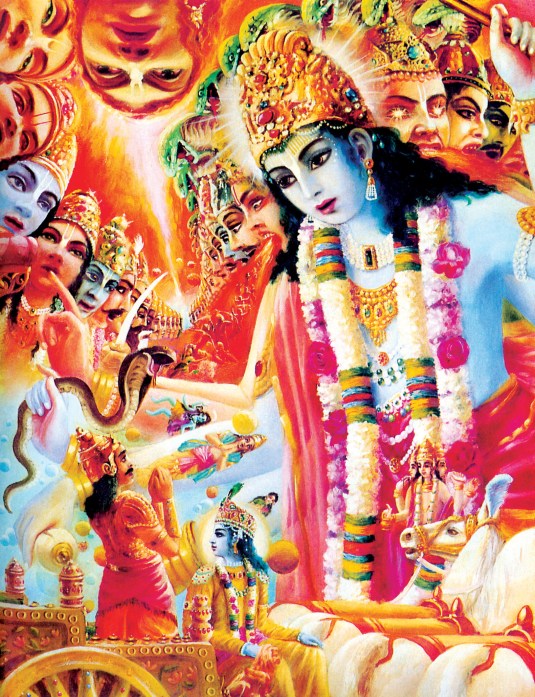
Click on image to enlarge
Arjuna said: You are the Supreme Brahman, the ultimate, the supreme abode and purifier, the Absolute Truth and the eternal divine person. You are the primal God, transcendental and original, and You are the unborn and all-pervading beauty. All the great sages such as Nārada, Asita, Devala, and Vyāsa proclaim this of You, and now You Yourself are declaring it to me.
O Kṛṣṇa, I totally accept as truth all that You have told me. Neither the gods nor demons, O Lord, know Thy personality.
Full verse and purport More
29 Jul 2012
by The Hare Krishna Movement
in Bhagavad-gita, Opulence of the Absolute
Tags: A.C. Bhaktivedanta Swami Prabhupada, all beautiful, beautiful existence, Bg 10.41-41, bhagavad-gita, fragmental manifestations of Krsna's opulence, glorious mighty creations, material world, Spiritual world, spring bu from a spark of My splendor, yad yad vibhutimat sattvam

Bhagavad-gita As It Is 1972 Edition
By His Divine Grace A.C. Bhaktivedanta Swami Prabhupada
Chapter Ten, Text 41-42
yad yad vibhūtimat sattvaṁ
śrīmad ūrjitam eva vā
tat tad evāvagaccha tvaṁ
mama tejo ‘ṁśa-sambhavam
Know that all beautiful, glorious, and mighty creations spring from but a spark of My splendor.
Purport
Any glorious or beautiful existence should be understood to be but a fragmental manifestation of Kṛṣṇa’s opulence, whether it be in the spiritual or material world. Anything extraordinarily opulent should be considered to represent Kṛṣṇa’s opulence.
More
25 Jul 2012
by The Hare Krishna Movement
in Bhagavad-gita, Changing Bodies, Science of Self Realization
Tags: A.C. Bhaktivedanta Swami Prabhupada, bhagavad-gita, blood corpuscles, changing bodies, changing body, dehino smin yatha dehe, from boyhood to youth to old age, krsna consciousness, self realization, soul, soul is eternal, Srila Prabhupada
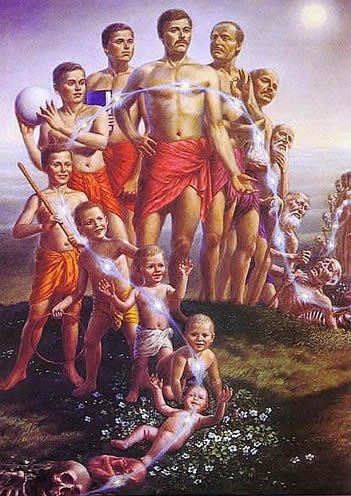
We Are Not These Bodies, We Are Soul
…within this body there is soul, and the body is changing every moment, but the soul is there. Just as a soul comes from the womb of his mother with a small body, and that small body changes—it becomes the body of a boy, it becomes the body of a youth, then it becomes the body of an old man, then it vanquishes… That we have to admit. We may say that the body is growing, but actually, the fact is, body is changing. It is medically admitted that we are changing our body every second. We are changing our blood corpuscles, and therefore a change of the body is taking place, and that is being manifested in a different shape only. Actually, we are changing every moment our body. So the ultimate change, when this body cannot be worked any more, just like a dress, when it is torn, when it is too old, you have to change it. Similarly, when this body becomes useless, no more, it cannot be pulled on any more, you take another body. Tathā dehāntara-prāptir. As we are, in our practical life, we are changing our body every moment, similarly, the last stage of changing this body is called death. Just as I give up this body, I have to enter into the womb of some kind of mother. These things are explained in the Vedic literatures. (Srila Prabhupada from lecture; San Francisco, April 2, 1968)
The soul is eternal, it is changing body, different bodies, and there are 8,400,000 different forms of body. According to his desire, he is entering another body.
…in the hundreds and thousands of universities all over the world there is no department of knowledge where the science of the soul is taught. Actually, we are all spirit soul. From Bhagavad-gītā we understand that we are transmigrating from one body to another, even in our present lives. All of us had at one time the body of a small baby. Where is that body? That body is gone. Presently I am an old man, but I remember that I was once a small baby. I still remember when I was about six months old; I was lying down on the lap of my elder sister, who was knitting, and I was playing. I can remember that, so it is possible for everyone to remember that he had a small body. After the baby’s body I had a boy’s body; then I had a youthful body, and now I am in this body. Where are those bodies? They are gone now. This is a different body. It is explained in Bhagavad-gītā that when I give up this body, I will have to accept another body. It is very simple to understand. I have changed so many bodies, not only from childhood to boyhood to youth, but according to medical science we are changing bodies every second, imperceptibly. This Process indicates that the soul is permanent. Although I have changed many bodies, I remember my baby body and my childhood body—I am the same person, soul. Similarly, when ultimately I change this body, I shall have to accept another. This simple formula is stated in Bhagavad-gītā. Everyone can reflect on it…(Srila Prabhupada from; Krsna Consciousness The Topmost Yoga System)
A person or an animal is not the material body; rather, the material body is the covering of the living being. Bhagavad-gītā compares the body to a dress and elaborately explains how one changes dresses one after another. The same Vedic knowledge is confirmed here. The living being, the soul, is constantly changing bodies one after another. Even in the present life, the body changes from childhood to boyhood, from boyhood to youth, and from youth to old age; similarly, when the body is too old to continue, the living being gives up this body and, by the laws of nature, automatically gets another body according to his fruitive activities, desires and ambitions. The laws of nature control this sequence, and therefore as long as the living entity is under the control of the external, material energy, the process of bodily change takes place automatically, according to one’s fruitive activities.
More
22 Jul 2012
by The Hare Krishna Movement
in Lectures, Vedas
Tags: A.C. Bhaktivedanta Swami Prabhupada, bhagavad-gita, brahmana, Conway Hall, Hindu, ksatriya, Lecture by Srila Prabhupada, Sanskrit, sudra, Teachings of the Vedas, vaisya, varnasrama, Veda, Vedas, Vedic knowledge

…The Vedas are not compilations of human knowledge. Vedic knowledge comes from the spiritual world, from Lord Krsna.
“Teachings of the Vedas”
[Delivered as a lecture by His Divine Grace A. C. Bhaktivedanta Swami Prabhupada on October 6, 1969, at Conway Hall, London, England.]
Ladies and gentlemen, today’s subject matter is the teachings of the Vedas. What are the Vedas? The Sanskrit verbal root of veda can be interpreted variously, but the purpose is finally one. Veda means knowledge. Any knowledge you accept is veda, for the teachings of the Vedas are the original knowledge. In the conditioned state, our knowledge is subjected to many deficiencies. The difference between a conditioned soul and a liberated soul is that the conditioned soul has four kinds of defects. The first defect is that he must commit mistakes. For example, in our country, Mahatma Gandhi was considered to be a very great personality, but he committed many mistakes. Even at the last stage of his life, his assistant warned, “Mahatma Gandhi, don’t go to the New Delhi meeting. I have some friends, and I have heard there is danger.” But he did not hear. He persisted on going and was killed. Even great personalities like Mahatma Gandhi, President Kennedy — there are so many of them — make mistakes. To err is human. This is one defect of the conditioned soul.
Another defect: to be illusioned. Illusion means to accept something which is not: maya. Maya means what is not. Everyone is accepting the body as the self. If I ask you what you are, you will say, “I am Mr. John; I am a rich man; I am this, I am that.” All these are bodily identifications. But you are not this body. This is illusion.
The third defect is the cheating propensity. Everyone has the propensity to cheat others. Although a person is fool number one, he poses himself as very intelligent. Although it is already pointed out that he is in illusion and makes mistakes, he will theorize: “I think this is this, this is this.” But he does not even know his own position. He writes books of philosophy, although he is defective. That is his disease. That is cheating.
Lastly, our senses are imperfect. We are very proud of our eyes. Often, someone will challenge, “can you show me God?” But do you have the eyes to see God? You will never see if you haven’t the eyes. If immediately the room becomes dark, you cannot even see your hands. So what power do you have to see? We cannot, therefore, expect knowledge (veda) with these imperfect senses. With all these deficiencies, in conditioned life, we cannot give perfect knowledge to anyone. Nor are we ourselves perfect. Therefore we accept the Vedas as they are.
More
16 Jul 2012
by The Hare Krishna Movement
in Ganges, Holy Places of Pilgrimage
Tags: bhagavad-gita, Ganges, ganges river ganges, Holy places of pilgrimage, mother ganges, places of pilgrimage, pure devotees, sinful reactions, Srila Prabhupada, Tulasi
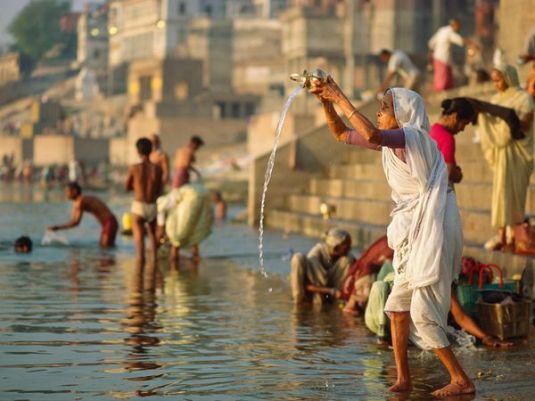
Some selected quotes on the river Ganges
Mother Ganges is worshiped by the water of the Ganges: a devotee takes a little water from the Ganges and offers it back to the Ganges. When the devotee takes the water, mother Ganges does not lose anything, and when the water is offered back, mother Ganges does not increase, but in this way the worshiper of the Ganges is benefited. Similarly, a devotee of the Lord offers the Lord patraṁ puṣpaṁ phalaṁ toyam—a leaf, flower, fruit or water—in great devotion, but everything, including the leaf, flower, fruit and water, belongs to the Lord, and therefore there is nothing to renounce or to accept. One must simply take advantage of the bhakti process because by following this process one does not lose anything but one gains the favor of the Supreme Person. (SB 9.9.12)
When there was a meeting of great sages at Naimiṣāraṇya, Sūta Gosvāmī was reciting Śrīmad-Bhāgavatam, and the importance of the Ganges was stated as follows: “The waters of the Ganges are always carrying the flavor of tulasī offered at the lotus feet of Śrī Kṛṣṇa, and as such the waters of the Ganges are ever flowing, spreading the glories of Lord Kṛṣṇa. Wherever the waters of the Ganges are flowing, all will be sanctified, both externally and internally.” ( Nectar of Devotion Chapter 7)
More
12 Jul 2012
by The Hare Krishna Movement
in Bhagavad-gita, Devotional Service
Tags: A.C. Bhaktivedanta Swami Prabhupada, Bg 10.8-11, bhagavad-gita, constantly devoted, devotional service, lamp of knowledge, shining lamp of knowledge, spiritual understanding, worship Me with love, worship of Krishna
…Pure devotees concentrate their minds in Kṛṣṇa consciousness in full devotional service; therefore they are always situated in the transcendental position. Devotional service and worship of Kṛṣṇa are very clearly indicated in the 10th chapter of Bhagavad-gita verses eight to eleven. That is the way of pure devotional service.
Bhagavad-gita As It Is
By His Divine Grace A.C. Bhaktivedanta Swami Prabhupada
Chapter 10, Text 8-11
The Opulence of the Absolute
I am the source of all spiritual and material worlds. Everything emanates from Me. The wise who know this perfectly engage in My devotional service and worship Me with all their hearts.
The thoughts of My pure devotees dwell in Me, their lives are surrendered to Me, and they derive great satisfaction and bliss enlightening one another and conversing about Me.
To those who are constantly devoted and worship Me with love, I give the understanding by which they can come to Me.
Out of compassion for them, I, dwelling in their hearts, destroy with the shining lamp of knowledge the darkness born of ignorance.
For full text and purports More
04 Jul 2012
by The Hare Krishna Movement
in Uncategorized
Tags: A.C. Bhaktivedanta Swami Prabhupada, Arjuna, as it is, bhagavad-gita, buddhi-yoga, chant the holy name of the Lord, constitution of the soul, Hare Krishna, karma, karma yoga, Krishna, krsna consciousness, material grief, philosophy of the soul, spiritual advancement, Sri Krsna, The Supreme Personality of Godhead
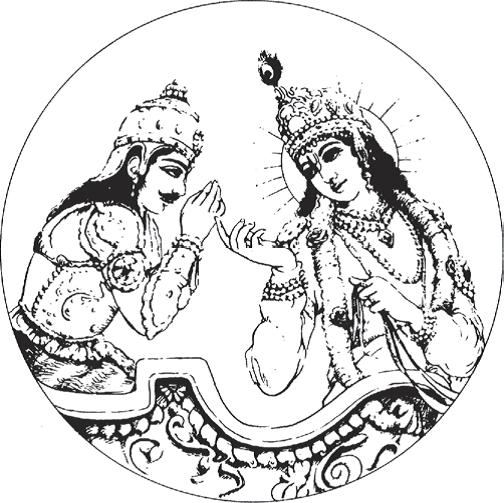
Bhagavad-gita As It Is – Macmillan 1972 Edition
By His Divine Grace A.C. Bhaktivedanta Swami Prabhupada
Chapter 3
TEXT 1
arjuna uvāca
jyāyasī cet karmaṇas te
matā buddhir janārdana
tat kiṁ karmaṇi ghore māṁ
niyojayasi keśava
arjunaḥ—Arjuna; uvāca—said; jyāyasī—speaking very highly; cet—although; karmaṇaḥ—than fruitive action; te—your; matā—opinion; buddhiḥ—intelligence; janārdana—O Kṛṣṇa; tat—therefore; kim—why; karmaṇi—in action; ghore—ghastly; mām—me; niyojayasi—engaging me; keśava—O Kṛṣṇa.
TRANSLATION
Arjuna said: O Janārdana, O Keśava, why do You urge me to engage in this ghastly warfare, if You think that intelligence is better than fruitive work?
PURPORT
The Supreme Personality of Godhead Śrī Kṛṣṇa has very elaborately described the constitution of the soul in the previous chapter, with a view to deliver His intimate friend Arjuna from the ocean of material grief. And the path of realization has been recommended: buddhi-yoga, or Kṛṣṇa consciousness. Sometimes Kṛṣṇa consciousness is misunderstood to be inertia, and one with such a misunderstanding often withdraws to a secluded place to become fully Kṛṣṇa conscious by chanting the holy name of Lord Kṛṣṇa. But without being trained in the philosophy of Kṛṣṇa consciousness, it is not advisable to chant the holy name of Kṛṣṇa in a secluded place where one may acquire only cheap adoration from the innocent public. Arjuna also thought of Kṛṣṇa consciousness or buddhi-yoga, or intelligence in spiritual advancement of knowledge, as something like retirement from active life and the practice of penance and austerity at a secluded place. In other words, he wanted to skillfully avoid the fighting by using Kṛṣṇa consciousness as an excuse. But as a sincere student, he placed the matter before his master and questioned Kṛṣṇa as to his best course of action. In answer, Lord Kṛṣṇa elaborately explained karma-yoga, or work in Kṛṣṇa consciousness, in this Third Chapter.
More
25 Jun 2012
by The Hare Krishna Movement
in Bhagavad-gita, Salvation, Srimad Bhagavatam
Tags: A.C. Bhaktivedanta Swami Prabhupada, Arjuna, Battlefield of Kuruksetra, bhagavad-gita, Bhisma, liberation from material bondage, merciful glance, salvation, SB 1.9.35, Srimad Bhagavatam, The Passing Away of Bhismadeva in the Presence of Lord Krsna

…The Lord diminished the duration of life of the opposite party by His merciful glance. It is said that all the fighters who assembled on the Battlefield of Kurukṣetra attained salvation by personally seeing the Lord at the time of death. Therefore, His diminishing the duration of life of Arjuna’s enemy does not mean that He was partial to the cause of Arjuna. Factually He was merciful to the opposite party because they would not have attained salvation by dying at home in the ordinary course of life. Here was a chance to see the Lord at the time of death and thus attain salvation from material life. Therefore, the Lord is all good, and whatever He does is for everyone’s good.
Srimad Bhagavatam
By His Divine Grace A.C. Bhaktivedanta Swami Prabhupada
Canto 1, Chapter 9, Text 35
The Passing Away of Bhismadeva in the Presence of Lord Krsna
sapadi sakhi-vaco niśamya madhye
nija-parayor balayo rathaṁ niveśya
sthitavati para-sainikāyur akṣṇā
hṛtavati pārtha-sakhe ratir mamāstu
sapadi—on the battlefield; sakhi-vacaḥ—command of the friend; niśamya—after hearing; madhye—in the midst; nija—His own; parayoḥ—and the opposite party; balayoḥ—strength; ratham—chariot; niveśya—having entered; sthitavati—while staying there; para-sainika—of the soldiers on the opposite side; āyuḥ—duration of life; akṣṇā—by looking over; hṛtavati—act of diminishing; pārtha—of Arjuna, son of Pṛthā (Kuntī); sakhe—unto the friend; ratiḥ—intimate relation; mama—my; astu—let there be.
In obedience to the command of His friend, Lord Śrī Kṛṣṇa entered the arena of the Battlefield of Kurukṣetra between the soldiers of Arjuna and Duryodhana, and while there He shortened the life spans of the opposite party by His merciful glance. This was done simply by His looking at the enemy. Let my mind be fixed upon that Kṛṣṇa.
Purport
In the Bhagavad-gītā (1.21-25) Arjuna ordered the infallible Lord Śrī Kṛṣṇa to place his chariot between the phalanxes of the soldiers. He asked Him to stay there until he had finished observing the enemies he had to face in the battle. When the Lord was so asked, He at once did so, just like an order carrier. And the Lord pointed out all the important men on the opposite side, saying, “Here is Bhīṣma, here is Droṇa,” and so on. The Lord, being the supreme living being, is never the order supplier or order carrier of anyone, whoever he may be. But out of His causeless mercy and affection for His pure devotees, sometimes He carries out the order of the devotee like an awaiting servant. By executing the order of a devotee, the Lord becomes pleased, as a father is pleased to carry out the order of his small child. This is possible only out of pure transcendental love between the Lord and His devotees, and Bhīṣmadeva was quite aware of this fact. He therefore addressed the Lord as the friend of Arjuna.
More
07 Jun 2012
by The Hare Krishna Movement
in A.C. Bhaktivedanta Swami Prabhupada, Devotee's, Krishna Consciousness, Lectures
Tags: A.C. Bhaktivedanta Swami Prabhupada, benefactor of the truthful devotee, bhagavad-gita, chanting Hare Krishna, Hear About Krishna, heard and chanted, Krishna, lecture by Prabhupada, material enjoyment, Paramata, Sri Krishna, supersoul, The Supreme Personality of Godhead

…I have not bribed these American and European boys to become Krishna conscious. I have no money. When I went to America, I had only seven dollars. One hour’s expenditure in New York. There is no question of bribing them. But they heard about Krishna. I was reading Bhagavad-gita on the street, in the park, and chanting. They heard, and they came to me. They became attracted. Why?
Just Give Them Chance to Hear About Krishna
Srimad-Bhagavatam Lecture 1.2.17 Vrndavana, October 28, 1972
By His Divine Grace A.C. Bhaktivedanta Swami Prabhupada
srnvatam sva-kathah krsnah
punya-sravana-kirtanah
hrdy antah-stho hy abhadrani
vidhunoti suhrt satam
Translation: “Sri Krishna, the Personality of Godhead, who is the Paramatma, Supersoul, in everyone’s heart and the benefactor of the truthful devotee, cleanses desire for material enjoyment from the heart of the devotee who relishes His messages, which are in themselves virtuous when properly heard and chanted.”
There is a English proverb that “God helps him who tries to help himself”. That is a English proverb. So to become Krsna conscious is not very difficult thing. People have no taste. They do not understand the importance of this Krsna consciousness movement. But this is the only way by which one can become perfect and happy.
It is confirmed in the Bhagavad-gita that just to become happy and peaceful one has to learn three things.
bhoktaram yajna-tapasam
sarva-loka-mahesvaram
suhrdam sarva-bhutanam
jnatva mam santim rcchati
If you want… Because the problem is that we want to be happy and peaceful. Everyone says, “I want peace. There is no peace in my mind.” That is a general understanding. Nobody can say that “I am completely happy and peaceful.” No, that is not possible. The material world is made in such a way that you cannot feel happy. That is not possible. First of all, we have come to this material world to enjoy sense gratification, but that is not our proper business. Our proper business is to satisfy the senses of Krsna, not our senses. So because we have deviated from our original position, therefore it is always a perplexity of our life. But due to illusion we cannot understand it.
More
07 Jun 2012
by The Hare Krishna Movement
in Uncategorized
Tags: 1972 Macmillan edition, A.C. Bhaktivedanta Swami Prabhupada, Arjuna, as it is, bhagavad-gita, Bhagavad-gita text and purports, happiness of distress, heavenly planets, Krishna, Krishna consciousness, loss or gain, material activities, Mukunda, sense gratification, son of Kunti, victory or defeat

This is the second half of Chapter Two “Contents of the Gita Sumarized”
Bhagavad-gita As It Is 1972 Macmillan Edition
By His Divine Grace A.C. Bhaktivedanta Swami Prabhupada
Chapter 2, Text & Purports 37-72
TEXT 37
hato vā prāpsyasi svargaṁ
jitvā vā bhokṣyase mahīm
tasmād uttiṣṭha kaunteya
yuddhāya kṛta-niścayaḥ
hataḥ—being killed; vā—either; prāpsyasi—you gain; svargam—the heavenly kingdom; jitvā—by conquering; vā—or; bhokṣyase—you enjoy; mahīm—the world; tasmāt—therefore; uttiṣṭha—get up; kaunteya—O son of Kuntī; yuddhāya—to fight; kṛta—determination; niścayaḥ—uncertainty.
TRANSLATION
O son of Kuntī, either you will be killed on the battlefield and attain the heavenly planets, or you will conquer and enjoy the earthly kingdom. Therefore get up and fight with determination.
PURPORT
Even though there was no certainty of victory for Arjuna’s side, he still had to fight; for, even being killed there, he could be elevated into the heavenly planets.
TEXT 38
sukha-duḥkhe same kṛtvā
lābhālābhau jayājayau
tato yuddhāya yujyasva
naivaṁ pāpam avāpsyasi
sukha—happiness; duḥkhe—in distress; same—in equanimity; kṛtvā—doing so; lābhālābhau—both in loss and profit; jayājayau—both in defeat and victory; tataḥ—thereafter; yuddhāya—for the sake of fighting; yujyasva—do fight; na—never; evam—in this way; pāpam—sinful reaction; avāpsyasi—you will gain.
TRANSLATION
Do thou fight for the sake of fighting, without considering happiness or distress, loss or gain, victory or defeat-and, by so doing, you shall never incur sin.
PURPORT
Lord Kṛṣṇa now directly says that Arjuna should fight for the sake of fighting because He desires the battle. There is no consideration of happiness or distress, profit or gain, victory or defeat in the activities of Kṛṣṇa consciousness. That everything should be performed for the sake of Kṛṣṇa is transcendental consciousness; so there is no reaction to material activities. He who acts for his own sense gratification, either in goodness or in passion, is subject to the reaction, good or bad. But he who has completely surrendered himself in the activities of Kṛṣṇa consciousness is no longer obliged to anyone, nor is he a debtor to anyone, as one is in the ordinary course of activities. It is said:
devarṣi-bhutāpta-nṛṇāṁ pitṝṇāṁ
na kiṅkaro nāyamṛṇī ca rājan
sarvātmanā yaḥ śaraṇaṁ śaraṇyaṁ
gato mukundaṁ parihṛtya kartam
(Bhag. 11.5.41)
“Anyone who has completely surrendered unto Kṛṣṇa, Mukunda, giving up all other duties, is no longer a debtor, nor is he obliged to anyone-not the demigods, nor the sages, nor the people in general, nor kinsmen, nor humanity, nor forefathers.” That is the indirect hint given by Kṛṣṇa to Arjuna in this verse, and the matter will be more clearly explained in the following verses.
More
Previous Older Entries Next Newer Entries













 The Hare Krishna Movement