01 Nov 2016
by The Hare Krishna Movement
in A.C. Bhaktivedanta Swami Prabhupada, Vidura das
Tags: A.C. Bhaktiveanta Swami Prabhupada, Arjuna, Battlefield of Kuruksetra, Bhagavad Gita, devotional service, Krishna, Krsna, revealed scriptures, SB1.15.25-26, SB1.15.27, SB1.15.28, SB1.15.29, SB1.15.30, SB1.15.31, Srila Prabhupada, Srila Prabhupadas instructions, Srimad Bhagavatam, Vidura das

I ran across this interesting compilation of quotes this morning on the Prabhupada News website, by Vidura Prabhu. This is a nice reminder that Krsna is present today, through His spoken words on the battlefield of Kuruksetra, and by chanting his holy names. And that Srila Prabhupada is also present today, through his words and instructions. I have done some slight editing (highlighting), and have included the full text and purports to SB 1.15.27-31 at bottom of post. -Vyasasan das
Arjuna Teaches Us How to Serve the Spiritual Master in His Absence
by: Vidura dasa
Oct 23 2011, USA — “The Lord left behind Him the instructions of the Bhagavad-gita not for the benefit of Arjuna alone, but also for all time and in all lands(1). […]The problem which arose in the heart of Arjuna on the Battlefield of Kuruksetra was solved by the teachings of the Bhagavad-gita. […]The merciful Lord left behind Him the great teachings of the Bhagavad-gita so that one can take the instructions of the Lord even when He is not visible to material eyesight(2). […] Thus the Bhagavad-gita, or any authentic scriptural sound representation of the Lord, is also the incarnation of the Lord. There is no difference between the sound representation of the Lord and the Lord Himself. One can derive the same benefit from the Bhagavad-gita as Arjuna did in the personal presence of the Lord.” (SB 1.15.27)
“Arjuna began to think of the Lord’s instructions to him on the Battlefield of Kuruksetra. Only those instructions began to eliminate the tinges of material contamination(3) in the mind of Arjuna.” (SB 1.15.28)
“As soon as Arjuna turned his attention towards the instructions of the Lord, as they are inculcated in the Bhagavad-gita, his true color of eternal association with the Lord became manifest, and thus he felt freed from all material contaminations.” (SB 1.15.29)
“As soon as Arjuna took up the instructions of the Bhagavad-gita, expert as he was, he could at once eradicate the material conception of Lord Krishna, his eternal friend. He could realize that the Lord was still present before him by His instruction(4), by His form, by His pastimes, by His qualities and everything else related to Him. […] One is not able to feel the presence of the Lord in all circumstances until one is endowed with the required transcendental vision made possible by devotional service prescribed in the revealed scriptures. Arjuna had attained this stage long before on the Battlefield of Kuruksetra, and when he apparently felt the absence of the Lord, he at once took shelter of the instructions of the Bhagavad-gita(5), and thus again he was placed in his original position*.” (SB 1.15.31)
More
16 Sep 2016
by The Hare Krishna Movement
in A.C. Bhaktivedanta Swami Prabhupada, Sannyasa, Spiritual Life, Spiritual Master, Srila Prabhupada
Tags: A.C. Bhaktiveanta Swami Prabhupada, bhakti Prajnana Kesava, family life, Guru Maharaja, Krishna, Muni Maharaja, sannyasa, sannyasa 1959, sanyasi, Spiritual Life, Sri Srimad Bhaktiprajnana Kesava Maharaja, Srila Prabhupada's acceptance of sannyasa 1959

(Muni Maharaja, Bhakti Prajnana Kesava Maharaja, A.C. Bhaktivedanta Swami)
Today marks Srila Prabhupada’s acceptance of Sannyasa. Thanks to Prabhupada Connect for so nicely putting together this list list of quotes by Srila Prabhupada on Sannyasa, which we have re-posted here.
Srila Prabhupada’s Sannyasa Initiation
Srila Prabhupada accepted the order of sannyasa from Sri Srimad Bhaktiprajnana Kesava Maharaja on September 17, 1959 at the Kesavaji Math in Mathura. Included below are some relevant quotes from Srila Prabhupada’s lectures and letters.
“When I was householder, several times there was indication given by my Guru Maharaja that I should give up family life and become a sannyasi and preach this Krishna consciousness movement. In several way there was hints from my spiritual master, but still, I was not willing. I was thinking, ‘If I go away, then my family, my sons, my daughters, they will suffer.’ But actually, I have left my family connection in 1950. Actually ’54, but introductory in ’50. For the last twenty years. But they are living; I am living. They are not dying in my absence, and I am not suffering without being in my family. On the other hand, by Krishna’s grace, I have got better family members. I have got nice children in a foreign country. They are taking so much care of me, I could not expect such care from my own children.
So this is God’s grace. We should depend on Krishna. If Krishna is kind, wherever we go, everyone will be pleased, everyone will be kind. And if Krishna is unpleased, even in your family life you’ll not be comfortable. Therefore, according to the Vedic system, at a certain age, it is indicated that one should retire from family life.” (Srila Prabhupada Lecture, Tittenhurst, London, September 12, 1969)
“The Krishna consciousness movement is not that we are asking everyone to become a sannyasi like me, and give up everything. No. That is not our program. You act as a brahmaṇa, as a ksatriya or a vaisya or a sudra. It doesn’t matter. But you try to satisfy Krishna. That is the program.” (Srila Prabhupada Lecture, Bombay, December 30, 1972)
More
04 May 2016
by The Hare Krishna Movement
in A.C. Bhaktivedanta Swami Prabhupada, Brahmastra Weapon, Srimad Bhagavatam
Tags: A.C. Bhaktiveanta Swami Prabhupada, atomic bomb, atomic energy, atomic radiation, Brahmastra Weapon, nuclear weapon, SB 1.7.28, SB 1.7.32, science of chanting hymns, Srila Prabhupada, Srimad Bhagavatam

This morning I was reading from the Srimad Bhagavatam, First Canto, Chapter 7, entitled “The Son of Drona Punished”. This chapter has always intrigued me, because although the Srimad Bhagavatam was compiled by Srila Vyasedeva five thousand years ago, there is mention of the ultimate weapon, the brahmāstra [nuclear weapon] being used. We think that Atomic energy or Nuclear energy is some modern technological advancement, but actually this knowledge has been around since the time that Srimad Bhagavatam was first spoken, many thousands of years ago.
…The brahmāstra is similar to the modern nuclear weapon manipulated by atomic energy. The atomic energy works wholly on total combustibility, and so the brahmāstra also acts. It creates an intolerable heat similar to atomic radiation, but the difference is that the atomic bomb is a gross type of nuclear weapon, whereas the brahmāstra is a subtle type of weapon produced by chanting hymns. It is a different science, and in the days gone by such science was cultivated in the land of Bhārata-varṣa. The subtle science of chanting hymns is also material, but it has yet to be known by the modern material scientists. Subtle material science is not spiritual, but it has a direct relationship with the spiritual method, which is still subtler. A chanter of hymns knew how to apply the weapon as well as how to retract it. That was perfect knowledge. (from purport to SB 1.7.28)
…The theory that the modern atomic bomb explosions can annihilate the world is childish imagination. First of all, the atomic energy is not powerful enough to destroy the world. And secondly, ultimately it all rests on the supreme will of the Supreme Lord because without His will or sanction nothing can be built up or destroyed. It is foolish also to think that natural laws are ultimately powerful. Material nature’s law works under the direction of the Lord, as confirmed in the Bhagavad-gītā. The Lord says there that natural laws work under His supervision. The world can be destroyed only by the will of the Lord and not by the whims of tiny politicians. Lord Śrī Kṛṣṇa desired that the weapons released by both Drauṇi and Arjuna be withdrawn, and it was carried out by Arjuna at once. Similarly, there are many agents of the all-powerful Lord, and by His will only can one execute what He desires. (from purport to 1.7.32)
More
04 Sep 2015
by The Hare Krishna Movement
in A.C. Bhaktivedanta Swami Prabhupada, Guru & Disciple, guru-tattva, Spiritual Master
Tags: A.C. Bhaktiveanta Swami Prabhupada, bona fide guru, bona fide spiritual master, guru, guru and disciple, Jayadvaita Swami, Krsna, Sanatan Goswami, spiritual master, Sri Caitanya Mahaprabhu, Sri Caitanya-caritamrta, SrilaPrabhupada

Recently there has been some discussion on the internet about Jayadvaita Swami’s remarks on kirtana standards in his Kirtan Seminar lectures. I cannot repeat here, what he said on the YouTube Lecture, finding it offensive and not worthy of repeating. Rather than dwell on the negetive statements of Jayadvaita Swami, we thought it better to repeat the words of the bona fide spiritual master Srila Prabhupada, who so nicely describes the characteristics of the “Bona Fide Guru” in the pages of the Sri Caitanya-caritmrta.
…The guru must be situated on the topmost platform of devotional service. There are three classes of devotees, and the guru must be accepted from the topmost class. The first-class devotee is the spiritual master for all kinds of people. It is said: gurur nṛṇām. The word nṛṇām means “of all human beings.” The guru is not limited to a particular group. It is stated in the Upadeśāmṛta of Rūpa Gosvāmī that a guru is a gosvāmī, a controller of the senses and the mind. Such a guru can accept disciples from all over the world. Pṛthivīṁ sa śiṣyāt. This is the test of the guru.
…When one has attained the topmost position of mahā-bhāgavata, he is to be accepted as a guru and worshiped exactly like Hari, the Personality of Godhead. Only such a person is eligible to occupy the post of a guru. (purport Madhya 24.330)
Full text and purport More
31 Aug 2015
by The Hare Krishna Movement
in ISKCON, Krishna, Krishna Consciousness, Krsna Consciousness, Temples, The Hare Krishna Movement
Tags: A.C. Bhaktiveanta Swami Prabhupada, Founder Acarya, grand opening of Radha Krishna temple, installation ceremony of Sri Radha Krishna, ISKCON center of central New Jersey, Nectar of Devotion, Sri Radha Shyamsundar, Sri Sri Radha Shyamsundar, temple and cultural center of NJ, The Hare Krishna Movement
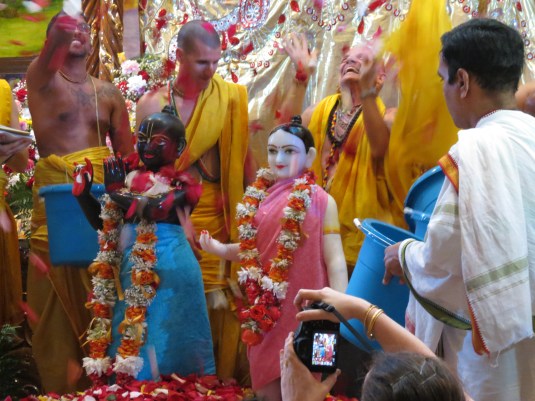
Deity Installation Ceremony of Sri Sri Radha Shyamsundar & Grand Opening of the Sri Sri Radha Krishna Temple & Cultrual Center
It was my good fortune and privilege to be in attendance at the Grand Opening of Sri Sri Radha Krishna Temple & Cultural Center and witness the Deity Installation Ceremony of Sri Sri Radha Shyamsundar. The three day event took place August 28 – 30th. The new center is located at 1020 W 7th St., Plainfield, New Jersey in a residential neighborhood, and is very easy to find. I would encourage everyone to make it a point to visit there and have darshan with the beautiful Sri Sri Radha Shyamsundar.
Picture slide show More
17 Aug 2015
by The Hare Krishna Movement
in A.C. Bhaktivedanta Swami Prabhupada, Govinda, Sri Caitanya-Caritamrta
Tags: A.C. Bhaktiveanta Swami Prabhupada, Adi 5.22, cintamani, I worship Govinda, purpose trees, spiritual gems, Sri Caitanya Mahaprabhu, Sri Caitanya-caritamrta, tending cows, the first progentitor, the primeval Lord
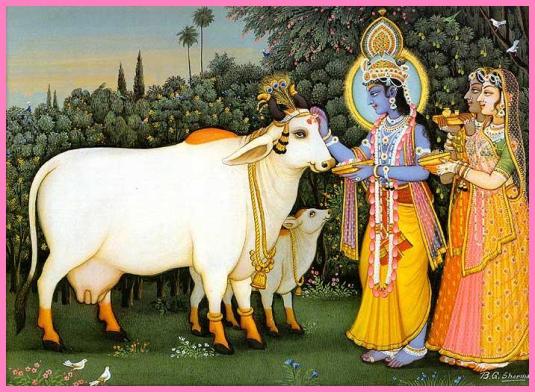
The full opulence of the internal potency of Godhead is always resplendent in Vaikuṇṭhaloka, where goddesses of fortune are ever-increasingly attached to serving the lotus feet of the Personality of Godhead. These goddesses of fortune, accompanied by their friends, always create a festive atmosphere of transcendental mirth. Always singing the glories of the Lord, they are not silent even for a moment. ( from purport to: Adi-lila 5.22)
Full verse and Purport! More
02 May 2015
by The Hare Krishna Movement
in A.C. Bhaktivedanta Swami Prabhupada, Lord Nrsimha, Srimad Bhagavatam
Tags: A.C. Bhaktiveanta Swami Prabhupada, appearance of Lord Nrismha, hiranyakasipu, Nrisimhadeva, prahlada, Prahlada Maharaja, SB 7.8, Srimad Bhagavatam
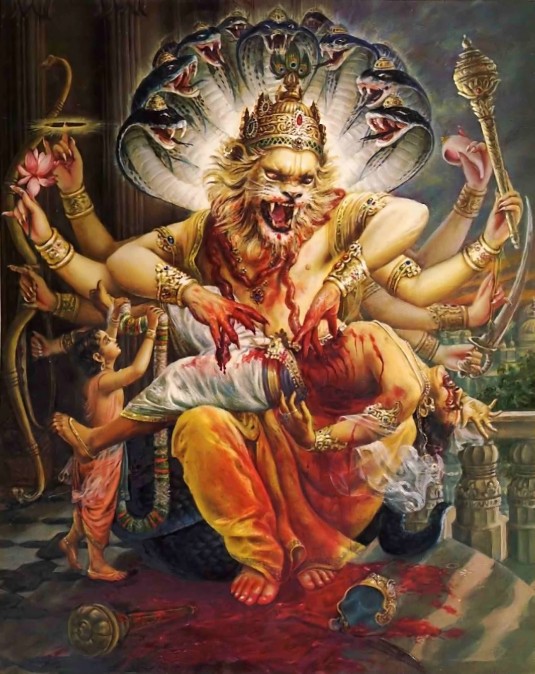
In honor of the appearance day of Lord Nrsimhadeva, we are posting the eight chapter of the Seventh Canto of the Srimad-Bhagavatam, entitled “Lord Nṛsiṁhadeva Slays the King of the Demons”.
click on image to enlarge
Śrīmad-Bhāgavatam
By His Divine Grace A. C. Bhaktivedanta Swami Prabhupāda
Canto Seven, Chapter Eight
Lord Nṛsiṁhadeva Slays the King of the Demons
Chapter Summary
As described in this chapter, Hiraṇyakaśipu was ready to kill his own son Prahlāda Mahārāja, but the Supreme Personality of Godhead appeared in front of the demon as Śrī Nṛkeśarī, half lion and half man, and killed him.
Following the instructions of Prahlāda Mahārāja, all the sons of the demons became attached to Lord Viṣṇu, the Supreme Personality of Godhead. When this attachment became pronounced, their teachers, Ṣaṇḍa and Amarka, were very much afraid that the boys would become more and more devoted to the Lord. In a helpless condition, they approached Hiraṇyakaśipu and described in detail the effect of Prahlāda’s preaching. After hearing of this, Hiraṇyakaśipu decided to kill his son Prahlāda. Hiraṇyakaśipu was so angry that Prahlāda Mahārāja fell down at his feet and said many things just to pacify him, but he was unsuccessful in satisfying his demoniac father. Hiraṇyakaśipu, as a typical demon, began to advertise himself as being greater than the Supreme Personality of Godhead, but Prahlāda Mahārāja challenged him, saying that Hiraṇyakaśipu was not God, and began to glorify the Supreme Personality of Godhead, declaring that the Lord is all-pervading, that everything is under Him, and that no one is equal to or greater than Him. Thus he requested his father to be submissive to the omnipotent Supreme Lord.
The more Prahlāda Mahārāja glorified the Supreme Personality of Godhead, the more angry and agitated the demon became. Hiraṇyakaśipu asked his Vaiṣṇava son whether his God existed within the columns of the palace, and Prahlāda Mahārāja immediately accepted that since the Lord is present everywhere, He was also present within the columns. When Hiraṇyakaśipu heard this philosophy from his young son, he derided the boy’s statement as just the talk of a child and forcefully struck the pillar with his fist.
As soon as Hiraṇyakaśipu struck the column, there issued forth a tumultuous sound. At first Hiraṇyakaśipu, the King of the demons, could not see anything but the pillar, but to substantiate Prahlāda’s statements, the Lord came out of the pillar in His wonderful incarnation as Narasiṁha, half lion and half man. Hiraṇyakaśipu could immediately understand that the extraordinarily wonderful form of the Lord was surely meant for his death, and thus he prepared to fight with the form of half lion and half man. The Lord performed His pastimes by fighting with the demon for some time, and in the evening, on the border between day and night, the Lord captured the demon, threw him on His lap, and killed him by piercing his abdomen with His nails. The Lord not only killed Hiraṇyakaśipu, the King of the demons, but also killed many of his followers. When there was no one else to fight, the Lord, roaring with anger, sat down on Hiraṇyakaśipu’s throne.
The entire universe was thus relieved of the rule of Hiraṇyakaśipu, and everyone was jubilant in transcendental bliss. Then all the demigods, headed by Lord Brahmā, approached the Lord. These included the great saintly persons, the Pitās, the Siddhas, the Vidyādharas, the Nāgas, the Manus, the prajāpatis, the Gandharvas, the Cāraṇas, the Yakṣas, the Kimpuruṣas, the Vaitālikas, the Kinnaras and also many other varieties of beings in human form. All of them stood not far from the Supreme Personality of Godhead and began offering their prayers unto the Lord, whose spiritual effulgence was brilliant as He sat on the throne.
Translations and purports More
28 Feb 2015
by The Hare Krishna Movement
in A.C. Bhaktivedanta Swami Prabhupada, Kali Yuga, Science of Self Realization
Tags: A.C. Bhaktiveanta Swami Prabhupada, dvapara-yuga, human life, Kali, Kali-yuga, satya-yuga, SB1.1.21, SB1.1.22, self realization, self-realization in the age of kali, Srimad Bhagavatam, Treta-yuga

Kali Yuga
Last week we did a post entitled In the Age of Kali and are continuing it here today. We begin with the description of the previous ages from Srimad Bhagavatam 1.1.21 followed by further descriptions of the age from text 1.1.22.
One thing that jumped out at me from my reading this morning was from the purport to text22, wherein Srila Prabhupada points out: “…people do not realize that this brief life, is but a moment on our great journey towards self-realization.” That put things in perspective for me.
This age of Kali is not at all suitable for self-realization as was Satya-yuga, the golden age, or Tretā- or Dvāpara-yugas, the silver and copper ages. For self-realization, the people in Satya-yuga, living a lifetime of a hundred thousand years, were able to perform prolonged meditation. And in Tretā-yuga, when the duration of life was ten thousand years, self-realization was attained by performance of great sacrifice. And in the Dvāpara-yuga, when the duration of life was one thousand years, self-realization was attained by worship of the Lord. But in the Kali-yuga, the maximum duration of life being one hundred years only and that combined with various difficulties, the recommended process of self-realization is that of hearing and chanting of the holy name, fame, and pastimes of the Lord. (purport SB 1.1.21)
The age of Kali is very dangerous for the human being. Human life is simply meant for self-realization, but due to this dangerous age, men have completely forgotten the aim of life. In this age, the life span will gradually decrease. People will gradually lose their memory, finer sentiments, strength, and better qualities. …And so this age is very difficult for those who want to utilize this life for self-realization. The people are so busy with sense gratification that they completely forget about self-realization. Out of madness they frankly say that there is no need for self-realization because they do not realize that this brief life is but a moment on our great journey towards self-realization. (purport 1.1.22)
Full Text and purports More
25 Feb 2015
by The Hare Krishna Movement
in A.C. Bhaktivedanta Swami Prabhupada, Hearing and Memorizing, Krsna Consciousness, Quotes by Srila Prabhupada, Spiritual Master, Sri Vrindavan das, Srila Prabhupada's Books
Tags: A.C. Bhaktiveanta Swami Prabhupada, Bhaktivedanta Book Trust, knowledge, Krishna consciousness, quotes by Srila Prabhupada, Spiritual Life, Sri Vrindavan das, the spiritula master

The following is a nice collection of Srila Prabhupada Quotes on the importance of reading and hearing, compiled by Sri Vrindavan das.
Touch Krishna Immediately by Sound Vibration
by Sri Vrindavan das
Lecture 13 January, 1969
Srila Prabhupada: “So although a physical body is not present, the vibration should be accepted as the presence of the Spiritual Master, vibration. What we have heard from the Spiritual Master, that is living.”
Paramahamsa: My question is, a pure devotee, when he comments on Bhagavad-gita, someone who never sees him physically, but he just comes in contact with the commentary, explanation, is this the same thing?
Srila Prabhupada: “Yes, you can associate with Krishna by reading Bhagavad-gita. And these saintly persons, they have given their explanations, comments. So where is the difficulty?”
More
17 Feb 2015
by The Hare Krishna Movement
in A.C. Bhaktivedanta Swami Prabhupada, Acyutanananda das, Introduction
Tags: A.C. Bhaktiveanta Swami Prabhupada, Acyutananda das, Goloka, Hare Krishna, Hari, Narottama Dasa Thakura, six goswamis of vrndavan, Songs of the Vaisnava Acaryas, Srila Bhaktivinoda, Srila Bhaktivinoda Thakura, Srinivasa Acarya, Vaisnava acaryas, Vaisnavas, Vedic mantras
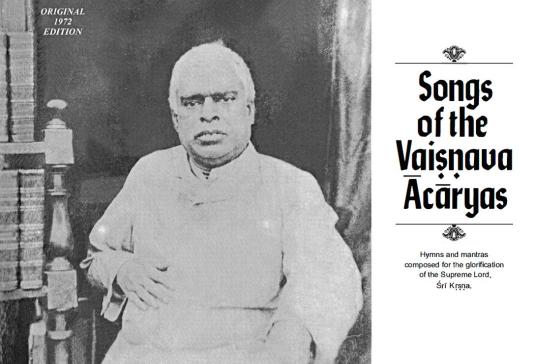
If I had to pick one book that inspired me the most throughout my devotional life, I guess I would have to say it is “Songs of the Vaisnava Acaryas”. I recently went to open it the other day, and it fell open to the Introduction. I took a moment to re-read it. We share it with you here today.
Introduction
by Acyutananda Swami
It was my good fortune to be in the service of Srila Prabhupada at Sri Mayapur, the birthplace of Lord Caitanya, in setting up the groundwork of our Society’s international center there. That year (1971) there was a terrible flood, but although for many days the water was rising, it was diverted from floodinging the Society’s property solely due to the embankment created by a road constructed by Srila Bhaktisiddhanta Sarasvati, our Parama Guru Maharaja. I wrote a letter to His Divine Grace explaining the situation and I mentioned, “The water has not entered our property. Srila Bhaktisiddhanta’s road has saved us.” Srila Prabhupada, however, wrote back in answer in a different tone: “Yes”, we are always saved by Srila Bhaktisiddhanta’s road, so go on glorifying the disciplic succession, and your life will be a great success.” Later on, when I suggested writing down the songs of Srila Bhaktivinoda Thakura and Narottama Dasa Thakura in English translations, His Divine Grace said, “Yes, we must push on this mission of Bhaktivinoda.” So here in this book, which is the first of a series of translations of the complete works of the Vaisnava acaryas in the line of succession coming after Sri Caitanya Mahaprabhu, I have also included a short life sketch of Thakura Bhaktivinoda. In the following volumes, the lives of Srila Narottama Dasa Thakura, Srinivasa Acarya, and other Vaisnava acaryas will appear.
More
27 Dec 2014
by The Hare Krishna Movement
in A.C. Bhaktivedanta Swami Prabhupada, Phalgun Krishna Pancami, Poetry of Srila Prabhupada, Vyas-puja
Tags: A.C. Bhaktiveanta Swami Prabhupada, abundant milk, ecstasy of the glories of Hari, His Divine Grace Srila Bhaktisiddhanta Sarasvati Thakura Prabhupada, milk laden cows, Phalgun Krishna Pancami, qualities of a Vaishnava, Vaishnava kingdom, Vrindavana Radha Damodara

Srila 108 Bhaktisiddhanta Saraswati Goswami Thakur
The following is an offering of prayers glorifying special characteristics of Srila 108 Bhaktisiddhanta Saraswati Goswami Thakur. Presented on the commemoration of his appearance at the Radha-Damodara temple, Vrindavan, India in 1961, by His Divine Grace A.C. Bhaktivedanta Swami Prabhupada . Very important instructions.
More
26 Nov 2014
by The Hare Krishna Movement
in A.C. Bhaktivedanta Swami Prabhupada, Bhagavad-gita, Lectures
Tags: A.C. Bhaktiveanta Swami Prabhupada, asuras, Draupada, draupadi's vastra-harana, Durga, Lecture by Srila Prabhupada, Lecture on Bhagavad gita, papam, pious acitivity, punyam, sinful activities
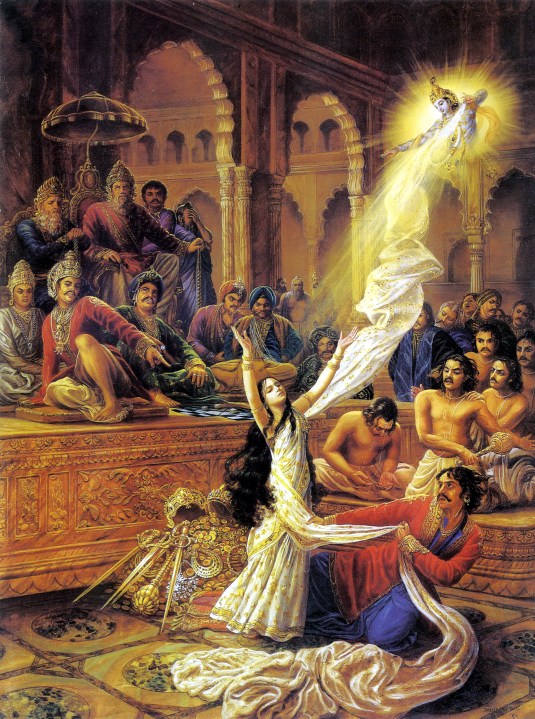
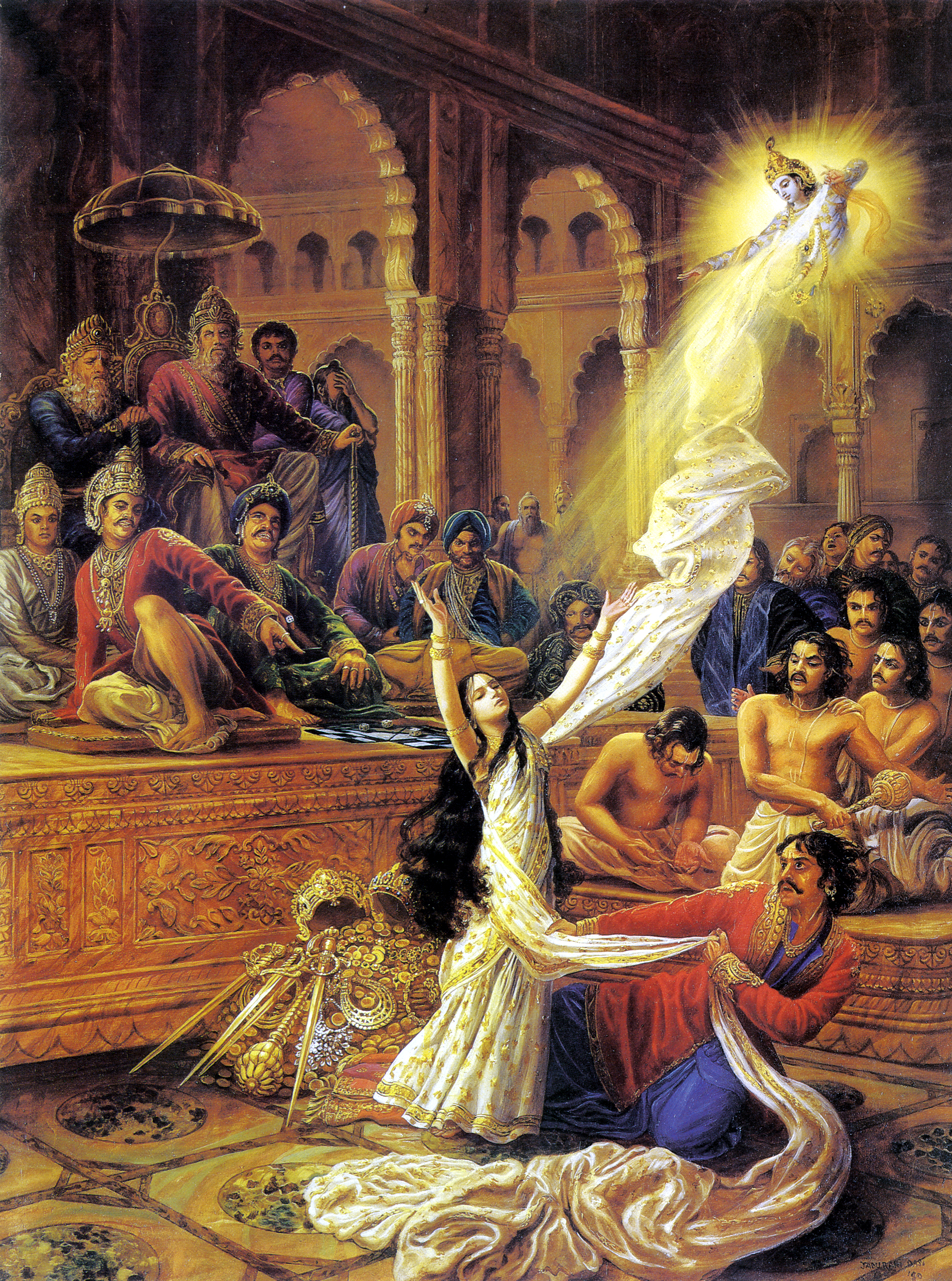
I have always liked this story of the dis-robing of Draupadi, and how she was saved by Krsna supplying endless heaps of sari. The following lecture by Srila Prabhupada is a very nice description of the contest between good and evil, or pious or impious activities.
Prabhupāda: So pāpam eva. Pāpam means sinful activities, and puṇyam is pious. So people should consider in every activity, whether it is pāpam or puṇyam, whether it is virtuous or sinful activities. But the asuras, they do not know. Pravṛttiṁ ca nivṛttiṁ ca na vidur asurā janāḥ [Bg. 16.7]. Those who are asuras, they do not care what is sinful or what is right. “I like it; I must do it.” This is asura. There is no reference to the authorities, whether the action which I am going to do, whether it is pious or impious…
…”Now she is our property. We can do whatever we like with. Arjuna has lost his wife.” So he advised that “Make her naked in this assembly.” To become naked in the, so many people, that is a great insult for woman. So actually, they tried to insult. Not tried, it was fact. But Kṛṣṇa saved. You know, Draupadi’s vastra-haraṇa. She was tried to become naked, but these people could not make her naked. The sārī was supplied by Kṛṣṇa, one after another, one after another, heaps of sārī. Then they become fed up, gave up that business, that “She cannot be made naked.” (from Bhagavad-gita 1.36 Lecture)
Full Lecture More
22 Nov 2014
by The Hare Krishna Movement
in A.C. Bhaktivedanta Swami Prabhupada, Krishna Consciousness, Krishna Nectar, Krsna, Krsna Consciousness, Srimad Bhagavatam
Tags: . rainy season, A.C. Bhaktiveanta Swami Prabhupada, beauty, Crsna consciousness, dark cloud, densely cloudy, eyes like lotus petals, ghana-syamam, Shyamasundara, Srimad Bhagavatam. Krsna, sundarya, the lords beauty

The Lord’s beauty resembles a dark cloud during the rainy season. As the rainfall glistens, His bodily features also glisten. Indeed, He is the sum total of all beauty. The Lord has four arms and an exquisitely beautiful face with eyes like lotus petals, a beautiful highly raised nose, a mind-attracting smile, a beautiful forehead and equally beautiful and fully decorated ears. (Srimad Bhagavatam 4.24.45-46)
The Lord’s beauty is compared to rainfall because when the rain falls in the rainy season, it becomes more and more pleasing to the people. After the scorching heat of the summer season, the people enjoy the rainy season very much. Indeed, they even come out of their doors in the villages and enjoy the rainfall directly. Thus the Lord’s bodily features are compared to the clouds of the rainy season. The devotees enjoy the Lord’s beauty because it is a collection of all kinds of beauties. Therefore the word sarva-saundarya-saṅgraham is used. No one can say that the body of the Lord is wanting in beautiful parts. It is completely pūrṇam. Everything is complete: God’s creation, God’s beauty and God’s bodily features. All these are so complete that all one’s desires can become fully satisfied when one sees the beauty of the Lord. The word sarva-saundarya indicates that there are different types of beauties in the material and spiritual worlds and that the Lord contains all of them. Both materialists and spiritualists can enjoy the beauty of the Lord. Because the Supreme Lord attracts everyone, including demons and devotees, materialists and spiritualists, He is called Kṛṣṇa. (from purport)
Full text and purport More
08 Nov 2014
by The Hare Krishna Movement
in Bhagavad-gita As It Is 1972 Edition, Devotional Service, Krishna Consciousness, Meditation, Yoga
Tags: A.C. Bhaktiveanta Swami Prabhupada, all that you do, all that you eat, all that you offer and give away, as it is, as well as all austerities that you may preform, Bg9.26, Bg9.27, bhagavad-gita, do it for Me, patram puspam phalam toyam, yat karosi yad asnasi

This morning I went into our temple room, as I do every morning, and offered my obeisances. As I was saying my morning prayers this thought just entered my mind; ‘Vyasasan das, reporting for service”. It seemed like a strange thing to be thinking so early in the morning, and I do not recall ever thinking like that before. But almost immediately, I was reminded of this verse from the Bhagavad-gita:
O son of Kuntī, all that you do, all that you eat, all that you offer and give away, as well as all austerities that you may perform, should be done as an offering unto Me.
I could not remember at first, what chapter and verse, but I went to the Bhagavad-gita As It Is, and began searching…Oh yes, I remember Chapter Nine, Text 27…and the purport reads:
…Everyone has to work for maintenance of his body and soul together, and Kṛṣṇa recommends herein that one should work for Him. Everyone has to eat something to live; therefore he should accept the remnants of foodstuffs offered to Kṛṣṇa. Any civilized man has to perform some religious ritualistic ceremonies; therefore Kṛṣṇa recommends, “Do it for Me,” and this is called arcanā. Everyone has a tendency to give something in charity; Kṛṣṇa says, “Give it to Me,”
This is real renunciation, real yoga; always thinking and planning how to serve the Lord. And for one brief moment in my life, my mind was right.
More
21 Oct 2014
by The Hare Krishna Movement
in A.C. Bhaktivedanta Swami Prabhupada, Lord Rsabhadeva, Srimad Bhagavatam, Threefold Miseries, Transcendental Knowledge, Varnasrama Dharma
Tags: A.C. Bhaktiveanta Swami Prabhupada, amhita, devotional service, eternal blissful life, living entities, Lord Rsabhadeva, material bodies, rsabha uvaca, Srimad Bhagavatam, transcendental knowledge
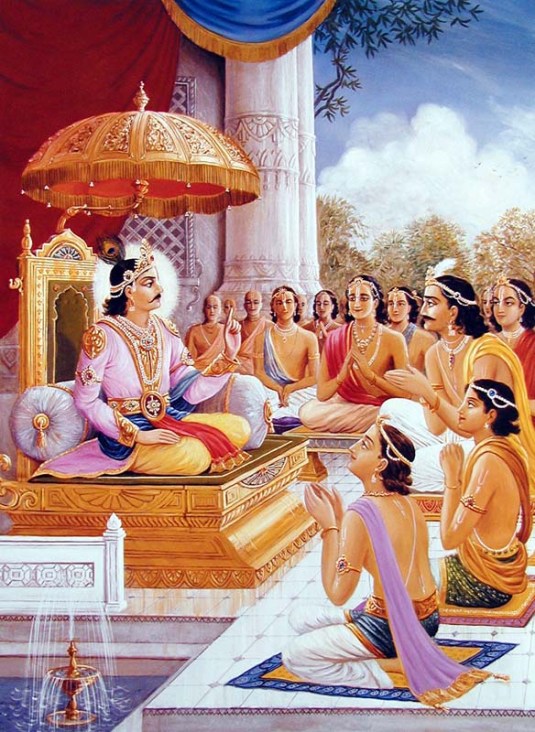
This morning by chance, I happened upon the teachings of Lord Rsabhadeva to His sons. It was in an old notebook that I opened just to see what was inside. Inside were prayers from the Vaisnava Songbook, the Brahma-samhita, Teachings of Pralada Maharaja, and these teachings of Lord Rsabhadeva. It was Sri Gandhari’s old gurukula study notebook, and what she was studying 30 years ago was very useful and timely today. It was just what I needed to read this morning and I share it with you today. It is verses 1-27, from the Fifth Canto of the Srimad Bhagavatam, chapter five.
Lord Ṛṣabhadeva told His sons: My dear boys, of all the living entities who have accepted material bodies in this world, one who has been awarded this human form should not work hard day and night simply for sense gratification, which is available even for dogs and hogs that eat stool. One should engage in penance and austerity to attain the divine position of devotional service. By such activity, one’s heart is purified, and when one attains this position, he attains eternal, blissful life, which is transcendental to material happiness and which continues forever.
More
14 Oct 2014
by The Hare Krishna Movement
in A.C. Bhaktivedanta Swami Prabhupada, Chanting Hare Krishna, The Hare Krishna Movement, Yoga
Tags: A.C. Bhaktiveanta Swami Prabhupada, chanting Hare Krishna, God realization, Hare Rama, Hari Kirtana, Kali-yuga, kirtan, sankirtan, self relization, supreme absolute truth, Vedic literatures, Visnu

harer nāma harer nāma
harer nāmaiva kevalam
kalau nāsty eva nāsty eva
nāsty eva gatir anyathā
In this Age of Kali there is no other means, no other means, no other means for self-realization than chanting the holy name, chanting the holy name, chanting the holy name of Lord Hari.
[Adi 17.21]
…
This hari-kīrtana was started five hundred years ago in Bengal by Lord Caitanya. In Bengal there is competition between the Vaiṣṇavas and the śāktas. The śāktas have introduced a certain type of kīrtana called kālī-kīrtana. But in the Vedic scriptures there is no recommendation of kālī-kīrtana. Kīrtana means hari-kīrtana. One cannot say, “Oh, you are Vaiṣṇava. You can perform hari-kīrtana. I shall perform śiva-kīrtana or devī-kīrtana or gaṇeśa-kīrtana.” No. The Vedic scriptures do not authorize any kīrtana other than hari-kīrtana. Kīrtana means hari-kīrtana, the glorification of Kṛṣṇa.
So this process of hari-kīrtana is very simple: Hare Kṛṣṇa, Hare Kṛṣṇa, Kṛṣṇa Kṛṣṇa, Hare Hare/ Hare Rāma, Hare Rāma, Rāma Rāma, Hare Hare. Actually there are only three words: Hare, Kṛṣṇa, and Rāma. But they are very nicely arranged for chanting so that everyone can take the mantra and chant Hare Kṛṣṇa, Hare Kṛṣṇa, Kṛṣṇa Kṛṣṇa, Hare Hare. Since we have started this movement in the Western countries, Europeans, Americans, Africans, Egyptians, and Japanese are all chanting. There is no difficulty. They are chanting very gladly, and they are getting the results. What is the difficulty? We are distributing this chanting free of charge, and it is very simple. Simply by chanting, one can have self-realization, God realization, and when there is God realization, then nature realization is included also. (from The Science of Self Realization)
More
29 Sep 2014
by The Hare Krishna Movement
in A.C. Bhaktivedanta Swami Prabhupada, Books by Srila Prabhupada, Free Downloads, Free eBooks, Nectar of Devotion
Tags: A.C. Bhaktiveanta Swami Prabhupada, Bhakti-rasamrta-sindhu, free downloads, free eBooks, Hare Krishna, ISKCON Press, Krishna Path, Lord Caitanya Mahaprabhu, Nectar of Devotion, Rupa Goswami, Srila Rupa Gosvami. Krsna consciouness movement, Sriman Jayananda brahmacari
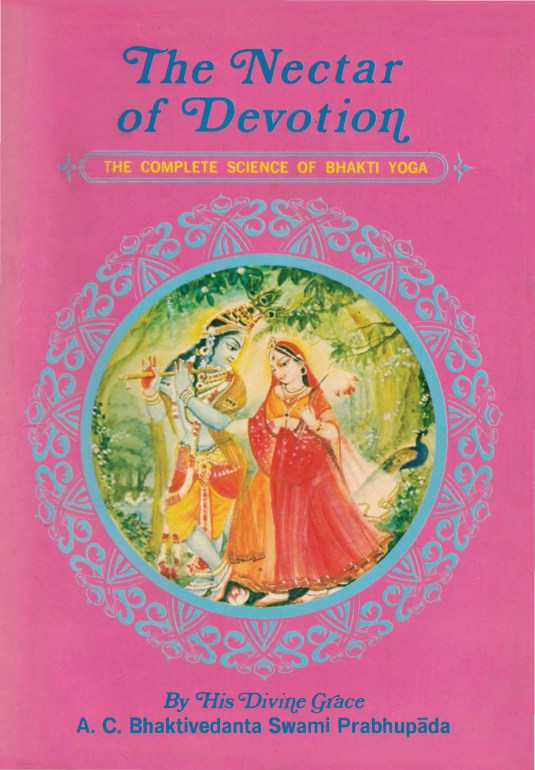
click on image to enlarge
This morning I wanted to share with you all one of my most favorite books The Nectar of Devotion. I began re-reading it this morning, and feel very inspired to practice my bhakti yoga with new enthusiasm. You can click on following links to read or save to your computer the scanned version or the pdf version.
From Preface
…The Nectar of Devotion is a summary study of Bhakti-rasāmṛta-sindhu, which was written in Sanskrit by Śrīla Rūpa Gosvāmī Prabhupāda. He was the chief of the six Gosvāmīs, who were the direct disciples of Lord Caitanya Mahāprabhu. …The Nectar of Devotion is specifically presented for persons who are now engaged in the Kṛṣṇa consciousness movement. I beg to offer my sincere thanks to all my friends and disciples who are helping me to push forward the Kṛṣṇa consciousness movement in the Western countries, and I beg to acknowledge, with thanks, the contribution made by my beloved disciple Śrīman Jayānanda brahmacārī. My thanks are due as well to the directors of ISKCON Press, who have taken so much care in publishing this great literature. Hare Kṛṣṇa.
A. C. Bhaktivedanta Swami
ISKCON Headquarters
Los Angeles, California
Scanned The_Nectar_of_Devotion-1970_ISKCON_Press_edition-Hardcover-SCAN (1)
PDF Nectar-of-Devotion-1970-Edition
More
19 Jul 2014
by The Hare Krishna Movement
in A.C. Bhaktivedanta Swami Prabhupada, Morning Walks, Science
Tags: A.C. Bhaktiveanta Swami Prabhupada, Bahulasva, Baradraj, bhagavata, Citsukhananda, dogmas, fools, Harikesa, Jayadvaita, Krsna-dasa, Moon Rocks from Arizona, morning walks with Srila Prabhupada, Nalini-kantha, Narayana, other planets, over-intelligent, paramahamsa, prabhupada, Rahu, rascaldom, rascals, scientists, Socrates, Sudama, Tamala Krsna, Yadubara, Yadunandana
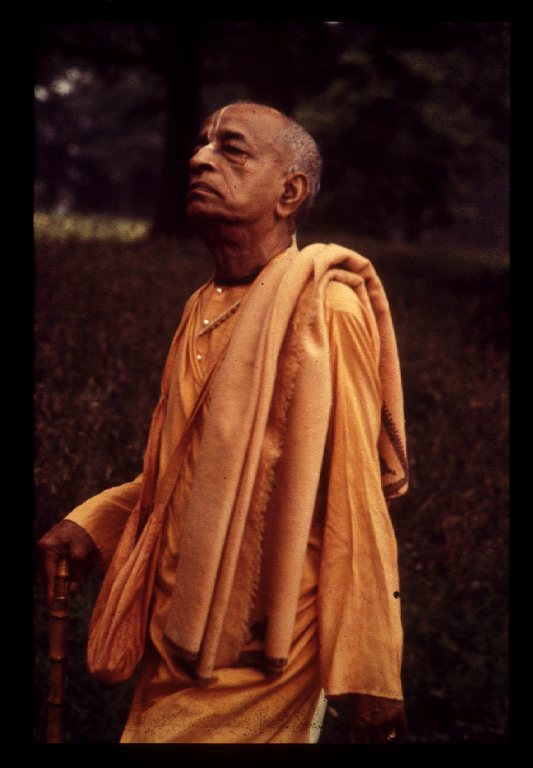
“Moon Rocks from Arizona”
Morning walk discussion by His Divine Grace A. C. Bhaktivedanta Swami Prabhupada and disciples
Recorded July 21, 1975
To hear lecture
Prabhupada: Oh. [break] Krsna dasa, some scientists say that there is no life in the other planets, and some scientists said there may be. So who is correct?
Paramahamsa: Well, didn’t the Yamadutas… You stated in your lecture yesterday that the Yamadutas said that what is truth is what is in the Vedas. So I assume from the Vedic knowledge that there is life on other planets. Logically speaking also.
Prabhupada: Yes. How can you say there is no life?
More
17 Jun 2014
by The Hare Krishna Movement
in A.C. Bhaktivedanta Swami Prabhupada, Bhagavad-gita, Krsna, Krsna Consciousness, Meditation, Yoga, Yogi
Tags: A.C. Bhaktiveanta Swami Prabhupada, bhakti yoga, Govinda, Krsna, krsna consciousness, meditation, Nrismha, Rama, Syamasundara, Varaha, yoga, yogas, yogi, yoginam api sarvesam

“Of all yogis, he who abides in Me with great faith is the highest of all.”
It is by great fortune that one comes to Kṛṣṇa consciousness on the path of bhakti-yoga to become well situated according to the Vedic direction. The ideal yogī concentrates his attention on Kṛṣṇa, who is called Śyāmasundara, who is as beautifully colored as a cloud, whose lotus-like face is as effulgent as the sun, whose dress is brilliant with jewels and whose body is flower garlanded. Illuminating all sides is His gorgeous luster, which is called the brahmajyoti. He incarnates in different forms such as Rāma, Nṛsiṁha, Varāha and Kṛṣṇa, the Supreme Personality of Godhead, and He descends like a human being, as the son of Mother Yaśodā, and He is known as Kṛṣṇa, Govinda and Vāsudeva. He is the perfect child, husband, friend and master, and He is full with all opulences and transcendental qualities. If one remains fully conscious of these features of the Lord, he is called the highest yogī. (from purport to Bg. 6.47)
This is more or less a continuation of yesterdays post Freedom From All Miseries as it is the last verse in the Chapter 6, entitled; “Sankhya-yoga”. This is one of the very best verses and purports in the Bhagavad-gita for study if one is an aspiring yogi…
…The culmination of all kinds of yoga practices lies in bhakti-yoga. All other yogas are but means to come to the point of bhakti in bhakti-yoga. Yoga actually means bhakti-yoga; all other yogas are progressions toward the destination of bhakti-yoga. From the beginning of karma-yoga to the end of bhakti-yoga is a long way to self-realization. Karma-yoga, without fruitive results, is the beginning of this path. When karma-yoga increases in knowledge and renunciation, the stage is called jñāna-yoga. When jñāna-yoga increases in meditation on the Supersoul by different physical processes, and the mind is on Him, it is called aṣṭāṅga-yoga. And, when one surpasses the aṣṭāṅga-yoga and comes to the point of the Supreme Personality of Godhead Kṛṣṇa, it is called bhakti-yoga, the culmination. Factually, bhakti-yoga is the ultimate goal, but to analyze bhakti-yoga minutely one has to understand these other yogas. The yogī who is progressive is therefore on the true path of eternal good fortune. (from purport to Bg. 6.47)
More
14 May 2014
by The Hare Krishna Movement
in A.C. Bhaktivedanta Swami Prabhupada, Free Downloads, Free eBooks, Srila Prabhupada's Books, Teachings of Lord Chaitanya, The Hare Krishna Movement
Tags: A.C. Bhaktiveanta Swami Prabhupada, devotees, impersonalism, Krishnapath, Krsna, Krsna consciousness movement, Lord Caitanya, pure devotional service, Supreme Lord, Supreme Personality of Godhead, Transcendental Teachings of Caitanya Mahaprabhu, voidism

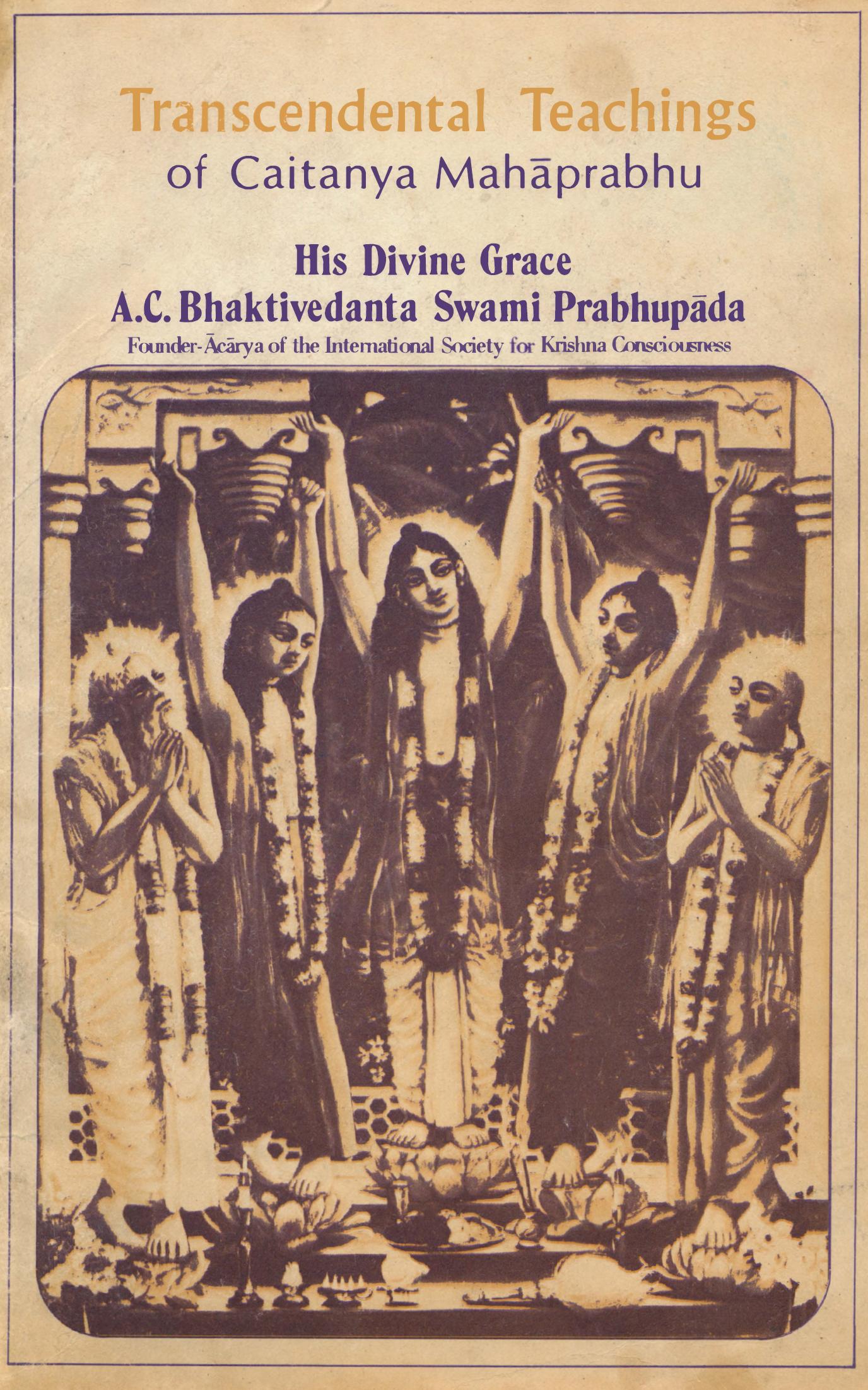
We share with you this nice little booklet printed in 1972 by the ISKCON Press. This book is Srila Prabhupada’s “A short sketch of the life and teachings of Lord Caitanya, the preacher of Srimad Bhagavtam”, which appeared in the Introduction to the Srimad Bhagavatam. This scanned copy was made available by Krishnapath.org where you can go to find other ebooks and Audio books that are available as a free download. To veiw or save the entire book follow link below. Hare Krishna!
The transcendental teachings of Lord Caitanya Mahaprabhu offer a practical and scientific method by which anyone can easily develop love for the Supreme Personality of Godhead, Krsna. These teachings, in their pure form, have been spread all over the world by His Divine Grace A.C. Bhaktivedanta Swami Prabhupada, to whom devotees of Lord Krsna and Lord Caitanya throughout the world offer their most humble and respectful obeisances.
Especially in the West, where the philosophies of impersonalism and voidism, presented in different ways, are enjoying temporary prominence, the culture of pure devotional service to the Supreme Lord appears to have been lost in the oblivion of time. Now Srila Prabhupada has appeared in the West to spread the Krsna consciousness movement introduced by Lord Caitanya in India 500 years ago and thus renovate the principles of pure devotional service. (From Preface)
to read online or to save click on following link; Transcendental Teachings of Caitanya Mahaprabhu
More
Previous Older Entries Next Newer Entries















 The Hare Krishna Movement