With all the political discussion going on this election year, I have been paying attention to some of the language. There are some words being used that I think I know, you know, words, we heard before, think we understand, but never actually took the time to look up in dictionary. Words like tyrant, autocracy, totalitarianism, liberality, etc. So this morning I took some time to look up the definition of some of these words. I began with the word “Tyranny”.
Simple definition: a government in which all power is in the hands of a single ruler. 2. : harsh, cruel, and severe government or conduct. 3. : a tyrannical act.
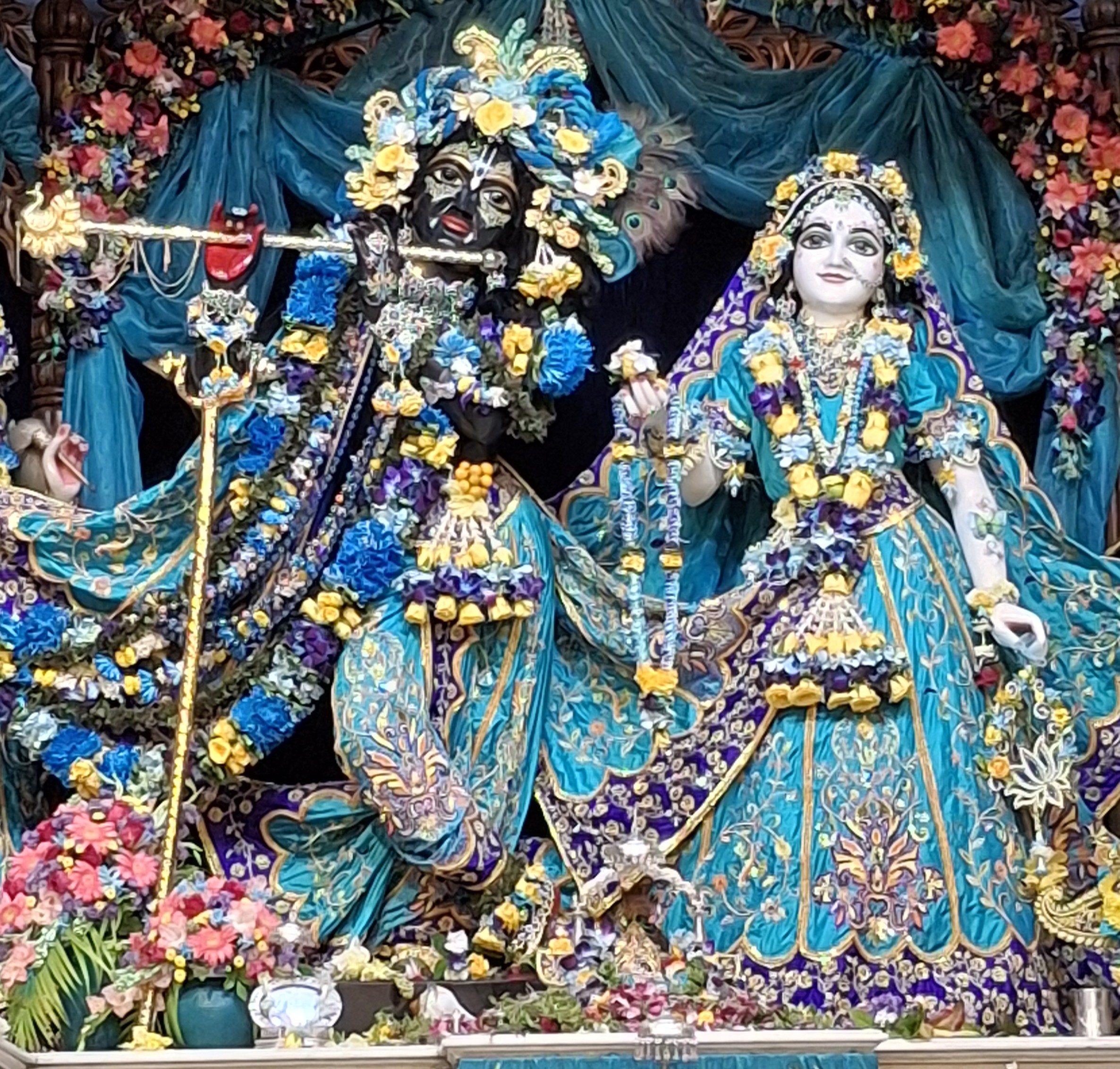
A few days ago on the full moon (purnima) we started the month of Kartika, or as I like to say, the month of Damodara. As always during this month, we sing the Damodara prayers (Sri Damodararastaka) daily and light a candle to offer. It is also a good time to read from the KRSNA Book and just delight in the childhood pastimes of Lord Krishna.
Included below are the lyrics and translations from the original “Songs of the Vaisnava Acaryas” song book.
(Mantra Rock Dance poster, Avalon Ballroom, San Francisco, 1967)
The Prabhupada Revolution
by Padmapani Das
For many of us who came of age in the Sixties and Seventies, the counterculture and its promise of an alternative society based on love and peace was an important part of our lives. Art, music, poetry, philosophy, ecology and human rights were just a few of the buzzwords floating around the collective psyche of the Sixties generation. Revolution was in the air. “The establishment” was doomed and soon to be replaced with a kinder, gentler society. Peace would reign supreme and all peoples of the world would unite and be free from the chains of oppression. Or so we thought.
There has been so much misinformation lately, on the news networks, on social media, in politics, etc. about election results, relief funds for hurricane victims, eating pets in Springfield Ohio, etc., that it got me thinking about truthfulness. The English definition is simply: the quality of being honest and not containing or telling any lies. However according to the Vedic definition which goes a little deeper: Satyam, truthfulness, means that facts should be presented as they are for the benefit of others.
Satyam, truthfulness, means that facts should be presented as they are for the benefit of others. Facts should not be misrepresented. According to social conventions, it is said that one can speak the truth only when it is palatable to others. But that is not truthfulness. The truth should be spoken in a straight and forward way, so that others will understand actually what the facts are. If a man is a thief and if people are warned that he is a thief, that is truth. Although sometimes the truth is unpalatable, one should not refrain from speaking it. Truthfulness demands that the facts be presented as they are for the benefit of others. That is the definition of truth. (from purport Bhagavada-gita 10. 4-5)
“The government is people’s men. So if you are, we are ourselves fools and rascals, the government will also be a set of fools and rascals. And if you are intelligent, the government will be intelligent, because now it is democracy. You select some man. So don’t blame government. You are government. If you are fools the government are fools. If you are intelligent the government is intelligent. It is up to you to change; then everything will be all right.” Srila Prabhupada (Conversation with News Reporters — 25 March 1976, Delhi)
…The so called democratic government means some of the sudras, rascals without any knowledge of the highest aim of life. By hook and crook they get some votes and get the responsible chair in government. Naturally they can whimsically enact any law which is against the interest of the people in general. (Letter to: Madhudvisa Kenya 15 September, 1971)
For some time now I have been meaning to look up the word Sociopath. Srila Prabhupada has wrriten a very nice essay, which was published in our Back To Godhead Magazine, entitled, “Who Is Crazy” (which is at bottom of post). Today we see leaders and public figures who seem to fit the category of ‘Crazy’, or ‘Sociopathtic’. So I wanted to look into the description of the Sociopth, to get a better understanding.
Profile of the Sociopath
Pathological Lying Has no problem lying coolly and easily and it is almost impossible for them to be truthful on a consistent basis. Can create, and get caught up in, a complex belief about their own powers and abilities. Extremely convincing and even able to pass lie detector tests.
Manipulative and Conning They never recognize the rights of others and see their self-serving behaviors as permissible. They appear to be charming, yet are covertly hostile and domineering, seeing their victim as merely an instrument to be used. They may dominate and humiliate their victims.
Here is a new word for your vaisnava vocabulary; laulyam which can be defined as desire and great eagerness, or as greed
“My dear Lord, O lotus-eyed one, when will that day come when on the bank of the Yamuna, I shall become just like a madman, and continue to chant Your holy name while incessant tears flow from my eyes?”
One should feelingly pray and become eager to render his particular type of service to the Lord. This is the teaching of all great devotees, especially Lord Caitanya.
In other words, one should learn how to cry for the Lord. One should learn this small technique, and he should be very eager and actually cry to become engaged in some particular type of service. This is called laulyam, and such tears are the price for the highest perfection. If one develops this laulyam, or excessive eagerness for meeting and serving the Lord in a particular way, that is the price to enter into the kingdom of God. Otherwise, there is no material calculation for the value of the ticket by which one can enter the kingdom of God. The only price for such entrance is this laulyam lālasāmayī, or desire and great eagerness.
Today marks the appearance day of Srila Bhaktivinoda Thakura. We honor it with a half day fast followed by a nice vegetarian feast. We share with you one of my favorite songs composed by Srila Bhaktivinoda.
When, oh when, will that day be mine? When my offenses ceasing, taste for the name increasing, when in my heart will your mercy shine? When, oh when will that day be mine?
Lower than a blade of grass, more tolerant than a tree. When will my mind attain this quality? Respectful to all, not expecting their honour, then shall I taste the name’s nectar sublime. When oh when will that day be mine?
“Prabhupada: Hare Krsna. So we have published our Nectar of Devotion. So every one of you should read this Nectar of Devotion repeatedly. The whole substance of Vaisnava philosophy and activities, everything is there. So every one of you read this Nectar of Devotion once, twice, thrice.”
The Appearance Day of Our Beloved Spiritual Master
His Divine Grace A. C. Bhaktivedanta Swami Prabhupada
Founder-Acarya of the International Society for Krishna Consciousness
Dear Srila Prabhupada
Please accept my humble obeisances, and kindly forgive my offences. I am truly grateful to you for all that you have given me. Every day when I go into our temple room, and I light a candle or stick of incense, sit down and chant japa or sing bhajans, whether I am cooking an offering or preparing the Lord’s plate, picking a flower to offer or washing and drying the Lord’s plate, reading from one of your many books, or simply thinking about Lord Krishna or Caitanya Mahaprabhu, I feel a deep sense of gratitude, and appreciation.
Today we celebrate the Appearance of Lord Krishna (Janmastami) with a full day fast, followed by a nice vegetarian feast. As we like to do on this day, we read from the KRSNA Book. So we are posting the complete chapter; “The Birth of Lord Kṛṣṇa”.
…As stated in the Bhagavad-gītā, the Lord says that His appearance, birth, and activities, are all transcendental, and one who understands them factually becomes immediately eligible to be transferred to the spiritual world. The Lord’s appearance or birth is not like that of an ordinary man who is forced to accept a material body according to his past deeds. The Lord’s appearance is explained in the Second Chapter: He appears out of His own sweet pleasure. When the time was mature for the appearance of the Lord, the constellations became very auspicious. The astrological influence of the star known as Rohiṇī was also predominant because this star is considered to be very auspicious. Rohiṇī is under the direct supervision of Brahmā. According to the astrological conclusion, besides the proper situation of the stars, there are auspicious and inauspicious moments due to the different situations of the different planetary systems. At the time of Kṛṣṇa’s birth, the planetary systems were automatically adjusted so that everything became auspicious. ( from Kṛṣṇa, the Supreme Personality of Godhead Chapter 3)
Today, being Krsna Janmastami, we are offering a free scanned copy of the original ISKCON Press 1970 Edition of KRSNA Book Vol. 1, which you can download. Just click on the following link to began downloading. This could take a while depending on the speed of your connection. This free scanned copy includes all the original art work as well.
I would like to share a very Special Photo of Srila Prabhupada in the San Francisco temple 1968 signing His name to a set of India published, first canto, Srimad Bhagavatam consisting of three volumes.
There is a backstory that bring back exciting memories to me. When Srila Prabhupada arrived in the USA, He carried with Him 200 sets of these books, which most were sold. The remaining books (assorted volumes) in India were shipped and arrived in the winter of 1966. In Srila Prabhupada’s Apt. it was me and Brahmananda that unpacked these volumes. They were shipped in thin steel painted black trunks. There were three or four of them and pretty banged-up during shipment. But the books were undamaged. There were only a small number of full sets left, most were 2nd and 3rd volumes of the set. The front-covers were packed separately. And it was my service to carefully put the front jackets on all the books right in front of Srila Prabhupada. I was so excited unpacking these volumes thinking as a young boy, what a great treasure I found. I had to carefully fold the jackets around each and every book while His Divine Grace watched. We stacked some books in His room and remainder one trunk that wasnt damaged we put all the other books. So this photo of Srila Prabhupada signing this set brought me back to those days that I was allowed to perform this humble service with great enthusiasm, and in my old age it brings my heart great happiness……your servant gargamuni das………
One of the most used books in our temple room is the songbook. Everyday it seems, I am flipping through the “Songs of the Vaisnava Acaryas”, singing one of the many songs or reciting some of the numerous pranams (prayers) as part of my daily sadhana. The following post is the first 13 pages of songbook, which in my mind is a nice way to start the day and is a good prelude to other devotional service.
Pranams from the Songs of the Vaisnava Acaryas
SRI GURU PRANAMA
om ajnana-timirandhasya jnananjana-salakaya caksur unmilitam yena tasmai sri-gurave namah
om-address; ajnana-of ignorance; timira-by the darkness; andhasya-of one who was blinded; jnana-anjana-by the ointment of spiritual knowledge; salakaya-by a medical instrument called a salaka, which is used to apply medical ointment to eyes afflicted with cataracts: caksuh-eyes; unmilitam-were opened; yena-by whom; tasmai-unto him; sri-gurave-unto my spiritual master; namah-obeisances.
I offer my respectful obeisances unto my spiritual master, who has opened my eyes, which were blinded by the darkness of ignorance, with the torchlight of knowledge.
This morning when I opened my computer I saw this Headline;“Middle East braces for week that could determine the course of the Gaza war”. And I was reminded of all the conflict at present in the world. Then I opened the Srimad Bhagavatam and began reading the Preface by Srila Prabhupada and it seemed so timely.
Śrīmad-Bhāgavatam by His Divine Grace A. C. Bhaktivedanta Swami Prabhupāda
Preface
We must know the present need of human society. And what is that need? Human society is no longer bounded by geographical limits to particular countries or communities. Human society is broader than in the Middle Ages, and the world tendency is toward one state or one human society. The ideals of spiritual communism, according to Śrīmad-Bhāgavatam, are based more or less on the oneness of the entire human society, nay, of the entire energy of living beings. The need is felt by great thinkers to make this a successful ideology. Śrīmad-Bhāgavatam will fill this need in human society. It begins, therefore, with the aphorism of Vedānta philosophy janmādy asya yataḥ (Bhag. 1.1.1.) to establish the ideal of a common cause.
Human society, at the present moment, is not in the darkness of oblivion. It has made rapid progress in the field of material comforts, education and economic development throughout the entire world. But there is a pinprick somewhere in the social body at large, and therefore there are large-scale quarrels, even over less important issues. There is need of a clue as to how humanity can become one in peace, friendship and prosperity with a common cause. Śrīmad-Bhāgavatam will fill this need, for it is a cultural presentation for the respiritualization of the entire human society.
I posted this some years ago, but this morning I happened upon it again, and so enjoyed it, we thought we would post it again. In this treatise Ajitananda Prabhu describes how Srila Prabhupada perfectly displayed the twenty-six qualities of a pure devotee of Lord Krishna.
In Praise of Srila Prabhupada . by Ajitananda dasa ________________
His Divine Grace A.C. Bhaktivedanta Swami Prabhupada, who successfully distributed the message of Lord Krsna throughout the world, was not an ordinary conditioned soul, governed by the harsh laws of material nature. Although to the unenlightened he may have appeared to exhibit commonplace characteristics, it is evident through the careful study of his life and activities, that Srila Prabhupada perfectly displayed the twenty-six qualities of a pure devotee of Lord Krsna. We learn from Vedic literature that one who possesses these qualities is necessarily free from material bondage, and enjoys an eternal position in the intimate association of the Supreme Lord. Such a great soul is very rarely found within this material realm, and owing to his unparalleled purity and exalted status, he is worshipable by the entire world. Individually, and as a collective society of aspiring devotees, we must always strive to appreciate Srila Prabhupada’s divine qualities, teach this application to others, and perform all of our devotional activities for his satisfaction. This treatise is an imperfect but hopeful attempt to please Srila Prabhupada by illustrating, in a practical way, how he perfectly displayed the twenty-six qualities of a pure devotee of Lord Krsna.
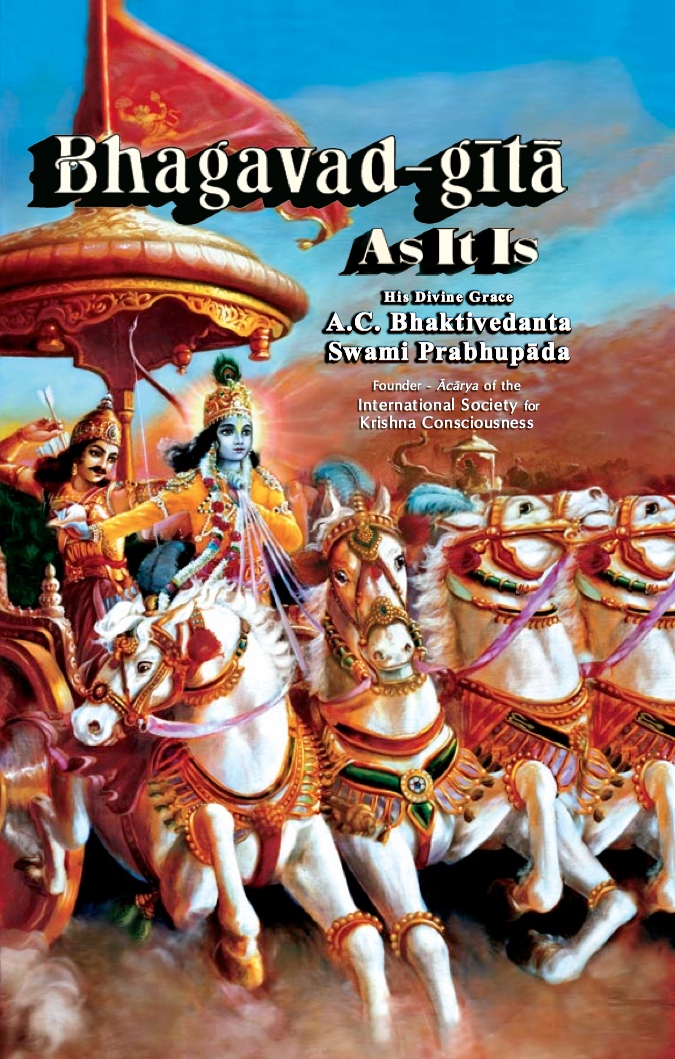
Bhagavad-gītā As It Is by His Divine Grace A. C. Bhaktivedanta Swami Prabhupada
PICTURE INDEX
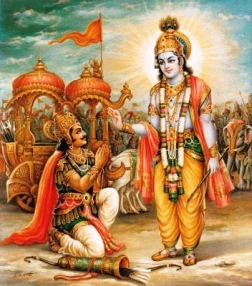
The illustrations of Bhagavad-gītā As It Is were painted by members of the International Society for Krishna Consciousness working under the personal direction of the author, their spiritual master, In the following descriptive index, the numbers in boldface type which follow each plate number refer to the chapter and verse of the Gītā that the picture illustrates.
I remember as a young book distributor on the Radha Damadora Traveling Sankirtan Party back in 1975, we were getting fresh new cases of the Caitanya-caritamrta to distribute, “Hot off the press”. Literally the pages were still warm. We couldn’t wait to open up a new case and look at all the new pictures.
Celebrating Sri Caitanya-caritamrta
A 16th-Century Bengali Masterpiece
By Kalakantha Dasa
By any standards, Caitanya Mahaprabhu led a most remarkable life. As a child-scholar, He refuted the leading philosophers of His day. Later, as a young renunciant, He traveled widely, converting kings, panditas, Muslims, Buddhists, and thousands of their followers to the path of Krsna-bhakti. In His final years, He exhibited unprecedented miracles and devotional ecstasies. Even today, five hundred years later, Lord Caitanya’s movement reverberates around the world with startling religious vitality.
The following is an article I posted some years ago, but I feel it is still timely, and it still of the utmost importance to our society. We need to understand what were Srila Prabhupada’s intentions and desires for the continuation of his mission. Although our page is not intended as a political forum, it is a tool in the mission of our spiritual master, for the propagation of The Hare Krishna Movement or Krishna Consciousness.
Now that Śrīla Prabhupāda has named these representatives Temple Presidents may henceforward send recommendations for first and second initiation to whichever of these eleven representatives are nearest their Temple.After considering the recommendation, these representatives many accept the devotee as an initiated disciple of Śrīla Prabhupāda by giving a spiritual name, or in the case of a second initiation, by chanting on the Gāyatrī thread just as Śrīla Prabhupāda had done.
The name of a newly initiated disciple should be sent by the representative who has accepted him or her to Śrīla Prabhupāda, to be included in Divine Grace’s “Initiated Disciples” book. (from July 9th letter)
The Rtvik Representative Of The Acharya by Kṛṣṇacandra Dāsa – Vṛndāvan:
Shortly after His Divine Grace A. C. Bhaktivedanta Swami Śrīla Prabhupāda entered into his Samādhi līlā in 1977; 11 of his senior disciples and members of the GBC who held the official position of representatives of His Divine Grace in 1st and 2nd spiritual initiations [as per July 9th Document], without authority and without an order by His Divine Grace announced themselves to be pure devotees of the Lord and forcibly seized the titles, roles and functions of acharyas and Initiating Spiritual Masters of ISKCON.
I have posted this article before, but due to its importance, I am re-posting it again. Also check out Arsha Prayoga for more on this subject. -V
Arsha Prayoga Part (I) – Resistance To Change By Locanananda Prabhu
Let me first offer my prostrated obeisances unto the lotus feet of that supreme swan-like devotee of the Lord, our spiritual master, His Divine Grace A.C. Bhaktivedanta Swami Prabhupada, by whose mercy the fallen souls of Kali Yuga may taste the sweetness of the narrations of the pastimes of the Lord and His pure devotees. As the bonafide representative of Sri Vyasadeva, he composed a mountain of transcendental literature to enlighten the entire human society, explaining even the most confidential truths regarding vaisnava philosophy.
His Divine Grace Srila Prabhupada displayed all of the symptoms of an empowered jiva soul, working tirelessly to distribute the transcendental message of love of Godhead throughout the world. It is therefore the duty of his followers to preserve the legacy and protect the honor of such a great spiritual personality whose every moment was dedicated to the spreading of Krishna consciousness.
Here is a new word for your Vaisnava Vocabulary: Bhāva. In the Glossary in the back of the Bhagavad-gita As It Is, 1972 Edition, the word Bhāva is defined as; the preliminary stage of transcendental love of Godhead. Bhāva is a big word and has various meanings
…The last stage of the devotional life is called bhāva, or transcendental love of Godhead.
“In the beginning one must have a preliminary desire for self-realization.…This taste leads one further forward to attachment for Kṛṣṇa consciousness, which is matured in bhāva, or the preliminary stage of transcendental love of God. Real love for God is called premā, the highest perfectional stage of life.” In the premā stage there is constant engagement in the transcendental loving service of the Lord. So, by the slow process of devotional service, under the guidance of the bona fide spiritual master, one can attain the highest stage, being freed from all material attachment, from the fearfulness of one’s individual spiritual personality, and from the frustrations resulting from void philosophy. Then one can ultimately attain to the abode of the Supreme Lord. (Bhagavad-gita 4.11)
So it seem that bhāva is not only the preliminary stage of transcendental love of Godhead but we find that this preliminary stage of transcendental love is also the path to the highest perfectional stage of life, pure love or premā. There are two ways to approach the Lord, one is with awe and reverence and the other is with affection; bhāva. One who approaches the Lord with affection, is sure to advance spiritually.
In the Srimad Bhagavatam we find many references to the word Bhāva and highlighted some of them here.