24 Apr 2012
by The Hare Krishna Movement
in Back to Godhead, Hayagriva das, Remembering Srila Prabhupada
Tags: Back to Godhead Magazine, Bowery, devotional service, hayagriva das, His Divine Grace, Kirtanananda, Krsna's service, matchless gifts, New York: Summer 1966, Second Avenue, Srila Prabhupada, Umapati
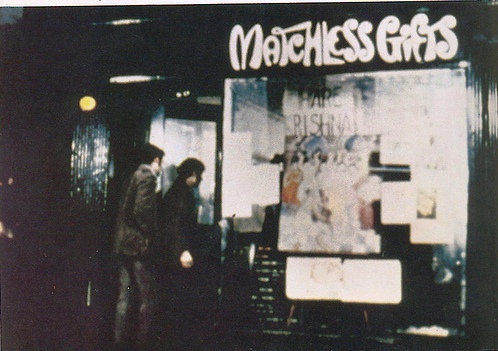
…Srila Prabhupada was lecturing from the Bhagavad-gita…then, incredibly, midway through the lecture, an old white-haired begrizzled Bowery bum entered the storefront and walked right through the middle of the room, past all of us who sat in shocked silence, and on up towards Srila Prabhupada, who sat beneath the back windows. I didn’t know what he was about to do, but I noticed that he was carrying a package of paper handtowels and a couple of rolls of toilet paper. He didn’t say a word, but walked right past Srila Prabhupada and carefully placed the hand-towels by the sink and the toilet paper on the floor under the sink. Then, clearing his throat and saying something incoherent, he turned around and walked out. No one knew what to say and no one knew whether or not Srila Prabhupada had been insulted.
“Just see,” Srila Prabhupada suddenly said. “He has just begun his devotional service. That is the process. Whatever we have—it doesn’t matter what—we must offer it for Krsna’s service.”
Sleepers Awake!
New York: Summer 1966
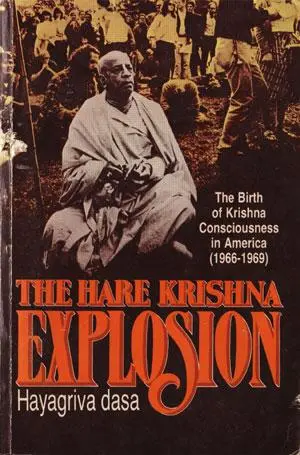
By Hayagriva das
Excerpted from ‘Back To Godhead’ Magazine
1970-1973 Vol.1, No. 46
When I first met my spiritual master, His Divine Grace A.C. Bhaktivedanta Swami Prabhupada, I felt that there was never a time when I did not know him. I never tire of telling of my first meeting with him on the streets of Lower East Side New York. At the time, I was hurrying from my Mott Street apartment, which had become a refuge for psychedeliacs, to a much quieter apartment on Fifth Street where I hoped to get some peace. I was walking down Houston Street and across Bowery, past the rushing traffic and stumbling derelicts, and after crossing Bowery, just before Second Avenue, I saw His Divine Grace jauntily strolling down the sidewalk, his head high in the air, his hand in a beadbag. He struck me like a famous actor in a very familiar movie. He seemed ageless, though later I found out that he was seventy years old. He was wearing the traditional saffron colored robes of a sannyasi, the renounced order, and quaint white shoes with points. Coming down Houston Street, he looked like the genie that popped out of Aladdin’s lamp. I was fresh from a trip to India, and His Divine Grace reminded me of the many holy men I had recently seen walking the dirt roads of Hardwar and Rishikesh and bathing in the Ganges. I had gone to India to look for a guru but had returned disappointed. It was on this bright July morning, when I was least expecting it, that Sri Krsna, out of His infinite mercy, sent guru to me. The old Vedic adage—by the grace of Krsna you get guru, and by the grace of guru you get Krsna—was justified. Afterwards, Srila Prabhupada (as we were later to call him) often told me, “If you are sincere, you don’t have to search out your guru. Krsna will send him.” So amid the hot clang and clamor of Houston and Bowery, guru had found me out.
More
23 Apr 2012
by The Hare Krishna Movement
in A.C. Bhaktivedanta Swami Prabhupada, Bhagavad-gita, Bhakti Yoga, Krishna Consciousness, Yoga
Tags: astanga-yoga, bhakti yoga, Govinda, jnana-yoga, karma yoga, Krishna, Srila Prabhupada, Syamasundara, Vasudeva, yoga, yogi

If one is fortunate enough to come to the point of bhakti-yoga, it is to be understood that he has surpassed all the other yogas. Therefore, to become Kṛṣṇa conscious is the highest stage of yoga, just as, when we speak of Himalayan, we refer to the world’s highest mountains, of which the highest peak, Mount Everest, is considered to be the culmination.
The culmination of all kinds of yoga practices lies in bhakti-yoga. All other yogas are but means to come to the point of bhakti in bhakti-yoga. Yoga actually means bhakti-yoga; all other yogas are progressions toward the destination of bhakti-yoga. From the beginning of karma-yoga to the end of bhakti-yoga is a long way to self-realization. Karma-yoga, without fruitive results, is the beginning of this path. When karma-yoga increases in knowledge and renunciation, the stage is called jñāna-yoga. When jñāna-yoga increases in meditation on the Supersoul by different physical processes, and the mind is on Him, it is called aṣṭāṅga-yoga. And, when one surpasses the aṣṭāṅga-yoga and comes to the point of the Supreme Personality of Godhead Kṛṣṇa, it is called bhakti-yoga, the culmination. Factually, bhakti-yoga is the ultimate goal, but to analyze bhakti-yoga minutely one has to understand these other yogas. The yogī who is progressive is therefore on the true path of eternal good fortune.
It is by great fortune that one comes to Kṛṣṇa consciousness on the path of bhakti-yoga to become well situated according to the Vedic direction. The ideal yogī concentrates his attention on Kṛṣṇa, who is called Śyāmasundara, who is as beautifully colored as a cloud, whose lotus-like face is as effulgent as the sun, whose dress is brilliant with jewels and whose body is flower garlanded. Illuminating all sides is His gorgeous luster, which is called the brahmajyoti. He incarnates in different forms such as Rāma, Nṛsiṁha, Varāha and Kṛṣṇa, the Supreme Personality of Godhead, and He descends like a human being, as the son of Mother Yaśodā, and He is known as Kṛṣṇa, Govinda and Vāsudeva. He is the perfect child, husband, friend and master, and He is full with all opulences and transcendental qualities. If one remains fully conscious of these features of the Lord, he is called the highest yogī.
More
22 Apr 2012
by The Hare Krishna Movement
in Devotional Service, Krishna Consciousness, Vaisnava-aparadha
Tags: bhakti creeper, His Divine Grace A.C. Bhaktivedanta Swami Prabhupada, Krsna consciousness becomes polluted by material activities, laws of nature, Lord Krsna, mad elephant offense, offending a brahmana, offending a vaisnava, pure consciousness, Srimad Bhagavatam, vaiṣṇava-aparādha, Vaisnavas

Sometimes we see that devotees, even though they are following the rules and regulations, appear not to be making very much spiritual advancement. Often we see that they appear to be going backwards rather than forward in their devotional lives. This is often the case of “the mad elephant offense” or vaisnava-aparadha, which can stop or destroy their devotional career, and should be carefully avoided. We have included a few select verses from Srila Prabhupada’s Srimad Bhagavatam which support this statement.
…To commit an offense against a devotee is very dangerous in devotional service. Lord Caitanya therefore said that an offense to a devotee is just like a mad elephant run loose; when a mad elephant enters a garden, it tramples all the plants. Similarly, an offense unto the feet of a pure devotee murders one’s position in devotional service…
…One’s pure intelligence, or pure Kṛṣṇa consciousness, becomes polluted by material activities. Pure consciousness can be revived by the process of sacrifice, charity, pious activities, etc., but when one pollutes his Kṛṣṇa consciousness by offending a brāhmaṇa or a Vaiṣṇava, it is very difficult to revive. Śrī Caitanya Mahāprabhu has described the vaiṣṇava-aparādha, or offense to a Vaiṣṇava, as “the mad elephant offense.” One should be very careful not to offend a Vaiṣṇava or a brāhmaṇa…
Srimad Bhagavatam 3.15.39
kṛtsna-prasāda-sumukhaṁ spṛhaṇīya-dhāma
snehāvaloka-kalayā hṛdi saṁspṛśantam
śyāme pṛthāv urasi śobhitayā śriyā svaś-
cūḍāmaṇiṁ subhagayantam ivātma-dhiṣṇyam
The Lord is the reservoir of all pleasure. His auspicious presence is meant for everyone’s benediction, and His affectionate smiling and glancing touch the core of the heart. The Lord’s beautiful bodily color is blackish, and His broad chest is the resting place of the goddess of fortune, who glorifies the entire spiritual world, the summit of all heavenly planets. Thus it appeared that the Lord was personally spreading the beauty and good fortune of the spiritual world.
Purport
When the Lord came, He was pleased with everyone; therefore it is stated here, kṛtsna-prasāda-sumukham. The Lord knew that even the offensive doormen were His pure devotees, although by chance they committed an offense at the feet of other devotees. To commit an offense against a devotee is very dangerous in devotional service. Lord Caitanya therefore said that an offense to a devotee is just like a mad elephant run loose; when a mad elephant enters a garden, it tramples all the plants. Similarly, an offense unto the feet of a pure devotee murders one’s position in devotional service. On the part of the Lord there was no offended mood because He does not accept any offense created by His sincere devotee. But a devotee should be very cautious of committing offenses at the feet of another devotee. The Lord, being equal to all, and being especially inclined to His devotee, looked as mercifully at the offenders as at the offended. This attitude of the Lord was due to His unlimited quantity of transcendental qualities. His cheerful attitude towards the devotees was so pleasing and heart-touching that His very smile was attractive for them. That attraction was glorious not only for all the higher planets of this material world, but beyond, for the spiritual world also. Generally a human being has no idea of what the constitutional position is in the higher material planets, which are far better constituted in regard to all paraphernalia, yet the Vaikuṇṭha planet is so pleasing and so celestial that it is compared to the middle jewel or locket in a necklace of jewels.
More
17 Apr 2012
by The Hare Krishna Movement
in Festivals, Ratha-yatra
Tags: festival of charoits, festival of India 2012 schedule, madhuha das, Ratha-yatra, summer tour, The Hare Krishna Movement
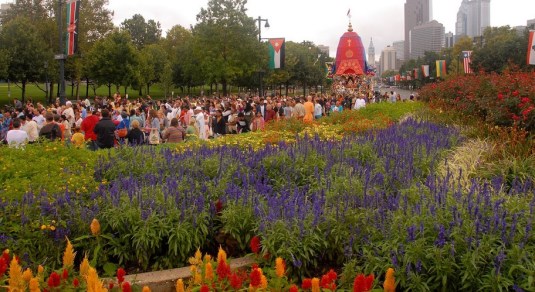
Festival Of India 2012 Summer Tour
2012 Proposed Tour Schedule (Up-dated March 21, 2012)
March 7———-Gaura Purnima
*March 17 and 18———-Miami, Florida, Ratha-yatra and Festival of India
April 2———-Washington D.C., American University, Festival of India
April 4 and 5———-University of Maryland; College Park, Festival of India
May 2———-Washington D.C., George Washington University, Festival of India
May 4———-University of Maryland, Baltimore, Festival of India
May 19———-Jacksonville, Florida, Ratha-yatra/Festival of India
*May 26 and 27———- Baltimore, Maryland, Ratha-yatra/Festival of India
June 2 and 3———-Atlanta, Georgia, Pani Hati/Ratha-yatra/Festival of India
*June 9———-New York City, New York, Ratha-yatra/Festival of India
*June 24———-Chicago, Illinois, Ratha-yatra/Festival of India
July 4———-Washington D.C., Ratha-yatra/Festival of India
*July 7 and 8———-Montreal, Quebec, Canada, Ratha-yatra/Festival of India
*July 14 and 15———-Toronto, Ontario, Canada, Ratha-yatra/Festival of India
July 17———-Thunder Bay, Ontario, Canada, Ratha-yatra/Festival of India
*July 21———-Calgary, Alberta, Canada, Ratha-yatra/Festival of India
July 22———- San Francisco, California, Ratha-yatra
*July 28———-Edmonton, Alberta, Canada, Ratha-yatra/Festival of India
July 31/August 1———-Las Vegas, Nevada, Harinam Sankirtan & Book Distribution on the Strip
*August 5———-Los Angeles, California, Ratha-yatra/Festival of India
August 9———-Vancouver, British Columbia, Canada, Sri Krishna Janmastami
August 10———-Vancouver, British Columbia, Canada, Srila Prabhupada’s Vyasa Puja
*August 18 and 19———- Vancouver, British Columbia, Canada, Ratha-yatra/Festival of India
*September 1, 2 and 3/Labor Day Weekend———-Seattle, Washington, Ratha-yatra/Festival of India
September 15 & 16———-Boston, Ratha-yatra/Srila Prabhupada’s Commonwealth Pier Arrival Fest
*September 22———-Philadelphia, Pennsylvania–Ratha-yatra/Radhastami
October 20———-Potomac, Maryland. Sri Ramacandra Vijayotsava Festival
*These cities/dates are Confirmed
Hare Krishna
Pasted from http://www.festivalofindia.org
13 Apr 2012
by The Hare Krishna Movement
in Krishna, Krishna Consciousness, The Hare Krishna Movement, The Reservoir of Pleasure
Tags: A.C. Bhaktivedanta Swami Prabhupada, bhagavad-gita, devotional service, His Divine Grace, Krishna consciousness, Krsna The Reservoir of Pleasure, pure consciousness, real life, real pleasure, Sri Krsna

Kṛṣṇa, the Reservoir of Pleasure
by His Divine Grace A. C. Bhaktivedanta Swami Prabhupāda
Kṛṣṇa—this sound is transcendental. Kṛṣṇa means the highest pleasure. All of us, every living being, seeks pleasure. But we do not know how to seek pleasure perfectly. With a materialistic concept of life, we are frustrated at every step in satisfying our pleasure because we have no information regarding the real level on which to have real pleasure. For the last few weeks we have been learning that we are not this body; we are consciousness. Not exactly consciousness, for consciousness is actually the symptom of our real identity: we are pure soul, now merged within this material body. Modern material science lays no stress on this; therefore the scientists are sometimes misled in their understanding of spirit soul. But spirit soul is a fact, which anyone can understand by the presence of consciousness. Any child can understand that consciousness is the symptom of the spirit soul.
Now the whole process we are trying to learn from the Bhagavad-gītā (The Song of God) is how to bring ourselves to this level of consciousness. And if we act from the level of consciousness, then we may not be pushed again into the level of this bodily conception; and, if we can continue on that level, if we can continue to act in pure consciousness, then, at the end of this body we shall be free from material contamination, our spiritual life will be revived, and the ultimate result will be that in our next life, after leaving this body, we shall have our full, eternal spiritual life. Spirit, as we have already discussed, is described as eternal.
More
12 Apr 2012
by The Hare Krishna Movement
in Narada-bhakti-sutra
Tags: A.C. Bhaktivedanta Swami Prabhupada, devotional service., gopis, Krishna, Narada Muni
click to enlarge picture
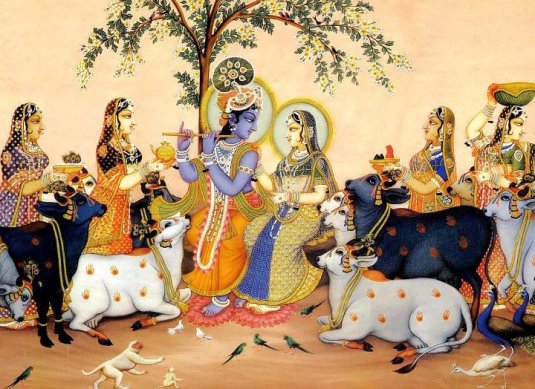
“My dear gopīs, I am not able to repay My debt for your spotless service, even within a lifetime of Brahmā. Your connection with Me is beyond reproach. You have worshiped Me, cutting off all domestic ties, which are difficult to break. Therefore please let your own glorious deeds be your compensation.”
Narada-bhakti-sutra
By His Divine Grace A.C. Bhaktivedanta Swami Prabhupada
Text 7
sā na kāmayamānā nirodha-rūpatvāt
sā—that devotional service in pure love of God; na—not; kāmayamānā—like ordinary lust; nirodha—renunciation; rūpatvāt—because of having as its form.
There is no question of lust in the execution of pure devotional service, because in it all material activities are renounced.
PURPORT
In pure devotional service there is no question of sense gratification. Some people mistake the loving affairs between Kṛṣṇa and the gopīs (cowherd girls) for activities of ordinary sense gratification, but these affairs are not lustful because there is no material contamination. As Rūpa Gosvāmī states in his Bhakti-rasāmṛta-sindhu (1.2.285),
premaiva gopa-rāmāṇāṁ kāma ity agamat prathām
ity uddhavādayo ’py etaṁ vāñchanti bhagavat-priyāḥ
“Although the dealings of the gopīs with Kṛṣṇa are wrongly celebrated by many as lust, great sages and saintly persons like Uddhava hanker for such loving affairs with Kṛṣṇa.” Śrīla Kṛṣṇadāsa Kavirāja, the author of Caitanya-caritāmṛta, has therefore said,
kāma, prema,—doṅhākāra vibhinna lakṣaṇa
lauha āra hema yaiche svarūpe vilakṣaṇa
“As there is a difference between iron and gold, so there is a difference between material lust and Kṛṣṇa’s loving affairs with the gopīs” (Cc. Ādi 4.164). Although such loving affairs may sometimes resemble material lust, the difference is as follows:
ātmendriya-prīti-vāñchā—tāre bali ‘kāma’
kṛṣṇendriya-prīti-icchā dhare ‘prema’ nāma
“The desire to satisfy one’s own senses is called lust, while the desire to satisfy the senses of Kṛṣṇa is called prema, love of God” (Cc. Ādi 4.165).
More
11 Apr 2012
by The Hare Krishna Movement
in Festivals, Ratha-yatra
Tags: Govinda's resturant, Henderson Heritage Parade and Festival, Prasadam, rathayatra festival in Las Vegas

Maha Harinam
Join in for hours of blissful chanting & dancing on the world famous Las Vegas Strip!
When: Friday, April 21, 6-9 PM
Meeting place: Govinda’s Center at 5:30 PM or the Excalibur outdoor parking lot at 6:00 PM
Harinam route: on Las Vegas Blvd. from Excalibur to Bellagio and back from Paris to MGM.
Ratha Yatra Parade
First ever Ratha Yatra in Las Vegas!
Please note: Ratha yatra is a part of the Henderson Heritage Parade and Festival.
When: Saturday, April 22, 9:30-11 AM
Start of the parade: Water St. & Ocean Ave. in Henderson, Water Street District, Map & Directions
Parade route: on Water St. from Ocean Ave. to Atlantic Ave.
What happens after the parade: Heritage Festival organized by the City of Henderson will follow the parade and will include live entertainment, international food booths, dance and cooking demonstrations, craft booths and more!
Please visit Govinda’s booth from 10:00 – 7:00 PM. We will be distributing prasadam, books and Indian gifts.
See us on the Henderson Amphitheater Stage at 1:30 PM performing live kirtan and classic Indian dance.
10 Apr 2012
by The Hare Krishna Movement
in Guru & Disciple, Remembering Srila Prabhupada, The Hare Krishna Movement
Tags: conditioned soul, devotees, disciple, Iskcon, Krishna, Prabhupada's ISKCON, Prahlada-Nrsibha das, spiritual master, Srila Prabhupada, Supreme Personality of Godhead

click on image to enlarge
Prabhupada’s ISKCON is Beautiful and Perfect!
By Prahlada-Nrsimha das
Apr 09, 2012 — USA (SUN)
I often write to simply sort out my own thoughts and get them off my chest, so to speak. Recently I came across the following letter I wrote a long time ago. Although it is just my own thoughts, maybe others will be inspired by it, so I am presenting it here:
“As it is said by Srila Visvanatha Cakravarti Thakura, saksad-dharitvena samasta-sastraih: a spiritual master, or the parampara-acarya, should be respected exactly like the Supreme Personality of Godhead.” (SB 4.22.4)
Here we see the difference between a conditioned soul (or even an advanced devotee) and Srila Prabhupada. We must respect all devotees even though they are conditioned souls, to one degree or another, but it says here that “the spiritual master, or the parampara-acarya should be respected exactly like the Supreme Personality of Godhead”. It is not proper to put a conditioned soul in this position and thus artificially give him (or her) the respect or worship equal to the Supreme Personality of Godhead. This will simply cause a disturbance.
Artificial or blind following can and will create havoc in the world.
More
10 Apr 2012
by The Hare Krishna Movement
in Bhagavad-gita, Devotional Service, Free Downloads, Raja-Vidya
Tags: Arjuna, Bg. 9.2, bhagavad-gita, books by Srila Prabhupada, chanting Hare Krishna, confidential knowledge, devotional service, Krishna, Raja-Vidya

click on link at bottom for a free download on entire book to read online or save in pdf format
…It is said that the execution of devotional service is so perfect that one can perceive the results directly. This direct result is actually perceived, and we have practical experience that any person who is chanting the holy names of Kṛṣṇa (Hare Kṛṣṇa, Hare Kṛṣṇa, Kṛṣṇa Kṛṣṇa, Hare Hare/ Hare Rāma, Hare Rāma, Rāma Rāma, Hare Hare)in course of time feels some transcendental pleasure and very quickly becomes purified of all material contamination. This is actually seen. Furthermore, if one engages not only in hearing but in trying to broadcast the message of devotional activities as well, or if he engages himself in helping the missionary activities of Kṛṣṇa consciousness, he gradually feels spiritual progress. This advancement in spiritual life does not depend on any kind of previous education or qualification. The method itself is so pure that by simply engaging in it one becomes pure.
Bhagavada-gita As It Is Macmillan Edition 1975
By His Divine Grace A.C. Bhaktivedanta Swami Prabhupada
Chapter 9, Text 2
rāja-vidyā rāja-guhyaṁ
pavitram idam uttamam
pratyakṣāvagamaṁ dharmyaṁ
su-sukhaṁ kartum avyayam
rāja-vidyā—the king of education; rāja-guhyam—the king of confidential knowledge; pavitram—the purest; idam—this; uttamam—transcendental; pratyakṣa—directly experienced; avagamam—understood; dharmyam—the principle of religion; susukham—very happy; kartum—to execute; avyayam—everlasting.
This knowledge is the king of education, the most secret of all secrets. It is the purest knowledge, and because it gives direct perception of the self by realization, it is the perfection of religion. It is everlasting, and it is joyfully performed.
Purport
This chapter of Bhagavad-gītā is called the king of education because it is the essence of all doctrines and philosophies explained before. There are seven principal philosophers in India: Gautama, Kaṇāda, Kapila, Yājñavalkya, Śāṇḍilya, Vaiśvānara, and, finally, Vyāsadeva, the author of the Vedānta-sūtra. So there is no dearth of knowledge in the field of philosophy or transcendental knowledge. Now the Lord says that this Ninth Chapter is the king of all such knowledge, the essence of all knowledge that can be derived from the study of the Vedas and different kinds of philosophy. It is the most confidential because confidential or transcendental knowledge involves understanding the difference between the soul and the body. And the king of all confidential knowledge culminates in devotional service.
More
09 Apr 2012
by The Hare Krishna Movement
in A.C. Bhaktivedanta Swami Prabhupada, Back to Godhead, The Hare Krishna Movement, Varnasrama Dharma
Tags: back to Godhead, bhagavad-gita, Hindu, Krsna Balarama Mandir, Lord Caitanya, Ramananda Raya, Srila Prabhupada, The Hare Krishna Movement, varnasrama dharma, varnasrama-dharma
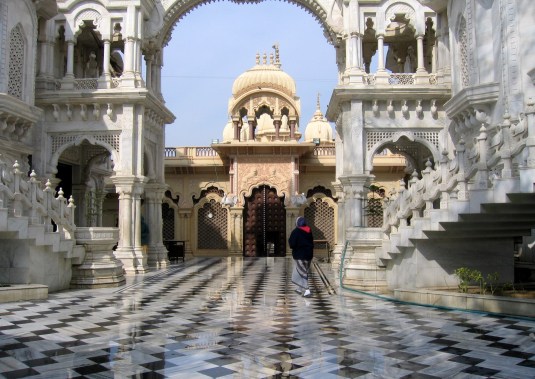
…When Lord Caitanya talked with the great devotee Ramananda Raya, the Lord asked him, “What is the basic principle of human life?” Ramananda Raya answered that human civilization begins when varnasrama-dharma is accepted. Before coming to the standard of varnasrama-dharma there is no question of human civilization. Therefore, the Krsna consciousness movement is trying to establish this right system of human civilization, which is known as Krsna consciousness, or daiva-varnasrama—divine culture.
Divine Culture
By His Divine Grace A.C. Bhaktivedanta Swami Prabhupada
Excerpted from ‘Back To Godhead 1974, Vol 1, No. 68
There is a misconception that the Krsna consciousness movement represents the Hindu religion. In act, however, Krsna consciousness is in no way a faith or religion that seeks to defeat other faiths or religions. Rather, it is an essential cultural movement for the entire human society and does not consider any particular sectarian faith. This cultural movement is especially meant to educate people in how they can love God.
Sometimes Indians both inside and outside of India think that we are preaching the Hindu religion, but actually we are not. One will not find the word “Hindu” in Bhagavad-gita. Indeed, there is no such word as “Hindu” in the entire Vedic literature. This word has been introduced by the Muslims from provinces next to India, such as Afghanistan, Baluchisthan and Persia. There is a river called “Sindhu” bordering the northwestern provinces of India, and since the Muslims there could not pronounce “Sindhu” properly, instead they called the river “Hindu,” and the inhabitants of this tract of land they called “Hindus.” In India, according to the Vedic language, the Europeans are called mlecchas or yavanas. Similarly, “Hindu” is a name given by the Muslims.
More
08 Apr 2012
by The Hare Krishna Movement
in Krishna, Lord Jesus Christ, Science of Self Realization
Tags: Easter Sunday, guru, Jesus, Jesus Christ, spiritual master, Srila Prabhupada, The Science of Self Realization
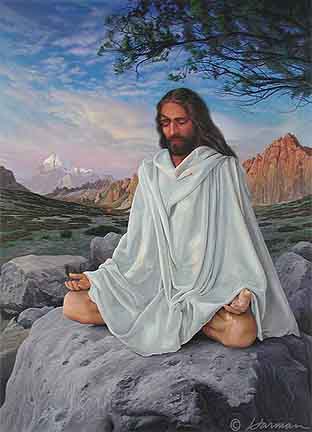
Today here in the West most of the World is celebrating Easter Sunday, therefore we are posting some of Srila Prabhupada’s instructions on Jesus Christ
…Jesus Christ was such a great personality—the son of God, the representative of God. He had no fault. Still, he was crucified. He wanted to deliver God consciousness, but in return they crucified him—they were so thankless. They could not appreciate his preaching. But we appreciate him and give him all honor as the representative of God.
Of course, the message that Christ preached was just according to his particular time, place, and country, and just suited for a particular group of people. But certainly he is the representative of God. Therefore we adore Lord Jesus Christ and offer our obeisances to him.
Once, in Melbourne, a group of Christian ministers came to visit me. They asked, “What is your idea of Jesus Christ?” I told them, “He is our guru. He is preaching God consciousness, so he is our spiritual master.” The ministers very much appreciated that.
Actually, anyone who is preaching God’s glories must be accepted as a guru. Jesus Christ is one such great personality. We should not think of him as an ordinary human being. The scriptures say that anyone who considers the spiritual master to be an ordinary man has a hellish mentality. If Jesus Christ were an ordinary man, then he could not have delivered God consciousness…
The Science of Self Realization
By His Divine Grace A.C. Bhaktivedanta Swami Prabhupada
Chapter 4,
Understanding Krsna and Christ
The Śrīmad-Bhāgavatam states that any bona fide preacher of God consciousness must have the qualities of titikṣā (tolerance) and karuṇā (compassion). In the character of Lord Jesus Christ we find both these qualities. He was so tolerant that even while he was being crucified, he didn’t condemn anyone. And he was so compassionate that he prayed to God to forgive the very persons who were trying to kill him. (Of course, they could not actually kill him. But they were thinking that he could be killed, so they were committing a great offense.) As Christ was being crucified he prayed, “Father, forgive them. They know not what they are doing.”
More
07 Apr 2012
by The Hare Krishna Movement
in Bhaktivinoda Thakura, Practicing Krishna Consciousness at Home, Prasadam
Tags: baja bhakta vatsala, bhoga arotik, Krishna's lunch, Sri Gaurahari, Srila Bhaktivinoda Thakura, Srila Prabhupada

This was the song that Srila Prabhupada introduced to be sung at the noon Bhoga-Arotik when offering Krishna His lunch
Bhaja Bhakata Vatsala
By Srila Bhaktivinoda Thakur
Just worship Sri Gaurahari, who is always affectionate toward His devotees. He is the same Supreme Godhead, Krsna, who sported in the cowherd pastures of Vraja and stole the hearts of Nanda and Yasoda.
Mother Yasoda calls to Krsna, “My dear Damodara, it is very late. Please come right now, sit down in the dining hall, and take Your lunch.”
On the direction of Nanda Maharaja, Krsna, the holder of Govardhana Hill, sits down, and then all the cowherd boys, along with Krsna’s elder brother, Sri Baladeva, sit down in rows to take their lunch.
They are then served a feast of sukta and various kinds of green leafy vegetables, then nice fried things, and a salad made of the green leaves of the jute plant. They are also served pumpkin, baskets of fruit, small square cakes made of lentils and cooked down milk, then thick yogurt, squash cooked in milk, and vegetable preparations made from the tower of the banana tree.
Then they receive fried squares of mung dahl patties, and urad dahl patties, capatis, and rice with ghee. Next, sweets made with milk, sugar and sesamum, rice flour cakes; thick cooked-down milk; cakes floating in milk; and sweet rice.
There is also sweet rice that tastes just like nectar due to its being mixed with camphor. There are bananas, and cheese which is nectarean and delicious. They are also served twelve kinds of sour preparations made with tamarinds, limes, lemons, oranges, and pomegranates.
There are puns made with white flour and sugar; puns filled with cream; laddus; and dahl patties boiled in sugared rice. Krsna eagerly eats all of the food.
In great ecstasy and joy Krsna eats the rice, curried vegetables, sweets, and pastries cooked by Srimati Radharani.
Krsna’s funny brahmana friend Madhumangala, who is very fond of Laddus, gets them by hook or by crook. Eating the laddus he shouts, “Haribol! Haribol!~’ and makes a funny sound by swapping his sides under his armpits with his hands.
Beholding Radharani and Her gopifriends out of the courters of His eyes, Krsna eats at the house of mother Yasoda with great satisfaction.
After lunch, Krsna drinks rose-scented water. Then all of the boys, standing in lines, wash their mouths.
After all the cowherd boys wash their hands and mouths, in great bliss they take rest with Lord Balarama.
The two cowherd boys Jambula and Rasala then bring Krsna pan made with betel nuts, fancy spices, and catechu. After eating that pin, Sri Krsnacandra then happily goes to sleep.
While Krsna happily takes His rest on an excellent bedstead, His servant Visalaksa cools Him with a fan of peacock feathers.
At mother Yasoda’s request the gopi Dhanistha brings remnants of food left on Krsna’s plate to Srimati Radharani, who eats them with great delight
Lalita-devi and the other gopis then receive the remnants, and within their hearts they sing the glories of Radharani and Krsna with great joy.
Thakura Bhaktivinoda, whose one and only Joy is the pastimes of Lord Hari, sings this Bhoga-arati song
Bengali lyrcis follow… More
05 Apr 2012
by The Hare Krishna Movement
in Caitanya Mahaprabhu, Chanting Hare Krishna, Sri Caitanya-Caritamrta
Tags: 1975 edition, A.C. Bhaktivedanta Swami Prabhupada, Adi-lila 7.95-56, chanting Hare Krishna, chanting the holy names of the Lord, Hare Krishna, Kali-yuga, Lord Sri Caitanya Mahaprabhu, Sri Caitanya-caritamrta

…It is to be understood that when Śrī Caitanya Mahāprabhu chanted and danced, He did so by the influence of the pleasure potency of the spiritual world. Śrī Caitanya Mahāprabhu never considered the holy name of the Lord to be a material vibration, nor does any pure devotee mistake the chanting of the Hare Kṛṣṇa mantra to be a material musical manifestation. Lord Caitanya never tried to be the master of the holy name; rather He taught us how to be servants of the holy name…I firmly believe that simply chanting the holy name of the Lord can remove all misconceptions of the material world. I believe that simply by chanting the holy name of the Lord one can attain the shelter of the lotus feet of the Lord. In this age of quarrel and disagreement, the chanting of the holy names is the only way to liberation from the material clutches.
Sri Caitanya-caritamrta – 1975 Edition
By His Divine Grace A.C. Bhaktivedanta Swami Prabhupada
Adi-lila 7. 95-96
Lord Caitanya in Five Features
“I firmly believe in these words of My spiritual master, and therefore I always chant the holy name of the Lord, alone and in the association of devotees. That holy name of Lord Kṛṣṇa sometimes causes Me to chant and dance, and therefore I chant and dance. Please do not think that I intentionally do it. I do it automatically.
Purport
A person who cannot keep his faith in the words of his spiritual master but acts independently never receives the authority to chant the holy name of the Lord. It is said in the Vedas (Śvetāśvatara Upaniṣad 6.23):
yasya deve parā bhaktir
yathā deve tathā gurau
tasyaite kathitā hy arthāḥ
prakāśante mahātmanaḥ
“Only unto those great souls who have implicit faith in both the Lord and the spiritual master are all the imports of Vedic knowledge automatically revealed.” This Vedic injunction is very important, and Śrī Caitanya Mahāprabhu supported it by His personal behavior. Believing in the words of His spiritual master, He introduced the saṅkīrtana movement, just as the present Kṛṣṇa consciousness movement was started with belief in the words of our spiritual master. He wanted to preach, we believed in his words and tried somehow or other to fulfill them, and now this movement has become successful all over the world. Therefore faith in the words of the spiritual master and in the Supreme Personality of Godhead is the secret of success. Śrī Caitanya Mahāprabhu never disobeyed the orders of His spiritual master and stopped propagating the saṅkīrtana movement. Śrī Bhaktisiddhānta Sarasvatī Gosvāmī, at the time of his passing away, ordered all his disciples to work conjointly to preach the mission of Caitanya Mahāprabhu all over the world. Later, however, some self-interested, foolish disciples disobeyed his orders. Each one of them wanted to become head of the mission, and they fought in the courts, neglecting the order of the spiritual master, and the entire mission was defeated. We are not proud of this; however, the truth must be explained. We believed in the words of our spiritual master and started in a humble way-in a helpless way-but due to the spiritual force of the order of the supreme authority, this movement has become successful.
More
02 Apr 2012
by The Hare Krishna Movement
in Guru & Disciple, ISKCON, Remembering Srila Prabhupada, Srila Prabhupada
Tags: Founder Acarya, Founder Acarya of the International Society for Krishna Consciousness, GBC, GBC Resolution #309, His Divine Grace A.C. Bhaktivedanta Swami Prabhupada, Iskcon, Srila Prabhupada, teachings of His Divine Grace
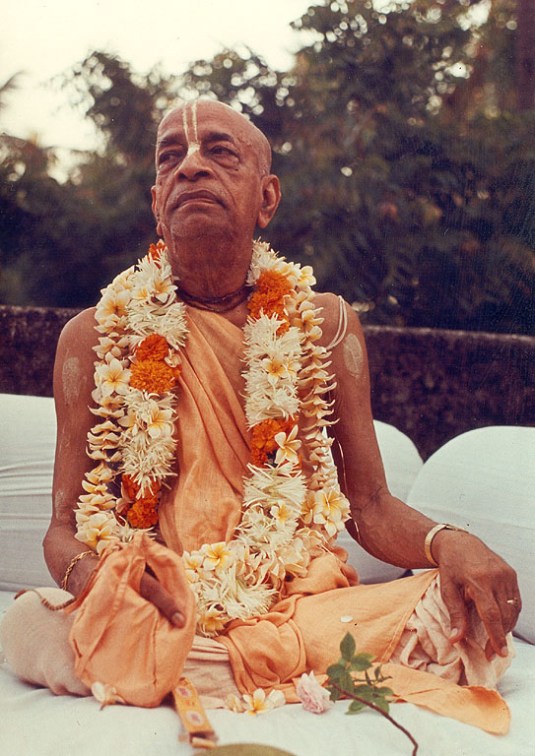
Here is a new GBC resolution I found interesting…
GBC Resolution #309
ISKCON GOVERNING BODY COMMISSION SOCIETY
Registration Number S/74662 under the West Bengal Societies Registration Act, 1961
P.O. Shree Mayapur Dham, Dist. Nadia, West Bengal 741313
MINUTES OF THE ANNUAL GENERAL MEETING
SRI MAYAPUR DHAM, FEBRUARY 10 – 21, 2012
309. Founder-Acarya on ISKCON Guru Websites
[Guideline]
Whereas the proliferation of official and unofficial websites of ISKCON gurus currently do not, in large part, prominently feature the personality and teachings of His Divine Grace A.C. Bhaktivedanta Swami Prabhupada as the Founder-Acarya of the International Society for Krishna Consciousness on the introduction page as well as on many other pages;
And whereas it is necessary to establish guidelines for such websites so that as far as possible visitors are made aware that whatever inspiration the devotees are receiving from the guru is due to the great mercy of Srila Prabhupada:
RESOLVED:
ISKCON gurus shall be responsible for ensuring that their own official websites adhere to the following guidelines:
1. They prominently feature a picture of Srila Prabhupada on the introductory page
2. They credit him as the “Founder-Acarya of the International Society for Krishna Consciousness”
3. They contain a brief summary of his accomplishments and provide authorized website links to his teachings
The Guru Services Committee will compile a suggested comprehensive template for use in guru websites.
02 Apr 2012
by The Hare Krishna Movement
in Krishna Consciousness, Teachings of Queen Kunti
Tags: asamaurdhva, Devaki, Hrsikesa, King Kamsa, Krsna, kuntidevi, Lord Brahma, Lord Krsna, Lord Siva, Nanda Maharaja, Queen Kunti, Vasudeva
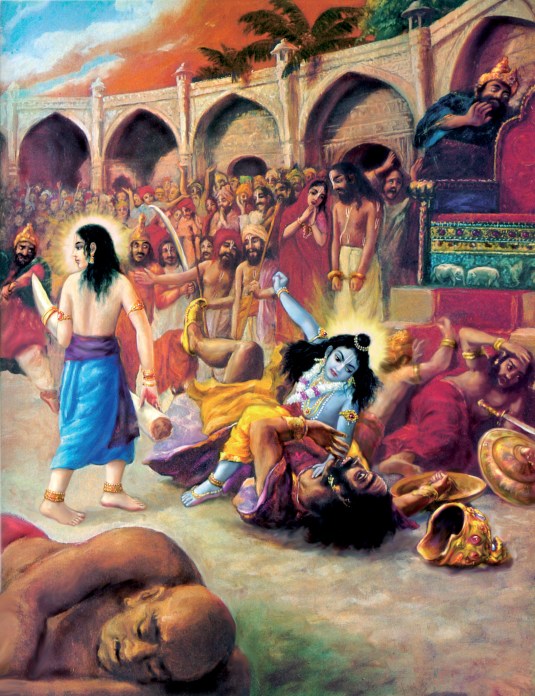
…Of course, the world is full of dangers. But Kuntīdevī says, “Because Devakī is Your devotee, You saved her from the distresses imposed upon her by her envious brother.”
…For sense gratification we have fallen into this material condition and are suffering in different varieties of life. Because this is the material world, even Kṛṣṇa’s mother was put into suffering. Devakī was so advanced that she became the mother of Kṛṣṇa, but still she was put into difficulties by her own brother, Kaṁsa. That is the nature of this material world. The living entities in this world are so jealous that if one’s personal interest is hampered, one will immediately be ready to give trouble to others, even to one’s nearest relatives.
“A person who acts in the service of Kṛṣṇa with his body, mind, intelligence, and words is a liberated person, even within the material world.”
Teachings of Queen Kunti
By His Divine Grace A.C. Bhaktivedanta Swami Prabhupada
Chapter 6
The Master of the Senses
yathā hṛṣīkeśa khalena devakī
kaṁsena ruddhāticiraṁ śucārpitā
vimocitāhaṁ ca sahātmajā vibho
tvayaiva nāthena muhur vipad-gaṇāt
O Hṛṣīkeśa, master of the senses and Lord of lords, You have released Your mother, Devakī, who was long imprisoned and distressed by the envious King Kaṁsa, and me and my children from a series of constant dangers.
—Śrīmad-Bhāgavatam 1.8.23
Devakī, the mother of Kṛṣṇa and sister of King Kaṁsa, was put into prison along with her husband, Vasudeva, because the envious King was afraid of being killed by Devakī’s eighth son (Kṛṣṇa). The King killed all the sons of Devakī who were born before Kṛṣṇa, but Kṛṣṇa escaped the danger of child-slaughter because He was transferred to the house of Nanda Mahārāja, Lord Kṛṣṇa’s foster father. Kuntīdevī, along with her children, was also saved from a series of dangers. But Kuntīdevī was shown far more favor because Lord Kṛṣṇa did not save the other children of Devakī, whereas He saved the children of Kuntīdevī. This was done because Devakī’s husband, Vasudeva, was living, whereas Kuntīdevī was a widow and there was none to help her except Kṛṣṇa. The conclusion is that Kṛṣṇa bestows more favor upon a devotee who is in greater dangers. Sometimes He puts His pure devotees in such dangers because in that condition of helplessness the devotee becomes more attached to the Lord. The more the attachment is there for the Lord, the more success is there for the devotee.
More
02 Apr 2012
by The Hare Krishna Movement
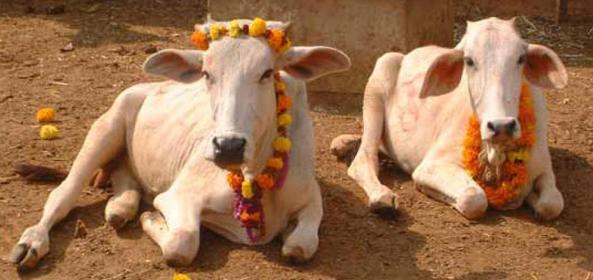
in Cow Protection, Devotee's, Kurma Rupa das
Tags: Care For Cows, careforcows.org, cow protection, cows, Cows Newsletter, goshalla, Hari Bhakti-vilas 16.252, Kurma Rupa dasa, Vrindavan

Care for Cows
By Kurma Rupa Dasa
Apr 01, 2012 — VRINDAVAN, INDIA (SUN) —
Dear Friends, Jai Govinda! Our April 2012 Care for Cows Newsletter has been posted. Please review it at your earliest convenience. In this edition of 32 pages (2.5 MB), we present reports on:
1. The arrival of a beautiful one-year-old dwarf cow.
2. A daring and heroic rescue of an abandoned bull calf.
3. The surprising transformation of a bull fighter.
4. The three-month attempt to save an injured bull calf.
5. The sixteen calves decorating our goshalla.
Thanks for your participation and support. I hope this finds you experiencing the happiness and inner satisfaction that accompanies cow protection. Jaya Sri Gopal!
Your friend and servant,
Kurma Rupa dasa
careforcows.org
May cows stay in front of me; may cows stay behind me; may cows stay on both sides of me. May I always reside in the midst of cows.
(Hari Bhakti-vilas 16.252)
30 Mar 2012
by The Hare Krishna Movement
in Lectures, Rama
Tags: A.C. Bhaktivedanta Swami Prabhupada, appearance of Lord Ramacandra, Lord Ramacandra, Rama, Rama Navami, Ramacandra, Ramadi, Sri Rama-navami lecture, Treta-yuga

…So Rāmacandra’s life, God’s activities, pastimes, if we hear, that means we are associating with Rāmacandra. There is no difference between His form, His name, His pastimes, and Himself. He’s absolute. Therefore either you chant the holy name of Rāma or you see the statue of Rāma or you talk of His pastimes, transcendental pastimes, everything, that means you are associating with the Supreme Personality of Godhead. So we take advantage of these days when the incarnation of God appears or disappears, and we try to associate with Him. By His association we become purified. Our process is purification. Kṛṣṇa consciousness means simply we are purifying our consciousness.
Śrī Rāma-Navamī, Lord Rāmacandra’s Appearance Day
By His Divine Grace A.C. Bhaktivedanta Swami Prabhupada
Hawaii, March 27, 1969
(kīrtana)
Prabhupāda: (chants maṅgalācaraṇa prayers)
rāmādi mūrtiṣu kalā-niyamena tiṣṭhan
nānāvatāram akarod bhuvaneṣu kintu
kṛṣṇaḥ svayaṁ samabhavat paramaḥ pumān yo
govindam ādi-puruṣaṁ tam ahaṁ bhajāmi
[Bs. 5.39]
This is a verse from Brahma-saṁhitā in which the incarnation of Lord Rāmacandra is described. Rāmādi. Not only Rāma, but there are many other, innumerable incarnations. They are compared with the waves of a river. As the waves of the river or the waves of the ocean cannot be counted, similarly, how many incarnations are there of the Supreme Lord it is not possible to count. But out of them, the principal names are mentioned in the śāstras. Therefore it is said rāmādi. Rāmādi means Rāma and also other, many incarnations. And they are existing. Not that one incarnation appeared and it is finished. No. Not like that. Just like Lord Rāmacandra appeared on this planet, say millions of years before. He appeared in the Treta-yuga. Treta-yuga means… We have passed only five thousand years of this age, Kali-yuga. Before that, there was Dvāpara-yuga. Dvāpara-yuga means 800,000 years. And before that, there was Tretā-yuga, which continued for twelve hundred thousands of years. That means at least two million years before Lord Rāmacandra appeared on this planet.
More
29 Mar 2012
by The Hare Krishna Movement
in Krsna is the Source of All Incarnations, Rama
Tags: A.C. Bhaktivedanta Swami Prabhupada, Hanuman, Rama, Ravana, Sita, Sri Rama, Srimad Bhagavatam, The Pewrsonality of Godhead

Srimad Bhagavatam
By His Divine Grace A.C. Bhaktivedanta Swami Prabhupada
Canto 1, Chapter 3, Text 22
Krsna Is the Source of All Incarnations
nara-devatvam āpannaḥ
sura-kārya-cikīrṣayā
samudra-nigrahādīni
cakre vīryāṇy ataḥ param
nara—human being; devatvam—divinity; āpannaḥ—having assumed the form of; sura—the demigods; kārya—activities; cikīrṣayā—for the purpose of performing; samudra—the Indian Ocean; nigraha-ādīni—controlling, etc.; cakre—did perform; vīryāṇi—superhuman prowess; ataḥ param—thereafter.
In the eighteenth incarnation, the Lord appeared as King Rāma. In order to perform some pleasing work for the demigods, He exhibited superhuman powers by controlling the Indian Ocean and then killing the atheist King Rāvaṇa, who was on the other side of the sea.
Purport
The Personality of Godhead Śrī Rāma assumed the form of a human being and appeared on the earth for the purpose of doing some pleasing work for the demigods or the administrative personalities to maintain the order of the universe. Sometimes great demons and atheists like Rāvaṇa and Hiraṇyakaśipu and many others become very famous due to advancing material civilization by the help of material science and other activities with a spirit of challenging the established order of the Lord. For example, the attempt to fly to other planets by material means is a challenge to the established order. The conditions of each and every planet are different, and different classes of human beings are accommodated there for particular purposes mentioned in the codes of the Lord. But, puffed up by tiny success in material advancement, sometimes the godless materialists challenge the existence of God. Rāvaṇa was one of them, and he wanted to deport ordinary men to the planet of Indra (heaven) by material means without consideration of the necessary qualifications. He wanted a staircase to be built up directly reaching the heavenly planet so that people might not be required to undergo the routine of pious work necessary to enter that planet. He also wanted to perform other acts against the established rule of the Lord. He even challenged the authority of Śrī Rāma, the Personality of Godhead, and kidnapped His wife, Sītā. Of course Lord Rāma came to chastise this atheist, answering the prayer and desire of the demigods. He therefore took up the challenge of Rāvaṇa, and the complete activity is the subject matter of the Rāmāyaṇa. Because Lord Rāmacandra was the Personality of Godhead, He exhibited superhuman activities which no human being, including the materially advanced Rāvaṇa, could perform. Lord Rāmacandra prepared a royal road on the Indian Ocean with stones that floated on the water. The modern scientists have done research in the area of weightlessness, but it is not possible to bring in weightlessness anywhere and everywhere. But because weightlessness is the creation of the Lord by which He can make the gigantic planets fly and float in the air, He made the stones even within this earth to be weightless and prepared a stone bridge on the sea without any supporting pillar. That is the display of the power of God.
26 Mar 2012
by The Hare Krishna Movement
in Chanting Hare Krishna, Devotee's, Diksha, Guru & Disciple, Hare Krishna Maha Mantra, Rupanuga das
Tags: A.C. Bhaktivedanta Swami Prabhupada, bhakti, Caitanya Caritamrta, disciples of Srila Prabhupada, Mad-lila 15. 105-111, Rupanuga das, spiritual master, Srila Prabhupada, vaisnava, vani

The Param-guru
By Sriman Rupanuga Prabhu (ACBSP)
Jan 20, 2012 (SUN)
Those sincere souls who have been submitting for decades to disciples of Srila Prabhupada as spiritual masters, only to be disappointed, need not leave the proven path of Bhakti as revealed by Srila Prabhupada (who is not at all at fault). Because of such disappointments, one may have doubts about success in Krsna consciousness. But the path is not to be abandoned. Instead, under the complete shelter of Srila Prabhupada one will be saved for sure from material existence.
There is no need to get initiated again and again. One can take complete shelter of Srila Prabhupada and the Holy Name, Nama Prabhu. Nama Rupe is independent, as confirmed in Caitanya-caritamrta Madhya lila, Chapter 15, verses 105 through 111 with purports, a must read carefully. These verses and purports below, clearly indicate that a sincere soul, initiated or not, can take shelter of Srila Prabhupada-vani and Lord Krsna, the Holy Name, directly.
The disappointed disciples of our Godbrothers remain on duty to give Srila Prabhupada’s mercy to the suffering masses of conditioned souls on this planet, which is known as Martyaloka or the planet of death. Krsna consciousness is a matter of life and death for everyone. Srila Prabhupada wanted millions, he said “a hundred million” devotees.
Respectful obeisances must go out to all the recently disappointed 1,500+ disciples, with the prayer to please take care to remain disciples under the direct protection of their Param-guru, Srila Prabhupada, who said that the grandfather is more kind to the sons than the father. So be it.
Pasted from; http://www.harekrsna.com/sun/editorials/01-12/editorials8173.htm
Caitanya-caritamrta Madhya lila, Chapter 15, text 105-111 with purports
More
25 Mar 2012
by The Hare Krishna Movement
in Bhagavad-gita, Krishna Consciousness, Raja-Vidya, Spiritual Life
Tags: A.C. Bhaktivedanta Swami Prabhupada, Action in Knowledge of Krsna, bound by karma, Brahma-samhita, fruitive reaction, karma, Krishna, material body, nature's arrangment, Raja-Vidya, the king of knowledge

…We must understand the meaning of relationships with Kṛṣṇa. In this material world we have many relationships as father, mother, wife or husband. Whatever relationship we find here is but a perverted reflection of the relationship we have with the Supreme Lord. Whatever we find in this material world is born of the Absolute Truth, but here it is pervertedly reflected in time. Whatever relationship we have with Kṛṣṇa goes on. If we have a relationship in friendship, that friendship is eternal and continues from life to life. In the material world, a friendship exists for a few years and then breaks; therefore it is called perverted, temporal, or unreal. If we make our friendship with Kṛṣṇa, it will never break. If we make our master Kṛṣṇa, we will never be cheated. If we love Kṛṣṇa as our son, He will never die. If we love Kṛṣṇa as our lover, He will be the best of all, and there will be no separation. Because Kṛṣṇa is the Supreme Lord, He is unlimited and has an unlimited number of devotees. Some are trying to love Him as lover or husband, and therefore Kṛṣṇa accepts this role. In whatever way we approach Kṛṣṇa, He will accept us, as He states in Bhagavad-gītā.
ye yathā māṁ prapadyante
tāṁs tathaiva bhajāmy aham
mama vartmānuvartante
manuṣyāḥ pārtha sarvaśaḥ
“All of them—as they surrender unto Me—I reward accordingly. Everyone follows My path in all respects, O son of Pṛthā.” (Bg. 4.11)
Raja-Vidya: The King of Knowledge
By His Divine Grace A.C. Bhaktivedanta Swami Prabhupada
Chapter 8
Action in Knowledge of Kṛṣṇa
na māṁ karmāṇi limpanti
na me karma-phale spṛhā
iti māṁ yo ’bhijānāti
karmabhir na sa badhyate
“There is no work that affects Me; nor do I aspire for the fruits of action. One who understands this truth about Me also does not become entangled in the fruitive reactions of work.”(Bg. 4.14)
The whole world is bound by karma. We all know of the existence of microbes or germs which exist by the million within the measurement of one millimeter. In the Brahma-saṁhitā it is stated that beginning with the microbe, which is called indragopa, up to Indra, the king of the heavenly planets, all are bound by karma, the reaction of work. We all have to suffer or enjoy the reactions of our work, be they good or bad. As long as we have to suffer or enjoy these reactions, we are bound to these material bodies.
By nature’s arrangement the material body is given to the living entity for his suffering or enjoying. Different types of bodies are acquired for different purposes. The body of a tiger is made for killing and eating raw meat. Similarly, the hogs are made in such a way that they can eat stool. And as human beings our teeth are made for eating vegetables and fruits. All of these bodies are made according to the work done in past lives by the living entity. Our next bodies are being prepared according to the work which we are now doing, but in the previously quoted verse Śrī Kṛṣṇa indicates that one who knows the transcendental nature of His activities becomes free from the reactions of activities. Our activities should be such that we will not again become entangled in this material world. This can be made possible if we become Kṛṣṇa conscious by studying Kṛṣṇa, learning of the transcendental nature of His activities, and understanding how He behaves in this material world and in the spiritual world.
More
Previous Older Entries Next Newer Entries








 The Hare Krishna Movement