02 Aug 2012
by The Hare Krishna Movement
in Bhagavad-gita, Spiritual Life, Spiritual World
Tags: A.C. Bhaktivedanta Swami Prabhupada, abode of the Supreme Lord, Bg 15.6, brahmajoti, effulgence, Goloka Vrndavana, Krsnaloka, self-luminous, spiritual sky, Spiritual world, The Spiritual Abode, Vaikunthas

…The spiritual world, the abode of the Supreme Personality of Godhead, Kṛṣṇa-which is known as Kṛṣṇaloka, Goloka Vṛndāvana-is described here. In the spiritual sky there is no need of sunshine, moonshine, fire or electricity, because all the planets are self-luminous. We have only one planet in this universe, the sun, which is self-luminous, but all the planets in the spiritual sky are self-luminous. The shining effulgence of all those planets (called Vaikuṇṭhas) constitutes the shining sky known as the brahmajyoti. Actually, the effulgence is emanating from the planet of Kṛṣṇa, Goloka Vṛndāvana. Part of that shining effulgence is covered by the mahat-tattva, the material world. Other than this, the major portion of that shining sky is full of spiritual planets, which are called Vaikuṇṭhas, chief of which is Goloka Vṛndāvana.
The abode of Lord Śrī Kṛṣṇa is described in the Bhagavad-gītā, Fifteenth Chapter, sixth verse:
na tad bhāsayate sūryo na śaśāṅko na pāvakaḥ
yad gatvā na nivartante tad dhāma paramaṁ mama
“That abode of Mine is not illumined by the sun or moon, nor by electricity. And anyone who reaches it never comes back to this material world.” (Bg. 15.6)
This verse gives a description of that eternal sky. Of course we have a material conception of the sky, and we think of it in relationship to the sun, moon, stars and so on, but in this verse the Lord states that in the eternal sky there is no need for the sun nor for the moon nor fire of any kind because the spiritual sky is already illuminated by the brahmajyoti, the rays emanating from the Supreme Lord. We are trying with difficulty to reach other planets, but it is not difficult to understand the abode of the Supreme Lord. This abode is referred to as Goloka. In the Brahma-saṁhitā it is beautifully described: Goloka eva nivasaty akhilātma-bhūtaḥ. The Lord resides eternally in His abode Goloka, yet He can be approached from this world, and to this end the Lord comes to manifest His real form, sac-cid-ānanda-vigraha. When He manifests this form, there is no need for our imagining what He looks like. To discourage such imaginative speculation, He descends and exhibits Himself as He is, as Śyāmasundara. Unfortunately, the less intelligent deride Him because He comes as one of us and plays with us as a human being. But because of this we should not consider that the Lord is one of us. It is by His potency that He presents Himself in His real form before us and displays His pastimes, which are prototypes of those pastimes found in His abode.
More
29 Jul 2012
by The Hare Krishna Movement
in Bhagavad-gita, Opulence of the Absolute
Tags: A.C. Bhaktivedanta Swami Prabhupada, all beautiful, beautiful existence, Bg 10.41-41, bhagavad-gita, fragmental manifestations of Krsna's opulence, glorious mighty creations, material world, Spiritual world, spring bu from a spark of My splendor, yad yad vibhutimat sattvam

Bhagavad-gita As It Is 1972 Edition
By His Divine Grace A.C. Bhaktivedanta Swami Prabhupada
Chapter Ten, Text 41-42
yad yad vibhūtimat sattvaṁ
śrīmad ūrjitam eva vā
tat tad evāvagaccha tvaṁ
mama tejo ‘ṁśa-sambhavam
Know that all beautiful, glorious, and mighty creations spring from but a spark of My splendor.
Purport
Any glorious or beautiful existence should be understood to be but a fragmental manifestation of Kṛṣṇa’s opulence, whether it be in the spiritual or material world. Anything extraordinarily opulent should be considered to represent Kṛṣṇa’s opulence.
More
25 Jul 2012
by The Hare Krishna Movement
in Bhagavad-gita, Changing Bodies, Science of Self Realization
Tags: A.C. Bhaktivedanta Swami Prabhupada, bhagavad-gita, blood corpuscles, changing bodies, changing body, dehino smin yatha dehe, from boyhood to youth to old age, krsna consciousness, self realization, soul, soul is eternal, Srila Prabhupada
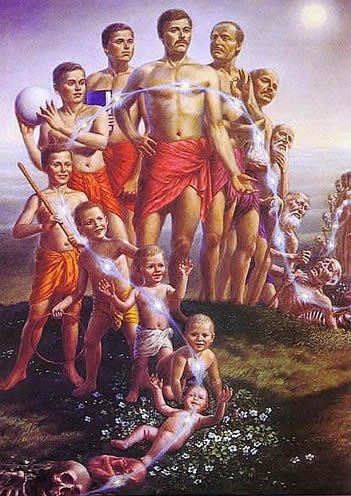
We Are Not These Bodies, We Are Soul
…within this body there is soul, and the body is changing every moment, but the soul is there. Just as a soul comes from the womb of his mother with a small body, and that small body changes—it becomes the body of a boy, it becomes the body of a youth, then it becomes the body of an old man, then it vanquishes… That we have to admit. We may say that the body is growing, but actually, the fact is, body is changing. It is medically admitted that we are changing our body every second. We are changing our blood corpuscles, and therefore a change of the body is taking place, and that is being manifested in a different shape only. Actually, we are changing every moment our body. So the ultimate change, when this body cannot be worked any more, just like a dress, when it is torn, when it is too old, you have to change it. Similarly, when this body becomes useless, no more, it cannot be pulled on any more, you take another body. Tathā dehāntara-prāptir. As we are, in our practical life, we are changing our body every moment, similarly, the last stage of changing this body is called death. Just as I give up this body, I have to enter into the womb of some kind of mother. These things are explained in the Vedic literatures. (Srila Prabhupada from lecture; San Francisco, April 2, 1968)
The soul is eternal, it is changing body, different bodies, and there are 8,400,000 different forms of body. According to his desire, he is entering another body.
…in the hundreds and thousands of universities all over the world there is no department of knowledge where the science of the soul is taught. Actually, we are all spirit soul. From Bhagavad-gītā we understand that we are transmigrating from one body to another, even in our present lives. All of us had at one time the body of a small baby. Where is that body? That body is gone. Presently I am an old man, but I remember that I was once a small baby. I still remember when I was about six months old; I was lying down on the lap of my elder sister, who was knitting, and I was playing. I can remember that, so it is possible for everyone to remember that he had a small body. After the baby’s body I had a boy’s body; then I had a youthful body, and now I am in this body. Where are those bodies? They are gone now. This is a different body. It is explained in Bhagavad-gītā that when I give up this body, I will have to accept another body. It is very simple to understand. I have changed so many bodies, not only from childhood to boyhood to youth, but according to medical science we are changing bodies every second, imperceptibly. This Process indicates that the soul is permanent. Although I have changed many bodies, I remember my baby body and my childhood body—I am the same person, soul. Similarly, when ultimately I change this body, I shall have to accept another. This simple formula is stated in Bhagavad-gītā. Everyone can reflect on it…(Srila Prabhupada from; Krsna Consciousness The Topmost Yoga System)
A person or an animal is not the material body; rather, the material body is the covering of the living being. Bhagavad-gītā compares the body to a dress and elaborately explains how one changes dresses one after another. The same Vedic knowledge is confirmed here. The living being, the soul, is constantly changing bodies one after another. Even in the present life, the body changes from childhood to boyhood, from boyhood to youth, and from youth to old age; similarly, when the body is too old to continue, the living being gives up this body and, by the laws of nature, automatically gets another body according to his fruitive activities, desires and ambitions. The laws of nature control this sequence, and therefore as long as the living entity is under the control of the external, material energy, the process of bodily change takes place automatically, according to one’s fruitive activities.
More
12 Jul 2012
by The Hare Krishna Movement
in Bhagavad-gita, Devotional Service
Tags: A.C. Bhaktivedanta Swami Prabhupada, Bg 10.8-11, bhagavad-gita, constantly devoted, devotional service, lamp of knowledge, shining lamp of knowledge, spiritual understanding, worship Me with love, worship of Krishna
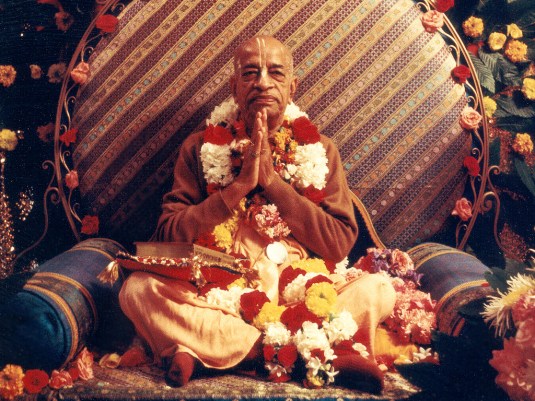
…Pure devotees concentrate their minds in Kṛṣṇa consciousness in full devotional service; therefore they are always situated in the transcendental position. Devotional service and worship of Kṛṣṇa are very clearly indicated in the 10th chapter of Bhagavad-gita verses eight to eleven. That is the way of pure devotional service.
Bhagavad-gita As It Is
By His Divine Grace A.C. Bhaktivedanta Swami Prabhupada
Chapter 10, Text 8-11
The Opulence of the Absolute
I am the source of all spiritual and material worlds. Everything emanates from Me. The wise who know this perfectly engage in My devotional service and worship Me with all their hearts.
The thoughts of My pure devotees dwell in Me, their lives are surrendered to Me, and they derive great satisfaction and bliss enlightening one another and conversing about Me.
To those who are constantly devoted and worship Me with love, I give the understanding by which they can come to Me.
Out of compassion for them, I, dwelling in their hearts, destroy with the shining lamp of knowledge the darkness born of ignorance.
For full text and purports More
25 Jun 2012
by The Hare Krishna Movement
in Bhagavad-gita, Salvation, Srimad Bhagavatam
Tags: A.C. Bhaktivedanta Swami Prabhupada, Arjuna, Battlefield of Kuruksetra, bhagavad-gita, Bhisma, liberation from material bondage, merciful glance, salvation, SB 1.9.35, Srimad Bhagavatam, The Passing Away of Bhismadeva in the Presence of Lord Krsna

…The Lord diminished the duration of life of the opposite party by His merciful glance. It is said that all the fighters who assembled on the Battlefield of Kurukṣetra attained salvation by personally seeing the Lord at the time of death. Therefore, His diminishing the duration of life of Arjuna’s enemy does not mean that He was partial to the cause of Arjuna. Factually He was merciful to the opposite party because they would not have attained salvation by dying at home in the ordinary course of life. Here was a chance to see the Lord at the time of death and thus attain salvation from material life. Therefore, the Lord is all good, and whatever He does is for everyone’s good.
Srimad Bhagavatam
By His Divine Grace A.C. Bhaktivedanta Swami Prabhupada
Canto 1, Chapter 9, Text 35
The Passing Away of Bhismadeva in the Presence of Lord Krsna
sapadi sakhi-vaco niśamya madhye
nija-parayor balayo rathaṁ niveśya
sthitavati para-sainikāyur akṣṇā
hṛtavati pārtha-sakhe ratir mamāstu
sapadi—on the battlefield; sakhi-vacaḥ—command of the friend; niśamya—after hearing; madhye—in the midst; nija—His own; parayoḥ—and the opposite party; balayoḥ—strength; ratham—chariot; niveśya—having entered; sthitavati—while staying there; para-sainika—of the soldiers on the opposite side; āyuḥ—duration of life; akṣṇā—by looking over; hṛtavati—act of diminishing; pārtha—of Arjuna, son of Pṛthā (Kuntī); sakhe—unto the friend; ratiḥ—intimate relation; mama—my; astu—let there be.
In obedience to the command of His friend, Lord Śrī Kṛṣṇa entered the arena of the Battlefield of Kurukṣetra between the soldiers of Arjuna and Duryodhana, and while there He shortened the life spans of the opposite party by His merciful glance. This was done simply by His looking at the enemy. Let my mind be fixed upon that Kṛṣṇa.
Purport
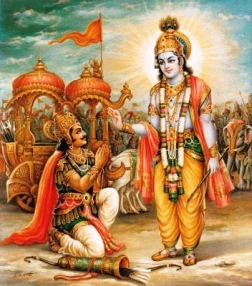
In the Bhagavad-gītā (1.21-25) Arjuna ordered the infallible Lord Śrī Kṛṣṇa to place his chariot between the phalanxes of the soldiers. He asked Him to stay there until he had finished observing the enemies he had to face in the battle. When the Lord was so asked, He at once did so, just like an order carrier. And the Lord pointed out all the important men on the opposite side, saying, “Here is Bhīṣma, here is Droṇa,” and so on. The Lord, being the supreme living being, is never the order supplier or order carrier of anyone, whoever he may be. But out of His causeless mercy and affection for His pure devotees, sometimes He carries out the order of the devotee like an awaiting servant. By executing the order of a devotee, the Lord becomes pleased, as a father is pleased to carry out the order of his small child. This is possible only out of pure transcendental love between the Lord and His devotees, and Bhīṣmadeva was quite aware of this fact. He therefore addressed the Lord as the friend of Arjuna.
More
29 May 2012
by The Hare Krishna Movement
in Bhagavad-gita, Srimad Bhagavatam, Varnasrama Dharma
Tags: A.C. Bhaktivedanta Swami Prabhupada, Bg. 4.13, caste divisions, four orders of life, occupation according to caste, Personality of Godhead, prescribed duties, Sb 1.2.13, varnasrama institution, varnasrama-dharma
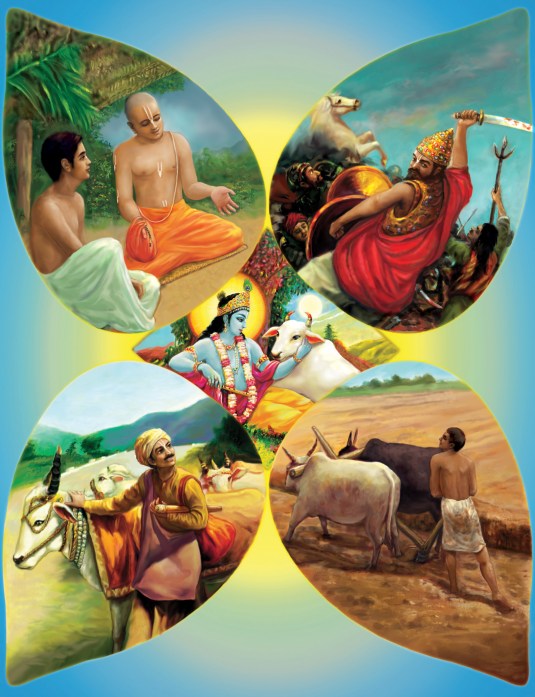
Here are two verses (one from the Srimad Bhagavatam; 1.2.13, and one from the Bhagavad-gita; 4.13) describing the importance of the varṇāśrama institution.
…the highest aim of life or the highest perfection of the institution of the varṇāśrama-dharma is to cooperate jointly for the satisfaction of the Supreme Lord.
Srimad Bhagavatam
By is Divine Grace A.C. Bhaktivedanta Swami PRabhupada
Canto One, Chapter 2, Text 13
ataḥ pumbhir dvija-śreṣṭhā
varṇāśrama-vibhāgaśaḥ
svanuṣṭhitasya dharmasya
saṁsiddhir hari-toṣaṇam
O best among the twice-born, it is therefore concluded that the highest perfection one can achieve by discharging the duties prescribed for one’s own occupation according to caste divisions and orders of life is to please the Personality of Godhead.
Human society all over the world is divided into four castes and four orders of life. The four castes are the intelligent caste, the martial caste, the productive caste and the laborer caste. These castes are classified in terms of one’s work and qualification and not by birth. Then again there are four orders of life, namely the student life, the householder’s life, the retired and the devotional life. In the best interest of human society there must be such divisions of life, otherwise no social institution can grow in a healthy state. And in each and every one of the abovementioned divisions of life, the aim must be to please the supreme authority of the Personality of Godhead. This institutional function of human society is known as the system of varṇāśrama-dharma, which is quite natural for the civilized life. The varṇāśrama institution is constructed to enable one to realize the Absolute Truth. It is not for artificial domination of one division over another. When the aim of life, i.e., realization of the Absolute Truth, is missed by too much attachment for indriya-prīti, or sense gratification, as already discussed hereinbefore, the institution of the varṇāśrama is utilized by selfish men to pose an artificial predominance over the weaker section. In the Kali-yuga, or in the age of quarrel, this artificial predominance is already current, but the saner section of the people know it well that the divisions of castes and orders of life are meant for smooth social intercourse and high-thinking self-realization and not for any other purpose.
More
26 Apr 2012
by The Hare Krishna Movement
in Bhagavad-gita
Tags: A.C. Bhaktivedanta Swami Prabhupada, Arjuna, Bg. 1, bhagavad-gita, Dhrtarastra, disciplic succession, Gita, gita-mahatmya, Glorification of the Gita, Krishna, Lord Sri Krsna, Sanjaya, scriptures, theistic science, Vedic wisdom

Dhrtarastra inquires from Sanjaya
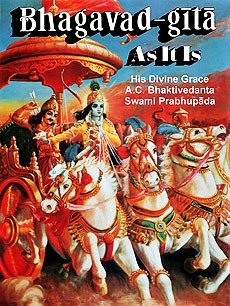
We are posting the First Chapter of the Original Bhagavad-gita As It Is 1972 Macmillian Edition complete with the corresponding pictures.
Bhagavad-gita As It Is 1972 Edition
By His Divine Grace A.C. Bhaktivedanta Swami Prabhupada
Chapter 1: Observing the Armies on the Battlefield of Kuruksetra
TEXT 1
dhṛtarāṣṭra uvāca
dharma-kṣetre kuru-kṣetre
samavetā yuyutsavaḥ
māmakāḥ pāṇḍavāś caiva
kim akurvata sañjaya
dhṛtarāṣṭraḥ—King Dhṛtarāṣṭra; uvāca—said; dharma-kṣetre—in the place of pilgrimage; kuru-kṣetre—in the place named Kurukṣetra; samavetāḥ—assembled; yuyatsavaḥ—desiring to fight; māmakāḥ—my party (sons); pāṇḍavāḥ—the sons of Pāṇḍu; ca—and; eva-certainly; kim—what; akurvata—did they do; sañjaya—O Sañjaya.
TRANSLATION
Dhṛtarāṣṭra said: O Sañjaya, after assembling in the place of pilgrimage at Kurukṣetra, what did my sons and the sons of Pāṇḍu do, being desirous to fight?
PURPORT
Bhagavad-gītā is the widely read theistic science summarized in the Gītā-māhātmya (Glorification of the Gītā). There it says that one should read Bhagavad-gītā very scrutinizingly with the help of a person who is a devotee of Śrī Kṛṣṇa and try to understand it without personally motivated interpretations. The example of clear understanding is there in the Bhagavad-gītā itself, in the way the teaching is understood by Arjuna, who heard the Gītā directly from the Lord. If someone is fortunate enough to understand Bhagavad-gītā in that line of disciplic succession, without motivated interpretation, then he surpasses all studies of Vedic wisdom, and all scriptures of the world. One will find in the Bhagavad-gītā all that is contained in other scriptures, but the reader will also find things which are not to be found elsewhere. That is the specific standard of the Gītā. It is the perfect theistic science because it is directly spoken by the Supreme Personality of Godhead, Lord Śrī Kṛṣṇa.
The topics discussed by Dhṛtarāṣṭra and Sañjaya, as described in the Mahābhārata, form the basic principle for this great philosophy. It is understood that this philosophy evolved on the Battlefield of Kurukṣetra, which is a sacred place of pilgrimage from the immemorial time of the Vedic age. It was spoken by the Lord when He was present personally on this planet for the guidance of mankind.
More
23 Apr 2012
by The Hare Krishna Movement
in A.C. Bhaktivedanta Swami Prabhupada, Bhagavad-gita, Bhakti Yoga, Krishna Consciousness, Yoga
Tags: astanga-yoga, bhakti yoga, Govinda, jnana-yoga, karma yoga, Krishna, Srila Prabhupada, Syamasundara, Vasudeva, yoga, yogi

If one is fortunate enough to come to the point of bhakti-yoga, it is to be understood that he has surpassed all the other yogas. Therefore, to become Kṛṣṇa conscious is the highest stage of yoga, just as, when we speak of Himalayan, we refer to the world’s highest mountains, of which the highest peak, Mount Everest, is considered to be the culmination.
The culmination of all kinds of yoga practices lies in bhakti-yoga. All other yogas are but means to come to the point of bhakti in bhakti-yoga. Yoga actually means bhakti-yoga; all other yogas are progressions toward the destination of bhakti-yoga. From the beginning of karma-yoga to the end of bhakti-yoga is a long way to self-realization. Karma-yoga, without fruitive results, is the beginning of this path. When karma-yoga increases in knowledge and renunciation, the stage is called jñāna-yoga. When jñāna-yoga increases in meditation on the Supersoul by different physical processes, and the mind is on Him, it is called aṣṭāṅga-yoga. And, when one surpasses the aṣṭāṅga-yoga and comes to the point of the Supreme Personality of Godhead Kṛṣṇa, it is called bhakti-yoga, the culmination. Factually, bhakti-yoga is the ultimate goal, but to analyze bhakti-yoga minutely one has to understand these other yogas. The yogī who is progressive is therefore on the true path of eternal good fortune.
It is by great fortune that one comes to Kṛṣṇa consciousness on the path of bhakti-yoga to become well situated according to the Vedic direction. The ideal yogī concentrates his attention on Kṛṣṇa, who is called Śyāmasundara, who is as beautifully colored as a cloud, whose lotus-like face is as effulgent as the sun, whose dress is brilliant with jewels and whose body is flower garlanded. Illuminating all sides is His gorgeous luster, which is called the brahmajyoti. He incarnates in different forms such as Rāma, Nṛsiṁha, Varāha and Kṛṣṇa, the Supreme Personality of Godhead, and He descends like a human being, as the son of Mother Yaśodā, and He is known as Kṛṣṇa, Govinda and Vāsudeva. He is the perfect child, husband, friend and master, and He is full with all opulences and transcendental qualities. If one remains fully conscious of these features of the Lord, he is called the highest yogī.
More
10 Apr 2012
by The Hare Krishna Movement
in Bhagavad-gita, Devotional Service, Free Downloads, Raja-Vidya
Tags: Arjuna, Bg. 9.2, bhagavad-gita, books by Srila Prabhupada, chanting Hare Krishna, confidential knowledge, devotional service, Krishna, Raja-Vidya

click on link at bottom for a free download on entire book to read online or save in pdf format
…It is said that the execution of devotional service is so perfect that one can perceive the results directly. This direct result is actually perceived, and we have practical experience that any person who is chanting the holy names of Kṛṣṇa (Hare Kṛṣṇa, Hare Kṛṣṇa, Kṛṣṇa Kṛṣṇa, Hare Hare/ Hare Rāma, Hare Rāma, Rāma Rāma, Hare Hare)in course of time feels some transcendental pleasure and very quickly becomes purified of all material contamination. This is actually seen. Furthermore, if one engages not only in hearing but in trying to broadcast the message of devotional activities as well, or if he engages himself in helping the missionary activities of Kṛṣṇa consciousness, he gradually feels spiritual progress. This advancement in spiritual life does not depend on any kind of previous education or qualification. The method itself is so pure that by simply engaging in it one becomes pure.
Bhagavada-gita As It Is Macmillan Edition 1975
By His Divine Grace A.C. Bhaktivedanta Swami Prabhupada
Chapter 9, Text 2
rāja-vidyā rāja-guhyaṁ
pavitram idam uttamam
pratyakṣāvagamaṁ dharmyaṁ
su-sukhaṁ kartum avyayam
rāja-vidyā—the king of education; rāja-guhyam—the king of confidential knowledge; pavitram—the purest; idam—this; uttamam—transcendental; pratyakṣa—directly experienced; avagamam—understood; dharmyam—the principle of religion; susukham—very happy; kartum—to execute; avyayam—everlasting.
This knowledge is the king of education, the most secret of all secrets. It is the purest knowledge, and because it gives direct perception of the self by realization, it is the perfection of religion. It is everlasting, and it is joyfully performed.
Purport
This chapter of Bhagavad-gītā is called the king of education because it is the essence of all doctrines and philosophies explained before. There are seven principal philosophers in India: Gautama, Kaṇāda, Kapila, Yājñavalkya, Śāṇḍilya, Vaiśvānara, and, finally, Vyāsadeva, the author of the Vedānta-sūtra. So there is no dearth of knowledge in the field of philosophy or transcendental knowledge. Now the Lord says that this Ninth Chapter is the king of all such knowledge, the essence of all knowledge that can be derived from the study of the Vedas and different kinds of philosophy. It is the most confidential because confidential or transcendental knowledge involves understanding the difference between the soul and the body. And the king of all confidential knowledge culminates in devotional service.
More
25 Mar 2012
by The Hare Krishna Movement
in Bhagavad-gita, Krishna Consciousness, Raja-Vidya, Spiritual Life
Tags: A.C. Bhaktivedanta Swami Prabhupada, Action in Knowledge of Krsna, bound by karma, Brahma-samhita, fruitive reaction, karma, Krishna, material body, nature's arrangment, Raja-Vidya, the king of knowledge

…We must understand the meaning of relationships with Kṛṣṇa. In this material world we have many relationships as father, mother, wife or husband. Whatever relationship we find here is but a perverted reflection of the relationship we have with the Supreme Lord. Whatever we find in this material world is born of the Absolute Truth, but here it is pervertedly reflected in time. Whatever relationship we have with Kṛṣṇa goes on. If we have a relationship in friendship, that friendship is eternal and continues from life to life. In the material world, a friendship exists for a few years and then breaks; therefore it is called perverted, temporal, or unreal. If we make our friendship with Kṛṣṇa, it will never break. If we make our master Kṛṣṇa, we will never be cheated. If we love Kṛṣṇa as our son, He will never die. If we love Kṛṣṇa as our lover, He will be the best of all, and there will be no separation. Because Kṛṣṇa is the Supreme Lord, He is unlimited and has an unlimited number of devotees. Some are trying to love Him as lover or husband, and therefore Kṛṣṇa accepts this role. In whatever way we approach Kṛṣṇa, He will accept us, as He states in Bhagavad-gītā.
ye yathā māṁ prapadyante
tāṁs tathaiva bhajāmy aham
mama vartmānuvartante
manuṣyāḥ pārtha sarvaśaḥ
“All of them—as they surrender unto Me—I reward accordingly. Everyone follows My path in all respects, O son of Pṛthā.” (Bg. 4.11)
Raja-Vidya: The King of Knowledge
By His Divine Grace A.C. Bhaktivedanta Swami Prabhupada
Chapter 8
Action in Knowledge of Kṛṣṇa
na māṁ karmāṇi limpanti
na me karma-phale spṛhā
iti māṁ yo ’bhijānāti
karmabhir na sa badhyate
“There is no work that affects Me; nor do I aspire for the fruits of action. One who understands this truth about Me also does not become entangled in the fruitive reactions of work.”(Bg. 4.14)
The whole world is bound by karma. We all know of the existence of microbes or germs which exist by the million within the measurement of one millimeter. In the Brahma-saṁhitā it is stated that beginning with the microbe, which is called indragopa, up to Indra, the king of the heavenly planets, all are bound by karma, the reaction of work. We all have to suffer or enjoy the reactions of our work, be they good or bad. As long as we have to suffer or enjoy these reactions, we are bound to these material bodies.
By nature’s arrangement the material body is given to the living entity for his suffering or enjoying. Different types of bodies are acquired for different purposes. The body of a tiger is made for killing and eating raw meat. Similarly, the hogs are made in such a way that they can eat stool. And as human beings our teeth are made for eating vegetables and fruits. All of these bodies are made according to the work done in past lives by the living entity. Our next bodies are being prepared according to the work which we are now doing, but in the previously quoted verse Śrī Kṛṣṇa indicates that one who knows the transcendental nature of His activities becomes free from the reactions of activities. Our activities should be such that we will not again become entangled in this material world. This can be made possible if we become Kṛṣṇa conscious by studying Kṛṣṇa, learning of the transcendental nature of His activities, and understanding how He behaves in this material world and in the spiritual world.
More
20 Mar 2012
by The Hare Krishna Movement
in Bhagavad-gita
Tags: A.C. Bhaktivedanta Swami Prabhupada, Bg. 10.35, bhagavad-gita, flwoers and trees blossom, Krsna's pastimes, of seasons I am flower-bearing spring, Spring, spring is the most joyful of all seasons

…Of course spring is a season universally liked because it is neither too hot nor too cold, and the flowers and trees blossom and flourish. In spring there are also many ceremonies commemorating Kṛṣṇa’s pastimes; therefore this is considered to be the most joyful of all seasons, and it is the representative of the Supreme Lord Kṛṣṇa.
Bhagavad-gita As It Is – Macmillan 1972 Edition
By His Divine Grace A.C. Bhaktivedanta Swami Prabhupada
Chapter 10, Text 35
The Opulence of the Absolute
bṛhat-sāma tathā sāmnāṁ
gāyatrī chandasām aham
māsānāṁ mārga-śīrṣo ‘ham
ṛtūnāṁ kusumākaraḥ
bṛhat-sāma—the Bṛhat-sāma; tathā—also; sāmnām—of the Sāma-veda song; gāyatrī—the Gāyatrī hymns; chandasām—of all poetry; aham—I am; māsānām—of months; mārga-śīrṣo ‘ham—the month of November-December; aham—I am; ṛtūnām—of all seasons; kusumākaraḥ—spring.
Of hymns I am the Bṛhat-sāma sung to the Lord Indra, and of poetry I am the Gāyatrī verse, sung daily by brāhmaṇas. Of months I am November and December, and of seasons I am flower-bearing spring.
Purport
It has already been explained by the Lord that amongst all the Vedas, the Sāma-veda is rich with beautiful songs played by the various demigods.
One of these songs is the Bṛhat-sāma, which has an exquisite melody and is sung at midnight.
In Sanskrit, there are definite rules that regulate poetry; rhyme and meter are not written whimsically, as in much modern poetry. Amongst the regulated poetry, the Gāyatrī mantra, which is chanted by the duly qualified brāhmaṇas, is the most prominent. The Gāyatrī mantra is mentioned in the Śrīmad-Bhāgavatam. Because the Gāyatrī mantra is especially meant for God realization, it represents the Supreme Lord. This mantra is meant for spiritually advanced people, and when one attains success in chanting it, he can enter into the transcendental position of the Lord. One must first acquire the qualities of the perfectly situated person, the qualities of goodness according to the laws of material nature, in order to chant the Gāyatrī mantra. The Gāyatrī mantra is very important in Vedic civilization and is considered to be the sound incarnation of Brahman. Brahmā is its initiator, and it is passed down from him in disciplic succession.
The months of November and December are considered the best of all months because in India grains are collected from the fields at this time, and the people become very happy. Of course spring is a season universally liked because it is neither too hot nor too cold, and the flowers and trees blossom and flourish. In spring there are also many ceremonies commemorating Kṛṣṇa’s pastimes; therefore this is considered to be the most joyful of all seasons, and it is the representative of the Supreme Lord Kṛṣṇa.
18 Mar 2012
by The Hare Krishna Movement
in Bhagavad-gita, Book Changes, Vyasasan das
Tags: A.C. Bhaktivedanta Swami Prabhupada, Arjuna, bhagavad-gita, book changes, disciplic succession, Parampara, Sri Krishna, Srila Prabhupada, Vedic knowledge


My heart laments with deep sorrow whenever I think of how the Books of His Divine Grace A.C. Bhaktivedanta Swami are being changed, and re-edited. But I think Srila Prabhupada has said it best in his introduction to Bhagavad-gita As It Is;
Vedic knowledge is not a question of research. Our research work is imperfect because we are researching things with imperfect senses. We have to accept perfect knowledge which comes down, as is stated in Bhagavad-gītā, by the paramparā disciplic succession. We have to receive knowledge from the proper source in disciplic succession beginning with the supreme spiritual master, the Lord Himself, and handed down to a succession of spiritual masters. Arjuna, the student who took lessons from Lord Śrī Kṛṣṇa, accepts everything that He says without contradicting Him. One is not allowed to accept one portion of Bhagavad-gītā and not another. No. We must accept Bhagavad-gītā without interpretation, without deletion and without our own whimsical participation in the matter. The Gītā should be taken as the most perfect presentation of Vedic knowledge. Vedic knowledge is received from transcendental sources, and the first words were spoken by the Lord Himself. The words spoken by the Lord are different from words spoken by a person of the mundane world who is infected with four defects. A mundaner 1) is sure to commit mistakes, 2) is invariably illusioned, 3) has the tendency to cheat others and 4) is limited by imperfect senses. With these four imperfections, one cannot deliver perfect information of all-pervading knowledge.( From Introduction to the Bhagavad-gita As It Is)
More
11 Mar 2012
by The Hare Krishna Movement
in Bhagavad-gita, Raja-Vidya, Spiritual Life
Tags: A.C. Bhaktivedanta Swami Prabhupada, Arjuna, bhagavad-gita, faith, guru, Krishna, material world, Raja-Vidya, spiritual knowledge, spiritual master, Spiritual world, surrender, the king of knowledge

As spirit souls we are part and parcel of the Supreme Spirit, but due to our desire to enjoy this material world, we have been put into material nature. Yet in whatever species of life we may be, Kṛṣṇa is the Father. Thus Bhagavad-gītā is not meant for any particular party or nation but for everyone all over the world… In this way people may realize their true spiritual nature and their relationship to the supreme spiritual whole.
“And when you have thus learned the truth, you will know that all living beings are but parts of Me—and that they are in Me, and are Mine. Even if you are considered to be the most sinful of all sinners, when you are situated in the boat of transcendental knowledge, you will be able to cross over the ocean of miseries. As a blazing fire burns firewood to ashes, O Arjuna, so does the fire of knowledge burn to ashes all the reactions to material activities.” (Bg. 4.35–37)
Raja-vidya: The King of Knowledge
By His Divine Grace A.C. Bhaktivedanta Swami Prabhupada
Chapter 7
Knowledge as Faith in Guru and surrender to Kṛṣṇa
In the Fourth Chapter of Bhagavad-gītā Śrī Kṛṣṇa concludes that of all sacrifices, the best is the acquisition of knowledge.
śreyān dravya-mayād yajñāj
jñāna-yajñaḥ parantapa
sarvaṁ karmākhilaṁ pārtha
jñāne parisamāpyate
“O chastiser of the enemy, the sacrifice of knowledge is greater than the sacrifice of material possessions. O son of Pṛthā, after all, the sacrifice of work culminates in transcendental knowledge.” (Bg. 4.33)
Knowledge is the best sacrifice because this conditional life is due to ignorance. The purpose of sacrifice, penance, yoga and philosophical discussion is to acquire knowledge. There are three stages of transcendental knowledge by which one realizes the impersonal aspect of God (Brahman realization), the localized aspect of God within the heart and within every atom (Paramātmā or Supersoul realization) and the realization of the Supreme Personality of Godhead (Bhagavān realization). But the very first step in acquiring knowledge is coming to understand that “I am not this body. I am spirit soul, and my aim of life is to get out of this material entanglement.” The point is that whatever sacrifice we make is intended to enable us to come to the point of real knowledge. The highest perfection of knowledge is given in Bhagavad-gītā as surrender to Kṛṣṇa (bahūnāṁ janmanām ante jñānavān māṁ prapadyate) (Bg. 7.19). The jñānavān, not the fool, surrenders unto Kṛṣṇa, and that is the highest stage of knowledge. Similarly, at the end of Bhagavad-gītā Śrī Kṛṣṇa advises Arjuna:
More
29 Feb 2012
by The Hare Krishna Movement
in A.C. Bhaktivedanta Swami Prabhupada, Bhagavad-gita, Divine and Demoniac Natures
Tags: A.C. Bhaktivedanta Swami Prabhupada. As It Is, anger, Bg. 16. 10-12, bhagavad-gita, Demoniac, Divine, greed, human civilization, lust, Original 1972 Edition, sense gratificiation, The Divine and Demoneac Natures
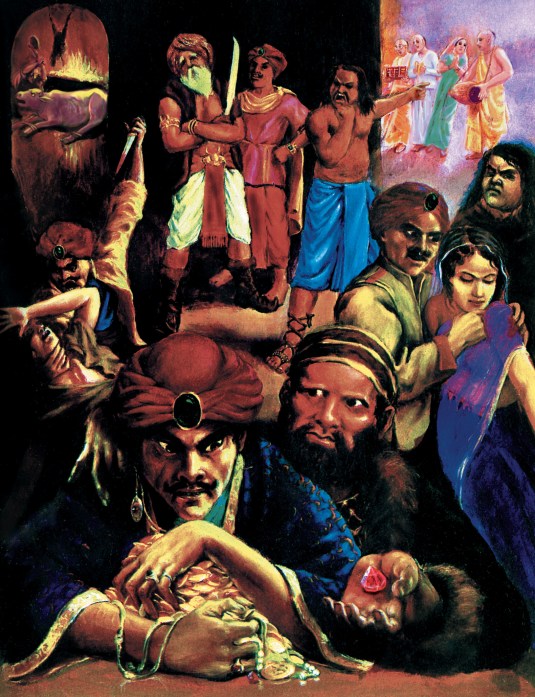
They believe that to gratify the senses unto the end of life is the prime necessity of human civilization. Thus there is no end to their anxiety. Being bound by hundreds and thousands of desires, by lust and anger, they secure money by illegal means for sense gratification.
Bhagavad-gītā As It Is
By His Divine Grace A. C. Bhaktivedanta Swami Prabhupāda
Chapter 16, Text 10-12
The Divine and Demoniac Natures
TEXT 10
kāmam āśritya duṣpūraṁ
dambha-māna-madānvitāḥ
mohād gṛhītvāsad-grāhān
pravartante ’śuci-vratāḥ
kāmam—lust; āśritya—taking shelter of; duṣpūram—insatiable; dambha—pride; māna—false prestige; mada-anvitāḥ—absorbed in conceit; mohāt—by illusion; gṛhītvā—taking; asat—nonpermanent; grāhān—things; pravartante—flourish; aśuci—unclean; vratāḥ—avowed.
The demoniac, taking shelter of insatiable lust, pride and false prestige, and being thus illusioned, are always sworn to unclean work, attracted by the impermanent.
Purport
The demoniac mentality is described here. The demons’ lust is never satiated. They will go on increasing and increasing their insatiable desires for material enjoyment. Although they are always full of anxieties on account of accepting nonpermanent things, they still continue to engage in such activities out of illusion. They have no knowledge and cannot tell that they are heading the wrong way. Accepting nonpermanent things, such demoniac people create their own God, create their own hymns and chant accordingly. The result is that they become more and more attracted to two things—sex enjoyment and accumulation of material wealth. The word aśuci-vratāḥ, unclean vow, is very significant in this connection. Such demoniac people are only attracted by wine, women, gambling and meat eating; those are their aśuci, unclean habits. Induced by pride and false prestige, they create some principles of religion which are not approved by the Vedic injunctions. Although such demoniac people are most abominable in the world, still, by artificial means, the world creates a false honor for them. Although they are gliding toward hell, they consider themselves very much advanced.
More
22 Feb 2012
by The Hare Krishna Movement
in Bhagavad-gita, Book Changes, Devotee's, Satyaraja das
Tags: A.C. Bhaktivedanta Swami Prabhupada, Allen Ginsberg, Bhagavad-gita As It Is, Brahmananda das, Bruce Scharf, Macmillan Edition, prabhupada, Rayarama das, Satyaraja das, Srila Prabhupada's Bhagavad-gita

To purchase a copy of the original 1972 Macmillan Edition of Srila Prabhupada’s Bhagavad-gita As It Is, click on image to visit online store
The surprising events surrounding the initial publication of Srila Prabhupada’s Bhagavad-gita As It Is.
The Macmillan Miracle
By Sriman Satyaraja Prabhu
The Bhagavad-gita was important to Srila Prabhupada. He saw it as the perfect book to convey Krishna consciousness, as it consists of the Lord’s own words and His interactions with His loving devotee. In 1939, just seven years after Prabhupada was initiated by his spiritual master, he wrote a lengthy introduction to the book in English, presaging his full translation and commentary, which appeared soon after he began his mission in the West.
When Prabhupada arrived in New York in 1965, he gave priority to his work on the Gita. In India he had already completed a translation, spanning well over a thousand pages, but it was stolen. In March 1966, Prabhupada was adjusting to life in the Western world when he met with another loss: his typewriter, cassette recorder, and several books were taken from him. But he was resilient and determined to complete his work. In 1967 he finished the new manuscript, again over a thousand pages, and resolved to get a major publisher so that his message would be heard throughout the world.
At the time, Allen Ginsberg, famous poet of the Beat Generation, was visiting the New York temple, and he was enjoying a friendly relationship with Srila Prabhupada. Since Ginsberg was an experienced published author, Prabhupada asked him to show the manuscript to his benefactors, which Ginsberg did. But they were unimpressed, claiming the book had little commercial value.
Prabhupada then gave the manuscript to Rayarama Dasa, an early disciple with some experience in the publishing world. Rayarama, too, was unsuccessful in his attempts, his contacts explaining their hesitation in much the same way that Ginsberg’s did.
More
16 Jan 2012
by The Hare Krishna Movement
in Bhagavad-gita, Krishna
Tags: A.C. Bhaktivedanta Swami Prabhupada, Atlas, Atlas holding the globe, Bg 9.5, Bhagavad-gita As It Is, creation, material manifestation, Spiritual world, Visnu
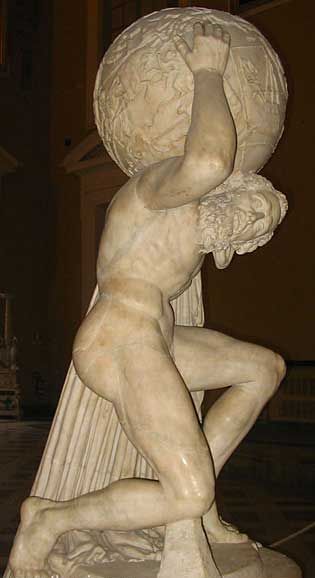
The Lord says that everything is resting on Him. This should not be misunderstood. The Lord is not directly concerned with the maintenance and sustenance of this material manifestation. Sometimes we see a picture of Atlas holding the globe on his shoulders; he seems to be very tired, holding this great earthly planet. Such an image should not be entertained in connection with Kṛṣṇa’s upholding this created universe. He says that although everything is resting on Him, still He is aloof.

Bhagavad-gita As It Is – Macmillan 1972 Edition
By His Divine Grace A.C. Bhaktivedanta Swami Prabhupada
Chapter 9, Text 5
na ca mat-sthāni bhūtāni
paśya me yogam aiśvaram
bhūta-bhṛn na ca bhūta-stho
mamātmā bhūta-bhāvanaḥ
na—never; ca—also; mat-sthāni—situated in Me; bhūtāni—all creation; paśya—just see; me—My; yogam aiśvaram—inconceivable mystic power; bhūta-bhṛt—maintainer of all living entities; na—never; ca—also; bhūta-sthaḥ—in the cosmic manifestation; mama—My; ātmā—Self; bhūta-bhāvanaḥ—is the source of all manifestations.
Translation
And yet everything that is created does not rest in Me. Behold My mystic opulence! Although I am the maintainer of all living entities, and although I am everywhere, still My Self is the very source of creation.
More
05 Jan 2012
by The Hare Krishna Movement
in A.C. Bhaktivedanta Swami Prabhupada, Bhagavad-gita, Krishna Consciousness, Yoga
Tags: bhagavad-gita, bhajete, His Divine Grace A.C. Bhaktivedanta Swami Prabhupada, Krishna, Krishna consciousness, prabhupada, yoga, yogi, yoginam api sarvesam

It is by great fortune that one comes to Kṛṣṇa consciousness on the path of bhakti-yoga to become well situated according to the Vedic direction. The ideal yogī concentrates his attention on Kṛṣṇa, who is called Śyāmasundara, who is as beautifully colored as a cloud, whose lotus-like face is as effulgent as the sun, whose dress is brilliant with jewels and whose body is flower garlanded. Illuminating all sides is His gorgeous luster, which is called the brahmajyoti. He incarnates in different forms such as Rāma, Nṛsiṁha, Varāha and Kṛṣṇa, the Supreme Personality of Godhead, and He descends like a human being, as the son of Mother Yaśodā, and He is known as Kṛṣṇa, Govinda and Vāsudeva. He is the perfect child, husband, friend and master, and He is full with all opulences and transcendental qualities. If one remains fully conscious of these features of the Lord, he is called the highest yogī.
Bhagavad-gita As It Is – Macmillan 1972 Edition
By His Divine Grace A.C. Bhaktivedanta Swami Prabhupada
Chapter 6, Text 47
yoginām api sarveṣāṁ
mad-gatenāntar-ātmanā
śraddhāvān bhajate yo māṁ
sa me yuktatamo mataḥ
yoginām—of all yogīs; api—also; sarveṣām—all types of; mat-gatena—abiding in Me; antaḥ-ātmanā—always thinking of Me within; śraddhāvān—in full faith; bhajate—renders transcendental loving service; yaḥ—one who; mām—Me (the Supreme Lord); saḥ—he; me—Mine; yuktatamaḥ—the greatest yogī; mataḥ—is considered.
Translation
And of all yogīs, he who always abides in Me with great faith, worshiping Me in transcendental loving service, is most intimately united with Me in yoga and is the highest of all.
More
01 Jan 2012
by The Hare Krishna Movement
in Bhagavad-gita, Time
Tags: Arjuna, As It Is 1972 Edition, bhagavad-gita, His Divine Grace A.C. Bhaktivedanta Swami Prabhupada, Krishna, past present and future, Srila Prabhupada, supersoul, supreme soul

…Anyone with a material body cannot remember his past life, nor can he foretell his future life, nor can he predict the outcome of his present life; therefore he cannot know what is happening in past, present and future. Unless one is liberated from material contamination, he cannot know past, present and future.
…out of millions and millions of men, some try to become perfect in this human form of life, and out of thousands and thousands of such perfected men, hardly one can understand what Lord Kṛṣṇa is. Even if one is perfected by realization of impersonal Brahman or localized Paramātmā, he cannot possibly understand the Supreme Personality of Godhead, Śrī Kṛṣṇa, without being in Kṛṣṇa consciousness.
Bhagavad-gita As It Is 1972 Edition
By His Divine Grace A.C. Bhaktivedanta Swami Prabhupada
Chapter 7, Text 26
vedāhaṁ samatītāni
vartamānāni cārjuna
bhaviṣyāṇi ca bhūtāni
māṁ tu veda na kaścana
veda—know; aham—I; sama—equally; atītāni—past; vartamānāni—present; ca—and; arjuna—O Arjuna; bhaviṣyāṇi—future; ca—also; bhūtāni—living entities; mām—Me; tu—but; veda—knows; na—not; kaścana—anyone.
Translation
O Arjuna, as the Supreme Personality of Godhead, I know everything that has happened in the past, all that is happening in the present, and all things that are yet to come. I also know all living entities; but Me no one knows.
Purport
Here the question of personality and impersonality is clearly stated. If Kṛṣṇa, the form of the Supreme Personality of Godhead, is considered by the impersonalists to be māyā, to be material, then He would, like the living entity, change His body and forget everything in His past life. Anyone with a material body cannot remember his past life, nor can he foretell his future life, nor can he predict the outcome of his present life; therefore he cannot know what is happening in past, present and future. Unless one is liberated from material contamination, he cannot know past, present and future.
More
31 Dec 2011
by The Hare Krishna Movement
in Bhagavad-gita, Time
Tags: Bg 10.33, Bg. 10.30, Bg. 11.32, bhagavad-gita, Bhaktivedanta Swami Prabhupada, His Divine Grace A.C, I am time, inexhaustable time, Krishna is Time, New Years Eve, Time, Time I Am

Happy New Year to all of our readers. Krishna has this to say about Time…
More
25 Dec 2011
by The Hare Krishna Movement
in Bhagavad-gita, Devotional Service, Krishna Consciousness, Lord Jesus Christ
Tags: Arjuna, bhagavad-gita, devotee is friendly to every living entity, devotional service, God consciousness, Jesus Christ, Lord Jesus Christ, Srila Prabhupada
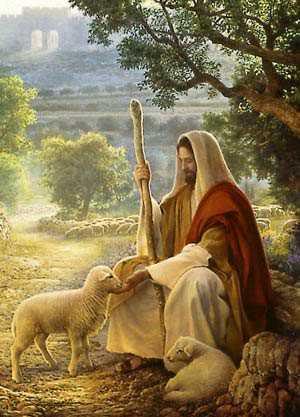
A devotee of Kṛṣṇa is friendly to everyone. Therefore it is said here that he has no enemy. How is this? A devotee situated in Kṛṣṇa consciousness knows that only devotional service to Kṛṣṇa (God) can relieve a person from all the problems of life. He has personal experience of this, and therefore he wants to introduce this system, Kṛṣṇa consciousness, or God Consciousness, into human society. There are many examples in history of devotees of the Lord risking their lives for the spreading of God consciousness. The favorite example is Lord Jesus Christ
He was crucified by the nondevotees, but He sacrificed His life for spreading God consciousness. Of course, it would be superficial to understand that He was killed. Similarly, in India also there are many examples, such as Ṭhākur Haridāsa. Why such risk? Because they wanted to spread Kṛṣṇa consciousness, and it is difficult. A Kṛṣṇa conscious person knows that if a man is suffering, it is due to his forgetfulness of his eternal relationship with Kṛṣṇa (God). Therefore, the highest benefit one can render to human society is relieving one’s neighbor from all material problems. In such a way, a pure devotee is engaged in the service of the Lord. Now, we can imagine how merciful Kṛṣṇa is to those engaged in His service, risking everything for Him. Therefore it is certain that such persons must reach the supreme planet after leaving the body.
Bhagavad-gita As It Is – Macmillan 1972 Edition
By His Divine Grace A.C. Bhaktivedanta Swami Prabhupada
Chapter 11 The Universial Form Text 55
mat-karma-kṛn mat-paramo
mad-bhaktaḥ saṅga-varjitaḥ
nirvairaḥ sarva-bhūteṣu
yaḥ sa mām eti pāṇḍava
mat-karma-kṛt—engaged in doing My work; mat-paramaḥ—concerning Me, the Supreme; mat-bhaktaḥ—engaged in My devotional service; saṅga-varjitaḥ—freed from the contamination of previous activities and mental speculation; nirvairaḥ—without an enemy; sarva-bhūteṣu—to every living entity; yaḥ—one who; saḥ—he; mām—unto Me; eti—comes; pāṇḍava—O son of Pāṇḍu.
Translation
My dear Arjuna, one who is engaged in My pure devotional service, free from the contaminations of previous activities and from mental speculation, who is friendly to every living entity, certainly comes to Me.
More
Previous Older Entries Next Newer Entries










 The Hare Krishna Movement