04 Jan 2014
by The Hare Krishna Movement
in A.C. Bhaktivedanta Swami Prabhupada, Deitie, Radha Raman
Tags: A.C. Bhaktivedanta Swami Prabhupada, impersonal or void, meditation, meditation on the form of the lord, process of meditation, Radha Raman, sac-cid-ananda-vigraha, Srimad Bhagavatam, Universal Form, virat-rupa, yoga

The process of meditation should begin from the lotus feet of the Lord and progress to His smiling face. The meditation should be concentrated upon the lotus feet, then the calves, then the thighs, and in this way higher and higher. The more the mind becomes fixed upon the different parts of the limbs, one after another, the more the intelligence becomes purified. (SB 2.2.13)
…The process of meditation recommended in the Śrīmad-Bhāgavatam is not to fix one’s attention on something impersonal or void. The meditation should concentrate on the person of the Supreme Godhead, either in His virāṭ-rūpa, the gigantic universal form, or in His sac-cid-ānanda-vigraha [Bs. 5.1], as described in the scriptures. There are authorized descriptions of Viṣṇu forms, and there are authorized representations of Deities in the temples. Thus one can practice meditating upon the Deity, concentrating his mind on the lotus feet of the Lord and gradually rising higher and higher, up to His smiling face.
Full text and purport More
25 Sep 2013
by The Hare Krishna Movement
in A.C. Bhaktivedanta Swami Prabhupada, Bhagavad-gita, Krsna Consciousness, Spiritual Life, Yoga
Tags: A.C. Bhaktivedanta Swami Prabhupada, Arjuna, as it is, Bg. 6.29, Bg. 6.30, bhagavad-gita, bhakti yoga, Krishna, Krishna consciousness, krsna conscious yogi, love of God, self realization, true yogi, yoga, yogi
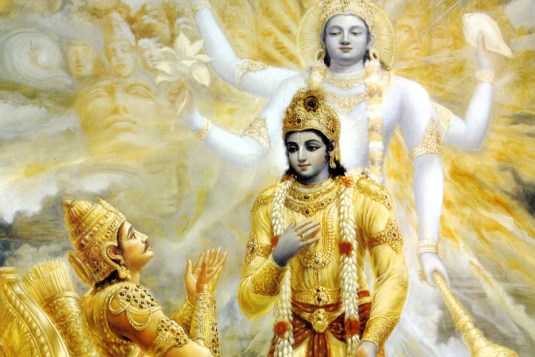
Please click on image to enlarge
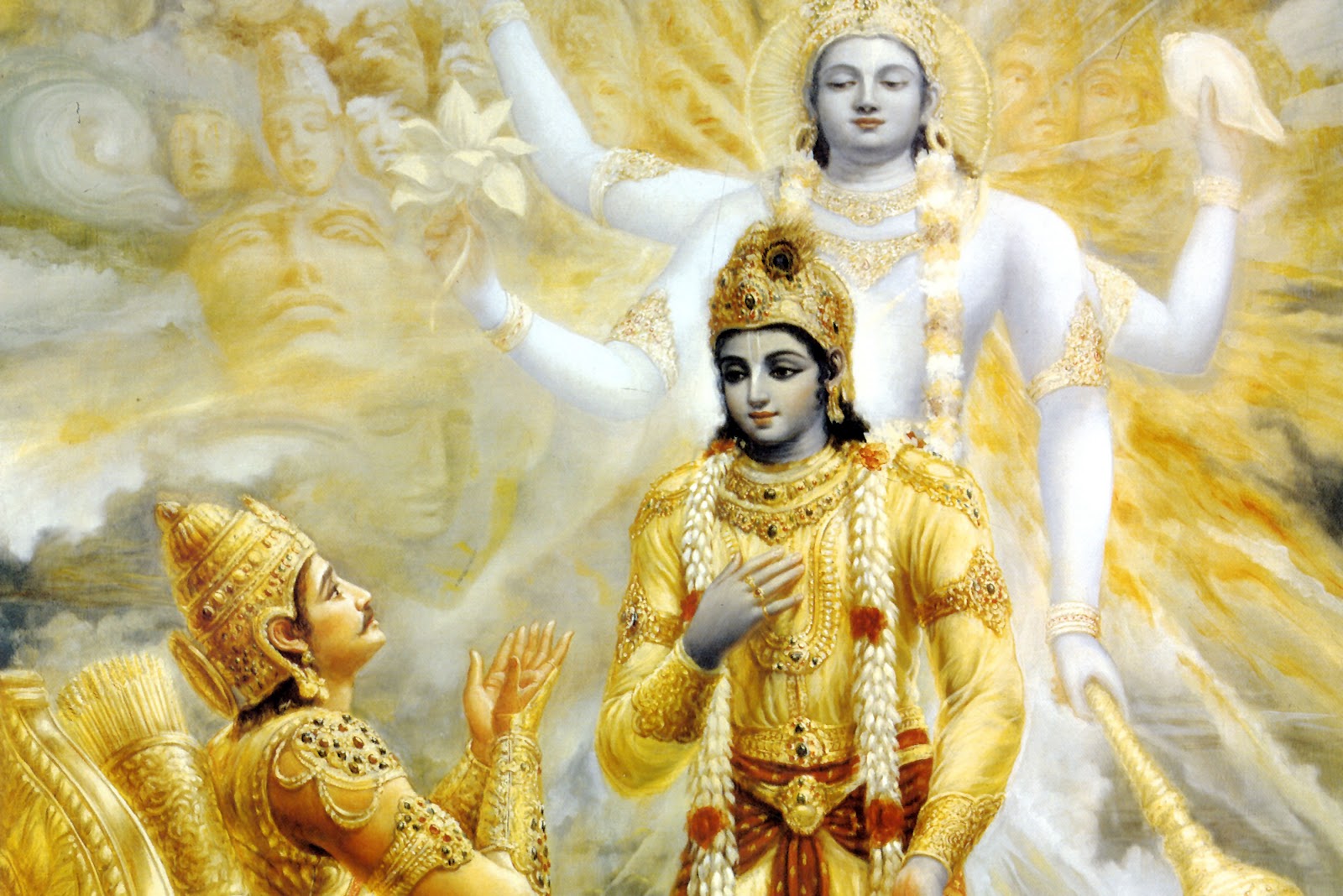
A true yogī observes Me in all beings, and also sees every being in Me. Indeed, the self-realized man sees Me everywhere. (Bg. 6.29)
For one who sees Me everywhere and sees everything in Me, I am never lost, nor is he ever lost to Me. (Bg. 6.30)
…A person in Kṛṣṇa consciousness certainly sees Lord Kṛṣṇa everywhere, and he sees everything in Kṛṣṇa…Nothing can exist without Kṛṣṇa, and Kṛṣṇa is the Lord of everything—this is the basic principle of Kṛṣṇa consciousness.
…Kṛṣṇa consciousness is the development of love of Kṛṣṇa—a position transcendental even to material liberation. (from purport to Bg.6.30)
Bhagavad-gita As It Is 1972 Edition
By His Divine Grace A.;C. Bhaktivedanta Swami Prabhupada
Chapter 6, Text 29-30
Full Text and Purports More
24 Sep 2013
by The Hare Krishna Movement
in A.C. Bhaktivedanta Swami Prabhupada, Bhagavad-gita, Bhakti Yoga, Krishna Consciousness, Yoga
Tags: A.C. Bhaktivedanta Swami Prabhupada, bhakti yoga, hatha yoga, jnana-yoga, karma yoga, krishna consciousness yoga, krsna consciousness, raja yoga, Supreme Personality of Godhead, yoga, yogi
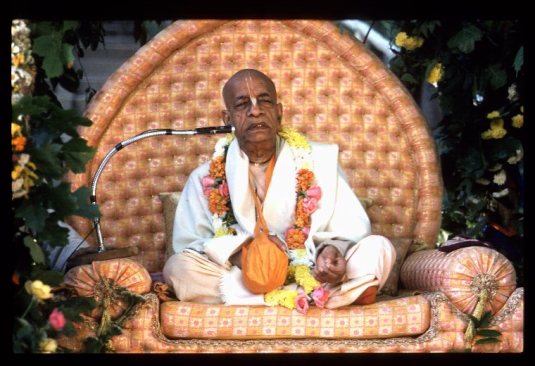
This morning my reading focused on the end of the 6th and beginning of the 7th chapters of the Bhagavad-gita As It Is. Wherein Srila Prabhupada describes…
…The culmination of all kinds of yoga practices lies in bhakti-yoga. All other yogas are but means to come to the point of bhakti in bhakti-yoga. Yoga actually means bhakti-yoga; all other yogas are progressions toward the destination of bhakti-yoga.
…Therefore, to become Kṛṣṇa conscious is the highest stage of yoga.
…Different types of yoga are only steppingstones on the path of Kṛṣṇa consciousness. One who takes directly to Kṛṣṇa consciousness automatically knows about brahmajyoti and Paramātmā in full. By practice of Kṛṣṇa consciousness yoga, one can know everything in full—namely the Absolute Truth, the living entities, the material nature, and their manifestations with paraphernalia.
In these two important verses (Bg 6.47 & 7.1) there is much good information about yoga, the different types of yoga, yoga practices, and the ultimate goal of yoga. Very informative!
More from purports followed by full text and purports More
26 Aug 2013
by The Hare Krishna Movement
in A.C. Bhaktivedanta Swami Prabhupada, Bhagavad-gita, Spiritual Life, Spiritual World
Tags: A.C. Bhaktivedanta Swami Prabhupada, bhakti, buddhi-yoga, karma yoga, Krishna, liberation, lotus feet of the Lord, material world, mukti, Personality of Godhead, Radha, Spiritual Life, spiritual sky, Spiritual world, Vaikuntha planets, vikunthaloka, yoga

please click on image to enlarge!
The liberated living entities seek that place where there are no material miseries. The Bhāgavatam says:
samāśritā ye padapallava-plavaṁ
mahat-padaṁ puṇya-yaśo murāreḥ
bhāvambudhir vatsa-padaṁ paraṁ padaṁ
paraṁ padaṁ yad vipadāṁ na teṣām
(Bhāg. 10.14.58)
“For one who has accepted the boat of the lotus feet of the Lord, who is the shelter of the cosmic manifestation and is famous as Mukunda or the giver of mukti, the ocean of the material world is like the water contained in a calf’s hoofprint. Param padam, or the place where there are no material miseries, or Vaikuṇṭha, is his goal, not the place where there is danger in every step of life.” (From purport to Bg. 2.51)
Full verse and purport More
25 Aug 2013
by The Hare Krishna Movement
in A.C. Bhaktivedanta Swami Prabhupada, Letters by Srila Prabhupada, Yoga
Tags: A.C. Bhaktivedanta Swami, asana, astanga-yoga, Bg 6.47, bhakti yoga, dhayana yoga, dhyana, hatha yoga, jnana-yoga, karma yoga, Krishna consciousness, link, link-up, meaning of yoga, meditation, pranayama, raja yoga, yoga, yoga meaning, yoga systems

click on image to enlarge
When we think of Yoga, we used to think of some old bearded yogi standing on his head, or more recently of young beautiful men & women in athletic clothing posing serenely, or a class full of people stretching on yoga mats. But actually the meaning of yoga is far beyond any of the physical gymnastics we tend to associate with the word. There are many systems of yoga, namely; karma yoga, jnana yoga, dhayana yoga, hatha yoga, bhakti yoga, and so many patterns of yoga. But as we understand from the Bhagavad-gita:
…in the Bhagavad-gītā it is clearly stated that…yoga means to get into touch with the Supreme Lord. The process, however, includes several bodily features such as āsana, dhyāna, prāṇāyāma and meditation (from purport SB 1.2.28-29)
…The word yoga means “link.” Any system of yoga is an attempt to reconnect our broken relationship with the Supreme Personality of Godhead. There are different types of yoga, of which bhakti-yoga is the best. In other yoga systems, one must undergo various processes before attaining perfection, but bhakti-yoga is direct. (from purport SB 10.2.6)
…The culmination of all kinds of yoga practices lies in bhakti-yoga. All other yogas are but means to come to the point of bhakti in bhakti-yoga. Yoga actually means bhakti-yoga; all other yogas are progressions toward the destination of bhakti-yoga. From the beginning of karma-yoga to the end of bhakti-yoga is a long way to self-realization. Karma-yoga, without fruitive results, is the beginning of this path. When karma-yoga increases in knowledge and renunciation, the stage is called jñāna-yoga. When jñāna-yoga increases in meditation on the Supersoul by different physical processes, and the mind is on Him, it is called aṣṭāṅga-yoga. And, when one surpasses the aṣṭāṅga-yoga and comes to the point of the Supreme Personality of Godhead Kṛṣṇa, it is called bhakti-yoga, the culmination. Factually, bhakti-yoga is the ultimate goal, but to analyze bhakti-yoga minutely one has to understand these other yogas. The yogī who is progressive is therefore on the true path of eternal good fortune. One who sticks to a particular point and does not make further progress is called by that particular name: karma-yogī, jñāna-yogī or dhyāna-yogī, rāja-yogī, haṭha-yogī, etc. If one is fortunate enough to come to the point of bhakti-yoga, it is to be understood that he has surpassed all the other yogas. Therefore, to become Kṛṣṇa conscious is the highest stage of yoga, just as, when we speak of Himalayan, we refer to the world’s highest mountains, of which the highest peak, Mount Everest, is considered to be the culmination.
It is by great fortune that one comes to Kṛṣṇa consciousness on the path of bhakti-yoga to become well situated according to the Vedic direction. The ideal yogī concentrates his attention on Kṛṣṇa, who is called Śyāmasundara, who is as beautifully colored as a cloud, whose lotus-like face is as effulgent as the sun, whose dress is brilliant with jewels and whose body is flower garlanded. Illuminating all sides is His gorgeous luster, which is called the brahmajyoti. He incarnates in different forms such as Rāma, Nṛsiṁha, Varāha and Kṛṣṇa, the Supreme Personality of Godhead, and He descends like a human being, as the son of Mother Yaśodā, and He is known as Kṛṣṇa, Govinda and Vāsudeva. He is the perfect child, husband, friend and master, and He is full with all opulences and transcendental qualities. If one remains fully conscious of these features of the Lord, he is called the highest yogī. (Bhagavad-gita 6.47)
The very word yoga means connecting link with the supreme being. We accept Krishna as the supreme being, and nobody is equal to him or greater than him. (Letter to Sri Krishna C. Batra – Vrindaban 8 December, 1975)
Full Letter + References More
11 Jul 2013
by The Hare Krishna Movement
in Festivals, Jagajivana das, Ratha-yatra
Tags: A.C. Bhaktivedanta Swami Prabhupada, Back to Godhead Magazine, BTG, chariots, Jagajivana das, Ratha-yatra, Srila Prabhupada, The Festival of the Chariots, yoga

The Festival of the Chariots
Excerpted from Back to Godhead Magazine Vol. 13, No. 6, 1978
by Jagajivana dasa
Intimations of a Festive World
This Krsna culture,” His Divine Grace A.C. Bhaktivedanta Swami Prabhupada used to say, “has so many festivals. We could have one every day. In the spiritual world, every day is a festival.” And when you first see the chariots, you wonder whether that’s just where they’ve come from. Three soaring, silk-covered peaks rumbling along on ten-foot wheels—you have a feeling they’ve come from somewhere you’ve been before, but haven’t been back to for a long while.
More
26 May 2013
by The Hare Krishna Movement
in A.C. Bhaktivedanta Swami Prabhupada, Krishna, Krishna Consciousness, Nectar of Devotion
Tags: A.C. Bhaktivedanta Swami Prabhupada, devotees, linking up with the Lord, Nectar of Devotion, perfection, perfectional stage of meeting krsna, Radha-Krsna, Radharani, Rupa Goswami, satisfaction, Srimati Radharani, steadiness, Yamuna, yoga

click on image to enlarge
…When Kṛṣṇa and His devotees meet, the meeting is technically called yoga, or linking up with the Lord. Such meetings between Kṛṣṇa and His devotees can be divided into three classes-namely, perfection, satisfaction, and steadiness. When the devotee meets with Kṛṣṇa in great eagerness, that state of meeting is called perfection.
An example of this perfectional stage of meeting Krishna can be found in the words of Srimati Radharani in this very nice verse;
Rādhārāṇī told Her companion, “My dear friend, I was just going to the bank of the Yamunā, and all of a sudden a very nice boy whose complexion is like a dark blue cloud became visible in front of My eyes. He glanced over Me in a way that I cannot describe. But since this has occurred, I am sorry that I can no longer engage My mind in the duties of My household affairs.”
The following is Chapter 39 from the Nectar of Devotion More
28 Apr 2013
by The Hare Krishna Movement
in A.C. Bhaktivedanta Swami Prabhupada, Journey of Self-Discovery, Krsna Consciousness
Tags: A.C. Bhaktivedanta Swami Prabhupada, everyone can see God, God, God consciousness, Gopal, Govinda, Krishna, self discovery, self realization, The Journey of Self-Discovery, Vedic literature, yoga

…The first thing Kṛṣṇa is looking for is how eager you are to see Him. Kṛṣṇa will respond. If you are actually eager to see Kṛṣṇa, then it is sure your efforts will be successful.
But you must desire Kṛṣṇa only. In this connection, Rūpa Gosvāmī has written a verse:
“My dear friend, there is one boy—His name is Govinda. He is standing on the bank of the Yamunā near the Keśi-ghāṭa, and He is playing on His flute. He is so beautiful, especially during this full-moon night. If you have any intentions to enjoy in this material world with your children, husband, or other family members, then please do not go there.”
The idea is that if you once see Kṛṣṇa, then you’ll forget all this nonsensical materialistic enjoyment. That is seeing Kṛṣṇa.
The gopīs are another example of great eagerness to see Kṛṣṇa. The gopīs came to Kṛṣṇa, being captivated by His beautiful features. They were young girls, and Kṛṣṇa was so beautiful. Actually they were lusty when they came to Kṛṣṇa, but Kṛṣṇa is so pure that they became first-class devotees. There is no comparison to the gopīs’ devotion, because they loved Kṛṣṇa with heart and soul. That is the qualification. They loved Kṛṣṇa so much that they didn’t care for family or reputation when they went out in the dead of night. Kṛṣṇa’s flute was sounding, and they were all fleeing their homes. Their fathers, their brothers, their husbands all said, “Where are you going? Where are you going in this dead of night?” But the gopīs didn’t care. They neglected their children, their family, everything. Their only thought was, “We must go to Kṛṣṇa.”
This eagerness is required. We must be very, very eager to see Kṛṣṇa.
More
24 Apr 2013
by The Hare Krishna Movement
in A.C. Bhaktivedanta Swami Prabhupada, Beyond Birth & Death, Krsna Consciousness
Tags: A.C. Bhaktivedanta Swami Prabhupada, bhakti yogis, death, dhyana yogis, dying, Elevation at Death, eternal life, hatha yogis, life after death, to link up, yoga, yogis

*click on image to enlarge
This is a continuation (chapter 2) from the small book, “Beyond Birth and Death”, by Srila Prabhupada. Personally, I like these small books, as so much of the philosophy of Krishna Consciousness is contained in them, in a very readable format. For a Free pdf download of entire book; follow link at bottom of post. Hare Krishna!
Beyond Birth and Death
By His Divine Grace A. C. Bhaktivedanta Swami Prabhupāda
Chapter Two
Elevation at Death
There are different kinds of transcendentalists who are called yogīs—haṭha-yogīs, jñāna-yogīs, dhyāna-yogīs, and bhakti-yogīs—and all of them are eligible to be transferred to the spiritual world. The word yoga means “to link up,” and the yoga systems are meant to enable us to link with the transcendental world. As mentioned in the previous chapter, originally we are all connected to the Supreme Lord, but now we have been affected by material contamination. The process is that we have to return to the spiritual world, and that process of linking up is called yoga. Another meaning of the word yoga is “plus.” At the present moment we are minus God, or minus the Supreme. When we add Kṛṣṇa—or God—to our lives, this human form of life becomes perfect.
At the time of death we have to finish that process of perfection. During our lifetime we have to practice the method of approaching that perfection so that at the time of death, when we have to give up this material body, that perfection can be realized.
More
11 Apr 2013
by The Hare Krishna Movement
in A.C. Bhaktivedanta Swami Prabhupada, Bob Cohen, Conversation with Srila Prabhupada, Perfect Answers Perfect Questions, Srila Prabhupada vani
Tags: A.C. Bhaktivedanta Swami Prabhupada, Bob Cohen, changing bodies, Perfect Wuestions Perfect Answers, philosophy of krishna consciousness, self realization, Srila Prabhupada, yoga

click on image to enlarge
Continuing with our series of a True account entitled Perfect Questions, Perfect Answers… A search for meaning carries Bob Cohen, a young American Peace Corps worker halfway around the world, to an ancient village in the midst of West Bengal. There, in a small bamboo hut, he finds a teacher who is able to tell him everything he ever wanted to know.
Perfect Questions, Perfect Answers
By His Divine Grace A. C. Bhaktivedanta Swami Prabhupāda
Chapter Nine, New York—July 4, 1972
Deciding for the Future
…Śrīla Prabhupāda: Now, you are a very intelligent boy. You can try to understand this philosophy. It is very important. For sense gratification people are wasting so much energy. They are not aware of what is going to happen in the next life. There is a next life, but foolish people are ignorant. This life is preparation for the next life. That they do not know. The modern education and its universities are completely in darkness about this simple knowledge. We are changing bodies every moment—that is a medical fact. After leaving this body, we will have to accept another body. How are we going to accept that body? What kind of body? This can also be known. For example, if someone is being educated, one can understand that when he passes his examination, he is going to be an engineer or medical practitioner. Similarly, in this life, you can prepare yourself to become something in the next life.
Barbara: [Bob’s wife] Can we decide what we want to be next life?
Śrīla Prabhupāda: Yes, you can decide. We have decided that next life we are going to Kṛṣṇa. This is our decision—back home, back to Godhead. Suppose you want to become educated. After this decision that you are going to be an engineer or you are going to be a medical practitioner, with that objective you prepare and educate yourself. Similarly, you can decide what you are going to do next life. But if you don’t decide, then the material nature will decide.
Full Chapter More
16 Mar 2013
by The Hare Krishna Movement
in A.C. Bhaktivedanta Swami Prabhupada, Gopis, KRSNA The Supreme Personality of Godhead
Tags: A.C. Bhaktivedanta Swami Prabhupada, gopis, Krishna, Krsna Book, meditation of seeing Krishna, samadhi, The Gopīs Attracted by the Flute, topmost yogi. Krsna, transcendental mediation, yoga, yogis

click on image to enlarge
…Kṛṣṇa was very expert in playing the flute, and the gopīs were captivated by the sound vibration, which was not only attractive to them, but to all living creatures who heard it. One of the gopīs told her friends, “The highest perfection of the eyes is to see Kṛṣṇa and Balarāma entering the forest and playing Their flutes and tending the cows with Their friends.”
Persons who are constantly engaged in the transcendental meditation of seeing Kṛṣṇa, internally and externally, by thinking of Him playing the flute and entering the Vṛndāvana forest, have really attained the perfection of samādhi. Samādhi (trance) means absorption of all the activities of the senses on a particular object, and the gopīs indicate that the pastimes of Kṛṣṇa are the perfection of all meditation and samādhi. It is also confirmed in the Bhagavad-gītā that anyone who is always absorbed in the thought of Kṛṣṇa is the topmost of all yogīs.
Kṛṣṇa, The Supreme Personality of Godhead 1970 Edition
By His Divine Grace A. C. Bhaktivedanta Swami Prabhupada
Vol. 1, Chapter 21
The Gopīs Attracted by the Flute
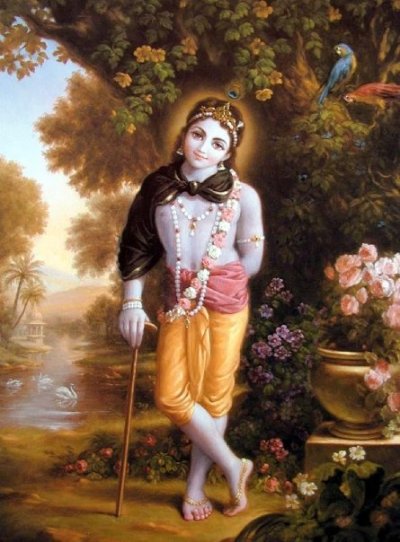
Kṛṣṇa was very pleased with the atmosphere of the forest where flowers bloomed and bees and drones hummed very jubilantly. While the birds, trees and branches were all looking very happy, Kṛṣṇa, tending the cows, accompanied by Śrī Balarāma and the cowherd boys, began to vibrate His transcendental flute. After hearing the vibration of the flute of Kṛṣṇa, the gopīs in Vṛndāvana remembered Him and began to talk amongst themselves about how nicely Kṛṣṇa was playing His flute. When the gopīs were describing the sweet vibration of Kṛṣṇa’s flute, they also remembered their pastimes with Him; thus their minds became disturbed, and they were unable to describe completely the beautiful vibrations. While discussing the transcendental vibration, they remembered also how Kṛṣṇa dressed, decorated with a peacock feather on His head, just like a dancing actor, and with blue flowers pushed over His ear. His garment glowed yellow-gold, and He was garlanded with a vaijayantī necklace. Dressed in such an attractive way, Kṛṣṇa filled up the holes of His flute with the nectar emanating from His lips. So they remembered Him, entering the forest of Vṛndāvana, which is always glorified by the footprints of Kṛṣṇa and His companions.
More
08 Mar 2013
by The Hare Krishna Movement
in A.C. Bhaktivedanta Swami Prabhupada, Bhagavad-gita, Om
Tags: A.C. Bhaktivedanta Swami Prabhupada, bhakti yoga, chanting Hare Krishna, mama om visnu-padaya, meditation, Om, om ajnana-timirandhasya, om namo bhagavate vasudevaya, om tat sat, omkara, syllable om, The Syllable Om, yoga

The Syllable Om
Many years ago as a young aspiring yogi, and with my very first attempts at meditation, I began my practice with the sacred syllable Om. Many years later and although I may have advanced somewhat spiritually, and practice bhakti-yoga, devotional service and the chanting of the Maha-mantra Hare Krishna, Hare Krishna, Krishna Krishna, Hare Hare, still all my morning prayers still begin with the syllable Om. Such as “om namo bhagavate vasudevaya” before my reading of the Srimad Bhagavatam. And my morning offering of respectful obeisances to my spiritual master Srila Prabhupada with the prayer “om ajñāna-timirāndhasya jñānāñjana-śalākayā, cakṣur unmīlitaṁ yena tasmai śrī-gurave namaḥ” and “nama oṁ viṣṇu-pādāya kṛṣṇa-preṣṭhāya bhū-tale,śrīmate bhaktivedānta-svāmin iti nāmine”. Today we are looking at a few slokas from the Bhagavad-gita where the syllable Om is used.
More
27 Feb 2013
by The Hare Krishna Movement
in A.C. Bhaktivedanta Swami Prabhupada, Krishna Consciousness, Kulashekara das, Remembering Srila Prabhupada, Srila Prabhupada, The Hare Krishna Movement
Tags: Billy Preston, Colin Jury, George Harrison, john & Yoko, John Lennon, kirtan at Georges house, Kulasekhara das, mantra meditation, prabhupada, Radha Krishna Temple, Shyamasundar, tablas, Tittenhurst, TM, Yamuna devi, yoga

click on image to enlarge
Srila Prabhupada’s England Visit
by Kulashekara Das
The journey with Swami Prabhupada has been the most satisfying aspect of my life. His values of life has given a new dimension to the world and has helped people in all the facets of life.
Advent
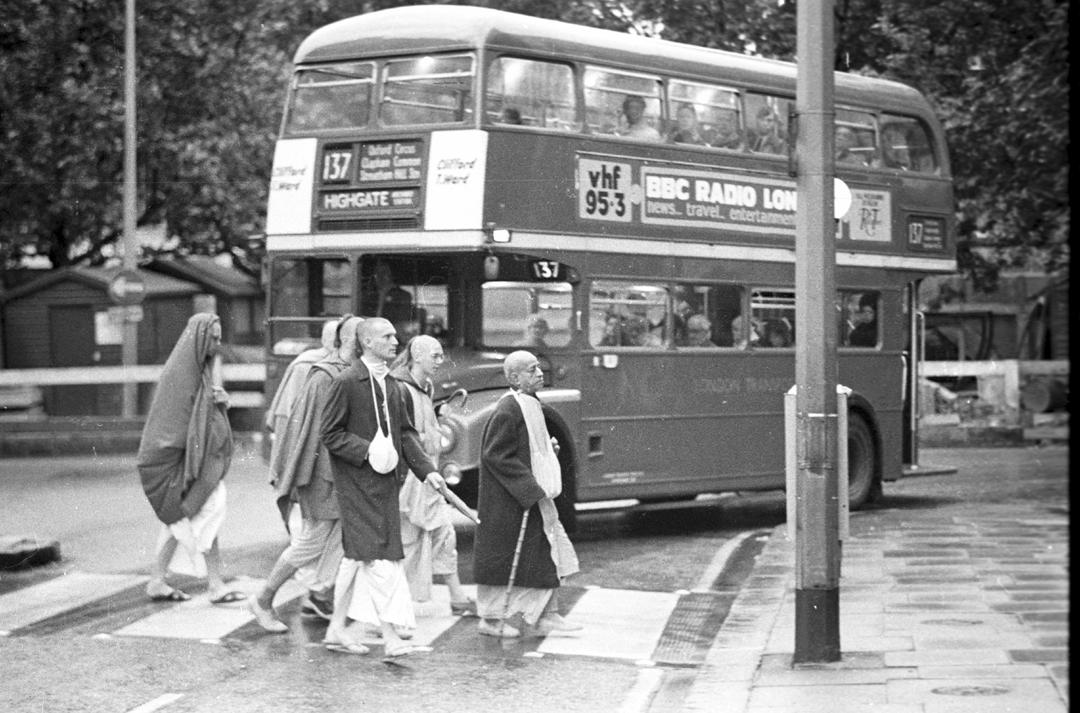
In the late 1960’s I first came in contact with practitioners of the Vaishnava tradition. Several American disciples of A.C. Bhaktivedanta Swami Prabhupada had arrived in the UK to establish a Radha Krishna Temple.
I was quite impressed with the depth of Vedic philosophy and especially with the chanting of the Holy Names of God. Almost overnight I quit my entire Rock n Roll lifestyle and my job and began my life as a Brahmachari. I soon found myself living at John & Yoko Lennon’s eighty plus acre estate – “Tittenhurst” and ended up staying there for six months.
More
23 Jan 2013
by The Hare Krishna Movement
in A.C. Bhaktivedanta Swami Prabhupada
Tags: A.C. Bhaktivedanta Swami Prabhupada, Absolute Truth, Arjuna, atma, Bg. 8, bhagavad-gita, Bhagavan, body mind soul, brahman, devotional seervice, fruitive activities, individual soul, karma, Krishna, krsna consciousness, living enity, Paramatma, Srimad Bhagavatam, transcendental, yoga, yoga principles

Bhagavad-gītā As It Is 1972 Edition
By His Divine Grace A. C. Bhaktivedanta Swami Prabhupāda
Chapter 8
Attaining the Supreme
More
28 Dec 2012
by The Hare Krishna Movement
in A.C. Bhaktivedanta Swami Prabhupada
Tags: A.C. Bhaktivedanta Swami Prabhupada, Arjuna, Bg.7, bhagavad-gita, four kinds of men, Gita, Knowledge of the Absolute, Krsna, krsna consciousness, practicing yoga in full consciousness of Me, Spiritual world, yoga

click on image to enlarge
…In this Seventh Chapter of Bhagavad-gītā, the nature of Kṛṣṇa consciousness is fully described. Kṛṣṇa is full in all opulences, and how He manifests such opulences is described herein. Also, four kinds of fortunate people who become attached to Kṛṣṇa, and four kinds of unfortunate people who never take to Kṛṣṇa are described in this chapter.
Bhagavad-gītā As It Is Complete 1972 Edition
By His Divine Grace A. C. Bhaktivedanta Swami Prabhupāda
Chapter 7
Knowledge of the Absolute
More
26 Dec 2012
by The Hare Krishna Movement
in Chanting Hare Krishna, Sri Nandanandana das, Stephen Knapp
Tags: age of kali, age of quarrel and anxiety, chanting Hare Krishna, Hare Krishna, Hare Rama, Maha Mantra, mantra meditation, sixteen words, Sri Nandanandana das, Stephen Knapp, Vedic Scriptures, yoga
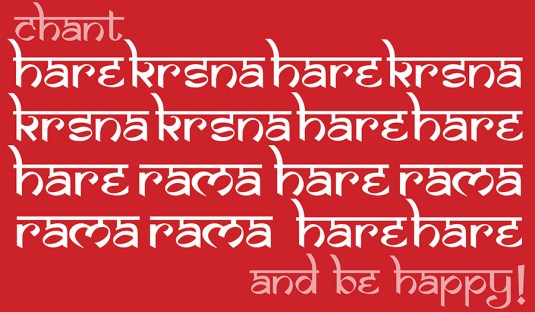
This is Part 2 in the series on chanting by Sri Nandanandana Prabhu. This is a collection of quotes from the Vedic Scriptures advocating the merits of chanting the Holy Names. To read Part 1
Chanting the Maha-Mantra
by Stephen Knapp (Sri Nandanandana dasa)
Part 2
There are many Vedic references which specifically recommend the chanting of the Hare Krishna maha-mantra as the most effective and advantageous means of reaching spiritual realization and counteracting all the problems of this age. Some of these verses are the following:
These sixteen words–Hare Krishna, Hare Krishna, Krishna Krishna, Hare Hare/Hare Rama, Hare Rama, Rama Rama, Hare Hare–are especially meant for counteracting the ill effects of the present age of quarrel and anxiety. (Kali-santarana Upanishad)
More
11 Dec 2012
by The Hare Krishna Movement
in A.C. Bhaktivedanta Swami Prabhupada, Yoga
Tags: A.C. Bhaktivedanta Swami Prabhupada, age of kali, Arjuna, as it is, ascetic, be a yogi, Bg. 6, bhagavad-gita, bhakti yoga, Collier Macmillan Publishers, complete 1972 edition, control the mind and senses, eightfold yoga system, empiricist, English equivalents, fruitive worker, krsna consciousness, Krsna consciousness is the highest stage of yoga practice, Macmillan Publishing Co., Paramatma, pratyahara, Sankhya-yoga, Sri Bhagavan uvaca, transcendental form of Krsna, translation and elaborate purports, true mystic, Vedānta philosophy, with Roman transliteration of the original Sanskrit text, yoga, yogi, yoginam api sarvesam

A yogī is greater than the ascetic, greater than the empiricist and greater than the fruitive worker. Therefore, O Arjuna, in all circumstances, be a yogī.
And of all yogīs, he who always abides in Me with great faith, worshiping Me in transcendental loving service, is most intimately united with Me in yoga and is the highest of all.
Bhagavad-gītā As It Is 1972 Edition
By His Divine Grace A. C. Bhaktivedanta Swami Prabhupāda
Chapter Six
Sāṅkhya-yoga More
27 Aug 2012
by The Hare Krishna Movement
in A.C. Bhaktivedanta Swami Prabhupada, Krsna Consciousness: The Topmost Yoga System, Yoga
Tags: A.C. Bhaktivedanta Swami Prabhupada, bhagavad-gita, bhakti yoga, goal of yoga, Krishna, krsna consciousness, The Topmost Yoga System, yoga
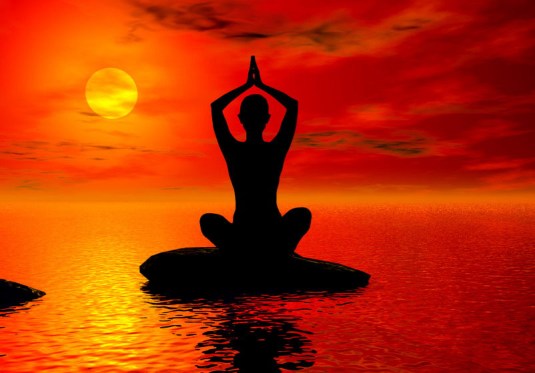
…Kṛṣṇa consciousness is the great necessity of human society. Learn it and appreciate it, comprehend it and assimilate it—and teach it. It is very simple. If you offenselessly chant Hare Kṛṣṇa, everything will be revealed from within because Kṛṣṇa is sitting within you. If you are strong and have faith and conviction in Kṛṣṇa, as well as in the spiritual master, the transparent via medium to Kṛṣṇa, then Kṛṣṇa is there. The Vedas say that if you have implicit faith in God and implicit faith in your bona fide guru, who teaches you Kṛṣṇa consciousness, then the result will be that all the Vedic scriptures will be revealed authoritatively.(Srila Prabhupada)
More
20 Aug 2012
by The Hare Krishna Movement
in Kali Yuga, Srimad Bhagavatam, Time
Tags: A.C. Bhaktivedanta Swami Prabhupada, age of kali, bhagavad-gita, dvapara-yuga, enlightenment, great sacrifice, Kali-yuga, meditation, Naimisaranya, satya-yuga, self realization, Sri Krishna, Srimad Bhagavatam, Treta-yuga, worship of the Lord, yoga

By human calculation, a thousand ages taken together is the duration of Brahmā’s one day. And such also is the duration of his night.
…This age of Kali is not at all suitable for self-realization as was Satya-yuga, the golden age, or Tretā- or Dvāpara-yugas, the silver and copper ages. For self-realization, the people in Satya-yuga, living a lifetime of a hundred thousand years, were able to perform prolonged meditation. And in Tretā-yuga, when the duration of life was ten thousand years, self-realization was attained by performance of great sacrifice. And in the Dvāpara-yuga, when the duration of life was one thousand years, self-realization was attained by worship of the Lord. But in the Kali-yuga, the maximum duration of life being one hundred years only and that combined with various difficulties, the recommended process of self-realization is that of hearing and chanting of the holy name, fame, and pastimes of the Lord.
The sages of Naimiṣāraṇya began this process in a place meant specifically for the devotees of the Lord. They prepared themselves to hear the pastimes of the Lord over a period of one thousand years. By the example of these sages one should learn that regular hearing and recitation of the Bhāgavatam is the only way for self-realization. Other attempts are simply a waste of time, for they do not give any tangible results. Lord Śrī Caitanya Mahāprabhu preached this system of Bhāgavata-dharma, and He recommended that all those who were born in India should take the responsibility of broadcasting the messages of Lord Śrī Kṛṣṇa, primarily the message of Bhagavad-gītā. And when one is well established in the teachings of Bhagavad-gītā, he can take up the study of Śrīmad-Bhāgavatam for further enlightenment in self-realization.
Further information on the Age of Kali More
17 Aug 2012
by The Hare Krishna Movement
in Uncategorized
Tags: A.C. Bhaktivedanta Swami Prabhupada, Arjuna, as it is, bhagavad-gita, Bhagavan, Iksvaku, imam vivasvate yogam, Krishna, Macmillan Edition, Manu, Original 1972 Macmillan, science of yoga, the blessed Lord said, The Supreme Personality of Godhead, transcendental knowledge, Vivasvan, yoga

Bhagavad-gītā As It Is
By His Divine Grace A. C. Bhaktivedanta Swami Prabhupāda
Chapter 4
Transcendental Knowledge
More
Previous Older Entries Next Newer Entries












 The Hare Krishna Movement