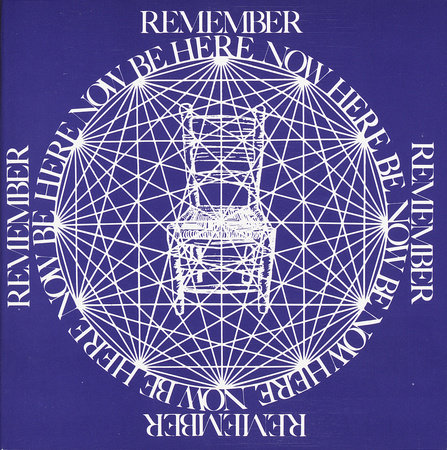
Today most people have heard of yoga and meditation, but I remember when I first took up yoga back in 1972, it was not so widely known. I was first introduced to it from the book “Be Here Now”. It was a very simplistic book, but it was full of ideas, quotes and images, that opened my mind to a world of spiritual thought. It introduced me to yoga, meditation, the concept of vegetarianism, spirituality, and the need of a Guru or Spiritual Master. I began to take seriously ideas that were introduced, such as self realization, living a more pure life, developing our relationship with God, finding out who is God, and finding my spiritual master (guru). So for me, the book was the beginning of my journey, as it was for many, so indeed it was a huge success, it that regard.
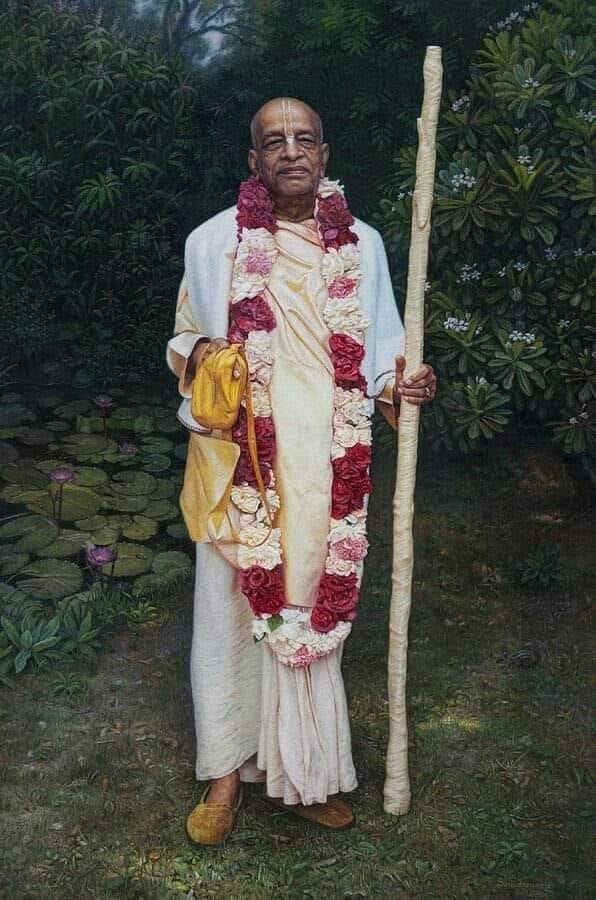
Maybe I was sincere, or maybe just lucky, but I soon found my eternal Spiritual Master, His Divine Grace A.C. Bhaktivedanta Swami Prabhupada, and he answered all my questions. He told me who is God (Krsna), what my relationship with him is (sanatan-dharma), the process for self realization (bhakti-yoga), and how to get out of this temporary material world and return home back to Godhead.
When I first began my practice of Yoga, it was purely as a spiritual Practice. Nowadays, people will take it up for many different reasons, such as weight loss, fitness, relaxation, or social acceptance and community. But I still see it as a spiritual practice. The daily asanas, which are good for my ageing body, are an offering, and the breathing is a mindful prayer.
The word Yoga means “Union”. To link our consciousness with a Higher Consciousness.
Yoga means “linking” with the Supreme. The Bhagavad-gītā describes several systems—karma-yoga (work), jñāna-yoga (knowledge), dhyāna-yoga (meditation), and aṣṭāṅga-yoga (eightfold path)—but ultimately declares bhakti-yoga, devotional service, to be the highest.
“Of all yogīs, he who always abides in Me with great faith, worshiping Me in transcendental loving service, is most intimately united with Me in yoga, and is the highest of all.” (Bg. 6.47) So one who thinks of the Supreme Lord always is the greatest yogi, the supermost jnani, and the greatest devotee at the same time.
This morning as I was making a breakfast offering, and was offering a nice glass of fresh milk, my mind just seemed to go to this picture of Krsna milking a cow. And I thought ‘milk is such a wonderful food, miraculous really. One can live on milk, and as small children milk is all that is required, and as we develop as yogis, we can subsist on the gifts of God, such as fruits, grains and milk, without a need for killing.
The above picture is one of my very favorites from the Krsna Book, because it is so simple and sweet, and there is a noticeable absence of technology.
The following are two verses from the Bhagavad-gita As It Is describing the healthy diet, and activities of the yogi.
There is no possibility of one’s becoming a yogī, O Arjuna, if one eats too much, or eats too little, sleeps too much or does not sleep enough.
He who is temperate in his habits of eating, sleeping, working and recreation can mitigate all material pains by practicing the yoga system. (Bg. 6.16-17)
When we speak of yoga we refer to linking up our consciousness with the Supreme Absolute Truth. Such a process is named differently by various practitioners in terms of the particular method adopted. When the linking up process is predominantly in fruitive activities, it is called karma-yoga, when it is predominantly empirical, it is called jñāna-yoga, and when it is predominantly in a devotional relationship with the Supreme Lord, it is called bhakti-yoga. Bhakti-yoga or Kṛṣṇa consciousness is the ultimate perfection of all yogas, as will be explained in the following verse.
And of all yogīs, he who always abides in Me with great faith, worshiping Me in transcendental loving service, is most intimately united with Me in yoga and is the highest of all. (Bhagavad-gita 6.47)
The culmination of all kinds of yoga practices lies in bhakti-yoga. All other yogas are but means to come to the point of bhakti in bhakti-yoga. Yoga actually means bhakti-yoga; all other yogas are progressions toward the destination of bhakti-yoga. From the beginning of karma-yoga to the end of bhakti-yoga is a long way to self-realization. Karma-yoga, without fruitive results, is the beginning of this path. When karma-yoga increases in knowledge and renunciation, the stage is called jñāna-yoga. When jñāna-yoga increases in meditation on the Supersoul by different physical processes, and the mind is on Him, it is called aṣṭāṅga-yoga. And, when one surpasses the aṣṭāṅga-yoga and comes to the point of the Supreme Personality of Godhead Kṛṣṇa, it is called bhakti-yoga, the culmination. Factually, bhakti-yoga is the ultimate goal, but to analyze bhakti-yoga minutely one has to understand these other yogas. The yogī who is progressive is therefore on the true path of eternal good fortune. One who sticks to a particular point and does not make further progress is called by that particular name: karma-yogī, jñāna-yogī or dhyāna-yogī, rāja-yogī, haṭha-yogī, etc. If one is fortunate enough to come to the point of bhakti-yoga, it is to be understood that he has surpassed all the other yogas. Therefore, to become Kṛṣṇa conscious is the highest stage of yoga, just as, when we speak of Himalayan, we refer to the world’s highest mountains, of which the highest peak, Mount Everest, is considered to be the culmination.
sarva-bhūta-stham—situated in all beings; ātmānam—the Supersoul; sarva—all; bhūtāni—entities; ca—also; ātmani—in the Self; īkṣate—does see; yoga-yukta-ātmā—one who is dovetailed in Kṛṣṇa consciousness; sarvatra—everywhere; sama-darśanaḥ—seeing equally.
TRANSLATION A true yogī observes Me in all beings, and also sees every being in Me. Indeed, the self-realized man sees Me everywhere.
PURPORT
A Kṛṣṇa conscious yogī is the perfect seer because he sees Kṛṣṇa, the Supreme, situated in everyone’s heart as Supersoul (Paramātmā).
Īśvaraḥ sarva-bhūtānāṁ hṛd-deśe ’rjuna tiṣṭhati.
The Supreme Lord is situated in everyone’s heart, O Arjuna, and is directing the wanderings of all living entities.
That supreme abode is called unmanifested and infallible, and it is the supreme destination. When one goes there, he never comes back. That is My supreme abode. (Bhagavad-gita 8.21)
Purport
The supreme abode of the Personality of Godhead, Kṛṣṇa, is described in the Brahma-saṁhitā as cintāmaṇi-dhāma, a place where all desires are fulfilled. The supreme abode of Lord Kṛṣṇa known as Goloka Vṛndāvana is full of palaces made of touchstone. There are also trees which are called “desire trees” that supply any type of eatable upon demand, and there are cows known as surabhi cows which supply a limitless supply of milk. In this abode, the Lord is served by hundreds of thousands of goddesses of fortune (Lakṣmīs), and He is called Govinda, the primal Lord and the cause of all causes. The Lord is accustomed to blow His flute (venum kvanantam). His transcendental form is the most attractive in all the worlds—His eyes are like the lotus petals and the color of His body like clouds. He is so attractive that His beauty excels that of thousands of cupids. He wears saffron cloth, a garland around His neck and a peacock feather in His hair. In the Gītā Lord Krṣṇa gives only a small hint of His personal abode (Goloka Vṛndāvana) which is the supermost planet in the spiritual kingdom. A vivid description is given in the Brahma-saṁhitā. Vedic literature states that there is nothing superior to the abode of the Supreme Godhead, and that that abode is the ultimate destination. When one attains to it, he never returns to the material world. Kṛṣṇa’s supreme abode and Kṛṣṇa Himself are non different, being of the same quality. On this earth, Vṛndāvana, ninety miles southeast of Delhi, is a replica of that supreme Goloka Vṛndāvana located in the spiritual sky. When Kṛṣṇa descended on this earth, He sported on that particular tract of land known as Vṛndāvana in the district of Mathurā, India.
Chanting the Maha Mantra, or the great “chant for deliverance”, is very easy, and can be preformed anywhere, anytime. Srila Prabhupada has said “from your lips to your ears”, it is that easy. It is the kind of yoga (union), or meditation, one can easily practice anywhere, anytime.
Chanting of the Hare Kṛṣṇa mantra is the easiest process of meditation. (from purport to Srimad Bhagavatam 4.8.53)
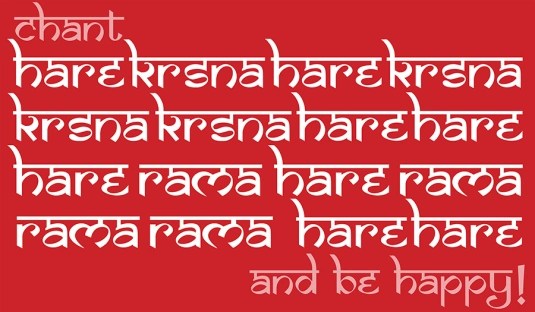
No other means of spiritual realization is as effective in this age of quarrel and hypocrisy as the chanting of the mahā-mantra: Hare Kṛṣṇa, Hare Kṛṣṇa, Kṛṣṇa Kṛṣṇa, Hare Hare / Hare Rāma, Hare Rāma, Rāma Rāma, Hare Hare. (BTG #30 1970)
Chanting the Hare Kṛṣṇa Mantra
(appeared as a separate pamphlet in 1967 and reproduced from the article “On Chanting the Hare Krishna Mantra” published in the 1970 Back to Godhead Magazine number 34)
“This simplest method of meditation is recommended for this age. By practical experience also, one can perceive that by chanting this mahā-mantra, or the Great Chanting for Deliverance, one can feel a transcendental ecstasy coming through from the spiritual stratum.”
…The best and ultimate authority is Kṛṣṇa, for He is our eternal well-wisher, and He always speaks for our benefit. Since we have to accept some authority, why not accept His? Simply by hearing of His glories from Bhagavad-gītā and Śrīmad-Bhāgavatam and by chanting His names: Hare Kṛṣṇa, Hare Krsna, Krsna Krsna, Hare Hare, Hare Rama, Hare Rama, Rama Rama, Hare Hare, we can swiftly perfect our lives.
Kṛṣṇa Consciousness, the Matchless Gift By His Divine Grace A. C. Bhaktivedanta Swami Prabhupāda Chapter One
Spiritual Knowledge Through Kṛṣṇa
The aim of this Kṛṣṇa consciousness movement is to bring all living entities back to their original consciousness. All living entities within the material world are, to varying degrees, afflicted with a type of madness. This Kṛṣṇa consciousness movement aims at curing man of his material disease and reestablishing his original consciousness. In a Bengali poem a great Vaiṣṇava poet has written, “When a man is haunted by ghosts, he can only speak nonsense. Similarly, anyone who is under the influence of material nature should be considered haunted, and whatever he speaks should be considered nonsense.” One may be considered a great philosopher or great scientist, but if he is haunted by the ghost of māyā, illusion, whatever he theorizes and whatever he speaks is more or less nonsensical. Today we are given the example of a psychiatrist who, when requested to examine a murderer, proclaimed that since all the patients with whom he had come in contact were more or less crazy, the court could excuse the murderer on those grounds if it so desired. The point is that in the material world it is very difficult to find a sane living entity. The prevailing atmosphere of insanity in this world is all caused by the infection of material consciousness.
This morning while I was chanting my japa (chanting silently the Hare Krishna mantra) I was thinking of how Google defined mantra meditation. So many people today have heard the words yoga and meditation, but what do they think it means? Some think yoga is just a good form of exercise, and meditation is just a way of shutting out the noise, and thinking of nothing. So I did a Google search:
Mantra meditation involves repeating a sacred sound, word, or phrase to focus the mind and promote relaxation. This technique helps to quiet the mind and allow for deeper states of meditation. The repeated mantra acts as a point of focus, helping to direct the mind and reduce mental chatter.
Mantra meditation is a technique that involves using mantras to relax the mind and help it focus.
Not bad definitions really, but for me, actually Yoga means “Union with God”, and Meditation means “Meditation on God”. So the ultimate goal of Yoga is bhakti-yoga, and the highest form of Mantra-meditation is to focus on God (Krishna).
“One has to qualify himself to see and understand God, and that process of qualification is called Kṛṣṇa consciousness. By engaging ourselves in God’s service, we become qualified to see God. Otherwise it is not possible.“
“One cannot understand the form, name, quality, or paraphernalia of God with one’s material senses.” (Cc Madya 17.136)
Just as God is eternal, we are also eternal, and when we establish our eternal relationship with the supreme, complete eternal, we realize our eternality.
God is the supreme living entity among all living entities, the supreme eternal among all eternals. By Kṛṣṇa consciousness, by purification of the senses, this knowledge will be realized, and we will come to see God.
The following post is Chapter 3 from the book “The Path to Perfection”which gives some instruction on Seeing God (Krsna) and on the yoga system.
I have been reading the Krsna Book lately, and just yesterday we were reading chapter 14 “Prayers Offered by Lord Brahma to Lord Krsna”, and I was reminded this was the last chapter Srila Prabhupada was working on in the Srimad Bhagavatam series before his passing. So I had another look at the Tenth Canto, part 3, and thought it a good idea to share it with all our readers.
This is the final Śrīmad-Bhāgavatam volume translated by His Divine Grace A. C. Bhaktivedanta Swami Prabhupada, Founder-Acarya of the International Society for Krishna Consciousness, before his untimely departure. We share it with you as a free PDF download. You can click on the above link to view the complete volume or save it to your computer.
Foward
This is the final Śrīmad-Bhāgavatam volume translated by His Divine Grace A. C. Bhaktivedanta Swami Prabhupada, founder-acarya of the International Society for Krishna Consciousness. It is smaller than the earlier volumes because it ends where the renowned author stopped translating just before his departure from this mortal world on November 14, 1977, at the Krsna-Balarama Mandira in Vrndavana, India.
The first part of this volume was produced in the usual fashion. Srila Prabhupada would sit and read silently from the Sanskrit text and then speak the translation and commentary into his dictaphone. Later, due to illness, it became necessary for his disciples to assist him personally.
In these last days Srila Prabhupada was gravely ill. Unable to eat for weeks, his health had deteriorated, making even the slightest movement excruciatingly painful.
As he lay still, a devotee would softly read the Sanskrit to him. Another disciple, sitting on his bed, held the microphone to him, nearly touching his mouth. And then Srila Prabhupada would speak, voice sometimes barely audible.
These recordings, made in his quarters at the temple, constitute the balance of this book.
In these final moments, the physician attending His Divine Grace confided that an ordinary man in such critical condition would have been crying out from the intense pain. Srila Prabhupada’s disciples were awestruck as they watched their spiritual master work quietly, undisturbed.
In the last part of the book we find Srila Prabhupada’s usual clarity of thought, constant scriptural references, scrupulous attention to detail, and rigorous philosophical exposition fully intact, just as they were in the preceding twenty-nine volumes of the Śrīmad-Bhāgavatam.
Srila Prabhpada’s last days and this translation will stands an inspiring reminder that even the severest material circumstances cannot impede the activities of a pure devotee of the Supreme Personality of Godhead.
…The process of meditation recommended in the Śrīmad-Bhāgavatam is not to fix one’s attention on something impersonal or void.
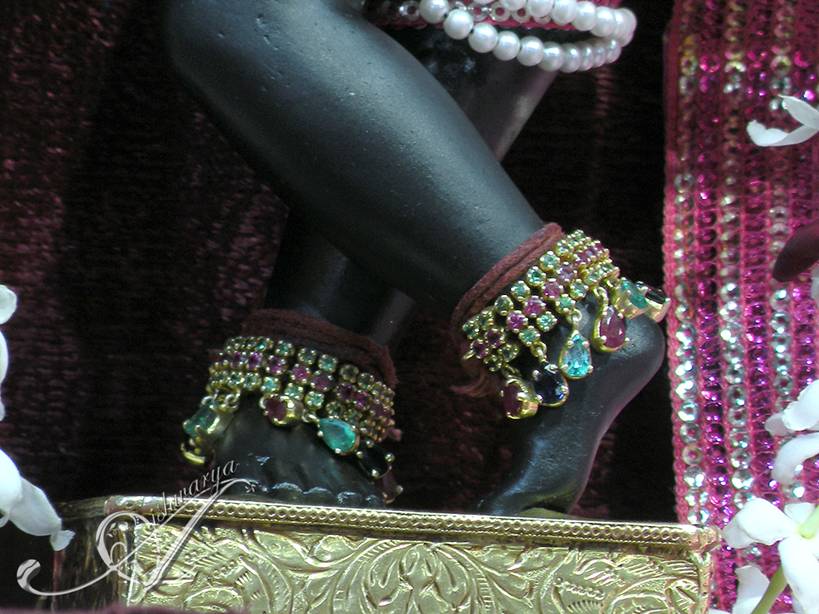
The process of meditation should begin from the lotus feet of the Lord and progress to His smiling face. The meditation should be concentrated upon the lotus feet, then the calves, then the thighs, and in this way higher and higher. The more the mind becomes fixed upon the different parts of the limbs, one after another, the more the intelligence becomes purified. (SB 2.2.13)
Śrīmad-Bhāgavatam By His Divine Grace A. C. Bhaktivedanta Swami Prabhupāda Canto Two, Chapter 2, Text 13-14
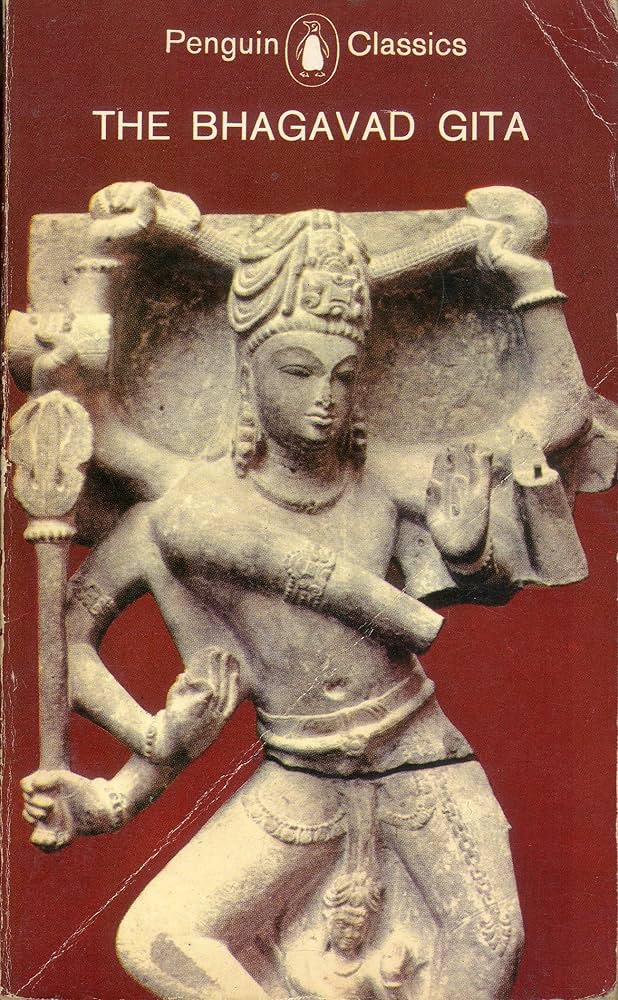
I remember back in my younger years, before I became a devotee, I decided to spend my summer off from college, hiking the Appalachian trail. I took with me some small books with me to read along the way. I was becoming interested in Eastern philosophy, and was asking myself questions like who is God, who am I, and what is my relationship with Him. I carried with me a small paperback book by Hermann Hesse entitled Siddhartha, a book by Henry David Thoreau; “Walden”, and the Penguin Classic; “The Bhagavad-gita.
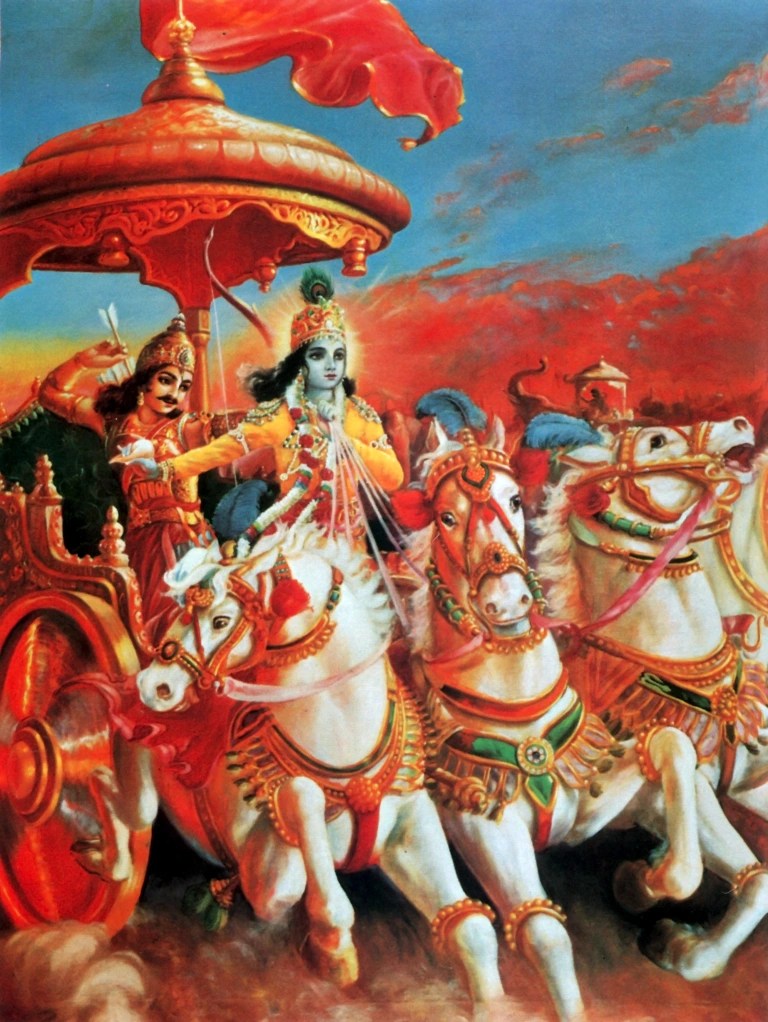
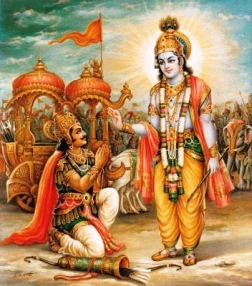
From the book “Siddhartha” I became interested in meditation and the journey to self discovery. From “Walden”, I became interested is self- sufficiency, or as I later describe it as simple living and high thinking, and from the Bhagavad-gita, I discovered who God is. Really. For some reason, as soon as I began reading, I immediately accepted that Krishna was God. This book was the song of God. This was God speaking to His friend Arjuna, instructing him. And I thought how wonderful to be a friend of God, to become Gods friend.
Even though I was raised as a Christian, went to church on Sunday, was taught by nuns and priests, I never got satisfactory answers to my question, Who is God? But this book the Bhagavad-gita, This was God Himself speaking to his friend. Now I knew, there is a God, and His name was Krishna.
About a year later I meet a Hare Krishna devotee at the Chicago O’Hare airport, and I got from him the Krsna Book, then later I went back there and found a deserted copy of the Bhagavad-gita As It Is, on a neglected bench seat, by His Divine Grace A. C. Bhaktivedanta Swami. It wasn’t just the translations that the penguin classic offered, but it was the complete edition, with original Sanskrit text, Roman transliterations, English equivalents, translation and elaborate purports.
This is an old photo taken in 1907 that my wife found on Facebook. I remember as a kid, thinking that’s what yogis do. Sit on a bed of nails, or levitate off the ground while meditating.
Before Srila Prabhupada came to the West, bringing with him the Vedic Philosophy, not many people had any idea of what was Yoga or Meditation. Or that there were different types of Yoga and Meditation.
We share with you an excerpt from the small paperback book by His Divine Grace A. C. Bhaktivedanta Swmai Prabhupada entitled ” The Perfection of Yoga ”
The yogī obviously has to go through a great deal of difficulty to purify the ātmā (mind, body and soul), but it is a fact that this can be done most effectively in this age simply by the chanting of Hare Kṛṣṇa, Hare Kṛṣṇa, Kṛṣṇa Kṛṣṇa, Hare Hare/ Hare Rāma, Hare Rāma, Rāma Rāma, Hare Hare. Why is this? Because this transcendental sound vibration is non-different from Kṛṣṇa. When we chant His name with devotion, then Kṛṣṇa is with us, and when Kṛṣṇa is with us, then what is the possibility of remaining impure? Consequently, one absorbed in Kṛṣṇa consciousness, in chanting the names of Kṛṣṇa and serving Him always, receives the benefit of the highest form of yoga. The advantage is that he doesn’t have to take all the trouble of the meditational process. That is the beauty of Kṛṣṇa consciousness.
I have always enjoyed SrilaPrabhupada’s sense of humor.
Prabhupada: ”Krsna has got accountant. [laughter] He keeps nice account of the activities of His devotees.”……
Prabhupada: So one thing is guaranteed. If you engage in Krsna consciousness, and suppose you do not become perfectly mature, some way or other you fall down… We should not fall down. Because if we have got enthusiasm and patience, we shall not fall down. But suppose we fall down. There is nothing inauspicious, because whatever you have done sincerely, that is recorded in the book, in the Krsna’s book. Krsna has got accountant. [laughter] He keeps nice account of the activities of His devotees. That’s a fact. Just like the non devotees’ accounts are kept by Yamaraja for punishment, similarly, devotees’ accounts are kept by Krsna, personally. Unless He keeps account, how He says, “I respond to the devotee to the proportionate surrender”? The real business is surrender to Krsna. If we surrender immediately, cent percent, then Krsna also gives you the result immediately, cent percent. ( The Nectar of Devotion Lecture , October 20, 1972, Vrndavana)
Sacha bole tomare lata…jagat harai dhana kali-yuga dukha lalge haspai . This is a Hindi verse by one devotee that this Kali-yuga is so abominable that if you speak truth, then people will come with some rod to beat you. But if you cheat them, bluff them. they’ll be bewildered (?), they’ll like it. If I say I’m God, people will say, “Oh, here is Swamiji, God.” They won’t inquire, that “How you have become God? What is the symptom of God? Have you got all the symptoms?” Nobody inquires. So these things happen. Unless one is not fixed up in the self, unless one does not understand what is real self, unless one does not understand what is Superself. So, yoga means to understand this self-realizing process. That is yoga.
“A true yogi observes Me in all beings and also sees every being in Me.”
…To see every being, everything in relationship with Krsna , that means you see Krsna everywhere. That is the prefection of yoga. As it is taught in the Bhagavad-gita, raso ‘ham apsu kaunteya prabhāsmi sasi-suryayoh: [Bg. 7.8] “I am the taste of water. I am the light of the sun and the moon.”
Bhagavad-gita Lecture 6.25-29 Recorded in Los Angeles, February 18, 1969
Prabhupāda: Page hundred and fifty-six.
Viṣṇujana: “Gradually, step by step, with full conviction, one should become situated in trance by means of intelligence, and thus the mind should be fixed on the Self alone and should think of nothing else.” [Bg. 6.25].”
Prabhupāda: Yes. The self, the mind should be fixed in self. We are self and Krsna is also self. So, just like if you fix up your eyes on the sun, then you can see the sun and yourself also. Sometimes in dense darkness we cannot see ourself also. That you have experienced. So I cannot see my body in dense darkness. Although body is with me, I am the body or I am whatever I am, I cannot see myself. That you have got experience. So if you are in the sunshine, sunlight, then you see the sun as well as yourself. Is it not? Therefore to see the self means first of all see the Supreme Self. The Supreme Self is Krsna . In the Vedas it is said, Kaṭhopaniṣad, nityo nityānāṁ cetanaś cetanānām (Katha Upanisad 2.2.13). The Supreme Self is the chief eternal of all eternals. He is the chief living being of all living beings. So this Krsna consciousness movement means to fix up in self. To, the same example. If you fix up your mind in Krsna, then you can fix up your mind in everything. The same example again, if you take care of your stomach, then you take care of all the bodily limbs. If your stomach is supplied nice nutritious food, the stomach is cleared of all disturbances then you keep good health. So if you pour water in the root of the tree, then you take care of all the branches, leaves, flowers, twigs, everything, automatically.
This is an old photo taken in 1907 that my wife found on Facebook. I remember as a kid, thinking that’s what yogis do. Sit on a bed of nails, or levitate off the ground while meditating.
Before Srila Prabhupada came to the West, bringing with him the Vedic Philosophy, not many people had any idea of what was Yoga or Meditation. Or that there were different types of Yoga and Meditation.
We share with you an excerpt from the small paperback book by His Divine Grace A. C. Bhaktivedanta Swmai Prabhupada entitled ” The Perfection of Yoga ”
The yogī obviously has to go through a great deal of difficulty to purify the ātmā (mind, body and soul), but it is a fact that this can be done most effectively in this age simply by the chanting of Hare Kṛṣṇa, Hare Kṛṣṇa, Kṛṣṇa Kṛṣṇa, Hare Hare/ Hare Rāma, Hare Rāma, Rāma Rāma, Hare Hare. Why is this? Because this transcendental sound vibration is nondifferent from Kṛṣṇa. When we chant His name with devotion, then Kṛṣṇa is with us, and when Kṛṣṇa is with us, then what is the possibility of remaining impure? Consequently, one absorbed in Kṛṣṇa consciousness, in chanting the names of Kṛṣṇa and serving Him always, receives the benefit of the highest form of yoga. The advantage is that he doesn’t have to take all the trouble of the meditational process. That is the beauty of Kṛṣṇa consciousness.
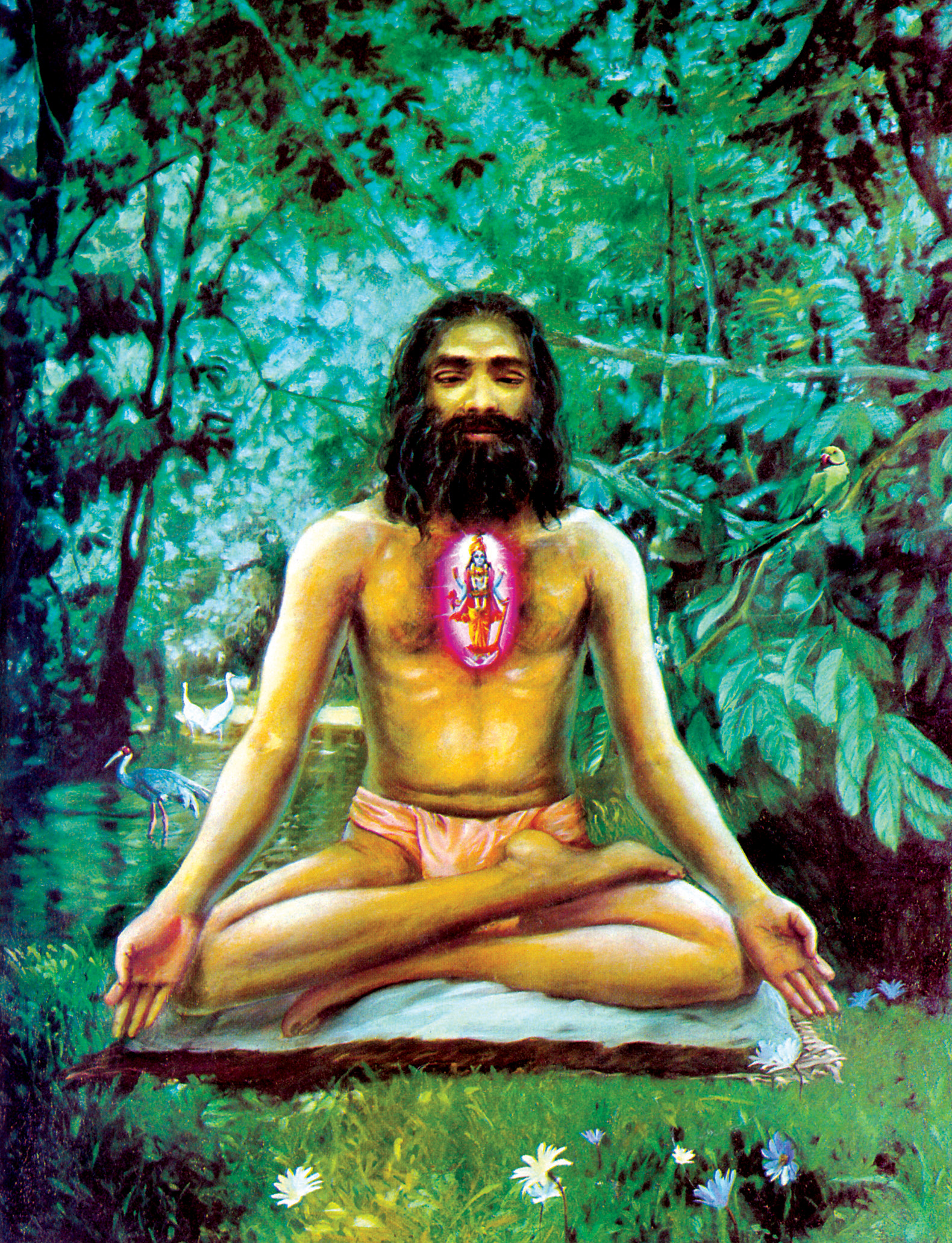
In yoga it is necessary to control all of the senses, and when all the senses are controlled, the mind must be engaged in thinking of Viṣṇu. One becomes peaceful after thus conquering material life.
jitātmanaḥ praśāntasya paramātmā samāhitaḥ
“for one who has conquered the mind, the Supersoul is already reached, for he has attained tranquillity.” ( Bg. 6.7)
This material world has been likened to a great forest fire. As in the forest, fire may automatically take place, so in this material world, although we may try to live peacefully, there is always a great conflagration. It is not possible to live in peace anywhere in the material world. But for one who is transcendentally situated—either by the meditational yoga system or by the empirical philosophical method or by bhakti-yoga—peace is possible. All forms of yoga are meant for transcendental life, but the method of chanting is especially effective in this age. Kīrtana may go on for hours, and one may not feel tired, but it is difficult to sit in lotus position perfectly still for more than a few minutes. Yet regardless of the process, once the fire of material life is extinguished, one does not simply experience what is called impersonal void. Rather, as Kṛṣṇa tells Arjuna, one enters into the supreme abode.
“By meditating in this manner, always controlling the body, mind and activities, the mystic transcendentalist attains to the kingdom of God through cessation of material existence.” (Bg. 6.15)
This morning as I was making a breakfast offering, and was offering a nice glass of fresh milk, my mind just seemed to go to this picture of Krsna milking a cow. And I thought ‘milk is such a wonderful food, miraculous really. One can live on milk, and as small children milk is all that is required, and as we develop as yogis, we can subsist on the gifts of God, such as fruits, grains and milk, without a need for killing.
The above picture is one of my very favorites from the Krsna Book, because it is so simple and sweet, and there is a noticeable absence of technology.
The following are two verses from the Bhagavad-gita As It Is describing the healthy diet, and activities of the yogi.
“Yoga” is a word becoming increasingly familiar to people all over the world. Many are asking, “What is yoga? What does the yoga practitioner seek to achieve? And what is the ultimate goal of yoga?”
If one is fortunate enough to come to the point of bhakti-yoga, it is to be understood that he has surpassed all the other yogas. Therefore, to become Kṛṣṇa conscious is the highest stage of yoga, just as, when we speak of Himalayan, we refer to the world’s highest mountains, of which the highest peak, Mount Everest, is considered to be the culmination.
The culmination of all kinds of yoga practices lies in bhakti-yoga. All other yogas are but means to come to the point of bhakti in bhakti-yoga. Yoga actually means bhakti-yoga; all other yogas are progressions toward the destination of bhakti-yoga. From the beginning of karma-yoga to the end of bhakti-yoga is a long way to self-realization. Karma-yoga, without fruitive results, is the beginning of this path. When karma-yoga increases in knowledge and renunciation, the stage is called jñāna-yoga. When jñāna-yoga increases in meditation on the Supersoul by different physical processes, and the mind is on Him, it is called aṣṭāṅga-yoga. And, when one surpasses the aṣṭāṅga-yoga and comes to the point of the Supreme Personality of Godhead Kṛṣṇa, it is called bhakti-yoga, the culmination. Factually, bhakti-yoga is the ultimate goal, but to analyze bhakti-yoga minutely one has to understand these other yogas. The yogī who is progressive is therefore on the true path of eternal good fortune.
It is by great fortune that one comes to Kṛṣṇa consciousness on the path of bhakti-yoga to become well situated according to the Vedic direction. The ideal yogī concentrates his attention on Kṛṣṇa, who is called Śyāmasundara, who is as beautifully colored as a cloud, whose lotus-like face is as effulgent as the sun, whose dress is brilliant with jewels and whose body is flower garlanded. Illuminating all sides is His gorgeous luster, which is called the brahmajyoti. He incarnates in different forms such as Rāma, Nṛsiṁha, Varāha and Kṛṣṇa, the Supreme Personality of Godhead, and He descends like a human being, as the son of Mother Yaśodā, and He is known as Kṛṣṇa, Govinda and Vāsudeva. He is the perfect child, husband, friend and master, and He is full with all opulences and transcendental qualities. If one remains fully conscious of these features of the Lord, he is called the highest yogī.
This morning I went into our temple room, as I do every morning, and offered my obeisances. As I was saying my morning prayers this thought just entered my mind; ‘Vyasasan das, reporting for service”. It seemed like a strange thing to be thinking so early in the morning, and I do not recall ever thinking like that before. But almost immediately, I was reminded of this verse from the Bhagavad-gita:
O son of Kuntī, all that you do, all that you eat, all that you offer and give away, as well as all austerities that you may perform, should be done as an offering unto Me.
I could not remember at first, what chapter and verse, but I went to the Bhagavad-gita As It Is, and began searching…Oh yes, I remember Chapter Nine, Text 27…and the purport reads:
…Everyone has to work for maintenance of his body and soul together, and Kṛṣṇa recommends herein that one should work for Him. Everyone has to eat something to live; therefore he should accept the remnants of foodstuffs offered to Kṛṣṇa. Any civilized man has to perform some religious ritualistic ceremonies; therefore Kṛṣṇa recommends, “Do it for Me,” and this is called arcanā. Everyone has a tendency to give something in charity; Kṛṣṇa says, “Give it to Me,”
This is real renunciation, real yoga; always thinking and planning how to serve the Lord. And for one brief moment in my life, my mind was right.
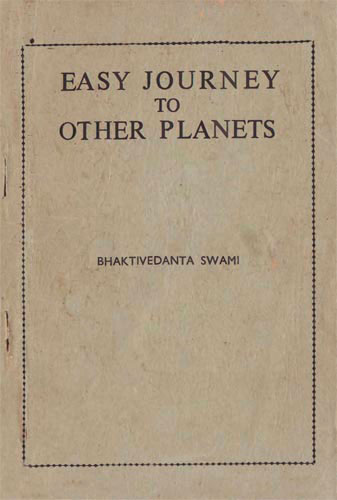
Easy Journey to Other Planets
By His Divine Grace A. C. Bhaktivedanta Swami
It is said that the perfect yogi can relinquish his body at death and journey, at the speed of mind, to antimaterial planets far beyond the limits of the material universe. Encompassing the systems of sankhya, astanga and bhakti, this absorbing publication treats the science of yoga, particularly in its application to out-of-body travel.
Easy Journey to Other Planets was one of the earliest small books available at the onset of The Hare Krishna Movement. The following is a link for a free download of the original edition that Srila Prabhupada printed in India before he ever came to the USA. Just click on link at bottom of post.
From the Preface of the book:
A living being, especially civilized man, has a natural desire to live forever in happiness. This is quite natural because, in his original state, the living being is both eternal and joyful. However, in the present conditioned state of life, he is engaged in a struggle against recurring birth and death. Therefore he has attained neither happiness nor immortality.
The latest desire man has developed is the desire to travel to other planets. This is also quite natural, because he has the constitutional right to go to any part of the material or spiritual skies. Such travel is very tempting and exciting because these skies are full of unlimited globes of varying qualities, and they are occupied by all types of living entities. The desire to travel there can be fulfilled by the process of yoga, which serves as a means by which one can transfer himself to whatever planet he likes–possibly to planets where life is not only eternal and blissful, but where there are multiple varieties of enjoyable energies. Anyone who can attain the freedom of the spiritual planets need never return to this miserable land of birth, old age, disease and death.
One can attain this stage of perfection very easily by his individual effort. He can simply follow, in his own home, the prescribed method of bhakti-yoga. This method, under proper guidance, is simple and enjoyable. An attempt is made herein to give information to the people in general, and to philosophers and religionists in particular, as to how one can transfer oneself to other planets by this process of bhakti-yoga-the highest of all yogic processes.









 The Hare Krishna Movement