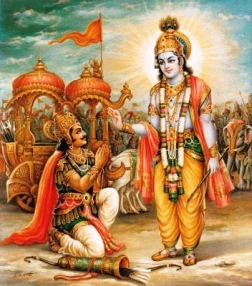
Krsna Is the Source of All Incarnations


Krsna Is the Source of All Incarnations
Srimad Bhagavatam Canto 1, Chapter 3, Text 1
By His Divine Grace A.C. Bhaktivedanta Swami Prabhupada

TEXT 1

sūta uvāca
jagṛhe pauruṣaṁ rūpaṁ
bhagavān mahad-ādibhiḥ
sambhūtaṁ ṣoḍaśa-kalam
ādau loka-sisṛkṣayā

SYNONYMS

sūtaḥ uvāca—Sūta said; jagṛhe—accepted; pauruṣam—plenary portion as the puruṣa incarnation; rūpam—form; bhagavān—the Personality of Godhead; mahat-ādibhiḥ—with the ingredients of the material world; sambhūtam—thus there was the creation of; ṣoḍaśa-kalam—sixteen primary principles; ādau—in the beginning; loka—the universes; sisṛkṣayā—on the intention of creating.

TRANSLATION

Sūta said: In the beginning of the creation, the Lord first expanded Himself in the universal form of the puruṣa incarnation and manifested all the ingredients for the material creation. And thus at first there was the creation of the sixteen principles of material action. This was for the purpose of creating the material universe.

PURPORT

The Bhagavad-gītā states that the Personality of Godhead Śrī Kṛṣṇa maintains these material universes by extending His plenary expansions. So this puruṣa form is the confirmation of the same principle. The original Personality of Godhead Vāsudeva, or Lord Kṛṣṇa, who is famous as the son of King Vasudeva or King Nanda, is full with all opulences, all potencies, all fame, all beauty, all knowledge and all renunciation. Part of His opulences are manifested as impersonal Brahman, and part of His opulences are manifested as Paramātmā. This puruṣa feature of the same Personality of Godhead Śrī Kṛṣṇa is the original Paramātmā manifestation of the Lord. There are three puruṣa features in the material creation, and this form, who is known as the Kāraṇodakaśāyī Viṣṇu, is the first of the three. The others are known as the Garbhodakaśāyī Viṣṇu and the Kṣīrodakaśāyī Viṣṇu, which we shall know one after another. The innumerable universes are generated from the skin holes of this Kāraṇodakaśāyī Viṣṇu, and in each one of the universes the Lord enters as Garbhodakaśāyī Viṣṇu.

In the Bhagavad-gītā it is also mentioned that the material world is created at certain intervals and then again destroyed. This creation and destruction is done by the supreme will because of the conditioned souls, or the nitya-baddha living beings. The nitya-baddha, or the eternally conditioned souls, have the sense of individuality or ahaṅkāra, which dictates them sense enjoyment, which they are unable to have constitutionally. The Lord is the only enjoyer, and all others are enjoyed. The living beings are predominated enjoyers. But the eternally conditioned souls, forgetful of this constitutional position, have strong aspirations to enjoy. The chance to enjoy matter is given to the conditioned souls in the material world, and side by side they are given the chance to understand their real constitutional position. Those fortunate living entities who catch the truth and surrender unto the lotus feet of Vāsudeva after many, many births in the material world join the eternally liberated souls and thus are allowed to enter into the kingdom of Godhead. After this, such fortunate living entities need not come again within the occasional material creation. But those who cannot catch the constitutional truth are again merged into the mahat-tattva at the time of the annihilation of the material creation. When the creation is again set up, this mahat-tattva is again let loose. This mahat-tattva contains all the ingredients of the material manifestations, including the conditioned souls. Primarily this mahat-tattva is divided into sixteen parts, namely the five gross material elements and the eleven working instruments or senses. It is like the cloud in the clear sky. In the spiritual sky, the effulgence of Brahman is spread all around, and the whole system is dazzling in spiritual light. The mahat-tattva is assembled in some corner of the vast, unlimited spiritual sky, and the part which is thus covered by the mahat-tattva is called the material sky. This part of the spiritual sky, called the mahat-tattva, is only an insignificant portion of the whole spiritual sky, and within this mahat-tattva there are innumerable universes. All these universes are collectively produced by the Kāraṇodakaśāyī Viṣṇu, called also the Mahā-Viṣṇu, who simply throws His glance to impregnate the material sky.

A Day in the Life of Jayananda Thakur

So we continue with the new upcoming book by Vishoka Prabhu; “A Day in the lLfe of Jayananda Thakur” We look foward to the release of this new book, and we thank him for sharing some of it with you.

Great Souls Sometimes Re-appear
By Sriman Vishoka Prabhu
Part one

Can devotees appear, disappear and then re-appear? Well, in a way, all souls are re-appearing again and again by the process of reincarnation. This report is very different from that. It’s about the re-appearance of great saints who once walked this earth, and who are not obliged or forced to reincarnate into a material body again, but sometimes re-appear in their devotee form. It’s about life after the disappearance of the soul from a material body, and the difference between great acharyas and ordinary souls in this regard. It is about how and why great acharyas appear, and after disappearance, they sometimes they give special re-appearances, and are always giving mercy to the conditioned souls.

More

Ritvik Defined


Ritvik Defined — By Narasimha Das
November 13, 1998 VNN2498

Srila Prabhupada never created any special status for “officiating acaryas.” Their function as ritivks is to assure that Srila Prabhupada requirements are met before a student is formally accepted for initiation in ISKCON. Like all senior initiated disciples, they are meant to be teachers by their practical example. They have accepted an added responsibility, an added burden on behalf of Srila Prabhupada. Their burden is to assure that Srila Prabhupada’s standards for initiation are preserved in ISKCON. (Srila Prabhupada’s July 9th directive sent to every leader in ISKCON mentions three times that all devotees are Srila Prabhupada’s disciples and that the deputed ritviks offer initiation on behalf of Srila Prabhupada. This same instruction was repeated by Srila Prabhupada several times additionally after July 9th in letters, documents, and instructions.) Ritviks are the priests authorized by the spiritual master or his institution to accept students on behalf of ISKCON and Srila Prabhupada. Srila Prabhupada made this perfectly clear. This understanding of the procedure Prabhupada prescribed is consistent with references to ritviks mentioned in Srila Prabhupada’s books.

EDITORIAL, Nov 13 (VNN) — Currently the term “ritvik” is used to refer to 1.) devotees of a particular camp, 2.) the ideas and convictions of “ritvik” devotees, and 3.) the “officiating acarya” who initiates on behalf of the spiritual master. I will try to offer guidelines for understanding the word “ritvik” according to Srila Prabhupada and the current usage among devotees.

More

Ritvik Initiation Simply Explained


Ritvik Initiation simply explained

There was a very simple and straight foward method which most of the early members of the Hare Krishna Society (ISKCON) were initiated, as explained in the following letter…

Letter to Kirtananda Swami
Los Angeles
7 January, 1974

Dear Kirtanananda Maharaja,

Please accept my blessings. I beg to acknowledge your requests for initiations of devotees at New Vrindaban, contained in your letter of December 30, 1973.

Upon your recommendation I am glad to accept the disciples for first initiation, and their spiritual names are as follows:

Susan Burchell—Madanalasa dasi
Jim Newsham—Jayanta dasa
Evelyn Newsham—Candrarekhika dasi
Sandra Chiefa—Kunjari dasi
Haynes Busby—Hari-dhama dasa

You may chant on their beads and instruct them seriously to always chant at least 16 rounds daily and obey the regulative principles. Only in this way is spiritual advancement possible.

Your recommendations for second initiation, Taru das, Radhanath das and Parambrahma das are accepted by me and their sacred threads and gayatri mantras are enclosed. See that they hear the mantra from the tape I have made, and have them hear it in their right ear. Give them further instructions on standards of a Brahman. Thank you for the daksina check for one hundred dollars.

Go on developing New Vrindaban: next month I am coming there. Is my apartment completed?

Your ever well-wisher,

A.C. Bhaktivedanta Swami

Simple Living, High Thinking


Plain Living, High Thinking
By Srila Prabhupada

The following conversation between His Divine Grace A.C. Bhaktivedanta Swami Prabhupada, Kirtanananda Swami , and Kulashekara dasa took place in New Vrindaban in June of 1976.

[Srila Prabhupada holds up a flower.] See the minute fibers in this flower. Can anyone manufacture this in a factory — such small fibers? And how brilliant the color is! If you study only one flower, you become God conscious. There is a machine that you call “nature,” and from this machine everything is coming. But who has built this machine?

More

Kṛṣṇa Consciousness: The Perfection of Mercy


Transcendental Teachings of Prahlada Maharaja
By His Divine Grace A.C. Bhaktivedanta Swami Prabhupada
Chapter 6

Kṛṣṇa Consciousness: The Perfection of Mercy

Prahlāda Mahārāja now gives his conclusion: “My dear friends, because the Supreme Lord is present everywhere and because we are part and parcel of the Supreme Lord, our duty is to be merciful to all living entities.” When a person is in a lower position, we have a duty to help him. For example, because a small child is helpless, he is dependent on the mercy of the parent: “Mother, I want this.” “Yes, my dear child.” We should be compassionate to all living entities and should show them mercy.

How can we show our mercy to everyone? There are millions and millions of poor people, so how can we show them all mercy? Are we able to supply clothing and food to all the needy persons of the world? That is not possible. How, then, can we be merciful to every living entity? By giving them Kṛṣṇa consciousness. That is how Prahlāda Mahārāja is showing his class friends real mercy. They were all fools, devoid of Kṛṣṇa consciousness, and therefore he was showing them how to become Kṛṣṇa conscious. This is the highest mercy. If you want to show any mercy at all to the living entities, then enlighten them in Kṛṣṇa consciousness, as Prahlāda Mahārāja did. Otherwise, it is materially beyond your power to show mercy.

More

Officiating Acharya’s


The War is Over
Editorial (VNN) – by Locanananda Das

There is a popular ideology that claims that Srila Prabhupad should still be considered the diksa guru in ISKCON. It is commendable that devotees who espouse this ideology want to see Krishna’s pure devotee unlimitedly and perpetually glorified. That goal can be accomplished by following the system of “officiating acharyas” that he factually authorized. An “officiating acharya” simply teaches by example how to follow in the footsteps of the great preceptor and founder acharya of ISKCON and then engages everyone in the service of expanding the sankirtan movement.

When Srila Prabhupad was asked how initiations would be performed after he was no longer physically present, his response was clear and powerful. He had been contemplating this question for ten years, and his main concern was to guarantee the continuity and future growth of his movement. His reply was “I shall recommend some of you to act as officiating acharya.” This was the term he wanted to introduce to describe the role of his disciples who would initiate new devotees as members of ISKCON after he had concluded his manifest pastimes.

More

Sampradaya Acarya


Sampradaya Acarya
By Sriman Rochan Prabhu 2003

The Sampradaya Acaryas who form the foundation of our parampara teach that the process of becoming Krsna conscious is not sentimental, but is instead an exact science for achieving the perfection of self-realization. As such, all aspects of this divine process are meticulously explained, clearly defined, and systematically presented. Adjustments needed to comply with time, place and circumstance can only be implemented by a maha-bhagavata Acarya ambassador of the past parampara Acaryas.

More

Srila Prabhupada on Initiation [compilation of quotes]


Quotes from Srila Prabhupada on Initiation
From Books, Conversations, Lectures & Letters
Pasted from Krishna.org

Please be happy in separation. I am separated from my Guru Maharaja since 1936 but I am always with him so long I work according to his direction. So we should all work together for satisfying Lord Krishna and in that way the feelings of separation will transform into transcendental bliss.
Prabhupada’s Initiation

More

A Day in the Life of Jayananda Thakur

The following is the introduction to the new book, soon to be released, on Jayananda Thakur, beautifully written by Sriman Vishoka Prabhu. Many of you remember Vishoka’s first book; “The Beautiful Life of Jayananda Thakur”, which was Vishoka’s tribute to Jayananda and portrays the beauty of something rarely seen-a genuinely happy man, experiencing a perfect life and death.

We will continue to post the chapters as they are released, so stay tuned.

More

His Divine Grace A.C. Bhaktivedanta Swami Prabhupada


By Krishna’smercy.org

A.C. Bhaktivedanta Swami, more affectionately known as Srila Prabhupada, is the founder of the International Society for Krishna Consciousness, ISKCON, or more popularly known as The Hare Krishna Movement. The movement was inaugurated in India by Lord Caitanya almost five hundred years ago. The age that we currently live in is full of quarrel and dissent and the only means of self-realization is through the constant chanting of the holy name of God.

Hare Krishna, Hare Krishna, Krishna Krishna, Hare Hare/Hare Rama, Hare Rama, Rama Rama, Hare Hare

More

25 Transcendental Qualities of Srimati Radharani


Srimati Radharani has twenty-five transcendental qualities, and She can control even Krsna by them. Her transcendental qualities are as follows:

1. She is sweetness personified
2. She is a fresh young girl
3. Her eyes are always moving
4. She is always brightly smiling
5. She possesses all auspicious marks on her body
6. She can agitate Krishna by the flavor of Her person

More

A short sketch of the life and teachings of Lord Caitanya


A short sketch of the life and teachings of Lord Caitanya,
The Preacher of Śrīmad-Bhāgavatam
By His Divine Grace A.C. Bhaktivedanta Swami Prabhupada

Lord Śrī Caitanya Mahāprabhu, the great apostle of love of God and the father of the congregational chanting of the holy name of the Lord, advented Himself at Śrīdhāma Māyāpura, a quarter in the city of Navadvīpa in Bengal, on the Phālgunī Pūrṇimā evening in the year 1407 Śakābda (corresponding to February 1486 by the Christian calendar).

More

“Do Not Change My Words” — Prabhupada


“Do Not Change My Words” — Prabhupada
Testimonials — By Gauridas Pandit dasa on January 30, 1998 at 8:37 am

Srila Prabhupada used to like to sit in his garden in Vrindavan especially in the mornings. He liked to hear his books read to him daily. One time Yasodanandan Prabhu was reading Sri Isopanisad when Srila Prabhupada stopped him and asked him to reread the last paragraph. After hearing it again Srila Prabhupada said, “Those are not my words! They are changing my words! Is my English not good enough?” Srila Prabhupada became very angry and continued, “This is the worst thing a disciple can do! Do not become like a leap frog and try to jump over the spiritual master thinking you know better than him. Tell them immediately [the editors] do not change my words!”

More

Arsha-Prayoga Part III – The Case Against Changing Prabhupada’s Books


EDITORIAL
BY LOCANANANDA DAS – 11-01-04

While planning to print the unabridged version of the Bhagavad-gita, Srila Prabhupada often referred to it as the revised and enlarged edition. When the BBT published its unauthorized adulterated Gita years later, they would henceforward refer to the 1972 printing as the original edition while calling theirs the revised and enlarged edition. This appears to be a subtle act of deception meant to validate the irreverent practice of changing Srila Prabhupada’s Books.

The remainder of this article will focus mainly on the Bhagavad-gita As It Is, which contains the essence of Vaishnava philosophy. Srila Prabhupada said that the Krishna consciousness movement is genuine, historically authorized, natural and transcendental due to its being based on the Bhagavad-gita As It Is. It was his conviction that the entire human society could embrace one God, Krishna, and live harmoniously by practicing one religion, devotional service to God, by chanting one mantra, the Hare Krishna Maha Mantra, and by following one scripture, the Bhagavad-gita As It Is. Because the Bhagavad-gita is so vitally important to the spreading of Krishna consciousness, the adverse effect of changing its original wording without the approval of the Acharya can hardly be estimated.

More

“Value of accepting a bona fide spiritual Master is more than we can calculate”


Vrindaban, Tuesday, 12 February, 1974:

Dear Ravendra Gupta, please accept my blessings. I have only recently received your letter of February 6, 1974, due to travelling.

I am very glad to hear you are following my instructions by chanting 16 rounds daily. In order to chant offenselessly, so that the chanting will have the greatest effect, one must avoid the four sinful activities.

You have asked “How serious would it be for me if I should miss the golden opportunity to become your initiated disciple?” You should know that the value of accepting a bona fide spiritual master is more than we can calculate.

More

Narada-bhakti-sutra Text 2

Narada-bhakti-sutra Text 2
Translation & Purport by His Divine Grace A.C. Bhaktivedanta Swami

TRANSLATION

Devotional service manifests as the most elevated, pure love for God.

PURPORT

As stated before, after attaining the highest stage of self-realization, one becomes situated in devotional service to the Lord. The perfection of devotional service is to attain love of God. Love of God involves the Supreme Personality of Godhead, the devotee, and the process of devotional service. Self-realization, the brahma-bhūta stage, is the beginning of spiritual life; it is not the perfectional stage. If a person understands that he is not his body and that he has nothing to do with this material world, he becomes free from material entanglement. But that realization is not the perfectional stage.
The perfectional stage begins with activity in the self-realized position, and that activity is based on the understanding that a living entity is eternally the subordinate servitor of the Supreme Lord. Otherwise, there is no meaning to self-realization. If one is puffed up with the idea that he is the Supreme Brahman, or that he has become one with Nārāyaṇa, or that he has merged into the brahmajyoti effulgence, then he has not grasped the perfection of life. As the Śrīmad-Bhāgavatam (10.2.32) states,

More

Leave the Books Alone!


Leave the books alone!
by Bhagavat das

My Dear Godbrothers and Godsisters:

Please accept my most humble obeisances! All Glories to Srila Prabhupada!

I am very glad that we as disciples of Srila Prabhupada are finally doing something about this great offense to our Spiritual Master. I would like to tell three stories that are personal experiences of mine with Srila Prabhupada and his books. It is my earnest hope that these stories will once and for all lay to rest the controversy of anyone ever editing Srila Prabhupadas books.

The first story takes place in Mayapur where Srila Prabhupada was talking about why he came to the material world.

More

Krishna Consciousness in a Nutshell

Krishna Consciousness in a Nutshell
By Sriman Hansadutta Prabhu

Self-realization the Aim of Life

Krishna consciousness is the original consciousness of every living being, and it is explained in different Vedic literatures. One of these literatures is the Chaitanya-charitamrita. Chaitanya-charitamrita means “characteristic of the eternal living force”. Every living being is eternal by nature, and because he is eternal, he cannot be happy in this material world, which is a temporary arrangement, however wonderful it may be. It is the duty of every living entity to learn the science of Krishna, or the science of the self, and to make himself perfect. He will attain freedom from the temporary world of material creation by reviving his original love of Krishna. In this way, he will return home, back to Godhead, which is the aim of all human endeavors, be they scientific, economic, artistic or cultural.

No one lives forever

Every living creature is subjected to four basic miseries, beginning with birth, continuing into old age and disease, and ending in death. No one wants to be miserable—everyone wants to be happy—but material nature functions in such a way that no one can be happy.

Ignoring this basic truth, modern thinkers, politicians, scientists, educators and artists are all struggling against the stringent laws of nature. They think by material adjustments they will find the happiness they hanker for. In spite of all comforts and the advancement of science, economics and politics, no one is happy—if for no other reason than life is temporary.

More

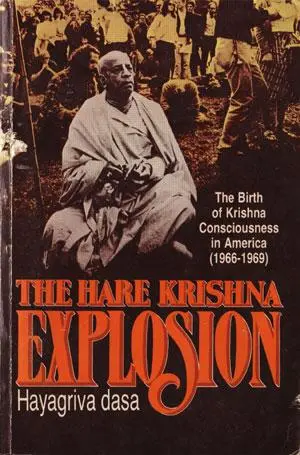
The Hare Krishna Explosion (Chapter 5)

The Hare Krishna Explosion
by Hayagriva Prabhu

Part I: New York, 1966
Chapter 5

The Hare Krishna Explosion

“If Krishna sees you are taking one step toward Him,” Swamiji says, “He will take ten toward you. He is so happy to see you turn to Him. He is more eager to see us return to Godhead than we are to go.”

Back in the Mott Street apartment, I stare at myself in the mirror and repeat my new name. “Now you are Krishna’s,” I think, inspecting the new kanthi beads around my neck. “These are Krishna’s dog collars, and they don’t come off.”

We all optimistically resolve to try to follow the rules. For most of us, meat eating and gambling pose no problems. Rules governing sex and intoxicants, however, force some rapid changes in living patterns. I decide to convert the old Mott Street apartment into a brahmachari ashram. Down come the psychedelic posters, and up go pictures of lotus-eyed Krishna.

The next day at the temple, we find a new notice posted on the bathroom door. There are additional rules and regulations written neatly in ink by Swamiji himself.

NOTICE

All initiated devotees must attend morning and evening classes. Must not be addicted to any kind of intoxicants, including coffee, tea and cigarettes. They are forbidden to have illicit sex-connections. Must be strictly vegetarian. Should not extensively mix with non-devotees. Should not eat foodstuffs cooked by non-devotees. Should not waste time in idle talks nor engage in frivolous sports. Should always chant and sing the Lord’s holy names, Hare Krishna, Hare Krishna. Krishna Krishna, Hare Hare, Hare Rama, Hare Rama, Rama Rama, Hare Hare.
Thank you.
A.C. Bhaktivedanta Swami, Acharya

Umapati says nothing when he reads the notice. Rayarama simply chuckles.
“No coffee, no tea,” he says, shaking his head.

More

Previous Older Entries Next Newer Entries

108 Imporant Slokas from the 1972 Bhagavad-gita As It Is

Click on image to go to Post

Click on image to go to Post

The Hare Krishna Cookbook

Songs of the Vaisnava Acaryas

Bhagavad-gita As It Is 1972 Edition “Online”

click on image

click on image to visit site

Srimad Bhagavatam Online

click on image

Raja-Vidya the King of Knowledge

click on image

click on image

Blog Stats

  • 4,581,632 hits

Enter your email address to subscribe to this blog and receive notifications of new posts by email.

Join 3,909 other subscribers

Important Slokas from the Brahma-samhita

click on image

click on image

Slokas from the Sri Isopanisad

click on image

click on image

Prayers By Queen Kunti (Slokas)

click on image

Gajendra’s Prayers of Surrender (Slokas)

click on image

A Short Statement of the Philosophy of Krishna Consciousness

click on image

click on image

July 9th Letter

click on image

click on image

The Hare Krishna Explosion

Reference Material/Study Guide

click on image

click on image

  • LINKS